
Research article · 2025 · Full text
International Journal of Horticulture and Food ScienceEvaluation of different hybrids of Chilli (Capsicum annuum L) under Vindhyan Agro-climatic condition
Volume 7(10) · Pages 43–45 · DOI: 10.33545/26631067.2025.v7.i10a.402 ↗
Research areasVirus-based gene therapy researchNerve injury and regenerationReceptor Mechanisms and Signaling
Abstract
Author-writtenThe experiment was conducted on Performance of hybrids of chilli with ten hybrids during 2023- 2024 at the Vegetable Research Field of Department of Horticulture, Sam Higginbottom University of Agriculture, Technology and Sciences, Prayagraj. The observations were taken and recorded on various growth, yield and quality contributing parameters. The results from the present investigation revealed that based on the mean performance of eight hybrids of Chilli, hybrids TMPH - 2448 and JAPANI LONG were found superior in terms of Fruit yield (q/ha). TMPH - 2448 was found to be best in terms of growth parameters (plant height, number of branches). However, on the basis of earliness parameters (flowering), hybrid TMPH - 2448 performed best. On the basis of Ascorbic Acid in Fruits, TMPH - 2448 is the best and the Total soluble solids was found best in TMPH - 2448. The highest gross return was found in the TMPH - 2448 and the B:C ratio was found in the same with 3.3. The experiment was laid out in Randomized Block Design with 3 replications and 8 varieties of Chilli.
Summary
Source-checkedPlain-language reading of the full paper, prepared with AI and checked against the text. Each point links to the authors' own words.
Why it matters
- Chili peppers are globally significant crops used extensively in agriculture and cooking. View evidence ↗
- The compound capsaicin provides the heat in chilis, making them valuable for both culinary use and scientific research. View evidence ↗
- Research in plant genetics and agronomy is driven by the need to optimize yield and manage diseases and climate resilience in chili cultivation. View evidence ↗
The question
- The study aimed to identify the best-performing chili variety among ten candidates based on growth, yield, and quality. View evidence ↗
What they did
- The experiment was conducted between 2023 and 2024 at the Vegetable Research Field in Prayagraj, India, using ten chili hybrids. View evidence ↗
- The study used a Randomized Block Design (RBD) with three replications for each of the ten chili varieties. View evidence ↗
- Researchers measured various parameters related to growth, yield, and quality. View evidence ↗
What they found
- TMPH-2448 had the fastest germination time (10.33 days), while SADABAHAR took the longest (15 days). View evidence ↗
- SADABAHAR was the earliest to flower (41 days), while TMPH-2448 was the latest (47.66 days). View evidence ↗
- SADABAHAR reached 50% flowering fastest (47.66 days), whereas TMPH-2448 took the longest (52.66 days). View evidence ↗
- TMPH-2448 and JAPANI LONG were identified as the superior hybrids regarding fruit yield. View evidence ↗
- TMPH-2448 provided the highest gross return and a benefit-cost (B:C) ratio of 3.3. View evidence ↗
What it means
- The authors conclude that TMPH-2448 is the best hybrid overall, excelling in growth parameters, fruit quality (ascorbic acid and total soluble solids), and economic return. View evidence ↗
Visual summary
1 visualsIllustrations explain the paper; charts are replotted from the paper's own table values.
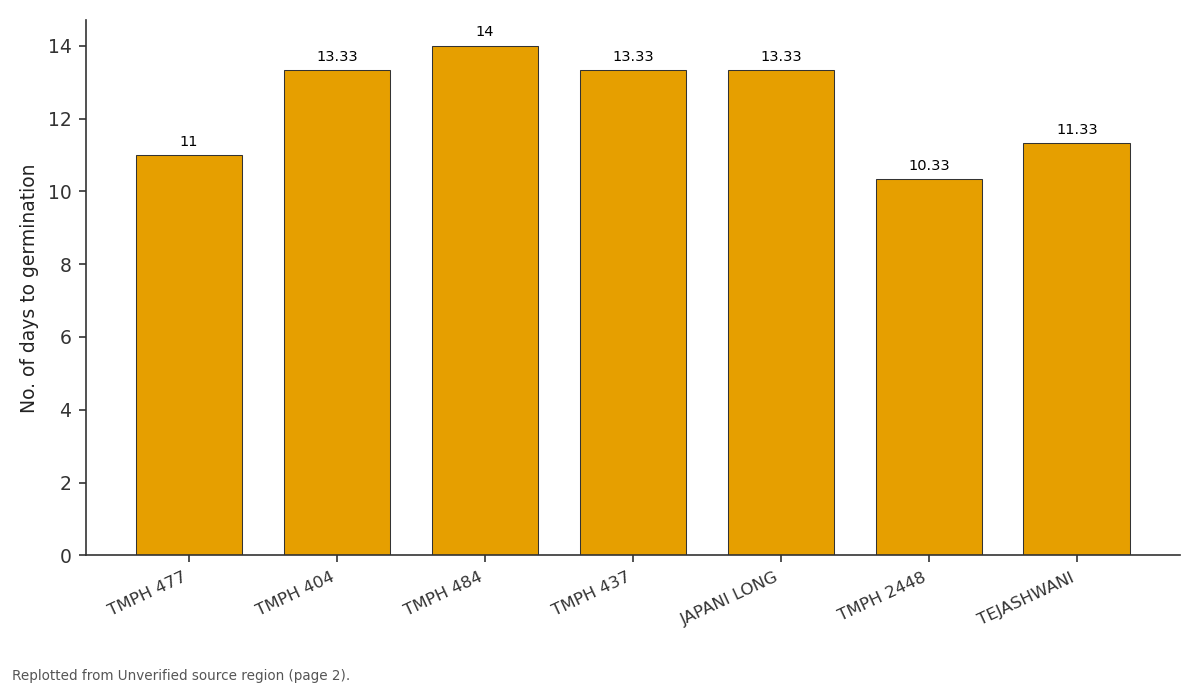
No. of days to germination: TMPH 477 vs TMPH 404 vs TMPH 484 vs TMPH 437 vs JAPANI LONG
Replotted from a table (page 2) of the original paper. Every bar is the paper's own table value.
View source evidence ↗Introduction
Chili peppers (Capsicum spp.), commonly referred to as chilis, are an integral part of global agriculture and culinary traditions. They belong to the Solanaceae family and are prized for their pungency, flavour, and nutritional value. Native to the Americas, particularly the regions of modern-day Mexico and Bolivia, chili peppers have been cultivated for over 6,000 years. They were disseminated worldwide after the Columbian exchange in the 15th century, becoming a staple in cuisines and agriculture across Africa, Asia, and Europe. The heat in chili peppers, produced by the compound capsaicin, has made them both a culinary staple and a focus of scientific study. Capsaicin stimulates heat receptors in the skin and mucous membranes, which has led to its use not only as a flavouring agent but also in medicinal applications, particularly in pain management and anti-inflammatory treatments. Chili cultivation is also of significant economic importance. Global production is concentrated in countries like China, India, and Mexico, where chilis serve as a vital crop for both domestic consumption and export. The agricultural challenges in chili cultivation-such as disease management, yield optimization, and climate resilience-make it a subject of active research, particularly in plant genetics and agronomy. From a nutritional standpoint, chili peppers are rich in vitamins A, C, and E, as well as antioxidants. They have been studied for their potential health benefits, including their roles in weight management, cardiovascular health, and cancer prevention. This research paper seeks to explore the biological, economic, and cultural significance of chili peppers, focusing on their genetic diversity, health benefits, and their global agricultural impact. By understanding both the agronomic and medicinal properties of chilis, researchers can contribute to enhanced crop management and better utilization of chili peppers in food and health industries.
Materials and Methods
The experiment was conducted in the Experimental Research field of Department of Horticulture, Naini Agricultural institute, Sam Higginbottom University of Agriculture Technology and Sciences, Prayagraj, during the year 2023. The experimental site is located in Naini in the southern part of Prayagraj at a distance of about 6km from Prayagraj City. It is situated at 250.80N Latitude and 810.50⁰E meters from sea level. Prayagraj has a sub-tropical climatic having peak temperatures during summer (in the month of May and June) with temperature reaching around 46⁰C with hot blazing winds and in winter (December and January) the temperature may fall as low as 2-3⁰C. The average rainfall is around 1013.4 (mm) annually with maximum concentration during the months of July to September with rare showers during winters. The experiment was carried out with the help of 8 varieties of chilli and all the essential intercultural operations were carried out according to the needs of the crop. The aim of the experiment was to find out the best performing variety from the 10 varieties in terms of growth, yield and quality. The experiment was laid out according to a Randomized Block Design (RBD) with 10 varieties of chilli with 3 replications each.
Growth Parameters
The ANOVA (Analysis of Variance) carried out for this experiment showed significant differences among the genotypes for all the 10 varieties studied indicating the presence of variability for various growth parameters. The seed germination and seedling growth parameters showed different variation in their performance with respect to the different hybrids taken. These results are in conformity with earlier reports of Nimnoi et al. [1] . The data recorded on days taken to germination are shown in Table 1. From the data it was observed that days taken to germination differ significantly in chilli genotypes ranging from 10 to 15 days. The maximum number of days was recorded in chilli hybrids SADABAHAR (15) followed by RAJ SEEDS G-4 (14.33). The minimum was recorded in chilli hybrid TMPH -2448 (10.33). According to the findings of Chaudhary et al. [2] Arshia Debbarma et al., Veerendra et al. [3] , Ch. Inao Khaba et al. D. Balasankaret et al. variations in the days taken to germination may be due to characteristic of genotypes, their interaction with environment and soil factors. The number of branches produced per plant at 90 days after transplanting in all the varieties are presented in Table 1. From the table it was observed that the number of branches produced per plant varied significantly in chilli genotypes after 90 days. The maximum number of branches was recorded in chilli hybrids TMPH -2448 (14) followed by TEJASHWANI (13.66) and minimum number of branches per plant was recorded in chilli hybrid SADABAHAR (10). The function of a plant's growing tips or primary meristems includes lengthening through cell division and elongation organizing the development of leaves along the stem. Similar findings were reported by Versha et al. Mopidevi et al. [4], Prasad et al. (2019) in Chilli. Therefore, variations in the number of branches per plant may be due to genotypic characteristics of genotypes, their interaction with environment and soil factors. The plant height at 90 days after transplanting in all the varieties are presented in Table 1. The maximum plant height was recorded in chilli hybrids TMPH -2448 (56.50) followed by TEJASHWANI (54.83) and minimum plant height was recorded in chilli hybrid SADABAHAR (49.17). The variations in the results may be due to genetics characters, localThe number of days to first flower initiation of the chilli hybrids are shown in table 1. Significantly the minimum days to 1st flowering emergence was recorded in the hybrids SADABAHAR (41) and maximum days to first flower initiation (47.66) were reported in the hybrid TMPH -2448.The Days of first flower initiation play an important role in deciding the earliness or lateness of crop in general. The variation in the first flower emergence might have been due to intermodal length, number of inter nodal and vigour of the crop. The results are in conformity with the findings of Manju and Sreelathakumary and Amit et al. [5] . The number of days to 50% flower initiation of the chilli hybrids are shown in Table 1. The minimum days of 50% flowering emergence was recorded in the hybrids SADABAHAR (47.66) maximum days to 50% flowering (52.66) reported in the hybrid TMPH -2448. The variation in the days to 50% flowering may be due to the high genetic makeup of genotypes. The variation in the days of 50% flowering emergence might also have been due to internodal length, number of internodal and vigour of the crop. Similar results were also observed by Shiva et al., Chattopadhayay [6] , Devi et al. [7] .
Hybrids
No The length and diameters of fruits of different chilli hybrids are shown in Table 1. The maximum fruit length (11.17) reported in the hybrid 21CHIHYB-3 and the minimum fruits length were recorded in the hybrid 21CHIHYB-5(7.10). The maximum fruits diameter (4.70) was reported in the hybrid 21CHIHYB-3 and the minimum fruits diameter was recorded in the hybrid 21CHIHYB-5 (3.10). The length of fruits is one of the major factors for deciding the yield of the crop. The variation in fruits length might have been due to the internodal length, sex ratio, fruit set percentage, genetic nature and their response to varying environment condition and higher uptake nutrient. [8] , Yatung et al., [9] in chilli.
References
11 in the original paper- Nimnoi P, Ruanpanun P. Suppression of root-knot nematode and plant growth promotion of chili (Capsicum flutescens L.) using co-inoculation of Streptomyces spp. Biol Control. 2020;145:104244.
- Choudhary VK, Kumari S, Chaurasia AK, Naseem M, Gupta A, Maiti RK. Effect of priming and ageing on seed quality parameters of chilli (Capsicum annuum L.). Int J Agric Environ Biotechnol. 2008;1(3):111-6.
- Verma VK, Jha AK, Patel RK, Ngachan SV. Studies on storage life, and effect of temperature and pre-sowing seed treatments on germination behaviour and maturity indices in King chilli. 2018.
- Mopidevi M, Reddy RVSK, Reddy KM, Naidu LN, Rani AS, Krishna KU. Assessment of genetic variability, heritability and genetic advance for quantitative and qualitative traits and ChLCV resistance in chilli (Capsicum annuum L.). J Pharmacogn Phytochem. 2018;7(6):1467-72.
- Amitvikram, Warshamana IK, Gupta M. Genetic correlation and path coefficient studies on yield and biochemical traits in chilli (Capsicum annuum L.). Int J Farm Sci. 2014;4(2):70-5.
- Chattopadhaya A, Amit BS, Nuka D, Subrata D. Diversity of genetic resources and genetic association analyses of green and dry chillies of eastern India. Chilean J Agric Res. 2011;71(3):350-6.
- Devi R, Kaur T, Kour D, Yadav AN, Suman A. Potential applications of mineral-solubilizing rhizospheric and nitrogen-fixing endophytic bacteria as microbial consortium for the growth promotion of chilli (Capsicum annuum L.). Biologia. 2022;77(10):2933-43.
- Sushmitha A, Allolli TB, Ganiger VM, Ajjappalavar PS, Evoor S, Gopali JB, et al. Assessment of genetic variability, heritability and genetic advance for growth, yield and quality traits of Byadgi Dabbi genotypes of chilli (Capsicum annuum L.). J Pharmacogn Phytochem. 2019;8(5):944-7.
- Yatung T, Dubey RK, Singh V, Upadhyay G. Genetic diversity of chilli (Capsicum annuum L.) genotypes of India based on morpho-chemical traits. Aust J Crop Sci. 2014;8(1):97-102.
- Saritha JK, Kulkarni RS, Rao AM, Manjunath A. Genetic divergence as a function of combining ability in chilli (Capsicum annuum L.). 2005.
- Vani SK, Sridevi O, Salimath PM. Studies on genetic variability, correlation and path analysis in chilli (Capsicum annuum L.). Ann Biol. 2007;23(2):117-21.