
Research article · 2025 · Full text
International Journal of Agriculture and Food SciencePhysico-Chemical Properties and Cost Structure of Paneer Whey Beverage Incorporated with Tomato Juice
Volume 7(10) · Pages 168–170 · DOI: 10.33545/2664844x.2025.v7.i10c.867 ↗
Research areasImage Processing and 3D ReconstructionHistorical and Archaeological StudiesAncient and Medieval Archaeology Studies
Abstract
Author-writtenThe study entitled “Utilization of Tomato Juice in Paneer Whey Beverage” was conducted during 2024-25 at the Section of Animal Husbandry and Dairy Science, College of Agriculture, Nagpur. Paneer whey beverages were prepared with four treatments by incorporating tomato juice at levels of 0% (T1), 4% (T2), 8% (T3), and 12% (T4) along with 10% sugar. The beverages were analyzed for sensory quality and physico-chemical characteristics. Results revealed that increasing tomato juice reduced fat but increased protein, total solids, ash, and acidity. Among all treatments, T3 (8% tomato juice) scored highest in sensory acceptability (overall acceptability score 8.0/9) and showed balanced nutritional composition. Cost analysis indicated that production costs ranged from ₹ 17.70 to ₹ 21.06 per litre, with T3 costing ₹ 19.94/litre. Thus, whey beverage with 8% tomato juice and 10% sugar was found superior in sensory appeal, nutritional value, and cost effectiveness.
Summary
Source-checkedPlain-language reading of the full paper, prepared with AI and checked against the text. Each point links to the authors' own words.
Why it matters
- India produces over 239 million metric tons of milk annually, resulting in large quantities of whey as a primary by-product. View evidence ↗
- Paneer whey is underutilized despite being rich in proteins, minerals, lactose, and water-soluble vitamins. View evidence ↗
- Tomato juice is a suitable additive for product diversification because it contains antioxidants, vitamin C, potassium, carotenoids, and lycopene. View evidence ↗
The question
- The study aimed to evaluate the cost structure and physico-chemical properties of paneer whey beverages blended with tomato juice to promote sustainable whey use and economic feasibility. View evidence ↗
What they did
- The research was conducted during 2024-25 at the College of Agriculture, Nagpur, within the Section of Animal Husbandry and Dairy Science. View evidence ↗
- Four treatments were tested using 10% sugar and varying levels of tomato juice: 0% (T1), 4% (T2), 8% (T3), and 12% (T4). View evidence ↗
What they found
- Fat content decreased as tomato juice increased, ranging from 0.46% in T1 (0% juice) to 0.42% in T4 (12% juice). View evidence ↗
- Protein content increased with the addition of tomato juice, rising from 0.41% in T1 to 0.45% in T4. View evidence ↗
- Total solids increased slightly as tomato juice levels rose, from 6.55% in T1 to 6.59% in T4. View evidence ↗
- Ash content increased from 0.53% in T1 to 0.56% in T4 as the proportion of tomato juice increased. View evidence ↗
- Acidity increased with higher tomato juice levels, moving from 0.17% in T1 to 0.21% in T4. View evidence ↗
- The beverage with 8% tomato juice (T3) was the most sensorially acceptable, receiving a score of 8.0/9. View evidence ↗
- Production costs per litre increased with tomato juice content, ranging from ₹17.70 (T1) to ₹21.06 (T4), with T3 costing ₹19.94. View evidence ↗
What it means
- The authors concluded that a whey beverage containing 8% tomato juice and 10% sugar is the superior formulation for sensory appeal, nutrition, and cost. View evidence ↗
Visual summary
2 visualsIllustrations explain the paper; charts are replotted from the paper's own table values.
Effect of Tomato Juice on Beverage Composition
AI-generated conceptual illustration (paneer whey beverage and tomato juice). It explains the idea and does not show study data.
View source evidence ↗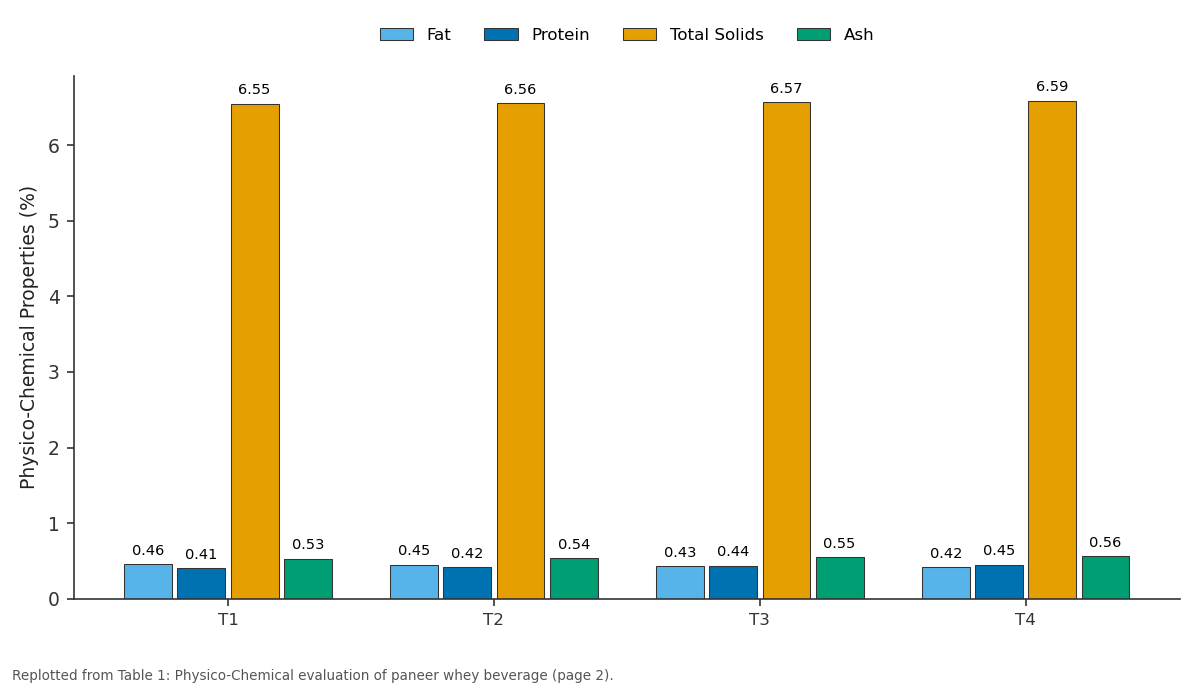
Fat and Protein and more: T1 vs T2 vs T3 vs T4
Replotted from Table 1 (page 2) of the original paper. Every bar is the paper's own table value.
View source evidence ↗Figures & tables
From the original paper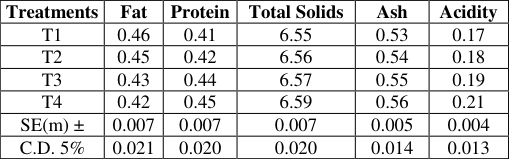 Table 1
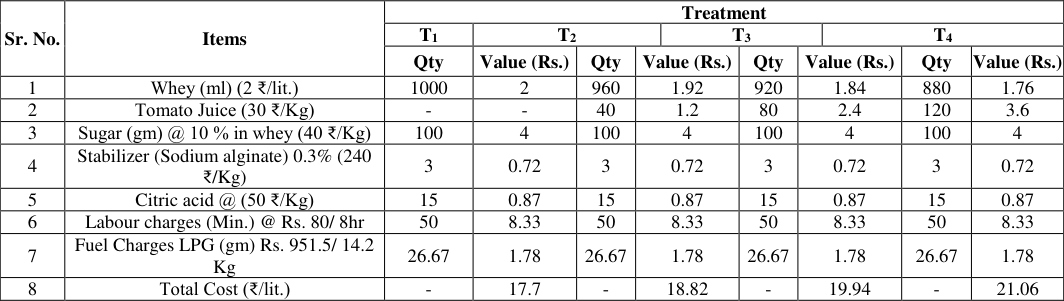 Table 1
Introduction
Milk is regarded as a nearly complete food, supplying essential nutrients in balanced proportions. India, being the largest producer of milk with over 239 million metric tons annually, generates substantial amounts of by-products, among which whey is most abundant. Paneer whey, rich in lactose, proteins, minerals, and water soluble vitamins, remains underutilized despite its nutritional and therapeutic potential. In recent years, increasing attention has been given to developing whey-based beverages to minimize environmental concerns from disposal while enhancing consumer health benefits. Tomato juice, being a rich source of lycopene, carotenoids, vitamin C, potassium, and antioxidants, offers an excellent option for value addition and product diversification. The combination of tomato juice with paneer whey can result in a functional, nutritious, and palatable beverage. This study focuses on evaluating the physico-chemical properties (such as pH, acidity, total solids, protein, fat, ash, and sensory quality) and assessing the cost structure of whey based beverages blended with tomato juice, aiming at sustainable utilization of whey and economic feasibility for dairy industries.
Material and Methods
Fresh, clean, cow milk was used for paneer whey preparation. Cow milk was procured for every trial from Section of Animal Husbandry and Dairy Science, College of Agriculture, Nagpur. Fresh clean, fully riped tomato fruit was purchased from local market. Citric acid, stabilizer, muslin cloth and few glassware were also used during the experiment.
Treatment Details used for the study
Treatment Details used for the study
Treatment
Treatment
Chemical analysis of paneer whey beverage Determination of Fat
The fat was determined by Gerber method as per procedure in SP: 18 (Part XI), 1981.
Determination of Protein
Protein percentage of beverage was determined as per the semi micro Kjeldahl method as recommended in IS:1479 part II (1961).
Determination of Total solids
The total solids percentage in paneer whey beverage was determined by using gravimetric method as per the procedure of IS: 1479 (Part II) (1961).
Determination of Acidity
The acidity of milk expressed on per cent lactic acid will be determined by method described in IS: 1479 (Part II) 1961.
Determination of Ash
Ash content of paneer whey beverage was determined as per the procedure described in IS: 1479 (Part II) 1961.
Cost of Production of paneer whey beverage
The cost of materials required for manufacture of paneer whey beverage during experimental period were taken into account for cost calculations. The product was prepared on laboratory scale and expenditure made on the recurring items were only considered for cost estimation.
Statistical analysis
The data obtained during different phases of this study was analyzed by using CRD (Completely Randomized Design) with four treatments and four replications.
Results and Discussion
Results and Discussion
Chemical composition of paneer whey beverage
The milk was analyzed for its chemical composition. Cow milk was standardized at 4 per cent fat and analyzed for moisture, fat, protein, ash and total solids. Paneer whey beverage prepared under different treatments were analyzed for fat, protein, total solids, ash and acidity.
Fat content
The average fat content in the beverage was significantly affected due to addition of tomato juice. The fat content of beverage prepared in the proportion of 100:0 (T₁), 96:4 (T2), 92:8 (T3) and 88:12 (T4) paneer whey to tomato juice were 0.46, 0.45, 0.43 and 0.42 per cent, respectively. The fat content in treatment (T1) was highest (0.46%) among all the treatments. The lowest fat content (0.42%) was observed in beverage prepared with addition of 12 parts of tomato juice.
The results indicated that fat content was highest in beverage prepared without addition of tomato juice (T1). Fat content in beverage was decreased the proportion of tomato juice in the beverage increased. This might be due to low fat content in tomato juice. Lashkare (2019) [3] reported that the fat content was determined higher (0.48%) in treatment (T1) whereas, treatment (T4) contained (0.36%) fat was acceptable in sensory evaluation. Maurya (2024) [5] stated that the fat score of pineapple juice based whey beverage (0.422) was noted in sample P1 while minimum score (0.362) in sample. These results are closely agreement with the results of present study.
Protein content
The average protein content in the beverage was significantly affected due to addition of tomato juice. The protein content of beverage prepared in the (T₁), (T2), (T3) and (T4), were 0.41, 0.42, 0.44 and 0.45 per cent respectively. The protein content in treatment (T4) beverage prepared with tomato juice was highest (0.45%) among all the treatments. From the present investigation it was observed that that as the addition of tomato juice increased there was increased in the protein content in the beverage. Lashkare (2019) [3] reported that the protein content in blends was found proportionately increased with increases the level of sugarcane juice. The variation might be due to higher amount of protein per cent was found in sugarcane juice. Maurya (2024) [5] stated that the protein score of pineapple juice based whey beverage (3.62) was noted in sample P1 while minimum score (0.37) in P2 sample.
The results are compareable with the findings of present study.
Total Solids content
The addition of tomato juice in preparation of beverage affected the total solids content. The average value of total solids content in beverage prepared in the proportion of 100:0 (T₁), 92:8 (T2), 90:10 (T3) and 88:12 (T4) paneer whey to tomato juice were 6.55, 6.56, 6.57 and 6.59 per cent respectively. Highest total solids were noticed in T4 (6.59 %). It is indicated that as the tomato juice level increased, total solids content in beverage also increased. More or less results were reported by Dhamsaniya and Varshney (2013) [1] who found that the acidity of whey based Ready to Serve (RTS) beverage from ripe banana juice was increased 0.15 to 0.40 per cent with an increases with levels banana juice. These results are in agreement with the findings of present study.
Ash content
The average ash content in the beverage was significantly affected due to addition of tomato juice. The ash content of beverage prepared in the proportion of 100:0 (T₁), 96:4 (T₂), 92:8 (T3), 88:12 (T4) paneer whey to tomato juice were 0.53, 0.54, 0.55 and 0.56 per cent respectively. The ash content in treatment (T1) plain beverage prepared without tomato juice was lowest (0.53%) among all the treatments. The highest ash content (0.56%) was observed in beverage prepared
with addition of 12 parts of tomato juice (T4). The increased in ash content might be due to the replacement of milk solids by tomato juice. Maurya (2024) [5] recorded that the ash score of pineapple juice based whey beverage (0.37) was noted in sample P4 while minimum score (0.31) in sample P1. These results are supportive to the results of present investigation.
Acidity content
The acidity content in tomato juice. beverage prepared with paneer whey to tomato juice in (T₁), (T2), (T3) and (T4) treatments were 0.17, 0.18, 0.19 and 0.21 per cent, respectively. Significantly lowest acidity content was noticed in T1 (0.17%) prepared without addition of tomato juice and highest acidity content was noticed in T4 (0.21%) prepared with 12 part of tomato juice. It is indicated that the acidity content in beverage increased with the increased tomato juice level. Lashkare (2019) [3] reported that the acidity content of sugarcane juice blends beverage was found increased with increases the amount of sugarcane juice for the preparation of beverages. The acidity of beverage increases with addition of sugarcane juice in respective treatment with higher titratable acidity than paneer whey. Meshram (2019) [4] stated that the acidity percentage was significantly highest (0.27%) in chhana whey beverage prepared with addition of 6 per cent strawberry juice (T4) while, acidity content was lowest (0.23%) in chhana whey beverage prepared without addition of strawberry juice (T1). These results are comparable with the findings of present study.
Cost structure of paneer whey beverage
The cost structure of 1 lit paneer whey beverage under various treatments was calculated by considering the prevailing retail market price for various items i.e. whey, tomato juice, sugar, stabilizer, citric acid, labour charges and fuel. Considering the cost structure of paneer whey beverage prepared from different treatments combination, it was observed that cost of production of 1 lit paneer whey beverage prepared under various treatments T1, T2, T3 and T4 were as Rs. 17.70, 18.82, 19.94 and 21.06, respectively. The lowest cost of production (Rs. 17.70) was recorded in case of paneer whey beverage prepared with addition of 0 parts of tomato juice (T1). While the highest cost of production (Rs. 21.06) of paneer whey beverage with 12 parts tomato juice (T4). However, paneer whey beverage prepared with 8 parts of tomato juice having cost of production (Rs. 19.94) was the best treatment for sensory evaluation.
Figures and tables from the paper
| Treatments | Fat | Protein | Total Solids | Ash | Acidity |
|---|---|---|---|---|---|
| T1 | 0.46 | 0.41 | 6.55 | 0.53 | 0.17 |
| T2 | 0.45 | 0.42 | 6.56 | 0.54 | 0.18 |
| T3 | 0.43 | 0.44 | 6.57 | 0.55 | 0.19 |
| T4 | 0.42 | 0.45 | 6.59 | 0.56 | 0.21 |
| SE(m) ± | 0.007 | 0.007 | 0.007 | 0.005 | 0.004 |
| C.D. 5% | 0.021 | 0.020 | 0.020 | 0.014 | 0.013 |
Table text extracted from the original PDF; superscript letters are shown inline. The original table image is below.
View original table image
| Sr. No. | Items | Treatment | — | — | — | — | — | — | — | — | — |
|---|---|---|---|---|---|---|---|---|---|---|---|
| T1 | T2 | T3 | T4 | ||||||||
| Qty | Value (Rs.) | Qty | Value (Rs.) | Qty | Value (Rs.) | Qty | Value (Rs.) | ||||
| 1 | Whey (ml) (2 ₹/lit.) | 1000 | 2 | 960 | 1.92 | 920 | 1.84 | 880 | 1.76 | ||
| 2 | Tomato Juice (30 ₹/Kg) | - | - | 40 | 1.2 | 80 | 2.4 | 120 | 3.6 | ||
| 3 | Sugar (gm) @ 10 % in whey (40 ₹/Kg) | 100 | 4 | 100 | 4 | 100 | 4 | 100 | 4 | ||
| 4 | Stabilizer (Sodium alginate) 0.3% (240 ₹/Kg) | 3 | 0.72 | 3 | 0.72 | 3 | 0.72 | 3 | 0.72 | ||
| 5 | Citric acid @ (50 ₹/Kg) | 15 | 0.87 | 15 | 0.87 | 15 | 0.87 | 15 | 0.87 | ||
| 6 | Labour charges (Min.) @ Rs. 80/ 8hr | 50 | 8.33 | 50 | 8.33 | 50 | 8.33 | 50 | 8.33 | ||
| 7 | Fuel Charges LPG (gm) Rs. 951.5/ 14.2 Kg | 26.67 | 1.78 | 26.67 | 1.78 | 26.67 | 1.78 | 26.67 | 1.78 | ||
| 8 | Total Cost (₹/lit.) | - | 17.7 | - | 18.82 | - | 19.94 | - | 21.06 |
Table text extracted from the original PDF; superscript letters are shown inline. The original table image is below.
View original table image
References
8 in the original paper- Dhamsaniya NK, Varshney AK. Development and evaluation of whey-based RTS beverage from ripe banana juice. J Food Process Technol. 2013;4:203.
- Ekude SS. Keeping quality of burfi prepared from cow milk blended with wood apple (Limonia acidissima) [M.Sc. thesis]. Akola: Dr. PDKV; 2018.
- Lashkare SV. Studied the preparation of paneer whey beverage blended with sugarcane juice [M.Sc. Agri. thesis]. Akola: Dr. PDKV; 2019.
- Meshram PS, Zinjarde RM, Bhalerao SB, Rathod PB. Preparation of chhana whey beverage blended with strawberry juice. Int J Chem Stud. 2019;7(5):24-6.
- Maurya JK. Development of whey beverage using pineapple fruit juice [M.Sc. (Agri.) thesis]. Kanpur: C.A.U.; 2024.
- Mehanna FAM, El-Messery TM, Mohamed AG. Production of functional processed cheese by using tomato juice. Int J Dairy Sci. 2017;10:155-60.
- Wadatkar P. Studies on preparation of paneer whey beverage using orange (Citrus reticulata) juice [Ph.D. (Agri.) thesis]. Akola: Dr. PDKV; 2017.
- Statista. Milk production by state in India. 2025. Available from: https://www.statista.com/statistics/622808/milkproduction-by-state-india