
Research article · 2025 · Full text
International Journal of Agriculture and Food ScienceEffect of FYM and Vermicompost on Growth and Yield of okra (Abelmoschus esculentus L.)” in sandy loam of Sri Ganganagar district in Rajasthan
Volume 7(10) · Pages 237–240 · DOI: 10.33545/2664844x.2025.v7.i10d.878 ↗
Research areasHealth disparities and outcomesObesity, Physical Activity, DietDiabetes, Cardiovascular Risks, and Lipoproteins
Abstract
Author-writtenThe study entitled “Effect of FYM and Vermicompost on Growth and Yield of Okra (Abelmoschus esculentus L.)” was conducted during the Kharif season of 2024 at the Department of Horticulture, Tantia University, Sri Ganganagar (Rajasthan). The experiment was designed in Randomized Block Design with seven treatments and three replications. The treatments comprised various combinations of FYM and Vermicompost. The results revealed that the treatment T3 (FYM 5 t/ha + Vermicompost 5 t/ha) recorded significantly higher growth parameters including plant height (66.45 cm), number of nodes (12.33), number of leaves (20.11), and number of branches (11.78). Similarly, yield attributes such as number of fruits per plant (21.42), average fruit weight (15.49 g), yield per plant (331.79 g), and fruit yield (74.42 q/ha) were highest in T3. Thus, combined application of FYM and Vermicompost can be recommended for obtaining higher yield and better growth of okra.
Summary
Source-checkedPlain-language reading of the full paper, prepared with AI and checked against the text. Each point links to the authors' own words.
Why it matters
- Okra is an economically significant vegetable crop cultivated in tropical and subtropical regions globally. View evidence ↗
- Farm yard Manure (FYM) is a decomposed mixture of cattle waste and bedding that improves soil structure and provides nitrogen, phosphorus, and potassium. View evidence ↗
- Vermicomposting uses earthworms to recycle organic waste into nutrient-rich casts that increase microbial density in the soil. View evidence ↗
The question
- The study aimed to evaluate how the application of Farm yard Manure (FYM) and Vermicompost affects the growth and yield of okra. View evidence ↗
What they did
- The research was conducted during the 2024 Kharif season at Tantia University in Sri Ganganagar, Rajasthan. View evidence ↗
- The experiment utilized a Randomized Block Design consisting of seven different treatments, each with three replications. View evidence ↗
- Treatments ranged from a control group to various combinations of FYM and Vermicompost applied at 2.25 kg/plot or 4.5 kg/plot. View evidence ↗
- The researchers measured growth parameters (height, nodes, leaves, branches) and yield parameters (fruit number, average weight, yield per plant, and total fruit yield). View evidence ↗
What they found
- The combination of 5 t/ha FYM and 5 t/ha Vermicompost (T3) produced the highest growth, with a plant height of 66.45 cm, 12.33 nodes, 20.11 leaves, and 11.78 branches. View evidence ↗
- Treatment T3 also achieved the maximum yield attributes: 21.42 fruits per plant, an average fruit weight of 15.49 g, 331.79 g yield per plant, and a total fruit yield of 74.42 q/ha. View evidence ↗
- The control group (T7) had the lowest yield performance, recording 15.49 fruits per plant and a total fruit yield of 53.49 q/ha. View evidence ↗
What it means
- The authors conclude that the combined application of 5 t/ha FYM and 5 t/ha Vermicompost is significantly superior for enhancing okra growth and yield. View evidence ↗
- The authors recommend the combined use of FYM and Vermicompost to achieve better growth and higher yields in okra. View evidence ↗
Visual summary
3 visualsIllustrations explain the paper; charts are replotted from the paper's own table values.
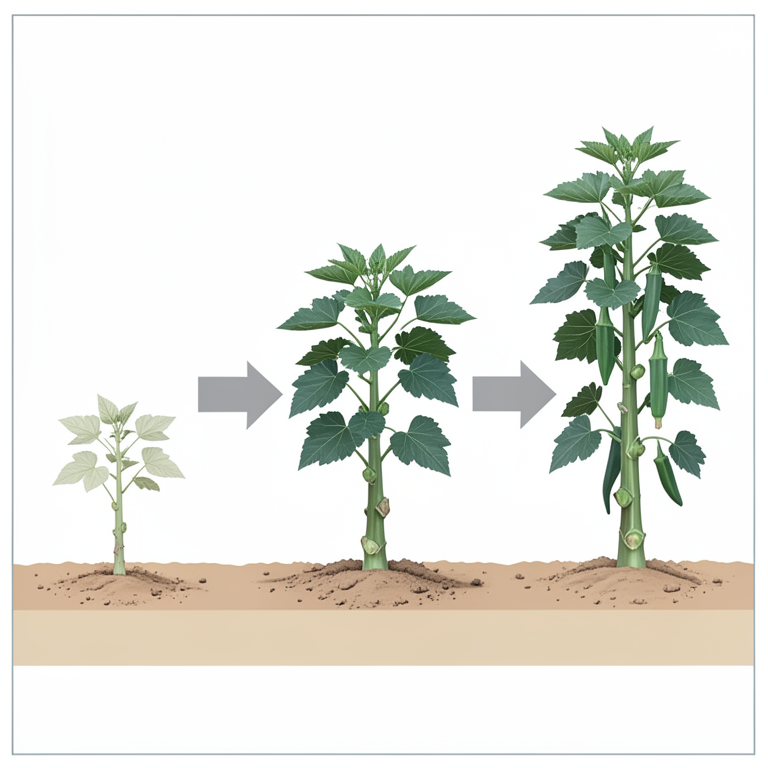
Experimental Treatment Layout
AI-generated conceptual illustration (okra plants (Abelmoschus esculentus) in sandy loam soil). It explains the idea and does not show study data.
View source evidence ↗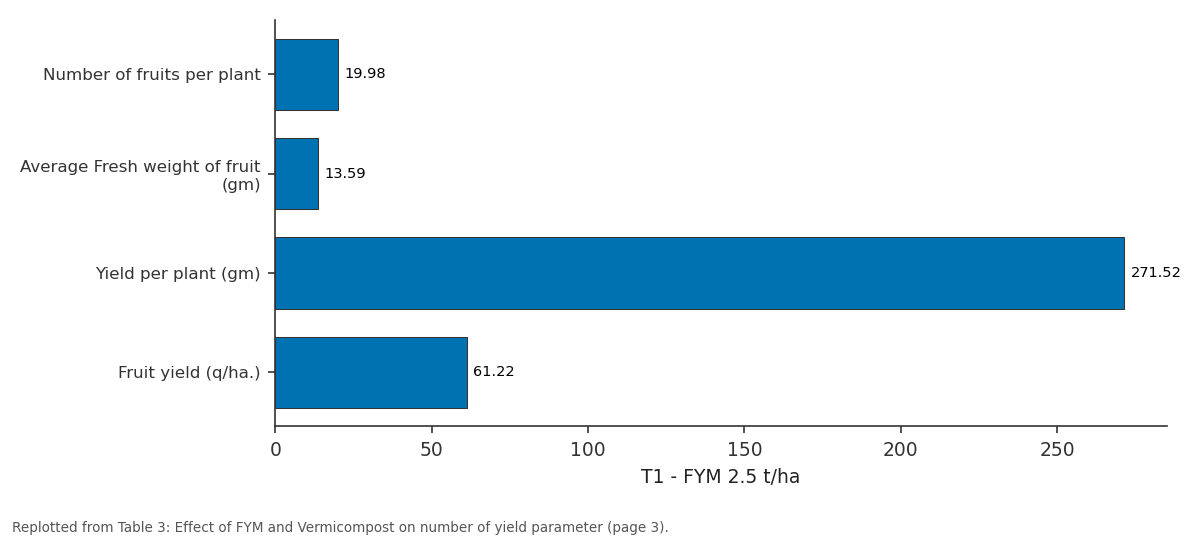
T1 - FYM 2.5 t/ha: Number of fruits per... vs Average Fresh weight of... vs Yield per plant (gm) vs Fruit yield (q/ha.)
Replotted from Table 3 (page 3) of the original paper. Every bar is the paper's own table value.
View source evidence ↗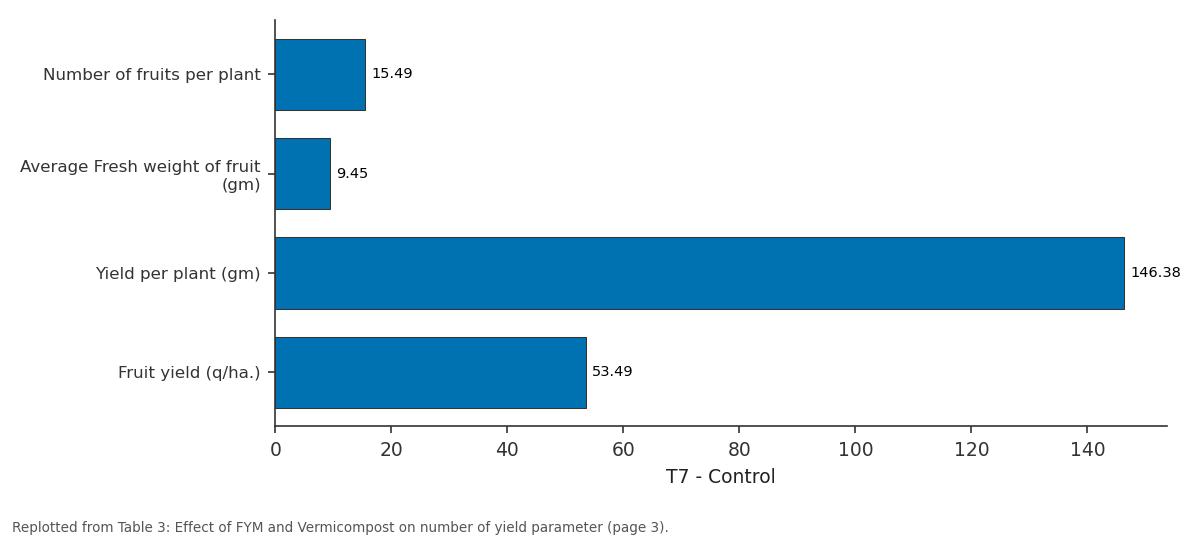
T7 - Control: Number of fruits per... vs Average Fresh weight of... vs Yield per plant (gm) vs Fruit yield (q/ha.)
Replotted from Table 3 (page 3) of the original paper. Every bar is the paper's own table value.
View source evidence ↗Figures & tables
From the original paper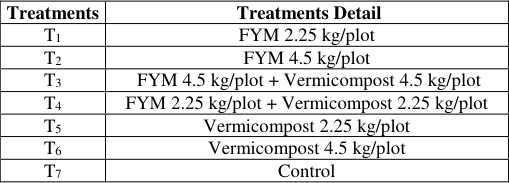 Table 1
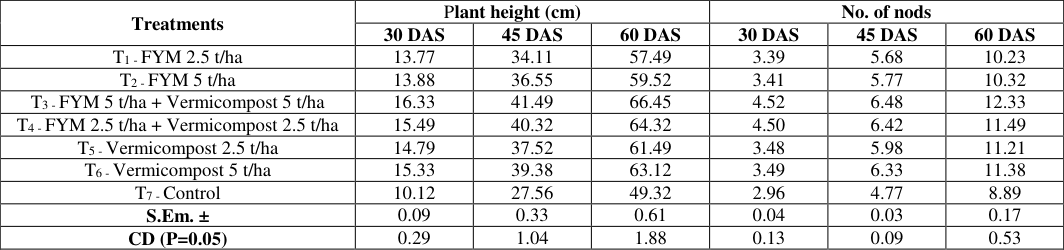 Table 1
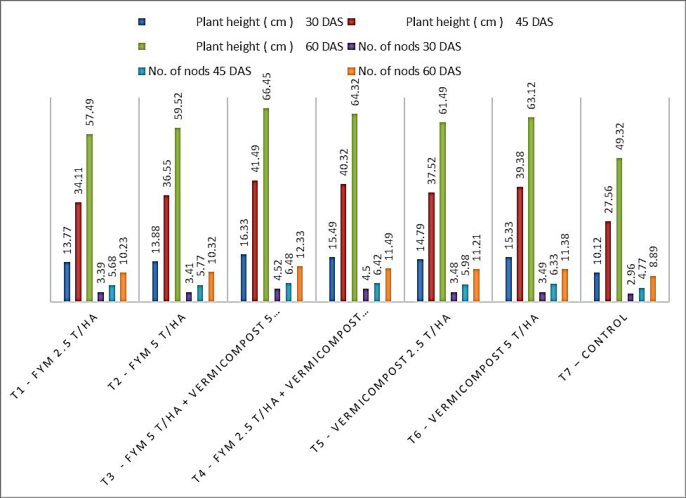 Figure 1
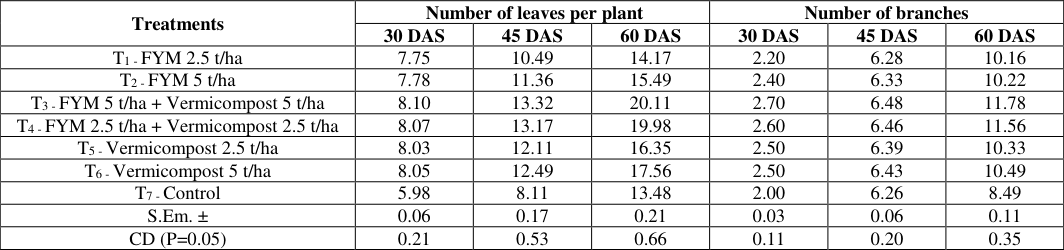 Table 2
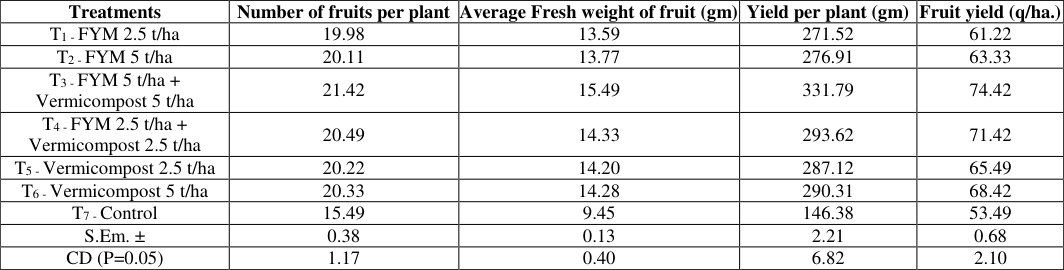 Table 3
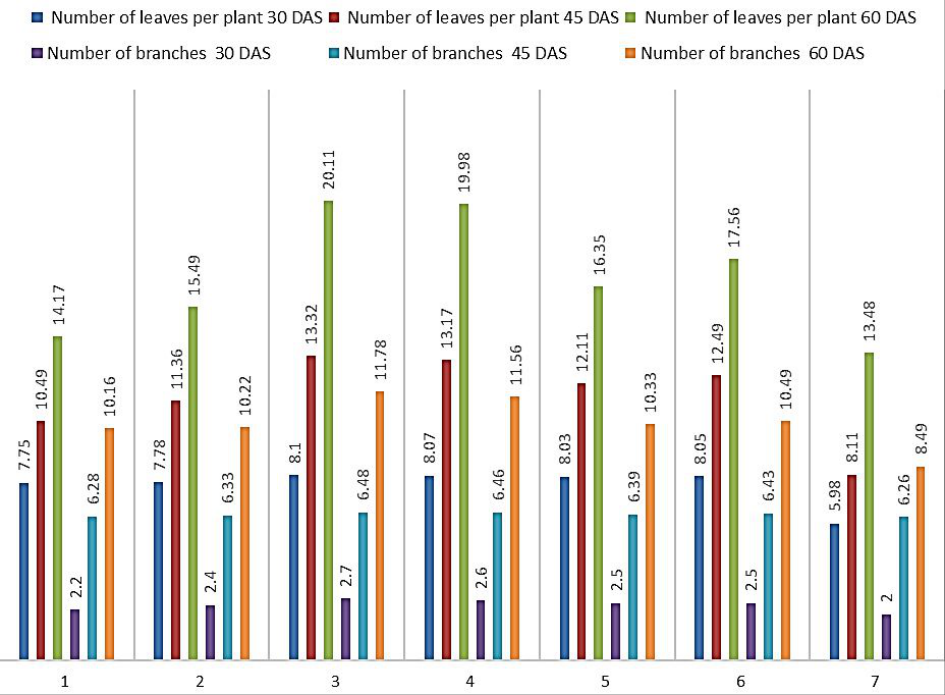 Figure 2
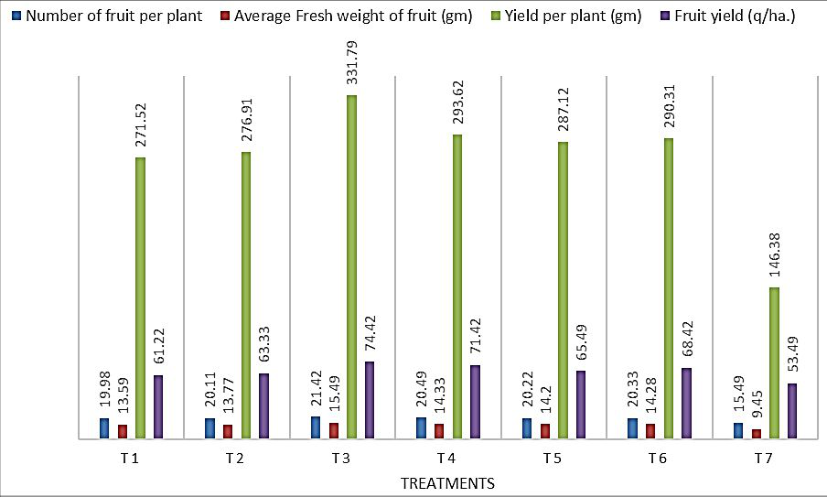 Figure 3
Introduction
Okra (Abelmoschus esculentus L. Moench) belongs to the family of Malvaceae being economically important vegetable crop grown in subtropical and tropical parts of the world. It is generally an annual plant. It is also known as lady’s finger or bhindi originate in tropical Africa.
Okra is one of the most popular vegetable in all sections of people. Okra is cultivated for its fibrous fruits or pods containing round and circular seeds. Okra is a good source of vitamins, minerals calories and amino acids found in seeds. It is a multipurpose crop due to its various uses of the fresh leaves, buds, flowers, pods, stems and seeds.
India is the largest producer of okra in the world. The major okra growing states are Uttar Pradesh, Odisha, Bihar, Andhra Pradesh and West Bengal. According to National Horticulture Board’s Statistical Report 2021-2022 (First Advance Estimate), the area of okra cultivation is 523 thousand ha and has a production of 6416 thousand MT across India. Okra is a good source of vitamins, calcium, potassium and other minerals.
Due to its high iodine content, consumption of okra is good for the control of goiter. Farm yard Manure (FYM) is a decomposed mixture of cattle dung and urine with straw and litter used as bedding material and residues from the fodder fed to the cattle. FYM contains about 0.5 % nitrogen (N), 0.25 % phosphorus (P), 0.5 % potassium (K). Application of well- rotten FYM improves the soil structure.
It increases the soil fertility and adds humus to the soil. It also improves the soil productivity. Vermicomposting is a process of recycling of organic wastes in an environmentally safe method with the help of earthworms. The worm casts apart from increasing the density of microbes also provide the required nutrients of plants.
It contains plant growth promoting substances such as NAA, cytokinins, gibberellins, etc. It helps in lowering C-N ratio, increasing humic acid content, action exchange capacity and water-soluble carbohydrates. Average vermicompost contains 0.9 to 1.5 percent N, 0.3 to 0.64 percent P2O5 and 0.54 to 1.72 percent K2O, 2.00 to 37.7 ppm Cu, 5.7 to 120 ppm Zn and 10.0 to 161.0 ppm Fe. Vermicompost is a by -product of non -thermophillic biodegradation of organic materials through correlation between earthworms and microorganism (Sallaku et al., 2009) [10].
NAAS Rating (2025): 4.97 IJAFS 2025; 7(10): 237-240 Akashdeep Sihag M.Sc. (Ag) Horticulture, Faculty of Agriculture, Tantia University, Sri Ganganagar, Rajasthan, India Alka Assistant Professor, Department of Horticulture, Faculty of Agriculture, Tantia University, Sri Ganganagar, Rajasthan, India Jayant Chhabra M.Sc. (Ag) Horticulture, Faculty of Agriculture, Tantia University, Sri Ganganagar, Rajasthan, India Sushil Kumar Kasnia M.Sc. (Ag) Horticulture, Faculty of Agriculture, Tantia University, Sri Ganganagar, Rajasthan, India Akashdeep Sihag M.Sc. (Ag) Horticulture, Faculty of Agriculture, Tantia University, Sri Ganganagar, Rajasthan, India https://www.agriculturaljournals.com
Materials And Methods
This chapter comprises the details about the material used and the methods adopted during the course of present investigation entitled “Effect of FYM and Vermicompost on Growth and Yield of okra (Abelmoschus esculentus L.)” conducted in kharif season during the year 2023-24 at the experimental field of Department of Horticulture, Faculty of Agriculture, Tantia University, Sri Ganganagar, 335002, Rajasthan. The details of the experiment performed, techniques employed and materials used for studies have been described below:
Experimental
Site: Department of Horticulture, Faculty of Agriculture, Tantia University, Sri Ganganagar, 335002, Rajasthan, which is situated at 24°34' N latitude and 73°40' E longitudes at an elevation of 583.5 meters above mean sea level. The field topography of the experimental site was fairly leveled with an adequate surface drainage and the field soil was having clay loam texture. Treatments Observation recorded Growth parameter 1. Plant height (cm) 2.
Number of Nods 3. Number of leaves 4. Number of branches Yield Parameter 5. Number of fruits 6.
Average fresh weight of fruit (gm) 7. Yield per plant (kg) 8. Fruit yield (q/ha.)
Result And Discussion
The results of the field experiment carried out on “Effect of FYM and Vermicompost on Growth and Yield of Okra (Abelmoschus esculentus L.)” in 2024-25 at the
Experimental
field of the present experiment was conducted at Department of Horticulture, Faculty of Agriculture, Tantia University, Sri Ganganagar, District Sri Ganganagar, 335002, Rajasthan are presented in this chapter. The data pertaining to the effect of different treatments on growth, flowering, yield parameters were statistically analysis for test of significance of the results. In addition to tabular presentation, data also depicted through graphs for better understanding wherever necessary. The analysis of variance for different characters is given in the appendices.
Treatments Treatments Detail T1 FYM 2.25 kg/plot T2 FYM 4.5 kg/plot T3 FYM 4.5 kg/plot + Vermicompost 4.5 kg/plot T4 FYM 2.25 kg/plot + Vermicompost 2.25 kg/plot T5 Vermicompost 2.25 kg/plot T6 Vermicompost 4.5 kg/plot T7 Control Table 1: Effect of FYM and Vermicompost on plant height/ number of nods Treatments Plant height (cm) No. of nods 30 DAS 45 DAS 60 DAS 30 DAS 45 DAS 60 DAS T1 - FYM 2.5 t/ha 13.77 34.11 57.49 3.39 5.68 10.23 T2 - FYM 5 t/ha 13.88 36.55 59.52 3.41 5.77 10.32 T3 - FYM 5 t/ha + Vermicompost 5 t/ha 16.33 41.49 66.45 4.52 6.48 12.33 T4 - FYM 2.5 t/ha + Vermicompost 2.5 t/ha 15.49 40.32 64.32 4.50 6.42 11.49 T5 - Vermicompost 2.5 t/ha 14.79 37.52 61.49 3.48 5.98 11.21 T6 - Vermicompost 5 t/ha 15.33 39.38 63.12 3.49 6.33 11.38 T7 - Control 10.12 27.56 49.32 2.96 4.77 8.89 S.Em. ± 0.09 0.33 0.61 0.04 0.03 0.17 CD (P=0.05) 0.29 1.04 1.88 0.13 0.09 0.53 Fig 1: Effect of FYM and Vermicompost on plant height / no. of nods https://www.agriculturaljournals.com Table 2: Effect of FYM and Vermicompost on Number of leaves / number of branches Treatments Number of leaves per plant Number of branches 30 DAS 45 DAS 60 DAS 30 DAS 45 DAS 60 DAS T1 - FYM 2.5 t/ha 7.75 10.49 14.17 2.20 6.28 10.16 T2 - FYM 5 t/ha 7.78 11.36 15.49 2.40 6.33 10.22 T3 - FYM 5 t/ha + Vermicompost 5 t/ha 8.10 13.32 20.11 2.70 6.48 11.78 T4 - FYM 2.5 t/ha + Vermicompost 2.5 t/ha 8.07 13.17 19.98 2.60 6.46 11.56 T5 - Vermicompost 2.5 t/ha 8.03 12.11 16.35 2.50 6.39 10.33 T6 - Vermicompost 5 t/ha 8.05 12.49 17.56 2.50 6.43 10.49 T7 - Control 5.98 8.11 13.48 2.00 6.26 8.49 S.Em. ± 0.06 0.17 0.21 0.03 0.06 0.11 CD (P=0.05) 0.21 0.53 0.66 0.11 0.20 0.35 Fig 2: Effect of FYM and Vermicompost on no. of leaves per plant/ number of branches Yield parameter Table 3: Effect of FYM and Vermicompost on number of yield parameter Treatments Number of fruits per plant Average Fresh weight of fruit (gm) Yield per plant (gm) Fruit yield (q/ha.) T1 - FYM 2.5 t/ha 19.98 13.59 271.52 61.22 T2 - FYM 5 t/ha 20.11 13.77 276.91 63.33 T3 - FYM 5 t/ha + Vermicompost 5 t/ha 21.42 15.49 331.79 74.42 T4 - FYM 2.5 t/ha + Vermicompost 2.5 t/ha 20.49 14.33 293.62 71.42 T5 - Vermicompost 2.5 t/ha 20.22 14.20 287.12 65.49 T6 - Vermicompost 5 t/ha 20.33 14.28 290.31 68.42 T7 - Control 15.49 9.45 146.38 53.49 S.Em. ± 0.38 0.13 2.21 0.68 CD (P=0.05) 1.17 0.40 6.82 2.10 https://www.agriculturaljournals.com Fig 3: Effect of FYM and Vermicompost on number of yield parameter 6. Kaur P, Bhardwaj M, Babbar I. Effect of vermicompost and vermiwash on growth of vegetables. Res J Anim Vet Fish Sci. 2015;3:9-12. 7.
| Treatments | Number of fruits per plant | Average Fresh weight of fruit (gm) | Yield per plant (gm) | Fruit yield (q/ha.) |
|---|---|---|---|---|
| T1 - FYM 2.5 t/ha | 19.98 | 13.59 | 271.52 | 61.22 |
| T2 - FYM 5 t/ha | 20.11 | 13.77 | 276.91 | 63.33 |
| T3 - FYM 5 t/ha + Vermicompost 5 t/ha | 21.42 | 15.49 | 331.79 | 74.42 |
| T4 - FYM 2.5 t/ha + Vermicompost 2.5 t/ha | 20.49 | 14.33 | 293.62 | 71.42 |
| T5 - Vermicompost 2.5 t/ha | 20.22 | 14.20 | 287.12 | 65.49 |
| T6 - Vermicompost 5 t/ha | 20.33 | 14.28 | 290.31 | 68.42 |
| T7 - Control | 15.49 | 9.45 | 146.38 | 53.49 |
| S.Em. ± | 0.38 | 0.13 | 2.21 | 0.68 |
| CD (P=0.05) | 1.17 | 0.40 | 6.82 | 2.10 |
Table text extracted from the original PDF; superscript letters are shown inline. The original table image is below.
View original table image
| Treatments | Number of leaves per plant | — | — | Number of branches | — | — |
|---|---|---|---|---|---|---|
| 30 DAS | 45 DAS | 60 DAS | 30 DAS | 45 DAS | 60 DAS | |
| T1 - FYM 2.5 t/ha | 7.75 | 10.49 | 14.17 | 2.20 | 6.28 | 10.16 |
| T2 - FYM 5 t/ha | 7.78 | 11.36 | 15.49 | 2.40 | 6.33 | 10.22 |
| T3 - FYM 5 t/ha + Vermicompost 5 t/ha | 8.10 | 13.32 | 20.11 | 2.70 | 6.48 | 11.78 |
| T4 - FYM 2.5 t/ha + Vermicompost 2.5 t/ha | 8.07 | 13.17 | 19.98 | 2.60 | 6.46 | 11.56 |
| T5 - Vermicompost 2.5 t/ha | 8.03 | 12.11 | 16.35 | 2.50 | 6.39 | 10.33 |
| T6 - Vermicompost 5 t/ha | 8.05 | 12.49 | 17.56 | 2.50 | 6.43 | 10.49 |
| T7 - Control | 5.98 | 8.11 | 13.48 | 2.00 | 6.26 | 8.49 |
| S.Em. ± | 0.06 | 0.17 | 0.21 | 0.03 | 0.06 | 0.11 |
| CD (P=0.05) | 0.21 | 0.53 | 0.66 | 0.11 | 0.20 | 0.35 |
Table text extracted from the original PDF; superscript letters are shown inline. The original table image is below.
View original table image
| Treatments | Plant height (cm) | — | — | No. of nods | — | — |
|---|---|---|---|---|---|---|
| 30 DAS | 45 DAS | 60 DAS | 30 DAS | 45 DAS | 60 DAS | |
| T1 - FYM 2.5 t/ha | 13.77 | 34.11 | 57.49 | 3.39 | 5.68 | 10.23 |
| T2 - FYM 5 t/ha | 13.88 | 36.55 | 59.52 | 3.41 | 5.77 | 10.32 |
| T3 - FYM 5 t/ha + Vermicompost 5 t/ha | 16.33 | 41.49 | 66.45 | 4.52 | 6.48 | 12.33 |
| T4 - FYM 2.5 t/ha + Vermicompost 2.5 t/ha | 15.49 | 40.32 | 64.32 | 4.50 | 6.42 | 11.49 |
| T5 - Vermicompost 2.5 t/ha | 14.79 | 37.52 | 61.49 | 3.48 | 5.98 | 11.21 |
| T6 - Vermicompost 5 t/ha | 15.33 | 39.38 | 63.12 | 3.49 | 6.33 | 11.38 |
| T7 - Control | 10.12 | 27.56 | 49.32 | 2.96 | 4.77 | 8.89 |
| S.Em. ± | 0.09 | 0.33 | 0.61 | 0.04 | 0.03 | 0.17 |
| CD (P=0.05) | 0.29 | 1.04 | 1.88 | 0.13 | 0.09 | 0.53 |
Table text extracted from the original PDF; superscript letters are shown inline. The original table image is below.
View original table image
| Treatments | Treatments Detail |
|---|---|
| T1 | FYM 2.25 kg/plot |
| T2 | FYM 4.5 kg/plot |
| T3 | FYM 4.5 kg/plot + Vermicompost 4.5 kg/plot |
| T4 | FYM 2.25 kg/plot + Vermicompost 2.25 kg/plot |
| T5 | Vermicompost 2.25 kg/plot |
| T6 | Vermicompost 4.5 kg/plot |
| T7 | Control |
Table text extracted from the original PDF; superscript letters are shown inline. The original table image is below.
View original table image
Kumar T, Kumar M, Singh MK, Kumar V, Kumar A, Kumar S, et al. Impact of integrated nutrient management (INM) on growth and economic yield of okra. Ann Hortic. 2013;6:107-14. 8. National Horticulture Board (NHB).
National Horticulture Board statistics report [Internet]. 2022 [cited 2025 Oct 13]. Available from: https://nhb.gov.in 9. Pratap UB, Pant KS. Performance of okra as influenced by tree spacing and organic manures under Melia composita based agri-silviculture systems.
Pharma Innov J. 2020;9:277-81. 10. Sallaku G, Babaj I, Kaciu S, Balliu A. The influence of vermicompost on plant growth characteristics of cucumber (Cucumis sativus L.) seedlings under saline condition. J Food Agric Environ. 2009;7:869-72. 11.
Thamburaj S. Textbook of Vegetables, Tuber Crops and Spices. New Delhi: Indian Council of Agricultural Research; 2014. p. 222. 12. Tomar VK, Bhatnagar RK, Palta RK.
Effect of vermicompost on production of brinjal and carrot. Bhartiya Krishi Anusandhan Patrika. 1998;13:153-6. 13. Verma S, Babu A, Patel A, Singh SK, Pradhan SS, Verma SK, et al. Significance of vermiwash on crop production: a review.
J Pharmacogn Phytochem. 2018;7:297-301. 14. Wagh SS, Laharia GS, Iratkar AG, Gajare S. Effect of INM on nutrient uptake, yield and quality of okra (Abelmoschus esculentus L. Moench).
Asian J Soil Sci. 2014;9:21-4.
Discussion
Among all treatments, T3 (FYM 5 t/ha + Vermicompost 5 t/ha) recorded the maximum growth and yield parameters. This may be attributed to improved soil structure, nutrient supply, and microbial activity due to the combined effect of FYM and Vermicompost. The synergistic effect enhanced nutrient availability, resulting in better root growth and higher yield. Similar findings were reported by Sharma and Choudhary (2014) and Gupta et al. (2019), who observed that integrated organic nutrient management significantly enhanced yield attributes of okra.
Conclusion
On the basis of present investigation entitled “Effect of FYM and Vermicompost on Growth and Yield of Okra (Abelmoschus esculentus L. Moench). It can be concluded that treatment T3 (FYM 5 t/ha + Vermicompost 5 t/ha) was found significantly superior in terms of growth and yield attributes of okra crop among organic manures.
References
5 in the original paper- Abha R, Meena ML, Singh R, Mandal RK. Effect of various organic manures on growth and yield of okra (Abelmoschus esculentus L. Moench). J Pharmacogn Phytochem. 2019;8:1203-5.
- Akhter S, Akter RS, Silva J, Da Haque A, Noor S. Efficacy of vermicompost to improve soil health, yield and nutrient uptake of cauliflower in grey terrace soil of Bangladesh. Dyn Soil Dyn Plant. 2013;6:103-9.
- Alam M, Hussain N, Zubair M, Hussain SB, Baloch MS. Integration of organic and inorganic sources of phosphorus for increased productivity of mungbean (Vigna radiata). Pak J Agric Sci. 2010;47:111-4.
- Hisham AA, Prasad VM, Saravanan S. Effect of FYM on growth, yield and fruits quality of okra (Abelmoschus esculentus L. Moench). J Agric Vet Sci. 2014;7:7-12.
- Joshi R, Singh J, Vig AP. Vermicompost as an effective organic fertilizer and biocontrol agent: effect on growth, yield and quality of plants. Rev Environ Sci Biotechnol. 2015;14:137-59.