
Research article · 2025 · Full text
International Journal of Agriculture and Food ScienceEcological Succession of Insect Pests complex and Beneficials in Tomato (Solanum lycopersicum L.) crop at Raisen District of Madhya Pradesh
Volume 7(9) · Pages 670–673 · DOI: 10.33545/2664844x.2025.v7.i9i.811 ↗
Research areasBotulinum Toxin and Related Neurological DisordersBacterial Genetics and BiotechnologyFungal and yeast genetics research
Abstract
Author-writtenTomato (Solanum lycopersicum L.) is an economically important vegetable crop, widely cultivated across India, with Madhya Pradesh being one of the leading producers. Despite its significance, tomato production faces severe yield constraints due to a complex of insect pests and fluctuating environmental conditions. The present study was conducted in Raisen district of Madhya Pradesh during 2022-23 and 2023-24 to document the ecological succession of insect pests and beneficial arthropods associated with tomato under field conditions. Observations were recorded twice weekly on a randomly selected sample of 25 plants from untreated plots of variety Arka Vishesh. Results indicated that sucking pests such as jassids (Amrasca biguttula biguttula), whiteflies (Bemisia tabaci), and aphids (Aphis gossypii) appeared early in the vegetative stage and persisted until the late reproductive stage. Thrips (Thrips tabaci) and leaf miners (Liriomyza trifolii) were active from vegetative to reproductive phases, while the invasive pinworm (Tuta absoluta) remained prevalent throughout the crop cycle. The fruit borer (Helicoverpa armigera) caused severe damage during fruiting, whereas red spider mites (Tetranychus spp.) appeared under warm, dry conditions in 2023-24. Among beneficials, ladybird beetles (Menochilus sexmaculatus) were consistently recorded across all stages, while lacewings (Chrysoperla sp.) appeared during the vegetative phase, highlighting their role in natural regulation. The findings emphasize a clear pattern of pest succession, validating earlier reports, and underscore the importance of integrating ecological knowledge into pest management strategies. Conservation of natural enemies and timely interventions can support sustainable tomato production.
Summary
Source-checkedPlain-language reading of the full paper, prepared with AI and checked against the text. Each point links to the authors' own words.
Why it matters
- Tomato is a vital vegetable crop in India, and Madhya Pradesh is one of the top producing states. View evidence ↗
- Tomato yields are severely limited by environmental fluctuations and a complex of insect pests. View evidence ↗
- Insect pests can cause tomato yield losses between 30% and 70%, depending on the intensity of the infestation and how it is managed. View evidence ↗
The question
- The study aimed to document the ecological succession of beneficial arthropods and insect pests in tomato crops in the Raisen district of Madhya Pradesh over two years (2022-23 and 2023-24). View evidence ↗
What they did
- The research used the Arka Vishesh tomato variety grown under field conditions in the Raisen district. View evidence ↗
- Researchers monitored 25 randomly selected plants from untreated plots, recording observations twice every week. View evidence ↗
- To allow insect populations to build up naturally, no chemical insecticides or protective treatments were applied to the field. View evidence ↗
What they found
- Sucking pests, including aphids, whiteflies, and jassids, were the first to appear at 24 days after transplanting (DAT) and remained until the late reproductive stage (up to 145 DAT). View evidence ↗
- Leaf miners and thrips were active throughout the crop's development, from the vegetative stage through to the reproductive stage. View evidence ↗
- The invasive tomato pinworm (Tuta absoluta) was a persistent threat, remaining present from the vegetative phase through the entire crop cycle. View evidence ↗
- The fruit borer (Helicoverpa armigera) appeared during the reproductive stage starting at 112 DAT, coinciding with the development of the fruit. View evidence ↗
- Ladybird beetles (Menochilus sexmaculatus) were consistently present as beneficial predators throughout the entire crop period. View evidence ↗
- Lacewings (Chrysoperla sp.) were observed during the vegetative stage, where they preyed on whiteflies and aphids. View evidence ↗
What it means
- The authors conclude that to minimize yield losses, integrated pest management (IPM) strategies should be used, combining ecological approaches, the conservation of natural enemies, and timely interventions. View evidence ↗
Visual summary
1 visualsIllustrations explain the paper; they do not show study data.
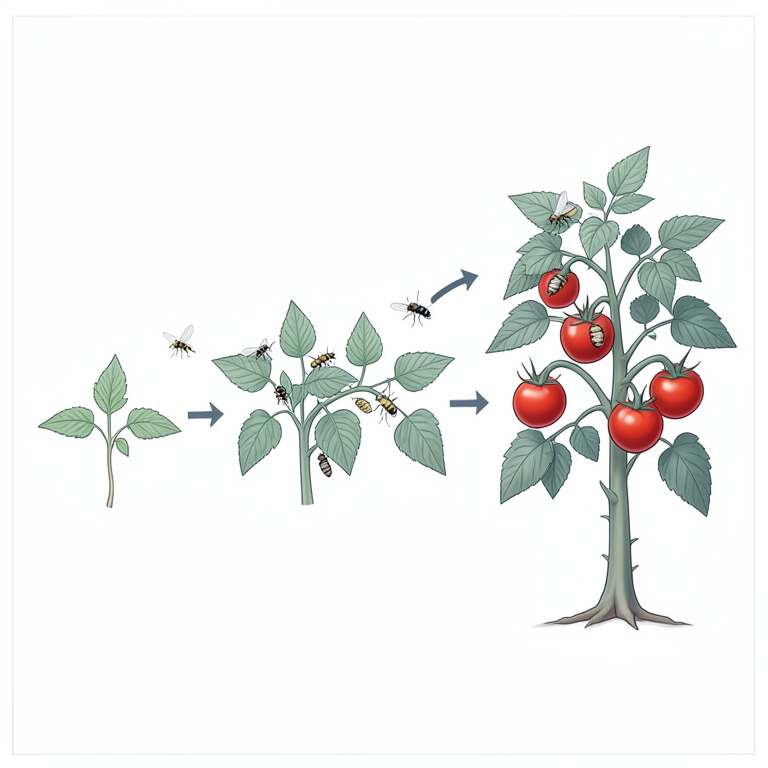
Timeline of Pest Appearance
AI-generated conceptual illustration (Tomato plants (Solanum lycopersicum L.) and associated insect pests). It explains the idea and does not show study data.
View source evidence ↗Figures & tables
From the original paper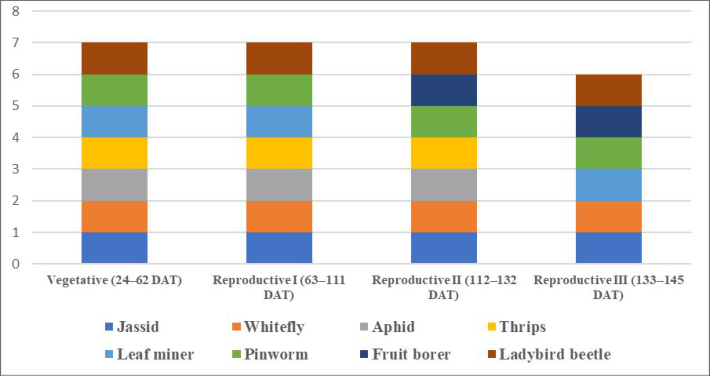 Figure 1
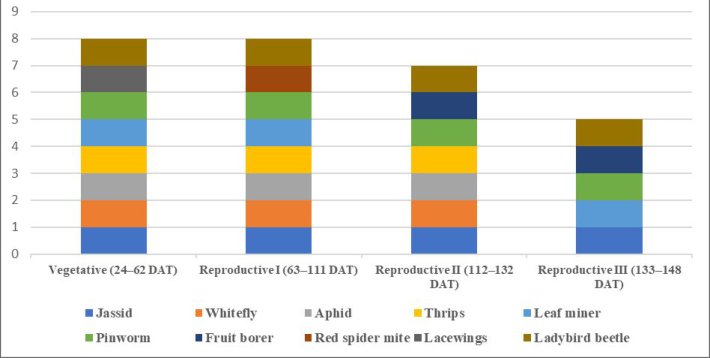 Figure 2
Introduction
Tomato (Solanum lycopersicum L.) is one of the most widely cultivated vegetable crops globally, belonging to the family Solanaceae. It is an important source of vitamins (A, C, and E), minerals, antioxidants such as lycopene, and contributes significantly to human nutrition. In addition to its nutritional value, tomato also plays a vital role in the agroeconomy, serving as a major cash crop for millions of small and marginal farmers. Globally, tomato occupies an area of about 5.05 million hectares with a production of 189.34 million metric tonnes and an average productivity of 37.5 tonnes per hectare (FAOSTAT, 2022). India ranks second in global tomato production after China, with a cultivated area of 0.80 million hectares, production of 21.18 million tonnes, and productivity of 26.4 tonnes per hectare (NHB, 2023). Within India, Madhya Pradesh is one of the leading tomato-producing states, contributing substantially to national acreage and output. The state has a cultivated area of 0.14 million hectares under tomato, producing 2.94 million tonnes with a productivity of 21.5 tonnes per hectare (NHB, 2023). The Raisen district, situated in the central part of Madhya Pradesh, is a significant tomato belt owing to its favorable agro-climatic conditions, fertile soils, and availability of irrigation. Tomato cultivation in this region plays a crucial role in supporting the livelihoods of farmers, but its productivity often fluctuates due to abiotic stresses and biotic constraints, particularly insect pest infestations. Tomato crops are vulnerable to a wide range of insect pests, which together form a complex pest community that varies with the crop growth stage and season. The major insect pests reported on tomato include the fruit borer (Helicoverpa armigera), whitefly (Bemisia tabaci), aphids (Aphis gossypii), leafminer (Liriomyza trifolii), thrips (Thrips tabaci), and jassids (Amrasca biguttula biguttula).
These pests cause significant yield losses either directly by feeding or indirectly by transmitting plant viruses, particularly Tomato leaf curl virus (ToLCV) vectored by whiteflies. Studies have estimated yield losses due to insect pests in tomato ranging between 30-70% depending on pest intensity and management practices (Sharma et al., 2020; Reddy et al., 2021) [3,4] . The occurrence and dominance of insect pests in tomato fields follow a pattern of ecological succession influenced by crop phenology, local weather conditions, and interspecific competition. Early in the crop season, sapfeeding pests such as aphids and whiteflies generally colonize the crop, followed by foliage feeders and later by fruit borers during the reproductive stage. Alongside pests, beneficial insects including predators (ladybird beetles, lacewings, spiders), parasitoids (Trichogrammatids, Braconids), and pollinators play an important role in natural pest regulation and maintaining ecological balance. The dynamics between pests and natural enemies are crucial for ecological sustainability and form the basis for integrated pest management (IPM). Despite tomato's economic significance in Madhya Pradesh, detailed and systematic studies on the ecological succession of insect pests and associated beneficials are limited, particularly in Raisen district. Such studies are essential to identify key pests and natural enemies, understand their seasonal patterns, and develop location-specific IPM strategies. Hence, the present investigation was undertaken to document the ecological succession of insect pest complexes and beneficial arthropods associated with tomato (Solanum lycopersicum L.) in Raisen district of Madhya Pradesh. The findings of this study will provide insights into pest-beneficial interactions, help forecast pest outbreaks, and support the development of sustainable management practices for enhancing tomato productivity in the region.
Material & Methods
The present study was conducted on tomato (Solanum lycopersicum L.) variety Arka Vishesh under field conditions at Raisen district of Madhya Pradesh. The experimental plot measured 10 m × 15 m, comprising 10 rows, each with a row length of 4.4 m. The spacing between rows was maintained at 60 cm, while 40 cm spacing was kept between adjacent plots to ensure proper crop growth, field management, and to avoid overlapping of observations. Field observations were initiated immediately after sowing and continued throughout the crop growth period. Data were recorded twice every standard week to monitor the insect pest complex and associated natural enemies. For each observation, 25 plants were randomly selected from the field to obtain representative and unbiased samples. The field was maintained without the application of any chemical insecticides or protective treatments, thereby allowing a natural build-up of insect populations. During each observation, insect pests and beneficial arthropods were carefully recorded. Particular attention was given to the order of appearance, duration of presence, and population status of different insect groups. Both harmful pests (such as fruit borers, sap-sucking insects, leaf miners, etc.) and beneficial insects (predators, parasitoids, and pollinators) were systematically documented. This methodological approach enabled the assessment of ecological succession of insect pests and natural enemies, providing valuable insights into population dynamics, seasonal incidence, and pest-beneficial interactions in tomato crops. The data generated from this study serve as a basis for developing effective integrated pest management (IPM) strategies suited to local agro-ecological conditions. Sucking pests such as jassids (Amrasca biguttula biguttula), whiteflies (Bemisia tabaci), and aphids (Aphis gossypii) were the earliest to colonize the crop, appearing from the vegetative phase (24 DAT) and persisting until the late reproductive stage (up to 145 DAT). These pests caused characteristic symptoms including leaf curling, chlorosis, and reduced vigour. Whiteflies were particularly important due to their role as vectors of Tomato Yellow Leaf Curl Virus (TYLCV). Thrips (Thrips tabaci) and leaf miners (Liriomyza trifolii) were also active from vegetative to reproductive stages, with thrips causing silvering and deformation of floral structures, and leaf miners producing serpentine mines that reduced photosynthetic efficiency. Their continuous activity highlights their adaptability and pest status. Similar persistence of jassids and whiteflies during tomato growth was reported by Patel et al. (2012) and Das and Ray (2010) [5,12] , who emphasized their earlyseason establishment and prolonged damage potential. Whiteflies, in particular, are critical due to their role in transmitting Tomato Yellow Leaf Curl Virus (TYLCV), a finding supported by Kumar et al. (2011) [8] , who stressed the yield losses linked to virus outbreaks. The invasive tomato pinworm (Tuta absoluta) was present from the vegetative phase and continued throughout the crop cycle, infesting leaves, stems, and fruits. Its prolonged activity and cryptic feeding habit made it a major challenge. The fruit borer (Helicoverpa armigera) was recorded during the reproductive stage (from 112 DAT), coinciding with fruit development. It caused direct fruit damage and economic losses. Among beneficial insects, the ladybird beetle (Menochilus sexmaculatus) was consistently observed throughout the crop period, preying on aphids, whiteflies, and thrips, indicating natural biological control potential.
Crop: Tomato
Crop: Tomato
Year 2023-24
Similar succession pattern was recorded with certain additional observations. Jassids, whiteflies, and aphids once again appeared early (24 DAT) and persisted until late stages, remaining major sucking pests. Aphid populations peaked during cooler conditions, while whitefliesmaintained dominance due to favourable climate and their virus-transmitting role. Thrips and leaf miners were observed from vegetative to reproductive stages, with heavy activity during warmer periods. Thrips caused floral deformities and served as vectors of Tomato Spotted Wilt Virus (TSWV), while leaf miners reduced leaf vigour through internal feeding. The invasive pinworm (Tuta absoluta) persisted throughout the crop cycle, causing extensive damage to all aerial plant parts. Similarly, fruit borer (H. armigera) was prominent during fruiting (from 112 DAT), inflicting severe fruit damage. A new addition to the pest complex was the red spider mite (Tetranychus spp.), recorded from 63-111 DAT during reproductive stages, thriving under warm and dry conditions and causing bronzing and defoliation. Among beneficials, lacewings (Chrysoperla sp.) were recorded during the vegetative stage, actively feeding on aphids and whiteflies, while ladybird beetles remained consistent predators throughout the season, further highlighting the role of natural enemies in regulating pest populations. The study revealed a clear ecological succession of insect pests and beneficials in tomato. Jassids, whiteflies, and aphids were dominant from the vegetative to reproductive stages, consistent with earlier reports highlighting their persistence and adaptability. Thrips and leaf miners peaked during flowering, causing significant damage and transmitting viral diseases, in agreement with observations by Jamuna (2019) and Yadav et al. (2014) [6,16] . The invasive Tuta absoluta emerged as a major threat, infesting all crop stages, while Helicoverpa armigera was prominent during fruiting, corroborating findings of Lal et al. (2007) [8] . Red spider mites appeared during warm, dry conditions, reflecting climate-driven outbreaks. Beneficial insects such as ladybird beetles and lacewings were consistently observed, indicating their potential in regulating pest populations and supporting sustainable pest management. These findings emphasize the need for integrated pest management (IPM) strategies that combine timely interventions, conservation of natural enemies, and ecological approaches to minimize yield losses.
Figures and tables from the paper
References
15 in the original paper- NHB. Horticultural Statistics at a Glance. National Horticulture Board, Ministry of Agriculture, Government of India. 2023.
- Sharma R, Singh P, Yadav R. Pest complex and management strategies in tomato. Indian J Entomol. 2020;82(3):456-462.
- Reddy KS, Kumar S, Rao V. Impact of insect pests on tomato productivity and integrated management approaches. Veg Sci. 2021;48(2):123-130.
- Das S, Ray S. Population dynamics of whitefly (Bemisia tabaci) on tomato and its role as a vector of Tomato Yellow Leaf Curl Virus. J Entomol Res. 2010;34(2):123-127.
- Jamuna R. Seasonal incidence and management of thrips (Thrips tabaci) in tomato crop. J AgriSearch. 2019;6(3):155-159.
- Kagezi GH, Sseruwagi P, Legg JP. Impact of thrips on tomato yield and virus transmission under field conditions. Afr Crop Sci J. 2001;9(2):281-290. International Journal of Agriculture and Food Science https://www.agriculturaljournals.com
- Kumar A, Singh R, Yadav R. Role of whiteflies in the epidemiology of Tomato Yellow Leaf Curl Virus. Indian J Virol. 2011;22(1):56-59.
- Lal OP, Sharma RK, Singh KM. Seasonal incidence and management of fruit borer (Helicoverpa armigera) in tomato. Indian J Entomol. 2007;69(3):235-239.
- Nandihalli BS, Krishnamoorthy A. Effect of temperature and humidity on the development of tomato insect pests. Karnataka J Agric Sci. 1999;12(1):112-116.
- Patel KG, Bhutani VP. Role of natural enemies in the management of insect pests of tomato. Indian J Agric Res. 2015;49(5):437-442.
- Patel RK, Singh S, Yadav R. Seasonal incidence of sucking pests of tomato in relation to weather parameters. Ann Plant Prot Sci. 2012;20(1):45-8.
- Rajan S, Reddy DJ, Prasad YG. Population dynamics of aphid (Aphis gossypii) on tomato and its relationship with abiotic factors. Indian J Plant Prot. 2013;41(1):6570.
- Saxena RK, Sharma A, Kumar V. Impact of overlapping pest infestations on tomato yield. J Plant Prot Res. 2011;51(4):307-312.
- Sinha S, Kumar P, Choudhary S. Seasonal abundance of thrips (Thrips tabaci) in central Indian tomato ecosystem. Int J Entomol Res. 2016;4(3):89-93.
- Yadav RK, Meena RS, Singh P. Seasonal incidence of leaf miner (Liriomyza trifolii) on tomato and its management. Bioscan. 2014;9(1):243-246.