
Research article · 2025 · Full text
International Journal of Agriculture and Food ScienceUse of bamboo solar dryers for household-level dehydration
Volume 7(9) · Pages 651–653 · DOI: 10.33545/2664844x.2025.v7.i9i.807 ↗
Research areasGeochemistry and Geologic MappingGeological Modeling and AnalysisSeismic Imaging and Inversion Techniques
Abstract
Author-writtenPost-harvest losses remain a significant constraint for smallholder agriculture, particularly for perishable fruits, vegetables and spices. This study evaluates the technical performance, user acceptance, and scaling potential of low-cost bamboo solar dryers introduced through Front Line Demonstrations (FLDs) conducted by Krishi Vigyan Kendra (KVK), Akola, Maharashtra between 2022 and 2024. The intervention involved 150 rural women beneficiaries across three villages and compared bamboo solar dryers with traditional open sun drying. Key performance indicators included drying time, product quality (visual assessment), and user feedback on ergonomics and adoption intent. Bamboo solar dryers reduced average drying time by 29.75% in 2022 and 33.99% in 2023-2024 compared to traditional methods. The enclosed design decreased contamination and improved color retention, while ergonomic features reduced drudgery for women users. The findings align with experimental literature on solar bamboo dryers and micro solar systems, indicating that locally fabricated bamboo dryers are a practical, gender-inclusive, and climate-resilient post-harvest solution. Recommendations include policy integration, capacity building for SHGs/FPOs, and further research on drying kinetics, nutrient retention, microbial safety, and economic feasibility.
Summary
Source-checkedPlain-language reading of the full paper, prepared with AI and checked against the text. Each point links to the authors' own words.
Why it matters
- In India, approximately 25-30% of fruits and vegetables are lost after harvest because of poor storage, processing, and handling. View evidence ↗
- Traditional open sun drying is cheap but leaves produce vulnerable to contamination from pests, weather, and dust, which reduces quality. View evidence ↗
- Bamboo-based solar dryers are a viable alternative because they use locally available materials and are inexpensive to build while maintaining necessary thermal properties. View evidence ↗
The question
- The study aimed to quantify how much drying time is saved using bamboo solar dryers compared to open sun drying, assess improvements in hygiene and quality, and evaluate user acceptance among rural women. View evidence ↗
What they did
- The intervention used a portable bamboo cabinet dryer featuring a black base for heat absorption, polyethylene glazing for greenhouse heating, and vents for natural airflow. View evidence ↗
- The study compared traditional open sun drying (control) against the bamboo solar dryer (intervention) using common household items like garlic, chilli, and sliced vegetables. View evidence ↗
- Drying efficiency was measured by recording the total hours from the start of the process (usually 09:00 h) until the produce reached a target final moisture content. View evidence ↗
What they found
- Visual inspections and interviews showed that the bamboo dryer produced items with better uniformity, better color retention, and less contamination from insects and dust than open sun drying. View evidence ↗
- Women reported less physical labor (drudgery) because the dryer's ergonomic tray heights reduced bending and eliminated the need to shift trays. View evidence ↗
- Between 70% and 80% of respondents expressed a willingness to permanently adopt the technology and pursue collective fabrication through farmer organizations or self-help groups. View evidence ↗
- Field observations showed that on sunny days, the internal temperature of the dryer typically rose 10-25°C above the ambient temperature. View evidence ↗
What it means
- The authors conclude that bamboo solar dryers are a practical, inexpensive, and gender-responsive solution for dehydrating food at the household level. View evidence ↗
- The authors recommend integrating these dryers into government rural livelihood and post-harvest schemes to provide training and subsidies for early adoption. View evidence ↗
- The study did not perform laboratory assays for microbiological contamination or nutrient retention, meaning it cannot make strong claims regarding food safety or nutrient preservation. View evidence ↗
- Because the study was a Front Line Demonstration (FLD), the researchers had limited control over environmental variables like humidity, ambient temperature, and solar irradiance. View evidence ↗
Visual summary
1 visualsIllustrations explain the paper; they do not show study data.
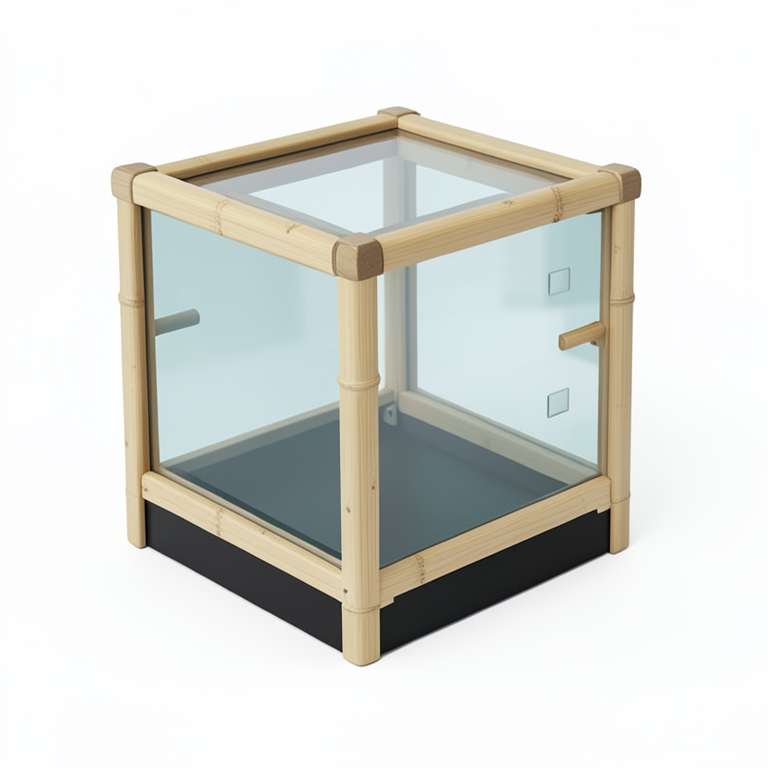
Bamboo Solar Dryer Components
AI-generated conceptual illustration (a portable bamboo solar cabinet dryer). It explains the idea and does not show study data.
View source evidence ↗Introduction
Global and national estimates indicate that a substantial proportion of fruits and vegetables commonly cited as 25-30% in India are lost after harvest due to inadequate handling, processing and storage (FAO, 2023) [4] . Losses are most acute for perishable commodities such as chilli, ginger, garlic and sliced vegetables, which require rapid moisture removal to reach safe storage conditions. Traditional open sun drying is widely practised at household and village levels. While inexpensive, open sun drying exposes produce to dust, precipitation, insects, birds and rodents, often leading to uneven drying, product contamination and inferior quality. Case-hardening, recontamination and long drying times are recurrent problems that limit marketability and shelf-life. Solar drying technologies fill a crucial gap between rudimentary open sun drying and expensive mechanical dryers. Solar dryers can be classified into direct, indirect and mixedmode systems and vary widely in cost, capacity and complexity (FAO, 2023) [4] . Micro solar dryer designs favour low-cost materials, portability and ease of use for household applications. Bamboo-based dryers combine local material availability and low fabrication cost with adequate thermal and mechanical properties. Empirical studies and engineering evaluations (e.g., Rawat et al., 2013; Ampratwum & Dorvlo, 1998; Demiray & Tulek, 2012) [10, 1, 3] report improved drying rates, reduced contamination and favorable thermal efficiencies for bamboo and cabinet-type dryers. Front Line Demonstrations (FLDs) implemented by Krishi Vigyan Kendras (KVKs) serve as an effective pathway for technology transfer and participatory validation under farmer conditions. Between 2022 and 2024, KVK Akola implemented FLDs of a bamboo solar dryer with the explicit goals of (i) quantifying drying time savings versus open sun drying, (ii) assessing product quality and hygiene improvements, and (iii) documenting user acceptance and scaling potential among rural women. This manuscript presents corrected calculations and an expanded discussion of the FLD results, situating them within the broader solar-drying literature.
Materials and Methods
Materials and Methods
Study area and beneficiaries
The demonstrations were conducted in three villages of Akola district, Maharashtra: Gadegaon (2022). A total of 150 household women participated (approximately 50 beneficiaries per year). Households were selected based on their active engagement in household-level processing and willingness to adopt the introduced technology.
Bamboo solar dryer design and construction
The bamboo solar dryer used in FLDs was a low-cost, portable, enclosed cabinet constructed with a bamboo frame, a black-painted base collector to absorb solar radiation, transparent polyethylene (or similar glazing) to create greenhouse heating, and ventilated inlets/outlets to promote natural convective flow. The capacity was suitable for household batches (approx. 2-5 kg per load depending on product), and trays were constructed using food-safe mesh or woven bamboo. The design principles follow FAO micro solar dryer guidance and earlier thermal performance studies (Rawat et al., 2013) [10] .
Experimental treatments and procedures
Two treatments were evaluated in each FLD: T₁ traditional open sun drying (control), and T₂ bamboo solar dryer (intervention). Products included locally available dehydrable commodities, with emphasis on chilli, garlic, and sliced vegetables as common household examples. Batches were standardized by initial mass and preprocessing (slicing/grading). The endpoint for drying was defined as a target final moisture content appropriate for safe storage (e.g., ~10% w.b. for chillies), measured by periodic weighing and standard laboratory or field moisture methods.
Measurements and derived indicators
Drying time (hours) was recorded as the elapsed time from the start of drying (typically ~09:00 h) until the target final moisture content was attained. The percentage time saved was calculated as: Time Saved (%) = (T₁ -T₂) / T₁ × 100
Where T₁ and T₂ are the mean drying times for the traditional and bamboo dryer treatments, respectively. Quality assessment was performed by visual inspection for contamination and color retention; user acceptance was captured via structured interviews focusing on ergonomics, perceived hygiene benefits, and willingness to adopt and promote the technology through SHGs/FPOs.
Data analysis
Summary statistics (mean and percentage reduction) were calculated by year. When within-household paired observations were available, paired comparison analysis is recommended (paired t-test or non-parametric equivalent), while cross-sectional comparisons should use independentsample tests or mixed-effect models with household as a random effect. For the FLD dataset presented here, aggregated means and corrected percentage calculations are reported; detailed inferential statistics are proposed for inclusion when raw replicate-level data are available.
Results
Results
Drying time and efficiency
Across three years and 150 participating households, the bamboo solar dryer reduced average drying time substantially relative to open sun drying. Table 1 reports the mean drying times and percentage time saved after correcting unit labels and calculation formulae. The corrected calculations show a 29.75% time saving in 2022 (from 8.00 h to 5.62 h) and approximately 33.99%time savings in 2023 and 2024 (from 7.92 h to 5.23 h). Faster drying translates into reduced exposure to contamination and may permit multiple drying cycles per day in favorable weather.
Product hygiene and quality
Qualitative assessments conducted via beneficiary interviews and visual inspection indicated that products dried in the bamboo dryer had better color retention, uniformity, and markedly less surface contamination from dust and insects compared to open sun-dried samples. While microbiological assays were not performed during FLDs, the reduced exposure time and enclosed design logically reduce contamination risk, aligning with published cabinetdryer evidence (Ampratwum & Dorvlo, 1998) [1] .
Ergonomic and socioeconomic outcomes
Women beneficiaries reported reduced drudgery primarily due to diminished need for shifting trays, lower bending (ergonomic tray heights), and a perceived time-savings that allowed diversion to other income-generating or domestic tasks. Many respondents (≈70-80% across sites) reported willingness to adopt the technology permanently and to explore collective fabrication via SHGs or FPOs.
Observations on thermal performance
Although FLDs were not controlled laboratory experiments, field observations indicate the dryer reached internal temperatures sufficient to enhance drying (typical rises of 10-25°C above ambient on sunny days), consistent with thermal performance described in Rawat et al. (2013) [10] and FAO guidance on micro solar systems (FAO, 2023) [4] .
Discussion
The FLD results demonstrate meaningful practical improvements in drying performance using low-cost bamboo solar dryers. Time savings of ~30-34% are comparable with other studies of cabinet and greenhousetype solar dryers that report 25-40% improvements over open sun drying (Demiray & Tulek, 2012; Rawat et al., 2013) [3,10] . Faster moisture removal reduces the window for microbial growth and favours product quality, especially for pigments and heat-labile nutrients. Design and thermal aspects: The bamboo dryer uses greenhouse and convective principles. A dark base collector absorbs solar radiation while the transparent glazing traps long wave radiation, increasing internal air temperature and promoting moisture evaporation. Ventilation is critical: natural convection vents should be sized to balance temperature rise with removal of humid air. Rawat et al. (2013) [10] reported thermal efficiencies in the 7-17% range for a similar bamboo dryer design; these translate to practical drying rates suitable for household-scale usage. FAO documentation highlights that proper tray spacing, thin slicing and pre-treatments (e.g., blanching for some vegetables) can further enhance quality and reduce total drying time (FAO, 2023) [4] . Gender and labor implications: The ergonomic design and workload reduction are especially relevant for women, who are often primary actors in household-level processing. Reduced draudgery and time-savings have implications for women's time-use, capacity for livelihood diversification, and potential for microenterprise development. Adoption through SHGs and FPOs leverages social capital and collective fabrication, likely reducing per-unit cost and enabling small-scale market-oriented production. Limitations: The FLD nature of this study implies limited control over environmental variables such as solar irradiance, ambient temperature and humidity, which vary across days and years. While aggregate mean values provide robust initial evidence, the study lacks replicate-level inferential statistics (e.g., paired t-tests, mixed models) because raw observation-level data were not included in this manuscript draft. Additionally, no laboratory assays for nutrient retention or microbiological contamination were conducted, which restricts strong claims about food safety or nutrient conservation. Future studies should integrate moisture-content tracking, drying-curve modelling (e.g., Page or Henderson-Pabis models), and biochemical/ microbial assays to provide a comprehensive technical validation. Economic considerations: Low material cost (bamboo, polyethylene glazing) and local fabrication suggest short payback periods, consistent with Rawat et al. (2013) [10] who reported payback within weeks to months depending on usage intensity. A formal cost-benefit analysis should consider material and labour costs, opportunity cost of women's time, and incremental income from improved marketability and reduced losses.
Conclusion
Bamboo solar dryers represent a practical, low-cost, and gender-responsive technology for household-level dehydration. Evidence from three years of FLDs in Akola district shows consistent reductions in drying time (~30-34%), improved product appearance and hygiene, and strong user acceptance among women beneficiaries. These factors indicate substantial potential for wider dissemination through SHGs and FPOs. To advance adoption and underpin policy recommendations, further research should quantify drying kinetics, nutrient retention, microbial safety and return on investment under representative field conditions.
Recommendations
Recommendations
References
11 in the original paper- Ampratwum DB, Dorvlo ASS. Evaluation of a solar cabinet dryer as an air heating system. Appl Energy. 1998;59(1):63-71.
- Barrett DM, Lloyd B. Advanced preservation methods and nutrient retention in fruits and vegetables. J Sci Food Agric. 2012;92:7-22.
- Demiray E, Tulek Y. Thin-layer drying of tomato (Lycopersicum esculentum Mill.) slices in a convective hot air dryer. Heat Mass Transf. 2012;48(5):841-7.
- Food and Agriculture Organization of the United Nations (FAO). Micro solar drying system. Rome: FAO; 2023. (FAO technical guidance on micro solar dryers).
- Hossain MA, Woods JL, Bala BK. Single-layer drying characteristics and color kinetics of red chillis. J Food Eng. 2007;42(11):1367-75.
- Jain D, Tiwari GN. Effect of greenhouse on crop drying under natural and forced convection. Energy Convers Manag. 2004;45:2777-93.
- Kooli S, Fadhel A, Farhat A, Belghith A. Drying of red pepper in open sun and greenhouse conditions: mathematical modeling and experimental validation. J Food Eng. 2007;79(3):1094-103.
- Murthy Ramana MV. A review of new technologies, modes and experimental investigations of solar dryers. Renew Sustain Energy Rev. 2009;13:835-44.
- Ponting JD, McBean DM. Temperature and dipping treatment effects on drying rates and drying times of grapes, prunes and other waxy fruits. Food Technol. 1970;24(12):85-8.
- Rawat P, Debbarma M, Sudhakar K. Thermal performance of low cost solar bamboo dryer. Int J ChemTech Res. 2013;5(2):1041-5.
- Ranganna S. Handbook of analysis and quality control for fruit and vegetable products. New Delhi: Tata McGraw-Hill; 1986.