
Research article · 2025 · Full text
International Journal of Horticulture and Food ScienceEffect of staggered planting and pinching time on flowering and quality of annual chrysanthemum
Volume 7(9) · Pages 40–43 · DOI: 10.33545/26631067.2025.v7.i9a.391 ↗
Research areasGeochemistry and Geologic MappingGeological Modeling and AnalysisElectrical and Electromagnetic Research
Abstract
Author-writtenThe present investigation entitled “Effect of staggered planting and pinching time on flowering and quality of annual chrysanthemum” during the year 2024-25 was undertaken at Horticulture Section, College of Agriculture, Nagpur. The experiment comprises of two factors; the main factor consists of four different planting time and four levels of pinching time as sub factor with sixteen different treatment combinations. The experiment was laid out in a Factorial Randomized Block Design with three replications. The result of the present study on flowering parameters indicated that, minimum days to first flower bud initiation, days to 50 per cent flowering, days to first fully opened flower from bud initiation and days to first harvesting of flowers from planting was recorded in treatment planting on first week of October and No pinching treatment. Whereas, maximum flowering duration was recorded in the treatment planting on first week of October and treatment pinching at 30 and 45 DAT. In respect of quality parameters, diameter of flower, weight of single flower, length of flower pedicel, longevity of intact flower on plant, shelf life and vase life of flower were recorded maximum in treatment planting on first week of October and No pinching treatment.
Summary
Source-checkedPlain-language reading of the full paper, prepared with AI and checked against the text. Each point links to the authors' own words.
Why it matters
- Annual chrysanthemum, or Crown Daisy, is a fast-growing ornamental crop valued in loose flower markets and landscaping for its vibrant, uniform, daisy-like blooms. View evidence ↗
- Staggered planting is used as a management practice to improve flower quality and production while ensuring a consistent market supply. View evidence ↗
- Pinching, the removal of the main stem's growing tip, is performed to encourage lateral branching and improve the quality of flower blooms. View evidence ↗
The question
- The study aimed to investigate how different staggered planting dates and pinching times affect the flowering and quality of annual chrysanthemums. View evidence ↗
What they did
- The research used a Factorial Randomized Block Design with three replications, testing sixteen combinations of four planting times and four pinching levels. View evidence ↗
- Planting times included the third week of September, first week of October, third week of October, and first week of November; pinching times were no pinching, 30 DAT, 45 DAT, and both 30 and 45 DAT. View evidence ↗
- The researchers measured flowering parameters (bud initiation, 50% flowering, opening time, harvesting time, and duration) and quality parameters (flower diameter, weight, pedicel length, longevity, shelf life, and vase life). View evidence ↗
What they found
- Planting in the first week of October resulted in the earliest flowering, with the minimum days to bud initiation (46.66), 50% flowering (63.42), flower opening (14.95), and first harvest (66.83). View evidence ↗
- The longest flowering duration (59.19 days) occurred with planting in the first week of October, while the shortest was seen in the first week of November. View evidence ↗
- No pinching led to the fastest flowering, recording the minimum days to bud initiation (39.65), 50% flowering (55.42), flower opening (13.58), and first harvest (61.17). View evidence ↗
- The maximum flowering duration (58.51) was achieved using pinching at both 30 and 45 DAT. View evidence ↗
- Planting in the first week of October produced the best quality flowers, with maximum diameter (6.51 cm), weight (5.64 g), pedicel length (11.65 cm), shelf life (3.27 days), vase life (7.35 days), and plant longevity (10.68 days). View evidence ↗
- The 'No pinching' treatment resulted in the highest quality parameters, including maximum flower diameter (6.74 cm), weight (5.93 g), pedicel length (13.46 cm), shelf life (3.48 days), vase life (6.35 days), and plant longevity (11.35 days). View evidence ↗
- The combination of planting in the first week of October with no pinching resulted in the earliest harvest (56.33 days). View evidence ↗
- The maximum vase life (8.13 days) was observed in the combination of first week of October planting and no pinching, which was comparable to pinching at 30 DAT (8.07 days). View evidence ↗
What it means
- The authors conclude that planting in the first week of October without pinching is the optimal combination for achieving both the earliest flowering and the highest flower quality. View evidence ↗
Visual summary
3 visualsIllustrations explain the paper; charts are replotted from the paper's own table values.
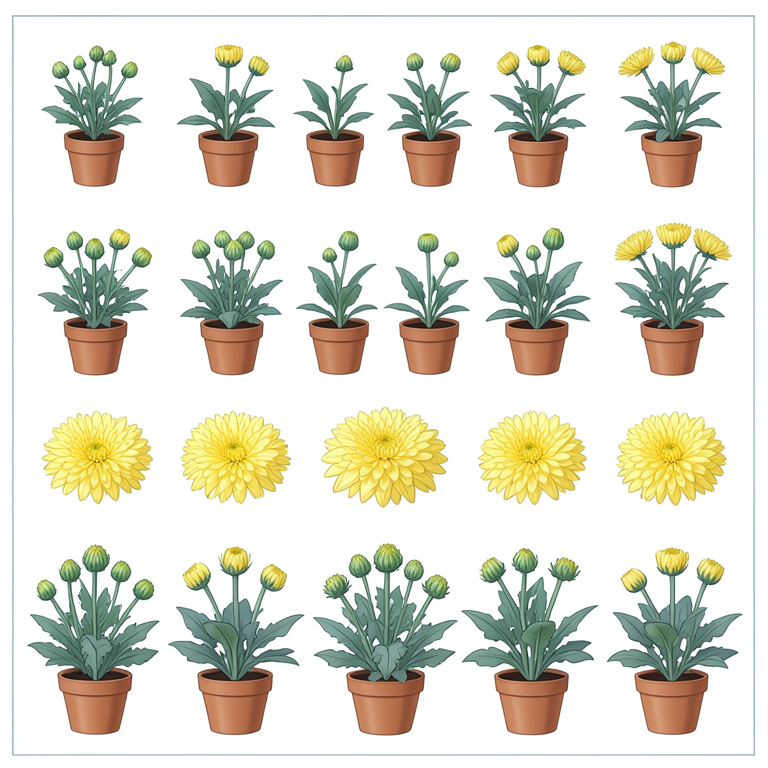
Experimental Factor Matrix
AI-generated conceptual illustration (annual chrysanthemum plants). It explains the idea and does not show study data.
View source evidence ↗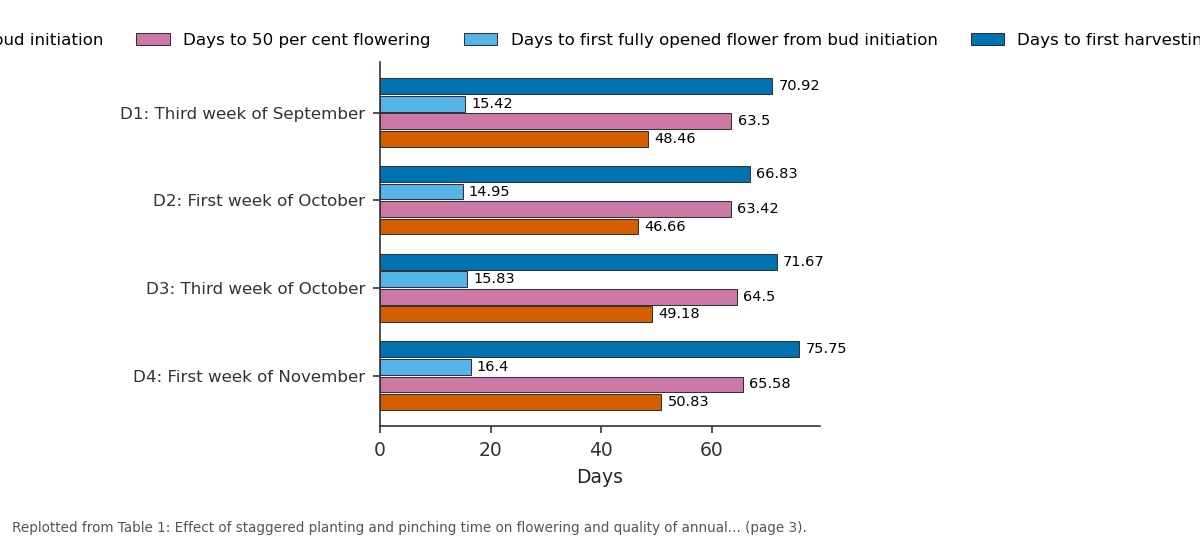
Days to first flower bud initiation and Days to 50 per cent flowering and more: D1: Third week of... vs D2: First week of... vs D3: Third week of... vs D4: First week of...
Replotted from Table 1 (page 3) of the original paper. Every bar is the paper's own table value.
View source evidence ↗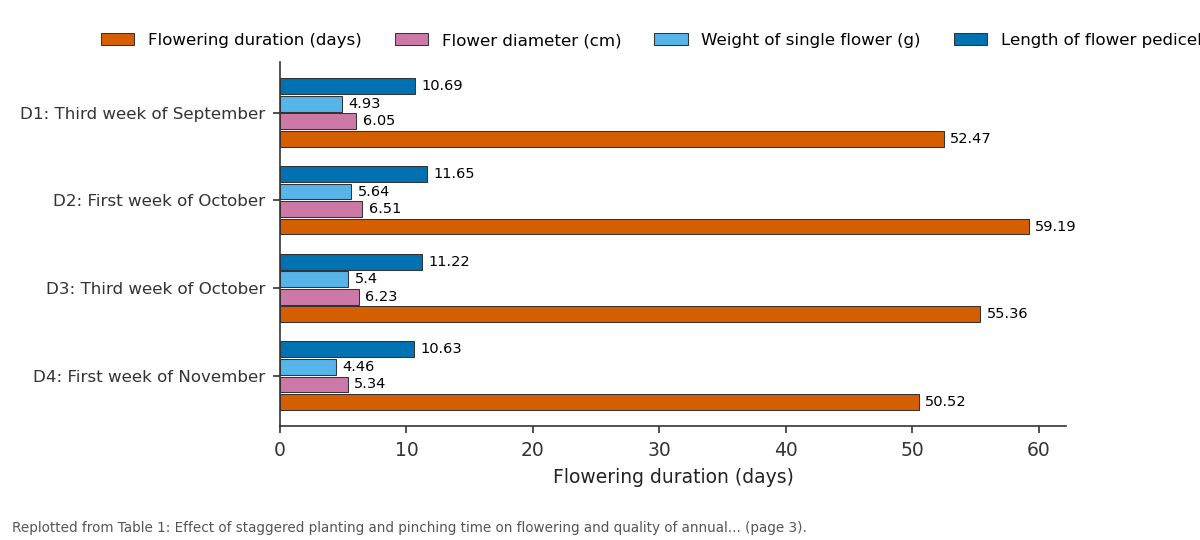
Flowering duration (days) and Flower diameter (cm) and more: D1: Third week of... vs D2: First week of... vs D3: Third week of... vs D4: First week of...
Replotted from Table 1 (page 3) of the original paper. Every bar is the paper's own table value.
View source evidence ↗Figures & tables
From the original paper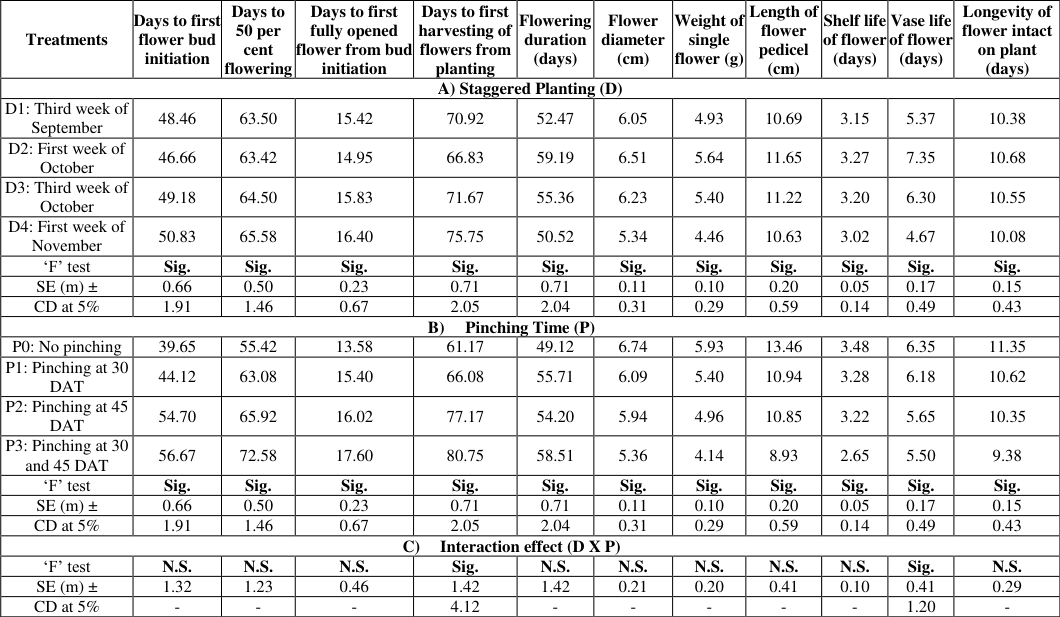 Table 1
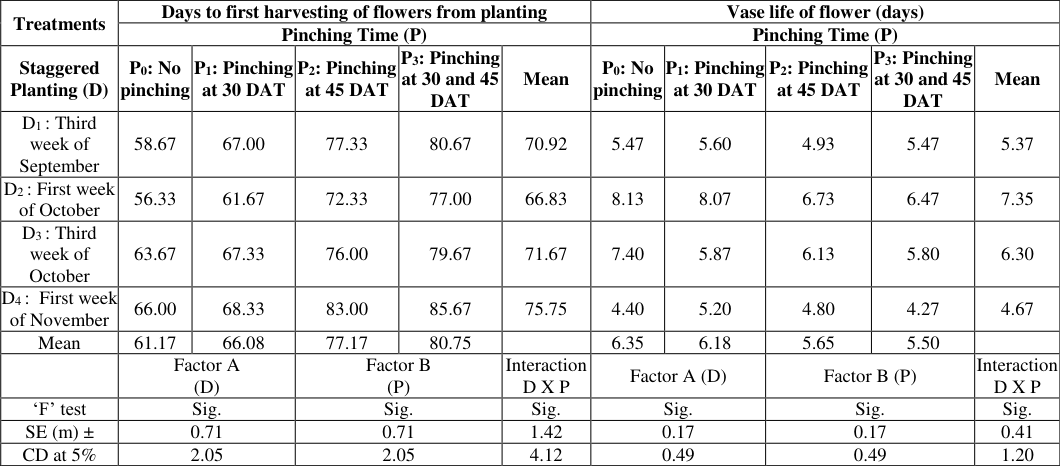 Table 2
Introduction
Annual chrysanthemum (Chrysanthemum coronarium L.), commonly known as Crown Daisy, is a fast-growing, ornamental flower crop belonging to the family Asteraceae. It is widely cultivated for its vibrant, uniform size, bright coloration and attractive yellow and white daisy-like blooms, which make it an excellent choice for loose flower markets and landscape decoration. These characteristics are crucial not only for aesthetic appeal but also for market value and post-harvest longevity. Unlike perennial chrysanthemums, annual chrysanthemum completes its life cycle within a single growing season, offering a quick floral return to growers. In India, loose flowers are commercially grown in specific areas of Maharashtra, Karnataka, Bihar, Punjab, Haryana, Uttar Pradesh, Madhya Pradesh, and West Bengal. Several states, including Tamil Nadu (21%), Karnataka (16%), Madhya Pradesh (14%), and West Bengal (12%), are commercial floriculture producers. When it comes to flower output, Maharashtra is among the top states. Commercial loose flowers are grown in a few areas of Maharashtra, including Nashik, Ahmednagar, Thane, Pune, Satara, Sangli, and Nagpur. Staggered planting is one of the crop management practices used to increase quality and flower production also regular supply of flower in the market. Whereas, pinching involves removing the soft, growing tip of the main stem to encourage the plant to develop more lateral branches to get quality flower blooms.
Material and Methods
The present study entitled "Effect of staggered planting and pinching time on flowering and quality of annual chrysanthemum" was carried out at PG Research unit, Horticulture Section, College of Agriculture, Nagpur during Rabi season in the year 2024-25. The experiment was laid out in Factorial Randomized Block Design with three replications. The experiment consists of two factors; Factor A consist of four different planting time viz., (Third week of September, first week of October, third week of October and first week of November) and Factor B consist of four pinching time viz., (No pinching, pinching at 30 DAT, pinching at 45 DAT and pinching at 30 and 45 DAT).
The experiment was carried out on a flat bed with a gross plot size of 2.25 m × 1.80 m. The seedlings were prepared on a nursery bed and transferred onto the main field. The spacing kept was 45 cm x 30 cm. The recommended dose of inorganic fertilizer NPK hectare -1 was administered to all experimental plots to provide NPK, respectively. The observations in respect of flowering parameters i.e., days to first flower bud initiation, days to 50 per cent flowering, days to first fully opened flower from bud initiation, days to first harvesting of flowers from planting, flowering duration and in quality parameters i.e., diameter of flower, weight of single flower, length of flower pedicel, longevity of intact flower on plant, shelf life and vase life of flower were recorded. The data was analyzed statistically as per the methods described by Panse and (1967) [11] .
Results and discussion
Results and discussion
Flowering parameters 3.1.1 Effect of staggered planting on flowering parameters
The data from Table 1 exhibited the significant difference among the planting time on flowering parameters. Significantly minimum days to first flower bud initiation (46.66), days to 50 per cent flowering (63.42), days to first fully opened flower from bud initiation (14.95) and days to first harvesting of flowers from planting (66.83) were recorded in the treatment planting on first week of October followed by treatment planting on third week of September. Significantly maximum flowering duration (59.19 days) was recorded in the treatment planting on first week of October and minimum was recorded in the treatment planting on first week of November. This early flowering might be due to optimal climatic conditions prevailing during the vegetative and floral initiation phases, particularly moderate temperature and favorable photoperiods. These results are in close conformity with Lakshmi et al. (2014) [8] in African marigold and Gaidhani et al. (2020) [4] in China aster, Jyothi et al. (2018) [7] in marigold and Mohanty et al. (2023) [9] in annual chrysanthemum.
| Treatments | Days to first flower bud initiation | Days to 50 per cent flowering | Days to first fully opened flower from bud initiation | Days to first harvesting of flowers from planting | Flowering duration (days) | Flower diameter (cm) | Weight of single flower (g) | Length of flower pedicel (cm) | Shelf life of flower (days) | Vase life of flower (days) | Longevity of flower intact on plant (days) |
|---|---|---|---|---|---|---|---|---|---|---|---|
| A) Staggered Planting (D) | |||||||||||
| D1: Third week of September | 48.46 | 63.50 | 15.42 | 70.92 | 52.47 | 6.05 | 4.93 | 10.69 | 3.15 | 5.37 | 10.38 |
| D2: First week of October | 46.66 | 63.42 | 14.95 | 66.83 | 59.19 | 6.51 | 5.64 | 11.65 | 3.27 | 7.35 | 10.68 |
| D3: Third week of October | 49.18 | 64.50 | 15.83 | 71.67 | 55.36 | 6.23 | 5.40 | 11.22 | 3.20 | 6.30 | 10.55 |
| D4: First week of November | 50.83 | 65.58 | 16.40 | 75.75 | 50.52 | 5.34 | 4.46 | 10.63 | 3.02 | 4.67 | 10.08 |
| ‘F’ test | Sig. | Sig. | Sig. | Sig. | Sig. | Sig. | Sig. | Sig. | Sig. | Sig. | Sig. |
| SE (m) ± | 0.66 | 0.50 | 0.23 | 0.71 | 0.71 | 0.11 | 0.10 | 0.20 | 0.05 | 0.17 | 0.15 |
| CD at 5% | 1.91 | 1.46 | 0.67 | 2.05 | 2.04 | 0.31 | 0.29 | 0.59 | 0.14 | 0.49 | 0.43 |
| B) Pinching Time (P) | |||||||||||
| P0: No pinching | 39.65 | 55.42 | 13.58 | 61.17 | 49.12 | 6.74 | 5.93 | 13.46 | 3.48 | 6.35 | 11.35 |
| P1: Pinching at 30 DAT | 44.12 | 63.08 | 15.40 | 66.08 | 55.71 | 6.09 | 5.40 | 10.94 | 3.28 | 6.18 | 10.62 |
| P2: Pinching at 45 DAT | 54.70 | 65.92 | 16.02 | 77.17 | 54.20 | 5.94 | 4.96 | 10.85 | 3.22 | 5.65 | 10.35 |
| P3: Pinching at 30 and 45 DAT | 56.67 | 72.58 | 17.60 | 80.75 | 58.51 | 5.36 | 4.14 | 8.93 | 2.65 | 5.50 | 9.38 |
| ‘F’ test | Sig. | Sig. | Sig. | Sig. | Sig. | Sig. | Sig. | Sig. | Sig. | Sig. | Sig. |
| SE (m) ± | 0.66 | 0.50 | 0.23 | 0.71 | 0.71 | 0.11 | 0.10 | 0.20 | 0.05 | 0.17 | 0.15 |
| CD at 5% | 1.91 | 1.46 | 0.67 | 2.05 | 2.04 | 0.31 | 0.29 | 0.59 | 0.14 | 0.49 | 0.43 |
| C) Interaction effect (D X P) | |||||||||||
| ‘F’ test | N.S. | N.S. | N.S. | Sig. | N.S. | N.S. | N.S. | N.S. | N.S. | Sig. | N.S. |
| SE (m) ± | 1.32 | 1.23 | 0.46 | 1.42 | 1.42 | 0.21 | 0.20 | 0.41 | 0.10 | 0.41 | 0.29 |
| CD at 5% | - | - | - | 4.12 | - | - | - | - | - | 1.20 | - |
Table text extracted from the original PDF; superscript letters are shown inline. The original table image is below.
View original table image
Effect of pinching time on flowering parameters
The data from Table 1 exhibited the significant difference among the pinching time on flowering parameters. Significantly minimum days to first flower bud initiation (39.65), days to 50 per cent flowering (55.42), days to first fully opened flower from bud initiation (13.58) and days to first harvesting of flowers from planting (61.17) were recorded in the treatment No pinching followed by treatment pinching at 30 DAT. Significantly maximum flowering duration (58.51) was recorded in the treatment pinching at 30 and 45 DAT followed by treatment pinching at 30 DAT. This progressive in flowering with pinching is likely to encouraging the vegetative growth by removal of apical dominance, which delays the transition to the reproductive phase. These results are in close conformity with Gaidhani et al. (2020) [4] in China aster, Sedhai et al. (2024) [12] and Halagi et al. (2023) [5] in African marigold, Badge et al. (2017) [2] and Amalseda et al. (2024) [1] in annual chrysanthemum.
Interaction effect
The data from Table 2 exhibited the significant difference among the staggered planting and pinching time on days to first harvesting of flowers from planting. Significantly minimum days to first harvesting of flowers (56.33 days) was found in treatment combination first week of October with No pinching which was followed by treatment combination third week of September with No pinching (58.67 days). Whereas, maximum days to first harvesting of flowers was recorded in treatment combination first week of November with pinching at 30 and 45 DAT (85.67 days). The interaction between planting and pinching treatments was significant, indicating that the combination of these two factors substantially influenced.
| Treatments | Days to first harvesting of flowers from planting | — | — | — | — | Vase life of flower (days) | — | — | — | — |
|---|---|---|---|---|---|---|---|---|---|---|
| Pinching Time (P) | Pinching Time (P) | |||||||||
| Staggered Planting (D) | P0: No pinching | P1: Pinching at 30 DAT | P2: Pinching at 45 DAT | P3: Pinching at 30 and 45 DAT | Mean | P0: No pinching | P1: Pinching at 30 DAT | P2: Pinching at 45 DAT | P3: Pinching at 30 and 45 DAT | Mean |
| D1 : Third week of September | 58.67 | 67.00 | 77.33 | 80.67 | 70.92 | 5.47 | 5.60 | 4.93 | 5.47 | 5.37 |
| D2 : First week of October | 56.33 | 61.67 | 72.33 | 77.00 | 66.83 | 8.13 | 8.07 | 6.73 | 6.47 | 7.35 |
| D3 : Third week of October | 63.67 | 67.33 | 76.00 | 79.67 | 71.67 | 7.40 | 5.87 | 6.13 | 5.80 | 6.30 |
| D4 : First week of November | 66.00 | 68.33 | 83.00 | 85.67 | 75.75 | 4.40 | 5.20 | 4.80 | 4.27 | 4.67 |
| Mean | 61.17 | 66.08 | 77.17 | 80.75 | 6.35 | 6.18 | 5.65 | 5.50 | ||
| Factor A (D) | Factor B (P) | Interaction D X P | Factor A (D) | Factor B (P) | Interaction D X P | |||||
| ‘F’ test | Sig. | Sig. | Sig. | Sig. | Sig. | Sig. | ||||
| SE (m) ± | 0.71 | 0.71 | 1.42 | 0.17 | 0.17 | 0.41 | ||||
| CD at 5% | 2.05 | 2.05 | 4.12 | 0.49 | 0.49 | 1.20 |
Table text extracted from the original PDF; superscript letters are shown inline. The original table image is below.
View original table image
Quality parameters 3.2.1 Effect of staggered planting on quality parameters
The data from Table 1 exhibited the significant difference among the planting time on quality parameters. Significantly maximum flower diameter (6.51 cm), weight of single flower (5.64 g), length of flower pedicel (11.65 cm), shelf life of flower (3.27 days), vase life of flower (7.35 days) and longevity of flower intact on plant (10.68 days) were recorded in the treatment planting on first week of October followed by treatment planting on third week of October. Significantly minimum flower diameter (5.34 cm), weight of single flower (4.46 g), length of flower pedicel (10.63 cm), shelf life of flower (3.02 days), vase life of flower (4.67 days) and longevity of flower intact on plant (10.08 days) were recorded in the treatment planting on first week of November. The early planting possibly ensured better vegetative growth, optimum utilization of environmental resources and favorable climatic conditions, which enhanced the flower development and size. These results are in close conformity with Thumar et al. (2020) [13] in chrysanthemum, Jyothi et al. (2018) [7] in marigold and Hawa et al. (2021) [6] in annual chrysanthemum.
Effect of pinching time on quality parameters
The data from Table 1 exhibited the significant difference among the pinching time on quality parameters. Significantly maximum flower diameter (6.74 cm), weight of single flower (5.93 g), length of flower pedicel (13.46 cm), shelf life of flower (3.48 days), vase life of flower (6.35 days) and longevity of flower intact on plant (11.35 days) were recorded in the treatment No pinching followed by treatment pinching at 30 DAT. Significantly minimum flower diameter (5.36 cm), weight of single flower (4.14 g), length of flower pedicel (8.93 cm), shelf life of flower (2.65 days), vase life of flower (5.50 days) and longevity of flower intact on plant (9.38 days) were recorded in the treatment pinching at 30 and 45 DAT. These results are in close conformity with Dobariya et al. (2023) [3] in annual chrysanthemum, Moon et al. (2017) in gaillardia and Badge et al. (2017) [2] in annual chrysanthemum.
Interaction effect
The data from Table 2 exhibited the significant difference among the staggered planting and pinching time on vase life of flower. Significantly maximum vase life of flower (8.13 days) was observed in treatment combination first week of October with No pinching which was found to be at par with treatment combination first week of October with pinching at 30 DAT (8.07 days). Whereas, minimum vase life of flower was recorded in treatment combination first week of November with pinching at 30 and 45 DAT (4.27 days). The interaction between staggered planting and pinching time was significant, indicating that the combination of these two factors substantially influenced vase life.
Conclusions
From the above investigation it can be concluded that, in respect of flowering parameter, earliness of flower bud initiation, 50 per cent flowering, fully opening of flower from bud initiation, and first harvesting of flower were noticed in treatment planting in first week of October with No pinching treatment. Similarly, in respect of quality parameter viz., weight of flower, diameter of flower, length of flower pedicel, shelf life and vase life of flower and longevity of flower intact on plant were recorded maximum in treatment planting at first week of October and No pinching treatment.
Acknowledgement
I sincerely thank my guide, Dr. Shalini A. Badge for their valuable guidance and support and my respectful thanks goes to my parents for their incredible love and support. I am also grateful to the Horticulture Section, College of Agriculture, Nagpur, for providing the necessary resources and facilities for this research
References
13 in the original paper- Amalseda D, Joshi NS, Nandaniya C, Parasana JS. Effect of plant growth retardant and pinching on growth, flowering and yield of annual chrysanthemum (Chrysanthemum coronarium L.) cv. Local Yellow. Int J Adv Biochem Res. 2024;8(7):922-5.
- Badge S, Panchbhai DM, Raut M, Shivankar S. Regulation of flowering in annual chrysanthemum by using pinching and cycocel. Int J Res Biol Sci Agric Technol. 2017;5(2):421-425.
- Dobariya K, Thumar BV, Varma A, Parasana JS. Influence of integrated nutrient management and pinching on yield and quality of annual chrysanthemum (Chrysanthemum coronarium L.). Pharma Innov J. 2023;12(7):489-94.
- Gaidhani A, Dalal SR, Nagre PK. Effect of different planting dates and pinching on growth and flowering of China aster. Int J Chem Stud. 2020;8(2):1120-4.
- Halagi MS, Maurya RP, Bundela MK, Jat MK. Effect of plant spacing and pinching interval on growth, yield and flower quality of African marigold (Tagetes erecta L.) under semi-arid conditions. Pharma Innov J. 2023;12(4):2246-54.
- Hawa RA, Gondane SU, Panchbhai DM. Effect of planting time and pinching on flower quality of annual chrysanthemum. J Pharmacogn Phytochem. 2021;10(1):80-3.
- Jyothi K, Goud CR, Girwani A, Kumar TS. Studies on the effect of planting dates and levels of pinching on growth, flowering and yield in marigold (Tagetes erecta) cv. Arka Agni. Int J Curr Microbiol Appl Sci. 2018;7(11):2705-13.
- Lakshmi, Pandey RK, Dogra S, Laishram N, Bhat D, Singh A, Jamwal S. Studies on effects of planting dates and spacing in African marigold (Tagetes erecta L.). Prog Hortic. 2014;46(1):149-52.
- Mohanty M, Mohanty CR, Jena S, Mohanty S. Effect of planting date on growth and flowering of annual chrysanthemum (Chrysanthemum coronarium L.). Pharma Innov J. 2023;12(4):1906-10.
- Moon SS, Masram GB, Gajbhiye RP. Effect of pinching and cycocel on flower yield and quality of Gaillardia. Int J Res Biol Sci Agric Technol. 2017;5(2):1205-8.
- Panse VG, Sukhatme PV. Statistical methods for agricultural workers. New Delhi: ICAR; 1967.
- Sedhai R, Katel S, Adhikari A. Effect of pinching on growth, flowering, and yield of African marigold (Tagetes erecta L.) cv. Calcutta Local. Fundam Appl Agric. 2024;9(3):204-12.
- Thumar BV, Chovatiya NV, Butani AM, Bhalu VB, Jindal M. Effect of planting time and pinching on flowering and yield of chrysanthemum (Dendranthema grandiflora) cv. Ratlam selection. J Pharmacogn Phytochem. 2020;9(2):414-6.