
Research article · 2025 · Full text
International Journal of Agriculture and Food ScienceEffect of Seed Treatment along with Spraying of Biopesticides on Sucking Pests of Okra (Abelmoschus esculentus (L.) Moench)
Volume 7(9) · Pages 519–523 · DOI: 10.33545/2664844x.2025.v7.i9g.788 ↗
Research areasGeochemistry and Geologic MappingGeological and Geophysical StudiesGeological Modeling and Analysis
Abstract
Author-writtenThe present study was carried out to evaluate various management treatments against major sucking pests of okra. In precount data of aphid and leaf hopper before first spray was significant. Because of seed treatment of thiamethoxam 35% FS to all seed before sowing except untreated control seeds it showed a significant difference in aphid and leaf hopper population in precount. The evaluation of various pesticides for their field efficacy against aphid and leaf hopper revealed that dimethoate 30% EC consistently provided the most effective and rapid reduction in sucking pest populations across all observations, maintaining the lowest pest population. The treatment dimethoate 30% EC (T6) followed by Azadirachtin 10000 ppm @ 1ml/l (T2) was found effective against aphids as well as leaf hopper for reducing the pest population throughout the crop growth. In order to next treatments Dashparni showed moderate and reliable control, significantly reducing sucking pest populations compared to other pesticides.
Summary
Source-checkedPlain-language reading of the full paper, prepared with AI and checked against the text. Each point links to the authors' own words.
Why it matters
- Insect pests are a major limiting factor for okra production, causing significant yield losses between 35% and 40%. View evidence ↗
- Sucking pests, specifically aphids, leafhoppers, and whiteflies, are major threats to okra and can cause a 17.46% loss in yield. View evidence ↗
- The overuse of conventional chemical pesticides in Asia has led to negative outcomes, including pest resistance, environmental degradation, and risks to human health. View evidence ↗
The question
- The study aimed to evaluate how seed treatments and various biopesticides affect the management of sucking pests in okra. View evidence ↗
What they did
- The research used a Randomized Block Design conducted during the 2025 summer season at the Zonal Agricultural Research Station in Pune. View evidence ↗
- The study used the 'Phule Utkarsha' okra variety, sown in February in plots measuring 4.8 m x 2.7 m with 30 x 15 cm spacing. View evidence ↗
- Except for the control group, seeds were treated before sowing with thiamethoxam 35% FS at a dose of 7.5 ml/kg. View evidence ↗
- Pest management involved three sprays applied at 15-day intervals using various biopesticides and one chemical control (dimethoate). View evidence ↗
What they found
- Seed treatment with thiamethoxam 35% FS significantly reduced the initial aphid population by 39% to 49% compared to untreated seeds. View evidence ↗
- Seed treatment also reduced the initial leafhopper population by 36% to 43% across different treatments. View evidence ↗
- Dimethoate 30% EC (2 ml/l) was the most effective treatment for aphids, resulting in the lowest cumulative mean of 4.96 aphids per plant. View evidence ↗
- Dimethoate 30% EC (2 ml/l) was also the most effective against leafhoppers, with a cumulative mean of 5.69 leafhoppers per plant. View evidence ↗
- Among biopesticides, Azadirachtin (7.05 aphids/plant), Dashparni (9.25 aphids/plant), and Pongamia oil (9.45 aphids/plant) were equally efficient in reducing aphid populations. View evidence ↗
- For leafhoppers, Azadirachtin (8.39/plant), Dashparni (10.37/plant), and Pongamia oil (7.68/plant) were the most effective biopesticide options. View evidence ↗
- Lecanicillium lecanii and Metarhizium anisopliae were the least effective treatments among those tested for aphid control. View evidence ↗
What it means
- The authors concluded that dimethoate 30% EC is the superior treatment for managing sucking pests in okra. View evidence ↗
Visual summary
1 visualsIllustrations explain the paper; they do not show study data.
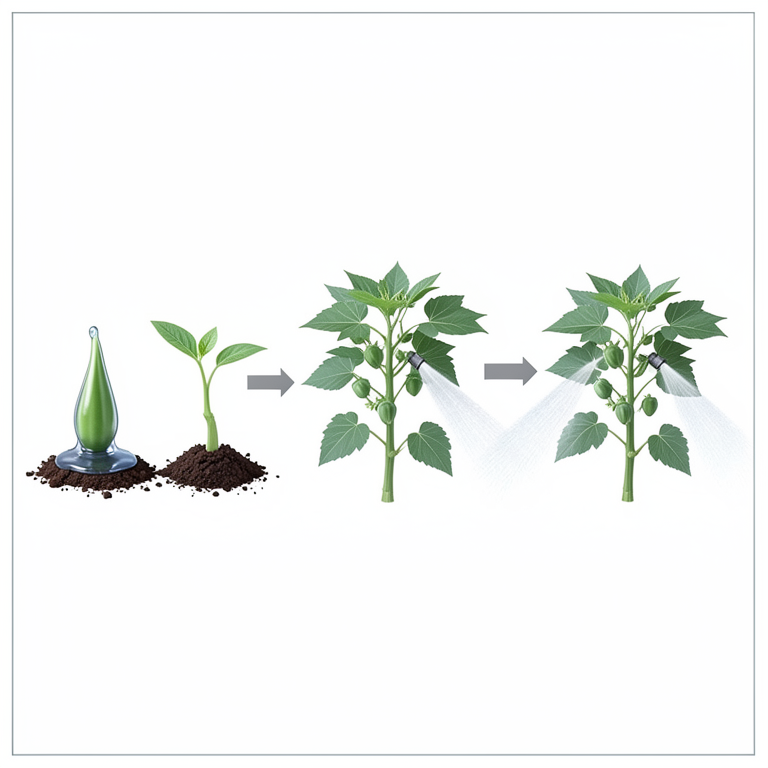
Treatment Workflow
AI-generated conceptual illustration (okra plants (Abelmoschus esculentus)). It explains the idea and does not show study data.
View source evidence ↗Figures & tables
From the original paper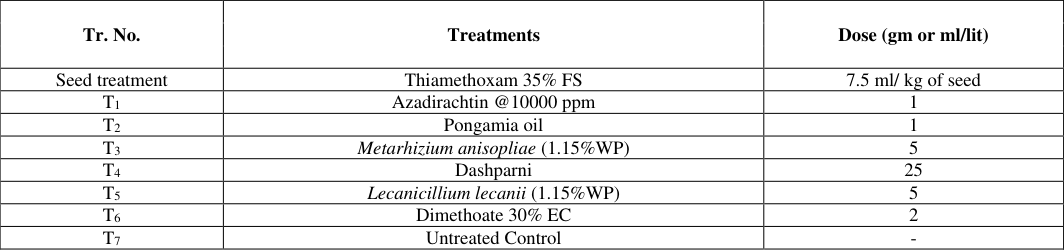 Table 1
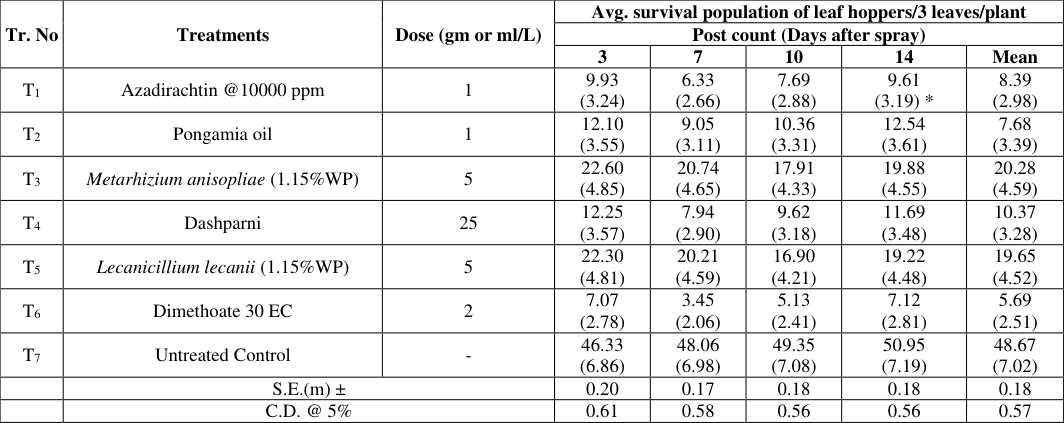 Table 2
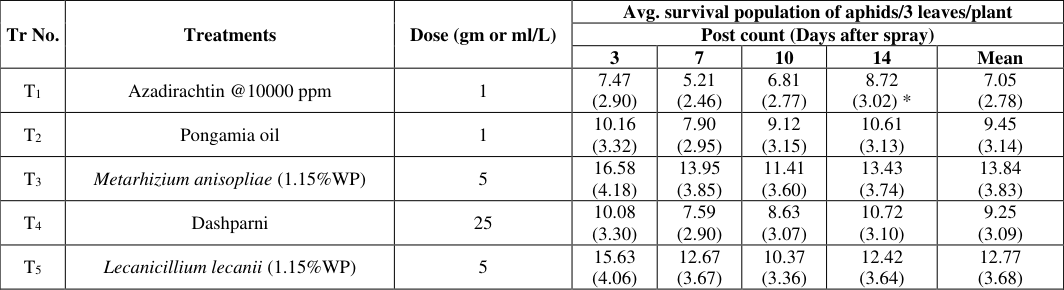 Table 3
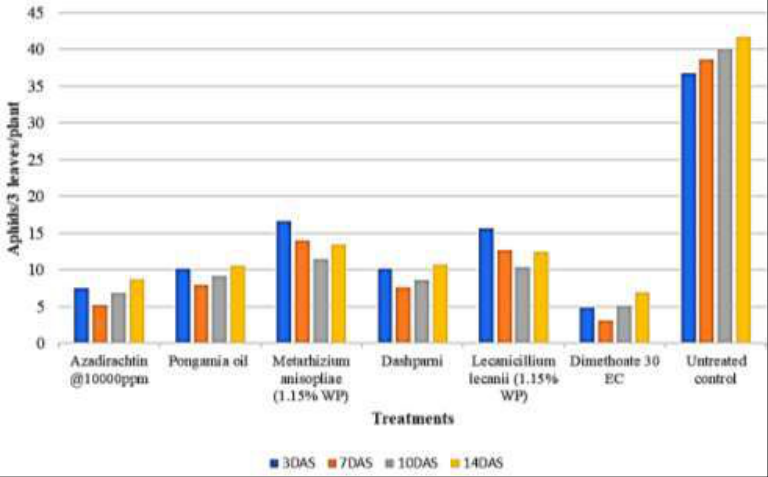 Figure 1
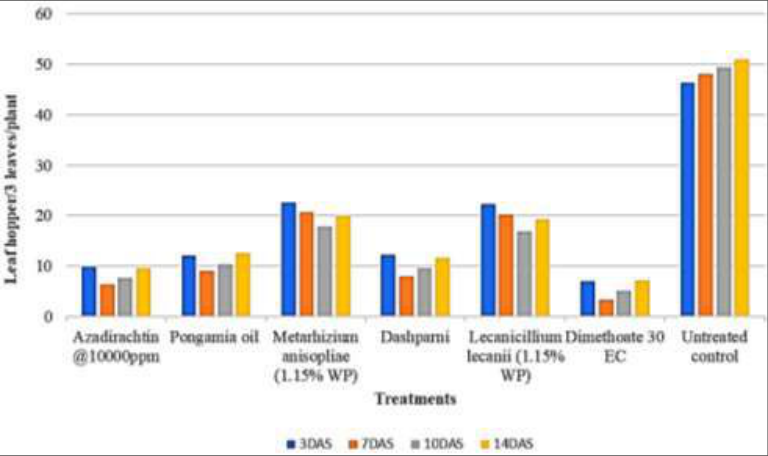 Figure 2
Introduction
In India, vegetables are a key component of daily nutrition, offering an economical supply of essential nutrients like carbohydrates, proteins, vitamins, minerals, and fiber. Okra, Abelmoschus esculentus (Linn.) Moench, also known as lady's finger (family: Malvaceae), an herbaceous, often cross pollinated, annual vegetable crop is one of the most important traditional vegetables in India. Okra is originating in Africa and is currently grown all over the world, primarily in tropical and sub-tropical regions such as West Africa, Bangladesh, India, Japan, and Nepal. It is a significant vegetable crop that is grown all over the world in the summer and kharif seasons. One of the main factors limiting okra production is the rising prevalence of insect pests, which cause enormous yield losses ranging from 35 -40 per cent. About 72 species of insects have been identified on okra (Rao and Rajendran, 2002) [11] . Among these insect pests Aphids (Aphis gossypii Glover), leafhoppers (Amrasca biguttula biguttula Ishida) and whiteflies (Bemisia tabaci Gennadius) are the major sucking pests that seriously harm okra crops and causes 17.46 per cent yield loss in okra (Ghosh, 1996) [6] . Although the crop is affected by the shoot and fruit borer Earias vittella (Fabricius) caused the most damage to fruits in terms of both quality and quantity (Papal and Bharpoda, 2009). The Homoptera: Aleuroididae cotton whitefly, Bemisia tabaci (Gennadius), has been identified as a significant pest of about 500 host plants and roughly 160 plant species, including okra (Costa et al. 1991) [5] . Okra aphid, Aphis gossypii Glover (Hemiptera: Aphididae), is a serious insect pest of okra. Nymphs and adults of this species are often found on the lower surface of leaves, where they feed on the phloem and cause yellowing, stunted growth, curling and crinkling of leaves. Amrasca biguttula biguttula, or leaf hopper, is one of the most destructive okra pests. It reduces the yield by sucking the sap from the bottom of the leaves and causing upward curling along the edge. Whiteflies, among the sucking pests that harm okra economically by feeding on phloem sap and affecting leaves and fruits with honey dew, which leads to the growth of sooty mould (Oliveira et al. 2001) [8] . These insect pests cause both qualitative and quantitative harm to the okra crop; infested fruits are unfit for human consumption, and affected plants produce less yield.
Although chemicals have gained a lot of attention and demonstrated their benefits in addressing food security, their continued and careless use in India and other Asian countries had a number of negative effects, including the development of insecticidal resistance in important pest species, harmful impact on beneficial organisms, pesticide residues in the food chain, deterioration of the eco-system and human health, and decreased profits (Pratap, 2003) [10] . Therefore, finding plant protection alternatives to conventional pesticides without compromising agricultural production and profitability is the main purpose. As a result, there is an increasing demand for ecologically sound control techniques to lessen the need for synthetic pesticides. Insect pests are more serious in the early stage of crop growth; thus, seed treatment is expected to give better protection to crop against these pests and help in enhancing the crop yield. Keeping this in view, the present investigation was undertaken to evaluate the effect of seed treatment and to determine the effectiveness of biopesticides against the okra sucking pest.
Material and Methods
The present investigation was carried out in Randomized Block Design during Summer season of 2025 under field conditions on experimental plot at Zonal Agricultural Research Station, Ganeshkhind, Pune for the management of sucking pests of okra. The seeds of okra variety "Phule Utkarsha" were sown during 1 st fortnight of February in a plot size 4.8 m x 2.7 m. with plant spacing 30 x 15 cm. Before sowing seeds were treated with thiamethoxam 35% FS. Desired quantities of seed were taken and treated with the recommended quantity of insecticide @ 7.5 ml/kg seed.
The seed was then dried in the shade and used for sowing.
In management of sucking pest of okra three sprays were applied at 15 days interval and treatment details are mentioned in Table .1. In order to find out effective treatment against sucking pest of okra, five plants from each treatment plot were selected randomly and tagged for recording observations. The number of nymphs and adults of aphid and leaf hopper were recorded on three leaves (top, middle, bottom) per plant. The observations were recorded a day before treatment application as precount and then at 3,7,10 and 14 days after each spraying as post-counts.
Results and Discussion
The cumulative results (Tables 2 and3) show that all of the treatments were found to be significantly more effective than the untreated control to manage okra sucking pests.
Efficacy of biopesticides against aphid on okra
The precount of first spray before spraying, the plots treated with thiamethoxam 35% FS seed treatment showed a 39 -49 per cent lower population of aphids as compared to untreated plots, highlighting effectiveness of seed treatment.
The observations recorded after first spray, treatment dimethoate 30% EC(T 6 ) @ 2 ml/l (6.24 aphids/plant) was recorded most significant reduction in aphid population which was at par with Azadirachtin 10000 ppm(T 1 ) @1ml/l. While the treatments Pongamia oil (T 2 ) @ 1 ml/l and Dashparni (T 4 ) @ 25 ml/l were found statistically at par with each other. In second spray, treatment with spraying of dimethoate 30% EC @ 2 ml/l registered least 4.24 aphids /plant and identified as most effective. Followed by spraying of Azadirachtin (10000 ppm) @ 1 ml/l was next in order of efficacy and first best treatment among botanicals was found at par with spraying of Pongamia oil @ 1 ml/l and Dashparni @ 25ml/l. While treatment L. lecanii (T 5 ) @ 5 g/l was next in order of superiority which was at par with spraying of M. anisopliae (T 3 ) @ 5 g/l it was less effective among all the treatments.
After third spray, treatment dimethoate 30% EC @ 2 ml/l was found excelled over all the treatments (4.02 aphids /plant). Among the botanicals first best treatment was Azadirachtin 10000 ppm @1ml/l was found statistically at par with Dashparni @ 25ml/l. Followed by treatment Pongamia oil @ 1 ml/l, while the treatment L. lecanii 1.15% WP @ 5 g/l and Metarhizium anisopliae 1.15% WP @ 5 g/l were equally effective. In cumulative effect (Table 2) dimethoate 30% EC @ 2 ml/l was shown to be better than all other treatments, with a minimum mean of 4.96 aphids/plant. The three biopesticide treatments that were found to be equally efficient in lowering the incidence of aphids were Azadirachtin 10000 ppm @ 1ml/lit (7.05 aphids /plant), Dashparni @ 25 ml/lit (9.25 aphids /plant) and Pongamia oil @ 1 ml/l (9.45 aphids /plant). The next best result was 12.77 aphids / plant with the treatment L. lecanii @ 5 g/l which was at par with M. anisopliae 5g /lit (13.84 aphids /plant). The present investigation was evaluated that dimethoate 30% EC performs superior over all treatments. These findings were consistent with in respect of effectiveness of insecticide against aphid which was earlier reported by Ahmad et al (2021) [1] who reported that dimethoate highly controlled aphid populations from the first spray, while botanical pesticides showed effective control starting from the second spray. Bisen et al. (2020) [4] reported that dimethoate 30% EC effective in keeping down aphids and leaf hopper population throughout crop growth.
| Tr. No | Treatments | Dose (gm or ml/L) | Avg. survival population of leaf hoppers/3 leaves/plant | — | — | — | — |
|---|---|---|---|---|---|---|---|
| Post count (Days after spray) | |||||||
| 3 | 7 | 10 | 14 | Mean | |||
| T1 | Azadirachtin @10000 ppm | 1 | 9.93 (3.24) | 6.33 (2.66) | 7.69 (2.88) | 9.61 (3.19) * | 8.39 (2.98) |
| T2 | Pongamia oil | 1 | 12.10 (3.55) | 9.05 (3.11) | 10.36 (3.31) | 12.54 (3.61) | 7.68 (3.39) |
| T3 | Metarhizium anisopliae (1.15%WP) | 5 | 22.60 (4.85) | 20.74 (4.65) | 17.91 (4.33) | 19.88 (4.55) | 20.28 (4.59) |
| T4 | Dashparni | 25 | 12.25 (3.57) | 7.94 (2.90) | 9.62 (3.18) | 11.69 (3.48) | 10.37 (3.28) |
| T5 | Lecanicillium lecanii (1.15%WP) | 5 | 22.30 (4.81) | 20.21 (4.59) | 16.90 (4.21) | 19.22 (4.48) | 19.65 (4.52) |
| T6 | Dimethoate 30 EC | 2 | 7.07 (2.78) | 3.45 (2.06) | 5.13 (2.41) | 7.12 (2.81) | 5.69 (2.51) |
| T7 | Untreated Control | - | 46.33 (6.86) | 48.06 (6.98) | 49.35 (7.08) | 50.95 (7.19) | 48.67 (7.02) |
| S.E.(m) ± | 0.20 | 0.17 | 0.18 | 0.18 | 0.18 | ||
| C.D. @ 5% | 0.61 | 0.58 | 0.56 | 0.56 | 0.57 |
Table text extracted from the original PDF; superscript letters are shown inline. The original table image is below.
View original table image
Followed by Azadirachtin@ 10000 ppm was effective these findings align with Uttam (2024) [13] evaluated various treatments for controlling aphids and jassids population in okra. who reported that among botanicals Azadirachtin @10000 ppm shown best result than Lecanicillium lecanii 1.15% WP. In respect of effectiveness next treatment was Dashparni the similar findings were reported by Akashe et al. (2009) [2] who reported the effectiveness of fermented Dashparni extract against sucking pest of okra.
Efficacy of biopesticides against leaf hoppers in okra.
The precount of first spray showed reduction in leaf hopper population because of seed treatment with thiamethoxam 35% FS to all seed before sowing except untreated control seeds it showed a significant difference in leaf hopper population. The seed treatment effectively lowered the leaf hopper population by 36 to 43 per cent in different treatment. The treatment dimethoate 30% EC (T 6 ) @ 2 ml/l treatment was shown to be superior to all other treatments in terms of recording the leaf hopper population after the first spray (10.21 leaf hoppers /plant) which found at par with Azadirachtin (T 1 ) (10000 ppm) @ 2 ml/l. Next effective treatment was Pongamia oil(T 2 ) @ 1 ml/l which was statistically on par with Dashparni (T 4 ) @25ml/l. After second spray, treatment dimethoate 30% EC @ 2 ml/l was found excelled over all the treatment (6.78 leaf hoppers /plant) and was found at par with Azadirachtin 10000 ppm @1ml/l. The next best treatment was Dashparni @25ml/l was on par with treatment Pongamia oil @ 1 ml/l. While the treatment L. lecanii 1.15% WP (T 5 ) @ 5 g/l was at par with treatment M. anisopliae 1.15% WP (T 3 ) @ 5 g/l.
In third spray, treatment dimethoate 30% EC @ 2 ml/l reported minimum 4.23 leaf hoppers /plant and demonstrated its superiority was at par with the treatment Azadirachtin (10000 ppm) @ 2 ml/l. While Dashparni @ 25 ml/l found at par with Pongamia oil @ 1ml/l. In cumulative effect (Table 3) a minimum mean of 5.69 leaf hoppers /plant, it was determined that dimethoate 30% EC @2 ml/l was superior to all other treatments. Azadirachtin 10000 ppm @ 1 ml/lit (8.39 leaf hoppers /plant), Dashparni @ 25 ml/lit (10.37 leaf hoppers /plant) and Pongamia oil @ 1 ml/l (7.68 leaf hoppers /plant) were the three biopesticide treatments that were shown to be equally effective in reducing the occurrence of leaf hopper. While, treatment with L. lecanii @ 5 g/l (20.28 leaf hoppers /plant), which was at par with M. anisopliae [3] .
| Tr No. | Treatments | Dose (gm or ml/L) | Avg. survival population of aphids/3 leaves/plant | — | — | — | — |
|---|---|---|---|---|---|---|---|
| Post count (Days after spray) | |||||||
| 3 | 7 | 10 | 14 | Mean | |||
| T1 | Azadirachtin @10000 ppm | 1 | 7.47 (2.90) | 5.21 (2.46) | 6.81 (2.77) | 8.72 (3.02) * | 7.05 (2.78) |
| T2 | Pongamia oil | 1 | 10.16 (3.32) | 7.90 (2.95) | 9.12 (3.15) | 10.61 (3.13) | 9.45 (3.14) |
| T3 | Metarhizium anisopliae (1.15%WP) | 5 | 16.58 (4.18) | 13.95 (3.85) | 11.41 (3.60) | 13.43 (3.74) | 13.84 (3.83) |
| T4 | Dashparni | 25 | 10.08 (3.30) | 7.59 (2.90) | 8.63 (3.07) | 10.72 (3.10) | 9.25 (3.09) |
| T5 | Lecanicillium lecanii (1.15%WP) | 5 | 15.63 (4.06) | 12.67 (3.67) | 10.37 (3.36) | 12.42 (3.64) | 12.77 (3.68) |
Table text extracted from the original PDF; superscript letters are shown inline. The original table image is below.
View original table image
Figures and tables from the paper
| Tr. No. | Treatments | Dose (gm or ml/lit) |
|---|---|---|
| Seed treatment | Thiamethoxam 35% FS | 7.5 ml/ kg of seed |
| T1 | Azadirachtin @10000 ppm | 1 |
| T2 | Pongamia oil | 1 |
| T3 | Metarhizium anisopliae (1.15%WP) | 5 |
| T4 | Dashparni | 25 |
| T5 | Lecanicillium lecanii (1.15%WP) | 5 |
| T6 | Dimethoate 30% EC | 2 |
| T7 | Untreated Control | - |
Table text extracted from the original PDF; superscript letters are shown inline. The original table image is below.
View original table image
References
13 in the original paper- Ahmad T, Gebrezghi HT, Tewelde Y. Effect of dimethoate, garlic and neem cake extracts on aphid, Aphis gossypii Glover (Hemiptera: Aphididae) of okra (Abelmoschus esculentus L.). J Eco-Friendly Agric. 2021;16(2):51-55.
- Akashe VB, Gud MA, Shinde SK, Deshpande AN. Efficacy of botanicals for the control of safflower aphid (Uroleucon compositae T.). Int J Agric Sci. 2009;5(2):482-484.
- Alam MK, Mala M, Islam KS, Jahan M. Effect of botanicals and synthetic insecticide on okra jassid, Amrasca devastans. Ann Plant Prot Sci. 2010;26(2):2402-2403.
- Bisen AV, Sonalkar VU, Naikwadi BV, Bhure K. Management of major sucking pests in okra, Abelmoschus esculentus using different management modules. J Entomol Zool Stud. 2020;8(4):1714-1722.
- Costa HS, Brown JK, Byrne DN. Host plant selection by the whitefly Bemisia tabaci (Gennadius) (Hom., Aleyrodidae) under greenhouse conditions. J Appl Entomol. 1991;112(1-5):146-152.
- Ghosh J. Assessment of loss of bhendi against red spider mite. Environ Ecol. 1996;14:480-481.
- Kekan A, Gurav S, Sanap P, Panchare A. Efficacy of different biopesticides against sucking pests infesting okra (Abelmoschus esculentus L. Moench). Int J Precious Pharm Res Appl. 2022;7:486-489.
- Oliveira MRV, Henneberry TE, Anderson P. History, current status, and collaborative research projects for Bemisia tabaci. Crop Prot. 2001;20(9):709-723.
- Papal SA, Bharpoda TM. Evaluation of different insecticides against shoot and fruit borer, Earias vittella (Fabricius) on okra grown for seed purpose. Karnataka J Agric Sci. 2009;22(3):707-709.
- Pratap SB. Economic potential of biological substitutes for agrochemicals. New Delhi: National Centre for Agricultural Economics and Policy Research; 2003. p. 180-196.
- Rao NS, Rajendran R. Joint action potential of neem with other plant extracts against the leafhopper, Amrasca devastans (Distant) on okra. Pest Manag Econ Zool. 2002;10:131-136.
- Shivanna BK, Gangadhara Naik R, Nagaraja MK, Basavaraja CM, Kalleswara Swamy C, Karegowda C. Bioefficacy of new insecticides against sucking insect pests of transgenic cotton. Int J Sci Nat. 2011;2(1):7983.
- Uttam MWS. Bioefficacy of different biopesticides against sucking pest complex of okra (Abelmoschus esculentus L. Moench) [dissertation]. Rahuri: Mahatma Phule Krishi Vidyapeeth; 2024. p. 42-55.