
Research article · 2025 · Full text
International Journal of Agriculture and Food ScienceInvestigations into leaf rust of wheat incited by Puccinia triticina Eriks
Volume 7(9) · Pages 539–545 · DOI: 10.33545/2664844x.2025.v7.i9g.791 ↗
Research areasCanadian Policy and GovernanceEnvironmental and Air Quality Managementactivated carbon and charcoal
Abstract
Author-writtenThe present study entitled “Investigations into leaf rust of wheat incited by Puccinia triticina Eriks” Based on the results in the seedling resistance test out of 23 wheat varieties 03 resistant varieties were found namely NIDW 1149, NIAW 3624 and NIAW 1415. In the adult plant resistance test out of 23 wheat varieties 06 wheat varieties were found resistant to leaf rust whereas, 03 wheat varieties were found moderately resistant to leaf rust. While 05 wheat varieties had shown moderately susceptible reaction to leaf rust. Although 09 wheat varieties had shown susceptible reaction to leaf rust. Studies on adult plant resistance by AUDPC, out of 23 wheat varieties none of the variety was found immune while, 13 wheat varieties expressed values of "AUDPC" less than 100 whereas, 05 wheat varieties expressed values of "AUDPC" between 101 to 200 against leaf rust. This indicates that considerable amount of resistance against leaf rust. 3 wheat varieties expressed value between 201 to 300 while 2 wheat varieties expressed “AUDPC” value above 500. These wheat varieties had shown susceptibility against leaf rust. Epidemiological study showed that the first incidence of disease was noticed in 1st meteorological week (First week of January 2025). The maximum ACI was observed 80 in 6th Meteorological week (Second week of February 2025). Then it was declined. The data revealed that, the maximum temperature and morning humidity showed positive correlation. In case of minimum temperature and evening humidity showed negative correlation.
Summary
Source-checkedPlain-language reading of the full paper, prepared with AI and checked against the text. Each point links to the authors' own words.
Why it matters
- Wheat is a critical staple crop for global food security and is the second most produced crop in India, providing significant calories and protein. View evidence ↗
- Leaf rust, caused by Puccinia triticina, is the most widespread and damaging disease limiting wheat productivity. View evidence ↗
- While race-specific resistance in wheat is often temporary, adult plant resistance (APR) tends to be more durable. View evidence ↗
The question
- The study aimed to evaluate fungicides, assess seedling and adult plant resistance in released wheat varieties, quantify disease using AUDPC, and analyze epidemiological factors. View evidence ↗
What they did
- Adult plant resistance was screened in the field under artificial epiphytotic conditions using a mixture of five leaf rust pathotypes. View evidence ↗
- Epidemiological studies were conducted during the Rabi-2024 season at the Regional Wheat Rust Research Station in Mahabaleshwar using the A 206 wheat variety. View evidence ↗
- Weekly weather data, including maximum and minimum temperatures and morning and evening relative humidity, were recorded to analyze disease intensity. View evidence ↗
What they found
- In the seedling resistance test, 3 out of 23 wheat varieties (NIDW 1149, NIAW 3624, and NIAW 1415) were found to be resistant. View evidence ↗
- In the adult plant resistance test of 23 varieties, 6 were resistant, 3 were moderately resistant, 5 were moderately susceptible, and 9 were susceptible. View evidence ↗
- Leaf rust first appeared in the first week of January 2025, reaching a peak Average Coefficient of Infection (ACI) of 80 in the second week of February 2025. View evidence ↗
- Maximum temperature and morning humidity were positively correlated with leaf rust severity. View evidence ↗
- Minimum temperature and evening humidity showed a negative correlation with the severity of leaf rust. View evidence ↗
What it means
- The authors concluded that while no varieties were fully immune, a subset showed strong resistance at both seedling and adult stages, with 13 varieties showing good resistance via AUDPC. View evidence ↗
- The authors concluded that disease development was favored by maximum temperature and morning humidity, but hindered by minimum temperature and evening humidity. View evidence ↗
Visual summary
3 visualsIllustrations explain the paper; charts are replotted from the paper's own table values.
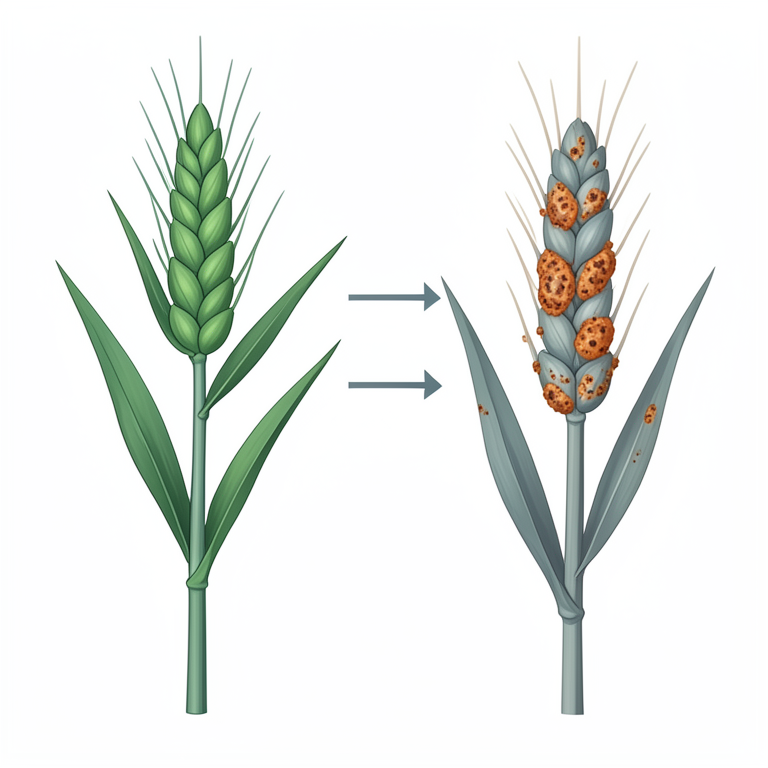
Environmental Drivers of Leaf Rust
AI-generated conceptual illustration (wheat plants). It explains the idea and does not show study data.
View source evidence ↗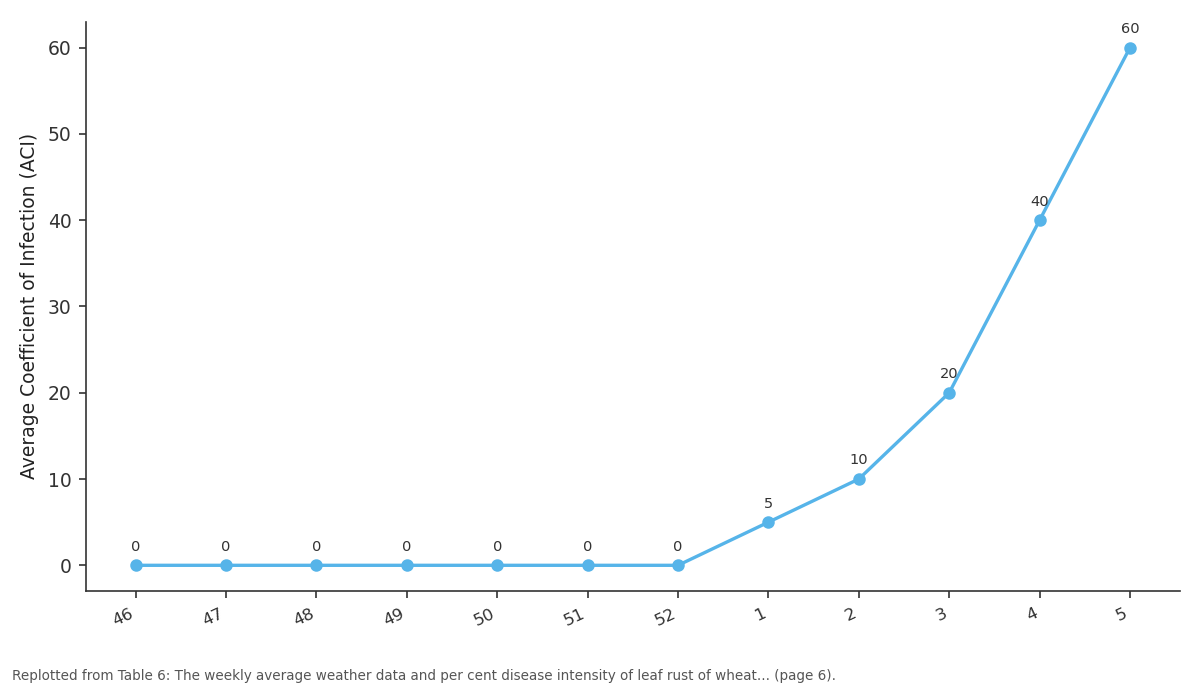
ACI: 46 vs 47 vs 48 vs 49 vs 50
Replotted from Table 6 (page 6) of the original paper. Every bar is the paper's own table value.
View source evidence ↗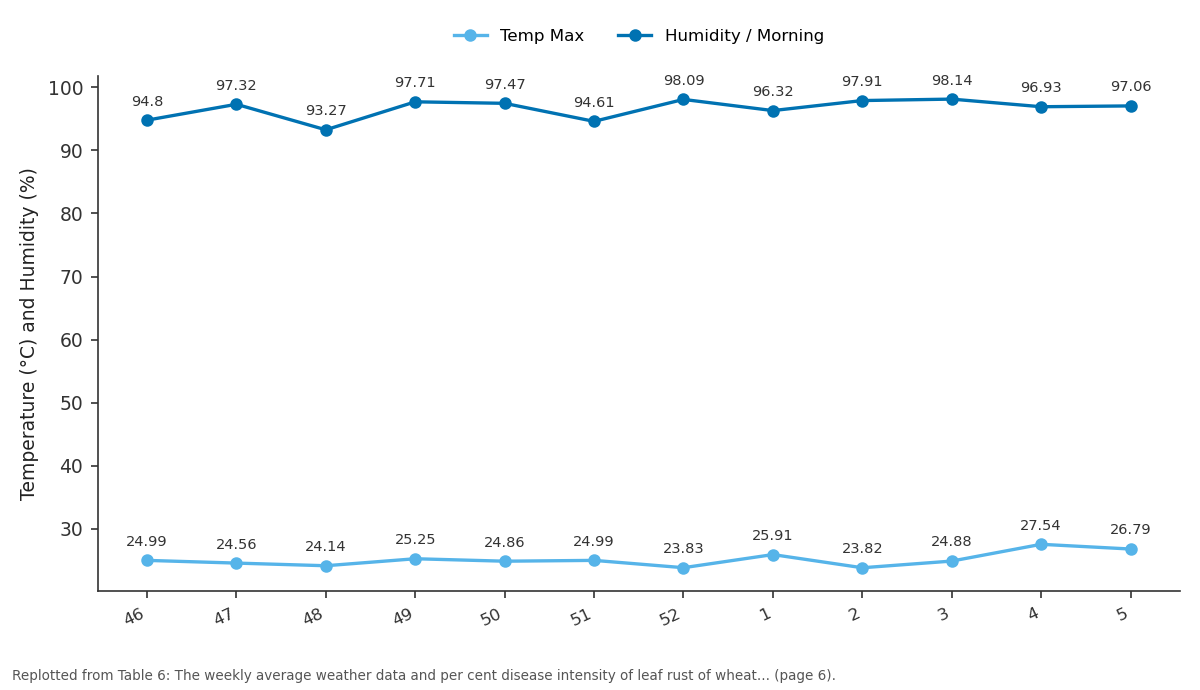
Temp Max and Humidity / Morning: 46 vs 47 vs 48 vs 49 vs 50
Replotted from Table 6 (page 6) of the original paper. Every bar is the paper's own table value.
View source evidence ↗Figures & tables
From the original paper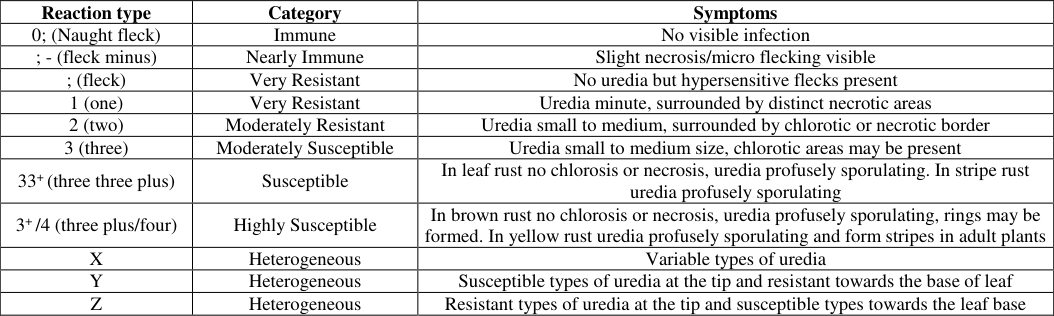 Table 1
 Table 2
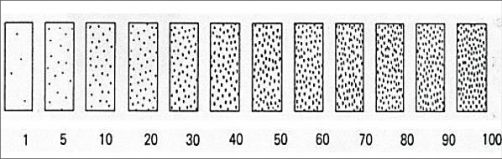 Figure 1
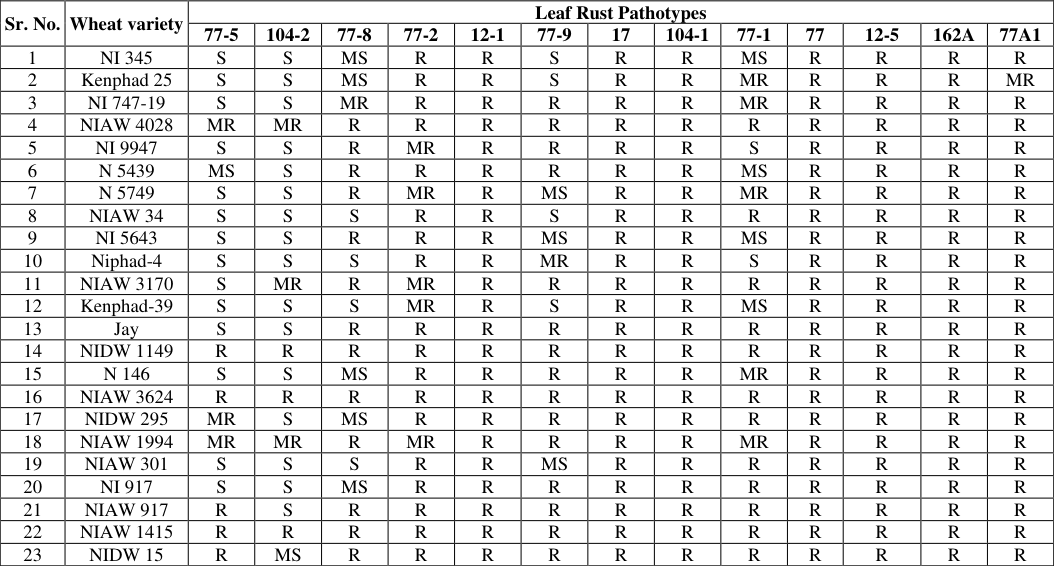 Table 3
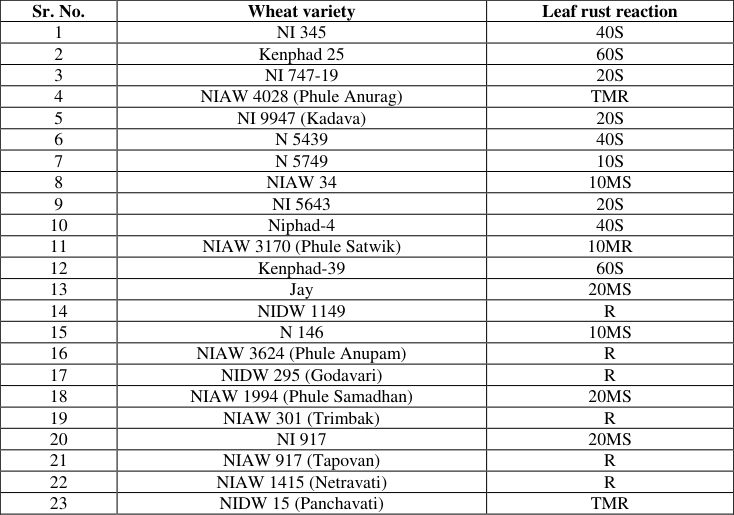 Table 4
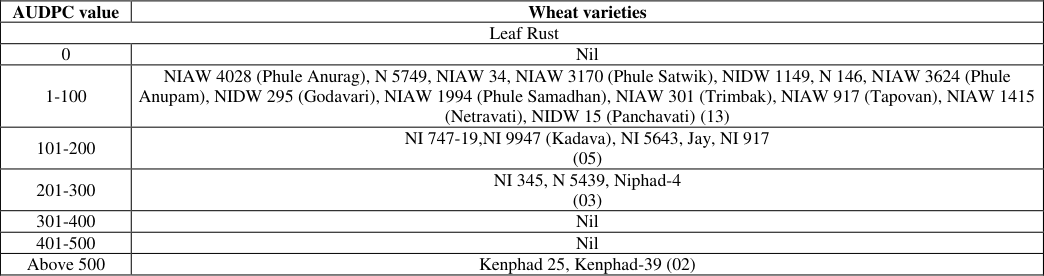 Table 5
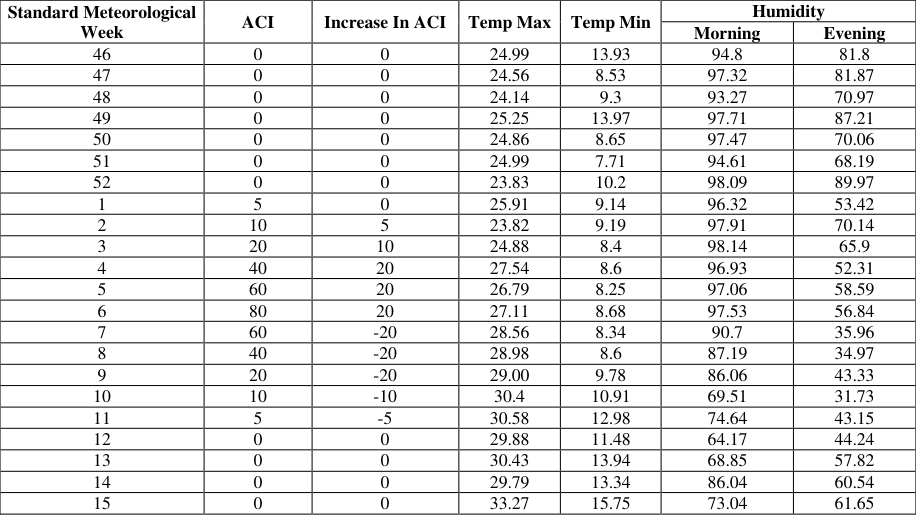 Table 6
 Table 7
Introduction
Wheat (Triticum aestivum L.) is a key staple crop that underpins global food and nutritional security. In India, it is second only to rice in area and production, supplying a major share of daily calories and protein. However, its productivity is constrained by several diseases, of which leaf rust (Puccinia triticina) is the most widespread and damaging. The disease develops rapidly under favorable climates, reducing grain weight and quality at both seedling and adult stages. Race-specific resistance is often short-lived, whereas adult plant resistance is more durable. Fungicides serve as supplementary measures where resistant varieties are long-lived. Management of leaf rust primarily relies on host resistance and fungicides. Resistant varieties provide the most economical and environmentally safe solution, yet race-specific resistance governed by single genes is often overcome by new virulent races. By contrast, adult plant resistance (APR), generally controlled by multiple minor genes, is more durable, though not always sufficient during severe epidemics. Fungicides such as triazoles (Propiconazole, Tebuconazole) and strobilurins (Azoxystrobin, Trifloxystrobin) are widely used as supplementary measures. However, large-scale dependence on chemical control is not sustainable, emphasizing the need for integrated strategies. (Bhardwaj et al., 2019) [2] . Epidemiological studies play a key role in understanding the relationship between disease progression and weather parameters such as temperature, humidity, and dew duration. Such insights help in forecasting epidemics and enabling timely interventions. The cultivation of improved resistant cultivars has contributed significantly to increased wheat yields. However, continuous monocropping has occasionally resulted in leaf rust epidemics.
Continuous efforts are always made to reduce the yield losses in wheat caused by the rusts. Although chemical control of this disease is known but it is not practical, economically feasible and environmentally friendly to use on such a large scale. Therefore, resistance to rusts in wheat is of critical importance. The utilization of resistance genes in wheat is the most effective, economic and environmentally safe approach for controlling rusts (Joshi et al., 1980) [4] . In this background, the present study was conducted with the objectives of evaluating fungicides against leaf rust, assessing seedling and adult plant resistance of released varieties, quantifying disease development using AUDPC, and studying epidemiological factors affecting disease progression.
Materials and methods 1. Seedling resistance of released wheat varieties against virulent races of leaf rust
In this trial released wheat varieties were evaluated under controlled conditions in glasshouse, for seedling resistance to virulent races of leaf rust pathogen.
Experimental details
Experimental details
Methodology
The Seedling Resistance Test (SRT) was carried out with individual virulent pathotypes of leaf rust viz.,77-5, 104-2, 77-8, 77-2, 12-1, 77-9, 17, 104-1, 77-1, 77, 12-5, 162A and 77A1 under glasshouse condition. For growing seedlings, aluminium pans or trays admeasuring 35 cm x 25 cm x 9 cm were used. These trays were filled with soil and compost and marked in to 6 rows of 10 holes in a row with the help of iron marker for sowing of seeds. Every seventh hole in each row was sown with universal susceptible Agra Local variety. The wheat varieties were sown in sequence of serial numbers. These seedlings were grown in spore proof conditions in seedling room and watered regularly. Spore suspension of the individual pathotypes was inoculated at the stage of maximum expanded 1 st leaf and non-emergence of second leaf. The inoculated trays were then incubated under moist humid chambers for 48 hrs and subsequently were transferred to glasshouse benches.
Observations recorded
Infection types were categorized into 11 groups as given below to record the host pathogen interaction (Nayer et.al., 1997).
Methodology
Released wheat varieties were sown on flat bed admeasuring 3.0 m x 1.3 m with a spacing of 22.5 cm between rows. Single row of 1.0 m length of each variety was sown. After every 20 th entry, a line of resistant (Check 'a' NIDW 1149, NIAW 3624, NIDW 295, NIAW 301, NIAW 917 and NIAW 1415) and susceptible (check 'b' NIDW 1149, NIAW 3624, NIDW 295, NIAW 301, NIAW 917 and NIAW 1415) were sown, in order to compare the rust development. Wheat varieties sown on each bed were surrounded by two rows of the varietal mixture consisting of Jay, N 146 and NI 917, NIDW 1149, NIAW 3624, NIDW 295, NIAW 301, NIAW 917 and NIAW 1415 Agra local, vijay, Pusa 4, A 206 having susceptibility to leaf rust. Inside lines were sown along with test varieties and outside lines were sown after one week, to provide continuous rust inoculum supply and built up of high inoculum density during the early stage of the test varieties. These infector/spreader rows were inoculated several times with mixture of leaf rust pathotypes. High humidity (more than 90%) was maintained by covering the beds with cages and gunny curtains overnight for rust development.
Observations recorded
Observations on intensity of leaf rust were noted as per the modified cobb's scale on the basis of per cent rust infection.
Observations recorded
The weekly observations on weather parameters viz., maximum temperature (°C), minimum temperature (°C), morning relative humidity (%) and evening relative humidity (%) were recorded. Intensity of disease was recorded from the first appearance of leaf rust disease. Correlation study was carried out between disease intensity and dependent weather parameter. In this study, the regression models were adjusted to include weather variables to forecast the rise in the per cent of leaf rust, as follows:
Y= b+(-0. 3). Nagarajan et al. (1990) [6] evaluated ten Chinese wheat cultivars for resistance against 23 races of the leaf rust pathogen. Among them, Zheng-Zhou 741 and Zheng-Zhou 742 exhibited strong seedling resistance to group 77 races. Patil et al. (2001) [7] evaluated 95 wheat cultivars for resistance to stem rust (Puccinia graminis f. sp. tritici) and leaf rust (Puccinia recondita f. sp. tritici) under artificial epiphytotic conditions using three specific pathotypes: 40A, 12-5, and 77-5. Their results revealed that none of the cultivars exhibited complete resistance to all pathotypes. However, eight cultivars Karchiya Mutant, Bijaga Red, MACS 2846, PBW 34, NI 9947, RAJ 1515, WH 542, and Coorang showed relatively high levels of resistance, with less than 20% disease susceptibility to both rusts.
Adult plant resistance test of released wheat varieties against leaf rust under field conditions
In the present investigation, 23 released wheat varieties were screened against mixture of prevalent pathotypes of leaf rust. [10] evaluated the seedling and adult plant responses of 13 wheat genotypes against leaf rust pathotype 77-5. They reported that genotypes Sel. T 3171, Sel. T 3114, and Sel. T 3170 exhibited resistance at both the seedling and adult plant stages, indicating stable resistance.
In contrast, Sel. T 3168, Sel. 3073, WR 544, and Kundan were susceptible at the seedling stage but showed moderate to high resistance at the adult stage, suggesting the presence of adult plant resistance (APR). However, genotypes Agra Local, Sonalika, and WL 711 were susceptible at both stages, with disease severity reaching up to 60S, indicating a lack of effective resistance genes. Moreover Muhammad et al. (2015) [5]
ACI = Average coefficient of Infection
When the correlation was analyzed between four independent variables (averaged over the previous seven days) and the dependent variable (leaf rust severity), the maximum temperature and morning humidity (0.082505), (0.262162) showed a positive correlation with the severity of leaf rust of wheat. In case of minimum temperature and evening humidity (-0.48719) (-0.42249) showed negative correlation with the severity of leaf rust of wheat, respectively. This data is presented in Table 7 [8] studied the effect of weather conditions on wheat leaf rust development in three major wheatgrowing regions of Pakistan Faisalabad, Bahawalpur, and Sakrand between 2003 and 2009. They evaluated six wheat cultivars and found that temperature and relative humidity had a significant positive correlation with leaf rust severity, while wind velocity showed a suppressive effect. Bahawalpur was identified as the most favourable site for leaf rust outbreaks due to its optimal temperature (16.85°C-20.44°C), high humidity (57.08%-76.95%), and low wind speed (1.98-4.07 km/hr). Furthermore, Mateen and Khan (2014) reported that environmental factors had great effect on the progress of stripe rust disease of wheat. A positive linear relationship between temperature (maximum and minimum) and disease severity showed that maximum stripe rust was highly noticed at 28-320C maximum temperatures and14-180C minimum temperatures. While, other environmental factors like relative humidity, rainfall and wind speed also showed positive correlation. Sandhu et al.
(2017) [9] investigated the influence of weather parameters on stripe rust incidence and severity in wheat cultivar PBW 343 during the 2012-13 and 2013-14 cropping seasons under both natural and artificial conditions. Their findings showed that disease incidence was higher in 2012-13, which was attributed to increased rainfall that season. The study revealed a positive correlation between disease severity and temperature as well as sunshine hours, while relative humidity was negatively correlated. The researchers concluded that temperature and humidity were the most critical environmental factors driving stripe rust outbreaks in wheat. Results of the present are in general agreement with those of foregoing researchers.
Conclusion
The study revealed that among 23 wheat varieties, 3 showed resistance at the seedling stage, while 6 varieties were resistant and 3 moderately resistant at the adult plant stage.
Based on AUDPC values, none were immune, but 13 varieties exhibited good resistance (<100 AUDPC). Disease first appeared in the 1st week of January 2025, peaked in mid-February (80 ACI), and then declined. Epidemiological analysis showed that maximum temperature and morning humidity favored disease development, while minimum temperature and evening humidity had a negative effect.
Acknowledgement
AcknowledgmentAuthors are thankful to the pathologist, research assistant and staff at Regional Wheat Rust Research Station, International Journal of Agriculture and Food Science https://www.agriculturaljournals.com Mahabaleshwar, Maharashtra (India) and College of Agriculture, Pune, Maharashtra (India) for providing necessary research facilities.
Figures and tables from the paper
| Reaction type | Category | Symptoms |
|---|---|---|
| 0; (Naught fleck) | Immune | No visible infection |
| ; - (fleck minus) | Nearly Immune | Slight necrosis/micro flecking visible |
| ; (fleck) | Very Resistant | No uredia but hypersensitive flecks present |
| 1 (one) | Very Resistant | Uredia minute, surrounded by distinct necrotic areas |
| 2 (two) | Moderately Resistant | Uredia small to medium, surrounded by chlorotic or necrotic border |
| 3 (three) | Moderately Susceptible | Uredia small to medium size, chlorotic areas may be present |
| 33+ (three three plus) | Susceptible | In leaf rust no chlorosis or necrosis, uredia profusely sporulating. In stripe rust uredia profusely sporulating |
| 3+ /4 (three plus/four) | Highly Susceptible | In brown rust no chlorosis or necrosis, uredia profusely sporulating, rings may be formed. In yellow rust uredia profusely sporulating and form stripes in adult plants |
| X | Heterogeneous | Variable types of uredia |
| Y | Heterogeneous | Susceptible types of uredia at the tip and resistant towards the base of leaf |
| Z | Heterogeneous | Resistant types of uredia at the tip and susceptible types towards the leaf base |
Table text extracted from the original PDF; superscript letters are shown inline. The original table image is below.
View original table image
| Symbol | Field Response | Symptoms | Constant Value |
|---|---|---|---|
| 0 | Immune | No visible infection. | |
| R | Resistant | Visible chlorosis or necrosis, no uredia are present | 0.2 |
| MR | Moderately Resistant | Small uredia are present and surrounded by chlorotic areas. | 0.4 |
| M | Intermediate (Mixed) | Variable sized uredia are present some with chlorosis, necrosis or both. | 0.6 |
| MS | Moderately Susceptible | Medium sized uredia are present and possibly surrounded by some chlorotic areas. | 0.8 |
| S | Susceptible | Large uredia are present, generally with little or no chlorosis or necrosis. | 1.0 |
Table text extracted from the original PDF; superscript letters are shown inline. The original table image is below.
View original table image
| Sr. No. | Wheat variety | Leaf Rust Pathotypes | — | — | — | — | — | — | — | — | — | — | — | — |
|---|---|---|---|---|---|---|---|---|---|---|---|---|---|---|
| 77-5 | 104-2 | 77-8 | 77-2 | 12-1 | 77-9 | 17 | 104-1 | 77-1 | 77 | 12-5 | 162A | 77A1 | ||
| 1 | NI 345 | S | S | MS | R | R | S | R | R | MS | R | R | R | R |
| 2 | Kenphad 25 | S | S | MS | R | R | S | R | R | MR | R | R | R | MR |
| 3 | NI 747-19 | S | S | MR | R | R | R | R | R | MR | R | R | R | R |
| 4 | NIAW 4028 | MR | MR | R | R | R | R | R | R | R | R | R | R | R |
| 5 | NI 9947 | S | S | R | MR | R | R | R | R | S | R | R | R | R |
| 6 | N 5439 | MS | S | R | R | R | R | R | R | MS | R | R | R | R |
| 7 | N 5749 | S | S | R | MR | R | MS | R | R | MR | R | R | R | R |
| 8 | NIAW 34 | S | S | S | R | R | S | R | R | R | R | R | R | R |
| 9 | NI 5643 | S | S | R | R | R | MS | R | R | MS | R | R | R | R |
| 10 | Niphad-4 | S | S | S | R | R | MR | R | R | S | R | R | R | R |
| 11 | NIAW 3170 | S | MR | R | MR | R | R | R | R | R | R | R | R | R |
| 12 | Kenphad-39 | S | S | S | MR | R | S | R | R | MS | R | R | R | R |
| 13 | Jay | S | S | R | R | R | R | R | R | R | R | R | R | R |
| 14 | NIDW 1149 | R | R | R | R | R | R | R | R | R | R | R | R | R |
| 15 | N 146 | S | S | MS | R | R | R | R | R | MR | R | R | R | R |
| 16 | NIAW 3624 | R | R | R | R | R | R | R | R | R | R | R | R | R |
| 17 | NIDW 295 | MR | S | MS | R | R | R | R | R | R | R | R | R | R |
| 18 | NIAW 1994 | MR | MR | R | MR | R | R | R | R | MR | R | R | R | R |
| 19 | NIAW 301 | S | S | S | R | R | MS | R | R | R | R | R | R | R |
| 20 | NI 917 | S | S | MS | R | R | R | R | R | R | R | R | R | R |
| 21 | NIAW 917 | R | S | R | R | R | R | R | R | R | R | R | R | R |
| 22 | NIAW 1415 | R | R | R | R | R | R | R | R | R | R | R | R | R |
| 23 | NIDW 15 | R | MS | R | R | R | R | R | R | R | R | R | R | R |
Table text extracted from the original PDF; superscript letters are shown inline. The original table image is below.
View original table image
| Sr. No. | Wheat variety | Leaf rust reaction |
|---|---|---|
| 1 | NI 345 | 40S |
| 2 | Kenphad 25 | 60S |
| 3 | NI 747-19 | 20S |
| 4 | NIAW 4028 (Phule Anurag) | TMR |
| 5 | NI 9947 (Kadava) | 20S |
| 6 | N 5439 | 40S |
| 7 | N 5749 | 10S |
| 8 | NIAW 34 | 10MS |
| 9 | NI 5643 | 20S |
| 10 | Niphad-4 | 40S |
| 11 | NIAW 3170 (Phule Satwik) | 10MR |
| 12 | Kenphad-39 | 60S |
| 13 | Jay | 20MS |
| 14 | NIDW 1149 | R |
| 15 | N 146 | 10MS |
| 16 | NIAW 3624 (Phule Anupam) | R |
| 17 | NIDW 295 (Godavari) | R |
| 18 | NIAW 1994 (Phule Samadhan) | 20MS |
| 19 | NIAW 301 (Trimbak) | R |
| 20 | NI 917 | 20MS |
| 21 | NIAW 917 (Tapovan) | R |
| 22 | NIAW 1415 (Netravati) | R |
| 23 | NIDW 15 (Panchavati) | TMR |
Table text extracted from the original PDF; superscript letters are shown inline. The original table image is below.
View original table image
| Standard Meteorological Week | ACI | Increase In ACI | Temp Max | Temp Min | Humidity | — |
|---|---|---|---|---|---|---|
| Morning | Evening | |||||
| 46 | 0 | 0 | 24.99 | 13.93 | 94.8 | 81.8 |
| 47 | 0 | 0 | 24.56 | 8.53 | 97.32 | 81.87 |
| 48 | 0 | 0 | 24.14 | 9.3 | 93.27 | 70.97 |
| 49 | 0 | 0 | 25.25 | 13.97 | 97.71 | 87.21 |
| 50 | 0 | 0 | 24.86 | 8.65 | 97.47 | 70.06 |
| 51 | 0 | 0 | 24.99 | 7.71 | 94.61 | 68.19 |
| 52 | 0 | 0 | 23.83 | 10.2 | 98.09 | 89.97 |
| 1 | 5 | 0 | 25.91 | 9.14 | 96.32 | 53.42 |
| 2 | 10 | 5 | 23.82 | 9.19 | 97.91 | 70.14 |
| 3 | 20 | 10 | 24.88 | 8.4 | 98.14 | 65.9 |
| 4 | 40 | 20 | 27.54 | 8.6 | 96.93 | 52.31 |
| 5 | 60 | 20 | 26.79 | 8.25 | 97.06 | 58.59 |
| 6 | 80 | 20 | 27.11 | 8.68 | 97.53 | 56.84 |
| 7 | 60 | -20 | 28.56 | 8.34 | 90.7 | 35.96 |
| 8 | 40 | -20 | 28.98 | 8.6 | 87.19 | 34.97 |
| 9 | 20 | -20 | 29.00 | 9.78 | 86.06 | 43.33 |
| 10 | 10 | -10 | 30.4 | 10.91 | 69.51 | 31.73 |
| 11 | 5 | -5 | 30.58 | 12.98 | 74.64 | 43.15 |
| 12 | 0 | 0 | 29.88 | 11.48 | 64.17 | 44.24 |
| 13 | 0 | 0 | 30.43 | 13.94 | 68.85 | 57.82 |
| 14 | 0 | 0 | 29.79 | 13.34 | 86.04 | 60.54 |
| 15 | 0 | 0 | 33.27 | 15.75 | 73.04 | 61.65 |
Table text extracted from the original PDF; superscript letters are shown inline. The original table image is below.
View original table image
References
10 in the original paper- Ahmad S, Khan MA, Haider MM, Iqbal Z, Iftikhar Y, Hussain M. Comparison of yield loss in different wheat varieties/lines due to leaf rust disease. Pak. J. Phytopathol. 2010;22(1):13-15.
- Bhardwaj SC, Singh GP, Gangwar OP, Prasad P, Kumar S. Status of Wheat Rust Research and Progress in Rust Management-Indian Context. Agronomy. 2019;9(12):892.
- Hasabnis SN, Joi MB, Shinde VK, Ilhe BM. Adult plant response of wheat varieties against leaf rust (Puccinia recondita F. sp. Tritici). Agricultural Science Digest. 2003;23(1):6-9.
- Joshi LM, Srivastava KD, Singh DV, Ramanujam K. Wheat rust epidemics in India since 1970. 1980.
- Muhammad S, Khan AI, Aziz-ur-Rehman FSA, Rehman A. Screening for leaf rust resistance and association of leaf rust with epediomological factors in wheat (Triticum aestivum L.). Pakistan Journal of Agricultural Sciences. 2015;52(3):691-700.
- Nagarajan S, Bedi R, Nayar SK, Bahadur P, Singh DV, Srivastava KD. Performance of some Chinese wheats against Puccinia recondita f. sp. tritici in the seedling and adult plant stages. 1990.
- Patil RJ, Hasabnis SN, Ilhe BM, Joi MB, Shinde VK. Rust reactions of some released wheat varieties and their use in artificial epiphytotics. 2001.
- Riaz A, Riaz A, Rattu AR, Tahir MI, Azeem M. Impact of epidemiological factors on development of Puccinia triticina sp. Tritici on wheat in Pakistan. J. Biol. Agri. Health. 2013;3(19):50-60.
- Sandhu SK, Dhaliwal LK, Pannu PPS. Effect of weather parameters on incidence and severity of stripe rust in wheat under natural and artificial conditions. J. Agrometeorol. 2017;19:272-277.
- Saritha RK, Sinha VC, Tomar SMS, Srivastava KD. Nature of adult plant resistance in some Triticum timopheevi derivatives to pathotype 121R63-1 of leaf rust. Indian Phytopathology. 2006;58(2):129-135.
Cited by 1
From OpenAlex, OpenCitations and reference lists read by Scinovex
- Screening bread wheat ( Triticum aestivum L .) genotypes for yellow rust resistance and grain yield performance ↗
Abera Olana, Hassen Shifa, Wuletaw Tadesse · Cogent Food & Agriculture · 2026
Yellow rust caused by Puccinia striiformis f. sp. tritici is one of the most destructive diseases of bread wheat (Triticum aestivum L.), causing severe yield losses in Ethiopia. The development of resistant cultivars remain the most effective, economical, and environmentally friendly strategy for managing the disease. This study aimed to evaluate the reaction of 240 spring bread wheat lines and…
❝ 0PDF