
Research article · 2025 · Full text
International Journal of Agriculture and Food SciencePurchasing Behaviour of Pesticides by Vegetable Growers and its Correlation with Socio-economic characteristics of Vegetable Growers
Volume 7(9) · Pages 524–527 · DOI: 10.33545/2664844x.2025.v7.i9g.789 ↗
Research areasGeochemistry and Geologic MappingGeological and Geophysical StudiesGeological Modeling and Analysis
Abstract
Author-writtenThe study was undertaken to assess the purchasing behaviour of pesticides by vegetable growers in Kolhapur district, Maharashtra. The present investigation was carried out in Kolhapur district of Maharashtra with the objectives of studying the socio-economic characteristics of vegetable growers, and to analyze their relationship with the purchasing behaviour of pesticides. Total 150 vegetable growers were selected for these study. It was observed that the socio-economic characteristics were significantly correlated with the purchasing behaviour of pesticides. Data were collected through a structured interview schedule and analyzed using correlation coefficients. The results revealed that most farmers relied on local input dealers for purchasing pesticides, with credit facility and immediate availability being the major deciding factors. Education, annual income, landholding size, and extension contact exhibited a significant positive correlation with scientific purchasing behaviour, whereas age and farming experience were negatively correlated with adoption of new pesticide brands and modern advisories. The findings highlight the need for strengthening extension services, improving farmers’ access to quality inputs, and promoting collective input procurement models to encourage rational and safe pesticide purchasing behaviour.
Summary
Source-checkedPlain-language reading of the full paper, prepared with AI and checked against the text. Each point links to the authors' own words.
Why it matters
- Vegetable production is essential for rural livelihoods, farm income, and ensuring nutritional and food security. View evidence ↗
- Because vegetable crops are tender and have short life cycles, they are highly susceptible to pests and diseases, leading farmers to rely heavily on chemical pesticides which represent a significant production cost. View evidence ↗
- Farmer purchasing behavior is often non-scientific, as many rely on dealers rather than experts, leading to the over-application of pesticides or the use of substandard products. View evidence ↗
The question
- The study aims to analyze how the purchasing behavior of vegetable growers in the Kolhapur district correlates with their socio-economic characteristics. View evidence ↗
What they did
- The research was conducted in five villages within each of the two purposively selected tahsils (Hatkanangale and Shirol) in the Kolhapur district of Maharashtra. View evidence ↗
- A total of 150 vegetable growers were interviewed using a structured interview schedule conducted in Marathi. View evidence ↗
- Socio-economic characteristics used as independent variables included age, education, farming experience, scientific orientation, social participation, landholding, income (annual and from vegetables), production area, extension contact, and information sources. View evidence ↗
- Pearson's correlation coefficient was used to analyze the relationship between the farmers' socio-economic characteristics and their pesticide purchasing behavior. View evidence ↗
What they found
- Education (r=0.162), farming experience (r=0.182), scientific orientation (r=0.232), social participation (r=0.198), and annual income (r=0.238) all showed significant positive correlations with rational purchasing decisions. View evidence ↗
- Highly significant positive correlations were found between purchasing behavior and income from vegetable production (r=0.236), extension contact (r=0.281), and sources of information (r=0.322). View evidence ↗
- Age (r=0.083), landholding (r=0.112), and the area under vegetable production (r=0.118) did not have a significant correlation with pesticide purchasing behavior. View evidence ↗
- Most farmers relied on local input dealers for pesticides, primarily driven by the availability of credit and immediate product availability. View evidence ↗
What it means
- The authors conclude that enhancing scientific purchasing behavior requires strengthening information dissemination, awareness campaigns, and extension services. View evidence ↗
- The authors recommend the formation of cooperatives or Farmer Producer Organizations (FPOs) to facilitate collective procurement, ensuring fair prices and reducing reliance on private dealers. View evidence ↗
Visual summary
1 visualsIllustrations explain the paper; charts are replotted from the paper's own table values.
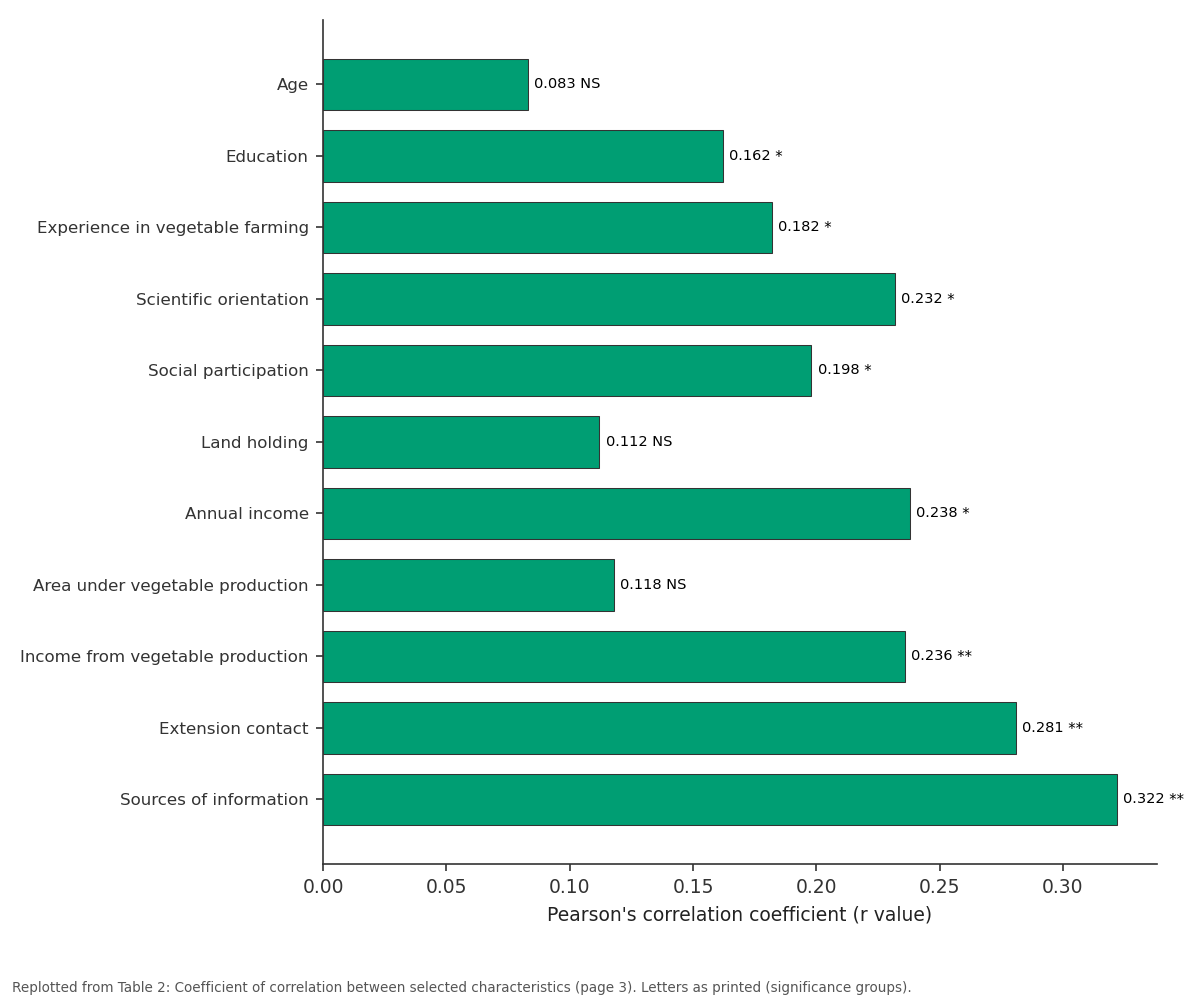
Vegetable growers (r value): Age vs Education vs Experience in vegetable... vs Scientific orientation vs Social participation
Replotted from Table 2 (page 3) of the original paper. Every bar is the paper's own table value.
View source evidence ↗Figures & tables
From the original paper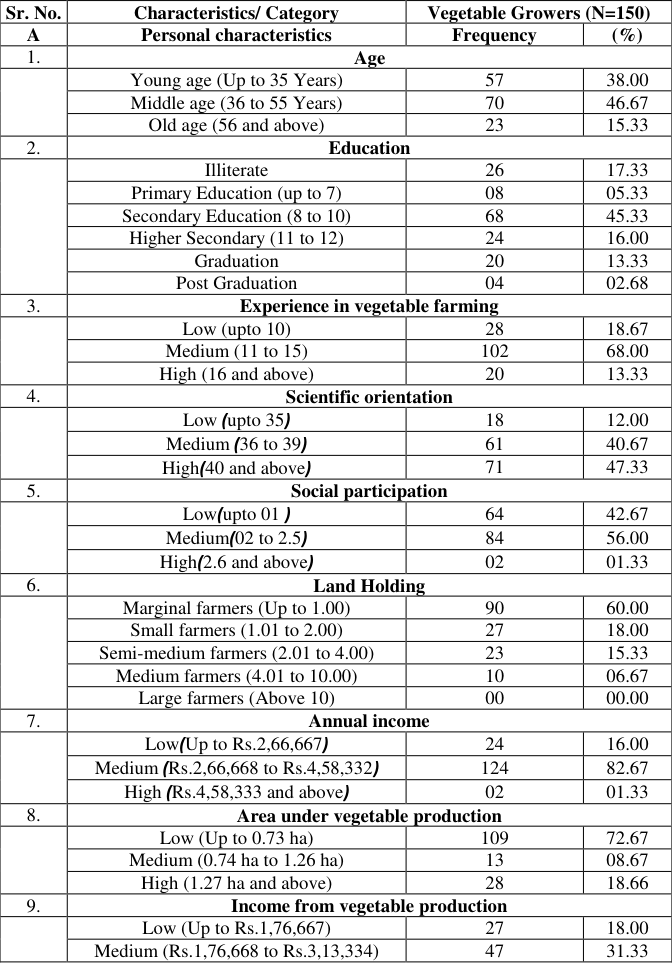 Table 1
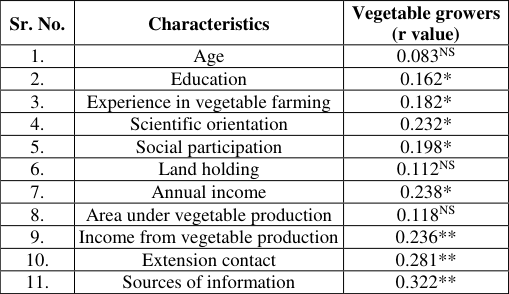 Table 2
Introduction
Vegetable production plays a crucial role in ensuring food and nutritional security, generating farm income, and supporting rural livelihoods. However, vegetable crops are highly susceptible to pest and disease attacks because of their tender nature and short life cycle. Farmers rely heavily on chemical pesticides to protect their crops and prevent yield losses, often accounting for a significant share of total production costs. Globally, India ranks among the leading pesticide consumers, and Maharashtra is one of the major states contributing to this demand due to its intensive vegetable cultivation. In Kolhapur district, pesticide use has become a common and integral practice among vegetable growers. The availability of a wide range of pesticide products and easy access through local dealers have further increased their use. However, the purchasing behaviour of farmers is not always scientific or rational. Many farmers tend to rely heavily on pesticide dealers for advice rather than on agricultural experts, and their decisions are influenced by factors such as price, credit facility, peer recommendations, and brand popularity. This often results in indiscriminate use, over-application, and in some cases, the purchase of unregistered or substandard products. Purchasing behaviour is shaped by a combination of socio-economic characteristics such as age, education, landholding size, income, farming experience, and access to extension services. Educated and progressive farmers are more likely to follow label instructions, buy recommended pesticides, and adopt Integrated Pest Management (IPM) strategies, while small and marginal farmers often depend solely on local dealers for decision-making. Understanding these behavioural patterns is vital for policy makers and extension agencies to promote rational pesticide use, reduce health and environmental risks, and improve farm profitability.
Therefore, this study aims to analyze the purchasing behaviour of vegetable growers in Kolhapur district and examine its correlation with their socio-economic characteristics. The findings will provide insights for designing need-based extension programs, ensuring the availability of quality pesticides, and developing strategies to guide farmers toward safe, cost-effective, and environmentally sound pest management practices.
Objective
To study the purchasing behavior of pesticides by vegetable growers and its correlation with socio-economic characteristics of vegetable growers
Methodology
The study was carried out in Kolhapur district of Maharashtra and two tahsils Hatkanangale, and Shirol were selected purposively due to the major vegetable growing belt in Kolhapur. Five villages of each tahsils were used to study. Total 150 vegetable growers were interviewed with the help of structured interview schedule in local language Marathi. For this study an ex-post facto research design was used to analyse the data. The statistical tools like frequency and % were obtained from collected data. The independent variables included age, education, experience in vegetable farming, scientific orientation, social participation, landholding, annual family income, area under vegetable production, income from vegetable production, extension contact, sources of information treated as socio-economic characteristics of respondents. The Scientific orientation was measured by considering Attitude towards Scientific method, benefit and perceived constraints. The dependent variable was the purchasing behavior of pesticides. Data were coded, tabulated, and analyzed using descriptive statistics such as frequency and percentage to describe purchasing behavior. Pearson's correlation coefficient was applied to determine the relationship between socio-economic characteristics of farmers and their purchasing behaviour of pesticides. The strength and direction of correlation helped to identify the key factors influencing rational purchasing decisions. [4] , had secondary to higher secondary education (45.33%) Similar conclusions were reported, and possessed low to medium vegetable farming experience (68.00%) this finding aligns with study of Most of the respondents had a low area under vegetable cultivation (72.67%). High scientific orientation (47.33%) and medium social participation (56.00%). Similar findings were reported by Patil (2017), were concentrated in the marginal landholding category (60.00%), (76.00 %) were in the low category for information sources, A considerable proportion showed high level of extension contact (60.00%). The relationship between selected characteristics of vegetable growers and the purchasing behaviour of pesticides were analyzed. The correlation coefficients are presented in Table 2. Sources of information 0.322** * Significant at 0.05 level; ** Significant at 0.01 level; NS = Nonsignificant
| Sr. No. | Characteristics | Vegetable growers (r value) |
|---|---|---|
| 1. | Age | 0.083NS |
| 2. | Education | 0.162* |
| 3. | Experience in vegetable farming | 0.182* |
| 4. | Scientific orientation | 0.232* |
| 5. | Social participation | 0.198* |
| 6. | Land holding | 0.112NS |
| 7. | Annual income | 0.238* |
| 8. | Area under vegetable production | 0.118NS |
| 9. | Income from vegetable production | 0.236** |
| 10. | Extension contact | 0.281** |
| 11. | Sources of information | 0.322** |
Table text extracted from the original PDF; superscript letters are shown inline. The original table image is below.
View original table image
Results and Discussion
The correlation analysis between purchasing behaviour and socio-economic variables revealed that education (r=0.162 * ), experience in vegetable farming (r=0.182*), scientific orientation (r=0.232*), social participation (r=0.198*), and annual income (r=0.238*) were positively and significantly correlated, indicating that higher education, greater farming experience, progressive outlook, active social engagement, and better income levels improve rational and scientific purchasing decisions. Stronger associations were observed with income from vegetable production (r=0.236**), extension contact (r=0.281**), and sources of information (r=0.322**), which were highly significant, suggesting that reliable income flow, effective advisory services, and access to multiple information sources play a crucial role in guiding farmers towards quality inputs and informed purchasing choices. Conversely, age (r=0.083 NS ), land holding (r=0.112 NS ), and area under vegetable production (r=0.118 NS ) showed nonsignificant correlations, implying that demographic characteristics and farm size do not necessarily determine purchasing behaviour. This highlights that farmers' decisions are more influenced by knowledge, guidance, and economic security than by age or land resources. Strengthening extension services, awareness campaigns, and information dissemination systems would therefore be effective strategies to enhance scientific purchasing behaviour among vegetable growers.
Conclusion
The study revealed that the purchasing behaviour of vegetable growers in Kolhapur district is influenced by multiple socio-economic factors such as education, income, landholding size, and extension contact. Farmers with higher education and greater access to information exhibited more rational purchasing decisions, followed label instructions, and preferred registered pesticide products. In contrast, small and marginal farmers, as well as those with limited extension exposure, showed a greater dependence on local dealers for advice, often leading to indiscriminate or suboptimal pesticide use. These findings highlight the urgent need to strengthen farmer education and capacity-building initiatives. Regular training programs, demonstrations, and farmer awareness campaigns on safe pesticide use and scientific purchasing practices can bridge the knowledge gap. Encouraging farmers to form cooperatives or farmer producer organizations (FPOs) for collective procurement can ensure access to quality inputs at fair prices and reduce dependence on private dealers. Policy makers, extension agencies, and agro-input suppliers must work together to create a transparent and farmerfriendly input supply chain. Promoting digital platforms for pesticide advisories, subsidizing personal protective equipment, and ensuring strict regulation of pesticide markets will enable growers to make informed, safe, and economically sound purchasing decisions, contributing to sustainable vegetable production.
Figures and tables from the paper
| Sr. No. | Characteristics/ Category | Vegetable Growers (N=150) | — |
|---|---|---|---|
| A | Personal characteristics | Frequency | (%) |
| 1. | Age | ||
| Young age (Up to 35 Years) | 57 | 38.00 | |
| Middle age (36 to 55 Years) | 70 | 46.67 | |
| Old age (56 and above) | 23 | 15.33 | |
| 2. | Education | ||
| Illiterate | 26 | 17.33 | |
| Primary Education (up to 7) | 08 | 05.33 | |
| Secondary Education (8 to 10) | 68 | 45.33 | |
| Higher Secondary (11 to 12) | 24 | 16.00 | |
| Graduation | 20 | 13.33 | |
| Post Graduation | 04 | 02.68 | |
| 3. | Experience in vegetable farming | ||
| Low (upto 10) | 28 | 18.67 | |
| Medium (11 to 15) | 102 | 68.00 | |
| High (16 and above) | 20 | 13.33 | |
| 4. | Scientific orientation | ||
| Low (upto 35) | 18 | 12.00 | |
| Medium (36 to 39) | 61 | 40.67 | |
| High(40 and above) | 71 | 47.33 | |
| 5. | Social participation | ||
| Low(upto 01 ) | 64 | 42.67 | |
| Medium(02 to 2.5) | 84 | 56.00 | |
| High(2.6 and above) | 02 | 01.33 | |
| 6. | Land Holding | ||
| Marginal farmers (Up to 1.00) | 90 | 60.00 | |
| Small farmers (1.01 to 2.00) | 27 | 18.00 | |
| Semi-medium farmers (2.01 to 4.00) | 23 | 15.33 | |
| Medium farmers (4.01 to 10.00) | 10 | 06.67 | |
| Large farmers (Above 10) | 00 | 00.00 | |
| 7. | Annual income | ||
| Low(Up to Rs.2,66,667) | 24 | 16.00 | |
| Medium (Rs.2,66,668 to Rs.4,58,332) | 124 | 82.67 | |
| High (Rs.4,58,333 and above) | 02 | 01.33 | |
| 8. | Area under vegetable production | ||
| Low (Up to 0.73 ha) | 109 | 72.67 | |
| Medium (0.74 ha to 1.26 ha) | 13 | 08.67 | |
| High (1.27 ha and above) | 28 | 18.66 | |
| 9. | Income from vegetable production | ||
| Low (Up to Rs.1,76,667) | 27 | 18.00 | |
| Medium (Rs.1,76,668 to Rs.3,13,334) | 47 | 31.33 |
Table text extracted from the original PDF; superscript letters are shown inline. The original table image is below.
View original table image
References
7 in the original paper- Chaudhary A, Prasad A. Role of socio-economic characteristics in pesticide purchasing and utilization: A correlation study. J Community Mobil Sustain Dev. 2023;18(1):72-80.
- Desai R, Joshi N. Market linkages and pesticide use in vegetable farming: An analysis of farmer behaviour. Maharashtra J Ext Educ. 2021;40:102-8.
- Gupta A, Yadav P. Purchasing behaviour and perception of pesticide quality among vegetable farmers in India. J Appl Nat Sci. 2023;15(1):34-41.
- Kumar V, Singh R. Farmers' awareness and adoption behaviour towards safe pesticide use in vegetable crops. Int J Farm Sci. 2022;12(1):45-53.
- Meena RS, Jat ML. Improving pesticide management behaviour through farmer field schools: Evidence from India. Agric Res Commun Cent J. 2022;43(4):215-23.
- Chaudhary AK. Adoption behaviour of mung bean farmers under FLDs. Indian J Ext Educ. 2018;54(2):459.
- Sharma R, Kaur J. Socio-economic factors influencing pesticide purchasing decisions among vegetable growers in Punjab, India. J Agric Ext Manag. 2021;22(2):65-72.