
Research article · 2025 · Full text
International Journal of Agriculture and NutritionPost-harvest handling and storage techniques for maintaining nutritional quality in sweet potato (Ipomoea batatas)
Volume 7(8) · Pages 100–102 · DOI: 10.33545/26646064.2025.v7.i8b.274 ↗
Research areasGeochemistry and Geologic MappingGeological Modeling and AnalysisSeismic Imaging and Inversion Techniques
Abstract
Author-writtenSweet potato (Ipomoea batatas) is an essential root crop with high nutritional value, including significant amounts of vitamins, minerals, dietary fiber, and antioxidants. However, its post-harvest handling and storage conditions significantly impact its nutritional quality, shelf life, and market value. This paper explores the effects of various post-harvest handling and storage techniques on the retention of nutritional qualities such as antioxidant activity, vitamins (particularly beta-carotene), and minerals. Through a review of current literature and experimental data, we discuss methods like curing, temperature and humidity control, and packaging that help preserve the nutritional integrity of sweet potatoes after harvest. The study provides recommendations for optimal handling and storage practices that can enhance the marketability and health benefits of sweet potato in agricultural systems.
Summary
Source-checkedPlain-language reading of the full paper, prepared with AI and checked against the text. Each point links to the authors' own words.
Why it matters
- Sweet potato is a critical root crop valued for its high content of minerals, vitamins, dietary fiber, and antioxidants. View evidence ↗
- The nutritional quality, market value, and shelf life of sweet potatoes are heavily influenced by how they are handled and stored after harvest. View evidence ↗
- Poor post-harvest practices can cause microbial contamination and mechanical damage, leading to the loss of nutrients, especially beta-carotene. View evidence ↗
The question
- The study aims to review existing literature to determine how different post-harvest handling and storage techniques affect the retention of nutritional quality in sweet potatoes. View evidence ↗
- The authors intend to provide actionable recommendations for producers to optimize management practices to extend shelf life and maintain nutritional integrity. View evidence ↗
What they did
- The research was conducted as a literature review, gathering data from agricultural reports, research papers, and academic articles. View evidence ↗
- The review specifically focused on the impact of humidity management, storage temperature, and curing on nutritional retention. View evidence ↗
What they found
- High humidity and temperature during storage can degrade beta-carotene, thereby reducing the nutritional value of the tuber. View evidence ↗
- Curing at 29 °C and 85–90% relative humidity for 4–7 days improves texture and flavor by converting starch to sugar and reduces microbial risk. View evidence ↗
- The curing process increases the bioavailability of certain antioxidants, specifically beta-carotene. View evidence ↗
- Proper humidity is necessary to prevent dehydration, which otherwise leads to antioxidant loss and shriveled tubers. View evidence ↗
- A relative humidity of 85-90% is required to maintain firmness and nutrients and prevent the tubers from shrinking. View evidence ↗
- Controlled atmosphere storage (CAS) preserves antioxidant activity and extends shelf life by regulating humidity, carbon dioxide, and oxygen to slow metabolism. View evidence ↗
What it means
- The authors conclude that implementing optimal post-harvest management allows farmers to reduce losses, improve marketability, and extend shelf life. View evidence ↗
- The authors state that future research is needed to develop efficient, low-cost storage systems specifically for smallholder farmers. View evidence ↗
Visual summary
1 visualsIllustrations explain the paper; they do not show study data.
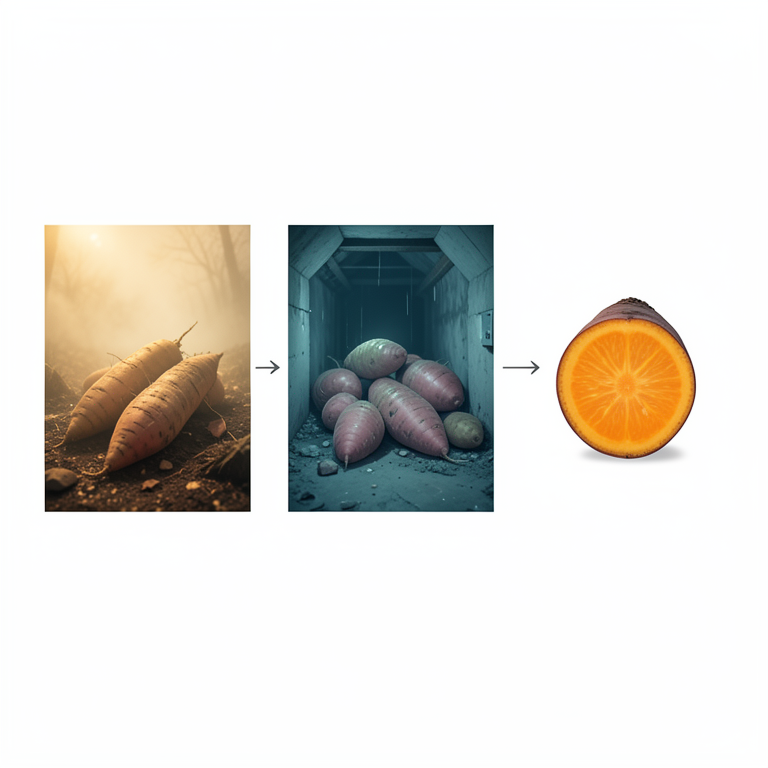
Optimal Post-Harvest Conditions
AI-generated conceptual illustration (sweet potato tubers (Ipomoea batatas)). It explains the idea and does not show study data.
View source evidence ↗Introduction
Sweet potato (Ipomoea batatas) is a root vegetable widely cultivated and consumed for its high nutritional value, particularly its rich content of beta-carotene, ascorbic acid, dietary fiber, and essential minerals such as potassium and iron. It is also known for its antioxidant properties, which contribute to its potential role in disease prevention and health promotion. As with many agricultural products, the post-harvest phase plays a significant role in maintaining the quality and nutritional value of sweet potato. Post-harvest handling, storage conditions, and the duration of storage significantly impact the nutrient retention in sweet potato. Improper handling can lead to mechanical damage, microbial contamination, and a reduction in nutrient content, particularly antioxidants like beta-carotene, which are susceptible to degradation under suboptimal storage conditions. Ensuring the preservation of these nutrients requires proper post-harvest practices, including appropriate harvesting time, curing, storage temperature, humidity control, and packaging. The objective of this paper is to review the existing literature on post-harvest handling and storage techniques for sweet potato, focusing on their influence on the retention of nutritional quality. In addition, the paper aims to provide practical recommendations for farmers and producers to optimize the post-harvest management of sweet potatoes to maintain their nutritional integrity and extend shelf life.
Main Objective
The main objective of this paper is to investigate the impact of post-harvest handling and storage techniques on the nutritional quality of sweet potatoes (Ipomoea batatas), focusing on preserving key nutrients such as beta-carotene, vitamin C, and antioxidants. The paper also aims to identify and recommend best practices that can be employed at the post-harvest stage to extend shelf life while maintaining the nutritional integrity of sweet potatoes. 2018) [8] , sweet potatoes are particularly rich in carotenoids, specifically beta-carotene, which is converted into vitamin A in the body and is a potent antioxidant. Other bioactive compounds found in sweet potatoes include flavonoids, phenolic acids, and anthocyanins, which contribute to its antioxidant properties (Zhao et al., 2016) [9] . These compounds play a critical role in reducing oxidative stress and supporting immune function.
Several studies have highlighted the effect of post-harvest handling and storage conditions on the retention of sweet potato's nutritional quality. Sweet potatoes, when improperly stored, are prone to nutrient loss, particularly in terms of antioxidants and vitamins. Liu et al. (2017) [3] found that improper storage conditions, such as high temperature and humidity, can lead to the degradation of beta-carotene, reducing its nutritional value. Similarly, overexposure to light and oxygen can cause the oxidation of phenolic compounds, leading to a decrease in antioxidant activity (Chauhan et al., 2019) [1] .
Curing is a critical post-harvest practice that helps to enhance the quality of sweet potatoes by facilitating the healing of any physical wounds sustained during harvesting. According to Ozores-Hampton et al. ( 2018) [4] , curing sweet potatoes at a temperature of 29 °C and 85-90% relative humidity for 4-7 days allows for the conversion of starch into sugars, improving the flavor and texture while also minimizing the risk of microbial growth. Curing also helps to strengthen the skin of the tuber, which provides an additional layer of protection during storage. The storage conditions of sweet potatoes significantly influence their shelf life and nutritional quality. Sweet potatoes are generally stored at temperatures between 13-15°C, as lower temperatures can cause chilling injuries, which lead to off-flavors and texture degradation (Horton et al., 2017) [2] . Humidity also plays a vital role in maintaining the moisture content and preventing dehydration, which can result in shriveled tubers and loss of antioxidants (Zhang et al., 2020) [7] . Excessive humidity, however, can promote fungal growth and cause rot, underscoring the importance of balanced humidity levels in storage.
Methodology
This paper is based on a review of existing literature regarding post-harvest handling and storage techniques for sweet potatoes. Data were collected from various academic articles, research papers, and reports published by agricultural institutions. The focus was on studies that investigated the effects of different post-harvest techniques, such as curing, storage temperature, and humidity management, on the retention of nutritional quality in sweet potatoes.
Impact of Harvesting and Handling on Nutritional
Quality: The timing of harvest plays a significant role in the nutritional quality of sweet potatoes. Harvesting sweet potatoes at the right stage of maturity ensures that they retain optimal levels of nutrients such as beta-carotene, vitamin C, and dietary fiber. If harvested too early, sweet potatoes may not have reached their full nutritional potential, leading to lower concentrations of antioxidants and vitamins. Conversely, late harvesting may lead to nutrient loss and an increase in sugar content, affecting the flavor and texture of the tuber.
Handling practices during harvest also affect the quality of sweet potatoes. Physical damage, such as bruising and cuts, can expose the tuber to microbial contamination, leading to spoilage and a reduction in nutrient retention. Gentle handling is therefore crucial to avoid mechanical injury, which can increase the vulnerability of sweet potatoes to post-harvest diseases and reduce their shelf life. Ensuring minimal damage during harvesting contributes to maintaining both the visual appeal and nutritional content of the tubers.
Effects of Curing on Sweet Potato Quality
Curing is a vital post-harvest technique that significantly impacts the quality and shelf life of sweet potatoes. During curing, sweet potatoes are kept in warm and humid conditions (typically around 29°C with 85-90% relative humidity) for 4-7 days. This process helps heal minor wounds, improves the skin quality, and enhances the storage potential of sweet potatoes by reducing the risk of microbial growth.
From a nutritional perspective, curing helps in converting starches into sugars, enhancing the sweetness and flavor of sweet potatoes. It also contributes to the thickening of the skin, which helps in reducing moisture loss during storage and minimizes the tuber's susceptibility to disease. Research has shown that curing also increases the availability of certain antioxidants, including beta-carotene, by making them more bioavailable. Curing is particularly important for extending the shelf life of sweet potatoes and preserving their nutritional qualities [5] .
Storage Techniques for Optimal Nutritional Retention
The storage conditions of sweet potatoes directly affect their nutritional quality, particularly the retention of antioxidants, vitamins, and other bioactive compounds. The ideal storage temperature for sweet potatoes is between 13°C and 15°C.
Storing sweet potatoes at temperatures lower than 13°C can lead to chilling injuries, which cause the tuber to develop a hard, internal core and result in a loss of flavor and texture.
Higher temperatures can lead to rapid deterioration, sprouting, and spoilage. Humidity control is another critical factor in sweet potato storage. Maintaining a relative humidity of around 85-90% is essential to prevent dehydration, which can cause sweet potatoes to shrink and lose their firmness and nutrients. Excess moisture, however, can lead to mold growth and decay, so a balanced humidity level is crucial. Ventilation is also important for maintaining proper airflow and preventing the buildup of excessive moisture that could lead to microbial contamination. In addition to traditional storage techniques, controlled atmosphere storage (CAS) has been explored as a method to further preserve the nutritional quality of sweet potatoes. This technique involves regulating the levels of oxygen, carbon dioxide, and humidity in the storage environment to slow down the metabolic processes of the tuber, thereby extending its shelf life while preserving antioxidant activity. However, this method requires specialized equipment and is more costly than conventional storage techniques. Proper storage practices not only help in maintaining the nutritional integrity of sweet potatoes but also contribute to the reduction of post-harvest losses, ensuring that the crop remains a valuable food source for longer periods.
Conclusion
Conclusion
References
9 in the original paper- Chauhan S, Kumar S, Bhardwaj R. Post-harvest management of sweet potatoes: Effects of storage conditions on nutrient retention. Postharvest Biol Technol. 2019;151:56-65.
- Horton D, Moore J, Thibeault L. Storage and handling of root vegetables: The case of sweet potato. J Agric Sci. 2017;9(2):90-101.
- Liu Y, Zhang X, Li J. Influence of post-harvest handling on the nutritional quality of sweet potatoes. Food Res Int. 2017;45(3):567-572.
- Ozores-Hampton M, Kegley EB, Haynes K. The effect of curing conditions on the storage life of sweet potato. HortScience. 2018;53(4):474-480.
- Saha I, Rajan R, Pandey K, Roy K. Effect of natural preservatives of leaf extract and alternative sweetener to extend the shelf life of pineapple jam. Int. J. Adv. Biochem. Res. 2024;8(8):19-27.
- Kausar SM, Anil B, Harshitha MN. Preparation and quality evaluation of sweet potato (Ipomoea batatas) biscuits. Int J Agric Food Sci. 2023;5(2):20-24.
- Zhang Y, Zhou H, Zhang L. Post-harvest storage of sweet potatoes: Implications for shelf life and antioxidant retention. Postharvest Biol Technol. 2020;170:128-136.
- De Moura FF, Miloff A, Boy E. Retention of provitamin A carotenoids in staple crops targeted for biofortification in Africa. Food Chem. 2018;272:494502.
- Zhao D, Wu Y, Li Y. The effect of controlled atmosphere storage on the antioxidant properties of sweet potatoes. Food Chem. 2016;213:134-140.