
Research article · 2025 · Full text
International Journal of Agriculture and Food ScienceEffects of transplanting dates and varietal selection on growth parameters of Rice (Oryza sativa L.)
Volume 7(12) · Pages 385–388 · DOI: 10.33545/2664844x.2025.v7.i12e.1068 ↗
Research areasRice Cultivation and Yield ImprovementAgricultural Science and FertilizationNitrogen and Sulfur Effects on Brassica
Abstract
Author-writtenA field study was conducted at the experimental farm Division of Agronomy, Sher-e-Kashmir University of Agricultural Sciences and Technology of Kashmir, Wadura Sopore to evaluate the influence of different transplanting dates and rice varieties on various growth parameters. Three transplanting dates (7th June, 14th June, and 21st June) and four rice varieties (Jehlum, SR-1, SR-2, and SR-3) were tested in a factorial design. Results indicated that transplanting dates and varieties significantly affected plant height, tiller production, leaf area index, dry matter accumulation, relative growth rate, and leaf number per culm at different growth stages. Early transplanting (7th June) resulted in taller plants (128.09 cm) at maturity compared to late transplanting (118.86 cm). Variety SR-2 recorded the highest plant height (133.73 cm), dry matter accumulation (130.88 q ha⁻¹), and leaf area index (5.36) at 60 DAT. Tiller production peaked at 60 DAT across all treatments, with SR-3 producing the highest number of tillers (468.77 m⁻²). Maximum leaf area index of 5.02 was achieved with 7th June transplanting at 60 DAT. Early transplanting generally favored growth parameters during later developmental stages, while variety SR-2 consistently performed better across most parameters.
Summary
Source-checkedPlain-language reading of the full paper, prepared with AI and checked against the text. Each point links to the authors' own words.
Why it matters
- Rice is a critical global cereal crop that provides a staple food source for over half of the world's population, making it essential for food security in developing nations. View evidence ↗
- The growth, development, and final yield of rice are heavily influenced by management practices, specifically the selection of the rice variety and the timing of transplanting. View evidence ↗
- Choosing the correct transplanting date is vital to ensure the crop encounters favorable environmental conditions during key growth stages like flowering and grain filling. View evidence ↗
The question
- The study aimed to evaluate how different rice varieties and transplanting dates affect various growth parameters of the crop. View evidence ↗
What they did
- The research was a field experiment conducted during the 2018 kharif season at the Sher-e-Kashmir University of Agricultural Sciences and Technology of Kashmir in Wadura Sopore. View evidence ↗
- The study used a factorial randomized block design with three replications, testing three transplanting dates (June 7, 14, and 21) and four rice varieties (Jehlum, SR-1, SR-2, and SR-3). View evidence ↗
What they found
- Plants transplanted on June 7 were significantly taller at maturity (128.09 cm) than those transplanted on June 21 (118.86 cm). View evidence ↗
- Variety SR-2 was the tallest across all measurement intervals, reaching a height of 133.73 cm at maturity. View evidence ↗
- Variety SR-3 showed the best tillering capacity, with 468.77 tillers per m² at 60 days after transplanting (DAT) and 336.11 tillers per m² at maturity. View evidence ↗
- Variety SR-2 had the highest leaf area index (LAI) throughout the season, peaking at 5.36 at 60 DAT and ending at 2.90 at maturity. View evidence ↗
- From 80 DAT until maturity, the June 7 transplanting date resulted in the highest dry matter accumulation, reaching 130.41 q ha⁻¹. View evidence ↗
- Variety SR-2 achieved the highest dry matter accumulation among all varieties, reaching 130.88 q ha⁻¹ at maturity. View evidence ↗
- Variety SR-2 had the most leaves per culm, with 5.23 at 60 DAT and 2.91 at maturity. View evidence ↗
- The relative growth rate (RGR) was higher for June 21 transplanting early on (0.130 g g⁻¹ day⁻¹ at 20-40 DAT), but June 7 transplanting was higher from 40-60 DAT (0.068 g g⁻¹ day⁻¹). View evidence ↗
Visual summary
1 visualsIllustrations explain the paper; they do not show study data.
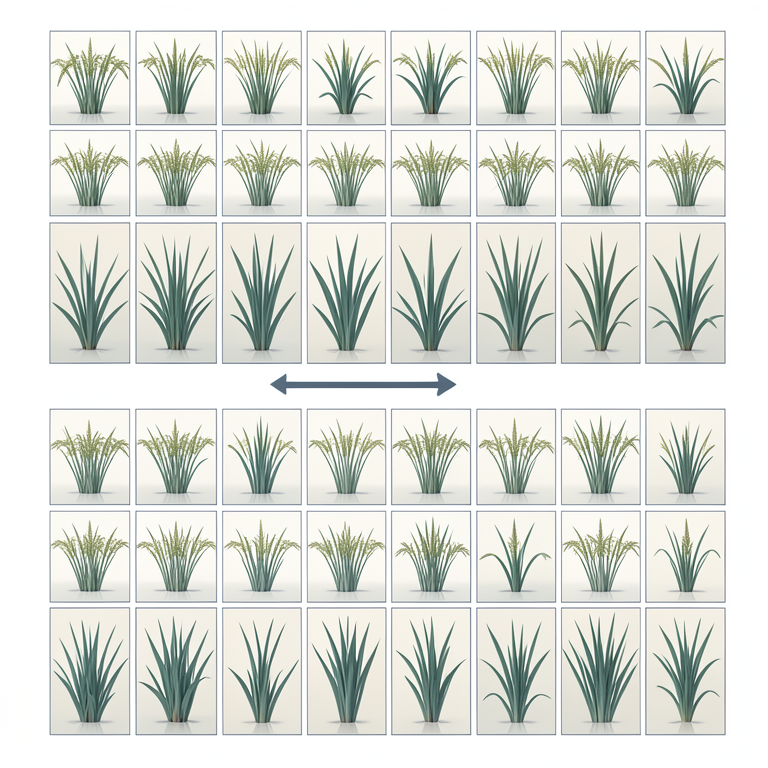
Experimental Design Layout
AI-generated conceptual illustration (Rice plants (Oryza sativa L.) in a field). It explains the idea and does not show study data.
View source evidence ↗Figures & tables
From the original paper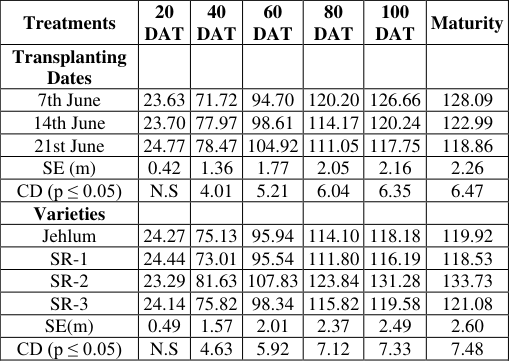 Table 1
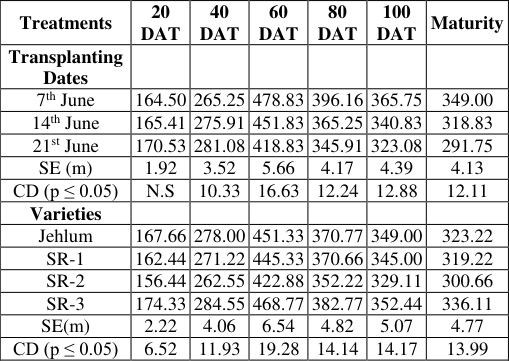 Table 2
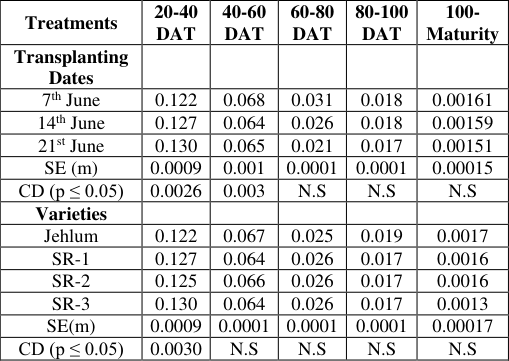 Table 5
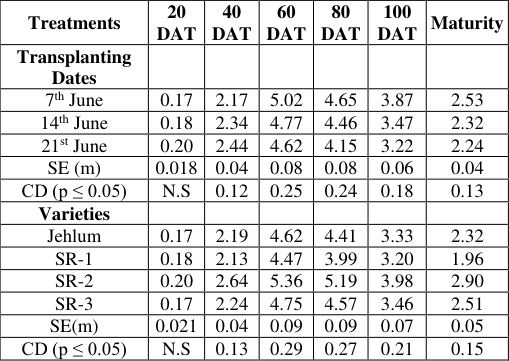 Table 3
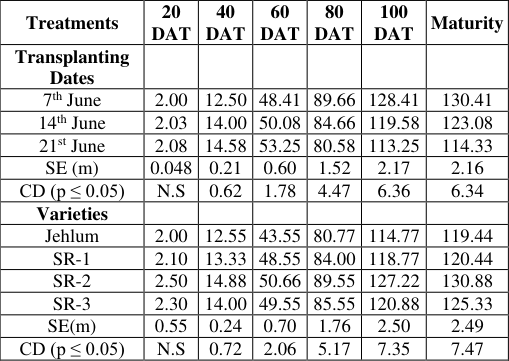 Table 4
Introduction
Rice (Oryza sativa L.) is one of the most important cereal crops globally, serving as a staple food for more than half of the world's population and contributing significantly to food security in developing countries. With the global population projected to reach 9.7 billion by 2050, there is an urgent need to enhance rice productivity to meet the increasing food demand. Rice cultivation covers approximately 165 million hectares worldwide, with Asia accounting for about 90% of global production and consumption. The success of rice cultivation largely depends on appropriate crop management practices, among which transplanting time and variety selection are critical factors that significantly influence plant growth, development, and ultimately yield. The timing of transplanting affects various physiological processes including germination, vegetative growth, reproductive development, and grain filling, while varietal selection determines the genetic potential and adaptability of the crop to specific environmental conditions. Transplanting date is a crucial agronomic decision that affects the entire growth cycle of rice. The optimal transplanting time ensures that the crop experiences favorable environmental conditions during critical growth phases such as tillering, panicle initiation, flowering, and grain filling. Early transplanting may expose the crop to unfavorable temperature conditions during early growth stages, while delayed transplanting can result in exposure to adverse weather conditions during the reproductive phase, potentially reducing yield and quality. The relationship between transplanting date and environmental factors such as temperature, photoperiod, solar radiation, and rainfall distribution plays a pivotal role in determining crop performance. Temperature is particularly important as it influences enzyme activity, metabolic processes, and developmental rates. Photoperiod sensitivity in rice varieties affects the timing of flowering and grain filling, making the synchronization of transplanting date with favorable photoperiodic conditions essential for optimal growth.
Growth parameters measured at 20-day intervals included:
Plant height (cm) using meter scale from soil surface to leaf apex during vegetative stage and panicle tip after emergence Tiller number per m² through direct counting Leaf area index (LAI) calculated as total leaf area per unit ground area Dry matter accumulation (q ha⁻¹) through destructive sampling, sun-drying, and oven-drying at 60-70°C to constant weight Relative growth rate (RGR) using formula: RGR = (loge W₂ -loge W₁)/(T₂ -T₁) Number of leaves per culm through direct counting Data were subjected to analysis of variance using OPSTAT software package, and treatment means were compared using least significant difference (LSD) test at 5% probability level.
Results
Results
Plant Height
Plant height increased consistently up to 100 DAT across all treatments, with marginal increases thereafter. At 20 DAT, transplanting dates showed no significant effect on plant height (23.63-24.77 cm). However, from 40 DAT onward, 7th June transplanting resulted in significantly taller plants (128.09 cm at maturity) compared to 21st June transplanting (118.86 cm), while remaining statistically similar to 14th June transplanting (122.99 cm).
Dry Matter Accumulation
Dry matter production showed significant variation among treatments. Up to 60 DAT, 21st June transplanting accumulated significantly higher dry matter (53.25 q ha⁻¹). However, from 80 DAT to maturity, 7th June transplanting showed superior dry matter accumulation, reaching 130.41 q ha⁻¹ at maturity. Among varieties, SR-2 demonstrated the highest dry matter accumulation capacity, achieving 130.88 q ha⁻¹ at maturity, followed by SR-3 (125.33 q ha⁻¹), SR-1 (120.44 q ha⁻¹), and Jehlum (119.44 q ha⁻¹).
Relative Growth Rate
Relative growth rate varied significantly during early growth periods. At 20-40 DAT, 21st June transplanting recorded higher RGR (0.130 g g⁻¹ day⁻¹), while from 40-60 DAT onward, 7th June transplanting maintained higher values (0.068 g g⁻¹ day⁻¹).
Conclusions
The study demonstrates that both transplanting dates and variety selection significantly influence rice growth parameters. Early transplanting (7th June) generally favored growth characteristics during later developmental stages, particularly for tiller retention, leaf area maintenance, and dry matter accumulation. Among varieties, SR-2 consistently performed better across most growth parameters, while SR-3 showed superior tillering capacity. These findings suggest that for optimal growth performance, early transplanting combined with appropriate variety selection (SR-2 for overall growth, SR-3 for high tillering) would be most beneficial. The interaction between transplanting time and variety characteristics highlights the importance of integrated crop management approaches for maximizing rice production potential.
Figures and tables from the paper
| Treatments | 20 DAT | 40 DAT | 60 DAT | 80 DAT | 100 DAT | Maturity |
|---|---|---|---|---|---|---|
| Transplanting Dates | ||||||
| 7th June | 23.63 | 71.72 | 94.70 | 120.20 | 126.66 | 128.09 |
| 14th June | 23.70 | 77.97 | 98.61 | 114.17 | 120.24 | 122.99 |
| 21st June | 24.77 | 78.47 | 104.92 | 111.05 | 117.75 | 118.86 |
| SE (m) | 0.42 | 1.36 | 1.77 | 2.05 | 2.16 | 2.26 |
| CD (p ≤ 0.05) | N.S | 4.01 | 5.21 | 6.04 | 6.35 | 6.47 |
| Varieties | ||||||
| Jehlum | 24.27 | 75.13 | 95.94 | 114.10 | 118.18 | 119.92 |
| SR-1 | 24.44 | 73.01 | 95.54 | 111.80 | 116.19 | 118.53 |
| SR-2 | 23.29 | 81.63 | 107.83 | 123.84 | 131.28 | 133.73 |
| SR-3 | 24.14 | 75.82 | 98.34 | 115.82 | 119.58 | 121.08 |
| SE(m) | 0.49 | 1.57 | 2.01 | 2.37 | 2.49 | 2.60 |
| CD (p ≤ 0.05) | N.S | 4.63 | 5.92 | 7.12 | 7.33 | 7.48 |
Table text extracted from the original PDF; superscript letters are shown inline. The original table image is below.
View original table image
| Treatments | 20 DAT | 40 DAT | 60 DAT | 80 DAT | 100 DAT | Maturity |
|---|---|---|---|---|---|---|
| Transplanting Dates | ||||||
| 7th June | 164.50 | 265.25 | 478.83 | 396.16 | 365.75 | 349.00 |
| 14th June | 165.41 | 275.91 | 451.83 | 365.25 | 340.83 | 318.83 |
| 21st June | 170.53 | 281.08 | 418.83 | 345.91 | 323.08 | 291.75 |
| SE (m) | 1.92 | 3.52 | 5.66 | 4.17 | 4.39 | 4.13 |
| CD (p ≤ 0.05) | N.S | 10.33 | 16.63 | 12.24 | 12.88 | 12.11 |
| Varieties | ||||||
| Jehlum | 167.66 | 278.00 | 451.33 | 370.77 | 349.00 | 323.22 |
| SR-1 | 162.44 | 271.22 | 445.33 | 370.66 | 345.00 | 319.22 |
| SR-2 | 156.44 | 262.55 | 422.88 | 352.22 | 329.11 | 300.66 |
| SR-3 | 174.33 | 284.55 | 468.77 | 382.77 | 352.44 | 336.11 |
| SE(m) | 2.22 | 4.06 | 6.54 | 4.82 | 5.07 | 4.77 |
| CD (p ≤ 0.05) | 6.52 | 11.93 | 19.28 | 14.14 | 14.17 | 13.99 |
Table text extracted from the original PDF; superscript letters are shown inline. The original table image is below.
View original table image
| Treatments | 20-40 DAT | 40-60 DAT | 60-80 DAT | 80-100 DAT | 100- Maturity |
|---|---|---|---|---|---|
| Transplanting Dates | |||||
| 7th June | 0.122 | 0.068 | 0.031 | 0.018 | 0.00161 |
| 14th June | 0.127 | 0.064 | 0.026 | 0.018 | 0.00159 |
| 21st June | 0.130 | 0.065 | 0.021 | 0.017 | 0.00151 |
| SE (m) | 0.0009 | 0.001 | 0.0001 | 0.0001 | 0.00015 |
| CD (p ≤ 0.05) | 0.0026 | 0.003 | N.S | N.S | N.S |
| Varieties | |||||
| Jehlum | 0.122 | 0.067 | 0.025 | 0.019 | 0.0017 |
| SR-1 | 0.127 | 0.064 | 0.026 | 0.017 | 0.0016 |
| SR-2 | 0.125 | 0.066 | 0.026 | 0.017 | 0.0016 |
| SR-3 | 0.130 | 0.064 | 0.026 | 0.017 | 0.0013 |
| SE(m) | 0.0009 | 0.0001 | 0.0001 | 0.0001 | 0.00017 |
| CD (p ≤ 0.05) | 0.0030 | N.S | N.S | N.S | N.S |
Table text extracted from the original PDF; superscript letters are shown inline. The original table image is below.
View original table image
| Treatments | 20 DAT | 40 DAT | 60 DAT | 80 DAT | 100 DAT | Maturity |
|---|---|---|---|---|---|---|
| Transplanting Dates | ||||||
| 7th June | 0.17 | 2.17 | 5.02 | 4.65 | 3.87 | 2.53 |
| 14th June | 0.18 | 2.34 | 4.77 | 4.46 | 3.47 | 2.32 |
| 21st June | 0.20 | 2.44 | 4.62 | 4.15 | 3.22 | 2.24 |
| SE (m) | 0.018 | 0.04 | 0.08 | 0.08 | 0.06 | 0.04 |
| CD (p ≤ 0.05) | N.S | 0.12 | 0.25 | 0.24 | 0.18 | 0.13 |
| Varieties | ||||||
| Jehlum | 0.17 | 2.19 | 4.62 | 4.41 | 3.33 | 2.32 |
| SR-1 | 0.18 | 2.13 | 4.47 | 3.99 | 3.20 | 1.96 |
| SR-2 | 0.20 | 2.64 | 5.36 | 5.19 | 3.98 | 2.90 |
| SR-3 | 0.17 | 2.24 | 4.75 | 4.57 | 3.46 | 2.51 |
| SE(m) | 0.021 | 0.04 | 0.09 | 0.09 | 0.07 | 0.05 |
| CD (p ≤ 0.05) | N.S | 0.13 | 0.29 | 0.27 | 0.21 | 0.15 |
Table text extracted from the original PDF; superscript letters are shown inline. The original table image is below.
View original table image
| Treatments | 20 DAT | 40 DAT | 60 DAT | 80 DAT | 100 DAT | Maturity |
|---|---|---|---|---|---|---|
| Transplanting Dates | ||||||
| 7th June | 2.00 | 12.50 | 48.41 | 89.66 | 128.41 | 130.41 |
| 14th June | 2.03 | 14.00 | 50.08 | 84.66 | 119.58 | 123.08 |
| 21st June | 2.08 | 14.58 | 53.25 | 80.58 | 113.25 | 114.33 |
| SE (m) | 0.048 | 0.21 | 0.60 | 1.52 | 2.17 | 2.16 |
| CD (p ≤ 0.05) | N.S | 0.62 | 1.78 | 4.47 | 6.36 | 6.34 |
| Varieties | ||||||
| Jehlum | 2.00 | 12.55 | 43.55 | 80.77 | 114.77 | 119.44 |
| SR-1 | 2.10 | 13.33 | 48.55 | 84.00 | 118.77 | 120.44 |
| SR-2 | 2.50 | 14.88 | 50.66 | 89.55 | 127.22 | 130.88 |
| SR-3 | 2.30 | 14.00 | 49.55 | 85.55 | 120.88 | 125.33 |
| SE(m) | 0.55 | 0.24 | 0.70 | 1.76 | 2.50 | 2.49 |
| CD (p ≤ 0.05) | N.S | 0.72 | 2.06 | 5.17 | 7.35 | 7.47 |
Table text extracted from the original PDF; superscript letters are shown inline. The original table image is below.
View original table image
References
22 in the original paper- Ahmad S, Iqbal N, Hussain S, Ullah A, Ahmad A. Effect of transplanting date on yield and yield International Journal of Agriculture and Food Science https://www.agriculturaljournals.com components of different rice varieties. J Agric Res. 2019;57(2):89-96.
- Bhuiya MSU, Khatun A, Mian MH. Growth and yield performance of aromatic rice varieties as influenced by different transplanting dates. Bangladesh J Agric Res. 2018;43(3):457-468.
- Das SK, Bhowal SK, Senapati BK, Reddy MD. Effect of transplanting dates on growth parameters and yield of hybrid rice varieties. Int J Curr Microbiol Appl Sci. 2020;9(4):1245-1253.
- Gautam AK, Singh KN, Singh RK, Kumar S. Influence of transplanting date on growth, development and productivity of basmati rice (Oryza sativa L.) varieties. J Pharmacogn Phytochem. 2018;7(4):894-899.
- Gomez KA, Gomez AA. Statistical procedures for agricultural research. 2nd ed. New York: John Wiley & Sons; 1984.
- Hassan MS, Mahmud F, Haque MN, Bhuiya MSU. Performance evaluation of BRRI developed rice varieties under different transplanting dates. J Bangladesh Agric Univ. 2019;17(3):318-324.
- International Rice Research Institute (IRRI). Rice almanac: source book for one of the most important food crops in the world. 4th ed. Los Baños (Philippines): IRRI; 2018.
- Jackson ML. Soil chemical analysis. New Delhi: Prentice Hall of India Pvt Ltd; 1967.
- Jackson ML. Soil chemical analysis. New Delhi: Prentice Hall of India Pvt Ltd; 1973.
- Jones JW, Hoogenboom G, Porter CH, Boote KJ, Batchelor WD, Hunt LA, et al. The DSSAT cropping system model. Eur J Agron. 2003;18(3-4):235-265.
- Kumar A, Nayak AK, Mohanty S, Das BS, Goswami R. Effects of water deficit stress on agronomic and physiological responses of rice and greenhouse gas emission from rice soil under elevated atmospheric CO₂. Sci Total Environ. 2018;650:2032-2050.
- Mishra BN, Prasad R, Gangaiah B, Shukla L. Effect of transplanting date on productivity, profitability and sustainability of rice (Oryza sativa L.) varieties. Indian J Agric Sci. 2017;87(8):1085-1089.
- Mondal MH, Bhuiya MSU, Maniruzzaman M, Roy MK, Hoque MM. Effect of transplanting dates on the growth and yield performance of transplanted aman rice varieties. Asian J Med Biol Res. 2019;5(1):56-62.
- Olsen SR, Cole CV, Watanabe FS, Dean LA. Estimation of available phosphorus in soils by extraction with sodium bicarbonate. USDA Circ. 1954;939:1-19.
- Pal S, Datta KK, Sharma VP, Sharma AK. An assessment of the impact of transplanting date on rice yield in different agro-climatic zones. Agric Syst. 2017;155:123-130.
- Piper CS. Soil and plant analysis. Bombay: Hans Publishers; 1966.
- Rahman MA, Chikushi J, Saifizzaman M, Lauren JG. Rice cultivars vary in sensitivity to high temperature stress during reproductive stage. Environ Exp Bot. 2020;169:103887.
- Singh RK, Singh Y, Xalxo MS, Verulkar SB. From QTL to variety-harnessing the benefits of QTLs for drought, flood and salt tolerance in mega rice varieties of India through a multi-institutional network. Plant Sci. 2016;242:278-287.
- Subbiah BV, Asija GL. A rapid procedure for the estimation of available nitrogen in soils. Curr Sci. 1956;25:259-260.
- Summerfield RJ, Roberts EH, Ellis RH, Lawn RJ. Towards the reliable prediction of time to flowering in six annual crops. IV. Cultivated and wild soya bean. Exp Agric. 1992;28(3):269-289.
- Xu L, Yuan S, Wang X, Chen Z, Li X, Christie P. Effect of organic manure application on rice yield, nutrient uptake, and soil fertility in a red paddy soil. Nutr Cycl Agroecosyst. 2018;110(3):481-492.
- Yoshida S. Fundamentals of rice crop science. Los Baños (Philippines): International Rice Research Institute; 1981.