
Research article · 2025 · Full text
International Journal of Agriculture and Food ScienceKnowledge and utilization of capacity building programmes under CAAST-CSAWM project on students and faculty of MPKV, Rahuri
Volume 7(12) · Pages 370–373 · DOI: 10.33545/2664844x.2025.v7.i12e.1065 ↗
Research areasAgricultural Systems and PracticesLivestock Management and Performance ImprovementInnovations and Analysis in Business and Education
Abstract
Author-writtenThe study was conducted to assess the knowledge and utilization of the Capacity Building Programme implemented under the CAAST-CSAWM project at Mahatma Phule Krishi Vidyapeeth (MPKV), Rahuri. The programme, initiated in 2018 under NAHEP-ICAR, aims to strengthen education, research, and skills in climate-smart agriculture, water management, geo-informatics, drones, robotics, IoT, and precision farming. A total of 150 beneficiaries, including postgraduate students and faculty who participated in multiple training programmes from 2018 to 2023, were selected through random sampling. An ex-post facto research design was used, and data were collected through a structured Google Form schedule. The data were analyzed using frequency, percentage, range, and Karl Pearson’s correlation coefficient. The findings revealed that all respondents (100.00%) were aware of the CAAST-CSAWM project, indicating that majority of participants demonstrated high knowledge of the thematic areas covered, especially in GIS, drones, IoT, robotics, precision agriculture, and crop-water relationships. 66.00% of respondents had a high level of knowledge, while 06.00% showed a low level. In terms of utilization, 54.67% of the respondents showed medium utilization of the acquired knowledge, and 27.33% demonstrated high utilization. Beneficiaries frequently applied the learning in research work, teaching, field activities, and extension work. The study concludes that the CAAST-CSAWM Capacity Building Programme has been highly effective in enhancing knowledge and promoting practical application of climate-smart and precision agriculture technologies among students and faculty. The programme fostered sustained learning, motivated research, and strengthened professional competence, demonstrating its significant contribution to agricultural education and capacity development at MPKV Rahuri.
Summary
Source-checkedPlain-language reading of the full paper, prepared with AI and checked against the text. Each point links to the authors' own words.
Why it matters
- The CAAST-CSAWM project was established in 2018 to improve education and skills in advanced agricultural fields such as climate-smart agriculture, water management, and precision farming. View evidence ↗
- A primary goal of the project is to build the professional capacity of faculty and postgraduate students (M.Sc./M.Tech and PhD) to enhance research and education. View evidence ↗
- The center has conducted 468 capacity building programs, reaching 82,520 participants, including farmers, students, and faculty. View evidence ↗
The question
- The study aimed to evaluate the level of knowledge acquired and how that knowledge was utilized by beneficiaries of the CAAST-CSAWM Capacity Building Programme. View evidence ↗
What they did
- The researchers used an ex-post facto research design because the training events had already taken place. View evidence ↗
- The sample consisted of 150 randomly selected respondents who participated in multiple training programs between 2018 and 2023. View evidence ↗
- Data were gathered using online Google Forms and analyzed through frequency, percentage, range, and Karl Pearson’s correlation coefficient. View evidence ↗
What they found
- All 150 respondents (100%) were aware of the CAAST-CSAWM project at their institution. View evidence ↗
- 86.00% of respondents reported gaining new knowledge in Geo-informatics, GIS, drones, robotics, IoTs, and precision agriculture. View evidence ↗
- A majority of the participants (66.00%) were categorized as having a high level of knowledge regarding the program's objectives and content. View evidence ↗
- The most common level of utilization was medium, reported by 54.67% of the respondents. View evidence ↗
- 27.33% of the respondents demonstrated a high level of utilization of the knowledge gained. View evidence ↗
- A substantial majority of respondents regularly integrated training content into their academic and research work, with 34.67% using it very frequently and 44.67% using it frequently. View evidence ↗
- Knowledge sharing with farmers and students was common, with 35.33% doing so very frequently and 46.67% frequently. View evidence ↗
What it means
- The authors conclude that the CAAST-CSAWM Capacity Building Programme had a strong positive impact on the knowledge and professional development of both faculty and students. View evidence ↗
- The program is considered successful in promoting sustained learning and the practical implementation of advanced agricultural technologies. View evidence ↗
Visual summary
2 visualsIllustrations explain the paper; charts are replotted from the paper's own table values.
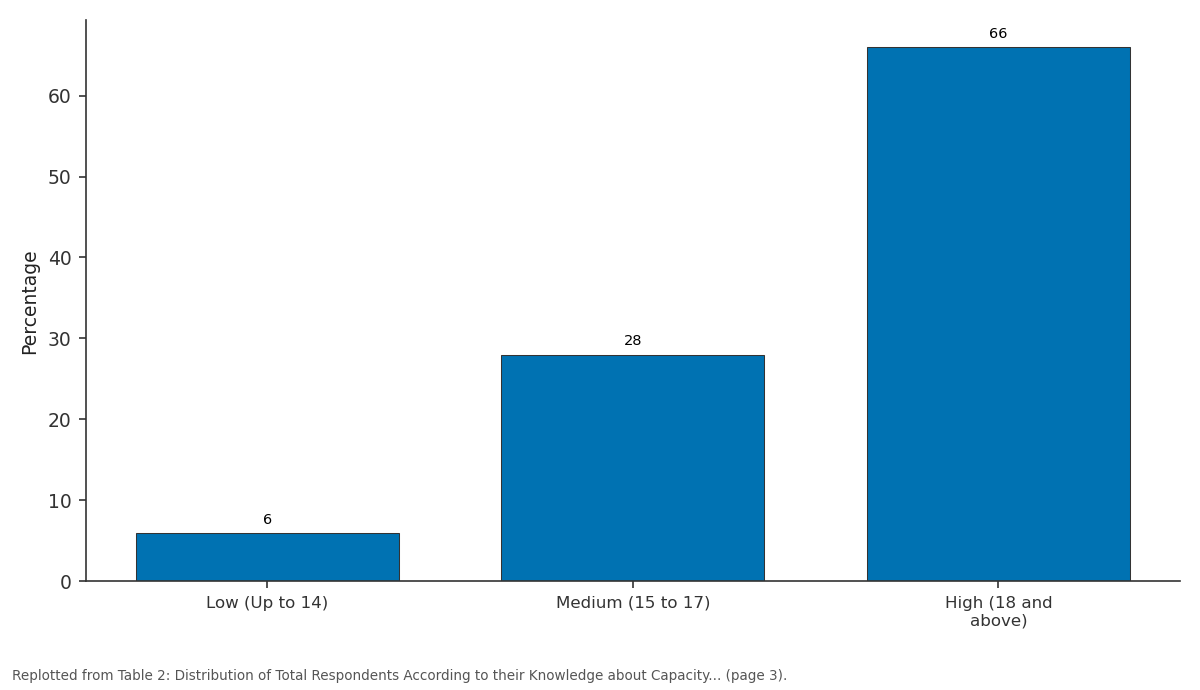
Percentage: Low (Up to 14) vs Medium (15 to 17) vs High (18 and above)
Replotted from Table 2 (page 3) of the original paper. Every bar is the paper's own table value.
View source evidence ↗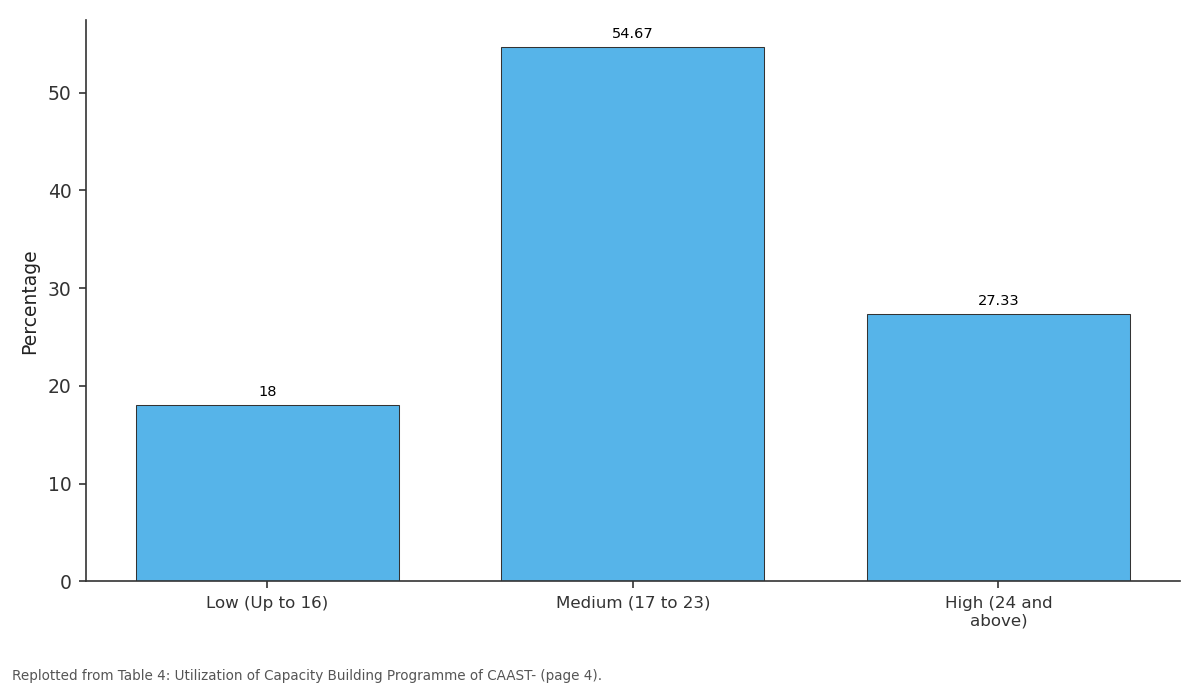
Percentage: Low (Up to 16) vs Medium (17 to 23) vs High (24 and above)
Replotted from Table 4 (page 4) of the original paper. Every bar is the paper's own table value.
View source evidence ↗Figures & tables
From the original paper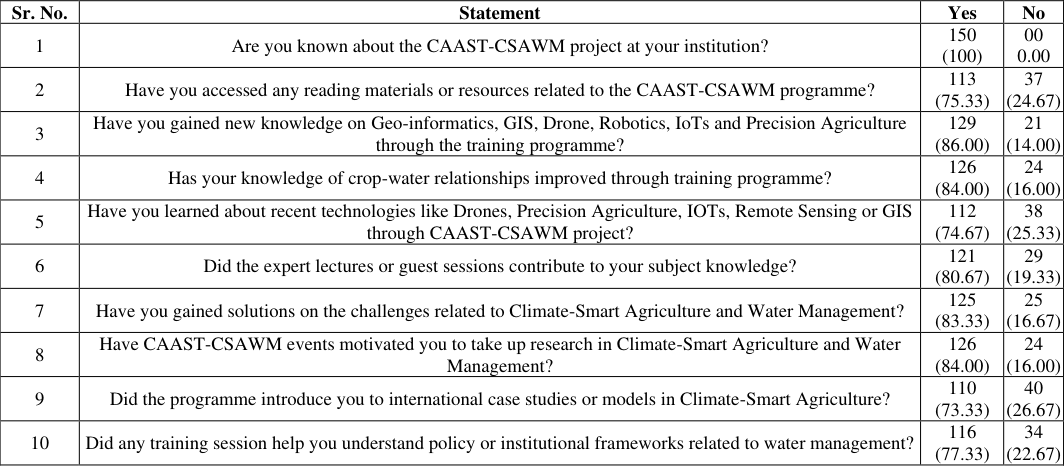 Table 1
 Table 2
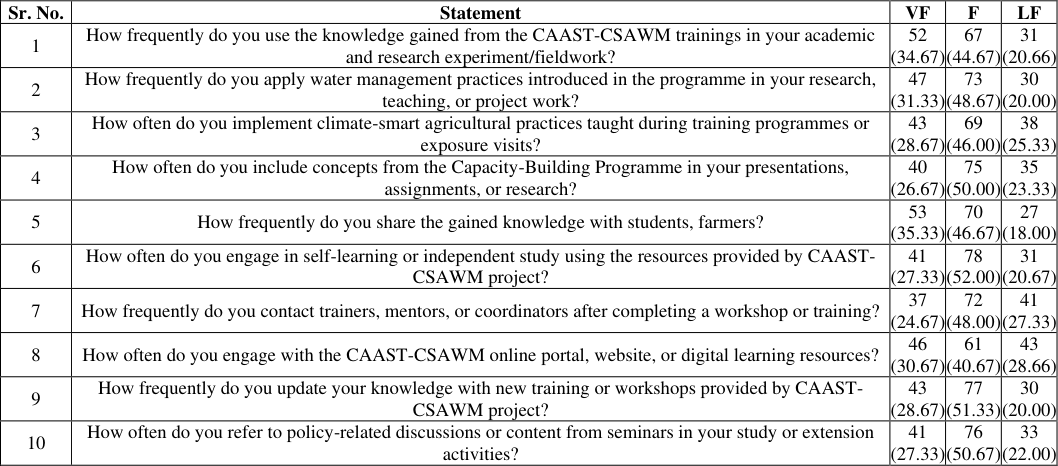 Table 3
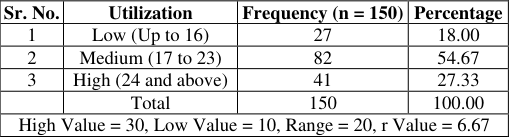 Table 4
Introduction
The Centre for Advanced Agricultural Science and Technology (CAAST) for Climate Smart Agriculture and Water Management (CSAWM) is functional since 2018 at Mahatma Phule Krishi Vidyapeeth (MPKV), Rahuri. It is implemented through the National Agricultural Higher Education Project (NAHEP), a flagship project of the Indian Council of Agricultural Research (ICAR) New Delhi. Its thrust areas are viz. climate smart agriculture and water management, Geo-informatics (RS/GIS), UAVs (Drone), Robotics, IoT, and precision agriculture. One of the objective of the project is to strengthen education, research and to build capacity amongst postgraduate students (M.Sc./M.Tech and PhD) and faculties of this university and other organizations. As a part of this, the centre has been conducting a series of workshops and training programmes for the benefit of students and faculty of the University since 2018. The focus of this centre has been to develop the capacity for the development and adoption of climate smart agriculture and precision water management technologies amongst the students and faculties of MPKV Rahuri through International/National training, studentsindustry interface, symposia, guest lectures, exposure visits and demonstrations on different thematic areas. Based on the specific thematic areas, this centre organized 468 national and international capacity building programmes through offline and online modes and developed the capacity of 82,520 participants comprising faculties, students, and farmers. (https://www.mpkv-caast.ac.in/)
Methodology
The present study aimed to assess the personal, socioeconomic, communicational, and psychological characteristics of beneficiaries of the CAAST-CSAWM Capacity Building Programme, as well as their knowledge level and utilization of the training. An ex-post facto research design, as suggested by Kerlinger (1976), was employed since the training and independent variables had already occurred. The study was conducted at Mahatma Phule Krishi Vidyapeeth (MPKV), Rahuri, covering M.Sc. and Ph.D. students and faculty from districts including Kolhapur, Sangli, Satara, Solapur, Pune, Ahmednagar, Nashik, Dhule, Nandurbar, and Jalgaon, where the CAAST-CSAWM centre operates in hybrid mode. 150 Respondents were randomly selected based on their participation in multiple training programmes from 2018 to 2023. Knowledge and utilization were assessed through structured schedules, The interview schedule was pre-tested on a nonsample group at MPKV for clarity and relevance. Data were collected online via Google Forms and analyzed using frequency, percentage, range, and Karl Pearson's coefficient of correlation to determine the relationship between independent variables and knowledge and utilization.
Results and Discussion
Knowledge: Knowledge represents the degree to which an individual possesses accurate information and understanding about a particular innovation, technology, concept, enabling informed decision-making and adoption. Table 1, illustrates the knowledge level of respondents regarding various aspects of the CAAST-CSAWM project and its related training programmes. All respondents 100 percent were aware of the CAAST-CSAWM project at their institution. A majority of respondents 75.33 percent reported accessing reading materials or resources related to the programme, indicating good engagement with the provided content. Regarding knowledge gained through the training, 86.00 percent of respondents acknowledged learning about Geo-informatics, GIS, drones, robotics, IoTs and precision agriculture, while 84.00 percent reported an improved understanding of crop-water relationships. Knowledge of recent technologies such as drones, precision agriculture, IoTs, remote sensing and GIS gained by 74.67 percent of respondents, suggesting the training successfully imparted current technical information. The contribution of expert lectures and guest sessions was recognized by 80.67 percent, highlighting the importance of expert input in enhancing subject knowledge. About 83.33 percent felt they gained solutions to challenges related to climate-smart agriculture and water management and were motivated by the programme events to pursue research in these areas. International case studies or models in climatesmart agriculture introduced by the programme were acknowledged by 73.33 percent of respondents. Similarly, the 77.33 percentage felt that training sessions helped them understand relevant policy or institutional frameworks related to water management. Table 2, reveal that a majority of the respondents, 66.00 percent, were come under the high knowledge category, indicating a strong understanding of the programme's objectives, content and relevance. About 28.00 percent of respondents fell into the medium knowledge category and 6.00 percent of respondents were found to have a low level of knowledge. The findings suggest that the majority of beneficiaries have gained substantial knowledge through the capacity building initiatives, which is a positive indicator of the programme's success in promoting awareness in climate-smart agriculture and water management practices. Finding is similar with work of Woreta et. al. (2013) [4] , Bansode and Narfide (2014) [1] .
| Sr. No. | Knowledge | Frequency (n = 150) | Percentage |
|---|---|---|---|
| 1 | Low (Up to 14) | 09 | 06.00 |
| 2 | Medium (15 to 17) | 42 | 28.00 |
| 3 | High (18 and above) | 99 | 66.00 |
| Total | 150 | 100.00 | |
| High Value = 20, Low Value = 11, Range = 9, r Value = 3 |
Table text extracted from the original PDF; superscript letters are shown inline. The original table image is below.
View original table image
| Sr. No. | Statement | Yes | No |
|---|---|---|---|
| 1 | Are you known about the CAAST-CSAWM project at your institution? | 150 (100) | 00 0.00 |
| 2 | Have you accessed any reading materials or resources related to the CAAST-CSAWM programme? | 113 (75.33) | 37 (24.67) |
| 3 | Have you gained new knowledge on Geo-informatics, GIS, Drone, Robotics, IoTs and Precision Agriculture through the training programme? | 129 (86.00) | 21 (14.00) |
| 4 | Has your knowledge of crop-water relationships improved through training programme? | 126 (84.00) | 24 (16.00) |
| 5 | Have you learned about recent technologies like Drones, Precision Agriculture, IOTs, Remote Sensing or GIS through CAAST-CSAWM project? | 112 (74.67) | 38 (25.33) |
| 6 | Did the expert lectures or guest sessions contribute to your subject knowledge? | 121 (80.67) | 29 (19.33) |
| 7 | Have you gained solutions on the challenges related to Climate-Smart Agriculture and Water Management? | 125 (83.33) | 25 (16.67) |
| 8 | Have CAAST-CSAWM events motivated you to take up research in Climate-Smart Agriculture and Water Management? | 126 (84.00) | 24 (16.00) |
| 9 | Did the programme introduce you to international case studies or models in Climate-Smart Agriculture? | 110 (73.33) | 40 (26.67) |
| 10 | Did any training session help you understand policy or institutional frameworks related to water management? | 116 (77.33) | 34 (22.67) |
Table text extracted from the original PDF; superscript letters are shown inline. The original table image is below.
View original table image
Utilization: It represents the adoption and practical application of innovations, information, or skills gained through training, demonstrations, or educational programmes. Table 3 reflect the application of knowledge in academic and research experiments or fieldwork. 34.67 percent of respondents reported very frequent use, while 44.67 percent used it frequently, indicating that a substantial majority integrate the training content into their work regularly. 31.33 percent very frequently and 48.67 percent frequently applied water management practices introduced by the programme in their research, teaching, or projects. Climate-smart agricultural practices taught during training were very frequently implemented by 28.67 percent and frequently by 46.00 percent of respondents. When it comes to incorporating concepts from the capacity-building programme into presentations, assignments, or research, 26.67 percent reported very frequent and 50.00 percent frequent usage. Sharing gained knowledge with students and farmers was also notable, with 35.33 percent doing so very frequently and 46.67 percent frequently. Engagement in self-learning or independent study using provided resources was very frequent for 27.33 percent and frequent for 52.00 percent of respondents. Contacting trainers, mentors, or coordinators post-training was very frequent for 24.67 percent and frequent for 48.00 percent. Use of the online portal or digital resources was very frequent for 3067 percent and frequent for 40.67 percent. Regarding updating knowledge through new trainings or workshops, 26.67 percent very frequently and 51.33 percent frequently did so. Finally, referring to policy-related discussions or seminar content in study or extension activities was very frequent for 27.33 percent and frequent for 50.67 percent of respondents. The study supports to the findings of Kulkarni et al. (2021) [3] . 4 indicate that 54.67 percent of the respondents fell into the medium utilization category, suggesting that most participants are applying the knowledge and skills gained from the programme to a moderate extent in their academic, research, or extension activities. A considerable 27.33 percent of respondents were found in the high utilization category. 18.00 percent of the respondents reported low utilization. This observation is consistent with the reported by Kavitha (2015) [1] .
| Sr. No. | Statement | VF | F | LF |
|---|---|---|---|---|
| 1 | How frequently do you use the knowledge gained from the CAAST-CSAWM trainings in your academic and research experiment/fieldwork? | 52 (34.67) | 67 (44.67) | 31 (20.66) |
| 2 | How frequently do you apply water management practices introduced in the programme in your research, teaching, or project work? | 47 (31.33) | 73 (48.67) | 30 (20.00) |
| 3 | How often do you implement climate-smart agricultural practices taught during training programmes or exposure visits? | 43 (28.67) | 69 (46.00) | 38 (25.33) |
| 4 | How often do you include concepts from the Capacity-Building Programme in your presentations, assignments, or research? | 40 (26.67) | 75 (50.00) | 35 (23.33) |
| 5 | How frequently do you share the gained knowledge with students, farmers? | 53 (35.33) | 70 (46.67) | 27 (18.00) |
| 6 | How often do you engage in self-learning or independent study using the resources provided by CAAST- CSAWM project? | 41 (27.33) | 78 (52.00) | 31 (20.67) |
| 7 | How frequently do you contact trainers, mentors, or coordinators after completing a workshop or training? | 37 (24.67) | 72 (48.00) | 41 (27.33) |
| 8 | How often do you engage with the CAAST-CSAWM online portal, website, or digital learning resources? | 46 (30.67) | 61 (40.67) | 43 (28.66) |
| 9 | How frequently do you update your knowledge with new training or workshops provided by CAAST- CSAWM project? | 43 (28.67) | 77 (51.33) | 30 (20.00) |
| 10 | How often do you refer to policy-related discussions or content from seminars in your study or extension activities? | 41 (27.33) | 76 (50.67) | 33 (22.00) |
Table text extracted from the original PDF; superscript letters are shown inline. The original table image is below.
View original table image
Conclusion
The study revealed that the CAAST-CSAWM Capacity Building Programme at MPKV, Rahuri has made a strong positive impact on both students and faculty. The programme successfully improved their knowledge in important areas like climate-smart agriculture, water management, GIS, drones, IoT, robotics, and precision farming. Most participants were well aware of the project and actively used the learning materials, expert lectures, and training sessions provided. It indicated that the CAAST-CSAWM programme effectively disseminated up-to-date knowledge and practical solutions related to advanced agricultural technologies and climate-smart practices. Expert contributions and comprehensive resources played a key role in enhancing participants understanding and motivation to engage in research, underscoring the programme's success in capacity building. The most beneficiaries used the knowledge learned through capacity building programme in their academic work, research, presentations, and field activities. The presence of higher utilizers which reflects the programme's practical value and potential impact when supported by adequate opportunities and resources. Most respondents regularly integrate the training content into project, research and extension activities and actively engage in self-learning, digital resource use and ongoing communication with mentors. This reflects the programme's success in fostering sustained learning, practical implementation and professional development among participants.
Acknowledgement
AcknowledgementThe authors express their sincere gratitude to all the respondents-students and faculty members of MPKV, Rahuri-for their valuable cooperation and willingness to share information regarding their knowledge and utilization of the Capacity Building Programmes under the CAAST-CSAWM Project.
Figures and tables from the paper
| Sr. No. | Utilization | Frequency (n = 150) | Percentage |
|---|---|---|---|
| 1 | Low (Up to 16) | 27 | 18.00 |
| 2 | Medium (17 to 23) | 82 | 54.67 |
| 3 | High (24 and above) | 41 | 27.33 |
| Total | 150 | 100.00 | |
| High Value = 30, Low Value = 10, Range = 20, r Value = 6.67 |
Table text extracted from the original PDF; superscript letters are shown inline. The original table image is below.
View original table image
References
5 in the original paper- Bansode SY, Nargide B. Information seeking behavior of B-School faculty members in digital environment: a case study. Int J Inf Dissemin Technol. 2014;4(2):130134.
- Kavitha S, Anandaraja N. Kisan Call Centre services to the farming community. Int J Agric Ext. 2017;5(2):4552.
- Kulkarni SA, Pawar RS, Kale MS. Impact assessment of CAAST-CSAWM training on student competency and knowledge enhancement. J Agric Ext Educ. 2021;57(3):112-118.
- Woreta SA, Kebede Y, Zegeye DT. Knowledge and utilization of information communication technology (ICT) among health science students at the University of Gondar, north-western Ethiopia. BMC Med Inform Decis Mak. 2013;13:1-7.
- Centre for Advanced Agricultural Science and Technology for Climate Smart Agriculture & Water Management (CAAST-CSAWM), MPKV Rahuri. About us [Internet]. Rahuri (India): Mahatma Phule Krishi Vidyapeeth; n.d. [cited 2025 Dec 3]. Available from: https://www.mpkv-caast.ac.in/ Centre for Advanced Agricultural Science and Technology for Climate Smart Agriculture & Water Management (CAAST-CSAWM). CAAST-CSAWM capacity-building programme details [Internet]. Rahuri (India): Mahatma Phule Krishi Vidyapeeth; n.d. [cited 2025 Dec 3]. Available from: https://www.mpkvcaast.ac.in/page/caastapps