
Research article · 2025 · Full text
International Journal of Agriculture and Food ScienceIndoor plants: A solution for indoor air pollution
Volume 7(12) · Pages 317–319 · DOI: 10.33545/2664844x.2025.v7.i12d.1059 ↗
Research areasIndoor Air Quality and Microbial ExposurePlant responses to elevated CO2Air Quality and Health Impacts
Abstract
Author-writtenAir pollution in India is a serious problem which affects the human health. There are many types of air pollution but indoor air pollution is very serious and dangerous to human health .Indoor air pollution is a huge, often overlooked issue, particularly in countries like India, where rapid urbanization, industrialization, and population growth are contributing to worsening air quality. People often don't realize how much indoor environments can be contaminated, not just by outdoor pollutants that enter, but by indoor sources like cooking fumes, cleaning products, and building materials. It's also alarming how many health problems are linked to poor indoor air quality, such as respiratory issues, headaches, and even long-term diseases like asthma, cardiovascular issues, and cancer. One of the most effective and natural ways to combat indoor air pollution is by using air-purifying plants. These plants help absorb harmful chemicals, increase oxygen levels, and improve overall air quality. Air-purifying plants naturally remove toxins from the air, inspire creativity and focus, increase mental health, serve as natural humidifiers, and bring life to a home.
Summary
Source-checkedPlain-language reading of the full paper, prepared with AI and checked against the text. Each point links to the authors' own words.
Why it matters
- Indoor air pollution is a critical health threat in India, often overlooked despite its danger to human health. View evidence ↗
- Indoor environments are contaminated by both infiltrating outdoor pollutants and internal sources such as building materials, cleaning products, and cooking fumes. View evidence ↗
- Poor indoor air quality is linked to a range of health issues, from immediate symptoms like headaches and respiratory problems to chronic diseases including cancer and cardiovascular issues. View evidence ↗
The question
- The authors aim to highlight the need for effective mitigation strategies for indoor air quality in densely populated countries like India, China, and the US. View evidence ↗
What they did
- The authors selected a set of important indoor plants found in the Rohtak region of Haryana and identified their air-purifying benefits using existing published literature. View evidence ↗
- The mechanism for air purification involves plants absorbing pollutants via roots and leaves, supplemented by soil microbes that break down harmful substances. View evidence ↗
What they found
- Poor indoor air quality can lead to Sick Building Syndrome (SBS), characterized by allergies, headaches, skin problems, and irritation of the throat, nose, and eyes. View evidence ↗
- Approximately 3 billion people globally use solid fuels like coal, charcoal, and crop residues for heating and cooking, contributing to indoor pollution. View evidence ↗
- The Spider Plant (Chlorophytum comosum) is effective at removing benzene, carbon monoxide, xylene, and formaldehyde. View evidence ↗
- Pothos (Epipremnum aureum) can remove carbon monoxide, toluene, xylene, formaldehyde, and benzene. View evidence ↗
- The Broad Lady Palm (Rhapis excelsa) removes a wide range of pollutants, including toluene, xylene, formaldehyde, nitrogen oxide, benzene, and ammonia. View evidence ↗
- The Snake Plant (Dracaena trifasciata) contributes to air purification by releasing oxygen during the night. View evidence ↗
- The ZZ Plant (Zamioculcas zamiifolia) is noted for removing toxic gases and carbon dioxide (CO₂). View evidence ↗
What it means
- The authors conclude that the use of interior plants will grow as public awareness of sustainability increases. View evidence ↗
- The authors state that further research is needed to select plant species based on their physiological, anatomical, and morphological traits for better air phytoremediation. View evidence ↗
Visual summary
1 visualsIllustrations explain the paper; they do not show study data.
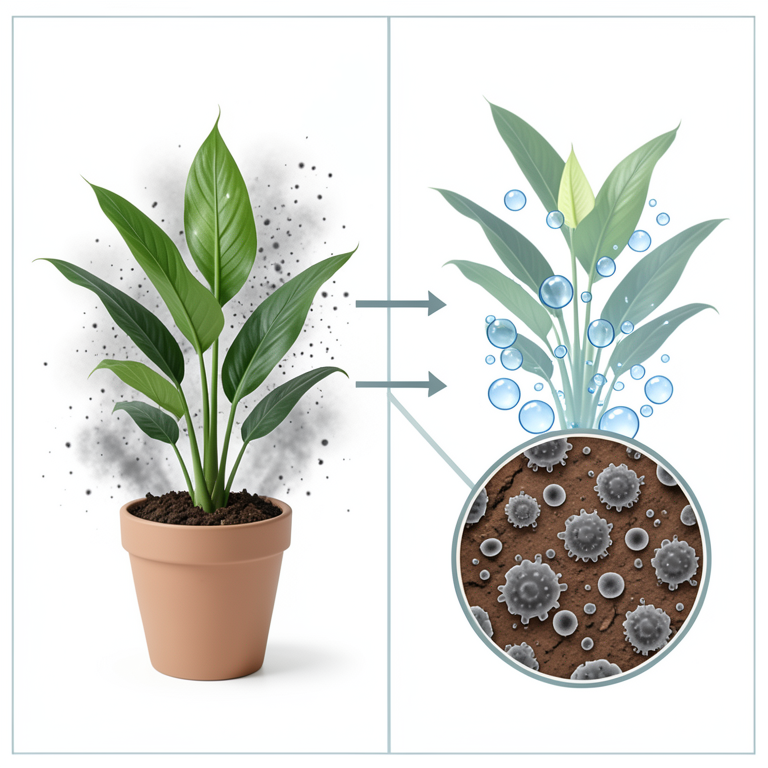
Plant Air Purification Mechanism
AI-generated conceptual illustration (potted indoor peace lily plant in a living room setting). It explains the idea and does not show study data.
View source evidence ↗Figures & tables
From the original paper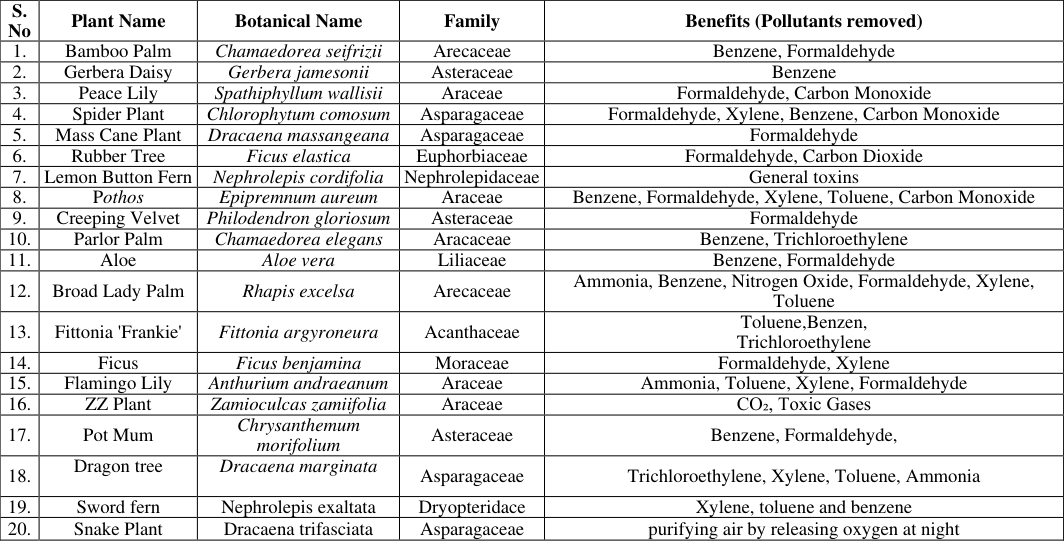 Table 1
Introduction
Air pollution has caused major concern over the world due to its widespread nature, damage to our environment and potential health risk to humans. There are many types of air pollution but indoor air pollution is very serious and dangerous to human health .Indoor air pollution refers to chemical, biological and physical contamination of indoor air. Indoor air pollutants range from biological contaminants like mild and bacteria to chemical pollutants, including toxic gases and volatile organic compounds (Bandehali et.al 2021) [1] . Like outdoor pollution, indoor air pollution might not always be apparent. It could stem from everyday household products, construction materials, or our methods to keep indoor environments comfortable. For example, poor ventilation can trap pollutants inside, and something as mundane as cooking can release harmful particles into the air. Indoor air pollution can be much higher than outdoor levels due to limited ventilation. The lack of fresh air circulation means pollutants can accumulate quickly, leading to higher concentrations. This can be exacerbated in energy-efficient buildings where airflow is minimized to conserve energy. The immediate health impact can be more profound, leading to headaches, fatigue, respiratory issues, and long-term chronic illnesses. According to the World Health Organization (WHO), approximately 3 billion people worldwide still rely on solid fuels such as waste wood, charcoal, coal, dung, and crop residues for cooking and heating. These fuels are often burned on open fires or traditional stoves, releasing a significant amount of air pollutants, including sulfur dioxide (SO₂), nitrogen oxides (NOₓ), carbon monoxide (CO), and particulate matter (PM) (WHO, 2014) [15] . In poorly ventilated spaces, these pollutants can accumulate to hazardous levels, posing serious health risks to the inhabitants. In addition to combustion sources, indoor environments are also affected by anthropogenic sources such as wooden construction materials, oil-based paints, scented decorative items, and even some types of indoor plants, all of which can emit volatile organic compounds (VOCs) at varying concentrations. Some indoor air pollutants like NOₓ, SO₂, ozone (O₃), and PM are common to both indoor and outdoor air, and may also infiltrate from outdoor sources (Wayon,2004) [12] . These pollutants can be inorganic, organic, biological, or even radioactive in nature. With a large portion of the population Spending most of their time indoors, improving indoor air
Types of Indoor Air Pollutants
There are numerous types of indoor air pollutants that originate from various sources within homes and office buildings. Some of these pollutants are generated indoors, while others infiltrate from the outdoor environment and become trapped due to poor ventilation (Sharma S et al 2022) [10] . Below are some of the most common indoor air pollutants, along with their sources and associated health effects 1. Particulate Matter (PM2.5 and PM10): Fine particulate matter, especially PM2.5 and PM10, is often present at elevated levels indoors. These particles originate from sources such as cooking, burning candles or incense, and smoking. Due to the confined nature of indoor spaces, these particles can quickly accumulate, leading to poor air quality.
Volatile Organic Compounds (VOCs):
VOCs are typically more concentrated indoors than outdoors, emitted by products such as cleaning agents, paints, varnishes, adhesives, and synthetic furnishings. Activities like painting or frequent cleaning without proper ventilation can significantly increase VOC levels. Exposure to VOCs may result in symptoms such as headaches, dizziness, fatigue, and long-term effects with prolonged exposure.
Carbon monoxide (CO) and radon are two of the most dangerous indoor air pollutants. CO can accumulate from unvented gas stoves, heaters, or faulty appliances, and is especially hazardous due to its odourless and colorless nature. Radon, a naturally occurring radioactive gas, can enter buildings through cracks in the foundation. Both gases pose serious health risks, including the potential for fatal poisoning in the case of carbon monoxide.
The impact of these air pollutants on human health depends on several factors, including toxicity, concentration, and duration of exposure. Health effects can vary widely among individuals. One common condition associated with poor indoor air quality is Sick Building Syndrome (SBS), in which occupants experience symptoms such as irritation of the eyes, nose, and throat, skin problems, headaches, and allergies. Interestingly, these symptoms often subside after the person leaves the affected building (Wargocki et al, 2000) [11] . ,2020 [2,4,5,7,16,8,13,9,6] .
Role of Indoor
Role of Indoor
Materials& Methods
Plants absorb pollutants through their leaves and roots. Microbes in the soil also play a key role in breaking down harmful substances. This dual action results in cleaner air and increased oxygen levels, benefiting individuals with respiratory conditions and allergies .There are diverse number of indoor plants in Rohtak region of Haryana but we selected some important indoor plants with maximum benefits in overcoming indoor pollution and identified them with earlier published literature and data are shown in table 1.
| S. No | Plant Name | Botanical Name | Family | Benefits (Pollutants removed) |
|---|---|---|---|---|
| 1. | Bamboo Palm | Chamaedorea seifrizii | Arecaceae | Benzene, Formaldehyde |
| 2. | Gerbera Daisy | Gerbera jamesonii | Asteraceae | Benzene |
| 3. | Peace Lily | Spathiphyllum wallisii | Araceae | Formaldehyde, Carbon Monoxide |
| 4. | Spider Plant | Chlorophytum comosum | Asparagaceae | Formaldehyde, Xylene, Benzene, Carbon Monoxide |
| 5. | Mass Cane Plant | Dracaena massangeana | Asparagaceae | Formaldehyde |
| 6. | Rubber Tree | Ficus elastica | Euphorbiaceae | Formaldehyde, Carbon Dioxide |
| 7. | Lemon Button Fern | Nephrolepis cordifolia | Nephrolepidaceae | General toxins |
| 8. | Pothos | Epipremnum aureum | Araceae | Benzene, Formaldehyde, Xylene, Toluene, Carbon Monoxide |
| 9. | Creeping Velvet | Philodendron gloriosum | Asteraceae | Formaldehyde |
| 10. | Parlor Palm | Chamaedorea elegans | Aracaceae | Benzene, Trichloroethylene |
| 11. | Aloe | Aloe vera | Liliaceae | Benzene, Formaldehyde |
| 12. | Broad Lady Palm | Rhapis excelsa | Arecaceae | Ammonia, Benzene, Nitrogen Oxide, Formaldehyde, Xylene, Toluene |
| 13. | Fittonia 'Frankie' | Fittonia argyroneura | Acanthaceae | Toluene,Benzen, Trichloroethylene |
| 14. | Ficus | Ficus benjamina | Moraceae | Formaldehyde, Xylene |
| 15. | Flamingo Lily | Anthurium andraeanum | Araceae | Ammonia, Toluene, Xylene, Formaldehyde |
| 16. | ZZ Plant | Zamioculcas zamiifolia | Araceae | CO₂, Toxic Gases |
| 17. | Pot Mum | Chrysanthemum morifolium | Asteraceae | Benzene, Formaldehyde, |
| 18. | Dragon tree | Dracaena marginata | Asparagaceae | Trichloroethylene, Xylene, Toluene, Ammonia |
| 19. | Sword fern | Nephrolepis exaltata | Dryopteridace | Xylene, toluene and benzene |
| 20. | Snake Plant | Dracaena trifasciata | Asparagaceae | purifying air by releasing oxygen at night |
Table text extracted from the original PDF; superscript letters are shown inline. The original table image is below.
View original table image
Conclusion
Interior plants will increasingly be used in indoor areas as people's awareness of sustainability grows. Total volatile organic compounds, Particulate matter, and oxidants and irritants are some of the several elements that make up indoor pollution. Furthermore, as most of society spends most of its time indoors, the current research is essential to improving indoor air quality. It is necessary to conduct more research on the selection of indoor plant species based on their morphological, anatomical, and physiological characteristics that have the potential to phytoremediate air. This will ensure that indoor living has positive health benefits and will promote learning, productivity, and quality of life. This work sheds light on the significance of this understanding, particularly in light of its implications for human health.
References
15 in the original paper- Bandehali S, Miri T, Onyeaka H, Kumar P. Current state of indoor air phytoremediation using potted plants and green walls. Atmosphere. 2021;12(4):473-473.
- Wolverton BC, Johnson A, Bounds K. NASA report on interior landscape plants for indoor air pollution. Washington DC: National Aeronautics and Space Administration; 1993. p. 1-44.
- Brilli F, Fares S, Ghirardo A, de Visser P, Calatayud V, Muñoz A, Menghini F. Plants for sustainable improvement of indoor air quality. Trends in Plant Science. 2018;23(6):507-512.
- Chauhan P, Rawat MS, Gauba P. Role of plants in indoor air remediation. International Journal of Engineering Technology Science and Research. 2017;4(9):749-756.
- Cornejo JJ, Muñoz MA, Stewart AJ. Studies on the decontamination of air by plants. Ecotoxicology. 1999;8(4):311-320.
- Han KT, Ruan LW. Effects of indoor plants on air quality: A systematic review. Environmental Science and Pollution Research. 2020;27(14):16019-16021.
- Kobayashi KD, Kaufman AJ, Griffis J, McConnell J. Using house plants to clean indoor air. Honolulu: University of Hawaii Cooperative Extension Service; 2007. p. 1-6.
- Papinchak H, Heather L. Effectiveness of house plants in reducing the indoor air pollutant ozone. HortTechnology. 2009;19(2):286-290.
- Pottorff L. Plants clean air inside our homes. Fort Collins: Colorado State University & Denver County Extension Master Gardener Program; 2010. p. 1-4.
- Sharma S, Bakht A, Jahanzaib M, Lee H, Park D. Evaluation of the effectiveness of common indoor plants in improving the indoor air quality of studio apartments. Atmosphere. 2022;13(11):1863-1863.
- Wargocki P, Wyon DP, Sundell J, Clausen G, Fanger PO. The effects of outdoor air supply rate in an office on perceived air quality, sick building syndrome symptoms and productivity. Indoor Air. 2000;10(4):222-236.
- Wyon DP. The effects of indoor air quality on performance and productivity. Indoor Air. 2004;14(Suppl 7):92-101.
- Wolverton BC, Wolverton JD. Plants and soil microorganisms: Removal of formaldehyde, xylene and ammonia from the indoor environment. Journal of the Mississippi Academy of Sciences. 1993;38(2):11-15.
- World Health Organization. Household (indoor) air pollution. Geneva: World Health Organization; 2014. p. 1-8.
- Yoo MH. Efficacy of indoor plants for the removal of single and mixed volatile organic pollutants and physiological effects of the volatiles on the plants. Journal of the American Society for Horticultural Science. 2006;131(4):452-458.