
Research article · 2025 · Full text
International Journal of Agriculture and Food ScienceFactors influencing cocoon pricing in Hindupur, Andhra Pradesh
Volume 7(12) · Pages 213–217 · DOI: 10.33545/2664844x.2025.v7.i12c.1044 ↗
Research areasSilkworms and Sericulture ResearchSilk-based biomaterials and applicationsAgricultural Economics and Practices
Abstract
Author-writtenThe study titled “Factors influencing cocoon pricing in Hindupur, Andhra Pradesh” is conducted to gain a deeper understanding of the economic dimensions of silk cocoon marketing. Research is carried out in the Sri Sathya Sai district, which ranks highest in mulberry cultivation area and hosts two regulated cocoon markets—Kadiri and Hindupur. When comparing these markets, noticeable seasonal variations were identified in cocoon arrivals and price fluctuations within the year. A strong correlation was observed between prices and market arrivals in Hindupur, whereas the relationship was weaker in Kadiri. Both conventional and functional analytical approaches were employed for data interpretation. Since cocoon production occurs year-round and fresh cocoons cannot be stored for more than a week, traders often exploit this perishability, offering lower prices at their discretion. As cocoon sales occur exclusively through regulated markets, traders tend to have greater control over price determination. The study aims to identify the current factors influencing cocoon pricing and to propose measures that ensure fair and remunerative prices for small and marginal cocoon farmers. Although the prices of silk products are steadily rising, cocoon prices have not followed the same trend, indicating the need for better alignment between cocoon and silk product price dynamics.
Summary
Source-checkedPlain-language reading of the full paper, prepared with AI and checked against the text. Each point links to the authors' own words.
Why it matters
- Sericulture is an agro-based industry that supports rural socio-economic development by providing significant employment for unemployed youth and small-scale farmers. View evidence ↗
- Because silk cocoons are highly perishable, the Andhra Pradesh government established the 1956 Regulation Act to prevent farmers from being exploited by unregulated traders. View evidence ↗
- There is a disconnect in pricing where the cost of finished silk products is rising, but the prices paid for the raw cocoons have not increased accordingly. View evidence ↗
The question
- The research aims to determine the factors that influence cocoon pricing to help ensure small and marginal farmers receive fair payment. View evidence ↗
What they did
- The study utilized secondary data regarding prices and production sourced from the official reports of the Hindupur Cocoon Market. View evidence ↗
- Researchers analyzed a dataset spanning four years to identify pricing and production patterns in the Hindupur market. View evidence ↗
- Data analysis was performed using statistical tools, including the mean, standard deviation, and coefficient of variation. View evidence ↗
What they found
- The lowest prices typically occur in the early summer; while July is noted as consistently low, May had the lowest 4-year average at 356 per KG. View evidence ↗
- Cocoon prices trend downward in May, June, and July partly because religious observances during Muslim festivals lead to reduced work participation by reelers. View evidence ↗
- Higher prices in January are linked to the winter season, which provides stable environmental conditions that result in better yields for farmers rearing from October to January. View evidence ↗
- Rainy season rearing leads to lower quality cocoons and crop losses due to high humidity, climatic fluctuations, and diseases. View evidence ↗
What it means
- The authors conclude that cocoon pricing in Hindupur is driven by a combination of environmental, seasonal, and socio-cultural factors. View evidence ↗
- The authors note that current cocoon yields still fall short of the potential productivity that could be achieved if modern technologies were more widely adopted. View evidence ↗
Visual summary
3 visualsIllustrations explain the paper; charts are replotted from the paper's own table values.
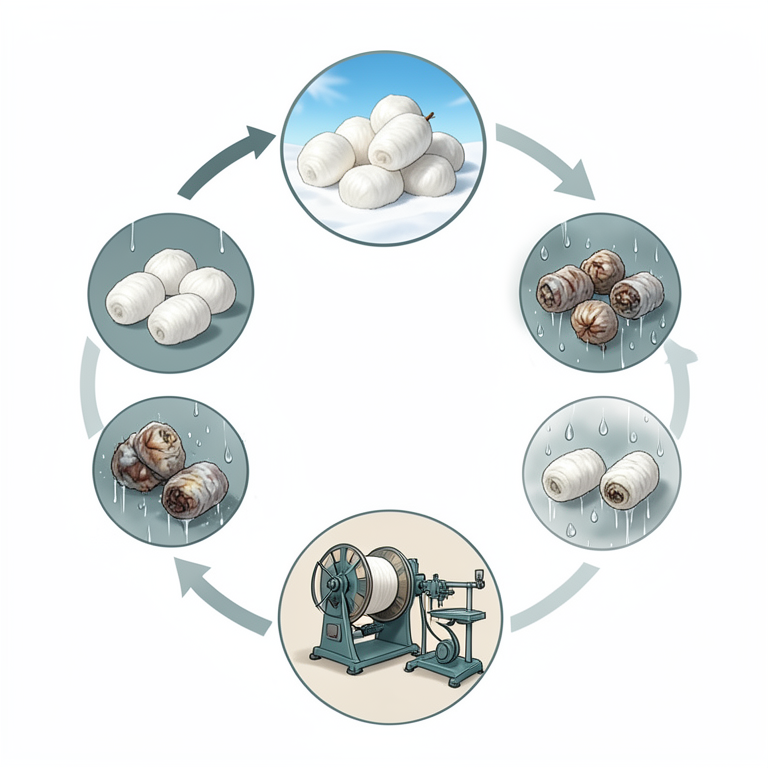
Seasonal Price Cycle
AI-generated conceptual illustration (silkworm cocoons). It explains the idea and does not show study data.
View source evidence ↗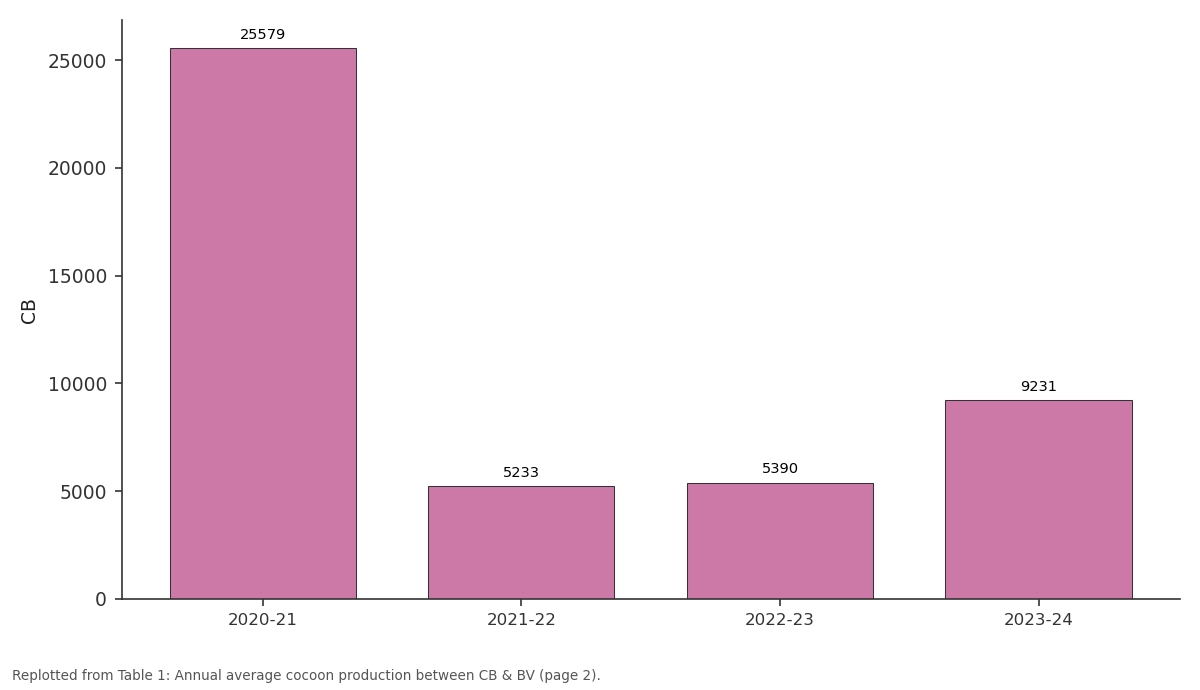
CB: 2020-21 vs 2021-22 vs 2022-23 vs 2023-24
Replotted from Table 1 (page 2) of the original paper. Every bar is the paper's own table value.
View source evidence ↗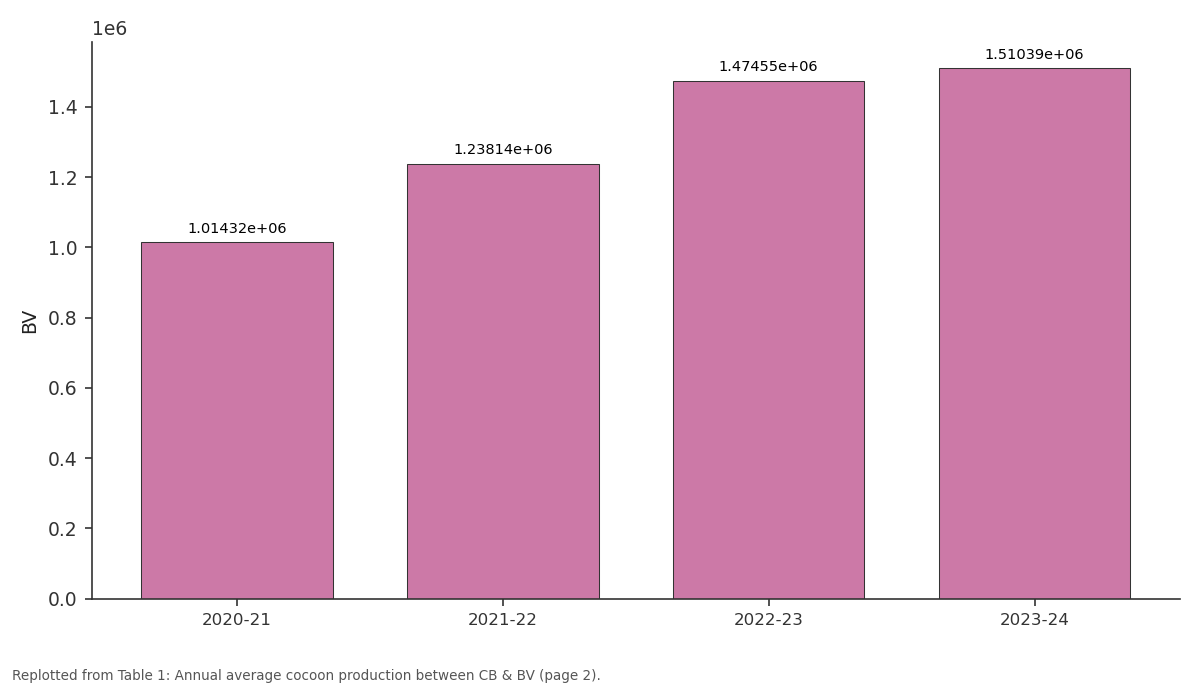
BV: 2020-21 vs 2021-22 vs 2022-23 vs 2023-24
Replotted from Table 1 (page 2) of the original paper. Every bar is the paper's own table value.
View source evidence ↗Figures & tables
From the original paper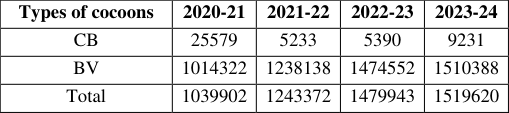 Table 1
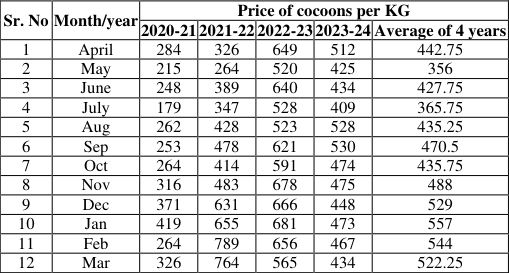 Table 2
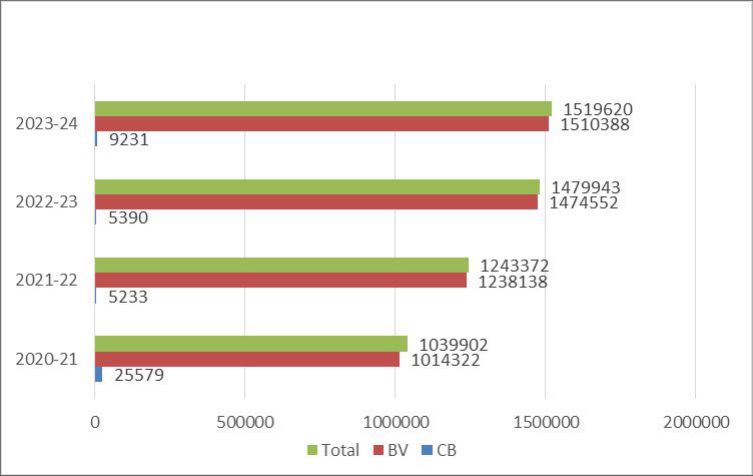 Figure 1
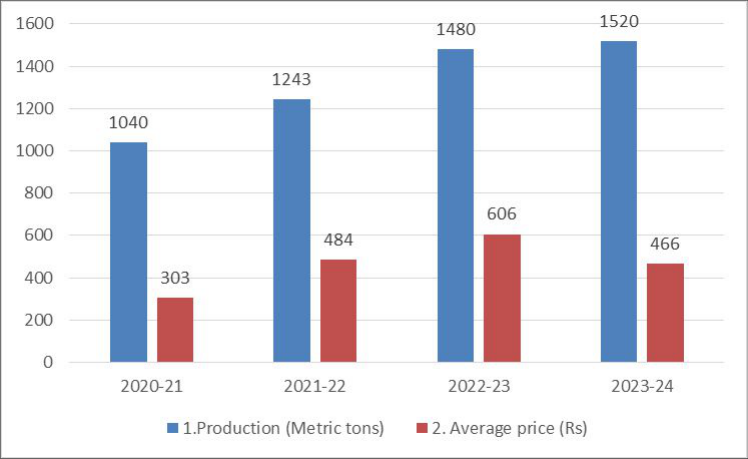 Figure 2
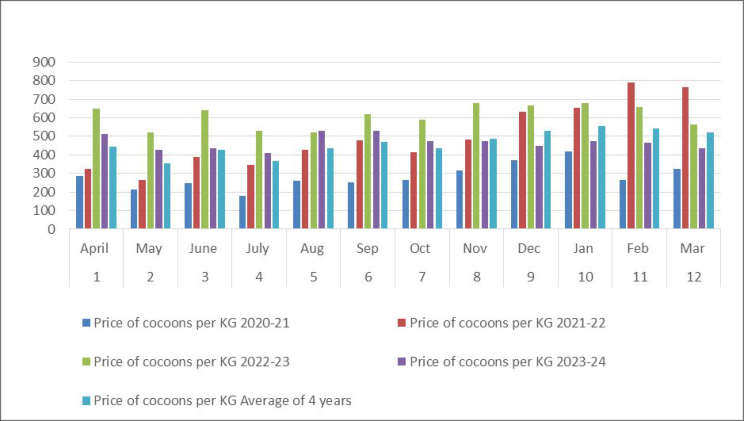 Figure 3
Introduction
Sericulture is a labour-intensive, agro-based industry that provides substantial employment opportunities to rural communities, particularly to unemployed youth, thereby contributing to the socio-economic upliftment of small and marginal farmers. The major economic strength of sericulture lies in its high employment potential with comparatively low investment requirements. Mulberry cultivation alone generates year-round employment for nearly twelve individuals, of whom approximately 60% are women, highlighting the significant role of women in the development of the sector. Mulberry gardens require minimal gestation time, remain productive for 12-15 years with low maintenance costs, and offer higher economic returns compared too many other agricultural crops. Andhra Pradesh is the second-largest producer of raw silk in India, following Karnataka. Recognising the potential of this sector to strengthen the rural economy and improve the livelihoods of farming communities, the Government of Andhra Pradesh has been extending various support measures to farmers and entrepreneurs involved in sericulture activities. A market is typically defined as a place where buyers and sellers gather regularly to exchange goods, livestock, or other commodities. In the context of sericulture, a cocoon market is a regulated platform where buyers and sellers conduct transactions through open auctions as mandated by law. Since silk cocoons are highly perishable and must be marketed immediately after harvest, the Government of Andhra Pradesh introduced the Andhra Pradesh Silkworm Seed and Cocoon (Regulation) Act, 1956 to protect cocoon farmers from exploitation by middlemen and unregulated private traders. Under this Act, regulated cocoon markets were established to ensure transparent transactions. All cocoon sales must take place through open auction, and payments are to be made either in cash or other approved modes. Furthermore, cocoons must be sold strictly by weight in accordance with the A.P. Weights and Measures Enforcement Act, 1958.
Methodology
For this study, secondary data on cocoon production and prices were collected from the annual and monthly reports of the Hindupur Cocoon Market, Government of Andhra Pradesh. The collected data were systematically tabulated and analysed using statistical tools such as the mean, standard deviation, and coefficient of variation. These tools helped in understanding the variability and trends in the market. Monthly average prices and yearly average prices were used to gain a comprehensive picture of seasonal and annual fluctuations in cocoon prices and arrivals. A four-year dataset was examined to identify the patterns, fluctuations, and overall behaviour of production and pricing in the Hindupur market.
Objectives
Objectives
Cocoon Markets Functioning in Andhra Pradesh
To safeguard cocoon farmers from exploitation by middlemen and unregulated private traders, the Government of Andhra Pradesh enacted the Andhra Pradesh Silkworm Seed and Cocoon Control Act, 1956. All activities related to silkworm seed, cocoon production, and marketing are governed under the provisions of this Act. Regulated cocoon markets were established with the following key objectives: To provide a convenient and accessible marketplace for both buyers and sellers. To publicly announce prevailing raw silk prices through silk exchanges. To promote proper grading and sorting of cocoons and enable price differentiation based on quality. To encourage cash transactions, accurate weighment, and fair business practices.
Regular Procedure of Transactions
No individual is permitted to sell or purchase cocoons outside the officially notified cocoon markets. Both the farmer (rearer) and the buyer must possess valid licences issued by the Department of Sericulture, Government of Andhra Pradesh. Cocoons produced by licensed rearers must be marketed exclusively through government-regulated cocoon markets.
Rearers have the freedom to sell their cocoons in any regulated market within the state. Upon arrival at the market, the rearer receives a triplicate bidding slip. After the auction, one copy is given to the buyer (reeler/LSP), one to the rearer, and one is retained by market officials. Lots containing immature cocoons are rejected by the department staff. Department personnel inspect each lot visually to assess quality and determine a base price. Cocoons are placed on designated auction stands for bidding. Buyers (reelers or LSPs) participate in open bidding in the presence of market officials and the rearer. Many Class-I cocoon markets have adopted eauctioning systems, ensuring greater transparency and wider participation. The highest bidder must obtain the rearer's approval for the bid amount, and both parties sign the bidding slip in the presence of officials. If the farmer is not satisfied with the offered price, he may request a second round of auctioning. Once the price is mutually accepted, the cocoons are weighed in the presence of both the buyer and the rearer, and signatures are recorded on the weighment slip. Buyers must deposit the total purchase amount along with a 1% market fee. Rearers receive payment from the designated counters after deducting the 1% market fee as per regulations.
Cocoon Production
The quality of silk cocoons is closely linked to the quality of mulberry leaves, which serve as the sole food source for silkworms. Higher mulberry leaf yield generally leads to improved cocoon production. Observations show that cocoon production typically increases between June and January, contributing to a gradual upward trend in cocoon prices during this period. Farmers usually rear two major types of silkworms: bivoltine and crossbreeds. Among these, bivoltine cocoons are known for superior quality and longer filament length, making them more desirable in the market.
Quality
Quality is another critical determinant of cocoon pricing. Important quality parameters include shell percentage, average filament length, and the proportion of defective cocoons in a lot.
Type of Silkworm
The species or breed of silkworm that produces the cocoon plays an important role in determining its market value. Cocoons produced by mulberry silkworms (Bombyx mori) are generally regarded as superior due to their fine quality and higher filament length, making them more valuable and expensive. In contrast, cocoons from certain crossbreeds or nonmulberry silkworms often appear yellowish and are typically priced lower because of differences in quality and filament characteristics.
Place of Origin
The geographical location where cocoons are produced also influences their price. Environmental conditions, mulberry leaf quality, and rearing practices vary from region to region, causing differences in cocoon quality. Price fluctuations commonly occur due to market demand and supply dynamics, and an inverse relationship is often observed-when production increases, prices tend to decline, and vice versa.
Price Variation
Cocoon prices are not constant; they fluctuate regularly in the market. The primary drivers of price variation are demand and supply, along with market arrivals and buyer requirements. Prices are also influenced by factors such as overall productivity, the number of farmers engaged in rearing during a particular period, and the specific rearing month, as seasonal conditions affect both cocoon production and market demand.
Conclusion
Cocoon production and pricing in the Hindupur market fluctuate due to several interrelated factors, including environmental conditions, seasonal influences, and sociocultural practices. Although cocoon output has increased in recent years, a considerable gap still exists between the current yields and the potential productivity achievable through modern technologies adopted by progressive farmers. Hindupur remains an important trading hub, attracting sericulturists from both Andhra Pradesh and Karnataka.
A clear relationship can be observed between the seasonal production pattern and the average cocoon price.
Historically, the highest prices are recorded in January, while July consistently registers the lowest prices compared to the annual average. These monthly variations are largely driven by changes in climate, differences in rearing and reeling efficiency, and the influence of cultural events. January falls within the winter season, which is highly favourable for silkworm rearing. Farmers who rear silkworms during October to January typically obtain better yields due to stable environmental conditions. Additionally, the reeling sector in Hindupur and nearby areas-predominantly operated by the Muslim community-faces fewer cultural interruptions during this period, allowing uninterrupted reeling activities and maintaining a steady balance between demand and supply. This results in better market prices. Conversely, July marks a decline in cocoon prices. Rearing during the rainy season is often affected by sudden climatic fluctuations, high humidity, and an increased incidence of communicable diseases, which lead to crop losses and poorquality cocoons. Furthermore, the months of May, June, and July coincide with major Muslim festivals such as Ramzan and Bakrid. During this period, many reelers temporarily reduce their work participation due to fasting and religious observances, affecting raw silk production and contributing to a downward trend in cocoon prices. Fluctuations in cocoon prices at the Hindupur market are shaped by a combination of environmental, seasonal, and cultural factors. The growth of the sericulture sector largely depends on how farmers adapt to these dynamic market conditions, as they determine the allocation of land, resources, and production efforts. Stable and remunerative cocoon prices are essential to motivate farmers to increase production, whereas pronounced price volatility discourages
Figures and tables from the paper
| Types of cocoons | 2020-21 | 2021-22 | 2022-23 | 2023-24 |
|---|---|---|---|---|
| CB | 25579 | 5233 | 5390 | 9231 |
| BV | 1014322 | 1238138 | 1474552 | 1510388 |
| Total | 1039902 | 1243372 | 1479943 | 1519620 |
Table text extracted from the original PDF; superscript letters are shown inline. The original table image is below.
View original table image
| Sr. No | Month/year | Price of cocoons per KG | — | — | — | — |
|---|---|---|---|---|---|---|
| 2020-21 | 2021-22 | 2022-23 | 2023-24 | Average of 4 years | ||
| 1 | April | 284 | 326 | 649 | 512 | 442.75 |
| 2 | May | 215 | 264 | 520 | 425 | 356 |
| 3 | June | 248 | 389 | 640 | 434 | 427.75 |
| 4 | July | 179 | 347 | 528 | 409 | 365.75 |
| 5 | Aug | 262 | 428 | 523 | 528 | 435.25 |
| 6 | Sep | 253 | 478 | 621 | 530 | 470.5 |
| 7 | Oct | 264 | 414 | 591 | 474 | 435.75 |
| 8 | Nov | 316 | 483 | 678 | 475 | 488 |
| 9 | Dec | 371 | 631 | 666 | 448 | 529 |
| 10 | Jan | 419 | 655 | 681 | 473 | 557 |
| 11 | Feb | 264 | 789 | 656 | 467 | 544 |
| 12 | Mar | 326 | 764 | 565 | 434 | 522.25 |
Table text extracted from the original PDF; superscript letters are shown inline. The original table image is below.
View original table image
References
11 in the original paper- Devaiah MC, Venkatagiriyappa, Achoth Lalith. Spatial integration and price relationship of Ramnagaram over minor silk cocoon markets of Karnataka. In: Proceedings of the International Congress on Tropical Sericulture. Central Silk Board; 1988. p. 77-84.
- Nagaraj N, Achoth Lalith, Bisaliah S, Ramanna R, Chinnaswamy KP. Spatial integration and price leadership in silk cocoon marketing of Karnataka. Sericologia. 1987;22(2):229-236.
- Arunkumar KS, Balasubramanyan, Achoth Lalith, Jayaram H. Interrelationship between domestic and international prices of silk yarn: a quantitative economic analysis. In: Global Silk Scenario -2001. International Conference on Silk; 1994. Oxford & IBH Publishing Company Pvt Ltd. p. 83.
- Parameshwarappa KJ. An economic analysis of domestic prices of Indian silk and export trade of silk goods [MSc thesis]. Bangalore: University of Agricultural Sciences; 1997.
- Halagundegowda GR, Kumaresan P, Kantharaju BM, Pallavi J. Modelling of price transmission: evidences from Indian silk market. Journal of Entomology and Zoology Studies. 2021;9(2):427-434.
- Chaithra R. Statistical evaluation of price behaviour of silk cocoon [MSc thesis]. Bangalore: University of Agricultural Sciences; 2015.
- Prabhakara YS. An economic analysis of silk marketing in Karnataka [MSc thesis]. Bangalore: University of Agricultural Sciences; 1988.
- Bharathi R, Havaldar YN, Megeri SN, Patil GM, Patil BL. A study on market integration of Ramanagaram and Siddlaghatta markets and forecasting of their prices and arrivals, Karnataka. Journal of Agricultural Sciences. 2011;24(3):347-349.
- Naik Gopal, Babu KR. Demand and supply prospects for high-quality raw silk. New Delhi: Oxford & IBH Publishing Co. Pvt. Ltd; 1993.
- Bharathi R. Price behaviour of mulberry silk cocoon in Ramnagar and Siddlaghatta market -a statistical analysis approach [MSc thesis]. Dharwad: University of Agricultural Sciences; 2009.
- Sekhar CSC. Agricultural market integration in India: an analysis of select commodities. Food Policy. 2012;37(3):309-322.