
Research article · 2025 · Full text
International Journal of Agriculture and Food ScienceScientific rationality, adoption and perceived effectiveness of ethno medical practices on hypotension in Idukki district Kerala
Volume 7(12) · Pages 65–67 · DOI: 10.33545/2664844x.2025.v7.i12a.1027 ↗
Research areasEthnobotanical and Medicinal Plants StudiesMedicinal Plant Extracts EffectsMorinda citrifolia extract uses
Abstract
Author-writtenThis study aimed to document the traditional ethnomedicinal practices (EMPs) used for the treatment of hypotension among tribal farmers in Idukki district, Kerala, to scientifically validate the selected remedies, and to assess their level of adoption and perceived effectiveness. Field surveys, participatory interviews, and focus group discussions were employed to document indigenous practices, while a comprehensive literature review was conducted to evaluate their scientific validity. A total of six EMPs were identified, eight of which had strong pharmacological evidence supporting their therapeutic potential, while one lacked documented proof. The adoption rate of these EMPs ranged from 83% to 97%, reflecting strong community trust and consistent reports of positive health outcomes. Commonly used medicinal plants included Alangium salviifolium, Benincasa hispida, Pterocarpus santalinus, and Hemidesmus indicus, all of which possess bioactive compounds with antioxidant, anti-proliferative, and immunomodulatory properties. The findings underscore the cultural significance and therapeutic value of these traditional healing practices and emphasize the importance of further pharmacological research, biodiversity conservation, and preservation of indigenous knowledge for sustainable healthcare development and future generations.
Summary
Source-checkedPlain-language reading of the full paper, prepared with AI and checked against the text. Each point links to the authors' own words.
Why it matters
- A significant portion of India's rural population, approximately 65-70%, relies on traditional medicine because it is affordable, accessible, and culturally accepted. View evidence ↗
- Hypotension (low blood pressure) can cause serious health issues, including dizziness, fatigue, and organ dysfunction if left untreated. View evidence ↗
- Tribal populations often depend on traditional herbal remedies for managing health conditions due to limited access to modern healthcare. View evidence ↗
The question
- The study aimed to document, scientifically validate, and assess the adoption and perceived effectiveness of traditional ethnomedicinal practices (EMPs) for hypotension among tribal farmers in Idukki, Kerala. View evidence ↗
What they did
- The researchers used judgment sampling to select 90 traditional healers or elderly farmers for interviews and conducted nine focus group discussions with 111 participants to validate the documented practices. View evidence ↗
What they found
- Out of six selected ethnomedicinal practices for hypotension, five were determined to be scientifically rational, while one was found to be irrational. View evidence ↗
- All rational practices were adopted by over 80% of respondents, whereas the single irrational practice was adopted by only 34.73%. View evidence ↗
- Plants used in the rational practices contained various phytochemicals, including flavonoids, phenolic compounds, and saponins, which are linked to therapeutic activities. View evidence ↗
- The study found that all practices perceived as effective by the community were also scientifically rational. View evidence ↗
What it means
- The authors conclude that these traditional remedies are scientifically relevant and culturally important, highlighting the need to preserve indigenous knowledge for sustainable healthcare. View evidence ↗
Visual summary
2 visualsIllustrations explain the paper; charts are replotted from the paper's own table values.
Rationality vs Adoption
AI-generated conceptual illustration (Traditional medicinal plants and herbs used for hypotension in Kerala). It explains the idea and does not show study data.
View source evidence ↗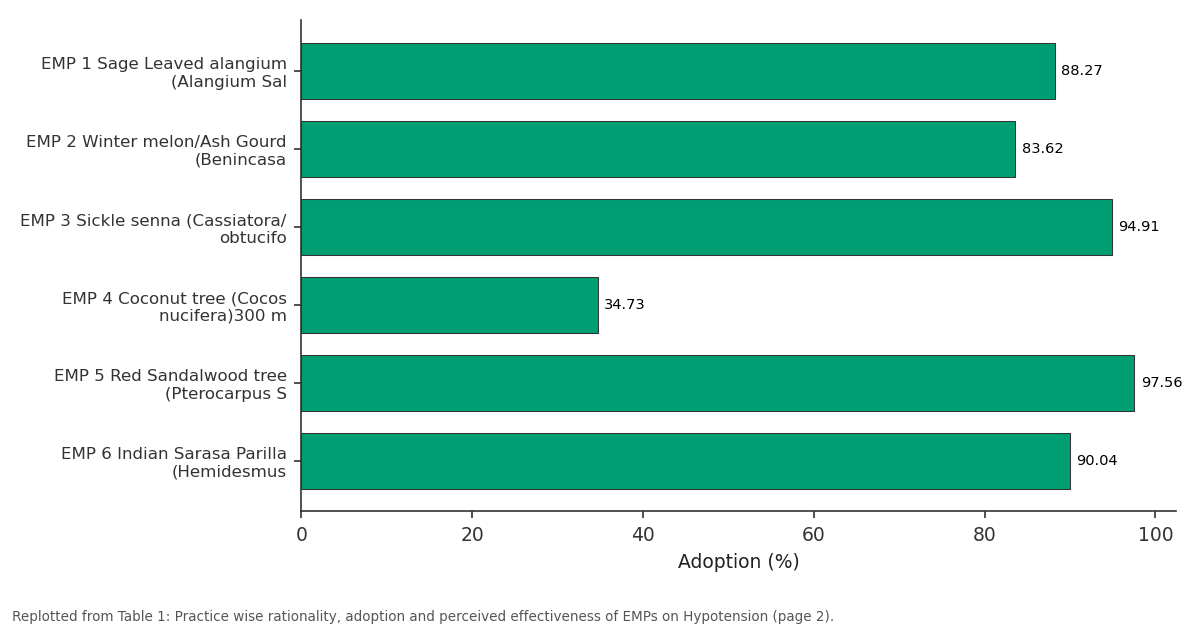
%: EMP 1 Sage Leaved... vs EMP 2 Winter melon/Ash... vs EMP 3 Sickle senna... vs EMP 4 Coconut tree... vs EMP 5 Red Sandalwood...
Replotted from Table 1 (page 2) of the original paper. Every bar is the paper's own table value.
View source evidence ↗Figures & tables
From the original paper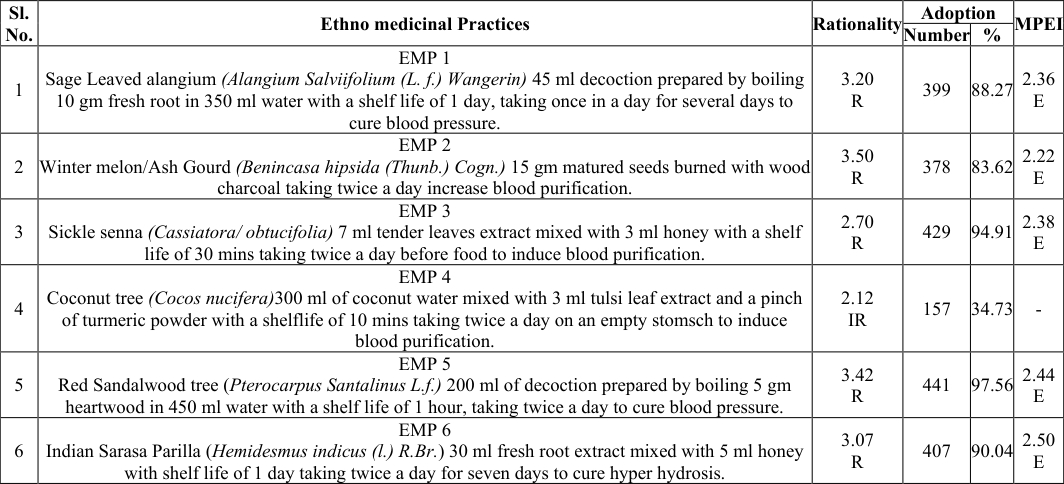 Table 1
Introduction
Traditional knowledge and indigenous healthcare systems have played a vital role in addressing the health needs of rural and tribal communities for generations. Ethnomedicinal practices (EMPs), derived from local flora and cultural heritage, form an essential part of primary healthcare among tribal populations. These practices are deeply embedded within the socio-cultural fabric of indigenous communities and are based on empirical observations, oral traditions, and centuries of experiential validation. In India, nearly 65-70 percent of the rural population depends on traditional medicine for their healthcare needs, largely due to its accessibility, affordability, and cultural acceptance. Kerala, known for its rich biodiversity and strong traditional medicinal systems such as Ayurveda and Siddha, is also home to several tribal communities who rely on native herbal formulations for treating various ailments. The Idukki district, in particular, represents one of the most ecologically diverse regions of the Western Ghats, inhabited by several tribal groups including the Muthuvan, Mannan, Malayaraya, Ullada, Hill Pulayan, Paliyan, Malavedan, and Malapandaram. These communities possess valuable indigenous knowledge on the use of local plants for the management of common diseases, including cardiovascular disorders such as hypotension. Hypotension or low blood pressure, though less frequently discussed as compared to hypertension, can lead to severe health complications such as fatigue, dizziness, and even organ dysfunction when untreated. The limited access of tribal populations to modern healthcare facilities often compels them to depend on traditional herbal remedies for managing such conditions. Many of these herbal formulations have been used for generations, yet their scientific rationale, pharmacological properties, and extent of community adoption remain inadequately documented. In this context, the present study was undertaken to identify, document, and scientifically validate traditional ethnomedicinal practices used for the treatment of hypotension among the tribal farmers of Idukki district, Kerala. The study further aimed to assess the extent of adoption and perceived effectiveness of these practices within the tribal community. The findings are expected to contribute to the preservation of indigenous knowledge, promote evidence-based validation of traditional practices, and support biodiversity conservation for sustainable healthcare development. Objectives 1. To identify and document ethnomedicinal practices (EMPs) used for hypotension treatment among tribal farmers in Idukki. 2. To scientifically assess the therapeutic potential and rationality of selected EMPs. 3. To analyze the extent of adoption and perceived effectiveness of these selected EMPs within the community.
Research Methodology
Phase I involved documenting Ethno-Medicinal Practices (EMPs) used by nine tribal groups of Idukki district-Muthuvan, Mannan, Malayaraya, Ullada, Hill Pulayan, Paliyan, Malavedan, and Malapandaram. All eight blocks were purposively selected in consultation with ITDP officials. Ten experienced traditional healers or elderly farmers from each tribe (total 90) were chosen through judgment sampling, and data on EMPs for treating hypotension were collected through informal interviews.
Nine focus group discussions with 111 participants were conducted to validate the information.
Phase II focused on assessing the rationality of six commonly reported EMPs. Experts in Agadathanthra from Ayurveda and Siddha institutions rated the EMPs using a four-point scale proposed by Husain and Sundaramari (2011) [4] . Of sixty-four experts approached, fifty-two responded. EMPs with a mean score ≥2.5 were considered rational. Additional insights were collected from forty-three Dravyaguna experts.
Phase III assessed the adoption and perceived effectiveness of EMPs among tribal farmers. A total of 452 farmers from forty village panchayats across eight blocks were selected using proportionate random sampling. Adoption was measured using a binary scoring method, and the Adoption Index was calculated. Perceived effectiveness was evaluated using the Perceived Effectiveness Index (PEI), with practices scoring above two considered effective. Only EMPs adopted by at least 50% of farmers were included for this assessment.
Results and Discussion
Scientific rationale behind the rational EMPs on Hypotension Hypotension or cardiovascular diseases are one of the risk factors for death. Functional non-nutrient food factors which are found in plants are found to be effective for health promotion and disease prevention. In this study, six indigenous herbal formulations which consisted of different plant ingredients were evaluated in terms of rationality.
In the case of hypotension, six EMPs were selected for the study, of which five practices were found as rational by the scientists, and the rest one practice was irrational. Also the rationale as outlined by the scientists for the rational practices has been presented in the Table 1.
It can be observed from the Table 1 that almost all the plants used in the rational EMPs were found to contain various phytochemicals such as phenolic compounds, flavonoids, phenolic glycosides, dietary fibre, protein, anthraquinones, tannin, saponins etc. in different combination as indicated against each medical practice in the above table. These phytochemicals are indicated to possess hypoglycemic, immunostimulatory, anti-inflammatory, and antipyretic activities that would cure hypotension related problems. This inference is in line with the findings of Kooshki and Hoseini (2014) [5] and Ogunbenro et al., (2018) [] . They reported that the above phytochemicals made possible effects of antioxidant phytochemical constituents, which bind the toxin in the blood and flush the impurities out of the body to promote the body's proper functioning system.
Table 1. Practice wise rationality, adoption and perceived effectiveness of EMPs on Hypotension
There are six EMPs on Hypotension, consisting of nine medical plant species. The detailed results are explained in the Table. All the EMPs (1, 2, 3, 5 and 6) were rated as rational, except one (EMP-4) which was irrational. It is interesting to note that all the rational EMPs were adopted by more than 80 percent of the respondents. The lone irrational EMP was adopted by 34.73 percent of the respondents. In short, 5 EMPS, out of the total 6, were adopted by more than 80 percent of the respondents. It is evident from Table 1 that all the practices were found to be effective. Furthermore, all the effective practices were found to be rational. EMPs viz., 1, 2, 5 and 6 had rationality score of more than three and were perceived as effective by tribal farmers. EMP 1 was adopted by 88.27 percent of the respondents with MPEI of 2.36. The extract of Alangium salvifolium had exhibited the hypoglycemic activity that indicates the release and potentiation of the action of epinephrine. The plant extract drastically increased the oxygen demand and led to tachycardia. The cardiotonic activity exhibited has positive ionotropic and chronotropic effects on the heart, probably due to alkaloids' presence (Venkateswarlu et al., 2011) [10] . Leaf extract also shows a hypotensive effect resulting in a rise in carotid blood pressure (Panara et al., 2016) [9] . Hence, the EMP 1 was widely adopted by the farmers. EMP 2 was adopted by 83.62 percent of the respondents with an MPEI of 2.22. Benincasa hispida fruit extract produced a significant increase in the urinary volume. There was a significant increase in sodium chloride excretion and a decrease in potassium excretion. Benincasa hispida whole fruit extract prevents nephrotoxicity and oxidative impairment of the kidney, as evidenced by a significantly reduced kidney weight, blood urea, blood creatinine, urinary glucose, and urinary potassium level and also increased body weight, urine volume, urinary creatinine, and blood total protein level. It also significantly increased tissue GSH levels and reduced lipid peroxidation levels (Al-Snafi, 2013) [1] . Hence, the EMP was widely adopted and perceived as effective. EMP 4 was adopted by 97.56 percent of the respondents with MPEI of 2.44. Pterocarpus santalinus is useful in treating blood-related disease and exhibits antihepatotoxicity (Azamthulla et al., 2015) [2] . P. santalinus possesses the anti-hyperglycemic and anti-hyperlipidemic active principle, which act by improving insulin secretion and alterations in the carbohydrate and lipid metabolism (Kondeti et al., 2010) [6] . Phenolic compounds present in P. santalinus exhibit antioxidative and hypolipidemic activities, and thereby protect the liver and heart against a wide variety of pathological conditions, including hyperlipidemia by inhibiting lipid synthesis. Pterostilbene present in P. santalinus increased LDL and reduced blood pressure in hyper-cholestemia (Bulle et al., 2016) [3] . Hence this EMP was found to be widely adopted.
EMP 195 was adopted by 90.04 percent of the respondents with MPEI of 2.50. Hemidesmus indicus was found to significantly lower body temperature, and it possesses an antipyretic effect (Lakshman et al., 2006) [7] . Hence this practice is widely adopted and perceived as effective.
In nutshell, it could be seen that out of the six EMPs in hypotensive treatment five were judged as rational practices. Five practices were adopted by more than fifty percent of the respondents and all the five practices were perceived as effective.
Conclusion
The study documented six traditional ethnomedicinal practices (EMPs) used for treating hypotension among the tribal farmers of Idukki district, Kerala. Of these, five were found to be rational and scientifically supported, while one was irrational. The rational EMPs showed high adoption rates, indicating strong community trust and effectiveness. Key medicinal plants such as Alangium salviifolium, Benincasa hispida, Pterocarpus santalinus, and Hemidesmus indicus exhibited proven therapeutic properties. The findings emphasize the cultural importance and scientific relevance of these traditional remedies and the need to preserve and validate indigenous knowledge for sustainable healthcare.
References
10 in the original paper- Al-Snafi AE. The pharmacological importance of Benincasa hispida: a review. Int J Pharm Sci Res. 2013;4(12):165-170.
- Azamthulla M, Balasubramanian R, Kavimani S. A review on Pterocarpus santalinus Linn. World J Pharm Res. 2015;4(2):282-292.
- Bulle S, Reddyvari H, Nallanchakravarthula V, Vaddi DR. Therapeutic potential of Pterocarpus santalinus L.: an update. Pharmacogn Rev. 2016;10(19):43-48.
- Husain AS, Sundaramari M. Scientific rationality and perceived effectiveness of indigenous technical knowledge on coconut (Cocos nucifera L.) cultivation in Kerala. J Trop Agric. 2011;49:78-87.
- Kooshki A, Hoseini BL. Phytochemicals and hypertension. Shiraz E-Med J. 2014;15(1):1-7.
- Kondeti VK, Badri KR, Maddirala DR, Thur SKM, Fatima SS, Kasetti RB, Rao CA. Effect of Pterocarpus santalinus bark on blood glucose, serum lipids, plasma insulin and hepatic carbohydrate metabolic enzymes in streptozotocin-induced diabetic rats. Food Chem Toxicol. 2010;48(5):1281-1287.
- Lakshman K, Shivaprasad HN, Jaiprakash B, Mohan S. Anti-inflammatory and antipyretic activities of Hemidesmus indicus root extract. Afr J Tradit Complement Altern Med. 2006;3(1):90-94.
- Ogungbenro RO, Oluwalana SA, Adedokun MO, Omosekeji RB. Ethnobotanical and phytochemical studies of some blood-cleansing herbs in Oyo and Ogun States, Southwestern Nigeria. J Adv Bot Zool. 2018;6(2):1-7.
- Panara K, Singh PK, Rawat P, Kumar V, Maruf M, Patel K, Kumar V. Importance of Alangium salvifolium and its pharmacological update. Eur J Med Plants. 2016;18:1-15.
- Venkateshwarlu R, Raju AB, Yerragunta VG. Phytochemistry and pharmacology of Alangium salvifolium: a review. J Pharm Res. 2011;4:1423-1425.
Cited by 1
From OpenAlex, OpenCitations and reference lists read by Scinovex
- Scientific rationality, adoption and perceived effectiveness of ethno medical practices on Throat Infection in Idukki District Kerala
Sundaramari M, Priyanka R, Simi Asharaf, Rajaguru S · International Journal of Agriculture Extension and Social Development · 2026
The present study aimed to document traditional ethno-medicinal practices (EMPs) used for the treatment of throat infections among tribal farmers of Idukki district, Kerala, to scientifically assess the rationality of selected practices, and to analyze their extent of adoption and perceived effectiveness. Field surveys, participatory informal interviews, and focus group discussions were carried out across major tribal groups to record indigenous knowledge related to throat ailments. Scientific validation of the selected EMPs was undertaken through expert evaluation and review of relevant liter