
Research article · 2025 · Full text
International Journal of Agriculture and Food ScienceEvaluation of agroforestry systems for carbon sequestration in Konkan Region
Volume 7(12) · Pages 95–99 · DOI: 10.33545/2664844x.2025.v7.i12b.1028 ↗
Research areasAgroforestry and silvopastoral systemsUrban Agriculture and SustainabilityForest ecology and management
Abstract
Author-writtenAgroforestry, a nature-based solution offers multifaceted benefits for sustainable development and climate change mitigation. Major objective of this study was to explores and evaluates the agroforestry systems for carbon sequestration in Konkan Region of Maharashtra state. Present study was conducted at the Research Farm of the AICRP on Agroforestry, Dr. Balasaheb Sawant Konkan Krishi Vidyapeeth, Dapoli, Dist Ratnagiri, in the year 2024. The highest carbon stock, carbon sequestration and carbon credits was was recorded in T6 - Mango based AFS which was 126.35 t/ha, 463.70 t/ha and 463.70 credit/ha respectively and lowest was reported in T2 - Malabar neem based AFS with 4.68 t/ha,17.17 t/ha and 17.17 credits/ha respectively. The study concludes that agroforestry systems, especially those involving Mango, Coconut, Asana, bamboo, and economically, it offers farmers an incentive to adopt sustainable practices through access to carbon markets for agroforestry farmers of the region. Strategic species selection, proper spacing, and management practices are essential to optimize both productivity and climate mitigation benefits.
Summary
Source-checkedPlain-language reading of the full paper, prepared with AI and checked against the text. Each point links to the authors' own words.
Why it matters
- Climate change is a critical global challenge driven by the rising concentration of greenhouse gases like carbon dioxide in the atmosphere. View evidence ↗
- Agroforestry is considered a nature-based solution that provides various benefits for mitigating climate change and supporting sustainable development. View evidence ↗
- Access to carbon markets provides an economic incentive for farmers to adopt sustainable agroforestry practices. View evidence ↗
The question
- The primary goal of the study was to evaluate different agroforestry systems for their carbon sequestration potential in the Konkan Region of Maharashtra. View evidence ↗
What they did
- The research was carried out during 2024-25 at the AICRP on Agroforestry Research Farm in Dapoli, Ratnagiri, Maharashtra. View evidence ↗
- The experiment utilized a Randomized Block Design consisting of eight different agroforestry treatments, each with three replications. View evidence ↗
- Tree biomass was estimated using allometric equations and literature-based wood density, applying a biomass expansion factor of 1.3. View evidence ↗
- Carbon credits were calculated at a rate of 1 t CO₂ per credit, with a market value of $20 (₹1500) per credit. View evidence ↗
What they found
- The Mango-based system (T6) had the highest total tree biomass at 247.01 t/ha, whereas the Malabar neem-based system (T2) had the lowest at 2.69 t/ha. View evidence ↗
- Total carbon stock peaked in the Mango-based system (T6) at 126.35 t/ha and was lowest in the Malabar neem-based system (T2) at 4.68 t/ha. View evidence ↗
- Total carbon sequestration ranged from 17.17 t/ha (lowest in Malabar neem T2) to 280.00 t/ha (highest in Mango T6). View evidence ↗
- Financial returns from carbon credits were highest for the Mango-based system (₹810,825.82/ha) and lowest for the Malabar neem-based system (₹30,023.46/ha). View evidence ↗
- Among intercrops, the Coconut-based system (T8) had the highest carbon stock (4.12 t/ha), while the Sandal-based system (T4) had the lowest (0.86 t/ha). View evidence ↗
What it means
- The authors conclude that the Mango-based agroforestry system is the most effective among those tested for carbon stock, sequestration, and credit generation. View evidence ↗
- The study suggests that well-planned agroforestry with appropriate species and management can help India meet its INDC targets and provide financial returns via carbon trading. View evidence ↗
Visual summary
1 visualsIllustrations explain the paper; they do not show study data.
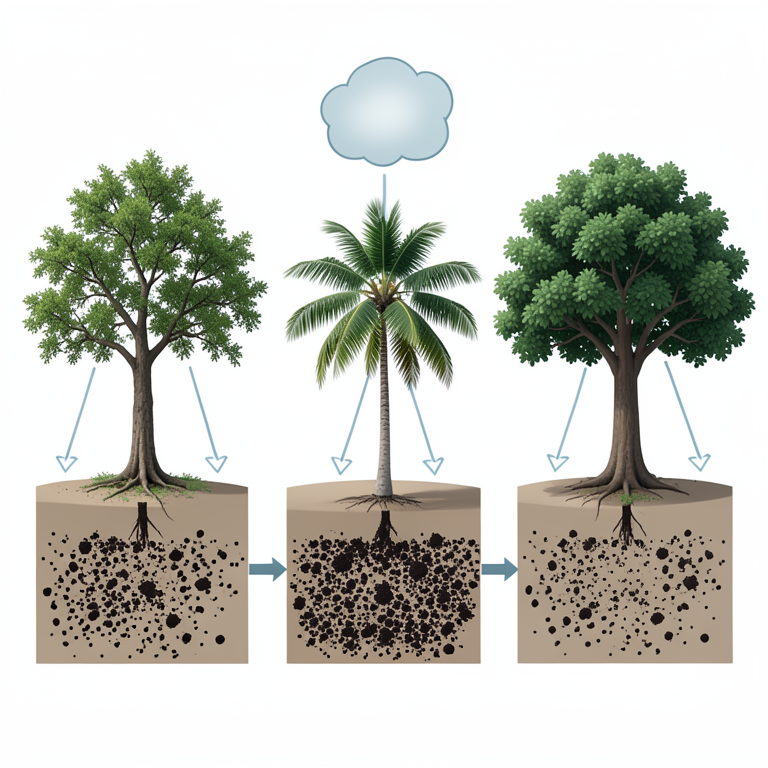
Comparison of Agroforestry Systems
AI-generated conceptual illustration (Mango trees, Coconut palms, and Malabar Neem trees in a Konkan region landscape). It explains the idea and does not show study data.
View source evidence ↗Figures & tables
From the original paper Table 1
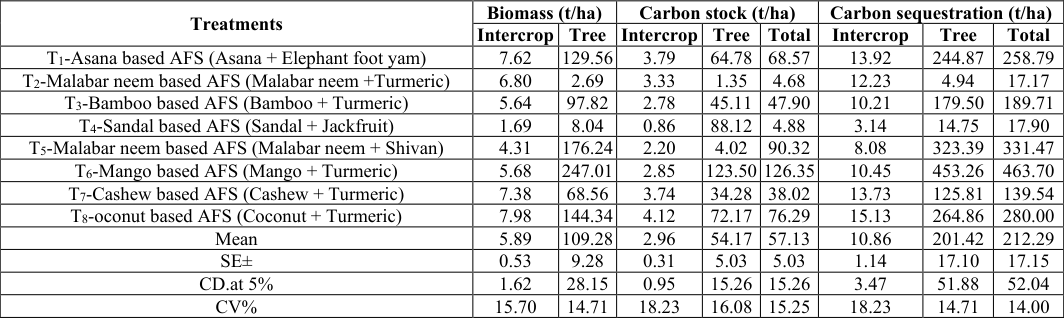 Table 2
 Table 3
Introduction
Climate change, caused by the increasing concentration of greenhouse gases (GHGs) such as carbon dioxide (CO₂) in the atmosphere, has emerged as one of the most critical global challenges of the 21 st century. Among various strategies to mitigate climate change, carbon sequestration, the process of capturing and storing atmospheric carbon, plays a pivotal role (IPCC, 2021). Agroforestry, a nature-based solution, offers multifaceted benefits for sustainable development and climate change mitigation. It enhances farmers' adaptive capacity to climate change while delivering ecological, social, and economic advantages (Telwala, 2022) [37] . Agroforestry systems act as carbon sinks through the accumulation of biomass in aboveground (trees, crops) and below-ground (roots) components, as well as through the enhancement of soil organic carbon (Nair et al., 2009; Montagnini & Nair, 2004) [29,25] . These systems are recognized for their potential to mitigate climate change, improve land productivity, enhance biodiversity, and strengthen livelihood resilience, especially in tropical and subtropical regions (Jose, 2009) [17] . However, the carbon sequestration potential of agroforestry systems varies depending on species composition, tree density, age, soil type, climatic conditions, and management practices (Nair, 2011) [28] . Agroforestry in India is increasingly recognized for its role in enhancing sustainable agriculture, rural livelihoods, and climate resilience. According to estimates, about 25.32 million hectares, or approximately 8.2% of the total geographical area, are under agroforestry practices (Dhyani & Handa, 2013) [8] . Maharashtra is among the leading states in India for agroforestry adoption, with an estimated 1.61 million hectares area under agroforestry (Panwar et al., 2022) [32] . The state practices diverse agroforestry systems tailored to its varied agro-climatic zones, from the semi-arid Deccan Plateau to the humid Konkan coast (Ilorkar et al., 2011) [13] . The Maharashtra State Forest Policy (2008) targets increasing tree cover to 33%, encouraging tree planting on private farmlands and non-forest lands. The National Agroforestry Policy (NAP) of 2014 aims to promote agroforestry through improved quality planting material, tree insurance, simplified regulations, and enhanced marketing opportunities (Chavan et al., 2015) [3] . It recognizes agroforestry's potential to achieve agricultural sustainability, optimize productivity, and mitigate climate change impacts (GOI, 2015). Agroforestry is also a significant element of India's Nationally Determined Contributions (INDCs) under the Paris Agreement, which are designed to establish an additional carbon sink of 2.5 to 3.0 billion tonnes of CO₂ equivalent per year through forest and tree cover by 2030 (UNFCCC, 2015). Further, afforestation and tree-based systems for climate mitigation are highlighted by the National Action Plan on Climate Change (NAPCC) through the Green India Mission. Studying carbon stock and carbon credits in agroforestry is important for multiple reasons. Environmentally, it helps quantify the potential of agroforestry to mitigate greenhouse gas emissions and supports the development of climateresilient land-use systems. Economically, it offers farmers an incentive to adopt sustainable practices through access to carbon markets. From a policy perspective, it provides scientific data that supports national and international climate commitments, such as India's National Agroforestry Policy (2014) and its Nationally Determined Contributions (NDCs) under the Paris Agreement. Thus, the assessment of carbon stock and understanding of carbon credit mechanisms are crucial for promoting agroforestry as a sustainable land-use option that integrates ecological, economic, and climate goals.
Materials and Methods
The study was conducted during 2024-25 at the Research Farm of the AICRP on Agroforestry, Central Experimental Station, Wakawali, Dr. Balasaheb Sawant Konkan Krishi Vidyapeeth, Dapoli, Ratnagiri (Maharashtra). The experimental site lies in the humid Konkan region (17º 45' N and 73º 26' E longitude having an elevation of 250 meters above mean sea level), characterized by lateritic soils derived from basalt, with >4000 mm annual rainfall and mean temperature ranging between 11-37°C. The experiment was laid out in a Randomized Block Design (RBD) with eight agroforestry treatments and three replications:
Initial status of experiment
The experiment was conducted on a well-established block plantation of selected agroforestry tree species at the Central Experimental Station, Wakavali, under the AICRP on Agroforestry. The details of block plantation in respect to year of plantation, age, row to row and plant to plant spacing is mentioned in Table 1 During the investigation year 2024-25, annual intercrops were freshly sown under agroforestry system to evaluate biomass accumulation and carbon sequestration potential of trees and intercrops. [4,19] . Wood density values from literature were used, and a biomass expansion factor (BEF) of 1.3 was applied. Below-ground biomass was assumed to be 25% of above-ground biomass (IPCC, 2006). Intercrop biomass was measured destructively from 1 m² plots by drying and weighing shoot and root components. Tree carbon stock was calculated using 0.50 × total dry biomass, while intercrop carbon content was estimated by the ash method. The total CO₂ sequestration was obtained by multiplying carbon stock by 3.67. Carbon credits were computed as 1 t CO₂ = 1 carbon credit, valued at $20 (₹1500) per credit as per market rate (Kumar et al., 2024) [20] . Data on biomass, carbon stock, carbon sequestration, and carbon credits were statistically analyzed using ANOVA as per Gomez and Gomez (1984) [12] . [35] ; Kumar (2019) [22] and Bhagya et al. (2017) [1] , who observed that improved intercrop performance in coconut-based systems due to better light availability and nutrient cycling. Similar findings were also reported by [23] .
| Treatments | Tree component under AF | Spacing (m) | Year of plantation | Age of plantation (Years) |
|---|---|---|---|---|
| T1 | Bridelia retusa | 10 x 5 | 2013 | 12 |
| T2 | Melia dubia | 5 x 5 | 2022 | 3 |
| T3 | Dendrocalamus stocksii | 10 x 10 | 2007 | 18 |
| T4 | Santalum album | 5 x 5 | 2013 | 12 |
| T5 | Melia dubia | 10 x 5 | 2015 | 10 |
| T6 | Mangifera indica | 10 x 10 | 2004 | 21 |
| T7 | Anacardium occidentale | 10 x 10 | 2006 | 19 |
| T8 | Cocus nucifera | 10 x 10 | 1999 | 26 |
Table text extracted from the original PDF; superscript letters are shown inline. The original table image is below.
View original table image
Results and Discussion
Results and Discussion
Total biomass, Carbon stock and Carbon sequestration by tree
Total tree biomass (TTB), the sum of above and below ground biomass, provides a complete estimate of tree carbon sequestration potential. The values for TTB across agroforestry systems are presented in [9] ; Murali et al. (2022) [27] ; Das et al. (2022) [5] ; Salunkhe et al. (2021) [34] ; Nimbalkar et al.
(2017) [31] , who highlighted the high carbon sequestration potential of mango-based systems in the Konkan and Deccan Plateau regions, respectively. In the present study, Malabar neem based AFS (T2) recorded notably low biomass, carbon stock and sequestration despite Chandana et al. (2020) [2] ; Gautam et al. (2025) [10] , Deshmukh et al.
(2025) [6] and Vasudev et al. (2021) [38] reporting higher carbon stocks under well-established Melia dubia systems.
Total Carbon stock and carbon sequestration by agroforestry systems
The data presented in [9] and Murali et al. (2022) [27] , who emphasized the high carbon storage capacity of mango orchards, particularly in tropical and semi-arid conditions, due to their large canopy spread, extended lifespan, and substantial woody biomass. [2] , Gautam et al. (2025) [10] , Deshmukh (2024) [7] . Whereas more or less similar value (4.66 t/ha) is reported by Vasudev et al. (2021) [38] in 2-year-old plantation of Melia dubia.
Figures and tables from the paper
| Treatments | Biomass (t/ha) | — | Carbon stock (t/ha) | — | — | Carbon sequestration (t/ha) | — | — |
|---|---|---|---|---|---|---|---|---|
| Intercrop | Tree | Intercrop | Tree | Total | Intercrop | Tree | Total | |
| T1-Asana based AFS (Asana + Elephant foot yam) | 7.62 | 129.56 | 3.79 | 64.78 | 68.57 | 13.92 | 244.87 | 258.79 |
| T2-Malabar neem based AFS (Malabar neem +Turmeric) | 6.80 | 2.69 | 3.33 | 1.35 | 4.68 | 12.23 | 4.94 | 17.17 |
| T3-Bamboo based AFS (Bamboo + Turmeric) | 5.64 | 97.82 | 2.78 | 45.11 | 47.90 | 10.21 | 179.50 | 189.71 |
| T4-Sandal based AFS (Sandal + Jackfruit) | 1.69 | 8.04 | 0.86 | 88.12 | 4.88 | 3.14 | 14.75 | 17.90 |
| T5-Malabar neem based AFS (Malabar neem + Shivan) | 4.31 | 176.24 | 2.20 | 4.02 | 90.32 | 8.08 | 323.39 | 331.47 |
| T6-Mango based AFS (Mango + Turmeric) | 5.68 | 247.01 | 2.85 | 123.50 | 126.35 | 10.45 | 453.26 | 463.70 |
| T7-Cashew based AFS (Cashew + Turmeric) | 7.38 | 68.56 | 3.74 | 34.28 | 38.02 | 13.73 | 125.81 | 139.54 |
| T8-oconut based AFS (Coconut + Turmeric) | 7.98 | 144.34 | 4.12 | 72.17 | 76.29 | 15.13 | 264.86 | 280.00 |
| Mean | 5.89 | 109.28 | 2.96 | 54.17 | 57.13 | 10.86 | 201.42 | 212.29 |
| SE± | 0.53 | 9.28 | 0.31 | 5.03 | 5.03 | 1.14 | 17.10 | 17.15 |
| CD.at 5% | 1.62 | 28.15 | 0.95 | 15.26 | 15.26 | 3.47 | 51.88 | 52.04 |
| CV% | 15.70 | 14.71 | 18.23 | 16.08 | 15.25 | 18.23 | 14.71 | 14.00 |
Table text extracted from the original PDF; superscript letters are shown inline. The original table image is below.
View original table image
| Treatment | Total CO₂ (t/ha) | Carbon credits/ha | Value (US$/ha) | Value (₹/ha) |
|---|---|---|---|---|
| T1-Asana based AFS (Asana + Elephant foot yam) | 258.79 | 258.79 | 5175.80 | 452520.19 |
| T2-Malabar neem based AFS (Malabar neem +Turmeric) | 17.17 | 17.17 | 343.40 | 30023.46 |
| T3-Bamboo based AFS (Bamboo + Turmeric) | 189.71 | 189.71 | 3794.20 | 331726.91 |
| T4-Sandal based AFS (Sandal + Jackfruit) | 17.90 | 17.90 | 358.00 | 31299.94 |
| T5-Malabar neem based AFS (Malabar neem + Shivan) | 331.47 | 331.47 | 6629.40 | 579608.44 |
| T6-Mango based AFS (Mango + Turmeric) | 463.70 | 463.70 | 9274.00 | 810825.82 |
| T7-Cashew based AFS (Cashew + Turmeric) | 139.54 | 139.54 | 2790.80 | 243999.64 |
| T8-Coconut based AFS (Coconut + Turmeric) | 280.00 | 280.00 | 5600.00 | 489608.00 |
Table text extracted from the original PDF; superscript letters are shown inline. The original table image is below.
View original table image
References
38 in the original paper- Bhagya HP, Maheswarappa HP, Bhat R. Carbon sequestration potential in coconut-based cropping systems. Indian J Hortic. 2017;74(1):1-5.
- Chandana P, Lata AM, Khan MAA, Krishna A. Climate change smart option and doubling farmer's income through Melia dubia-based agri-silviculture system. Curr Sci. 2020;118(3):444-448.
- Chavan SB, Keerthika A, Dhyani SK, Handa AK, Newaj R, Rajarajan K. National agroforestry policy in India: a low-hanging fruit. Curr Sci. 2015;108:18261834.
- Chave J, Réjou-Méchain M, Búrquez A, Chidumayo E, Colgan MS, Delitti WB, Vieilledent G. Improved allometric models to estimate the aboveground biomass of tropical trees. Global Change Biol. 2014;20(10):3177-3190.
- Das P, Dhara PK, Panda S. Fruit-based agroforestry systems: potential means for sustaining carbon sequestration, improving soil health and diet of community in red and lateritic zone of West Bengal, India. Int J Sci Eng Res. 2022;13(12):832-843.
- Deshmukh PP, Tiwari P, Dobriyal M, Yadav RP, Handa AK, Kumar N, et al. Effects of tree planting geometry on lentil nutritional quality, tree biomass and economic returns in Melia dubia-based agroforestry system in Bundelkhand region of India. Front Agron. 2025;7:1675259.
- M.Sc. thesis, Rani Lakshmi Bai Central Agricultural University, Jhansi; 2024.
- Dhyani SK, Handa AK. Area under agroforestry in India: an assessment for present status and future perspective. Indian J Agrofor. 2013;15(1):1-11.
- Ganeshamurthy AN, Ravindra V, Rupa TR. Carbon sequestration potential of mango orchards in India. Curr Sci. 2019;117(12):2006-2013.
- Gautam K, Kumar N, Ram A, Dev I, Choudhury BU, Singh NR, et al. Root architecture and carbon sequestration potential of fast-growing agroforestry tree species in semi-arid Central India. Front Agron. 2025;7:1597122.
- Government of India. National Agroforestry Policy - 2014; 2015.
- Gomez LA, Gomez AA. Statistical procedure for agricultural research. New York: John Wiley & Sons; 1984. p. 680.
- Ilorkar V, Suroshe S, Jiotode DJ. Agroforestry interventions across different agroclimatic zones in Maharashtra, India. Indian J For. 2011.
- IPCC. Guidelines for national greenhouse gas inventories: agriculture, forestry and other land use. Intergovernmental Panel on Climate Change; 2006.
- ISFR. Forest Survey of India. Ministry of Environment, Forest & Climate Change; 2021.
- Jember AA, Taye MA, Gebeyehu G, Mulu G, Long TT, Jayaraman D, Abebe S. Carbon stock potential of highland bamboo plantations in northwestern Ethiopia. Carbon Balance Manag. 2023;18(1):3.
- Jose S. Agroforestry for ecosystem services and environmental benefits: an overview. Agrofor Syst. 2009;76(1):1-10.
- Joy J, Raj AK, Kunhamu TK, Jamaludheen V, Jayasree K. Fodder production and carbon stock of calliandra under coconut plantation. Range Manage Agrofor. 2019;40(1):109-117.
- Kaushal R, Subbulakshmi V, Tomar JMS, Alam NM, Jayaprakash J, Mehta H, Chaturvedi OP. Predictive models for biomass and carbon stock estimation in male bamboo (Dendrocalamus strictus L.) in Doon valley, India. Acta Ecol Sin. 2016;36(6):469-476.
- Kumar A, Malik MS, Shabnam S, Kumar R, Karmakar S, Das SS, et al. Carbon sequestration and credit potential of gamhar (Gmelina arborea Roxb.)-based agroforestry system for zero carbon emission of India. Sci Rep. 2024;14(1):4828.
- Kumar A, Malik MS, Shabnam S, Kumar R, Karmakar S, Das SS, et al. Carbon sequestration and credit potential of gamhar (Gmelina arborea Roxb)-based agroforestry system for zero carbon emission of India. Sci Rep. 2024;14(1):4828.
- Kumar R. Impact of nutrient management on carbon trading under agroforestry system. M.Sc. thesis, Birsa Agricultural University, Ranchi; 2019.
- Kumar Y, Thakur A, Thakur TK. Impact of tree age on biomass growth and carbon accumulation capacity of agroforestry system. Ecol Environ Conserv. 2022;28(4):1844-1850.
- Mahadik SP. Carbon sequestration and soil fertility under asana-based agroforestry system in rainfed lateritic soil. M.Sc. thesis, Dr. Balasaheb Sawant Konkan Krishi Vidyapeeth, Dapoli; 2021.
- Montagnini F, Nair PR. Carbon sequestration: an underexploited environmental benefit of agroforestry systems. In: New Vistas in Agroforestry. Springer; 2004. p. 281-295.
- More DD. Studies on carbon sequestration under bamboo-based agroforestry system in alfisol. M.Sc. thesis, Dr. Balasaheb Sawant Konkan Krishi Vidyapeeth, Dapoli; 2022.
- Murali V, Gowthami P, Prashanth Kumar A, Gajanand P. Carbon sequestration potential of different mango cultivars in the tropical hot and semi-arid climate of Deccan Plateau, India. 2022.
- Nair PKR. Carbon sequestration studies in agroforestry systems: a reality check. Agrofor Syst. 2011;86(2):243253.
- Nair PKR, Kumar BM, Nair VD. Agroforestry as a strategy for carbon sequestration. J Plant Nutr Soil Sci. 2009;172(1):10-23.
- Namitha VV, Sheeja RK, Prathapan K. Carbon sequestration potential in coconut-based cropping system: a review. Agric Rev. 2025;46(1):143-146.
- Nimbalkar SD, Patil DS, Sharma JP, Daniel JN. Quantitative estimation of carbon stock and carbon sequestration in smallholder agroforestry farms of mango and Indian gooseberry in Rajasthan, India. Environ Conserv J. 2017;18(1-2):103-107.
- Panwar P, Mahalingappa DG, Kaushal R, Bhardwaj DR, Chakravarty S, Shukla G, et al. Biomass production and carbon sequestration potential of different agroforestry systems in India: a critical review. Forests. 2022;13(8):1274.
- Ramesh T, Manjaiah KM, Mohopatra KP, Rajasekar K, Ngachan SV. Assessment of soil organic carbon stocks and fractions under different agroforestry systems in subtropical hill agroecosystems of northeast India. Agrofor Syst. 2015;89(4):677-690.
- Salunkhe SS, Ayare BL, Bhange HN, Thokal RT, Dhekale JS. Assessment of biomass and carbon stocks in mango (Mangifera indica L.) orchards of Ratnagiri district of Maharashtra State, India. Int J Environ Clim Change. 2021;11(12):487-494.
- Shinde VV, Maheswarappa HP, Ghavale SL, Sumitha S, Wankhede SM, Haldankar PM. Productivity and carbon sequestration potential of coconut-based cropping system as influenced by integrated nutrient management practices. J Plantation Crops. 2020;48(2):103-110.
- Swamy SL, Mishra A. Comparison of biomass and carbon storage in three promising fast-growing tree plantations under agroforestry system in sub-humid tropics of Chhattisgarh, India. Univ J Agric Res. 2014;2:284-296.
- Telwala Y. Unlocking the potential of agroforestry as a nature-based solution for localizing sustainable development goals: a case study from a drought-prone region in rural India. Nature-Based Solutions. 2022.
- Vasudev L, Chavan RL, Devagiri GM. Carbon sequestration potential in total biomass of Melia dubia Cav. under semi-arid region of Karnataka. Int J Chem Stud. 2021;9(2):898-909.