
Research article · 2025 · Full text
International Journal of Agriculture and Food SciencePublic private partnership in agriculture and allied sector: A review
Volume 7(12) · Pages 100–104 · DOI: 10.33545/2664844x.2025.v7.i12b.1029 ↗
Research areasPublic-Private Partnership ProjectsLogistics and Infrastructure AnalysisFisheries and Aquaculture Studies
Abstract
Author-writtenThe agriculture and allied sectors in India face persistent challenges such as climate change, shrinking cultivable land, water scarcity, and recurring disease outbreaks. Addressing these issues requires coordinated, system-wide innovation that extends beyond the capacity of individual stakeholders. This review explores the evolution, relevance, operational models, and impact of Public-Private Partnerships (PPPs) as effective mechanisms for agricultural development. PPPs-contractual collaborations with shared planning, resources, and risks-combine private sector efficiency with public sector responsibility. Although PPPs in India have expanded rapidly, agriculture and allied sectors remain underrepresented compared to infrastructure, especially roads. The review outlines key PPP models, including BOT, BOO, and Joint Ventures, and highlights notable examples such as Project Golden Ray, ITC’s e-Choupal, and Karuna Animal Ambulance Services. These cases demonstrate improvements in productivity, market access, and animal health. Despite challenges like coordination gaps and corruption risks, well-designed PPPs are crucial for driving investment, innovation, and farmers’ income growth.
Summary
Source-checkedPlain-language reading of the full paper, prepared with AI and checked against the text. Each point links to the authors' own words.
Why it matters
- India's agriculture and allied sectors are hindered by ongoing issues including water scarcity, climate change, disease outbreaks, and a reduction in cultivable land. View evidence ↗
- Pressure on agricultural resources is increasing, as the grain-producing area per person is projected to drop from 0.22 hectares in 1950 to 0.06 hectares by 2050. View evidence ↗
- Because agricultural challenges are complex, they require coordinated, system-wide innovation rather than efforts by a single stakeholder. View evidence ↗
The question
- The review aims to examine the evolution, operational models, relevance, and impact of Public-Private Partnerships (PPPs) as tools for agricultural development. View evidence ↗
What they did
- The authors analyzed various PPP models, such as Build-Operate-Transfer (BOT), Build-Own-Operate (BOO), and Joint Ventures, and reviewed specific case studies like e-Choupal and Project Golden Ray. View evidence ↗
- The review notes that in India, there are currently 9,242 PPP projects across 28 sectors with a total value of ₹6,813,008.32 crore. View evidence ↗
What they found
- PPP initiatives in India are heavily skewed toward infrastructure, with road projects accounting for 52% of partnerships, while health and education only contribute 3.7%. View evidence ↗
- Project Golden Ray, launched in 2009, provided 90 MT of hybrid seeds to nearly 19,000 farmers, which nearly doubled maize yields in the Banswara and Udaipur districts. View evidence ↗
- The e-Choupal initiative has expanded to approximately 6,500 kiosks in 40,000 villages across 10 states, benefiting nearly 4 million farmers. View evidence ↗
- A 30-year PPP program in Australia costing Aus$1 billion successfully eradicated bovine TB in 1997 and bovine brucellosis in 1989. View evidence ↗
- An organic Basmati rice PPP in Uttarakhand increased farmer income by approximately Rs. 235 per ton and generated a profit of Rs. 245 per ton for Kohinoor Foods Ltd. View evidence ↗
- In Ethiopia, a poultry PPP led to EthioChicken supplying 13 million day-old chicks in 2018, which represented nearly one-third of the country's total production. View evidence ↗
- As of May 2021, the Karuna Animal Ambulance and Mobile Veterinary Dispensary (MVD) network in Gujarat had treated over 3.45 lakh animals using 410 MVDs. View evidence ↗
- PPPs face significant drawbacks, including communication gaps due to multiple partners and increased risks of corruption stemming from complex procedures. View evidence ↗
What it means
- The authors conclude that well-structured PPPs are essential to engage the private sector and secure the investment needed to double farmers' incomes in India. View evidence ↗
Visual summary
1 visualsIllustrations explain the paper; they do not show study data.
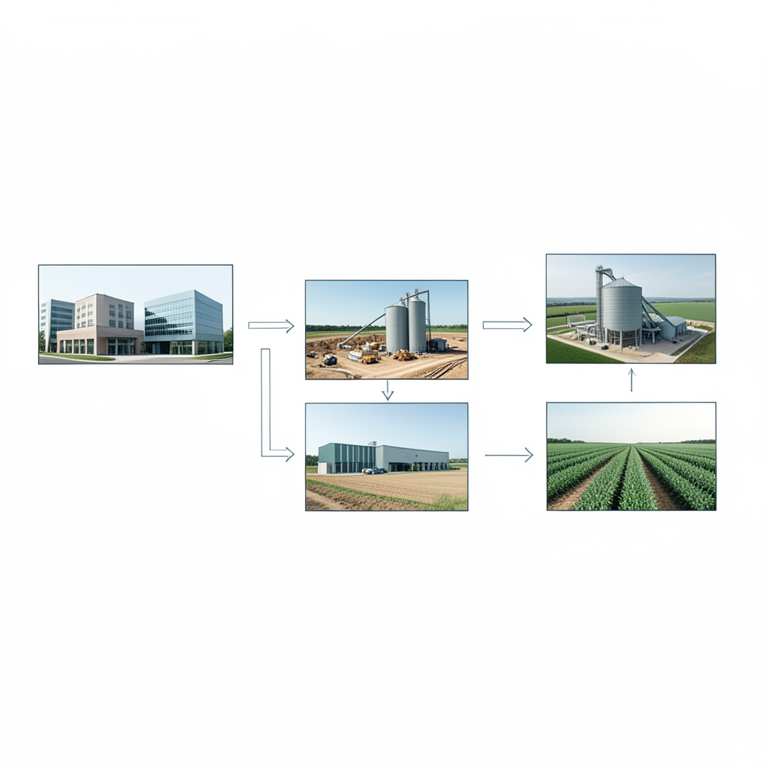
PPP Operational Models
AI-generated conceptual illustration (Agricultural infrastructure and farmland). It explains the idea and does not show study data.
View source evidence ↗Figures & tables
From the original paper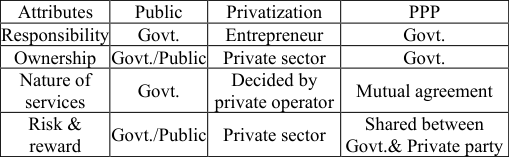 Table 1
 Table 1
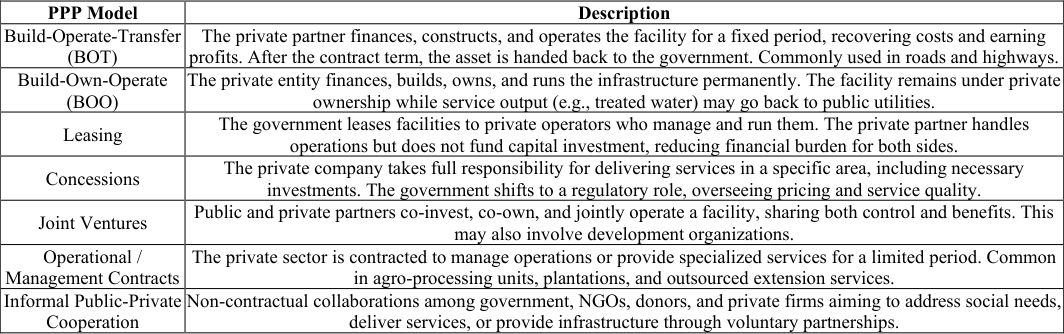 Table 2
Introduction
Public private partnership is a long-term contract between a private party and a government entity, for providing a public asset or service, in which the private party bears significant risk and management responsibility and remuneration is linked to performance (World Bank). In India PPP is defined as "a partnership between a public sector entity and a private sector Effective collaboration between public and private actors through Public-Private Partnerships (PPP) can strengthen agricultural sustainability in low-income countries. In the livestock and agriculture sectors, PPPs enable advanced research, technology development, and the delivery of innovative products that benefit smallholders, resource-poor farmers, and marginalized communities (Anonymous, 2014) [1] .
History and present status of PPP in India
The PPP model originated in Europe, particularly Italy, as a collaboration in which public and private sectors jointly mobilize private investment to create public assets and services. India has long used similar arrangements-such as the Great Indian Peninsular Railway (1853), the Bombay Tramway (1874), and early power distribution in Mumbai and Kolkata. The idea aligned with India's mixed-economy approach adopted in 1948 under Nehru, encouraging both public and private participation in nation-building. However, heavy regulation later created mistrust and slower economic growth, leading to fiscal stress and balance-ofpayment issues. This prompted renewed cooperation, including involving business leaders in policymaking through the Rajya Sabha, helping rebuild trust and strengthen PPPs. After limited activity until the early 2000s, PPP projects expanded rapidly-rising from 86 projects before 2004 to over 758 by 2011, and about 881 projects worth over INR 5.4 trillion by 2013 across multiple sectors. Road projects make up the majority of PPP initiatives in India, representing about 52% of all partnerships. However, social sectors like health and education remain underrepresented, contributing only 3.7% of PPP projects. To support long-gestation infrastructure ventures, the India Infrastructure Finance Company Limited (NBFC) was created to provide necessary financial assistance (Gupta & Singh, 2018) [8] . Currently in India, 9,242 projects worth ₹6,813,008.32 crore are operating under the PPP model across 28 sectors (Anonymous a ).
Need of PPP in agriculture and allied sector
• Greater emphasis is being placed on agricultural research and innovation.
• The increase in MSP is motivating farmers to continue and expand cultivation.
Features of PPP Comparison Between Public, Private and PPP Attribute
In privatization, the private sector takes full responsibility for funding and delivering a service, along with ownership of the assets and all associated risks. In contrast, PPPs keep the government responsible for service provision, while ownership usually remains with the public sector. In privatization, the private provider decides the scope of services, whereas in PPPs, these are defined through a contract. Risks in privatization lie entirely with the private party, but in PPPs they are shared between the government and the private sector (Bafanda & Khandi 2018) [4] . [4] Table 1: Difference Between Privatization and PPP
| Privatization | Public-Private Partnership (PPP) |
|---|---|
| The private sector takes full charge of financing and delivering the service. | The government retains primary responsibility for ensuring service delivery. |
| Asset ownership is transferred to the private entity, along with benefits and liabilities. | Asset ownership generally remains with the government while the private partner manages operations. |
| The private operator decides the scope and manner of service delivery. | The scope of work and service standards are defined jointly through a formal contract. |
| Most operational and financial risks are borne entirely by the private sector. | Risks and returns are shared between the government and the private partner. |
Table text extracted from the original PDF; superscript letters are shown inline. The original table image is below.
View original table image
| Attributes | Public | Privatization | PPP |
|---|---|---|---|
| Responsibility | Govt. | Entrepreneur | Govt. |
| Ownership | Govt./Public | Private sector | Govt. |
| Nature of services | Govt. | Decided by private operator | Mutual agreement |
| Risk & reward | Govt./Public | Private sector | Shared between Govt.& Private party |
Table text extracted from the original PDF; superscript letters are shown inline. The original table image is below.
View original table image
Attributes
Attributes
Privatization
Public-Private Partnership (PPP) The private sector takes full charge of financing and delivering the service. The government retains primary responsibility for ensuring service delivery.
Asset ownership is transferred to the private entity, along with benefits and liabilities.
Asset ownership generally remains with the government while the private partner manages operations. The private operator decides the scope and manner of service delivery.
The scope of work and service standards are defined jointly through a formal contract. Most operational and financial risks are borne entirely by the private sector.
Risks and returns are shared between the government and the private partner. (Bafanda & Khandi 2018) [4] Applicability of PPP A project may be taken up through the PPP route when one or more of the following conditions are present: • The government faces financial limitations or lacks the required technical expertise to execute the project independently. • Involving private investors can enhance service quality, raise service standards, or speed up project completion.
• The project allows for healthy competition among potential private sector participants. • Private sector participation opens avenues for new ideas, improved methods, and innovation in public service delivery. • There are no legal or regulatory barriers that prevent private sector involvement in delivering the service.
(Husain & Amin 2018) [9] Conditions for a successful PPP For a public-private partnership to be effective, it should meet at least three basic criteria:
• Value for the private partner: The project should offer financial returns or help the private company access new markets.
• Value for citizens: It must provide services that people need and might not receive at the same cost or quality under normal government delivery. • Value for the government: The initiative should help the government meet policy goals, social responsibilities, or broader development objectives.
(Husain & Amin 2018) [9] Table 2: Models of PPP
PPP Model Description
The private partner finances, constructs, and operates the facility for a fixed period, recovering costs and earning profits. After the contract term, the asset is handed back to the government. Commonly used in roads and highways. Build-Own-Operate (BOO)
The private entity finances, builds, owns, and runs the infrastructure permanently. The facility remains under private ownership while service output (e.g., treated water) may go back to public utilities.
Leasing
The government leases facilities to private operators who manage and run them. The private partner handles operations but does not fund capital investment, reducing financial burden for both sides.
Concessions
The private company takes full responsibility for delivering services in a specific area, including necessary investments. The government shifts to a regulatory role, overseeing pricing and service quality.
Joint Ventures Public and private partners co-invest, co-own, and jointly operate a facility, sharing both control and benefits. This may also involve development organizations.
Operational / Management Contracts
The private sector is contracted to manage operations or provide specialized services for a limited period. [15] Advantages of PPP [6] .
GALVmed (Global Alliance for Livestock Veterinary Medicines)
ALVmed, a UK-based nonprofit public-private partnership headquartered in Edinburgh, focuses on developing and delivering livestock health products for smallholder farmers. Its South Asia office collaborates with government and nongovernment agencies to improve access to affordable animal health solutions for rural livestock keepers. In India, GALVmed currently operates in the states of Odisha, Bihar, West Bengal, Assam, Nagaland, and Jharkhand (Bafanda & Khandi 2018) [4] .
Mahyco-DBT partnership on plant genomics.
Under the Agriculture Biotechnology Support Programme (ABSP-II), Mahyco, IIVR, UAS Dharwad, and TNAU Coimbatore collaborated to develop transgenic brinjal resistant to fruit and shoot borer. ABSP funded the project, DBT supported regulatory processes, Mahyco supplied the cry gene, and IIVR led varietal development. Brinjal transformation began in 2000, and TNAU carried out confined field trials of Bt brinjal during 2007-08 (Ponnusamy, K. 2013) [14] .
PPP for agricultural extension
Madhya Pradesh initiated a PPP in agricultural extension on 5 November 2001, involving MANAGE, the state Department of Agriculture, and Dhanuka Agritech. The collaboration aimed to raise farm productivity and improve farmers' livelihoods by offering soil testing, training, exposure visits, demonstrations, technology dissemination, agricultural events, market support, and credit facilities, along with services through cyber dhabas (Marbaniang et al. 2020) [11] .
Project Sunshine
The Tribal Development Department of Gujarat partnered with Monsanto to supply hybrid seeds to small and marginal farmers in remote areas under Project Sunshine. Initially launched as Project Rainbow in 2007 across 300 villages of Dahod and Panchmahal, the government purchased seeds from private companies and distributed them with support from dairy cooperatives and NGOs. The project aimed to double farmers' incomes within five years. By 2011, it expanded to 20 talukas in five districts-Banaskantha, Dahod, Panchmahal, Sabarkantha, and Vadodara-benefiting about 2.25 lakh farmers (Shukla et al. 2016) [15] .
Bovine brucellosis and tuberculosis eradication arrangements: Australia's Brucellosis and Tuberculosis
Eradication Campaign (BTEC) began in 1970, initially fully planned and funded by the government. Over time, the cattle industry took an active role in planning, management, and financing, contributing about half the costs by the 1980s. A new BTEC Committee in 1984 ensured industry representation and joint decision-making on responsibilities and expenses. The collaboration between government and industry led to the successful eradication of bovine brucellosis in 1989 and bovine TB in 1997, completing a program that cost around Aus$1 billion over 30 years (Black 2012) [7] . [16] .
PPP for organic production
PPP for organic production
PPP in poultry sector in Ethiopia
Since 2010, Ethiopia has implemented a PPP to develop the poultry sector, involving EthioChicken and the public Veterinary Services. EthioChicken produces hybrid day-old chicks, which grower agents raise to 45 days with proper healthcare before distribution to smallholder farmers through a network supported by the Ministry of Livestock and Fisheries. The project expanded in phases from Tigray to four additional regions, with EthioChicken managing government farms, hatcheries, and a feed mill. The initiative boosted local economies through farm rentals, employment creation, and new incomes, while increasing national poultry production-EthioChicken supplied 13 million dayold chicks in 2018, covering nearly one-third of Ethiopia's total production (N'Guessan et al. 2022) [13] .
Karuna Animal Ambulance Services (KAAS) -Gujarat
Karuna Animal Ambulance Services (KAAS) -Gujarat
Future prospects of
Future prospects of
References
16 in the original paper- Anonymous. Public-Private Partnerships for Agricultural Innovation: 6th meeting of the Food Chain Analysis Network, Paris, 13-14 October 2014. Paris: OECD; 2014.
- Anonymous (b). https://www.emri.in/1962-animalmobile-medical-ambulance-2/
- Bafanda RA, Khandi SA. Public private partnership and its role in livestock sector. International Journal of Technical Research & Science. 2018;2(12):837-846.
- Batjargal T, Zhang M. Review of key challenges in public-private partnership implementation. Journal of Infrastructure, Policy and Development. 2021;5(2):1378.
- Benjongtoshi MM, Bier K, Awomi OS, Aier I. Public private partnership, potentials and scope in India with special reference to Nagaland. Just Agriculture Multidisciplinary E-Newsletter. 2021.
- Black PF. Good governance of animal health systems and public-private partnerships: an Australian case study. Rev Sci Tech Int Off Epizoot. 2012;31:699-708.
- Gupta V, Singh AK. Current scenario of public-private partnership (PPP) projects in India. International Research Journal of Engineering and Technology. 2018;5(07):953-956.
- Husain SS, Amin MR. Public private partnership in livestock sector of Bangladesh. Bangladesh Journal of Animal Science. 2018;46(3):172-178.
- Larsen J. Population growth leading to land hunger. Washington (DC): Earth Policy Institute; 2003.
- Marbaniang EK, Chauhan JK, Kharumnuid P. Public private partnership (PPP) in agriculture: a step towards sustainable agricultural development. Agric Food. 2020;2:387-390.
- Nanda SS. Infrastructure development in India: the role of public-private partnership. International Journal of Core Engineering & Management. 2015;2(6):60-70.
- N'Guessan NGB, Poupaud M, Dieuzy-Labaye I, Asfaw YT, Wieland B, Tesfu F, Peyre M. Evaluation of public-private partnership in the veterinary domain using impact pathway methodology: in-depth case study in the poultry sector in Ethiopia. Frontiers in Veterinary Science. 2022;9:735269.
- Ponnusamy K. Impact of public private partnership in agriculture: a review. Indian Journal of Agricultural Sciences. 2013;83(8):803-808.
- Shukla R, Sharma S, Thumar VM. Role and importance of public private partnerships in agricultural value chain and infrastructure. International Journal of Commerce and Business Management. 2016;9(1):113-118.
- Singh S. Institutional innovations for agricultural development in India: experience and prospects. Ahmedabad (Gujarat): CMA, IIM Ahmedabad; 2015.
- Spielman DJ, Von Grebmer K. Public-private partnerships in agricultural research: an analysis of challenges facing industry and the Consultative Group on International Agricultural Research. Washington (DC): International Food Policy Research Institute; 2004. Vol. 113.