
Research article · 2025 · Full text
International Journal of Advanced Chemistry ResearchA Comprehensive Review of Volumetric Analysis: From Classical Titrations to Modern Cross-Disciplinary Applications
Volume 7(11) · Pages 84–89 · DOI: 10.33545/26646781.2025.v7.i11b.335 ↗
Research areasVarious Chemistry Research TopicsWater Quality Monitoring and AnalysisBiosensors and Analytical Detection
Abstract
Author-writtenVolumetric analysis plays a crucial role in quantitative analytical chemistry for centuries and remains a fundamental technique in both educational and professional laboratories. This review discusses the evolution of volumetric analysis from its classical roots which are in acid-base, redox, complexometric, and precipitation titrations to its modern incarnations. It also explores the enduring theoretical principles, including the mathematics of titration curves and error analysis, and discuss the persistent challenges students face in mastering the technique. Furthermore, the article highlights the paradigm shift brought by technological advancements, including digital instrumentation, automated titration systems, and sophisticated data analysis algorithms. Crucially, this review contextualizes the expanded meaning of "volumetric analysis" beyond chemistry, showcasing its critical applications in medical imaging, materials science, and environmental monitoring. Finally, we consider future perspectives, emphasizing the integration of micro-sampling techniques, advanced sensors, machine learning, and green chemistry principles to enhance the accuracy, speed, sustainability, and scope of volumetric methods.
Summary
Source-checkedPlain-language reading of the full paper, prepared with AI and checked against the text. Each point links to the authors' own words.
Why it matters
- Volumetric analysis is a long-standing, fundamental technique used for quantitative measurement in both professional and educational chemistry laboratories. View evidence ↗
- The method remains useful because it is simple, cost-effective, and provides relatively high accuracy. View evidence ↗
The question
- The review aims to connect classical chemical volumetric analysis with its modern evolution into a cross-disciplinary tool. View evidence ↗
What they did
- Classical volumetric analysis is theoretically based on chemical equilibrium, stoichiometry, and the concept of equivalence. View evidence ↗
- The review identifies that errors in volumetric analysis are classified as either random (indeterminate) or systematic (determinate). View evidence ↗
What they found
- Manual titrations are prone to significant operational errors caused by human factors, such as personal bias in color detection and parallax errors. View evidence ↗
- The use of automated titrators and computer-interfaced systems improves throughput and reproducibility by using sensors and algorithms to find the equivalence point. View evidence ↗
- Volumetric Absorptive Microsampling (VAMS) enables the precise collection of small blood volumes, typically between 10-50 µL. View evidence ↗
- In pulmonary medicine, volumetric analysis provides more accurate growth rate data (volume doubling time) for nodules than traditional linear measurements. View evidence ↗
- Digital Volume Correlation (DVC) allows for the analysis of internal material deformations by correlating 3D X-ray computed tomography data. View evidence ↗
- In biological studies, volume is not always a direct indicator of functional capacity or neuronal count, which can lead to oversimplified interpretations. View evidence ↗
What it means
- The authors conclude that the core principle of deriving quantitative data from measured volumes is universally powerful across multiple scientific disciplines. View evidence ↗
- The authors suggest that the integration of AI, microfluidics, and advanced sensors will lead to further innovative applications of volumetric analysis. View evidence ↗
Visual summary
1 visualsIllustrations explain the paper; they do not show study data.
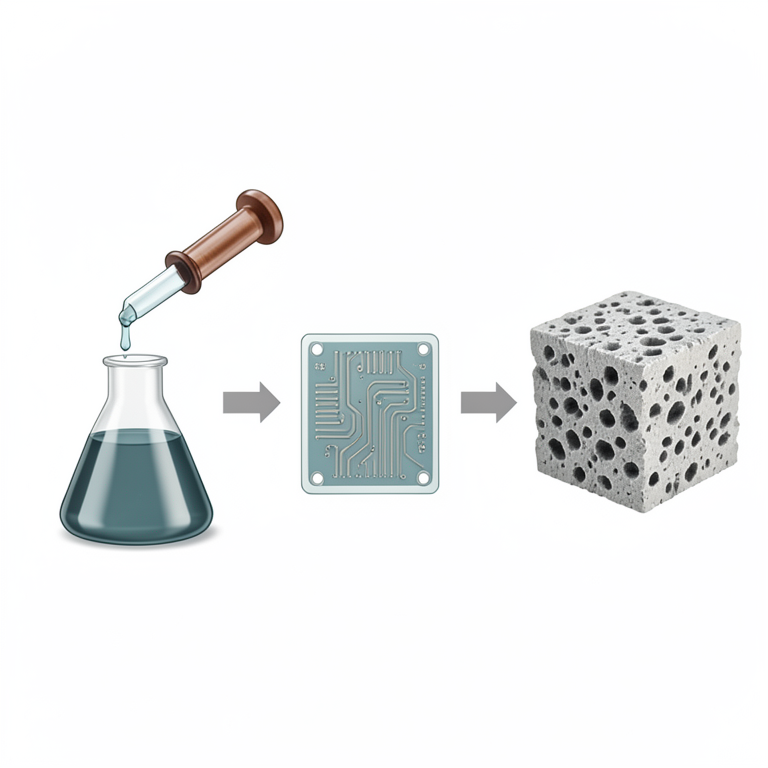
Conceptual Evolution of Volumetric Analysis
AI-generated conceptual illustration (Laboratory glassware, a microfluidic chip, and a 3D X-ray computed tomography scan of a porous material). It explains the idea and does not show study data.
View source evidence ↗Figures & tables
From the original paper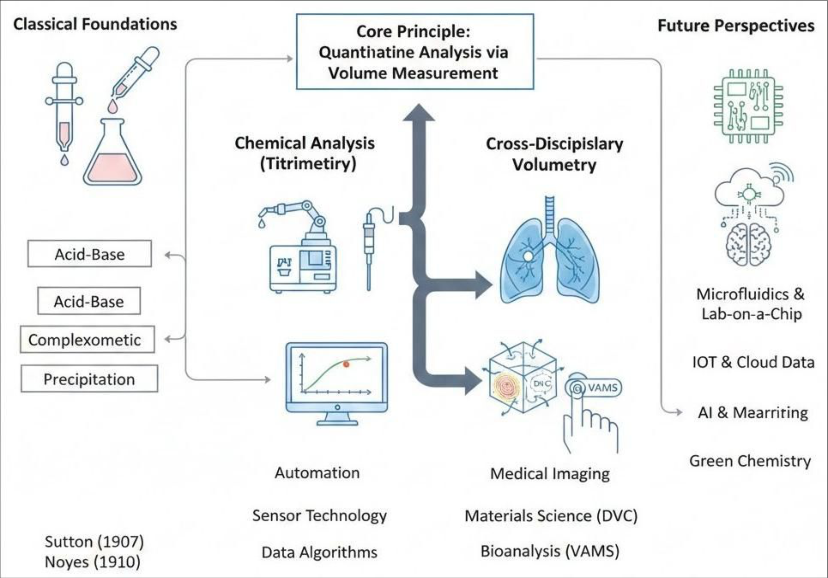 Figure 1
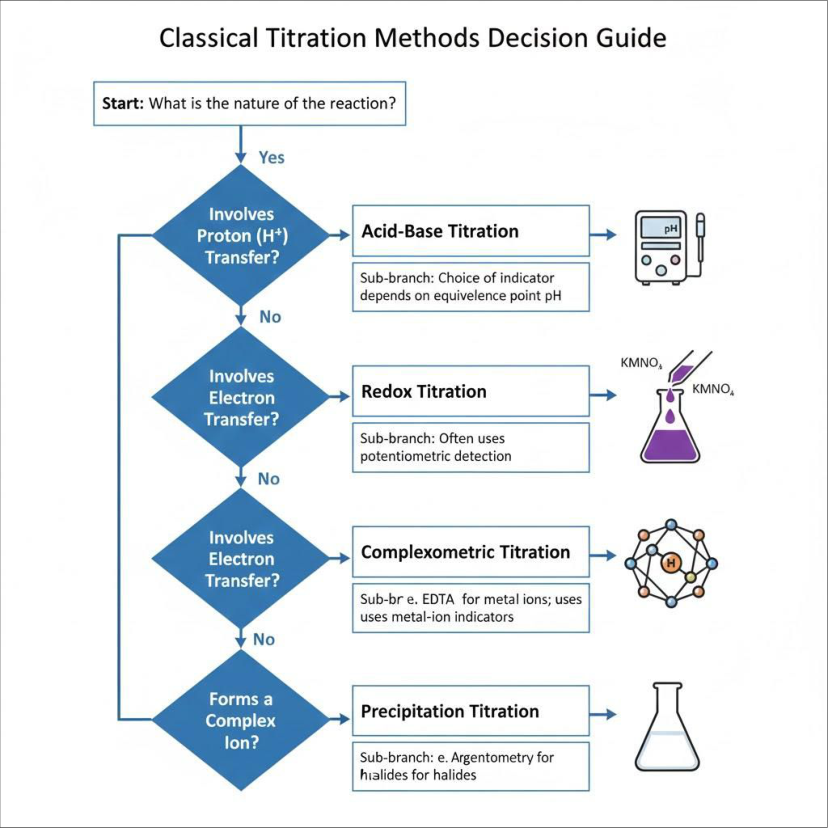 Figure 2
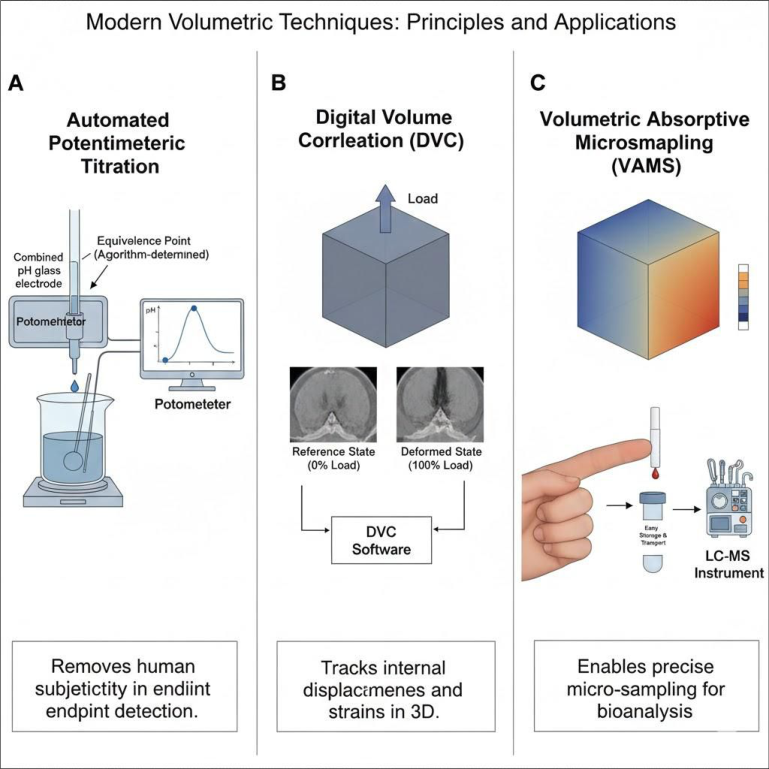 Figure 3
Introduction
Volumetric analysis, also known as titrimetry, is a quantitative analytical method used to determine the concentration of an unknown analyte by measuring the volume of a standard reagent (the titrant) required to complete a specific chemical reaction with it [1,2] . For generations, the burette, pipette, and conical flask have been the iconic instruments symbolizing this technique. Its principles are enshrined in classic texts like Sutton's Systematic Handbook of Volumetric Analysis [3] and are a staple of undergraduate chemistry curricula worldwide [4,5] . The enduring utility of volumetric analysis lies in its simplicity, cost-effectiveness, and relatively high accuracy. A study by Ghaemi et al. [6] reaffirmed its role as a reliable method for quantitative determination in industrial and educational settings. However, the term "volumetric analysis" has transcended its chemical origins. In fields like radiology and materials science, it now refers to the measurement of the volume of three-dimensional objects from imaging data [7,8,9] . This review aims to bridge these two interpretations, providing a comprehensive overview of classical chemical volumetric analysis while exploring its conceptual and technological evolution into a modern, cross-disciplinary tool. The evolution of volumetric analysis from its classical chemical roots to modern, cross-disciplinary applications and future directions
Fundamental Principles and Classical Foundations
The theoretical underpinnings of volumetric analysis are based on stoichiometry, chemical equilibrium, and the concept of equivalence. The key requirement is a rapid, quantitative reaction with a well-defined endpoint.
Core Concepts
• Titrant: A standard solution of known concentration, carefully added to the analyte. • Titrand (Analyte): The solution whose concentration is to be determined.
• Equivalence Point:
The theoretical point at which the amount of titrant added is chemically equivalent to the amount of analyte present, as defined by the reaction stoichiometry.
• End Point: The experimentally observed point where a physical change (e.g., color change of an indicator, potential shift) indicates that the reaction is essentially complete. The choice of a correct indicator is critical to minimize the error between the end point and the equivalence point [10,11] .
Theoretical Underpinnings and Calculations
The mathematics behind volumetric analysis is straightforward yet powerful. The fundamental equation at the equivalence point is:
where 𝐶 represents concentration and 𝑉 represents volume.
The selection of indicators is guided by a deep understanding of titration curves-plots of a solution parameter (e.g., pH, pM, potential) against the volume of titrant added. Noyes' pioneering work [10] laid the foundation for the quantitative theory of acid-base indicators, linking their color change to the pH at the equivalence point. The sharpness of the titration curve's inflection point determines the feasibility of a titration and the choice of indicator. For complexometric titrations, the concepts of pM and conditional stability constants are crucial, as detailed in modern analytical chemistry texts [12] .
Types of Titrations
Classical volumetric analysis is categorized based on the reaction type:
• Acid-Base Titrations: Involve the transfer of a proton.
The pH curve provides diagnostic information about the strength of the acid and base involved. • Redox Titrations: Based on electron transfer between reacting species. The Nernst equation governs the potential change during the titration. • Complexometric Titrations: Utilize the formation of a complex ion, most famously using EDTA to determine metal ions. Masking and demasking agents are often employed to enhance selectivity [12] . • Precipitation Titrations: Involve the formation of an insoluble precipitate, such as in the Argentometric method for chloride determination.
Fig 2:
A decision tree for selecting the appropriate classical titration method based on the chemical reaction involved.
Quality and Error Analysis in Volumetric Analysis
The accuracy and precision of volumetric results are paramount. Errors can be systematic (determinate) or random (indeterminate).
Sources of Error
• Instrumental Errors: These include mis calibrated glassware (burettes, pipettes, volumetric flasks). The tolerance limits for Class A glassware are standardized but represent a potential source of systematic error [1] . • Methodological Errors: These arise from the inherent limitations of the technique, such as a slight solubility of a precipitate, co-precipitation, or the finite difference between the end point and the equivalence point. • Operational Errors: Human factors are significant, especially in manual titrations. These include parallax errors in reading menisci, inconsistent swirling, premature endpoint judgment, and personal bias in detecting color changes [4,13] . Anamuah-Mensah [4] specifically identified students' conceptual misunderstandings of molarity and stoichiometry as a major source of operational error.
Minimizing Errors Strategies to minimize errors include:
• Calibration: Regular calibration of glassware and instruments.
• Blanks: Running blank titrations to correct for impurities in reagents. • Replication: Performing multiple trials to assess precision and identify outliers. • Standardization: Frequently standardizing titrant solutions against a primary standard.
• Instrumental
Endpoint Detection: Using potentiometric, photometric, or thermometric methods to remove the subjectivity of visual detection [2,14] .
4.
4.
Techniques and Instrumentation
The late 20th and early 21st centuries have seen a significant transformation in volumetric practices, moving from purely manual techniques to instrument-assisted and fully automated methods.
Automation and Digitalization
Modern automated titrators and computer-interfaced systems control reagent delivery, monitor the reaction with high-precision sensors, and use algorithms to precisely determine the equivalence point, enhancing reproducibility and throughput. Dubey et al. [15] proposed advanced computational techniques, including signal processing algorithms, for more accurately predicting the equivalence point from titration data, thereby reducing human error. Wang et al. [2] discuss a comprehensive teaching laboratory program that transitions students from classic titrations to modern methods, including the use of potentiometric sensors, pH probes, and data-logging interfaces for real-time curve analysis.
Advanced Kinetic and Adsorption Studies
The principles of volumetric measurement are crucial in other analytical domains. Wang et al. [16] reviewed common practices in gravimetric and volumetric adsorption experiments, highlighting how precise gas volumetry (using manometric or volumetric apparatus) is essential for characterizing porous materials like zeolites and metalorganic frameworks. The accuracy of these gas sorption measurements directly impacts the determination of surface area and pore size distribution.
Micro-Sampling Techniques
A significant advancement in bioanalysis is Volumetric Absorptive Micro sampling (VAMS), which allows for the collection of a precise, small volume of blood (e.g., 10-50 µL) via a porous tip. As reviewed by Dodeja et al. [17] , this technique minimizes invasiveness, simplifies sample storage and transport, and is compatible with modern analytical instruments like LC-MS. It represents a fusion of volumetric precision with micro-scale technology, addressing the challenges of traditional venous blood collection.
Volumetric Analysis Beyond Chemistry: Cross-Disciplinary Applications
The concept of measuring volume to derive quantitative information has been powerfully adopted in several nonchemical fields, vastly expanding the impact of "volumetric analysis."
Medical Imaging and Diagnostics
In clinical practice, "volumetric analysis" refers to the calculation of organ or lesion volume from CT or MRI scans, providing more accurate data than 1D or 2D measurements.
• Oncology: Planz et al. [8] detailed its use in assessing tumor burden and monitoring treatment response in oncology, as changes in volume are a more sensitive indicator of progression or regression than diameterbased criteria. Similarly, Díez Valle et al. [18] used volumetric analysis to precisely quantify the extent of tumor resection in glioblastoma surgery, correlating the volume of residual fluorescent tissue with patient outcomes. • Pulmonary Medicine: Nair et al. [7] described its critical role in the longitudinal assessment of pulmonary nodules, providing more accurate growth rate analysis (volume doubling time) than traditional linear measurements, which is crucial for early lung cancer detection.
• Surgery and Reconstruction: Chae et al. [19] reviewed various volumetric techniques (e.g., MRI, 3D stereophotogrammetry) for planning breast reconstruction surgery, ensuring symmetrical and aesthetically pleasing outcomes by quantifying breast volume pre-and post-operatively.
Materials Science and Engineering • Digital Volume Correlation (DVC): As reviewed by
Buljac et al. [9] , DVC is a modern technique that tracks displacements and calculates strains within the volume of a material (e.g., composites, bones) under load by correlating 3D image data from X-ray computed tomography. This is a direct analog to 2D digital image correlation but in three dimensions, allowing for a fullfield analysis of internal deformations. • Finite Volume Methods (FVM): While not a direct measurement technique, FVM is a numerical scheme for solving partial differential equations, foundational in computational fluid dynamics, that discretizes a domain into finite volumes for analysis [20] . The name itself underscores the fundamental nature of volume-based quantification in computational science.
Neuroscience and Biology
Roth et al. [21] provided a critical appraisal of using hippocampal volume as a proxy for cognitive function in birds and mammals. Their work highlights both the power and the pitfalls of volumetric analysis in biological studies, emphasizing that volume is not always a direct indicator of neuronal count or functional capacity, and cautioning against oversimplified interpretations of brain structurefunction relationships.
Future Perspectives
The future of volumetric analysis is oriented towards miniaturization, integration, intelligence, and sustainability. Garg et al. [22] highlight trends such as the development of novel nano-sensors and ion-selective electrodes for endpoint detection, which offer higher sensitivity and selectivity. The integration of machine learning (ML) and artificial intelligence (AI) algorithms for real-time data analysis, endpoint prediction, and anomaly detection is poised to become more sophisticated, moving beyond the early computational approaches of Dubey et al. [15] . The push for green analytical chemistry is also influencing the field. Techniques like VAMS [17] align with the principles of reducing waste and solvent use. Future developments will likely see an increased focus on:
• Lab-on-a-chip and Microfluidics: Downsizing entire titration processes onto microfluidic platforms for ultralow volume consumption and high-throughput analysis [23] .
• Internet of Things (IoT) Integration: Smart, connected titration systems that log data directly to the cloud, enabling remote monitoring and data sharing. • Advanced Materials for Sensors: Development of more robust, selective, and sensitive chemical sensors using nanomaterials and molecularly imprinted polymers to expand the range of analyzable substances [22, 24] . • Hyphenated Techniques: Coupling titration systems with spectroscopic detectors (e.g., UV-Vis, FTIR) to provide simultaneous structural and quantitative information during the titration process.
Conclusion
From the classic titration curves sketched in student lab notebooks to the complex 3D reconstructions of tumors in a hospital's radiology department, volumetric analysis has demonstrated remarkable resilience and adaptability. Its core principle-deriving quantitative information from measured volumes-has proven to be universally powerful.
In chemistry, it has evolved from a purely manual art to a precise, often automated, and increasingly "green" science. Beyond chemistry, it has become an indispensable tool for quantification in medicine, engineering, and biology. As technology continues to advance with AI, microfluidics, and advanced sensors, this foundational analytical concept will undoubtedly continue to find new and innovative applications, solidifying its place for another century of scientific discovery.
Figures and tables from the paper
References
24 in the original paper- McPherson P. Practical volumetric analysis. Royal Society of Chemistry; 2014.
- Wang Y, Geng J, Zhu Z. A comprehensive teaching laboratory program on titration analysis: transition from classic to modern approaches. J Chem Educ. 2024;101(2):612-620.
- Sutton F. A systematic handbook of volumetric analysis. P. Blakiston's Son; 1907.
- Anamuah-Mensah J. Student difficulties with volumetric analysis. [PhD dissertation]. University of British Columbia; 1981.
- Alam GM, Oke OK, Oloruntegbe T. Volumetric analysis and chemistry students' performance: combined influence of study habit, physiological and psychological factors. Sci Res Essays. 2010;5(11):1325-1332.
- Ghaemi Z, et al. A review on titration: a fundamental method of quantitative chemical analysis. J Chem Rev. 2023;5(4):496-516.
- Nair A, et al. Contextualizing the role of volumetric analysis in pulmonary nodule assessment: AJR expert panel narrative review. Am J Roentgenol. 2023;220(3):314-329.
- Planz VB, Lubner MG, Pickhardt PJ. Volumetric analysis at abdominal CT: oncologic and non-oncologic applications. Br J Radiol. 2019;92(1095):20180631.
- Buljac A, et al. Digital volume correlation: review of progress and challenges. Exp Mech. 2018;58(5):661708.
- Noyes AA. Quantitative application of the theory of indicators to volumetric analysis. J Am Chem Soc. 1910;32(7):815-861.
- Harris DC. Quantitative chemical analysis. 9th ed. W. H. Freeman; 2016.
- Harvey D. Modern analytical chemistry. McGraw-Hill; 2000.
- Soares MI, et al. Virtual labs: a tool for teaching titrations. J Chem Educ. 2022;99(7):2674-2680.
- Zimmerman J, Jacobsen JJ. Quantitative techniques in volumetric analysis. 1996:1117.
- Dubey RB, Hanmandlu M, Gupta SK. An advanced technique for volumetric analysis. Int J Comput Appl. 2010;1(1):91-98.
- Wang J-Y, et al. A review of common practices in gravimetric and volumetric adsorption kinetic experiments. Adsorption. 2021;27(3):295-318.
- Dodeja P, et al. Applications of volumetric absorptive microsampling technique: a systematic critical review. Ther Drug Monit. 2023;45(4):431-462.
- Díez Valle R, et al. Surgery guided by 5-aminolevulinic fluorescence in glioblastoma: volumetric analysis of extent of resection in single-center experience. J Neurooncol. 2011;102(1):105-113.
- Chae MP, et al. Breast volumetric analysis for aesthetic planning in breast reconstruction: a literature review of techniques. Gland Surg. 2016;5(2):212-226.
- Barth T, Ohlberger M. Finite volume methods: foundation and analysis. 2003.
- Roth TC, et al. Is bigger always better? A critical appraisal of the use of volumetric analysis in the study of the hippocampus. Philos Trans R Soc B. 2010;365(1542):915-931.
- Garg N, Goyal A, Das P. Recent advances and future perspectives in volumetric analysis. In: Advanced techniques of analytical chemistry: Volume 1. 2022;1:16.
- Pumera M. Microfluidics in chemical analysis. Analyst. 2009;134(10):1965-1975.
- Bakker E, Qin Y. Electrochemical sensors. Anal Chem. 2006;78(12):3965-3984.