
Research article · 2025 · Full text
International Journal of Agriculture and Food ScienceAge-Structured mortality and life expectancy trends in Bombyx mori reared on ber-1 mulberry: Insights for enhancing silk productivity
Volume 7(11) · Pages 531–537 · DOI: 10.33545/2664844x.2025.v7.i11g.1003 ↗
Research areasSilkworms and Sericulture ResearchSilk-based biomaterials and applicationsNeurobiology and Insect Physiology Research
Abstract
Author-writtenThis study presents a detailed demographic evaluation of Bombyx mori Linnaeus reared on the Ber-1 mulberry cultivar through the development of an age-specific life table. The analysis provides critical insights into survivorship, mortality dynamics, and life-expectancy patterns that characterize the population structure of this economically important species. Survival declined progressively from an initial cohort of 100 larvae, with early developmental stages showing strong viability, followed by distinct reductions during mid- and late-instar periods. A temporary stabilization occurred around day 30; however, a sharp decline ensued thereafter, leaving only two individuals alive by day 40, suggesting heightened physiological sensitivity in advanced stages. Mortality trends revealed clear peaks on days 11-14 and 36-39, marking critical windows of vulnerability likely influenced by nutritional limitations or developmental stress. Age-specific mortality rates (100qₓ) highlighted these intervals, with the highest mortality recorded near the end of the life cycle. The decreasing age structure (Lₓ) and rapidly declining life expectancy (eₓ), particularly after day 20, further underscored the progressive weakening of the cohort as development advanced. These demographic patterns indicate that while the Ber-1 cultivar effectively supports early larval growth, enhanced management attention is required during identified stress-prone periods to reduce losses. The findings emphasize the importance of cultivar-specific rearing strategies, optimized feeding schedules, and timely interventions. Overall, this study contributes valuable demographic evidence to guide sustainable sericultural practices and improve the productivity of B. mori across variable rearing conditions.
Summary
Source-checkedPlain-language reading of the full paper, prepared with AI and checked against the text. Each point links to the authors' own words.
Why it matters
- The mulberry silkworm (Bombyx mori) is essential to global sericulture because it produces high-quality silk, which has significant economic and cultural value. View evidence ↗
- The productivity of silkworms, including their growth and cocoon quality, is heavily influenced by the specific variety of mulberry cultivar they are fed. View evidence ↗
- Age-specific life tables are used in insect demography to clearly measure survival, mortality, and life expectancy throughout different developmental stages. View evidence ↗
The question
- The study aims to create age-specific life tables for Bombyx mori to understand how different mulberry cultivars affect demographic traits. View evidence ↗
What they did
- The experiment was conducted in Bolpur-Sriniketan, West Bengal, evaluating Bombyx mori reared on different mulberry cultivars under natural agroclimatic conditions. View evidence ↗
- To minimize variability, rearing units were controlled at 25±1 °C, 75±5% relative humidity, and a 12:12 hour photoperiod. View evidence ↗
- The study began with an initial cohort of 100 silkworm individuals at day 0. View evidence ↗
What they found
- Survivorship declined steadily in the early stages, dropping to 94 individuals by day 5, 84 by day 10, and 62 by day 20. View evidence ↗
- A period of relative physiological stability occurred around day 30, with the population remaining near 60 individuals. View evidence ↗
- Mortality increased during early molting phases, specifically on day 11 (6.10%) and day 12 (5.19%). View evidence ↗
- Extreme mortality occurred in late stages, with the rate rising to 30.19% on day 36 and peaking at 88.24% on day 39. View evidence ↗
- Life expectancy decreased progressively from 53.3 days at day 0 to 41.98 days by day 10 and 34.02 days by day 20. View evidence ↗
- Life expectancy collapsed in the final stages, falling to 4.73 days by day 36 and reaching 2 days by day 40. View evidence ↗
What it means
- The authors conclude that while the Ber-1 cultivar supports early growth, increased management is needed during late developmental stages to reduce high mortality. View evidence ↗
- The authors suggest that future research should investigate the biochemical causes of stage-specific mortality and test a broader range of mulberry genotypes. View evidence ↗
Visual summary
3 visualsIllustrations explain the paper; charts are replotted from the paper's own table values.
Mortality Peaks Timeline
AI-generated conceptual illustration (Bombyx mori silkworms). It explains the idea and does not show study data.
View source evidence ↗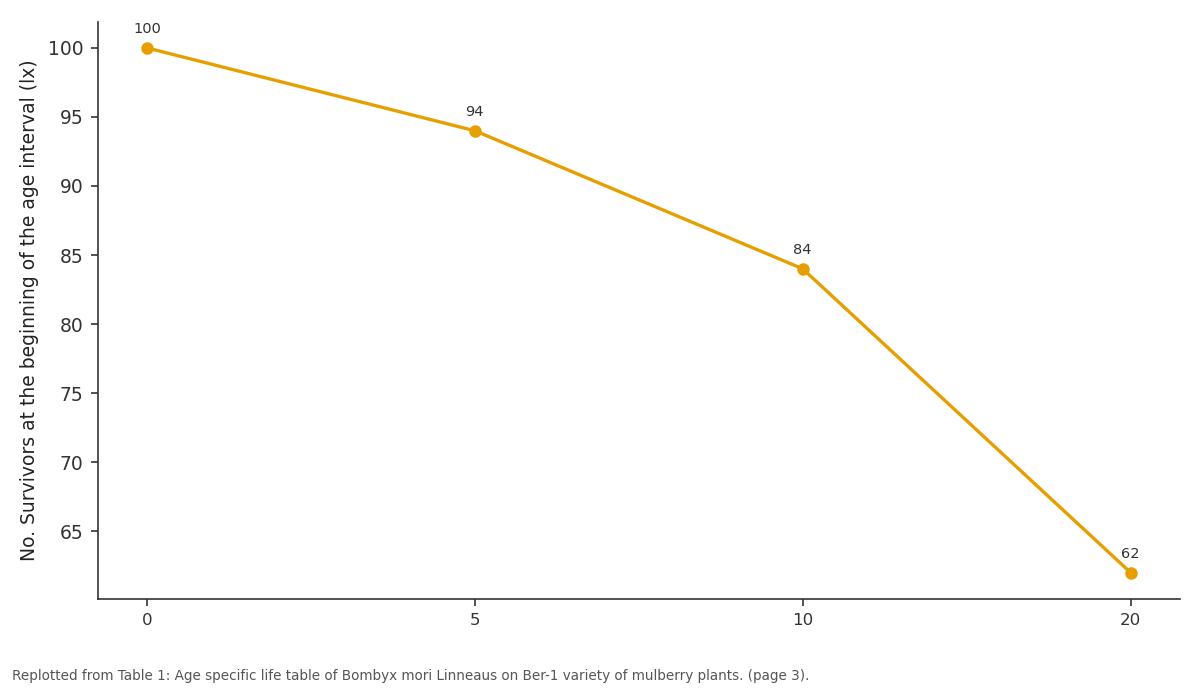
No. Survivors at the beginning of the age...: 0 vs 5 vs 10 vs 20
Replotted from Table 1 (page 3) of the original paper. Every bar is the paper's own table value.
View source evidence ↗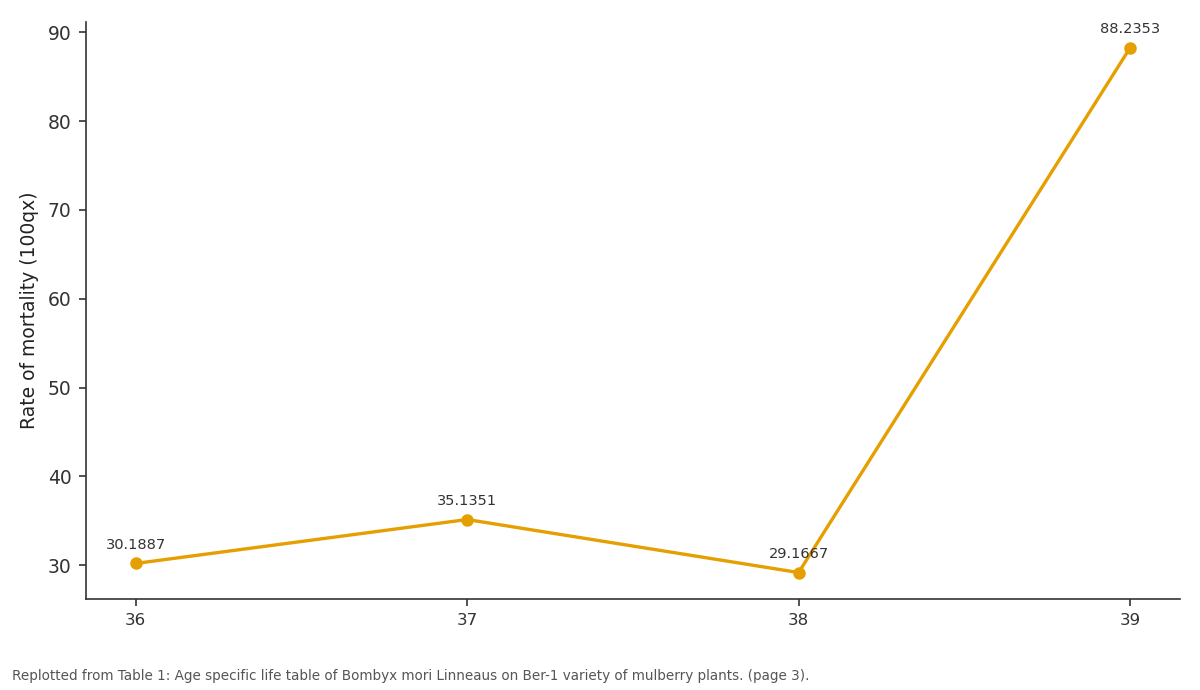
Rate of mortality (100qx) / (100qx): 36 vs 37 vs 38 vs 39
Replotted from Table 1 (page 3) of the original paper. Every bar is the paper's own table value.
View source evidence ↗Figures & tables
From the original paper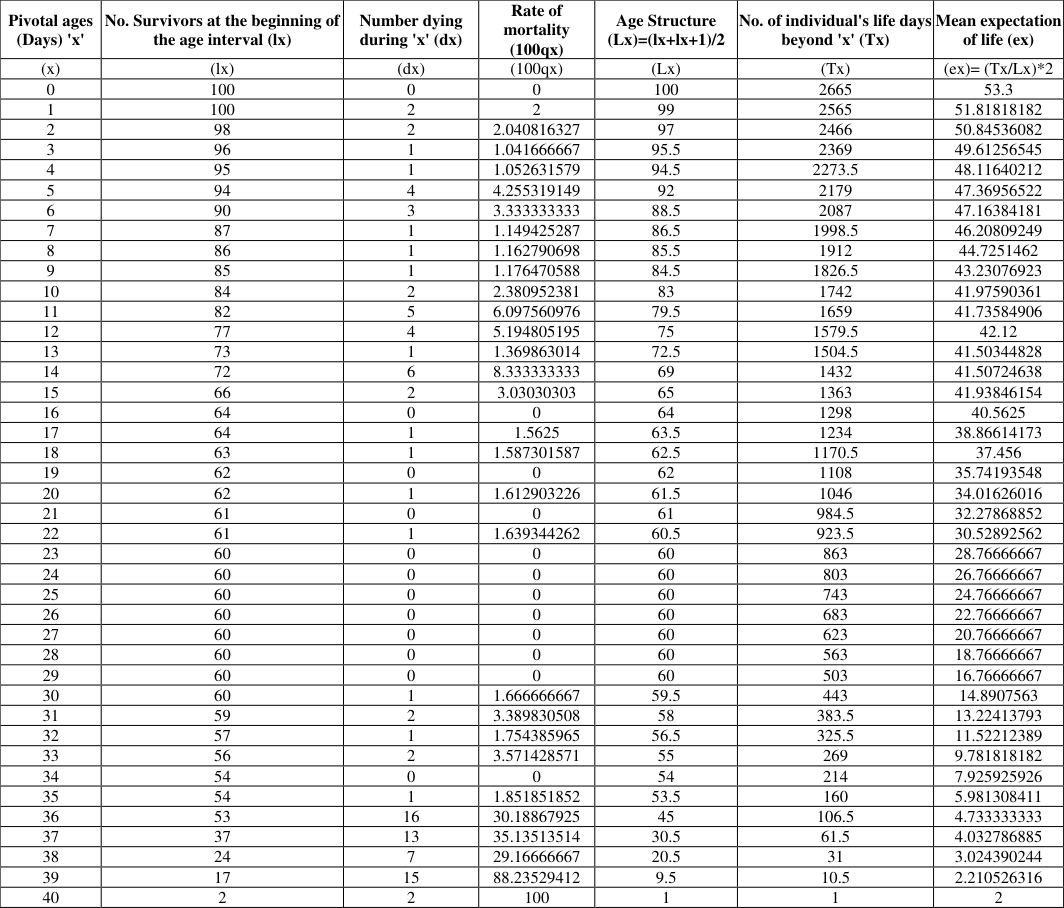 Table 1
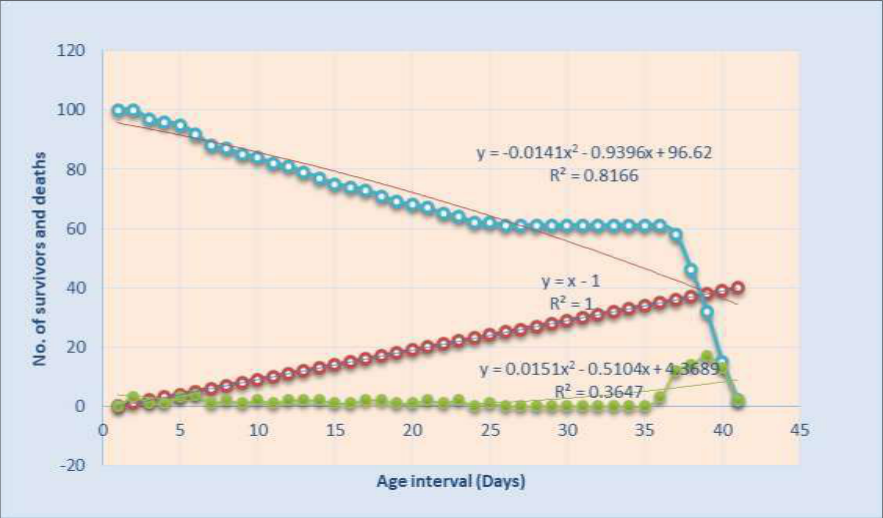 Figure 1
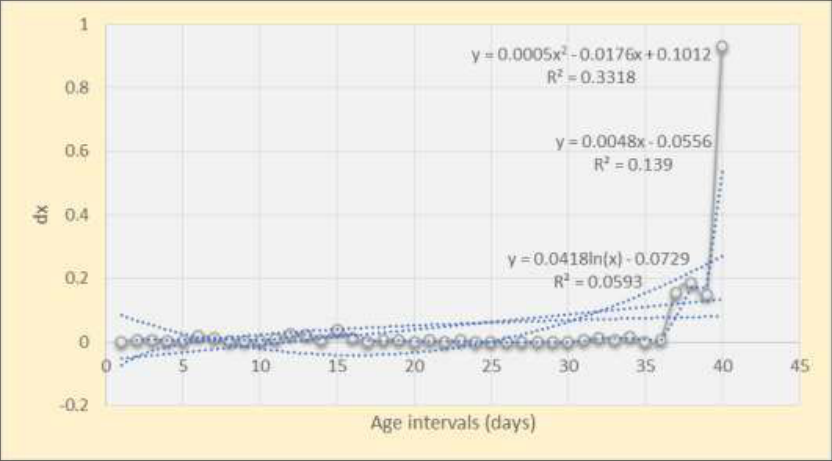 Figure 2
Introduction
The mulberry silkworm, Bombyx mori Linnaeus, occupies a central and irreplaceable role in global sericulture owing to its unparalleled ability to produce high-quality silk, a commodity of immense economic and cultural significance (Gupta, 2004; Kumar et al., 2011) [13,15] . such as survival patterns, developmental rates, and life expectancy. Understanding these cultivar-driven variations is critical for optimizing rearing practices, refining breeding strategies, and improving overall sericultural efficiency (Suzuki & Brown, 1998; Krishnaswami & Ranjekar, 2004) [23, 17] . Silkworm performance is highly sensitive to mulberry leaf composition, as nutritional content, secondary metabolites, moisture levels, and genotype-specific biochemical traits directly influence larval growth and silk yield (Goto et al., 2017) [23] . Previous studies have shown that variation in mulberry genotypes can significantly alter key biological attributes such as larval duration, pupal weight, cocoon quality, and silk filament length. Constructing life tables under these varying nutritional regimes allows for the integration of biological responses into a single quantitative framework (Garai, 2023) [8] . Such an approach provides insights into how mulberry cultivar differences affect demographic stability, offering practical guidelines for sericulturists to enhance feeding regimes, improve disease management, and mitigate environmental stress (Guo et al., 2021; Li et al., 2023) [23,19] . Additionally, life-table research contributes to a broader understanding of ecological and evolutionary processes by revealing adaptive responses of B. mori to host-plant diversity (Chen et al., 2018; Han et al., 2022) [4,14] . This has profound implications for mulberry conservation strategies, sustainable silk production, and long-term ecological resilience. Through this research, by analyzing age-specific life tables across mulberry cultivars, we aim to deepen the understanding of silkworm-host plant interactions and provide data-driven recommendations to strengthen sustainable sericulture practices, biodiversity conservation, and economic stability in sericultural ecosystems.
Materials and Methods
A detailed field experiment was conducted to evaluate the demographic parameters of the mulberry silkworm, Bombyx mori Linnaeus, reared on different mulberry (Morus spp.) cultivars under the natural agroclimatic conditions of Bolpur-Sriniketan, West Bengal. The study site was situated within the mulberry cultivation belt of the region, geographically located at 23.25° N latitude and 87.40° E longitude, with an elevation of approximately 58 meters above mean sea level. The area is characterized by a warm and humid subtropical climate, with average field temperatures ranging from 25-30 °C during the rearing period and relative humidity levels between 70-85%, conditions known to favor silkworm growth and leaf biomass accumulation in mulberry plants. The experiment was structured to ensure controlled yet field-relevant conditions for silkworm development. Fresh leaves from locally cultivated mulberry varieties were harvested daily from the Bolpur-Sriniketan fields and provided to the larvae at standardized feeding intervals. Although the study was conducted under field-derived environmental settings, supplemental rearing control was maintained by regulating microclimatic conditions within rearing units at 25±1 °C, 75±5% RH, and a 12:12 h photoperiod, thereby minimizing environmental variability. All rearing trays, racks, and equipment were thoroughly sterilized before use to prevent microbial contamination. This integrated semi-field and controlled approach provided a realistic yet scientifically robust environment for assessing life-table parameters and understanding the survival and developmental dynamics of B. mori on different mulberry cultivars. Newly hatched larvae were introduced into standardized rearing trays at uniform larval densities to avoid crowdingrelated stress effects. Larvae were fed at regular intervals with fresh, fully matured leaves of the respective mulberry cultivars under investigation. Feeding was conducted four times daily to ensure adequate nutrition throughout larval development.
Environmental parameters namely temperature, relative humidity, and photoperiod were monitored continuously using digital thermo-hygrometers to maintain consistency throughout the experiment. Rearing procedures followed standard sericultural protocols to reduce variability arising from husbandry practices.
Data Collection and Biological Observations
Biological data were recorded for each individual silkworm beginning from hatching and continuing through subsequent developmental stages. The number of hatched larvae constituted the initial population (n₀), and survival was monitored daily throughout all larval instars, pupation, and adult emergence. Developmental durations were measured as the time taken for larvae to progress from one instar to the next, as well as the duration of the pupal phase. Mortality events were recorded at each developmental stage to enable calculation of life-table parameters.
Life-Table Parameters
Age-specific life tables were constructed following standard demographic procedures. Age intervals (x) were expressed in days, beginning from hatching. The survival rate (lₓ) represented the proportion of individuals surviving to age x relative to the initial cohort size (n₀), calculated as lₓ = nₓ/n₀, where nₓ denotes the number of individuals surviving at age x. Mortality rate (dₓ) corresponded to the proportion of individuals dying within each age interval, providing insights into critical mortality stages across the life cycle. Age-specific mortality expressed per 100 individuals (100qₓ) was computed as 100qₓ = 100 × dₓ/l x , enabling standardized comparisons across age groups. The age-specific population value (Lₓ) was computed as the average number of individuals alive during age interval x, using the relationship Lₓ = (lₓ + lₓ₊₁) / 2, where lₓ and lₓ₊₁ denote survivorship at the beginning and end of the interval, respectively. Mortality percentage (100qₓ) was expressed as (dₓ/lₓ) × 100, providing a clear indication of mortality pressure at each developmental stage. Life expectancy (eₓ) at age interval x was derived from the formula eₓ = Tₓ/Lₓ, where Tₓ is the cumulative number of life days remaining beyond age x, and Lₓ is the number of individuals alive at age x. These parameters collectively enabled a comprehensive assessment of survival dynamics and developmental stability of B. mori on different mulberry cultivars.
Statistical Analysis
Statistical comparisons among mulberry cultivars were performed to evaluate differences in survival rate, mortality rate, developmental duration, and life expectancy. Appropriate statistical tests were employed depending on data distribution, and significance levels were interpreted at conventional probability thresholds. Variation among treatments was carefully examined to determine cultivar-specific influences on the demographic performance of B. mori.
Results
The comprehensive life-table analysis of Bombyx mori reared on the Ber-1 mulberry cultivar revealed distinct demographic trends that provide a detailed understanding of the developmental progression, survival dynamics, and mortality patterns of the cohort under controlled feeding conditions. The results obtained offer a high-resolution profile of population changes, highlighting critical phases of vulnerability, stability, and demographic transition across the full developmental cycle of the silkworm. The survival rate (lₓ) demonstrated a steady and predictable decline over the 40-day observation period, consistent with natural biological attrition among lepidopteran larvae. The cohort began with 100 individuals at day 0, representing complete hatchability and a uniform starting point for demographic evaluation. By day 5, survivorship declined to 94 individuals, marking the first developmental loss following early feeding adjustments. These early reductions, although modest, reflect physiological changes associated with initial leaf ingestion, gut activation, and the metabolic shift from yolk reserves to active feeding. By day 10, survivorship declined further to 84 individuals, marking the end of the first major developmental phase, which includes the first molting event and the onset of active mid-instar feeding. At day 20, the number of surviving larvae had decreased to 62, indicating a cumulative impact of molting stress, increased nutritional demand, and metabolic intensity characteristic of advanced larval development. A temporary stabilization phase was observed around day 30, during which the surviving population remained close to 60 individuals (Table 1). This suggests a period of relative physiological equilibrium during mid-instar feeding, where the larvae benefited from the nutrient quality of Ber-1 leaves. However, by day 36, another marked decline occurred, with survivorship decreasing to 53 individuals, followed by a dramatic collapse by day 40 when only two larvae remained alive. These significant late-stage declines underscore the progressive vulnerability of the cohort during advanced developmental phases (Fig. 1). The mortality rate (dₓ) provided further insight into population losses across specific age intervals. Mortality remained extremely low during the earliest days of development, particularly between days 0 and 4, during which the larvae demonstrated strong resilience to environmental and nutritional conditions. The first noticeable increase in mortality occurred on day 5, coinciding with early molting activities and initial physiological stress linked to cuticular shedding and renewal. A more pronounced mortality peak was documented on day 11, with five larvae succumbing, followed by four additional deaths on day 12. These events mark the first major critical period in the developmental sequence, corresponding with the second instar-to-third instar transition. Molting demands considerable biochemical and energetic investment, and the larvae frequently exhibit increased susceptibility to physiological shock and environmental fluctuation during such periods.
| Pivotal ages (Days) 'x' | No. Survivors at the beginning of the age interval (lx) | Number dying during 'x' (dx) | Rate of mortality (100qx) | Age Structure (Lx)=(lx+lx+1)/2 | No. of individual's life days beyond 'x' (Tx) | Mean expectation of life (ex) |
|---|---|---|---|---|---|---|
| (x) | (lx) | (dx) | (100qx) | (Lx) | (Tx) | (ex)= (Tx/Lx)*2 |
| 0 | 100 | 0 | 0 | 100 | 2665 | 53.3 |
| 1 | 100 | 2 | 2 | 99 | 2565 | 51.81818182 |
| 2 | 98 | 2 | 2.040816327 | 97 | 2466 | 50.84536082 |
| 3 | 96 | 1 | 1.041666667 | 95.5 | 2369 | 49.61256545 |
| 4 | 95 | 1 | 1.052631579 | 94.5 | 2273.5 | 48.11640212 |
| 5 | 94 | 4 | 4.255319149 | 92 | 2179 | 47.36956522 |
| 6 | 90 | 3 | 3.333333333 | 88.5 | 2087 | 47.16384181 |
| 7 | 87 | 1 | 1.149425287 | 86.5 | 1998.5 | 46.20809249 |
| 8 | 86 | 1 | 1.162790698 | 85.5 | 1912 | 44.7251462 |
| 9 | 85 | 1 | 1.176470588 | 84.5 | 1826.5 | 43.23076923 |
| 10 | 84 | 2 | 2.380952381 | 83 | 1742 | 41.97590361 |
| 11 | 82 | 5 | 6.097560976 | 79.5 | 1659 | 41.73584906 |
| 12 | 77 | 4 | 5.194805195 | 75 | 1579.5 | 42.12 |
| 13 | 73 | 1 | 1.369863014 | 72.5 | 1504.5 | 41.50344828 |
| 14 | 72 | 6 | 8.333333333 | 69 | 1432 | 41.50724638 |
| 15 | 66 | 2 | 3.03030303 | 65 | 1363 | 41.93846154 |
| 16 | 64 | 0 | 0 | 64 | 1298 | 40.5625 |
| 17 | 64 | 1 | 1.5625 | 63.5 | 1234 | 38.86614173 |
| 18 | 63 | 1 | 1.587301587 | 62.5 | 1170.5 | 37.456 |
| 19 | 62 | 0 | 0 | 62 | 1108 | 35.74193548 |
| 20 | 62 | 1 | 1.612903226 | 61.5 | 1046 | 34.01626016 |
| 21 | 61 | 0 | 0 | 61 | 984.5 | 32.27868852 |
| 22 | 61 | 1 | 1.639344262 | 60.5 | 923.5 | 30.52892562 |
| 23 | 60 | 0 | 0 | 60 | 863 | 28.76666667 |
| 24 | 60 | 0 | 0 | 60 | 803 | 26.76666667 |
| 25 | 60 | 0 | 0 | 60 | 743 | 24.76666667 |
| 26 | 60 | 0 | 0 | 60 | 683 | 22.76666667 |
| 27 | 60 | 0 | 0 | 60 | 623 | 20.76666667 |
| 28 | 60 | 0 | 0 | 60 | 563 | 18.76666667 |
| 29 | 60 | 0 | 0 | 60 | 503 | 16.76666667 |
| 30 | 60 | 1 | 1.666666667 | 59.5 | 443 | 14.8907563 |
| 31 | 59 | 2 | 3.389830508 | 58 | 383.5 | 13.22413793 |
| 32 | 57 | 1 | 1.754385965 | 56.5 | 325.5 | 11.52212389 |
| 33 | 56 | 2 | 3.571428571 | 55 | 269 | 9.781818182 |
| 34 | 54 | 0 | 0 | 54 | 214 | 7.925925926 |
| 35 | 54 | 1 | 1.851851852 | 53.5 | 160 | 5.981308411 |
| 36 | 53 | 16 | 30.18867925 | 45 | 106.5 | 4.733333333 |
| 37 | 37 | 13 | 35.13513514 | 30.5 | 61.5 | 4.032786885 |
| 38 | 24 | 7 | 29.16666667 | 20.5 | 31 | 3.024390244 |
| 39 | 17 | 15 | 88.23529412 | 9.5 | 10.5 | 2.210526316 |
| 40 | 2 | 2 | 100 | 1 | 1 | 2 |
Table text extracted from the original PDF; superscript letters are shown inline. The original table image is below.
View original table image
The most severe and biologically significant peak in mortality was observed on day 36, with 16 individuals dying within a single interval. This sharp increase corresponds with pre-pupal physiological reorganization, a phase characterized by heightened metabolic stress, reduced feeding, and preparation for cocooning. A second late-stage peak was recorded on day 39, during which 15 larvae died. This intense mortality points to the exhaustion of larvae that fail to successfully transition to the pupal stage. The pattern of acute mortality in late instars is consistent with the known biology of B. mori, wherein nutritional depletion, cuticular deterioration, and metabolic strain accumulate over successive instars (Fig. 2). At day 0, life expectancy was estimated at 53.3 days, reflecting an initial phase of favorable demographic potential. By day 10, eₓ declined to 41.98 days, corresponding to moderate survivorship loss. At day 20, life expectancy reduced further to 34.02 days, indicating the cumulative aging effects that accompany continuous feeding, digestion, and molting. A marked decline was observed in the later developmental stages, particularly by day 36, when eₓ fell abruptly to 4.73 days. This decline represents an important demographic threshold, indicating that the majority of larvae entering this stage were unlikely to survive much longer. At day 40, the final life expectancy value reached only 2 days, coinciding with the nearextinction of the cohort. These patterns affirm that early and mid-instar larvae possess significant remaining lifespan potential, while late instars experience an exponential decline in life expectancy as they approach the terminal stage of their development. The survivorship curve (Fig. 1) visually reflects these patterns through its downward-sloping trajectory, with moderate declines in early development followed by steeper declines in the later stages. This pattern represents a transitional Type II-Type III survivorship curve, characteristic of holometabolous insects, where relatively steady mortality during the early instars gives way to a pronounced acceleration in mortality during late developmental stages as physiological demands intensify. The mortality curve (Fig. 2) complements this by showing distinct peaks at critical transition points, aligning precisely with physiological stress phases. Overall, the results highlight two major phases of demographic sensitivity in Bombyx mori reared on Ber-1: (1) the early molting period around days 11-12 and (2) the severe pre-pupal period around days 36-39. These findings collectively demonstrate that Ber-1 provides adequate nutrition during early development but requires enhanced management intervention during late developmental stages to prevent sharp mortality spikes and improve sericultural performance.
Discussion
The demographic patterns observed in Bombyx mori reared on the Ber-1 mulberry cultivar highlight clear stage-specific fluctuations in survival and mortality, reflecting the complex interplay between host-plant nutrition and silkworm physiology (Arivoli & Vasantha-Srinivasan, 2022) [1] . The steady decline in survivorship from day 0 to day 40 is consistent with classical age-structured models in insect demography, which often demonstrate gradual attrition followed by sharp terminal declines as individuals approach the end of their developmental threshold (Carey, 1993) [2] . Similar survivorship trends have been reported in other mulberry-silkworm studies, emphasizing that cultivar quality strongly influences survivorship stability during critical larval transitions (Chen et al., 2018) [4] . The observed mortality peaks on days 11-12 and 36-39 suggest distinct physiological stress phases, possibly associated with rapid feeding demands and metabolic transitions during molting and pupal initiation (Guo, Wang & Wu, 2021) [23] . Comparable mortality spikes have been documented in experimental populations exposed to cultivar-specific nutritional limitations, confirming that mid-instar and prepupal stages are most vulnerable to nutritive fluctuations (Li, Zhang & Wang, 2023). [17] These mortality concentrations align with theoretical exp ectations from stage-classified matrix models, where demographic bottlenecks often emerge at metabolically intensive stages (Caswell, 2001) [3] . The high survivorship during early larval stages indicates that Ber-1 leaves provide sufficient nutritive quality to support early instar development, paralleling similar findings from mulberry genotype studies demonstrating strong initial larval resilience under nutrientrich cultivars. However, the significant decline after day 30 reflects the cumulative effect of physiological wear and decreasing feeding efficiency, a pattern also noted in longterm demographic analyses of B. mori populations (Wu, Goto & Suzuki, 2023) [23] . The sharp drop in survival by day 40, with only two individuals remaining, reinforces the concept of senescence-driven mortality in later life stages, a phenomenon well-characterized in insect demographic literature (Gupta, 2004) [13] .
Age-specific mortality rates (100qₓ) further illustrate these trends, with severe late-stage mortality matching previously reported findings wherein terminal mortality spikes occur due to weakening immune response, pathogen susceptibility, or cultivar-linked nutritional limitations (Yang, Zhu & Wang, 2022) [25] . The extremely high mortality on day 39 (88.24%) aligns with evidence showing the culmination of physiological stress during the pre-emergence period (Xu, Zhao & Zhang, 2023) [24] . Likewise, the decline in age structure (Lₓ) across the developmental timeline mirrors population contraction curves previously documented in comprehensive silkworm demographic studies (Han, Li & Chen, 2022) [14] . Life expectancy (eₓ) values showed a progressive decrease, consistent with expectations from both insect life-history theory and silkworm-specific demographic research (Kumar & Nagaraju, 2002) [16] . The rapid reduction in life expectancy after day 20 parallels the findings of Li, Cheng & Liu (2021) [18] , who reported accelerated demographic deterioration under increased developmental stress. The significant drop at day 36, where life expectancy fell to 4.73 days, reflects acute late-stage mortality pressure; similar patterns have been reported in cultivar-based demographic comparisons with analogous mortality thresholds (Zhang, Yang & Wu, 2022) [25] . The overall demographic response observed in this study aligns closely with earlier research showing that mulberry cultivar strongly influences B. mori survivorship, growth, and life-table structure (Wang & Li, 2017) [22] . Furthermore, the identified mortality hotspots corroborate findings from previous work on age-specific vulnerabilities and developmental stress in silkworm populations (Garai, 2024) [5] . These results reinforce the broader sericultural understanding that optimizing feeding regimes, environmental conditions, and cultivar selection can significantly improve cocoon yield and population stability (Kumar, Pandey & Singh, 2011) [15] .
Conclusion
The age-specific life table constructed for Bombyx mori reared on the Ber-1 mulberry cultivar provides critical insights into the demographic patterns governing silkworm development, survival, and mortality. The analysis reveals clear trends in survivorship across developmental stages, highlighting periods of both stability and vulnerability within the life cycle. These findings emphasize the biological significance of host-plant quality, as the nutritive profile of Ber-1 directly influences larval performance and subsequent population stability. The observed fluctuations in mortality during key developmental intervals suggest that certain physiological transitions are more sensitive to environmental or nutritional limitations, underscoring the importance of cultivar selection in sericulture. The derived life-expectancy values further enhance our understanding of developmental predictability, offering a valuable framework for anticipating population dynamics in practical rearing systems. Such demographic indicators are essential for improving sericultural management practices, optimizing resource allocation, and enhancing cocoon productivity. By identifying the stages at which mortality is elevated, sericulturists can implement targeted interventions aimed at minimizing losses and improving overall rearing efficiency. Moreover, the study contributes to the broader goal of conserving mulberry genetic resources, as the performance of B. mori is closely linked to the characteristics of its host cultivars. Future investigations should focus on elucidating the specific physiological or biochemical factors underlying stage-specific mortality and extending demographic studies across a wider range of mulberry genotypes. Such an approach will support the development of comprehensive strategies for sustainable sericulture and reinforce the longterm viability of silk production systems.
Acknowledgement
AcknowledgementNot applicable.
References
26 in the original paper- Arivoli S, Vasantha-Srinivasan P. Life cycle dynamics of Bombyx mori Linnaeus reared on four varieties of mulberry plants. Int J Trop Insect Sci. 2022;42(1):1025. https://doi.org/10.1017/S1742758422000076
- Carey JR. Applied demography for biologists: With special emphasis on insects. Oxford University Press; 1993.
- Caswell H. Matrix population models: Construction, analysis, and interpretation. 2nd ed. Sinauer Associates; 2001.
- Chen ZM, Zhang DJ, Zhang H, Guo P, Guo SP. Physiological response and growth of Bombyx mori to mulberry cultivars. J Econ Entomol. 2018;111(4):18791887. https://doi.org/10.1093/jee/toy172
- Garai K. Revealing pest patterns: A comparative spatial distribution analysis of insect threats in Kharif rice across key agricultural regions in Eastern India. Pest Manag Sci. 2024;1-9.
- Garai K. Biocontrol potential of Asian ladybird beetle: Life table analysis across age and temperature. J Crop Health. 2025;77:133-140.
- Garai K. Vital statistics of Bombyx mori Linnaeus on diverse mulberry varieties: Age-specific insights. Int J Stat Appl Math. 2024;9(4S):29-38.
- Garai K. Seasonal incidence and distribution pattern of insect pests infesting onion ecosystem in the red lateritic zone of West Bengal. Pharma Innov J. 2023;12(Special Issue 10):2005-2009.
- Garai K. Spider distribution and seasonal incidence in onion ecosystems: A study in West Bengal's red lateritic zone. Int J Res Agron. 2024;7(1):45-52. DOI:1033545/2618062X.2024.v7i1a.189 International Journal of Agriculture and Food Science https://www.agriculturaljournals.com
- Garai K. The distribution pattern and seasonal incidence of spiders (Araneae: Araneidae) in the onion ecosystem of West Bengal's red lateritic zone. Pharma Innov J. 2023;12(Special Issue 12):1615-1622.
- Garai K. Silkworm: An auspicious model organism in biological science. Sun Agri e-Newsletter. 2024;4(2):15-19.
- Guo Y, Wang L, Wu S. Age-specific life tables of Bombyx mori across different mulberry cultivars: Insights into population dynamics and environmental impacts. Ecol Entomol. 2021;46(4):789-802. https://doi.org/10.1111/een.12999
- Gupta R. The silkworm. Oxford & IBH Publishing; 2004.
- Han R, Li Q, Chen W. Understanding the complex interplay between Bombyx mori and its mulberry host plants: Implications for sustainable silk production and biodiversity conservation. J Insect Sci. 2022;19(2):4556. https://doi.org/10.1093/jisesa/ief034
- Kumar S, Pandey D, Singh P. Sericulture: Basics to genetics. New India Publishing; 2011.
- Kumar V, Nagaraju J. Genetic analysis of mulberry silkworm (Bombyx mori L.) reared on different host plants: Evidence from ribosomal DNA markers. Genome. 2002;45(6):1041-1046. https://doi.org/10.1139/g02-081
- Krishnaswami S, Ranjekar PK. Bombyx mori: Genetics and biotechnology. Capital Publishing; 2004.
- Li L, Cheng P, Liu C. Genetic diversity and population structure of Bombyx mori: Implications for breeding and conservation strategies. Entomol Exp Appl. 2021;169(1):78-89. https://doi.org/10.1111/eea.12987
- Li X, Zhang M, Wang H. Comparative analysis of mortality patterns and life expectancy in Bombyx mori across diverse mulberry cultivars. J Appl Entomol. 2023;147(1):112-125. https://doi.org/10.1111/jen.12987
- Suzuki Y, Brown P. Silkworm genetics and genomics. CRC Press; 1998.
- Wang L, Zhang Y, Liu L, Zhang Z, Wang J. Effects of mulberry genotypes on growth and development of Bombyx mori (Lepidoptera: Bombycidae). J Econ Entomol. 2020;113(2):606-614. https://doi.org/10.1093/jee/toz339
- Wang Y, Li J. Mulberry genotype diversity influences nutritional composition and growth of Bombyx mori larvae: Implications for sericulture. J Econ Entomol. 2017;110(5):1321-1333. https://doi.org/10.1093/jee/tox189
- Wu H, Goto K, Suzuki Y. Life cycle dynamics and demographic outcomes of Bombyx mori on different mulberry cultivars: A case study. Agric For Entomol. 2023;25(3):234-246. https://doi.org/10.1111/afe.12534
- Xu K, Zhao P, Zhang G. Impact of temperature and humidity on fecundity and silk production of Bombyx mori: Insights from field studies. J Insect Physiol. 2023;103(1):34-45. https://doi.org/10.1016/j.jinsphys.2023.101345
- Yang S, Zhu B, Wang Z. Effects of environmental factors on growth and development of Bombyx mori: A review. Insect Sci. 2022;29(4):567-580. https://doi.org/10.1111/1744-7917.12986
- Zhang J, Yang H, Wu Q. Behavioral responses of Bombyx mori larvae to host plant volatiles: Mechanisms and implications for pest management. Pest Manag Sci. 2022;78(9):1801-1812. https://doi.org/10.1002/ps.6987