
Research article · 2025 · Full text
International Journal of Horticulture and Food ScienceA review of smart agriculture and its impact on revolutionizing agricultural production
Volume 7(11) · Pages 31–34 · DOI: 10.33545/26631067.2025.v7.i11a.427 ↗
Research areasSmart Agriculture and AIInternet of Things and AIInnovations in Aquaponics and Hydroponics Systems
Abstract
Author-writtenAs the world's population grows, traditional agriculture confronts substantial challenges from resource constraint and climate change, making food security and sustainability top priorities. Smart agriculture, which incorporates technology such as artificial intelligence (AI), the internet of things (IoT), and drones, provides novel solutions for increasing productivity and resource efficiency. AI technologies are used to examine large agricultural datasets such as satellite imaging, soil properties, and weather patterns, resulting in better crop and resource management as well as higher yields. IoT technologies help by monitoring environmental conditions and accurately managing irrigation and agricultural inventory. Furthermore, drones are used to check crop health and apply fertilisers with precision, reducing waste and increasing efficiency. Practical examples in the Netherlands, Japan, and the United States demonstrate how smart agriculture has cut water and fertiliser consumption while increasing production. However, problems remain, such as high implementation costs, a lack of technical expertise, and insufficient communication infrastructure in rural areas. Smart agriculture in Iraq offers significant opportunities to improve productivity through technologies such as smart irrigation systems, climate data analysis, and drones. However, its implementation faces challenges related to a lack of infrastructure and training, requiring government efforts and international support to overcome these obstacles and achieve food security. Integrating artificial intelligence and Internet of Things technologies into the agricultural sector can contribute to more efficient use of water and energy resources. Partnerships between universities, research centers, and agricultural companies are crucial in developing innovative solutions tailored to local environmental and economic conditions. Raising awareness among farmers about the importance of shifting towards digital agriculture is an essential step to ensure the sustainability of agricultural production and achieve comprehensive rural development.
Summary
Source-checkedPlain-language reading of the full paper, prepared with AI and checked against the text. Each point links to the authors' own words.
Why it matters
- Traditional agriculture is currently facing significant challenges due to climate change and limited resources, which threatens global food security. View evidence ↗
- With the global population projected to reach 9 billion by 2050, the FAO indicates that food production needs to increase by 70%. View evidence ↗
- Smart agriculture utilizes AI, IoT, and drones to offer new ways to improve resource efficiency and agricultural productivity. View evidence ↗
The question
- The paper aims to explore the revolutionary role of smart agriculture and its capacity to transform global food supply systems. View evidence ↗
What they did
- The review describes how AI uses machine learning and neural networks to analyze large datasets, including soil characteristics, weather patterns, and satellite imagery. View evidence ↗
- IoT technology is employed via sensors and probes to monitor real-time environmental factors such as air quality, light levels, soil moisture, and temperature. View evidence ↗
- Drones (UAVs) equipped with multispectral and thermal cameras are used for precise surveys and monitoring of crop health. View evidence ↗
What they found
- In the Netherlands, vertical farms have demonstrated productivity per square meter that is 300% higher than that of traditional farms. View evidence ↗
- The 'Mirai' smart farm in Japan achieved a 50% increase in production and a 90% reduction in water consumption. View evidence ↗
- Precision agriculture in Iowa, USA, increased field productivity by 20% and reduced the use of fertilizers by 25%. View evidence ↗
- Research from the University of California suggests smart agriculture can boost output by 20% while reducing resource use by up to 50%. View evidence ↗
- Smart irrigation systems help improve environmental sustainability by reducing methane emissions compared to traditional irrigation. View evidence ↗
- High initial implementation costs often make smart agriculture technologies inaccessible to small-scale farmers in developing nations. View evidence ↗
- The effectiveness of IoT devices is limited in many rural areas due to insufficient internet infrastructure. View evidence ↗
What it means
- The authors conclude that smart agriculture is an effective tool for adapting to climate change through precise scheduling and smart irrigation. View evidence ↗
- The authors recommend implementing targeted training programs to empower farmers to use these technologies efficiently. View evidence ↗
- A significant barrier to widespread adoption is the lack of technical awareness and experience among farmers regarding the operation and maintenance of smart systems. View evidence ↗
Visual summary
1 visualsIllustrations explain the paper; they do not show study data.
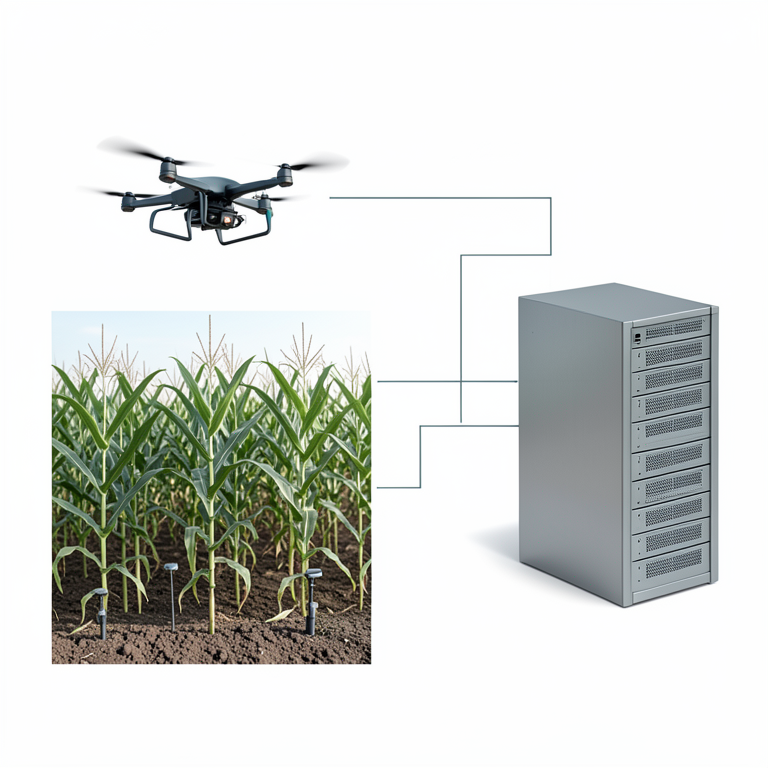
Smart Agriculture Ecosystem
AI-generated conceptual illustration (a corn field with soil sensors and a drone). It explains the idea and does not show study data.
View source evidence ↗Introduction
The expanding global population, which is expected to reach 9 billion by 2050, has pushed food security to the forefront of global challenges. According to the Food and Agriculture Organisation (FAO), food production must increase by 70% to meet rising demand [1] . Traditional agricultural methods are limited due to resource shortages, climate change, and decreased soil fertility. In this setting, smart agriculture, which is powered by artificial intelligence (AI) and the Internet of Things (IoT), appears as a transformative solution with the potential to improve agricultural efficiency and sustainability. Smart agriculture uses cutting-edge technology to enable precision farming, optimise resource use, and increase output. AI technologies use machine learning and predictive analytics to evaluate large datasets and deliver practical insights into crop management and weather trends [2] . Meanwhile, IoT devices such as soil moisture sensors and automated irrigation systems allow for real-time monitoring and management of farming operations [3] . As countries attempt to strike a balance between food production and environmental sustainability, smart agriculture provides an important step towards reaching this goal. Countries like as the United Kingdom are incorporating AI and IoT technology into their agricultural systems to address issues like resource inefficiencies and manpower shortages [4] . This introduction lays the groundwork for further exploration of smart agriculture's revolutionary role and ability to change global food supply systems.
1.1 Modern Technologies in Smart Agriculture 1.1.1 Artificial Intelligence (AI): Artificial intelligence is the foundation for creating smart agriculture. Machine learning and neural networks are used to examine massive volumes of agricultural data (2). This data could include weather patterns, soil characteristics, satellite imaging, and even data from ground sensors [5] .
Examples of AI Applications 1. Satellite and Drone Image Analysis: AI is used to detect crop illnesses by evaluating collected photos, allowing for early action to avoid disease spread [6] . 2. Water and Irrigation Management: AI systems analyse meteorological and humidity data to determine crop water needs [7] .
Productivity Optimisation through Predictions: By
assessing climatic and soil data, AI can make precise planting and harvesting suggestions, enhancing crop output [8] .
Internet of Things (IoT):
IoT has enormous promise for collecting and evaluating real-time agricultural data [3,27] . Sensors and probes in IoT devices detect environmental factors surrounding crops, including temperature, soil moisture, light levels, and even air quality.
IoT Applications in Smart Agriculture 1. Smart Irrigation Systems: IoT devices connected to irrigation systems can control water flow using realtime soil moisture data [3] .
Agricultural Inventory Management: IoT devices
help monitor grain stocks and stored crops, maintaining their quality and reducing spoilage [9] .
Livestock Health Monitoring:
IoT sensors can be linked to animals to track their health and detect infections early on [10] .
Drones:
Drones are an essential part of the smart agriculture system. These UAVs can undertake quick and precise surveys of agricultural areas [11] . They are also fitted with thermal and multispectral cameras to monitor crop health.
Benefits of Using Drones 1. Crop Health Assessment:
Drones can collect information on crop conditions like as growth rates and insect infestations [6] .
Fertilisers and Pesticides Application: Drones can
use exact field maps to apply fertiliser and pesticides in a targeted manner, decreasing waste and ensuring efficient coverage [12] . 3. Disaster Management Support: Drones can provide quick evaluations of flood and drought damage [13] .
Practical Examples of Smart Agriculture 2.1 Smart Vertical Farms in the Netherlands
The Netherlands is the world leader in smart agriculture applications. Vertical farms incorporate technologies such smart LED lighting and climate control systems to optimise productivity [14] . A study found that vertical farms in the Netherlands produce 300% better productivity per square metre than ordinary farms [15] .
"Mirai" Smart Farm in Japan:
The "Mirai" farm uses cutting-edge AI and IoT technologies to control agricultural lifecycles. All aspects, including lighting and feeding, are properly managed. This resulted in a 90% reduction in water use and a 50% increase in production [16] .
Precision Agriculture in the United States:
Precision agriculture is being adopted in Iowa, with the use of IoT sensors and AI to determine the optimal maize cultivation strategies. According to the United States Department of Agriculture [17] , this strategy has decreased fertiliser use by 25% while increasing field productivity by 20%.
Benefits and Opportunities
Offered by Smart Agriculture 3.1 Improving Resource Efficiency: Smart agriculture technology aid in the efficient use of natural resources like water and fertiliser [18] . The University of California found that smart agriculture might reduce resource usage by up to 50% while boosting output by 20% [7] .
Enhancing Environmental Sustainability:
Smart agriculture helps to reduce carbon emissions and the negative environmental impact of farming [19] . Smart irrigation systems, for example, contribute to the reduction of methane emissions linked with traditional irrigation operations [20] .
Improving Global Food Security:
Smart agriculture improves food production in resource-constrained countries. These technologies can help to alleviate global food poverty by improving resource management and productivity [21] .
Challenges and Barriers 4.1 High Costs:
The early costs of implementing smart technology present a considerable obstacle. These technologies are frequently unavailable to small-scale farmers, particularly in poor countries [22] .
Lack of Training:
Smart agriculture necessitates advanced technical capabilities. The absence of proper training poses a barrier to widespread implementation of these technologies [14] .
Connectivity Issues in Rural Areas:
Many rural areas continue to lack sufficient internet infrastructure, limiting the usage of IoT devices [9] .
Smart Agriculture in Iraq: Opportunities for Development and Challenges
In Iraq, traditional agriculture has various obstacles, including water scarcity, poor resource utilisation, and the negative consequences of climate change on agricultural production [23] . With the agricultural industry under increasing strain, smart agriculture technologies have the potential to significantly improve land productivity and provide food security.
Opportunities for Developing Smart Agriculture in Iraq 1. Water Management: Water scarcity is one of Iraq's key concerns, and smart agricultural technologies like smart irrigation systems have the potential to drastically minimise water waste [24] .
Climate Data Analysis: Using artificial intelligence
(AI) to evaluate meteorological data could enhance planting and harvesting timing, increasing production and lowering losses caused by adverse weather conditions [25] . 3. Drone Usage: Drones could help monitor and assess crop health, detecting pests and diseases early and minimising the need for pesticides [26] .
Despite the inherent opportunities, Iraq confronts major hurdles in deploying smart agriculture technology, including a lack of communication infrastructure and inadequate technical training for farmers [23] . However, the Iraqi government and international partners are working to improve these technologies in rural regions in order to overcome these obstacles and achieve better results in the agricultural sector.
Recommendations and the Future Investing in Research and Development:
To reduce the cost of smart technologies, more investment is needed [10] .
Providing Training Programs for Farmers:
Empowering farmers to use technology efficiently requires the implementation of targeted training programs [12] .
Building Strong Internet Infrastructure in Rural
Areas: Enhancing connectivity is essential for the widespread adoption of IoT devices in remote areas [28] .
Conclusion
Smart autumn is a major contributor to agricultural production, representing a qualitative shift in the way agricultural resources are managed by employing digital technologies such as the Internet of Things (IoT), artificial intelligence (AI), mouse-to-mouse, drones, and data analysis systems. This approach aims to achieve more efficient and sustainable agriculture, capable of meeting the environmental, climatic, and economic challenges facing the world today. The importance of smart agriculture lies in its ability to increase the efficiency of natural resource use, especially water, fertilizers, and energy, through precise monitoring of plant and soil needs in real time. It also contributes to improving crop productivity and quality by predicting agricultural diseases and pests at their early stages, reducing losses and improving economic returns for farmers. In addition, smart farming systems enable more accurate agricultural decisions based on data rather than personal experience alone, which raises the level of agricultural planning and management. Smart agriculture also stands out as an effective tool for combating the effects of climate change, helping adapt to changes in temperature and rainfall through smart irrigation systems and precise scheduling of agricultural operations. It also contributes to reducing the carbon footprint of the agricultural sector by reducing the use of fuel and excessive chemical fertilizers, thus preserving ecological balance. Despite these advantages, the implementation of smart agriculture faces several obstacles, most notably the high costs of modern technologies and the difficulty of providing digital infrastructure in rural areas. Furthermore, the lack of technical awareness among farmers and the lack of experience in operating and maintaining smart systems pose obstacles to their widespread adoption. In addition, limited internet and electrical power networks in some agricultural areas limit the effectiveness of IoT and remote sensing applications. The absence of supportive government policies and the scarcity of agricultural financing programs dedicated to digital transformation pose a major challenge to the widespread adoption of smart agriculture in developing countries. Furthermore, concerns over agricultural data security and information privacy pose an additional obstacle amid the expanding use of internet-connected systems.
References
28 in the original paper- FAO. The State of Food and Agriculture. Rome: Food and Agriculture Organisation of the United Nations; 2019.
- Jha K, Doshi A, Patel P, Shah M. A comprehensive review on automation in agriculture using artificial intelligence. Artif Intell Agric. 2019;2:1-12.
- Sharma A, Jain A, Gupta P, Chowdary V. Machine learning applications for precision agriculture: A comprehensive review. IEEE Access. 2021;9:48434873.
- Ahmed B, Shabbir H, Naqvi SR, Peng L. Smart agriculture: Current state, opportunities, and challenges. IEEE Access. 2024;12:144456-144478.
- Walter A, Finger R, Huber R, Buchmann N. Opinion: Smart farming is key to developing sustainable agriculture. Proc Natl Acad Sci USA. 2017;114(24):6148-6150.
- Makam S, Komatineni BK, Meena S, Meena U. Unmanned aerial vehicles (UAVs): An adoptable technology for precise and smart farming. Discov Internet Things. 2024;4(1).
- Erokhin V, Mouloudj K, Bouarar AC, Mouloudj S, Gao T. Investigating farmers' intentions to reduce water waste through water-smart farming technologies. Sustainability. 2024;16(11):4638.
- Mana AA, Allouhi A, Hamrani A, Rehman S, El Jamaoui I, Jayachandran K. Sustainable AI-based production agriculture: Exploring AI applications and implications in agricultural practices. Smart Agric Technol. 2024;7:100416.
- Mustaza SM, Pauzi NAM, Zainal N, Moubark AM. Artificial intelligence in precision agriculture: A review. J Kejuruteraan. 2025;37(2):1025-1047.
- Quy VK, Hau NV, Anh DV, Quy NM, Ban NT, Lanza S, et al. IoT-enabled smart agriculture: Architecture, applications, and challenges. Appl Sci. 2022;12(7):3396.
- Obaideen K, Yousef B, Almallahi MN, Ramadan M. An overview of smart irrigation systems using IoT. Energy Nexus. 2022;7(8):100124.
- Cheng C, Fu J, Su H, Ren L. Recent advancements in agriculture robots: Benefits and challenges. Machines. 2023;11(1):48.
- Gryshova I, Balian A, Antonik I, Miniailo V, Nehodenko V, Nyzhnychenko Y. Artificial intelligence in climate-smart agriculture: Toward a sustainable farming future. Access Sci Bus Innov Digit Econ. 2024;5(1):125-140.
- Greco C, Gaglio R, Settanni L, Sciurba L, Ciulla S, Orlando S, et al. Smart farming technologies for sustainable agriculture: A case study of a Mediterranean aromatic farm. Agriculture. 2025;15(8):810.
- Nina N, Lucas L, Sridar K. Vertical farming innovation in urban Netherlands: Sustainable solutions with modern hydroponics. Techno Agric Studium Res. 2024;1(1):102-112.
- Li D, Nanseki T, Chomei Y, Kuang J. A review of smart agriculture and production practices in Japanese large-scale rice farming. J Sci Food Agric. 2022;103(4):1-13.
- Mosheim R, Schimmelpfennig DE. Advances in efficiency and productivity analysis. In: Parmeter CF, Sickles RC, editors. Springer Proceedings in Business and Economics. Cham: Springer; 2020.
- Magomadov V. Deep learning and its role in smart agriculture. J Phys Conf Ser. 2019;1399(4):044109.
- Gökkür S, Çağır F, Arda E. Climate change and sustainable agriculture. J Agric Biotechnol Educ. 2022;2(2):63-74.
- Sharma K, Shivandu SK. Integrating artificial intelligence and Internet of Things (IoT) for enhanced crop monitoring and management in precision agriculture. Sens Int. 2024;5:100292.
- Mihrete TB, Mihretu FB. Crop diversification for ensuring sustainable agriculture, risk management and food security. Glob Challenges. 2025;9(2):202400267.
- FAO. What factors shape small-scale farmers' and firms' adoption of new technologies. Rome: Food and Agriculture Organisation of the United Nations; 2023.
- Miho AA. Economic diversification in Iraq: A comprehensive review. Bhinneka. 2024;2(3):287-301.
- Ewen CDT. Waterborne diseases and wastewater treatment in Iraq. J Food Prot. 2024;87(1):100204.
- Al Jabouri AAN. Industrial agriculture and its role in realizing the dream of self-sufficiency in Iraq. Ishtar J Econ Bus Stud. 2022;3(2).
- Qubaa AR, Aljawwadi TA, Hamdoon AN, Mohammed RM. Using UAVs/drones and vegetation indices in the visible spectrum to monitor agricultural lands. Iraqi J Agric Sci. 2021;52(3):601-610.
- Aljuraisy AM, Abdel Wahab ID. Application of water quality index (WQI) to assess groundwater quality in Kirkuk governorate, Iraq. Int J Adv Chem Res. 2024;6(1):31-37. doi:10.33545/26646781.2024.v6.i1a.165
- Krishnababu ME, Rama Devi B, Soni A, Panigrahi CK, Sudeepthi B, Rathi A, et al. A review on precision agriculture: Navigating the future of farming with AI and IoT. Am J Smart Syst Precis Netw. 2024;10(2):336-349.
Cited by 2
From OpenAlex, OpenCitations and reference lists read by Scinovex
- Addressing Global Challenges and Overcoming Barriers to the Widespread Adoption of Precision Agriculture Technologies ↗
Farhat Yasmeen, Sajid Hussain, Muhammad Hamza Iqbal, Maria Ehsan, Naveed Iqbal Raja · Advances in computational intelligence and robotics book series · 2026
Precision Agriculture has emerged revolutionary approach to modern farming, integrating technologies such as Geographic Information Systems, Global Positioning Systems, drones, artificial intelligence, Internet of Things, and big data analytics to achieve data-driven, site-specific crop management. This review explores how PA addresses critical global challenges, including food insecurity, resource depletion, and climate change, while promoting sustainable agricultural development. The review categorizes…
❝ 0 - Obstacles to digital transformation in agricultural extension institutions in the Middle Euphrates Governorates of Iraq ↗
Ahmed Dhahir Al-Janabi, Waleed Sabbar Ayyed, Asmaa Zuhair Younis Al–Hafidh · South Asian Journal of Agricultural Sciences · 2026
From the perspective of employees employed in agricultural extension institutions in the Middle Euphrates governorates of Babylon, Karbala, Najaf, and Diwaniya, the research aimed to investigate the obstacles to digital transformation in Iraqi agricultural extension organizations.A random sample of 31% of the research population 325 employees of agricultural extension centerswas chosen, resulting in 100 responders.The questionnaire served as the primary