
Research article · 2025 · Full text
International Journal of Horticulture and Food ScienceA review on Agronomy in aspect of practice sustainable agriculture flow
Volume 7(11) · Pages 26–30 · DOI: 10.33545/26631067.2025.v7.i11a.426 ↗
Research areasAgricultural Systems and PracticesSustainable Agricultural Systems AnalysisFisheries and Aquaculture Studies
Abstract
Author-writtenThrough this review we focusing on the systematic flow and outreaches of the Practicing Agricultural values in respect of agronomy for general growth and development of field analysis and diversification in the crop yielding methods.
Summary
Source-checkedPlain-language reading of the full paper, prepared with AI and checked against the text. Each point links to the authors' own words.
Why it matters
- The review focuses on the systematic application of agricultural values within agronomy to improve field analysis and diversify crop yielding methods. View evidence ↗
- Sustainable agriculture is generally understood through three primary lenses: environmental, economic, and social sustainability. View evidence ↗
What they did
- The authors describe a 'Substitution Strategy' (Level 1) where sustainable agriculture is approached by slightly modifying current methods rather than transforming them. View evidence ↗
- The 'Agroecological Strategy' (Level 2) involves creating farming systems based on ecological rules to manage crops in a combined, environmentally friendly system. View evidence ↗
- The 'Global Strategy' (Level 3) focuses on solving agricultural issues globally by altering the relationship between agriculture and society, including the entire food system. View evidence ↗
What they found
- The substitution strategy effectively reduces chemical use in the short term, but may fail long-term as pests develop resistance to biopesticides. View evidence ↗
- Biodiversity in agricultural systems can be improved through cultural practices such as crop rotation, intercropping, agroforestry, composting, and green manuring. View evidence ↗
- Economic sustainability is defined as the ability of a system to provide products and services with a value that exceeds the cost of production. View evidence ↗
- Social sustainability involves meeting societal needs for safety and fairness across generations, with food security serving as a critical component. View evidence ↗
- Agricultural sustainability is dependent on scale; a practice that is sustainable at the field level may not be sustainable when applied to a larger farm scale. View evidence ↗
- Converting food-producing land to biofuel production in one region (e.g., the US) can trigger deforestation for food in other regions (e.g., the Amazon), increasing greenhouse gas emissions. View evidence ↗
What it means
- The authors conclude that agronomy is an essential science for addressing global issues because it manages complexity across multiple scales, from molecular levels to global farming systems. View evidence ↗
- A limitation in agricultural research is that results from one experimental field may not be repeatable in another due to unknown variations in soil and weather. View evidence ↗
Visual summary
2 visualsIllustrations explain the paper; they do not show study data.
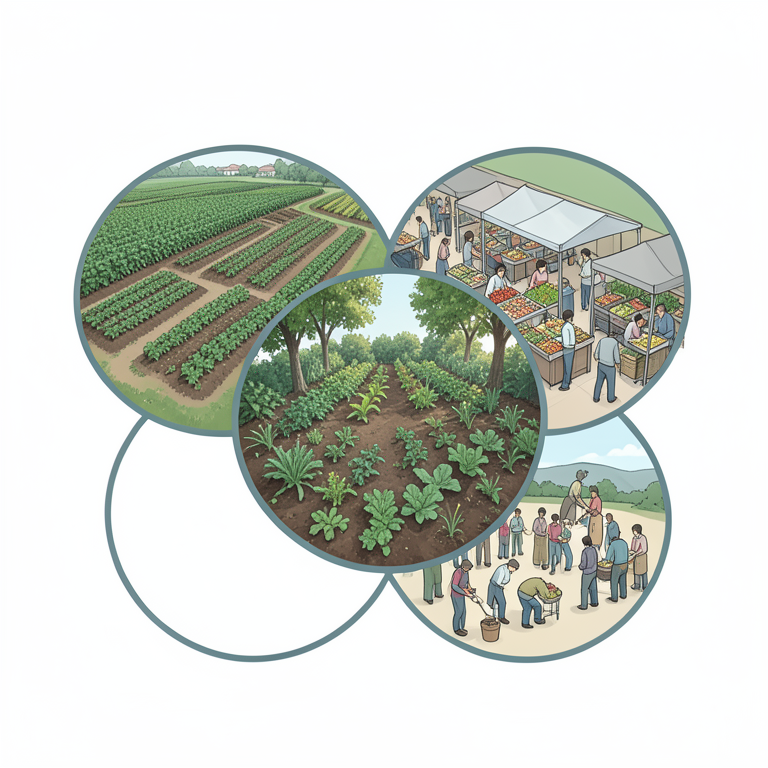
The Three Pillars of Sustainable Agriculture
AI-generated conceptual illustration (A diverse sustainable farmland landscape). It explains the idea and does not show study data.
View source evidence ↗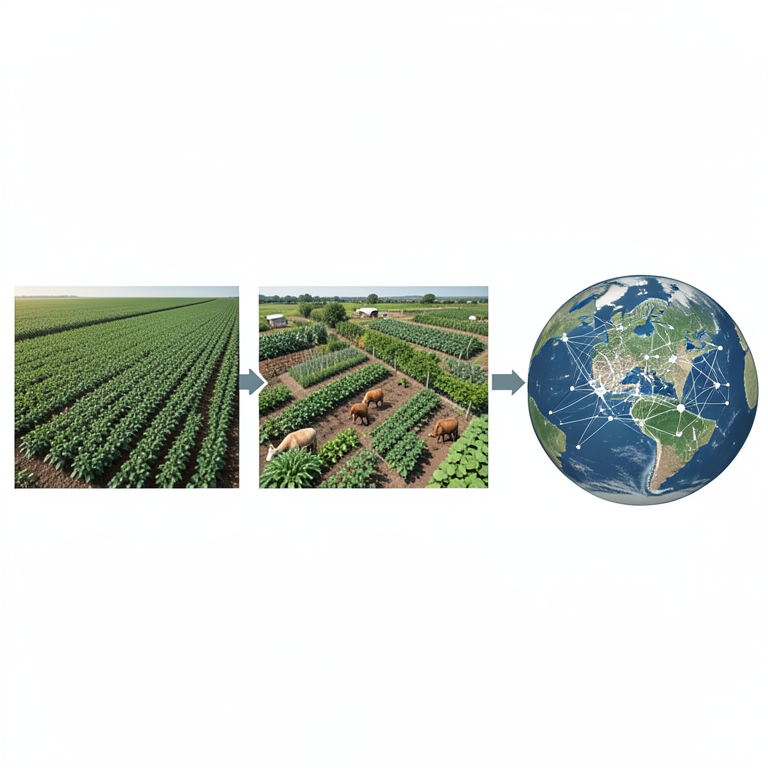
Hierarchy of Sustainability Strategies
AI-generated conceptual illustration (diverse agricultural landscapes). It explains the idea and does not show study data.
View source evidence ↗Introduction
In a well-known special issue of the Agronomy Journal from 1996, several respected authors shared their opinions on the "Use and Abuse of Crop Simulation Models," after more than 30 years of developing these tools to support system approaches in agronomy. These authors agreed, with different reasons, to reject the idea of a "universal model," which is a model that is supposed to predict how any crop will grow in any place, under any weather conditions, and with any farming techniques. So there was a need to find a balance between the mathematical and numerical aspects of crop models, like how they are set up, how certain they are, and how long they take to run, and the range of situations they can be used in, which people wanted to be as wide as possible. So, the idea is to find the best balance between how well a model can make educated guesses and how helpful it is for making real decisions. Sinclair and Seligman suggested in their paper from 1996, which became a key reference for people working in crop modelling, some tips to make the most out of the money spent on crop modelling. One of these guidelines went against what was usual back then. It suggested that instead of using existing models in a systematic way, people should create new models or heavily change old ones to fit specific problems. Sinclair and Seligman (1996) called these kinds of models "ad hoc models." These models wouldn't have the extra parts that come with general crop models, and they could be as simple as needed for the task. Sinclair and Seligman also said that making models tailored to specific problems was possible because there were already software tools available at that time for this kind of work. The goal of this article is to look back at how the idea of ad hoc modelling has developed over the last 15 years. It also aims to explore two key challenges that often come up when doing ad hoc modelling: Figuring out which parts and processes of the system being studied should be included or left out in the model, based on what question the model is meant to answer (this is called model conceptualization), and Finding ways to reduce the time and expertise needed to build the software for these custom crop models (this is known as model computerization) [1] .
Sustainable Growth in Agronomy
The idea of " development is widely accepted by many people because it talks about important global goals, but it doesn't clearly explain how to actually achieve those goals. Sustainable agriculture faces the same problem, as shown in many reports [2][3][4][5][6][7] . Many authors and organizations around the world provide their own definition of sustainable agriculture. Some authors see sustainable agriculture as a group of methods aimed at dealing with major worries people have about food quality and protecting the environment [8] . Some writers look at how well farming systems can keep crops growing and producing well for many years [21,9] . Some writers look at just one part of sustainability, like flexibility. Flexibility means how well agriculture can change and prepare for future problems, as Gafsi et al. found in 2006. All the authors agree that there are three main ways to think about sustainable agriculture: one that focuses on the environment, another on the economy, and a third on society. In simple terms, agricultural systems are seen as sustainable when they can keep working well over a long time. This means they need to be profitable, not harm the environment, and treat people fairly. Beyond just thinking about ideas, the real challenge is creating actual plans and tools to achieve worldwide objectives. This is a tough job because the people involved don't all agree on what to look for when judging how sustainable a farming system is, and they also don't agree on how to balance those different factors. Many indicators have already been created to assess sustainability.
Level 1: The Substitution Strategy
This level means that the substitution logic is used, where current farming methods are only slightly changed, but not completely transformed. For example, toxic chemicals and mineral fertilizers like NPK should be replaced with substances that are less harmful, don't stay in the soil for long, and use less energy. Using biopesticides and growing genetically modified plants can help reduce pest problems and lower the need for harmful pesticides. Growing symbiotic N legumes instead of using expensive and energy-intensive N fertilizers can also help make farming more sustainable. Here, research is usually carried out at the plot level, which is the most common level for agronomists.
Encouraging partnerships with scientists who research basic processes, like geochemists, pathologists, and biologists, is important. The substitution method works well for a limited time because it helps reduce the use of chemical treatments significantly. But in the long term, it might not work well because pests can become resistant after using biopesticides, for example [10] .
Level 2: The Agroecological Strategy
The idea behind the agroecological strategy is to create new and creative ways of farming that use natural rules to manage crops in a combined system. This strategy uses ideas from ecology to create, build, and manage farming systems that are good for the environment and can last over time. Encouraging biodiversity in agricultural systems helps with important natural processes like recycling nutrients, improving soil structure, and managing diseases. Cultural practices like intercropping, crop rotation, agroforestry, composting, and green manuring can help improve biodiversity. Recent studies also look at new problems in integrated pest management, which uses a mix of biological, physical, cultural, and genetic methods to control pests [11] .
Using different farming methods like crop rotations, intercropping, and mixing plant varieties can help increase biodiversity. This approach is suggested as a way to avoid using chemicals [12] . At this level, agronomy should work with landscape ecology because the different features of the landscape can help in managing pests. To boost farm productivity, we should use ecological ideas and fit them into farming practices. The agroecological strategy therefore needs to increase the size of the experiments. Experimental scenarios should not be planned for individual plots, but rather for bigger areas or regions. So, to do proper investigations, we need a much better idea of how living things interact at the plot level and even bigger areas. They also need help from other fields like ecology and geography.
Level 3: The Global Strategy
The main idea of the global strategy is to address agricultural problems on a worldwide level by changing how agriculture connects with society. Most problems with intensive farming are strongly connected to how its economy works. There are basic conflicts between different goals that agriculture is meant to achieve. For example, making more and less expensive food items without harming the soil, and growing fruits and veggies without any chemical pesticides left behind and without any signs of pests seem to be hard goals to reach. So, the world's approach is based on changing how we see agriculture in society, which is reflected in new developments in agroecology [13] . This approach believes that sustainability can't be achieved just by farming systems, but also needs to include the food system, that is, the connections between farms and how people eat, and the systems that get food from farms to people. For example, authors who looked at how production and marketing are connected showed interest in alternative food systems that focus on locally produced goods [14] . So, the world needs a plan that brings together experts from different fields like agriculture, environmental science, social studies, money matters, and government.
To understand how crops are grown, agronomists need to bring together many complicated sciences that affect farming in different ways depending on the size of the area and the time frame involved. Agronomists also have to deal with a lot of changes in the environment. Because of this, the results from one experimental field might not be possible to repeat in another field. This is because there could be small, maybe even unknown, differences in the soil and weather conditions. So, a major part of agricultural research is to figure out when each discovery works. When it comes to combining farming methods, an important thing is to expand the usual sizes used in studying crops, like looking at individual plants or small areas, to bigger sizes that matter more to farmers. These bigger sizes could include groups of small areas and the whole farm area, and even larger regions. In a way, agronomy is a science that deals with complexity, bringing together knowledge from different levels, starting from molecules and individual living things, up to farming systems and even the whole world [23] . So, agronomy is becoming more and more important as the science that deals with global issues because. Today, most people and a lot of scientific research agree on which economic, social, and environmental factors are key to understanding sustainability. The parts fit together, and their connection is usually shown with a three-part Venn diagram. Each circle in the diagram stands for one part of sustainability: economic, social, and environmental. The circles overlap to show how these parts are linked and depend on each other. There is less agreement, however, about how much these elements should or need to overlap in order to achieve sustainability on a larger scale-a question that is more likely to depend on the specific context. Economic sustainability means a system's ability to keep offering products and services that are worth more than what it costs to make them. For things that are sold for money, like products and services, the way to calculate their value is simple. This method is used as a starting point for trading agricultural products (Soumyajit Biswas et al, 2024) [30] . However, the math gets complicated when trying to figure out the value of things that are either overlooked, like soil biodiversity, or pushed onto others, like nitrate pollution. For agriculture, this is a big issue and has led to a lot of research and discussion in economics. Social sustainability means a system's ability to keep up with society's needs for fairness and safety, including fairness between different generations. Food security, which means having a stable, enough, and easy-to-reach food supply, is a key part of a fair society. This is followed by good community health, strong rural areas, and fairness in gender rights [29] . These problems, along with many other social factors, help improve people's well-being by either creating more chances for them or reducing their suffering [15] . New developments in sustainability science, like the recent creation of models that look at both natural and human systems together, offer a fresh way to bring together knowledge about how different systems interact. These models help organize and study results based on both ecological and social factors within the area of sustainability. The dynamics are connected: natural systems offer ecosystem services, which are also called nature's benefits for people, to the social systems. Ecosystem services can be divided into four main categories that were identified by the Millennium Ecosystem Assessment. These categories are: provisioning services, which include things like food, fiber, and clean drinking water; regulating services, such as controlling floods and preventing diseases; supporting services, like the formation of soil and the cycling of nutrients; and cultural services, which involve things like the beauty of nature and opportunities for recreation [16,17] . How services affect people depends on how the ecosystems, which provide those services, are managed. For example, biologist Scott Collins and his team developed a socialecological model that has been modified for use in agriculture. This modified model, shown in Figure 1, displays ecosystem services at the bottom of the diagram as results of interactions within cropping systems. These interactions involve biotic structure, which refers to the organisms living in agricultural areas, and ecosystem function, which refers to the activities these organisms perform. For example, plants, insects, and tiny microbes work together to take in carbon dioxide, create living material, and move nutrients around. These interactions lead to results that help people by offering services like food, climate stability, and fertile soil. How people see these services and how they then change their actions and rules lead to changes in what goes into the ecosystem and how it is managed. Some changes are straightforward and planned, happening at the field level; others are not planned and happen on a larger scale. Inputs and management affect how well the cropping system provides ecosystem services, and this process keeps going on. Think about changes in the types of crops grown and the use of farming chemicals, which are purposeful decisions made by people based on the social system, as an example. Farmers work hard to plan and take care of the crops they grow so that they can offer the kinds of food people want to buy, all while keeping the prices reasonable and making sure it can be done without harming the environment. Climate change and exposure to invasive pests are not on purpose, but they are caused by the way people and societies are organized. Farmers respond to these changes by creating flexible management plans to keep their crop yields and profits stable. The system's ability to keep improving allows for looking into and testing connections between social and environmental factors related to farming practices-this is very important for understanding issues related to sustainability, which are really about the relationship between people and the environment [18,19] . Agriculture helps support the environment by offering important services, and people especially value the food, fuel, and fiber it provides. However, less noticed are the ways agriculture helps with biogeochemical services, like keeping the climate stable and ensuring clean water, and biodiversity services, like helping with pollination or controlling pests and diseases. Agriculture can also cause problems for ecosystems: it might lead to polluted water with nitrates instead of clean water, or result in soil erosion instead of helping to keep the soil healthy [20] . Sometimes, it's helpful to think of an ecosystem service as reducing a disservice, like when comparing a new method to the usual way of doing things [31] . Another important consideration is scale: agricultural sustainability is entirely scale-dependent. For example, an agricultural or land management practice that is sustainable within an individual field may lack sustainability at the larger farm scale, especially if the inputs required to maintain stable production eventually exceed the capacity of the farm to provide them. Similarly, big-scale farming sustainability depends on how well local and regional areas can keep resources healthy and reduce damage. Even though the long-term supply of fertilizer might stay steady, and the money farmers spend on fertilizer can be paid back quickly because it helps grow more grain, the system isn't sustainable when looking at a bigger area. This happens through a process called eutrophication, where nitrogen and phosphorus from farms end up in groundwater, drinking water, and waterways. This pollution causes bad algae growth and creates "dead zones" in lakes and coastal areas.
In the end, true sustainability has to be considered on a global level, as shown by recent discussions about the climate impact of land use changes linked to biofuel growth. Changing land that is used to grow food into land that is used to make fuel in one place, like in the United States. When land in the Midwest is converted for other purposes, it often leads to new land being converted for food production somewhere else, like in the Amazon region. This process gives off greenhouse gases and greatly lowers the climate benefits that biofuels usually provide [22,33] .
In another example, national environmental policies that reduce food production in one part of the world might cause food production to grow or become more dependent on chemicals in other areas. In some cases, this result doesn't actually improve the environment worldwide, but instead moves the negative effects of farming to different parts of the world; in the worst situations, it can make the global environment even worse. To understand these geographic trade-offs, you need to look at how local practices affect things on a global scale. The idea of sustainable agriculture began in the United States in the 1980s, inspired by the moral and political beliefs of John Locke from the 1600s and Thomas Jefferson from the 1700s. More recently, it has also been influenced by the concept of "sense of place," which comes from the poetry and writings of Wendell Berry and Wes Jackson. Conservation and protecting natural resources are also important parts of this vision, and these ideas come from the writings of Aldo Leopold, Louis Bromfield, and Edward Faulkner. Robert Rodale later expanded on this by promoting regenerative agriculture, which not only protects the environment but also helps to improve the land's ability to produce food. Soil organic matter is a key focus in these writings, and it is part of the "humus farming" approach that was practiced in England and Europe. This idea became known as organic agriculture in the United States after Jerome Rodale introduced it in 1945. The connection between the health of the soil, plants, animals, and humans forms the basis of the philosophy behind organic farming. Today, organic agriculture keeps focusing on nurturing the "living soil": improving the natural processes that happen in the soil, especially those that rely on living organisms, and avoiding the use of artificial chemicals and fertilizers. The idea of sustainable intensification aims to improve natural processes to lessen the need for man-made chemicals, but it doesn't mean completely stopping their use. In the U.S., the farm problems from the 1980s made people more aware of the social effects of farming. Because farm incomes were dropping, rural communities were getting worse, and midsized farms were slowly disappearing, sustainable agriculture had to expand its goals. It started to include rural community health and the well-being of farming families. Globalization, which focuses on saving costs and new competitors from faraway places, has created more pressure.
In the United States, the farm crisis of the 1980s made the social aspects of agriculture more urgent (Vaijnath Kantiram Chavan et al., 2024) [28] . Because farm incomes are going down, rural communities are getting worse, and mediumsized farms are slowly disappearing, sustainable agriculture had to expand its goals. It started to include the health of rural communities and the happiness of farm families. Globalization, which focuses on saving costs and new competitors from faraway places, has created more challenges. One result of intensification is that animal farming has become more vertical. This integration marks some major changes. The labor force today is not like the family farms from before. In many areas around the world, there's a big, continuous shift from mixed farming systems that combine crops and animals to large-scale operations that mainly focus on raising animals. Third, animals are getting farther and farther away from where they usually get their food and from places where their manure can be used as fertilizer. Today, the limits of sustainable agriculture go much further than just the farm. People who are setting up and creating food systems today think about how different parts of farm communities are connected. The size of farms, how people in the community connect with each other, and the spread of trade and money markets around the world all play a big role in shaping both the social and economic health of societies. A recent effort to expand the definition of sustainable intensification to clearly include issues related to social justice, especially the fair distribution of food, and decision-making processes that involve empowering individuals, shows this progress [24][25][26][27][28][29][30] .
Acknowledgement
AcknowledgementAuthors would like to Thanks SAGE University for providing this platform.
References
34 in the original paper- Hansen JW, Jones JW. A systems framework for characterizing farm sustainability. Agric Syst. 1996;51:185-201.
- Gliessman SR. Agroecology: Ecological processes in agriculture. Michigan: CRC Press; 1998. 357 p.
- Gold M. Sustainable agriculture: definitions and terms. Special Reference Briefs 99-02. USDA National Agricultural Library; 1999. https://www.nal.usda.gov/afsic/pubs/srb9902.shtml
- Boiffin J, Hubert N, Durand N, editors. Agriculture et développement durable: Enjeux et questions de recherche. Paris: INRA; 2004. 92 p.
- Dupraz C. Entre agronomie et écologie: vers la gestion d'écosystèmes cultivés. Rev Demeter. 2005:1-16.
- Tilman D, Cassman KG, Matson PA, Naylor R, Polasky S. Agricultural sustainability and intensive production practices. Nature. 2002;418:671-677.
- Francis CA, Sander D, Martin A. Search for a sustainable agriculture: reduced inputs and increased profits. Crops Soils Mag. 1987;39:12-14.
- Ikerd J. The need for a system approach to sustainable agriculture. Agric Ecosyst Environ. 1993;46:147-160.
- Altieri M, Rosset P. Agroecology and the conversion of large-scale conventional systems to sustainable management. Int J Environ Stud. 1996;50:165-185.
- Gurr GM, Wratten SD, Altieri MA. Ecological engineering for pest management. Collingwood: CSIRO Publishing; 2004. 244 p.
- Vandermeer J, van Noordwijk M, Anderson J, Ong C, Perfecto I. Global change and multi-species agroecosystems: concepts and issues. Agric Ecosyst Environ. 1998;67:1-22.
- Gliessman SR. Agroecology: The ecology of sustainable food systems. 2 nd ed. Boca Raton: CRC Press; 2006. 384 p.
- Lamine C, Bellon S. Conversion to organic farming: a multidimensional research object at the crossroads of agricultural and social sciences. Agron Sustain Dev. 2009;29:1-15. DOI:10.1051/agro:2008007
- Power AG, Broglie K, Chan C, Colaizzi P, Durán A, Garcia R, Bateman IJ, et al. Ecosystem services and agriculture: tradeoffs and synergies. Philos Trans R Soc B. 2010;365(1554):2959-2971. DOI:10.1098/rstb.2010.0143
- Kates RW, Clark WC, Corell R, Hall JM, Jaeger CC, Lowe I, et al. Sustainability science. Science. 2001;292(5517):641-642.
- Millennium Ecosystem Assessment. Ecosystems and human well-being: synthesis. Washington, DC: Island Press; 2005.
- Collins SL, Carpenter SR, Swinton SM, Orenstein DE, Childers DL, Gragson TL, et al. An integrated conceptual framework for social-ecological research. Front Ecol Environ. 2011;9:351-357.
- Robertson GP, Hamilton SK. Long-term ecological research at the Kellogg Biological Station LTER site: conceptual and experimental framework. In: Hamilton SK, Doll JE, Robertson GP, editors. The ecology of agricultural landscapes: long-term research on the path to sustainability. New York: Oxford University Press; 2015. p. 1-32.
- Zhang W, Ricketts TH, Kremen C, Carney K, Swinton SM. Ecosystem services and dis-services to agriculture. Ecol Econ. 2007;64(2):253-260.
- Salma SB, Shubham, Kaushal S. Aeroponics: An emerging food growing system in sustainable agriculture for food security. Int J Res Agron. 2024;7(11):93-97.
- Rissman AR, Carpenter SR. Progress on nonpoint pollution: barriers and opportunities. Daedalus. 2015;144(3):105-114. Field CB, Michalak AM. Water, climate, energy, food: inseparable and indispensable. Daedalus. 2015;144(3):1-144.
- Biswas S, Halder S, Koley B, Adak E, Sengupta S. The role of precision farming in sustainable agriculture: An overview. Int J Agric Extension Social Dev. 2024;7(4):219-228.
- Berry W. The unsettling of America: culture and agriculture. San Francisco: Sierra Club Books; 1977.
- Jackson W. Becoming native to this place. Lexington: University Press of Kentucky; 1994.
- Leopold A. A Sand County almanac: and sketches here and there. New York: Oxford University Press; 1949.
- Rodale JI. Pay dirt: farming and gardening with composts. Emmaus, PA: Rodale Press; 1945.
- Garnett T, Appleby MC, Balmford A, Bateman IJ, Benton TG, Bloomer P, et al. Sustainable intensification in agriculture: premises and policies. Science. 2013;341(6141):33-34.
- Chavan VK, Patil PK. A study of agriculture land use efficiency of Dhule district: A geographical analysis. Int J Geogr Geol Environ 2024;6(1):170-173. DOI: 10.22271/27067483.2024.v6.i1c.217
- Adanehi SJ, Oduntan FT, Idu EE. Exploring the access of agricultural extension services among small-scale garden egg farmers in Abaji area council, Abuja. Int J Agric Extension Social Dev. 2022;5(1):48-53. DOI:10.33545/26180723.2022.v5.i1a.123
- Biswas S, Halder S, Koley B, Adak E, Sengupta S. The role of precision farming in sustainable agriculture: An overview. Int J Agric Extension Social Dev. 2024;7(4):219-228. doi:10.33545/26180723.2024.v7.i4c.536
- Loos J, Abson DJ, Chappell MJ, Hanspach J, Mikulcak F, Tichit M, et al. Putting meaning back into 'sustainable intensification'. Front Ecol Environ. 2014;12(6):356-361.
- Robertson GP, Gross KL, Hamilton SK, Landis DA, Schmidt TM, Snapp SS, et al. Farming for ecosystem services: an ecological approach to production agriculture. BioScience. 2014;64(5):404-415.
- Agarwal D, Devra SJ, Tiwari A, Siddharajsinh RR. Probability and probability distribution as decision making tool in agriculture: A review. Int J Stat Appl Math 2024;9(5):208-213. DOI: 10.22271/maths.2024.v9.i5c.1862
- Searchinger T, Heimlich R, Houghton RA, Dong F, Elobeid A, Fabiosa J, et al. Use of U.S. croplands for biofuels increases greenhouse gases through emissions from land-use change. Science. 2008;319(5867):12381240.