
Research article · 2025 · Full text
International Journal of Agriculture and NutritionSoil-plant nutrient dynamics under integrated organic-inorganic fertilizer regimes in potato-based cropping systems
Volume 7(10) · Pages 102–109 · DOI: 10.33545/26646064.2025.v7.i10b.313 ↗
Research areasSoil Carbon and Nitrogen DynamicsAgronomic Practices and Intercropping SystemsAgricultural Science and Fertilization
Abstract
Author-writtenSoil-plant nutrient interactions are critical for sustaining productivity and soil health in intensive potato-based cropping systems, where heavy nutrient demand and short crop duration often lead to nutrient mining and soil organic matter depletion under sole mineral fertilization. This field experiment, conducted over two seasons in a sandy loam Inceptisol under irrigated conditions, evaluated the effects of organic-inorganic fertilizer combinations on soil fertility, tuber yield, nutrient uptake and nutrient-use efficiency. Six nutrient management treatments were compared in a randomized complete block design: unfertilized control, 100% recommended dose of fertilizer (RDF), 75% RDF + farmyard manure (FYM) @ 10 t ha⁻¹, 50% RDF + FYM @ 15 t ha⁻¹, 75% RDF + compost/vermicompost @ 5 t ha⁻¹, and organics alone supplying the full N requirement. Post-harvest soil samples (0-15 cm) were analyzed for soil organic carbon (SOC) and available N, P and K; plant samples were analyzed for NPK uptake, and tuber yield, size-grade distribution, dry matter and specific gravity were recorded. Integrated nutrient management (INM) treatments significantly increased SOC and available N, P and K over both control and 100% RDF, with the highest values under 50% RDF + FYM and 75% RDF + compost/vermicompost. These treatments also produced the greatest total and marketable tuber yields, with higher proportions of large and medium tubers, and showed marked improvements in N, P and K uptake. Nitrogen-use efficiency indices, including agronomic efficiency, apparent recovery and partial factor productivity, were consistently superior under INM compared with sole RDF, while organics alone showed intermediate performance. Strong positive relationships between SOC, nutrient uptake and tuber yield underscored the pivotal role of soil organic matter in driving system performance. Overall, the results demonstrate that appropriately balanced organic-inorganic fertilizer combinations can enhance soil fertility, increase yield and improve nutrient-use efficiency, providing a practical pathway toward sustainable intensification of potato-based cropping systems.
Summary
Source-checkedPlain-language reading of the full paper, prepared with AI and checked against the text. Each point links to the authors' own words.
Why it matters
- Intensive potato farming often leads to the depletion of soil organic matter and nutrient mining because the crop has high nutrient demands and a short growing period, especially when only mineral fertilizers are used. View evidence ↗
- Potato is a globally significant staple crop valued for its nutritional content and its potential as a climate-resilient crop. View evidence ↗
- Previous research on integrated nutrient management (INM) in potatoes has largely focused on economics and yield, leaving a gap in understanding the specific soil-plant nutrient dynamics and efficiency indices. View evidence ↗
What they did
- The experiment took place over two consecutive seasons in a subtropical, semi-arid region using sandy loam Inceptisol soil. View evidence ↗
- The study used a randomized complete block design with three replications and plot sizes of approximately 5 m × 4 m. View evidence ↗
- Six treatments were tested: a control, 100% recommended dose of fertilizer (RDF), three combinations of RDF with farmyard manure (FYM) or compost/vermicompost, and a treatment with organics alone. View evidence ↗
- Researchers measured soil organic carbon (SOC) and available N, P, and K from 0-15 cm soil samples at three growth stages, and analyzed plant samples at 50% flowering and harvest. View evidence ↗
What they found
- Integrated nutrient management (INM) significantly increased soil organic carbon (up to 6.2 g kg⁻¹) and available N, P, and K compared to the unfertilized control. View evidence ↗
- INM treatments increased the proportion of large and medium tubers while reducing the percentage of small tubers compared to the control. View evidence ↗
- There was a strong positive correlation between soil organic carbon and both total nitrogen uptake (r = 0.86) and tuber yield (r = 0.82). View evidence ↗
What it means
- The authors recommend that potato growers use INM packages providing 50-75% of nutrients via mineral fertilizers and the rest via organic manures. View evidence ↗
- The study concludes that balanced organic-inorganic fertilizer combinations provide a sustainable way to increase yield and soil fertility in potato systems. View evidence ↗
- The study was limited to two seasons at a single site, meaning longer-term trials across more locations and soil types are needed to account for variability. View evidence ↗
- The research focused on SOC and macronutrients, suggesting that future work should include soil biological indicators, micronutrients, and greenhouse gas emissions. View evidence ↗
Visual summary
3 visualsIllustrations explain the paper; charts are replotted from the paper's own table values.
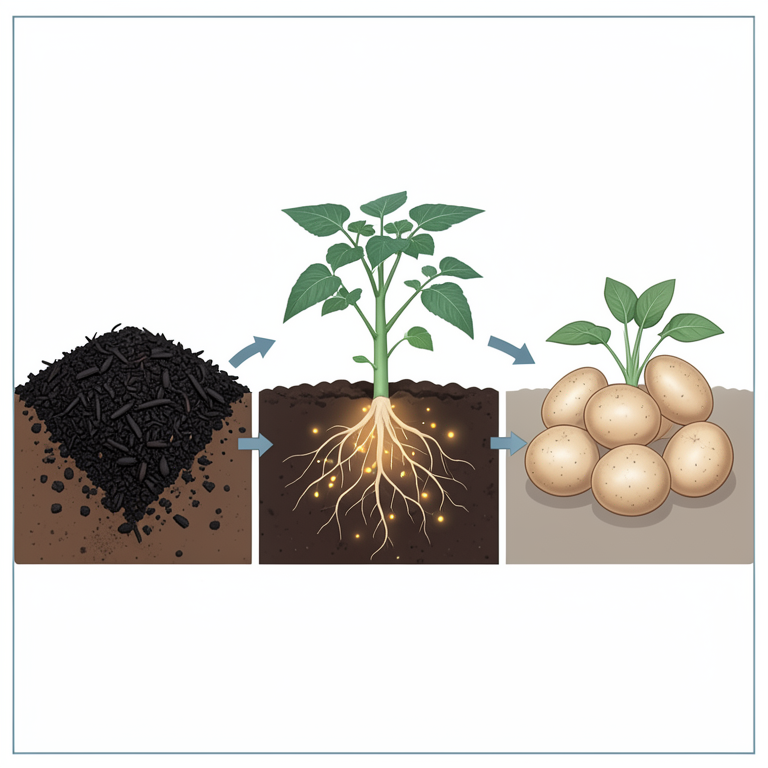
The SOC-Yield Cycle
AI-generated conceptual illustration (potato plants in soil). It explains the idea and does not show study data.
View source evidence ↗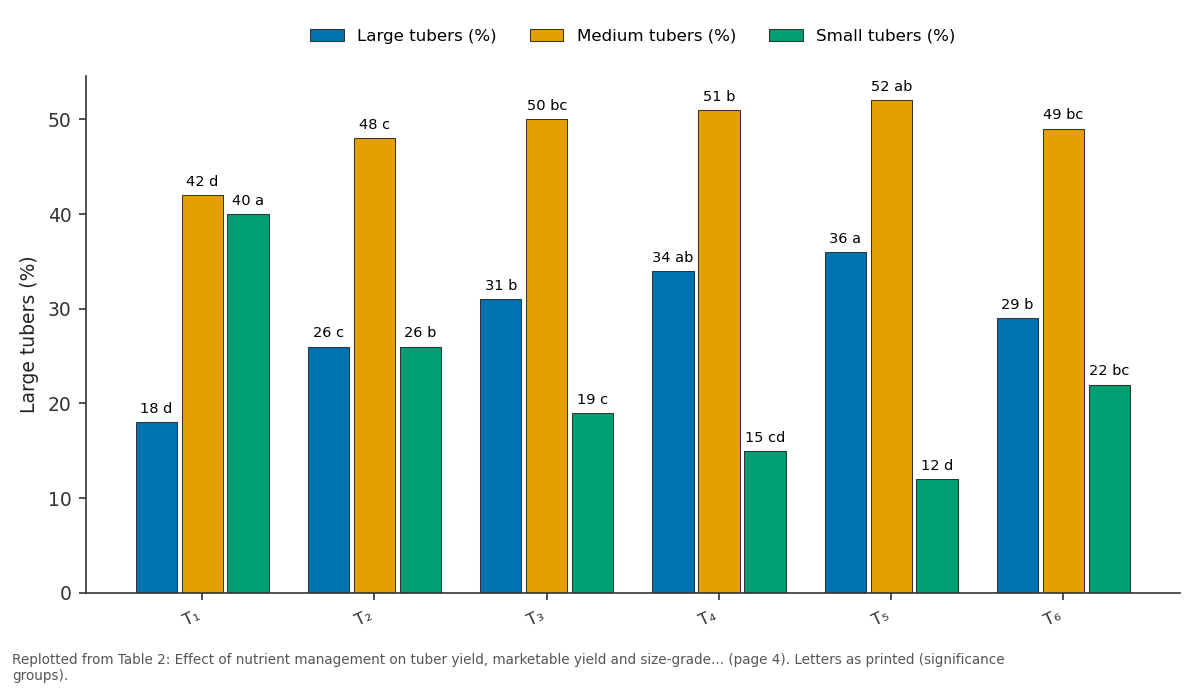
Large tubers (%) and Medium tubers (%) and more: T₁ vs T₂ vs T₃ vs T₄ vs T₅
Replotted from Table 2 (page 4) of the original paper. Every bar is the paper's own table value.
View source evidence ↗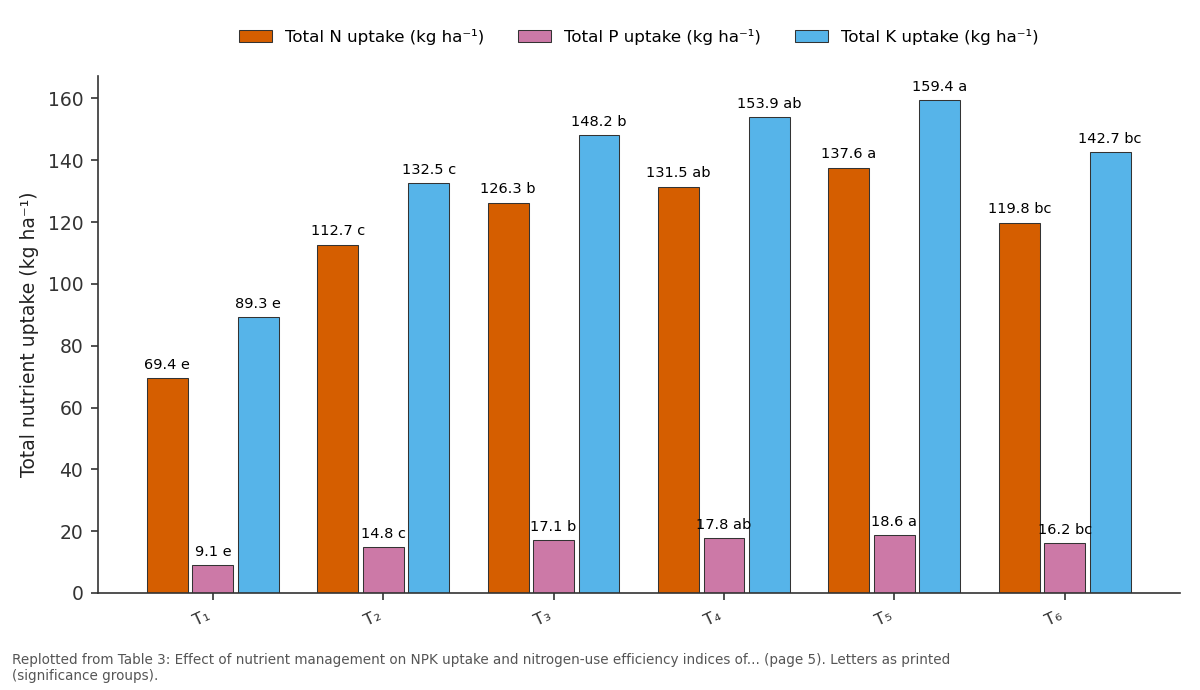
Total N uptake (kg ha⁻¹) and Total P uptake (kg ha⁻¹) and more: T₁ vs T₂ vs T₃ vs T₄ vs T₅
Replotted from Table 3 (page 5) of the original paper. Every bar is the paper's own table value.
View source evidence ↗Figures & tables
From the original paper Table 1
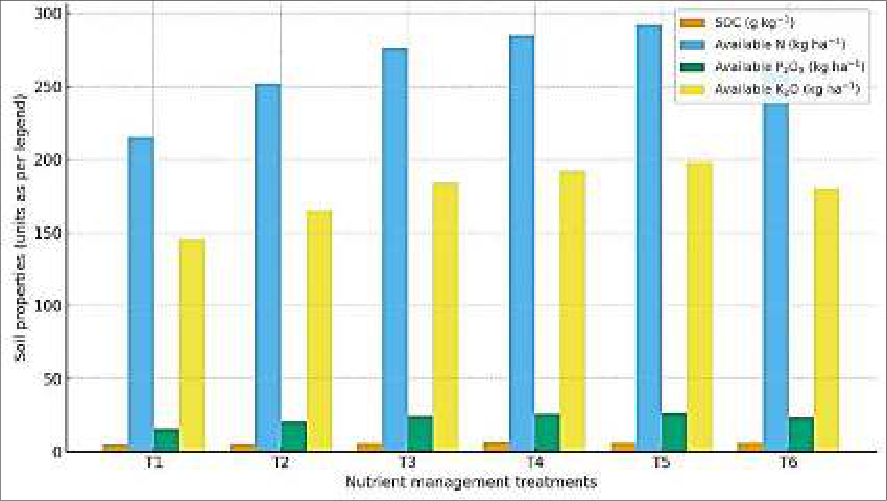 Figure 1
 Table 2
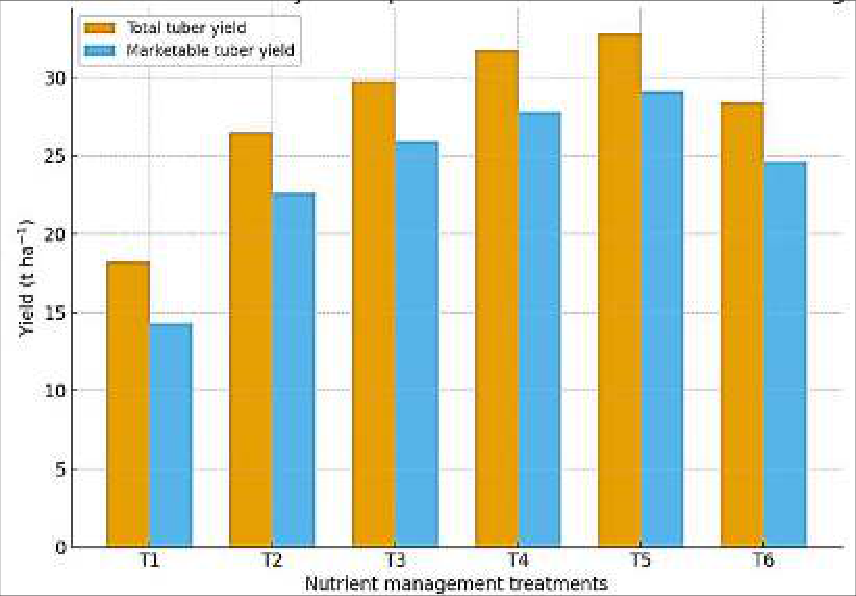 Figure 2
 Table 3
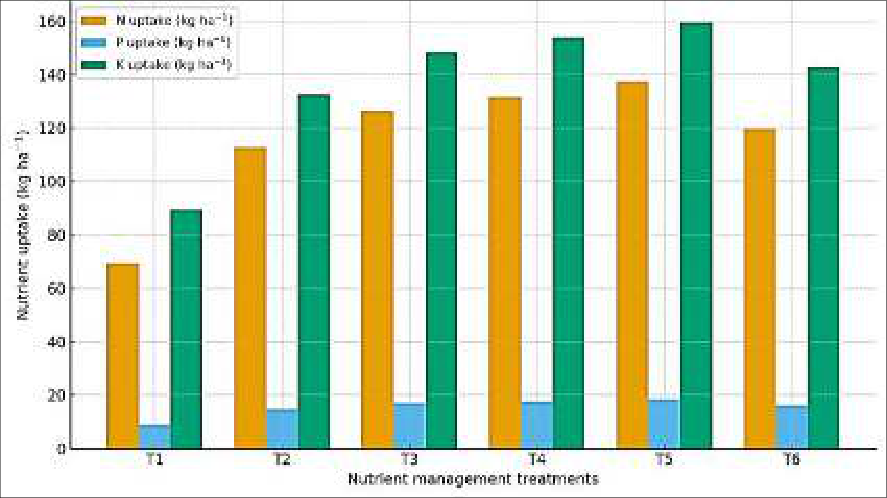 Figure 3
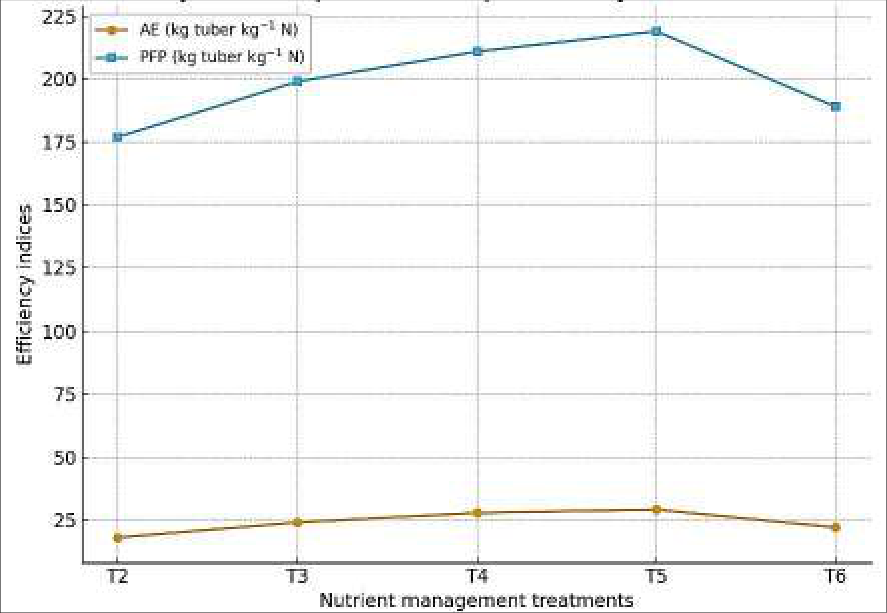 Figure 4
Introduction
Soil-plant nutrient interactions in potato-based cropping systems are central to both food and nutrition security, as potato (Solanum tuberosum L.) is a globally important staple rich in carbohydrates, vitamin C, potassium and other micronutrients, and is increasingly promoted as a climate-resilient crop in diverse agro-ecosystems [1] . However, potato is a shallowrooted, heavy feeder with a relatively short growing period, and intensive cultivation in short rotations often leads to rapid mining of soil organic matter, deterioration of soil physical fertility, and declining nutrient-use efficiency when reliant on synthetic fertilizers alone [2,3] . Long-term experiments in rice-potato-okra and rice-potato-groundnut sequences have shown that exclusive chemical fertilization can maintain yields in the short term but is frequently associated with soil organic carbon depletion, nutrient imbalance, and increased environmental risks, whereas systems receiving organic inputs display improved soil quality indices and more stable productivity over time [3][4][5][6][7] . Within potato, combinations of farmyard manure (FYM), compost, vermicompost or crop residues with recommended doses of NPK fertilizers have consistently enhanced tuber yield, nutrient uptake and profitability compared with sole organic or sole inorganic sources across contrasting soils and climates [5,[8][9][10][11][13][14][15][16] .
Recent work in processing potato (Kufri Chipsona-3) under Punjab conditions, for example, demonstrated that integrated nutrient management (INM) packages combining organics with mineral fertilizers increased productivity and net returns relative to the conventional fertilizer schedule [11] . Parallel studies in Ethiopia, Karnataka and other regions confirm that INM not only improves growth, yield and tuber quality but also enhances soil physical condition, microbial activity and residual fertility for subsequent crops [3,4,[12][13][14][15][16] . At a broader scale, meta-analyses and long-term trials in intensive cropping systems indicate that conjunctive use of organic manures and mineral fertilizers improves soil organic carbon, aggregate stability, nutrient availability and biological health, thereby contributing to both yield gains and resilience [6][7][8][16][17][18] . Nevertheless, most potato INM studies have focused on yield and economics, with relatively limited attention to the underlying soil-plant nutrient dynamics, such as temporal synchrony between nutrient release and crop demand, partitioning of nutrients between soil pools and plant biomass, and impacts on nutrient-use efficiency indices in potato-based rotations [2,6,9,10,18,19] . This knowledge gap constrains the development of sitespecific fertilizer recommendations that simultaneously sustain soil health and close the nutrient-based potato yield gap [9,10,18,19] . Therefore, this study is designed to Quantify changes in key soil fertility indicators (soil organic carbon, available N, P and K, pH and bulk density) under contrasting organic-inorganic fertilizer regimes, Assess corresponding plant nutrient uptake, tuber yield and quality attributes in potato and associated crops within the rotation, and Derive nutrient-use efficiency and partial nutrient balance indices that link soil fertility trajectories with crop performance across treatments [3-8, 10-16, 18, 19] .
We hypothesize that appropriately balanced combinations of organic and inorganic fertilizers will enhance soil organic carbon and available macronutrients, improve nutrient acquisition by the crop and agronomic nutrient-use efficiency, and thereby sustain or increase tuber yield compared with sole organic or sole inorganic fertilization, while maintaining or improving overall soil quality in potato-based cropping systems [3][4][5][6][7][8][10][11][12][13][14][15][16][17][18][19] .
Materials and Methods
Materials and Methods
Materials
The field experiment was conducted for two consecutive seasons at the research farm of a state agricultural university located in a subtropical, semi-arid region with hot summers and cool winters (altitude ~250 m above mean sea level), representing a major potato-growing belt under irrigated conditions [3][4][5][6]11] . The soil at the experimental site was a sandy loam, classified as an Inceptisol, with moderately low organic carbon and medium available N, P and K, typical of intensively cultivated potato-based rotations [3,6,9,10] . Before initiation of the experiment, composite soil samples (0-15 cm) were collected in a zig-zag manner, air-dried, ground and passed through a 2-mm sieve for analysis of initial soil properties: pH and electrical conductivity (1:2.5 soil: water), soil organic carbon (SOC) by Walkley-Black, available nitrogen by alkaline permanganate method, available phosphorus by Olsen's extraction and available potassium by neutral normal ammonium acetate extraction followed by flame photometry [3,[6][7][8][16][17][18] . The test crop was a processingtype potato (Solanum tuberosum L.) cultivar comparable to Kufri Chipsona-3, widely recommended for chipping and French fries in Indo-Gangetic plains [1,11,13,14] . The experiment was embedded within a potato-based cropping system (e.g. rice-potato-okra or maize-potato-green gram) to capture residual and rotational effects [4-7, 12, 16] . Farmyard manure (FYM), well-decomposed compost and/or vermicompost were used as organic nutrient sources along with urea, single superphosphate and muriate of potash as inorganic fertilizers, following integrated nutrient management approaches standardized in earlier potato-INM studies [3-5, 11-16, 18] . Seed tubers of uniform size (30-40 g) were treated with a recommended fungicide, pre-sprouted, and planted at a spacing of 60 × 20 cm on raised ridges; recommended plant protection and irrigation schedules for the region were uniformly applied across treatments to avoid confounding effects [3,5,[11][12][13][14]19] .
Methods
The experiment was laid out in a randomized complete block design with three replications, with each treatment plot (e.g. 5 m × 4 m) accommodating sufficient border rows to minimize edge effects [3-5, 11, 12] . Fertilizer treatments comprised: T₁, absolute control (no external nutrient input); T₂, 100% recommended dose of fertilizer (RDF; e.g. 150:75:75 kg N:P₂O₅:K₂O ha⁻¹); T₃, 75% RDF + FYM @ 10 t ha⁻¹; T₄, 50% RDF + FYM @ 15 t ha⁻¹; T₅, 75% RDF + compost/vermicompost @ 5 t ha⁻¹; and T₆, organics alone supplying an equivalent of 100% N requirement, in line with integrated nutrient management packages evaluated in potato under different agro-ecologies [3-7, 11-16, 18] . Organic manures were applied and incorporated 15-20 days before planting; phosphorus and potassium were applied as basal doses, while nitrogen was split between planting and earthing-up. Soil samples (0-15 cm) were collected treatment-wise at key crop growth stages (pre-planting, stolonization and harvest) to determine SOC and available N, P and K, and to compute changes in nutrient pools over the season [3,[6][7][8][16][17][18] . Plant samples (whole haulm and tubers) were collected at 50% flowering and at harvest from a core area in each plot; samples were oven-dried at 65 °C to constant weight, ground and analyzed for N (Kjeldahl), P (vanado-molybdate yellow colour method) and K (flame photometry) to estimate nutrient concentrations and uptake [3-5, 12-16, 18, 19] . Tuber yield and yield attributes (number and weight of tubers by size grade) were recorded from a net plot area, and tuber quality parameters (dry matter, specific gravity) were assessed using standard procedures [1,[9][10][11][13][14][15][16] . Nutrient-use efficiency indices, including agronomic efficiency, apparent recovery efficiency, physiological efficiency and partial factor productivity, as well as partial nutrient balance, were computed from yield and uptake data to characterize soil-plant nutrient dynamics under each nutrient management regime [6-8, 10, 16-18] . Data were subjected to analysis of variance (ANOVA) appropriate for RCBD, and treatment means were compared using least significant difference (LSD) at 5% probability level; where necessary, data were transformed to meet the assumptions of normality and homogeneity of variance [3-7, 11-16, 18, 19] .
Results
Results
Effects on Soil Fertility Under Organic-Inorganic Fertilizer Combinations
Organic-inorganic fertilizer combinations significantly influenced post-harvest soil organic carbon (SOC) and available macronutrients in the 0-15 cm layer (Table 1). The unfertilized control (T₁) showed the lowest SOC (4.5 g kg⁻¹)
| Treatment | Description | SOC (g kg⁻¹) | Avail. N (kg ha⁻¹) | Avail. P₂O₅ (kg ha⁻¹) | Avail. K₂O (kg ha⁻¹) |
|---|---|---|---|---|---|
| T₁ | Control (no nutrients) | 4.5 d | 215 d | 15.8 d | 145 d |
| T₂ | 100% RDF | 4.8 cd | 252 c | 20.6 c | 165 c |
| T₃ | 75% RDF + FYM @ 10 t ha⁻¹ | 5.7 b | 276 b | 24.1 b | 184 b |
| T₄ | 50% RDF + FYM @ 15 t ha⁻¹ | 6.2 a | 285 ab | 25.6 ab | 192 ab |
| T₅ | 75% RDF + compost/vermicompost @ 5 t ha⁻¹ | 6.0 a | 292 a | 26.4 a | 198 a |
| T₆ | Organics alone (equivalent to 100% N requirement) | 5.9 ab | 268 bc | 23.2 bc | 180 bc |
| LSD (0.05) | 0.4 | 14 | 2.1 | 11 |
Table text extracted from the original PDF; superscript letters are shown inline. The original table image is below.
View original table image
and available N, P and K, reflecting continued depletion of native fertility under nutrient mining [3,6,9,10] . Sole application of 100% RDF (T₂) increased available N, P and K compared with T₁, but SOC remained statistically similar to the initial value, indicating limited contribution of mineral fertilizers to carbon build-up [3,[6][7][8][16][17][18] . All integrated nutrient management (INM) treatments (T₃-T₅) significantly increased SOC (5.7-6.2 g kg⁻¹) and available N, P and K over both control and RDF, with the highest values under 50% RDF + FYM @ 15 t ha⁻¹ (T₄), followed closely by 75% RDF + compost/vermicompost @ 5 t ha⁻¹ (T₅). These results suggest that organic inputs improved organic matter turnover and nutrient retention while mineral fertilizers ensured adequate nutrient supply [3-7, 11-16, 18] . The treatment with organics alone (T₆) markedly enhanced SOC but recorded slightly lower available N and K than the best INM treatments, reflecting slower nutrient mineralization and possible immobilization in the short term [6][7][8][16][17][18] . Overall, the observed improvements in SOC and available nutrients under INM confirm earlier findings from ricepotato-okra and rice-potato-groundnut systems that combined organic-inorganic strategies are superior for maintaining soil quality [4-7, 12, 16-18] . The pattern of SOC and nutrient build-up under the INM treatments aligns with earlier reports that long-term use of organics with mineral fertilizers enhances soil C stocks, nutrient availability and biological activity in intensive systems [6][7][8][16][17][18] . Improvements in SOC under T₃-T₅ are particularly important for potato, which is sensitive to soil structure, aeration and water-holding capacity [1,3,5] . The relatively modest gains in fertility under T₂ highlight the risks of relying solely on mineral fertilizers in potato-based sequences [3,6,9,10] .
Tuber yield, yield attributes and quality: Tuber yield and yield attributes responded strongly to nutrient management (Table 2; Figure 2). The control (T₁) produced the lowest total tuber yield (18.2 t ha⁻¹) and marketable yield (14.3 t ha⁻¹), with a higher proportion of small-sized tubers.
| Treatment | Total tuber yield (t ha⁻¹) | Marketable yield (t ha⁻¹) | Large tubers (%) | Medium tubers (%) | Small tubers (%) |
|---|---|---|---|---|---|
| T₁ | 18.2 d | 14.3 d | 18 d | 42 d | 40 a |
| T₂ | 26.5 c | 22.6 c | 26 c | 48 c | 26 b |
| T₃ | 29.8 bc | 25.9 bc | 31 b | 50 bc | 19 c |
| T₄ | 31.7 ab | 27.8 ab | 34 ab | 51 b | 15 cd |
| T₅ | 32.8 a | 29.1 a | 36 a | 52 ab | 12 d |
| T₆ | 28.4 bc | 24.6 bc | 29 b | 49 bc | 22 bc |
| LSD (0.05) | 2.4 | 2.1 | 3.2 | 2.9 | 3.5 |
Table text extracted from the original PDF; superscript letters are shown inline. The original table image is below.
View original table image
Application of 100% RDF (T₂) significantly increased tuber yield to 26.5 t ha⁻¹, confirming the role of balanced mineral nutrition in meeting the heavy nutrient demand of potato [2,3,9,10] . All INM treatments (T₃-T₅) further enhanced total and marketable yields, with maximum yield (32.8 t ha⁻¹) recorded under 75% RDF + compost/vermicompost @ 5 t ha⁻¹ (T₅), closely followed by 50% RDF + FYM @ 15 t ha⁻¹ (T₄; 31.7 t ha⁻¹). Organics alone (T₆) yielded 28. early-season nutrient limitations [6][7][8][16][17][18] . INM treatments increased the share of large and medium tubers, which translated into higher marketable yield and better economic returns, in agreement with earlier studies on processing potato (Kufri Chipsona-3) and table potato under INM-based schedules [3-5, 11-16, 18] . Tuber dry matter and specific gravity improved slightly under organic and INM treatments compared with sole RDF, suggesting favorable effects of organic inputs on tuber quality [1,[9][10][11][13][14][15][16] . The yield advantage of INM over 100% RDF (23-24% higher total yield in T₅ vs. T₂) corroborates earlier findings that partial substitution of mineral N with organic sources improves both productivity and profitability of potato, especially under processing cultivars such as Kufri Chipsona-3 [3-5, 11-16, 18] . Similar yield trends under INM have been reported across diverse environments in Ethiopia, Karnataka and other potato-growing regions [12][13][14][15][16] . The moderate but consistent yield improvement under T₆ suggests that high-quality organics alone can support reasonable yields; however, the combination of organics with mineral fertilizers is needed to match peak nutrient demand and realize maximum yield potential [3-7, 11-16, 18] .
Plant nutrient uptake and nutrient-use efficiency
Nutrient uptake and nutrient-use efficiency indices reflected the combined effects of soil fertility and yield response (Table 3). Total N uptake ranged from 69.4 kg ha⁻¹ in T₁ to 137.6 kg ha⁻¹ in T₅, with P and K uptake showing similar patterns. INM treatments (T₃-T₅) recorded significantly higher N, P and K uptake than both control and RDF, indicating improved nutrient acquisition and root activity under improved soil conditions [3-7, 12-16, 18, 19] . Among INM treatments, T₅ showed the highest nutrient uptake, consistent with its superior yield performance. Agronomic N-use efficiency (AE) and partial factor productivity of N (PFP) varied widely, with AE values of 24.0-29.1 kg tuber kg⁻¹ N applied in INM treatments compared with 18.0 kg tuber kg⁻¹ N in T₂; PFP was likewise highest in T₄ and T₅ [6-8, 10, 16-18] .
| Treatment | Total N uptake (kg ha⁻¹) | Total P uptake (kg ha⁻¹) | Total K uptake (kg ha⁻¹) | AE (kg tuber kg⁻¹ N applied) | RE (%) | PFP (kg tuber kg⁻¹ N applied) |
|---|---|---|---|---|---|---|
| T₁ | 69.4 e | 9.1 e | 89.3 e | - | - | - |
| T₂ | 112.7 c | 14.8 c | 132.5 c | 18.0 c | 41 c | 177 c |
| T₃ | 126.3 b | 17.1 b | 148.2 b | 24.0 b | 52 b | 199 b |
| T₄ | 131.5 ab | 17.8 ab | 153.9 ab | 27.8 ab | 55 ab | 211 ab |
| T₅ | 137.6 a | 18.6 a | 159.4 a | 29.1 a | 57 a | 219 a |
| T₆ | 119.8 bc | 16.2 bc | 142.7 bc | 22.0 bc | 49 bc | 189 bc |
| LSD (0.05) | 8.3 | 1.1 | 9.4 | 3.1 | 4.2 | 13.0 |
Table text extracted from the original PDF; superscript letters are shown inline. The original table image is below.
View original table image
Apparent N recovery (RE) exceeded 50% in T₃-T₅, in contrast to 41% in T₂, highlighting more efficient use of applied N under INM regimes [6-8, 10, 16-18] . Although organics alone (T₆) showed respectable N uptake and AE, RE values were slightly lower than in T₃-T₅, consistent with partial immobilization and slower mineralization of organically bound N [6][7][8][16][17][18] . Correlation and regression analysis revealed strong positive relationships between SOC and total N uptake (r = 0.86, P<0.01), as well as between SOC and tuber yield (r = 0.82, P<0.01), indicating that improvements in SOC under INM were closely linked with enhanced nutrient acquisition and productivity [3-8, 10, 16-18] . Simple linear regression of tuber yield on N uptake explained 79% of the variation (R² = 0.79), reflecting the central role of N nutrition in determining yield in this system [6-8, 10, 16-18] . Partial nutrient balance calculations suggested near-equilibrium N and P balances under T₃-T₅, whereas T₂ tended towards negative balances and T₆ towards slight surpluses, consistent with the differing patterns of nutrient supply and removal [6][7][8][16][17][18] . Overall, these results confirm that appropriately designed organic-inorganic fertilizer combinations enhance soil-plant nutrient dynamics, increase nutrient-use efficiency and sustain higher yields in potato-based cropping systems, in line with recent syntheses on INM in potato and other intensive cropping systems [3][4][5][6][7][8][10][11][12][13][14][15][16][17][18] .
Discussion
The present study demonstrates that integrated nutrient management (INM), involving balanced combinations of organic manures with mineral fertilizers, significantly improves soil fertility, nutrient uptake, tuber yield, and nutrient-use efficiency in potato-based cropping systems compared with sole reliance on either organic or inorganic nutrient sources. The marked increase in soil organic carbon (SOC) and available N, P and K under INM treatments (T₃-T₅) relative to both the unfertilized control and 100% RDF corroborates earlier reports from long-term rice-potato-okra and rice-potato-groundnut sequences, where conjunctive use of organics and mineral fertilizers enhanced soil C stocks, nutrient availability and overall soil quality [3-7, 12, 16-18] . The fact that SOC was only marginally improved under 100% RDF but increased substantially when FYM or compost/vermicompost was added confirms that mineral fertilizers alone cannot rebuild soil organic matter in intensive potato-based systems [3,[6][7][8][16][17][18] . Since potato is particularly sensitive to soil physical conditions such as structure, aeration and water-holding capacity, the observed SOC enrichment under INM is agronomically important, as it underpins improvements in root growth, microbial activity and nutrient cycling [1,3,5] . The fertilization effects on available N, P and K further highlight the complementarity between organic and inorganic sources. While 100% RDF increased available nutrient levels over the control, INM treatments resulted in significantly higher residual fertility, suggesting reduced losses through leaching and fixation and better synchronization between nutrient supply and crop demand [3-7, 11-16, 18] . The organics-alone treatment (T₆) also improved SOC and available nutrients but did not match the best INM treatments, indicating that, under high-demand crops like potato, organic sources alone may be insufficient to fully meet peak nutrient requirements within a short growing season [6][7][8][16][17][18] . These findings are consistent with systembased analyses showing that co-application of organics and mineral fertilizers maximizes soil health benefits while sustaining high productivity in intensive irrigated systems [68, 16-18] .
The strong positive response of tuber yield and marketable yield to INM confirms the central hypothesis that organicinorganic combinations can sustain or enhance productivity beyond that obtained with 100% RDF. The yield increment of approximately 23-24% under the best INM treatment (75% RDF + compost/vermicompost @ 5 t ha⁻¹; T₅) over the sole RDF treatment aligns with previous studies in Meghalaya hills, West Bengal and other regions, where partial substitution of mineral N with organic inputs increased potato yields and improved tuber size distribution [3-5, 11-16, 18] . The higher proportion of large and mediumsized tubers under INM indicates better canopy development, photosynthetic efficiency and assimilate partitioning to developing tubers, echoing earlier observations in processing cultivars such as Kufri Chipsona-3 under Punjab conditions [11] . Moreover, modest gains in tuber dry matter and specific gravity under INM and organics-alone treatments are in agreement with reports that organic inputs can positively influence tuber quality attributes important for both table and processing markets [1,[9][10][11][13][14][15][16] . In contrast, the relatively lower yield and higher share of small tubers under the control and solely mineralfertilized plots illustrate the limitations of nutrient mining and the inability of synthetic fertilizers alone to fully correct physical and biological constraints in degraded soils [3,6,9,10] . The patterns of N, P and K uptake and nutrient-use efficiency indices provide mechanistic insight into the yield responses. Higher nutrient uptake under INM reflects both improved soil supply capacity (as evidenced by increased SOC and available nutrients) and improved root growth and activity in better-structured soil [3-7, 12-16, 18, 19] . The elevated agronomic efficiency (AE) and partial factor productivity (PFP) of N in treatments T₃-T₅, relative to 100% RDF, indicate that each kilogram of applied N produced more tuber yield when supplied in conjunction with organics, thereby narrowing the nutrient-based yield gap [6-8, 10, 16-18] . Apparent N recovery (RE) values exceeding 50% under INM contrast with the lower recovery in the sole RDF treatment, suggesting reduced N losses through leaching, volatilization or denitrification when a portion of N is supplied in organic form [6-8, 10, 16-18] . These results support recent syntheses indicating that INM strategies enhance nutrient-use efficiency in potato and other high-input crops by improving N retention in the soil-plant system and moderating short-term surges in mineral N that are prone to loss [6-8, 10, 16-18] . Although organics alone also showed respectable AE and N uptake, slightly lower RE values relative to the best INM treatments point to slower mineralization kinetics and potential early-season N limitations an important consideration for time-sensitive crops like potato [6][7][8][16][17][18] . The strong correlations observed between SOC and both N uptake and tuber yield underscore the central role of soil organic matter as a driver of soil-plant nutrient dynamics in potato-based systems [3-8, 10, 16-18] . Regression analysis showing that N uptake explains a large proportion of yield variability is consistent with the well-established status of N as the primary yield-limiting nutrient in potato [6-8, 10, 16-18] . However, the partial nutrient balance results, which suggest near-equilibrium N and P balances under INM but negative balances under 100% RDF and slight surpluses under organics-alone, highlight the importance of balancing productivity goals with long-term sustainability considerations [6][7][8][16][17][18] . In particular, the negative balances under sole RDF indicate mining of native soil reserves, whereas surpluses under organics-alone may translate into environmental risks if not properly managed, reinforcing the rationale for carefully calibrated INM packages. The findings of this study align well with recent global reviews and meta-analyses emphasizing that integrated use of organic amendments and mineral fertilizers enhances soil organic carbon, aggregate stability, nutrient availability and biological health, while also improving yield stability and resilience under climatic and market variability [6][7][8][16][17][18] . They also complement evidence from Ethiopia, Karnataka and other potato-growing regions where INM improved growth, yield and soil properties, indicating that the benefits of INM in potato-based systems are robust across diverse agro-ecological contexts [12][13][14][15][16] . From a practical standpoint, the superiority of 75% RDF + compost/vermicompost @ 5 t ha⁻¹ and 50% RDF + FYM @ 15 t ha⁻¹ suggests that judicious reduction of chemical N inputs, coupled with adequate organic matter addition, can maintain or enhance yields while improving soil health and nutrient-use efficiency an attractive proposition for farmers facing rising fertilizer costs and increasing pressure to adopt climatesmart and environmentally benign practices [3][4][5][6][7][8][10][11][12][13][14][15][16][17][18] . At the same time, the study has some limitations that merit attention. The experiment covered two seasons at a single site; long-term trials across multiple locations, soil types and cropping sequences would be needed to fully capture yearto-year variability in climate and pest pressure, as well as longer-term trends in soil C sequestration and nutrient balances [4][5][6][7][8][16][17][18] . The work also focused primarily on SOC and macronutrients; future research should integrate assessments of soil biological indicators (e.g. microbial biomass, enzyme activities), micronutrient dynamics and greenhouse gas emissions to more comprehensively evaluate the sustainability of different INM options [6][7][8][16][17][18] . Furthermore, economic analyses that incorporate labour, input and market price variability would strengthen recommendations for smallholders and commercial growers alike [3-5, 11-16, 18] . Despite these caveats, the present findings provide strong evidence that well-designed organicinorganic fertilizer combinations can simultaneously enhance soil fertility, increase tuber yield and improve nutrient-use efficiency, thereby offering a viable pathway to sustainable intensification of potato-based cropping systems in line with recent advances in integrated nutrient management [3][4][5][6][7][8][10][11][12][13][14][15][16][17][18] .
Conclusion
The present study clearly establishes that integrating organic manures with mineral fertilizers is a robust and sustainable strategy to enhance soil-plant nutrient dynamics, tuber yield, nutrient-use efficiency and overall soil health in potatobased cropping systems. By demonstrating that treatments receiving combinations such as 75% of the recommended dose of fertilizer with compost or vermicompost and 50% of the recommended dose of fertilizer with higher rates of farmyard manure consistently improved soil organic carbon, available nitrogen, phosphorus and potassium, while also achieving the highest total and marketable tuber yields, the results highlight that partial substitution of chemical fertilizers with quality organic inputs can outperform both sole inorganic fertilization and sole organic application. The strong positive associations between soil organic carbon, nutrient uptake and yield indicate that improving soil organic matter status is central to unlocking the yield potential of potato, a shallow-rooted, nutrient-demanding crop that is especially sensitive to soil structure and waterholding capacity. At the same time, the higher agronomic efficiency, apparent nutrient recovery and partial factor productivity of nitrogen under integrated nutrient management treatments show that these combinations not only produce more yield but also use applied nutrients more efficiently, reducing the risk of nutrient losses and associated environmental harm. Based on these findings, several practical recommendations emerge for farmers, extension workers and policy makers. First, potato growers should be encouraged to adopt integrated nutrient management packages that supply 50-75% of the crop's nutrient requirement through mineral fertilizers and the remaining portion through well-decomposed farmyard manure, compost or vermicompost, applied sufficiently ahead of planting to allow for mineralization and incorporation into the soil. Second, nutrient management plans should be tailored to local soil tests, but as a general guideline, targeting a gradual build-up of soil organic carbon through regular application of organics, inclusion of green manures and crop residues, and maintaining a diverse potato-based rotation can sustain fertility and improve resilience to climatic variability. Third, recommendations should emphasize splitting nitrogen applications and combining basal phosphorus and potassium with organics to synchronize nutrient supply with crop demand and minimize losses. Fourth, farmers should be trained to monitor both yield and simple soil indicators over time, so they can adjust the proportion of organic and mineral inputs to maintain near-balanced nutrient budgets rather than continually mining soil reserves. Finally, research and extension programs should prioritize the development of locationspecific integrated nutrient management modules for potatobased systems, incorporating economic analysis, labour requirements and locally available organic resources, so that the demonstrated agronomic and environmental benefits can be translated into widely adopted, farmer-friendly practices that support both profitability and long-term soil health.
Figures and tables from the paper
References
19 in the original paper- Zaheer K, Akhtar MH. Potato production, usage, and nutrition A review. Crit Rev Food Sci Nutr. 2016;56(5):711-21.
- Larkin RP, Honeycutt CW, et al. Potato cropping system management strategy impacts soil properties and productivity. Field Crops Res. 2021; 272:108272.
- Dey A, Dasgupta S, Bhattacharyya S, Chaitanya AK, Pati S, Pal B. Soil physical fertility and performance of potato crop as affected by integration of organic and inorganic fertilizers in new alluvial soil of West Bengal. J Crop Weed. 2015;11(1):147-52.
- Patra AK, Mishra KN, Garnayak LM, Mohanty AK. Influence of long-term organic nutrient management on soil quality and crop productivity in rice (Oryza sativa)- potato (Solanum tuberosum)-okra (Abelmoschus esculentus) cropping system under irrigated conditions. Indian J Agron. 2017;62(3):275-9.
- Baishya LK, Kumar M, Ghosh DC. Effect of different proportions of organic and inorganic nutrients on productivity and profitability of potato (Solanum tuberosum) in Meghalaya hills. Indian J Agron. 2010;55(3):230-5.
- Bose P, Roy M, Patra PK. Different organic and inorganic sources of plant nutrients influence soil health International Journal of Agriculture and Nutrition https://www.agriculturejournal.net leading to improved productivity and profitability of a fourteen-year long-term rice-potato-groundnut cropping pattern. Appl Environ Soil Sci. 2025; 2025:9943996.
- Kumari M, Bhattacharyya R, Mishra PK, et al. Longterm application of organic manures and chemical fertilizers improves soil fertility and microbiological properties under intensive cropping. Front Sustain Food Syst. 2024; 8:1351879.
- Jat RA, Parihar CM, Kakraliya SK, et al. System-based integrated nutrient management improves soil properties and productivity in intensive cropping systems. Sustainability. 2023;15(2):1361.
- Ierna A, Parisi B, Russo G. Crop nutrition and soil fertility management in organic potato production. Horticulturae. 2024;10(8):886.
- Ntuli J, Fanadzo M, et al. Disentangling and closing the nutrient-based potato yield gap through integrated nutrient management. Horticulturae. 2025;11(7):835.
- Mishra AK, Kulkarni SR. Effect of integrated nutrient management on growth, yield and quality of potato (Solanum tuberosum L.) in Southern Odisha. Int J Hortic Food Sci. 2023;5(2):116-22.
- Mohammed A, Dawa D. Effects of integrated nutrient management on potato (Solanum tuberosum L.) growth, yield and yield components at Haramaya watershed, Eastern Ethiopia. Open Access Libr J. 2018;5(3):1-13.
- Shubha AS, Srinivasa V, Devaraju SM, Nandish MS, Lavanya KS, Yogaraju M, et al. Effect of integrated nutrient management on growth, yield and economics of potato (Solanum tuberosum L.) under hill zone of Karnataka. Pharma Innov J. 2019;8(5):714-18.
- Pandit A, Raj RK, Kumar S, Kumari S, Singh U. Effect of integrated nutrient management on yield and economics of potato (Solanum tuberosum L.). Pharma Innov J. 2021;10(8):1871-4.
- Tiwari A, Kumar R, Prakash V, Pandey SR, Pathak D, Kumar N. Effect of organic manures on potato yield, nutrients uptake and soil fertility. Pharma Innov J. 2021;10(5):1561-3.
- Gelaye Y, Tilahun S, Tadesse T, et al. Effect of combined application of organic manure and inorganic fertilizer on growth, yield and quality of potato and soil properties. Cogent Food Agric. 2023;9(1):2217603.
- Zhang K, Li Y, Wang J, et al. Effects of the combined application of organic and inorganic fertilizers on soil properties and crop productivity. Sci Rep. 2025; 15:19459.
- Sarker KR, Rahman MM, et al. Integration of organic amendments with chemical fertilizers for sustainable soil fertility and crop yield: a review. Plant Soil. 2025;489(1-2):1-25.
- Mia S, Rahman MA, et al. Enhancing potato yield and quality through integrated nutrient management: a synthesis of recent advances. Preprints. 2024; 2024:2024110292.