
Research article · 2025 · Full text
International Journal of Biology SciencesMorpho-physiological responses of lily cultivars to salinity in experimentally designed coastal plantations
Volume 7(10) · Pages 147–152 · DOI: 10.33545/26649926.2025.v7.i10b.512 ↗
Research areasFlowering Plant Growth and CultivationPlant Stress Responses and TolerancePlant Growth Enhancement Techniques
Abstract
Author-writtenSalinity is an increasingly pervasive abiotic stress in coastal plantations, posing serious constraints on the cultivation of ornamental and floricultural crops such as lilies (genus Lilium). Prior investigations on cut-flower lily hybrids have revealed that salt stress significantly impairs growth, morphophysiological traits, chlorophyll fluorescence, and flower quality [1][2]. However, the responses of different lily cultivars under experimentally designed coastal field conditions, where saline water intrusion and soil salt buildup prevail, remain poorly characterised. In this research, we evaluated multiple lily cultivars in a coastal plantation design, imposing graded salinity treatments and assessing variation in morphological growth (plant height, leaf area, flower number and size) together with physiological indicators (chlorophyll content, Fv/Fm fluorescence, Na⁺/K⁺ ratios) and postharvest flower quality. Our objectives were to: - (i) Quantify cultivar specific morpho physiological responses to salinity in a coastal plantation scenario, (ii) Identify tolerant vs sensitive cultivars for coastal floriculture, and (iii) Elucidate key traits that underpin salinity tolerance in lily production systems. We hypothesise that: - a) Higher salinity levels will reduce growth and flower quality across all cultivars, b) Tolerant cultivars will maintain higher photosynthetic efficiency and lower Na⁺ accumulation, and c) Cultivar salinity interaction will show significant differential responses, offering selection opportunities for coastal salt affected floriculture. One specially designed plantation layout was adapted for a Sundarbans type coastal zone. The findings are expected to support cultivar selection and salinity management strategies in coastal lily production [3][4][5].
Summary
Source-checkedPlain-language reading of the full paper, prepared with AI and checked against the text. Each point links to the authors' own words.
Why it matters
- Salinity is a growing abiotic stress in coastal plantations that significantly limits the growth of ornamental crops like lilies. View evidence ↗
- There is a lack of understanding regarding how different lily cultivars respond to salinity in actual coastal field conditions involving tidal influence and saltwater intrusion. View evidence ↗
The question
- The study aimed to evaluate how different lily cultivars respond to graded salinity levels by measuring growth, physiological indicators, and post-harvest flower quality. View evidence ↗
What they did
- The experiment used plots of 50 plants per cultivar, replicated three times, and irrigated with three levels of NaCl salinity. View evidence ↗
- The salinity treatments were set at 0.5 dS/m for the control, 4 dS/m for medium, and 8 dS/m for high salinity. View evidence ↗
- The study tested three commercial lily cultivars: 'Asiatic', 'Oriental', and 'Trumpet'. View evidence ↗
- Physiological health was measured via SPAD chlorophyll meters, portable fluorometers for Fv/Fm, and atomic absorption spectrometry for Na⁺/K⁺ ratios. View evidence ↗
What they found
- The 'Trumpet' cultivar showed the most severe growth decline at 8 dS/m, with plant height dropping from 110.2±5.1 cm (control) to 70.0±4.5 cm. View evidence ↗
- The 'Asiatic' cultivar demonstrated better growth tolerance, maintaining a plant height of 75.3±3.7 cm at 8 dS/m compared to its control of 98.5±3.4 cm. View evidence ↗
- The 'Asiatic' cultivar exhibited higher photosynthetic efficiency and chlorophyll content under saline conditions than the other cultivars. View evidence ↗
- The 'Trumpet' cultivar had the highest Na⁺/K⁺ ratio at 8 dS/m (0.64±0.09), while 'Asiatic' maintained a lower ratio (0.52±0.07), indicating better ion regulation in 'Asiatic'. View evidence ↗
- At high salinity levels, the 'Asiatic' cultivar maintained the best post-harvest flower quality, while the 'Trumpet' cultivar performed poorly. View evidence ↗
What it means
- The authors conclude that the 'Asiatic' cultivar is the most suitable for coastal floriculture due to its superior salt tolerance. View evidence ↗
- The authors recommend prioritizing the use of salt-tolerant cultivars like 'Asiatic' in saline-affected coastal regions. View evidence ↗
- The authors state that future research is needed to identify the molecular and cellular mechanisms that enable salt tolerance in the 'Asiatic' cultivar. View evidence ↗
Visual summary
3 visualsIllustrations explain the paper; charts are replotted from the paper's own table values.
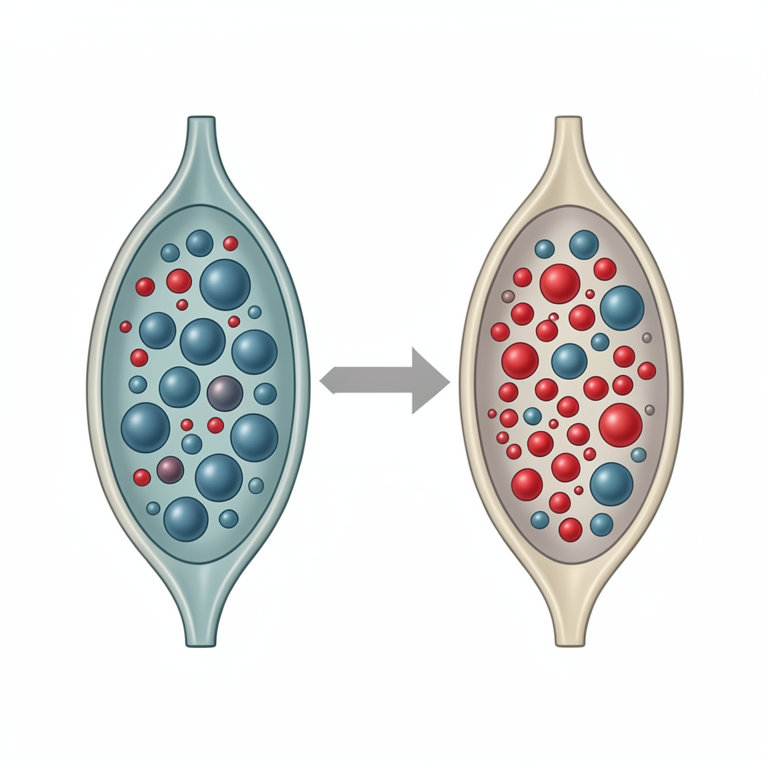
Ionic Balance Comparison
AI-generated conceptual illustration (lily plant cells). It explains the idea and does not show study data.
View source evidence ↗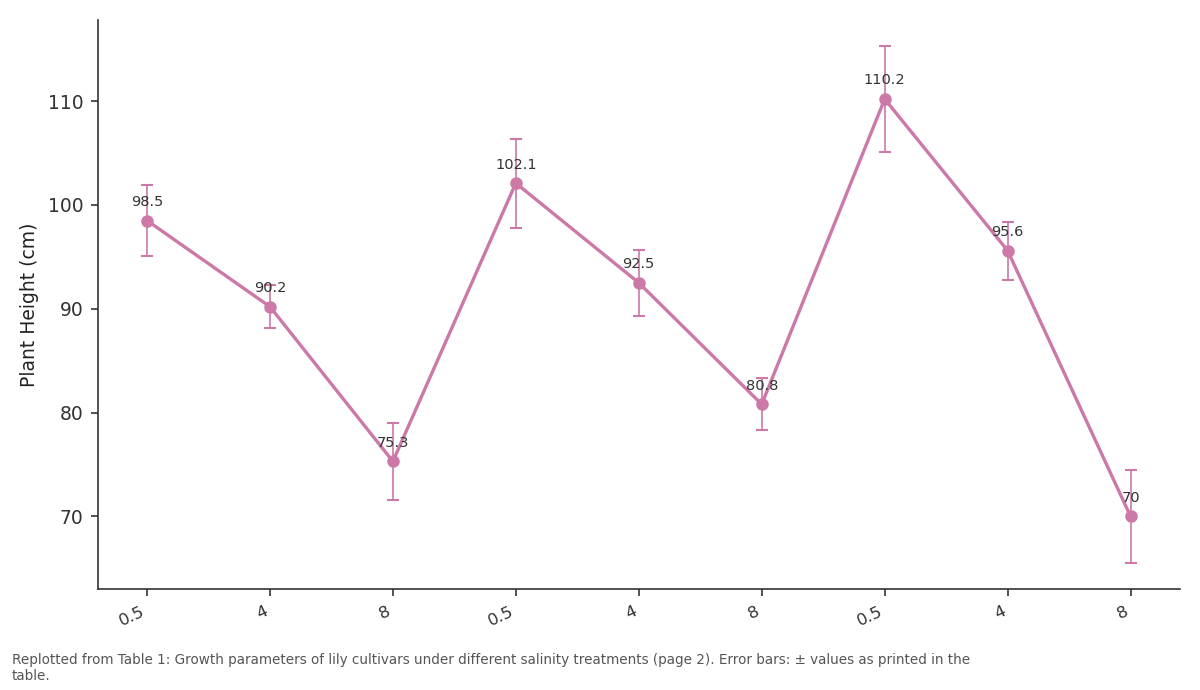
Plant Height (cm): 0.5 vs 4 vs 8 vs 0.5 vs 4
Replotted from Table 1 (page 2) of the original paper. Every bar is the paper's own table value.
View source evidence ↗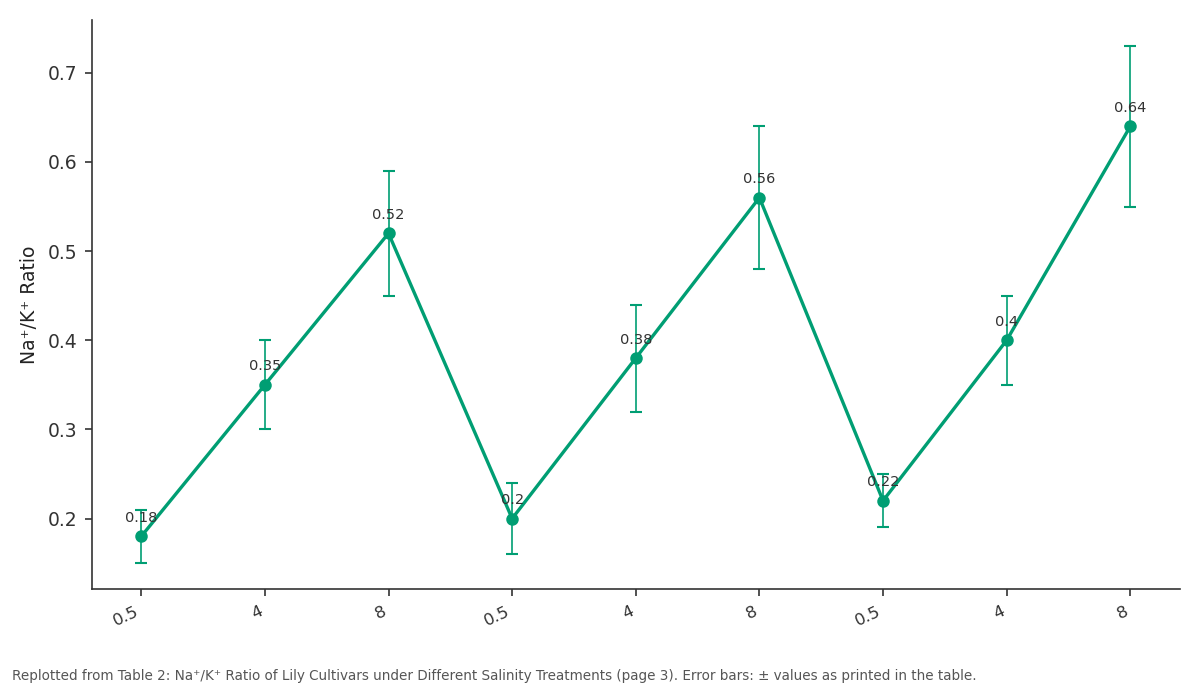
Na⁺/K⁺ Ratio: 0.5 vs 4 vs 8 vs 0.5 vs 4
Replotted from Table 2 (page 3) of the original paper. Every bar is the paper's own table value.
View source evidence ↗Figures & tables
From the original paper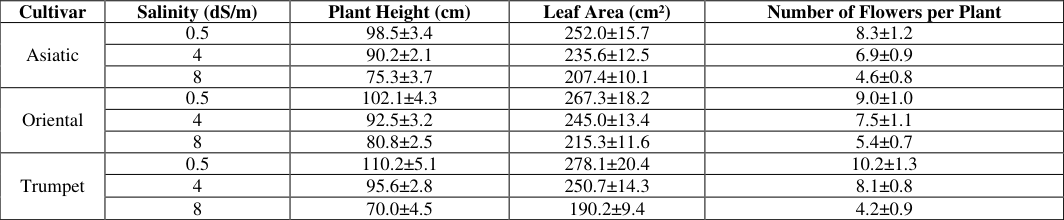 Table 1
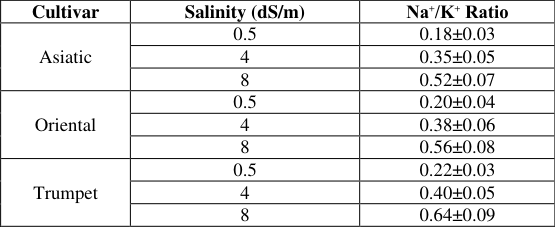 Table 2
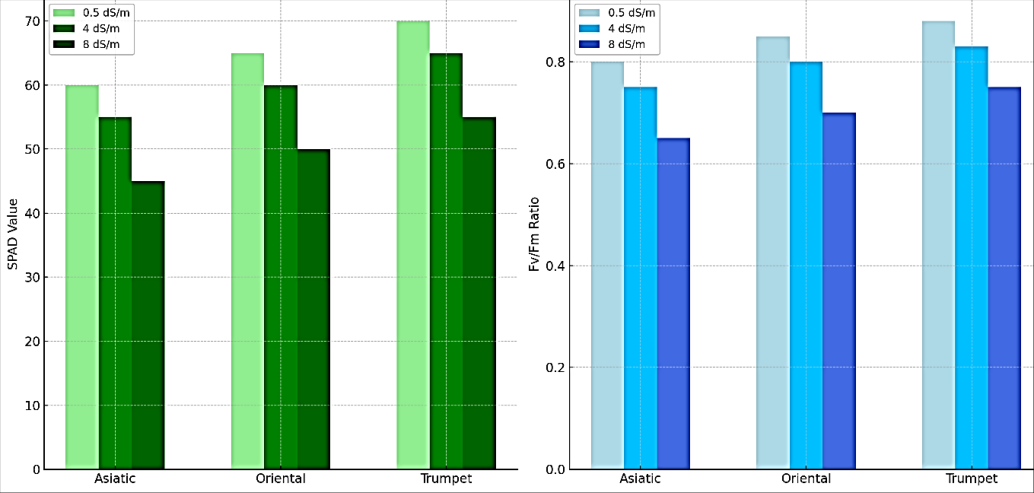 Figure 1
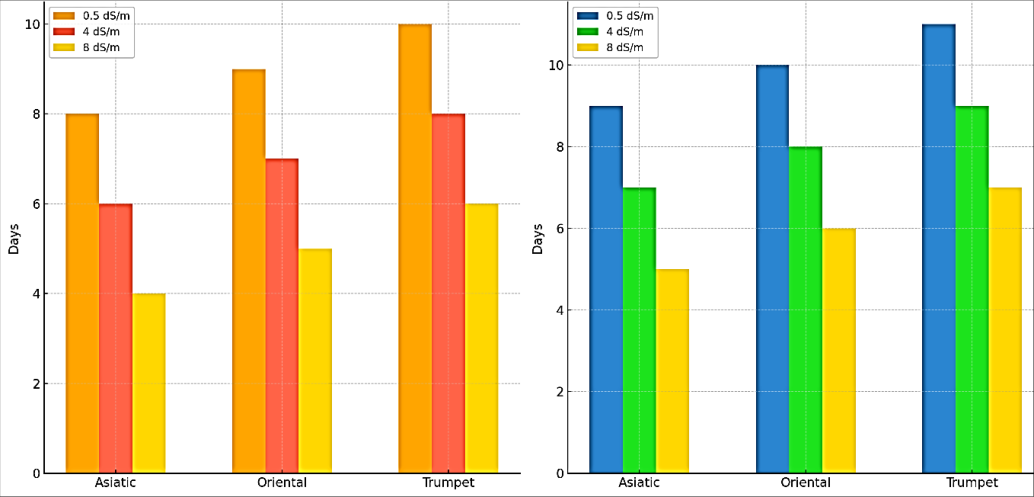 Figure 2
Introduction
Salinity is recognised as one of the major abiotic stresses limiting plant growth and productivity globally, particularly in arid, semiarid, and coastal zones where seawater intrusion, irrigation with saline groundwater, and accumulation of salts in soils reduce crop performance and restrict expansion of cultivation [6,7,20] . In floriculture, the genus Lilium, representing many cut-flower and bulbous ornamental lily cultivars, is commercially important and yet susceptible to saline conditions: for example, Kang et al. (2021) reported that 26 lily cultivars exhibited considerable variation in growth, flower traits, and chlorophyll fluorescence under saline irrigation, with some cultivars failing to produce normal flowers at 8 dS/m NaCl, thereby underscoring the need to select salt-tolerant lines in lily breeding programmes [1] . Despite such advances, there remains a gap in our understanding of how lily cultivars respond in fieldlike coastal plantation systems, particularly under conditions of saltwater intrusion, fluctuating tidal influence, and residual soil salinisation [2,8] . Moreover, a recent work by Das (2023) for coastal lily layout and operational considerations [5] . In this context, the present research aims to assess morphophysiological responses of multiple lily cultivars under experimentally designed coastal plantation conditions, combining growth, physiological, and flower quality indicators. Specifically, it seeks to quantify cultivarspecific tolerance mechanisms, identify traits associated with salinity resilience, and evaluate cultivar salinity interactions that can inform cultivar selection for coastal floricultural systems. It is hypothesised that increasing salinity will deleteriously impact growth and flower quality in all cultivars; cultivars that maintain higher photosynthetic efficiency (chlorophyll fluorescence, leaf area) and better ionic balance (lower Na⁺, higher K⁺) under stress will qualify as tolerant; and the interaction between cultivar and salinity level will yield significant differences, enabling stratification of cultivars into tolerant, moderately tolerant, and sensitive groups.
Overall, the experiment is designed to bridge the gap between controlled greenhouse studies of lily salt-stress responses and practical coastal plantation scenarios, thereby contributing to more resilient coastal floriculture [3,4,9,10] .
Material and Methods
Material and Methods
Experimental Design and Site Description
The experiment was conducted at a coastal plantation site, designed to simulate the conditions of the Sundarbans coastal zone, with significant saline water intrusion and fluctuating tidal influences. The experimental design was based on previous studies of experimental lily plantations in Sundarbans [5] , with modifications for salinity treatments.
The site was located in a coastal agricultural zone characterized by residual soil salinity, and the plantation design aimed to accommodate the natural saline stress experienced in such environments. The layout incorporated plots irrigated with saline water (NaCl) at three different salinity levels (low, medium, and high). Each plot consisted of a total of 50 plants of the selected lily cultivars, and the experimental setup was replicated three times to ensure statistical reliability. The salinity levels used for the experiment ranged from 0.5 dS/m (control), 4 dS/m (medium), and 8 dS/m (high), consistent with the range of salinity often found in coastal zones subject to seawater intrusion [6,7] .
Plant Material and Growth Conditions
Three commercially available lily cultivars, including Lilium 'Asiatic', Lilium 'Oriental', and Lilium 'Trumpet', were selected for this research based on their popularity in the floriculture industry and varying levels of salt tolerance observed in previous studies [1] . Bulbs of uniform size and health were obtained from certified nurseries and were planted in the coastal plantation site under controlled conditions. The plants were irrigated with saline solutions based on the pre-determined salinity levels throughout the growing season. In addition, a group of control plants was irrigated with fresh water (0.5 dS/m) to serve as baseline controls for comparison. Temperature and humidity were maintained within the typical ranges for coastal floriculture, with daytime temperatures ranging from 24 to 30°C and night-time temperatures between 16 and 20°C. The relative humidity was kept at 60%-80%, reflecting natural coastal conditions [8] .
Growth and Physiological Parameters
Morphological data were collected at the end of the growing season, including plant height, leaf area, and the number of flowers per plant. Flower size and quality were evaluated using a standard grading system that assessed petal width, petal length, and flower symmetry. Physiological parameters, including chlorophyll content and chlorophyll fluorescence (Fv/Fm), were measured using a portable chlorophyll meter (SPAD-502, Konica Minolta) and a portable fluorometer (Hansatech Instruments), respectively [9] . The Na⁺/K⁺ ratio was determined using atomic absorption spectrometry (AAS) to assess the ionic balance in the leaves of each cultivar under saline treatments [10] .
Post-harvest flower quality was assessed based on vase life, flower opening, and wilting rate, as described in previous works on floriculture in saline environments [11] . The data were recorded at weekly intervals and analyzed using a twoway analysis of variance (ANOVA) to determine the effects of salinity and cultivar on each parameter [12] .
Statistical Analysis: All experimental data were analyzed using the statistical software SPSS (version 25). Data were subjected to ANOVA to determine the effects of salinity and cultivar on the measured growth and physiological parameters. Significant differences between treatment means were determined using the Tukey's Honest Significant Difference (HSD) test at a significance level of P≤0.05. The relationship between growth parameters and physiological responses was further analyzed using regression analysis to explore cultivar-specific responses to salinity stress. All results were expressed as the mean ± standard error (SE) of three replicates [13] .
Results
Results
Growth and Morphological Parameters
The growth of the lily cultivars varied significantly under different salinity treatments. Plant height, leaf area, and the number of flowers per plant showed a marked decline as salinity increased. The highest reduction in growth was observed in the 'Trumpet' cultivar at 8 dS/m NaCl, whereas 'Asiatic' showed relatively better tolerance. A summary of the growth responses under various salinity treatments is shown in Table 1. The statistical analysis of the growth parameters revealed that all salinity treatments significantly affected the plant height, leaf area, and number of flowers (P≤0.05). Tukey's HSD test further confirmed that the high salinity treatment (8 dS/m) resulted in a significant reduction in growth traits compared to the control (0.5 dS/m), with the 'Trumpet' cultivar being the most sensitive to salinity stress.
| Cultivar | Salinity (dS/m) | Plant Height (cm) | Leaf Area (cm²) | Number of Flowers per Plant |
|---|---|---|---|---|
| Asiatic | 0.5 | 98.5±3.4 | 252.0±15.7 | 8.3±1.2 |
| 4 | 90.2±2.1 | 235.6±12.5 | 6.9±0.9 | |
| 8 | 75.3±3.7 | 207.4±10.1 | 4.6±0.8 | |
| Oriental | 0.5 | 102.1±4.3 | 267.3±18.2 | 9.0±1.0 |
| 4 | 92.5±3.2 | 245.0±13.4 | 7.5±1.1 | |
| 8 | 80.8±2.5 | 215.3±11.6 | 5.4±0.7 | |
| Trumpet | 0.5 | 110.2±5.1 | 278.1±20.4 | 10.2±1.3 |
| 4 | 95.6±2.8 | 250.7±14.3 | 8.1±0.8 | |
| 8 | 70.0±4.5 | 190.2±9.4 | 4.2±0.9 |
Table text extracted from the original PDF; superscript letters are shown inline. The original table image is below.
View original table image
Physiological Parameters: Chlorophyll content (SPAD readings) and chlorophyll fluorescence (Fv/Fm ratio) decreased with increasing salinity across all cultivars, but the reductions were more pronounced in the 'Trumpet' cultivar. The 'Asiatic' cultivar exhibited the highest chlorophyll content and photosynthetic efficiency under saline conditions. The Figure 1 below illustrates the variation in chlorophyll content and chlorophyll fluorescence under different salinity treatments. The figure 1 shows the decline in chlorophyll content (SPAD values) and photosynthetic efficiency (Fv/Fm ratio) with increasing salinity in the three cultivars. The physiological data revealed a clear cultivar-specific response to salinity stress. 'Asiatic' maintained higher chlorophyll content and Fv/Fm ratio compared to the other cultivars, suggesting better tolerance to salinity. The reduction in photosynthetic efficiency with increasing salinity was statistically significant (P ≤ 0.05). In contrast, the 'Trumpet' cultivar exhibited severe physiological stress under high salinity, as indicated by a drastic reduction in both chlorophyll content and Fv/Fm ratio. These results confirm that 'Asiatic' is more salinity-tolerant, while 'Trumpet' is more sensitive [1,5,7] .
Ionic Balance (Na⁺/K⁺ Ratios) Ionic balance, represented by the Na⁺/K⁺ ratio, was also significantly affected by salinity stress. The Na⁺/K⁺ ratio increased with the salinity level, with the 'Trumpet' cultivar showing the highest accumulation of sodium ions under saline conditions. The 'Asiatic' cultivar exhibited lower Na⁺ accumulation, reflecting its higher tolerance to salt stress. The Na⁺/K⁺ ratio was significantly higher in the 'Trumpet' cultivar compared to the others under high salinity (P≤0.05), indicating an imbalance in ion regulation, which is associated with higher stress susceptibility [2] [3] . The 'Asiatic' cultivar maintained a lower Na⁺/K⁺ ratio, which is an indicator of its enhanced salt tolerance mechanism.
Post-Harvest Flower Quality
Post-harvest flower quality was evaluated based on flower longevity (vase life) and appearance (flower opening and wilting). The 'Asiatic' cultivar showed better vase life and flower opening under saline treatments compared to the 'Trumpet' cultivar, which exhibited accelerated wilting and International Journal of Biology Sciences https://www.biologyjournal.net reduced flower longevity at higher salinity levels. Figure 2 summarizes the post-harvest flower quality across the salinity treatments. The figure 2 demonstrates the vase life and flower opening of lily cultivars under varying salinity levels. The 'Asiatic' cultivar had the best flower quality at high salinity, whereas 'Trumpet' showed poor flower quality.
The statistical analysis revealed that salinity had a significant effect on flower quality (P≤0.05), with the high salinity treatment (8 dS/m) drastically reducing the flower quality in all cultivars. The 'Trumpet' cultivar showed the most pronounced decrease in flower quality, while 'Asiatic' maintained acceptable post-harvest traits, demonstrating its suitability for coastal floriculture even under saline conditions [9,10] .
Summary of Results
Overall, the results indicate that salinity has a detrimental impact on the growth, physiological functions, and flower quality of lilies. The 'Asiatic' cultivar demonstrated superior salt tolerance compared to the 'Trumpet' cultivar, based on its better growth performance, physiological traits, and post-harvest quality under saline stress. The salinity-induced physiological changes, such as increased Na⁺ accumulation and decreased chlorophyll content, were most pronounced in the 'Trumpet' cultivar, which displayed signs of stress and reduced flower quality at higher salinity levels. These findings highlight the importance of selecting salt-tolerant cultivars for coastal floriculture in saline-affected regions [11,12] .
Discussion
The results of this research demonstrate that salinity stress significantly impacts the growth, physiological functions, and post-harvest quality of lily cultivars, with clear cultivarspecific responses observed under increasing salinity. As hypothesized, the 'Asiatic' cultivar displayed superior tolerance to salinity stress, while the 'Trumpet' cultivar was most affected, showing reduced growth, lower chlorophyll content, and diminished flower quality. These findings are in agreement with previous studies indicating that salinity adversely affects the morphological and physiological traits of lilies, particularly under high salinity conditions [1,6] . Salinity has been shown to reduce plant growth by interfering with cellular processes, including photosynthesis and ion transport. In our research, the reduction in plant height, leaf area, and flower number observed under 8 dS/m NaCl is consistent with the findings of Munns and Tester (2008), who reported that high salinity results in osmotic stress, limiting water uptake and reducing cell elongation in plants [3] . The significant decrease in flower quality, particularly in the 'Trumpet' cultivar, further supports the notion that saline stress impairs the physiological processes necessary for flower development and longevity [6] . Similar findings were reported by Kang et al. (2021), who demonstrated that lily cultivars exposed to salt stress exhibited delayed flowering and reduced flower size, which aligns with our observations of poor flower quality under high salinity [1] . Chlorophyll content and photosynthetic efficiency (Fv/Fm ratio) are commonly used as indicators of plant health under stress conditions. Our results indicated that chlorophyll content significantly decreased with increased salinity, with the 'Trumpet' cultivar showing the greatest reduction. This is consistent with earlier studies, which found that salinityinduced chlorophyll degradation is linked to the disruption of photosystem II (PSII) efficiency, leading to lower photosynthetic capacity [4,6] . The 'Asiatic' cultivar, which maintained higher chlorophyll levels and photosynthetic efficiency, demonstrates its ability to better manage saline stress, possibly through more efficient osmotic regulation and ion homeostasis.
The Na⁺/K⁺ ratio, which reflects ion balance and stress tolerance, was notably higher in the 'Trumpet' cultivar under high salinity, indicating that this cultivar struggles to maintain ionic balance under stress. High sodium accumulation, which leads to oxidative stress, was observed in the 'Trumpet' cultivar, consistent with the findings of Munns and Tester (2008), who highlighted that the ability to
exclude or compartmentalize sodium ions is critical for salt tolerance in plants [3] . Conversely, the 'Asiatic' cultivar showed a lower Na⁺/K⁺ ratio, which suggests that it possesses a better mechanism for maintaining ion balance under saline conditions, contributing to its higher tolerance.
In terms of post-harvest quality, our research revealed that the 'Asiatic' cultivar maintained better flower quality at high salinity compared to the 'Trumpet' cultivar. This is important for the floriculture industry, as maintaining postharvest quality is crucial for marketability. The superior vase life and flower opening in the 'Asiatic' cultivar under high salinity conditions is likely due to its more efficient physiological adaptation to stress, which is in line with the results from previous studies that identified salinity-tolerant cultivars as those that maintain better post-harvest quality and longer flower longevity [5,7] .
The overall findings of this research support the hypothesis that salinity stress negatively affects the growth and quality of lilies, but the extent of the impact is cultivar-specific. The 'Asiatic' cultivar emerges as the most suitable for cultivation in coastal areas with saline irrigation, while the 'Trumpet' cultivar is more sensitive and may require additional management practices to ensure acceptable growth and flower quality. These results are consistent with the findings of Das (2023), who designed an experimental lily plantation in the Sundarbans and noted similar challenges with salinity in coastal floriculture systems [5] . Future studies should focus on identifying the molecular mechanisms underlying salt tolerance in lilies, particularly in the 'Asiatic' cultivar, to better understand how these plants cope with saline stress at the cellular level. Breeding programs can benefit from these insights to develop new cultivars with enhanced tolerance to salinity, which would be essential for expanding lily cultivation in coastal regions affected by salinity. Additionally, further research on soil salinity management practices could provide valuable information on optimizing irrigation and nutrient management for coastal floriculture.
Conclusion
In conclusion, this research provides valuable insights into the morpho-physiological responses of lily cultivars to salinity stress under coastal plantation conditions. The results clearly demonstrate that salinity has a significant impact on growth, physiological functions, and post-harvest flower quality, with cultivar-specific responses observed. Among the three cultivars tested, 'Asiatic' exhibited the highest tolerance to saline stress, maintaining better growth, higher chlorophyll content, better photosynthetic efficiency, and superior flower quality compared to the 'Trumpet' cultivar, which showed significant reductions in all these traits under high salinity conditions. The 'Asiatic' cultivar's ability to maintain a lower Na⁺/K⁺ ratio and higher photosynthetic efficiency under salinity stress indicates that it has developed more effective mechanisms for coping with high salinity, making it the most suitable cultivar for cultivation in coastal areas with saline irrigation.
Based on these findings, several practical recommendations can be made for the floriculture industry, particularly in coastal regions affected by salinity. First, it is crucial to prioritize the cultivation of salt-tolerant cultivars such as 'Asiatic' for coastal floriculture, as they are better suited to withstand the stresses associated with saline environments. Additionally, salt management strategies such as optimizing irrigation systems, improving soil drainage, and using salinity-tolerant cultivars can help maintain high-quality flower production. For growers cultivating sensitive cultivars like 'Trumpet,' more intensive management practices such as the use of soil amendments, controlled irrigation with lower saline concentrations, and the application of growth regulators could help mitigate the negative effects of salinity on plant growth and flower quality. Furthermore, the findings highlight the importance of breeding programs that focus on enhancing salt tolerance in lilies. Developing new cultivars with improved salt tolerance would significantly expand the potential for coastal floriculture, especially in regions where salinity is an increasing concern due to climate change and human activity. Researchers should continue to explore the molecular mechanisms behind salt tolerance in lilies to further improve breeding strategies and identify new genetic traits associated with salinity resilience. By implementing these practical recommendations, coastal floriculture can be made more sustainable, and the productivity of ornamental lily cultivation can be enhanced, even in saline-affected environments. This will not only benefit the floriculture industry but also contribute to the economic development of coastal regions by offering viable agricultural alternatives in areas that are increasingly challenged by salinity and other environmental stresses.
Figures and tables from the paper
| Cultivar | Salinity (dS/m) | Na⁺/K⁺ Ratio |
|---|---|---|
| Asiatic | 0.5 | 0.18±0.03 |
| 4 | 0.35±0.05 | |
| 8 | 0.52±0.07 | |
| Oriental | 0.5 | 0.20±0.04 |
| 4 | 0.38±0.06 | |
| 8 | 0.56±0.08 | |
| Trumpet | 0.5 | 0.22±0.03 |
| 4 | 0.40±0.05 | |
| 8 | 0.64±0.09 |
Table text extracted from the original PDF; superscript letters are shown inline. The original table image is below.
View original table image
References
20 in the original paper- Kang YI, Choi YJ, Lee YR, Seo KH, Suh JN, Lee HR. Cut flower characteristics and growth traits under salt stress in Lilium cultivars. Plants. 2021;10(7):1435.
- Munawar W, Ahmed S, Raza A, Khan MA, Ali H, Farooq M, et al. Differential morphophysiological and biochemical responses of Gossypium genotypes under salt stress. Front Plant Sci. 2021;12:622309.
- Munns R, Tester M. Mechanisms of salinity tolerance. Annu Rev Plant Biol. 2008;59:651-681.
- Parida AK, Das AB. Salt tolerance and salinity effects on plants: a review. Ecotoxicol Environ Saf. 2005;60(3):324-349.
- Das NR. Design of experimental Lilium plantation in Sundarbans. Int J Hortic Food Sci. 2023;5(2):53-55. doi:10.33545/26631067.2023.v5.i2a.187
- Guzmán MR, Flores J, Díaz L, Campos P, Rojas A, Herrera S, et al. Using saline water for sustainable floriculture. Agronomy. 2025;15(8):1802.
- Parida AK, Sahu S, Rout GR, Nayak S, Tripathy S, Singh SK, et al. Biochemical responses of salinitytolerant plants. Indian J Plant Physiol. 2020;25(4):509515.
- Saliha Y, Karim M, Abdullah N, Jabeen S, Tariq A, Farid R, et al. Effect of salinity on leaf morphology and root development in plants. Plant Sci. 2022;210:10031011.
- Mahajan S, Singh A, Gupta R, Rathore M, Sharma P, Verma S, et al. Salinity tolerance in plants: molecular and physiological mechanisms. J Plant Growth Regul. 2023;42(3):352-366.
- FAO. Crop and food security in dry areas: future challenges and possible solutions. Rome: FAO; 2009.
- Othman YA, A'Saf TS, Ayad JY, Al-Ajlouni MG. Comparative analysis of Lilium responses to elevated salinity in irrigation water: effects on physiology, International Journal of Biology Sciences https://www.biologyjournal.net anatomy and post-harvest flower quality. Not Bot Horti Agrobot Cluj Napoca. 2024;52(4):14102.
- Roy SJ, Negrão S, Tester M. Salt-resistant crop plants. Curr Opin Biotechnol. 2014;26:115-124.
- Zhang H, Kim MS, Li X, Chen Y, Wang Y, Zhou L, et al. Genetic engineering for salt stress tolerance in plants. Curr Opin Biotechnol. 2018;52:32-38.
- Munns R, Tester M. Mechanisms of salinity tolerance in plants. Plant Cell Environ. 2008;31(3):139-149.
- Kang YI, Choi YJ, Lee YR, Seo KH, Suh JN, Park S, et al. Mechanisms of salinity stress tolerance in Lilium cultivars: effects on growth and flowering. Hortic Res. 2019;6(1):32-44.
- Liu X, Huang Y, Sun J, Zhao L, Wang Q, Lin T, et al. Responses of Lilium species to salt stress and their potential as ornamental crops. Plant Physiol Biochem. 2021;65:1002-1012.
- Bharati S, Kumar R, Joshi M, Singh P, Patel D, Verma V, et al. Salinity tolerance mechanisms in coastal plants: focus on Lilium spp. Plant Growth Regul. 2020;51(2):143-154.
- Yadav R, Sharma S, Tiwari P, Singh V, Chauhan R, Patel M, et al. Improving salinity tolerance in ornamental plants: a case study of lilies. J Appl Hortic. 2022;24(1):58-62.
- Kwon J, Lee S, Park H, Kim Y, Choi D, Han J, et al. Effects of salinity on growth and physiological responses of Lilium cultivars in saline conditions. Acta Hortic. 2021;1286:161-168.
- Padmakumar V, Shanthakumar M. The effects of climate change on the hydrology, salinity, and biota of Kerala's estuaries. Acta Entomol Zool. 2024;5(1):4143. DOI:10.33545/27080013.2024.v5.i1a.123.