
Research article · 2025 · Full text
International Journal of Agriculture and Food ScienceManagement of Phomopsis blight of brinjal with various fungicides under field condition
Volume 7(11) · Pages 387–390 · DOI: 10.33545/2664844x.2025.v7.i11e.982 ↗
Research areasAgricultural Practices and Plant GeneticsHumic Substances and Bio-Organic StudiesFungal Plant Pathogen Control
Abstract
Author-writtenIn vivo efficacy of fungicides were assessed against Phomopsis vexans causing Phomopsis blight of brinjal. The tested fungicides were Carbendazim 50 % WP, Propiconazole 25 % EC, Hexaconazole 5 % EC, Mancozeb 75 % WP, Propineb 70 % WP, Carbendazim 12 % + Mancozeb 63% WP, Carboxin 37.5% + Thiram 37.5% WP and Pyraclostrobin 13.3% + Epoxiconazole 5 % SE. Field trials were conducted during Kharif 2024 in the experimental field of Department of Plant Pathology, College of Agriculture, Latur using Pusa Purple Round variety of brinjal. The trial was laid out in Randomized Block Design with three replications. After the third spray Seedling dip with Carboxin 37.5% + Thiram 37.5% WP and Spray Carbendazim 50% WP showed least disease severity of 16.27 % and showed highest disease control 63.25% respectively over the untreated control plot. The same treatment resulted in maximum fruit yield of 28.96 t/ha registering 60.00 % increase in yield over the untreated control plot with ICBR of 1:25.91. The second best treatment was Seedling dip with Carboxin 37.5% + Thiram 37.5% WP and Spray Carbendazim 12% + Mancozeb 63% WP showed disease severity of 16.53 % and showed disease control 62.66 % respectively over the untreated control plot with fruit yield of 28.60 t/ha registering 58.01 % increase in yield over the untreated control plot with ICBR of 1:20.74 followed by Seedling dip with Carboxin 37.5% + Thiram 37.5% WP and Spray Hexaconazole 5% EC showed disease severity of 16.80 % and showed disease control 62.05 % respectively over the untreated control plot with fruit yield of 28.59 t/ha registering 57.96 % increase in yield over the untreated control plot with highest ICBR of 1:26.00. These treatments were at par with each other and significantly superior over rest of the treatments. The untreated control plot recorded maximum disease severity of 44.27 % and lowest fruit yield 18.10 t/ha.
Summary
Source-checkedPlain-language reading of the full paper, prepared with AI and checked against the text. Each point links to the authors' own words.
Why it matters
- Brinjal, also known as eggplant, is a primary fruit vegetable crop widely grown in India's tropical and subtropical regions. View evidence ↗
- Phomopsis blight, caused by the fungus Phomopsis vexans, is a common disease that damages seedlings, leaves, branches, and fruits of brinjal. View evidence ↗
- Phomopsis blight typically results in a 15-20% reduction in crop yield. View evidence ↗
The question
- The study aimed to identify effective fungicides for managing Phomopsis vexans under in vivo field conditions. View evidence ↗
What they did
- The experiment used the Pusa Purple Round variety of brinjal during Kharif 2024 in Latur, employing a Randomized Block Design with three replications. View evidence ↗
- Eight fungicide treatments were tested, including various formulations of Carbendazim, Propiconazole, Hexaconazole, Mancozeb, Propineb, Carboxin+Thiram, and Pyraclostrobin+Epoxiconazole. View evidence ↗
- The treatment protocol involved dipping seedlings in Carboxin 37.5% + Thiram 37.5% WP followed by three foliar sprays of the assigned fungicides. View evidence ↗
- Researchers measured disease intensity using a 0-5 rating scale and recorded net fruit yield in tons per hectare. View evidence ↗
What they found
- The combination of Carboxin+Thiram seedling dip and Carbendazim 50% WP spray (T1) was most effective, reducing disease severity to 16.27% compared to 44.27% in the untreated control. View evidence ↗
- Treatment T1 achieved the highest disease control rate at 63.25%. View evidence ↗
- Treatment T1 produced the maximum fruit yield of 28.96 t/ha, whereas the untreated control yielded 18.10 t/ha. View evidence ↗
- The highest Incremental cost: Benefit Ratio (ICBR) of 1:26.00 was recorded for treatment T3 (Carboxin+Thiram dip and Hexaconazole 5% EC spray). View evidence ↗
- Treatments T1, T6, and T3 were found to be statistically at par and significantly superior to other treatments. View evidence ↗
What it means
- The authors conclude that seedling dip with Carboxin 37.5% + Thiram 37.5% WP followed by Carbendazim 50% WP spray is the most effective method for controlling Phomopsis blight. View evidence ↗
- The authors state that all tested fungicides were effective in managing the disease compared to the untreated control. View evidence ↗
Visual summary
2 visualsIllustrations explain the paper; charts are replotted from the paper's own table values.
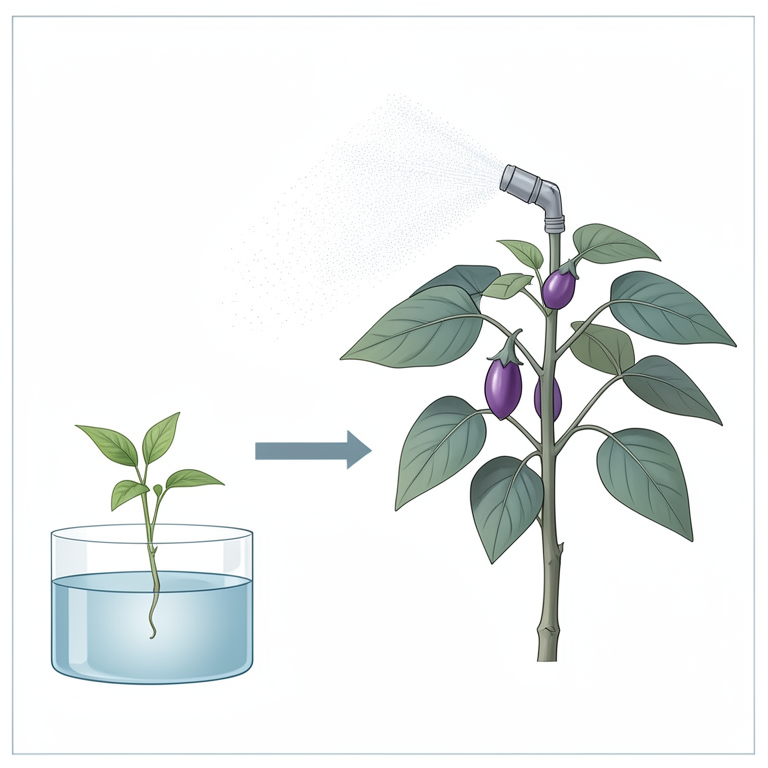
Treatment Workflow
AI-generated conceptual illustration (brinjal plants). It explains the idea and does not show study data.
View source evidence ↗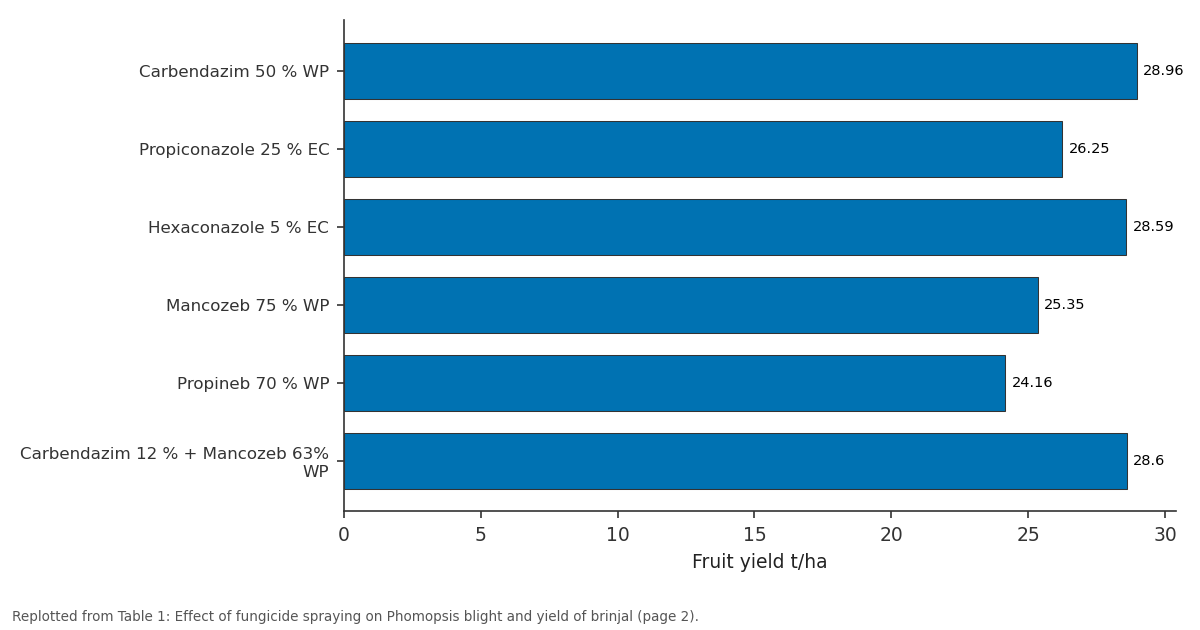
Fruit yield* t/ha: Carbendazim 50 % WP vs Propiconazole 25 % EC vs Hexaconazole 5 % EC vs Mancozeb 75 % WP vs Propineb 70 % WP
Replotted from Table 1 (page 2) of the original paper. Every bar is the paper's own table value.
View source evidence ↗Figures & tables
From the original paper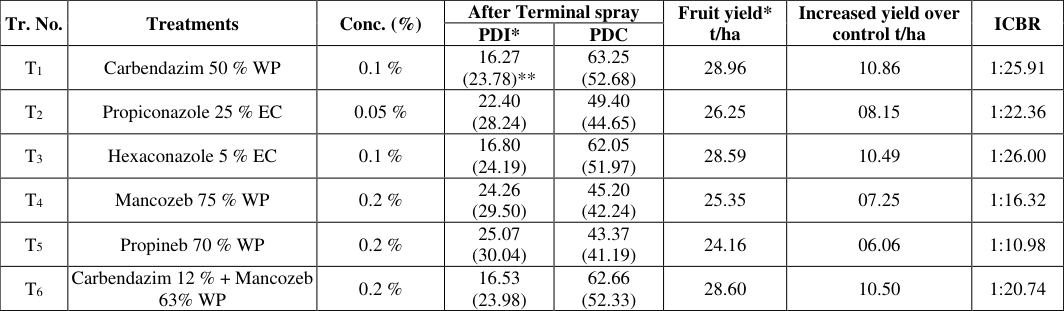 Table 1
Introduction
Brinjal (Solanum melongena L.), belonging to the family Solanaceae is commonly known as eggplant and Guinea squash, which is the native of India from where it spread to other parts of the world (Yawalkar, 1985) [20] . It is one of the most popular and principle fruit vegetable crop grown in the tropical and subtropical regions of India. It is highly productive and usually finds a place as "Poor man's crop" and also described as "King of Vegetables", due to its wide usage in Indian foods (Rajan and Markose, 2002) [14] . It is one of the most popular and principle fruit vegetable crop grown in the tropical and subtropical regions of India. Brinjal, besides being a significant vegetable, has been widely used in traditional medicine for treating various ailments (Kashyap et al., 2003) [10] . It is appreciated for its medicinal properties, including its cholesterol-lowering effects, mainly attributed to the polyunsaturated fatty acids (linoleic and linolenic acids) present in the fruit's flesh and seeds in high quantities. In traditional medicine, brinjal is noted for its use in treating liver diseases, allergies, rheumatism, leucorrhea and intestinal worms. Its seeds are used as stimulants, while its leaves have narcotic properties. Additionally, brinjal is used to alleviate toothache (Nadkarni, 1927) [11] . It is mainly grown in Indian states like Orissa, Bihar, Punjab, West Bengal, Karnataka, Maharashtra, Andhra Pradesh and Uttar Pradesh (Akhtar et al., 2007) [1] , with an area and production of 6,77,000 ha and 1,27,79,000 MT respectively and productivity of 18.87 tons per ha (Anon., 2023) [2] . Brinjal suffers from various abiotic stresses like salinity, drought, low and high temperature and heavy-metal as well as biotic stresses including viral, bacterial, fungal, nematodes, phytoplasmal pathogens, parasitic plants and insect herbivores, causing enormous qualitative as well as quantitative losses. [17] . Among various fungal diseases, Phomopsis blight is most widely occurred disease caused by the fungus Phomopsis vexans (Sacc. & Syd.). It affects the seedling, leaves, branches and fruits, leading to significant yield and quality losses. The disease typically causes 15-20 % reduction in crop yield. (Jakatimath et al., 2017) [8] Hence experiment to find out effective fungicides against Phomopsis vexans was conducted under in vivo condition.
Method of recording observations Disease severity
For the purpose of measuring the severity of the disease, five plants per treatment in each replication were chosen at random and tagged. Prior to the first spray, an initial observation was made and further observations were made 7 days after each spray. Seven days following the last spray, the final observations were noted and Per cent Disease severity/ intensity were calculated. Disease intensity of fruit rot was recorded by applying 0-5 rating scale given by Kalda et al. (1976) [9] and presented in Table below. Percent disease intensity (PDI)/severity were calculated as per formula given by Wheeler (1969) [19] ,
Rating scale for Fruit rot
The percent disease control (PDC) were calculated by applying formula,
Yield
Fruits were harvested at maturity and yields of net were recorded as kg per plot and later expressed in tons per ha.
Statistical analysis
The data obtained in the experiment conducted (in vivo) were subjected to statistical analysis. The standard error (S.E.) and critical difference (C.D.) @ 5% level of significance were worked out (Panse and Sukhatme, 1978) [13] and per cent data was transformed into arc sine values. [18] who assessed the effectiveness of five fungicides Bavistin (0.1%), Vitavax (0.1%), Blitox-50 (0.2%), Ridomil (0.2%), Indofil M-45 (0.2%) and one bio-pesticide Nimbidine (0.5%), on disease severity and yield of brinjal. They found that spraying Bavistin (0.1%) and Vitavax (0.1%) at 15-day intervals was most effective in reducing disease incidence and increasing yield. conducted experiment to assess the efficacy of different fungi toxicants in in-vivo condition and observed that seed treatment with Saaf @ 2g/kg seed + 2 foliar sprays with Contaf @ 0.1% recorded least disease intensity with highest fruit yield. The data in table 1 represented that the significant difference in yield of brinjal due to various treatments over the untreated control. Among the treatments, highest yield of 28.96 t/ha was obtained in treatment T 1 ( Beura et al., (2008) recorded maximum fruit yield (227.25 q/ha) registering 71.12 % increase in yield over control with maximum cost benefit ratio of 1:12.85 and Chaukhe et al., (2017) [4] who reported that maximum yield of brinjal (185.52 q/ha) registering 32.10 % increase in yield over control with maximum cost benefit ratio of 1:12.87 with carbendazim (0.1%) against Phomopsis blight of brinjal.
| Tr. No. | Treatments | Conc. (%) | After Terminal spray | — | Fruit yield* t/ha | Increased yield over control t/ha | ICBR |
|---|---|---|---|---|---|---|---|
| PDI* | PDC | ||||||
| T1 | Carbendazim 50 % WP | 0.1 % | 16.27 (23.78)** | 63.25 (52.68) | 28.96 | 10.86 | 1:25.91 |
| T2 | Propiconazole 25 % EC | 0.05 % | 22.40 (28.24) | 49.40 (44.65) | 26.25 | 08.15 | 1:22.36 |
| T3 | Hexaconazole 5 % EC | 0.1 % | 16.80 (24.19) | 62.05 (51.97) | 28.59 | 10.49 | 1:26.00 |
| T4 | Mancozeb 75 % WP | 0.2 % | 24.26 (29.50) | 45.20 (42.24) | 25.35 | 07.25 | 1:16.32 |
| T5 | Propineb 70 % WP | 0.2 % | 25.07 (30.04) | 43.37 (41.19) | 24.16 | 06.06 | 1:10.98 |
| T6 | Carbendazim 12 % + Mancozeb 63% WP | 0.2 % | 16.53 (23.98) | 62.66 (52.33) | 28.60 | 10.50 | 1:20.74 |
Table text extracted from the original PDF; superscript letters are shown inline. The original table image is below.
View original table image
Results and discussion
Results and discussion
Conclusion
Seedlings dip with Carboxin 37.5% + Thiram 37.5% WP and spray of Carbendazim 50% WP found most effective in controlling Phomopsis blight showed least disease severity of 16.27 % and showed highest disease control 63.25% respectively over the untreated control plot. The same treatment resulted in maximum fruit yield of 28.96 t/ha registering 60.00 % increase in yield over the untreated control plot with ICBR of 1:25.91.The second best treatment was Seedling dip with Carboxin 37.5% + Thiram 37.5% WP and Spray Carbendazim 12% + Mancozeb 63% WP showed disease severity of 16.53 % and showed disease control 62.66 % respectively over the untreated control plot with fruit yield of 28.60 t/ha registering 58.01 % increase in yield over the untreated control plot with ICBR of 1:20.74 followed by Seedling dip with Carboxin 37.5% + Thiram 37.5% WP and Spray Hexaconazole 5% EC showed disease severity of 16.80 % and showed disease control 62.05 % respectively over the untreated control plot with fruit yield of 28.59 t/ha registering 57.96 % increase in yield over the untreated control plot with highest ICBR of 1:26.00. These treatments were at par with each other and significantly superior over rest of the treatments. All treated fungicides were found effective in management of Phomopsis blight as compared to control.
References
20 in the original paper- Akhtar J, Chube HS, Singh HB. Phomopsis blight and fruit rot of brinjal. In: Biotechnology Plant Health Management. 2007. p. 421-38.
- Anonymous. Agricultural Statistics at a Glance. 2023. p. 94.
- Beura SK, Mahanta IC, Mahapatra KB. Economics and chemical control of Phomopsis twig blight and fruit rot of brinjal. J Mycopathol Res. 2008;46(1):73-6.
- Chaukhe AN, Patil MJ, Sawai HR, Parate RL, Chargen SU. Fungicidal control of Phomopsis blight of brinjal. Int J Res Biosci Agric Technol. 2017;5(2):398-400.
- Chaukhe AN, Patil MJ, Tekale AG, Deshmukh AP. Effect of chemical control of Phomopsis blight of brinjal caused by Phomopsis vexans. Int J Chem Stud. 2020;8(4):2051-3.
- Choudhary B, Gaur K. The development and regulations of Bt brinjal in India. ISAAA. 2009;38:1-2.
- Islam M, Asaduzzaman M, Faruk M, Hossain M, Sarker M, Alam K. Environmental and chemical control of Phomopsis blight and fruit rot of eggplant caused by Phomopsis vexans. J Sci Found. 2021;18(2):81-7.
- Jakatimath S, Mesta R, Mushrif S, Biradar IB, Ajjappanavar PS. In vitro evaluation of fungicides, botanicals and bio-agents against Phomopsis vexans, the causal agent of fruit rot of brinjal. J Pure Appl Microbiol. 2017;11:229-35.
- Kalda TS, Swarup V, Choudhary B. Studies on resistance to Phomopsis blight in eggplant (Solanum melongena L.). Veg Sci. 1976;3:65-70.
- Kashyap SV, Collonier C, Fusari F, Haicor R, Rotino GL, Sihachakr D, et al. Biotechnology of eggplant. Sci Hortic. 2003;97(1):1-25.
- Nadkarni KM. Indian Materia Medica. 2nd ed. Bombay: Popular Prakashan; 1927.
- Pani BK, Singh DV, Nanda SS. Chemical control and economics of Phomopsis blight and fruit rot of brinjal in the Eastern Ghat Highland Zone of Odisha. Int J Agric Environ Biotechnol. 2013;6:581-3.
- Panse VG, Sukhatme PG. Statistical Methods for Agriculture Workers. New Delhi: IARI; 1978.
- Rajan S, Markose BL. Propagation of Horticultural Crops. Horticulture Science Series. 2002;6:94.
- Rohini, Gowtham HG, Niranjana SR. Evaluation of efficacy of fungicides against Phomopsis leaf blight of brinjal (Solanum melongena L.). Int J Agric Sci Resour. 2015;5(6):45-50.
- Ekka S, Kumar M, Lal HC, Chakravarty MK, Soren A. Management of fruit rot of brinjal caused by Phomopsis vexans through fungicides, plant extract and host plant resistance. Int J Curr Microbiol Appl Sci. 2018;7:511924.
- Singh BK, Singh S, Singh GK, Yadav SM. Some important plant pathogenic diseases of brinjal (Solanum melongena L.) and their management. Plant Pathol J. 2014;13:208-13.
- Singh R, Singh PC, Kumar D, Sachan NS. Management of Phomopsis leaf blight of brinjal through different fungicides and biopesticides. HortFlora Res Spectr. 2012;1:371-4.
- Wheeler BEJ. An Introduction to Plant Diseases. London: John Wiley & Sons Ltd.; 1969. p. 301.
- Yawalkar KS. Vegetable Crops in India. Nagpur: Agriculture and Horticulture Publishing House; 1985. p. 85.