
Research article · 2025 · Full text
International Journal of Agriculture and Food ScienceUtilization of farmers towards Mahadbt portal in Ahilyanagar district
Volume 7(11) · Pages 364–366 · DOI: 10.33545/2664844x.2025.v7.i11e.977 ↗
Research areasFisheries and Aquaculture StudiesAgricultural Economics and PracticesAgricultural Systems and Practices
Abstract
Author-writtenThe present study entitled Utilization of Farmers Towards MahaDBT Portal in Ahilyanagar District was conducted during the year 2024–25 with 120 farmers selected through random sampling. The study aimed to assess the level of utilization pattern of farmers towards the MahaDBT portal which serves as a unified online platform for Direct Benefit Transfer (DBT) schemes in Maharashtra. Data were collected using a structured interview schedule and analyzed using the range method. The results revealed that the majority of farmers (64.17%) possessed a medium level of utilization, 54.17 per cent of respondents showed medium utilization, while, 28.33 per cent showed high and 17.50 per cent low utilization.
Summary
Source-checkedPlain-language reading of the full paper, prepared with AI and checked against the text. Each point links to the authors' own words.
Why it matters
- Agriculture is fundamental to India's economy, with over 58% of rural families depending on it for their livelihood. View evidence ↗
- The Maharashtra government created the MahaDBT portal to give citizens and farmers direct, transparent access to government schemes and reduce the need for intermediaries. View evidence ↗
- Despite its potential, the use of the MahaDBT portal by farmers is limited by constraints related to awareness, infrastructure, and technology. View evidence ↗
The question
- The study aimed to evaluate how farmers in the Ahilyanagar district utilize the MahaDBT portal for Direct Benefit Transfer schemes. View evidence ↗
What they did
- The research involved 120 randomly selected farmers (15 from each of eight villages) across the Shrirampur and Rahuri talukas of the Ahilyanagar district. View evidence ↗
- Researchers used the range method to categorize utilization levels as low, medium, or high, and applied simple percentage analysis for data interpretation. View evidence ↗
What they found
- The majority of farmers (54.17%) showed a medium level of portal utilization, while 28.33% showed high utilization and 17.50% showed low utilization. View evidence ↗
- Buying seeds and fertilizers was a common use, with 40.00% of respondents using the portal very frequently for this purpose. View evidence ↗
- For purchasing pesticides and insecticides, 36.67% of farmers used the portal very frequently. View evidence ↗
- The portal was least used for mechanization equipment (like tractors), with 33.34% of respondents reporting they did not use it at all for this purpose. View evidence ↗
- Using the portal to pay children's school fees was rare, with only 5.83% of respondents using it very frequently. View evidence ↗
What it means
- The authors concluded that most farmers in the Ahilyanagar district utilize the MahaDBT portal at a medium level. View evidence ↗
- The authors recommend increasing digital inclusion through awareness programs, mobile tutorials, and offline assistance centers provided by local government and agricultural services. View evidence ↗
Visual summary
1 visualsIllustrations explain the paper; charts are replotted from the paper's own table values.
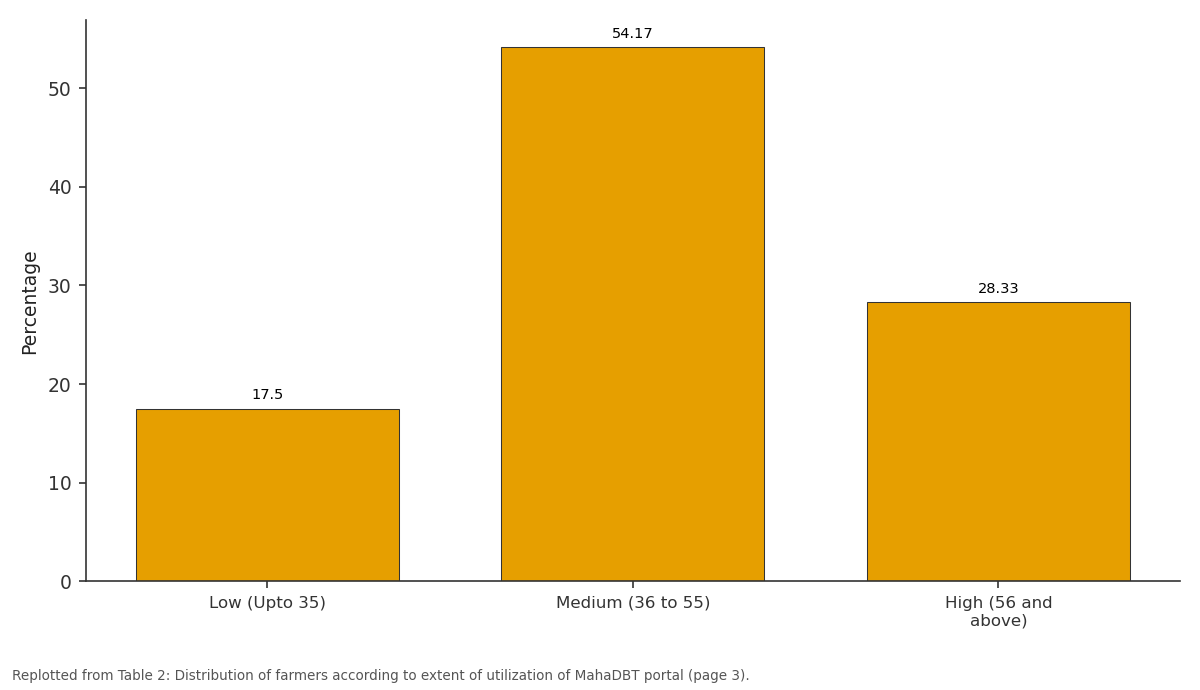
Percentage: Low (Upto 35) vs Medium (36 to 55) vs High (56 and above)
Replotted from Table 2 (page 3) of the original paper. Every bar is the paper's own table value.
View source evidence ↗Figures & tables
From the original paper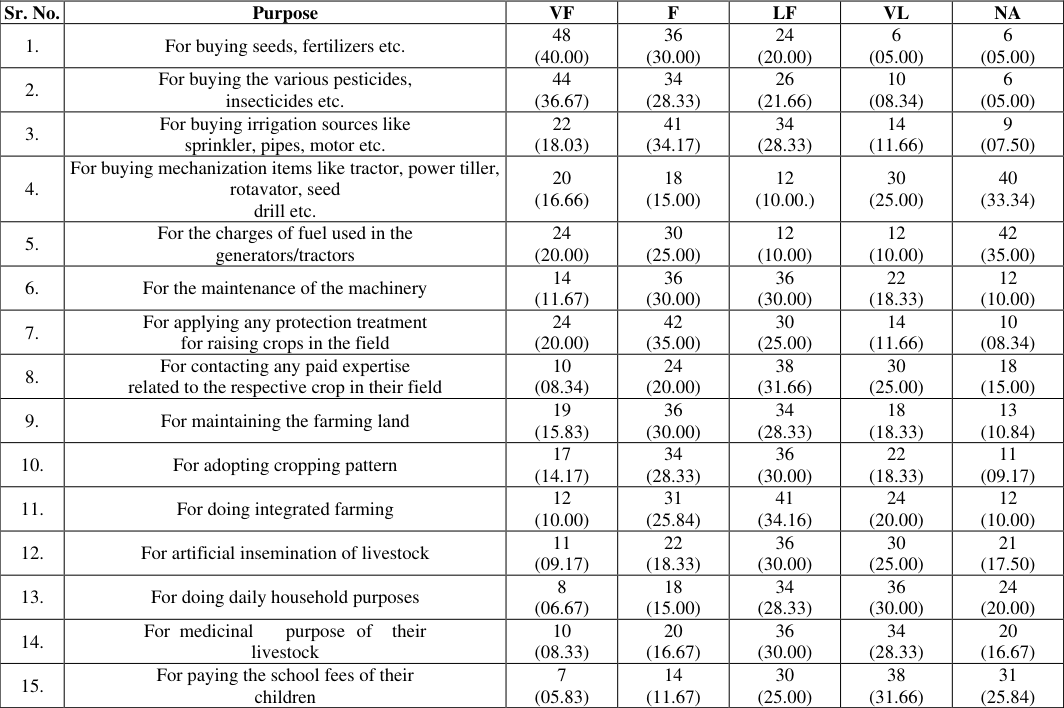 Table 1
 Table 2
Introduction
Agriculture is the foundation of Indias economy and greatly improves the lives of farmers personally, socially and economically. More than 58 per cent of rural families in India rely on agriculture. ICT and IoT tools provide real-time information directly to farmers. ICT includes various technologies like networks, electronic devices and mobile apps that help share knowledge efficiently. ICT has been especially helpful for small and marginal farmers, improving their marketing and increasing their income. It also gives farmers a platform to share their ideas, experiences and innovations. Additionally, it encourages farmers to use scientific methods for better farming. Among ICT tools, mobile phones are becoming very popular, transforming how agricultural information is shared. Mobile phones have also led to the development of useful farming apps and online portals benefiting farmers and others in the sector (Manobharathi and Anandaraja, 2021) [2] . Direct Benefit Transfer was introduced in India in 2013 as a major reform to improve the delivery of government welfare schemes. Its goal was to make the transfer of funds and information quicker, more accurate and transparent while reducing fraud and duplication. The DBT Mission, under the Cabinet Secretariat, oversees the implementation of DBT programs across all government ministries. An Electronic Payment Framework was established for all central government schemes where cash benefits are transferred directly to beneficiaries. Since Aadhaar provides a unique identity, it is preferred for identifying and verifying beneficiaries. DBT is a top priority for the government and the DBT Bharat Portal (https://dbtbharat.gov.in/) was launched in 2016 to manage all DBT-related schemes. This portal contains details about schemes, beneficiaries, fund transfers and official documents. The Government of Maharashtra launched the MahaDBT (Maharashtra Direct Benefit Transfer) portal to provide farmers and citizens with direct access to various government schemes ensuring transparency, timeliness and reduction in intermediary layers. It serves as a single-window platform where farmers can apply for subsidies and financial benefits. However despite its potential the utilization level of the MahaDBT portal among farmers remains limited due to various technical, infrastructural and awareness-related constraints. Assessing farmers knowledge and utilization level helps understand the effectiveness of such digital interventions in rural development.
Methodology
The study was conducted in Ahilyanagar district of Maharashtra covering Shrirampur and Rahuri taluka. Total eight villages were selected i.e. Rahuri, Deshwandi, Pimpari Avghad, Aradgaon, Belapur, Waladgaon, Ainatpur, Karegaon and from each village 15 respondents were selected randomly to involve total 120 respondents for the study purpose. Primary data were collected through a pretested structured interview schedule during the agricultural year 2024-25. The data were analyzed using the range method to categorize farmers into low, medium, and high levels utilization based on their scores. Simple percentage analysis was also used for interpretation.
Results and Discussion
The data regarding utilization of MahaDBT portal is presented in Table 1. The data in Table 1 revealed that a considerable proportion of respondents utilized the MahaDBT portal for various agricultural purchases and operational expenses. 40.00 per cent of the respondents utilized the MahaDBT portal very frequently utilizing it for buying seed, fertilizers etc. followed by 30.00 per cent of the respondents used it frequently, 20.00 per cent respondents less frequently, 5.00 per cent each of the respondents very less and not at all. It was observed from the Table 1 that 36.67 per cent respondents utilized the MahaDBT portal very frequently for buying pesticides and insecticides, followed by 28.33 per cent used it frequently, 21.66 per cent less frequently, 8.34 per cent very less and 5.00 per cent not at all. In the case of irrigation-related purchases such as sprinklers, pipes and motors, 18.03 per cent respondents utilized it very frequently, 34.17 per cent frequently, 28.33 per cent less frequently, 11.66 per cent very less and 7.50 per cent not at all. for buying mechanization equipments like tractors, power tillers, rotavators and seed drills 16.66 per cent respondents utilized MahaDBT portal very frequently, 15.00 per cent frequently, 10.00 per cent less frequently, 25.00 per cent very less and 33.34 per cent not at all. Similarly, for paying fuel charges for generators and tractors, 20.00 per cent of the respondents utilized the portal very frequently, followed by 25.00 per cent frequently, 10.00 per cent less frequently, 10.00 per cent very less and 35.00 per cent not at all. Analysis of Table 1 further revealed that 11.67 per cent of respondents utilized the portal very frequently for machinery maintenance, while, 30.00 per cent each reported using it frequently and less frequently, 18.33 per cent very less and 10.00 per cent not at all. For applying protection treatments to crops, 20.00 per cent of the respondents utilized the portal very frequently, followed by 35.00 per cent frequently, 25.00 per cent less frequently, 11.66 per cent very less and 8.34 per cent not at all. A smaller share i.e. 8.34 per cent respondents utilized the portal very frequently for contacting paid expertise related to crops, while, 20.00 per cent did so frequently, 31.66 per cent less frequently, 25.00 per cent very less and 15.00 per cent not at all. Further, the data indicated that 15.83 per cent of respondents utilized the MahaDBT portal very frequently for maintaining farming land, followed by 30.00 per cent frequently, 28.33 per cent less frequently, 18.33 per cent very less, and 10.84 per cent not at all. For adopting different cropping pattern 14.17 per cent respondents utilized it very frequently,28.33 per cent frequently, 30.00 per cent less frequently, 18.33 per cent very less and 9.17 per cent not at all. Integrated farming activities were carried out very frequently by 10.00 per cent of respondents through the portal, while, 25.84 per cent did so frequently, 34.16 per cent less frequently, 20.00 per cent very less and 10.00 per cent not at all. For artificial insemination of livestock, only 9.17 per cent reported very frequent use of the portal, 18.33 per cent frequent use, 30.00 per cent less frequent use, 25.00 per cent very less and 17.50 per cent not at all. It was observed that only 6.67 per cent respondents utilized the portal very frequently for daily household purposes, followed by 15.00 per cent frequently, 28.33 per cent less frequently,30.00 per cent very less and 20.00 per cent not at all. The same proportion 6.67 per cent respondents utilized it very frequently for medicinal purpose of livestock, with 15.00 per cent frequently, 30.00 per cent less frequently, 28.33 per cent very less and 16.67 per cent not at all. Another 8.33 per cent reported very frequent use of the portal for livestock medicinal purpose, followed by 16.67 per cent frequently, 30.00 per cent less frequently, 28.33 per cent very less and 16.67 per cent not at all. For paying school fees of children, only 5.83 per cent respondents utilized it very frequent use, while, 11.67 per cent did so frequently, 28.33 per cent less frequently, 30.00 per cent very less and 20.00 per cent not at all. These results show partial alignment with Gupta (2023)
| Sr. No. | Purpose | VF | F | LF | VL | NA |
|---|---|---|---|---|---|---|
| 1. | For buying seeds, fertilizers etc. | 48 (40.00) | 36 (30.00) | 24 (20.00) | 6 (05.00) | 6 (05.00) |
| 2. | For buying the various pesticides, insecticides etc. | 44 (36.67) | 34 (28.33) | 26 (21.66) | 10 (08.34) | 6 (05.00) |
| 3. | For buying irrigation sources like sprinkler, pipes, motor etc. | 22 (18.03) | 41 (34.17) | 34 (28.33) | 14 (11.66) | 9 (07.50) |
| 4. | For buying mechanization items like tractor, power tiller, rotavator, seed drill etc. | 20 (16.66) | 18 (15.00) | 12 (10.00.) | 30 (25.00) | 40 (33.34) |
| 5. | For the charges of fuel used in the generators/tractors | 24 (20.00) | 30 (25.00) | 12 (10.00) | 12 (10.00) | 42 (35.00) |
| 6. | For the maintenance of the machinery | 14 (11.67) | 36 (30.00) | 36 (30.00) | 22 (18.33) | 12 (10.00) |
| 7. | For applying any protection treatment for raising crops in the field | 24 (20.00) | 42 (35.00) | 30 (25.00) | 14 (11.66) | 10 (08.34) |
| 8. | For contacting any paid expertise related to the respective crop in their field | 10 (08.34) | 24 (20.00) | 38 (31.66) | 30 (25.00) | 18 (15.00) |
| 9. | For maintaining the farming land | 19 (15.83) | 36 (30.00) | 34 (28.33) | 18 (18.33) | 13 (10.84) |
| 10. | For adopting cropping pattern | 17 (14.17) | 34 (28.33) | 36 (30.00) | 22 (18.33) | 11 (09.17) |
| 11. | For doing integrated farming | 12 (10.00) | 31 (25.84) | 41 (34.16) | 24 (20.00) | 12 (10.00) |
| 12. | For artificial insemination of livestock | 11 (09.17) | 22 (18.33) | 36 (30.00) | 30 (25.00) | 21 (17.50) |
| 13. | For doing daily household purposes | 8 (06.67) | 18 (15.00) | 34 (28.33) | 36 (30.00) | 24 (20.00) |
| 14. | For medicinal purpose of their livestock | 10 (08.33) | 20 (16.67) | 36 (30.00) | 34 (28.33) | 20 (16.67) |
| 15. | For paying the school fees of their children | 7 (05.83) | 14 (11.67) | 30 (25.00) | 38 (31.66) | 31 (25.84) |
Table text extracted from the original PDF; superscript letters are shown inline. The original table image is below.
View original table image
Extent of utilization of MahaDBT portal
The data on extent of utilization of the MahaDBT portal by the respondents is presented in Table 2. The findings presented in Table 2 reported that clear distribution of utilization pattern of respondents regarding the MahaDBT portal. The data revealed that 54.17 per cent of participants exhibited a medium level of utilization pattern, while, 28.33 per cent showed high utilization pattern. About 17.50 per cent respondents had low usage pattern. This distribution indicated that a substantial number of respondents were actively engaged with the portals features. These results show partial alignment with Shelke (2020) and Arbat (2021).
| Sr. No. | Category | Respondents (N=120) | — |
|---|---|---|---|
| Frequency | Percentage | ||
| 1. | Low (Upto 35) | 21 | 17.50 |
| 2. | Medium (36 to 55) | 65 | 54.17 |
| 3. | High (56 and above) | 34 | 28.33 |
| Total | 120 | 100.00 |
Table text extracted from the original PDF; superscript letters are shown inline. The original table image is below.
View original table image
Conclusion
The study concluded that a majority of the farmers in Ahilyanagar district had medium level of utilization of the MahaDBT portal. The findings emphasize the need for capacity building and awareness programs through agricultural extension services, Krishi Vigyan Kendras (KVKs) and local government institutions. Providing offline assistance centers and mobile-based tutorials can enhance digital inclusion ensuring a simplified registration process and improved internet access will further strengthen farmers participation in digital governance systems like MahaDBT.
References
5 in the original paper- Katekar V. A study of practices in Vidarbha region of Maharashtra. Rambhau Mhalgi Prabodhini Indian J Democr Governance. 2023;3(2):Oct 2022-Mar 2023.
- Manobharathi K, Anandaraja N. Mobile based agricultural apps and portals for farmer welfare in India. J Farm Sci. 2021;34(Spl 5):562-6.
- Arbat SP. Utilization pattern of Grape Master App by grape growers [MSc thesis]. Rahuri: MPKV; 2021. Unpublished.
- Shelke D. Utilization pattern of Krushik App by the farmers [MSc thesis]. Rahuri: MPKV; 2020. Unpublished.
- Gupta A. Knowledge and utilization of Kisan Credit Card Scheme by the farmers of Chittorgarh and Pratapgarh districts of Rajasthan [PhD dissertation]. Udaipur: MPUAT; 2023.