
Research article · 2025 · Full text
International Journal of Advanced Chemistry ResearchDetermination of metal-ligand stability constants of some substituted pyrazolines with Co(II), Ni(II), La(III), Tb(III) spectrophotometrically
Volume 7(11) · Pages 15–18 · DOI: 10.33545/26646781.2025.v7.i11a.327 ↗
Research areasMetal complexes synthesis and propertiesInorganic and Organometallic ChemistryLanthanide and Transition Metal Complexes
Abstract
Author-writtenThe stability constants of complexes formed between some substituted pyrazolines and transition/lanthanide metal ions have been determined spectrophotometrically in 70% (v/v) ethanol-water medium at room temperature. The ligands studied include L4 and L6, representing differently substituted pyrazolines possessing potential donor sites such as azomethine nitrogen and carbonyl oxygen atoms. The metal ions investigated were Co(II) and Ni(II) with ligand L4, and La(III) and Tb(III) with ligand L6.The absorbance data at varying metal-to-ligand ratios were analysed using the Job’s method of continuous variation and mole-ratio method, from which the composition and formation constants (log K) of the complexes were evaluated. The results revealed the formation of 1:1 and 1:2 (metal: ligand) complexes depending on the system. The calculated stability constants indicated that all metal-ligand complexes are stable, with the order of stability following the Irving-Williams sequence for the transition metal complexes, i.e., Co(II) < Ni(II), and La(III) < Tb(III) for the lanthanide complexes. The relatively higher stability of the Tb(III) and Ni(II) complexes suggests stronger coordination through nitrogen and oxygen donor atoms, confirming the chelating ability of substituted pyrazolines. The study provides valuable insight into the coordination behaviour of substituted pyrazolines toward both transition and rare-earth metal ions and supports their potential application in analytical, catalytic, and biological systems.
Summary
Source-checkedPlain-language reading of the full paper, prepared with AI and checked against the text. Each point links to the authors' own words.
Why it matters
- Substituted pyrazolines are valuable in medicinal chemistry due to their tunable chemical reactivity and diverse biological activities, such as anticancer and antimicrobial properties. View evidence ↗
- Measuring stability constants (log K) is essential for quantifying the strength of metal-ligand interactions, which informs applications in drug design, catalysis, and analytical chemistry. View evidence ↗
- Lanthanide ions like La(III) and Tb(III) are used in MRI contrast agents and luminescent materials because they prefer higher coordination numbers and have large ionic radii. View evidence ↗
The question
- The study aims to use spectrophotometry to determine the stability constants of specific substituted pyrazolines when complexed with metal ions in a mixed ethanol-water medium. View evidence ↗
What they did
- The researchers tested ligand L4 with Co(II) and Ni(II), and ligand L6 with La(III) and Tb(III), focusing on donor sites at the carbonyl oxygen and azomethine nitrogen. View evidence ↗
- Stock solutions of both the ligands (L4, L6) and the metal ions were prepared at a concentration of 1 × 10⁻³ M in a 70% ethanol-water mixture. View evidence ↗
- Experiments were conducted at 25±2°C, with 0.1 M NaCl used to maintain a constant ionic strength. View evidence ↗
What they found
- Stability followed the Irving-Williams sequence for transition metals (Ni > Co) and was higher for the smaller lanthanide ion (Tb > La). View evidence ↗
- Lanthanide complexes showed higher stability constants than Co(II) complexes due to their ability for stronger chelation and higher coordination numbers. View evidence ↗
What it means
- The authors conclude that substituted pyrazolines form stable complexes in 70% ethanol-water, with transition metals favoring 1:1 and lanthanides favoring 1:2 stoichiometry. View evidence ↗
- The authors state that spectrophotometry is a reliable, simple, and sensitive method for determining the stability constants and stoichiometry of these complexes. View evidence ↗
Visual summary
1 visualsIllustrations explain the paper; charts are replotted from the paper's own table values.
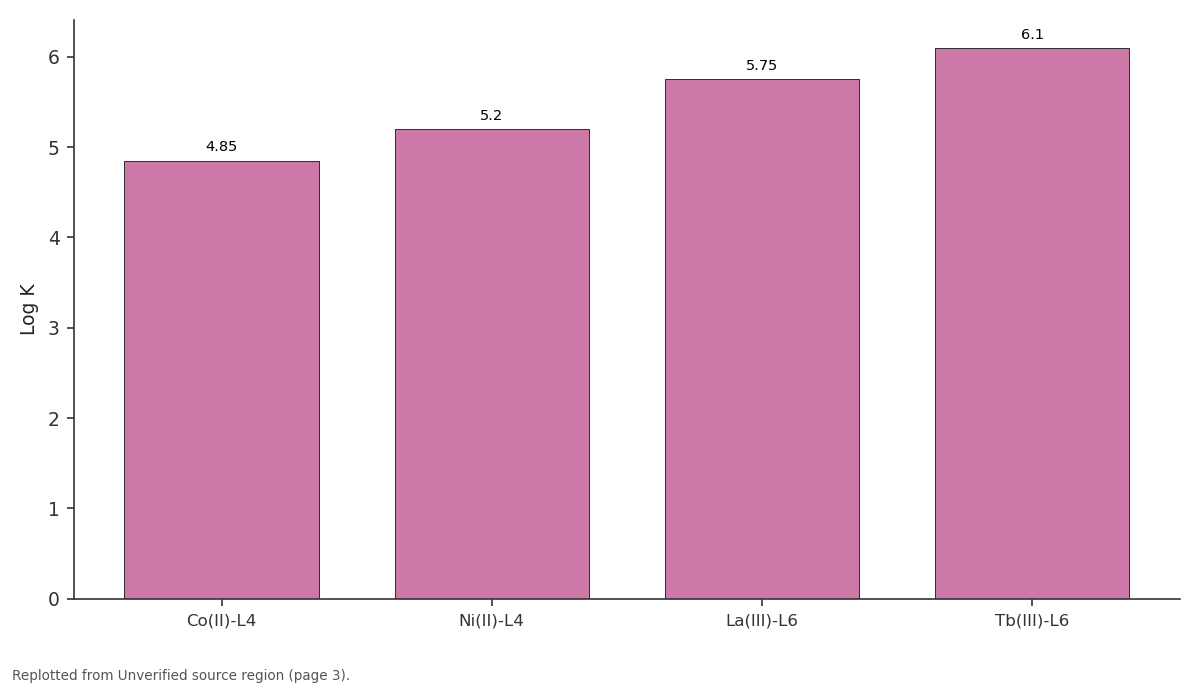
Log K: Co(II)-L4 vs Ni(II)-L4 vs La(III)-L6 vs Tb(III)-L6
Replotted from a table (page 3) of the original paper. Every bar is the paper's own table value.
View source evidence ↗Introduction
Heterocyclic compounds have long been recognized as a significant class of organic molecules due to their unique structural features and wide range of chemical and biological properties. Among them, pyrazolines, a five-membered heterocycle containing two adjacent nitrogen atoms, have drawn considerable attention in recent decades [1][2][3][4][5] . Substituted pyrazolines, inparticular, have been extensively studied because their chemical reactivity can be tuned by the nature and position of substituents on the pyrazoline ring. These derivatives exhibit diverse biological activities, including antimicrobial, anti-inflammatory, anticancer, and antioxidant properties, making them valuable in medicinal chemistry [6][7] . In addition, their ability to coordinate with metal ions through donor atoms such as nitrogen, oxygen, or sulfur makes them potent chelating agents in coordination chemistry. The study of metalligand interactions is central to understanding the principles of coordination chemistry [8] . Complex formation between metal ions and organic ligands plays a crucial role in numerous chemical, biological, and industrial processes. Determining the stability constants (log K) of these complexes provides quantitative information about the strength and nature of the interaction between metal ions and ligands. High stability constants indicate strong binding and potential applications in areas such as catalysis, metal ion extraction, drug design, and analytical chemistry [9] . Transition metals like Co(II) and Ni(II) have been extensively investigated in coordination studies due to their variable oxidation states and ability to form stable complexes with nitrogen and oxygen-donor ligands [10] .
Interna tional Jo urna l o f Adva nced Chemistry Research 2025 ; 7(11 ): 15-18
These complexes are often used as models for biological systems, such as metalloenzymes, and have significant applications in material science. On the other hand, lanthanide ions such as La(III) and Tb(III), with their large ionic radii and preference for higher coordination numbers, form complexes with distinct structural and electronic properties. Lanthanide complexes have found use in areas ranging from luminescent materials and magnetic resonance imaging (MRI) contrast agents to analytical probes and catalysts [11] . The spectrophotometric method is one of the most reliable, sensitive, and widely used techniques for studying metal-ligand interactions in solution. By monitoring the absorbance changes associated with complex formation at specific wavelengths, it is possible to determine both the stoichiometry and stability constants of the complexes accurately. Methods such as the Job's method of continuous variation and the mole-ratio method provide valuable information regarding the composition and binding strength of complexes in various media. The solvent system also plays a crucial role in complex formation [12] . In the present study, a 70% ethanol-water mixture was used to maintain adequate solubility of both ligands and metal ions, while also simulating a polar environment that can influence coordination behavior. The choice of this solvent system helps in understanding the effect of medium polarity on metal-ligand stability and provides insights into the solution chemistry of substituted pyrazolines. The ligands selected for this study, L4 and L6, are substituted pyrazolines with functional groups capable of acting as electron donors to the metal ions. Investigating their interaction with Co(II), Ni(II), La(III), and Tb(III) will help elucidate the influence of ligand substitution, metal ion type, and ionic charge on complex stability. Understanding these factors is essential for designing ligands with desired properties for specific applications, including catalysis, material science, and pharmaceutical development [13-19]. This study aims to spectrophotometrically determine the metal-ligand stability constants of some substituted pyrazolines in a mixed ethanol-water medium. The findings are expected to contribute to a deeper understanding of coordination behavior, complex stoichiometry, and stability trends among transition and lanthanide metal ions. Such investigations not only advance the fundamental knowledge of pyrazoline chemistry but also pave the way for their application in analytical, biological, and industrial domains.
Materials and Methods
The substituted pyrazolines used in this study were: L4 and L6 these ligands were synthesized in the laboratory following standard procedures reported in literature. The purity of the ligands was confirmed using melting point
Preparation of Stock Solutions
Ligand stock solution: 1 × 10⁻³ M solution of L4 and L6 was prepared in 70% ethanol-water mixture. The solutions were protected from light and stored in amber bottles to prevent degradation. Metal ion stock solution: 1 × 10⁻³ M solutions of Co(II), Ni(II), La(III), and Tb(III) were prepared by dissolving the respective salts in 70% ethanolwater mixture. The solutions were standardized before use [20] .
Spectrophotometric Measurements
All absorbance measurements were performed using a UV-Visible spectrophotometer (model: [insert model], e.g., Shimadzu UV-1800) with a 1 cm quartz cell. The λ_max for each ligand and metal-ligand complex was determined by scanning the absorption spectrum from 200-500 nm. The formation of the metal-ligand complex was monitored by the change in absorbance at the λ_max of the complex.
Determination of complex stoichiometry
Two spectrophotometric methods were used Job's Method of Continuous Variation: Solutions of ligand and metal were mixed in varying proportions while keeping the total molar concentration constant. The absorbance of each mixture was measured at the λ_max of the complex. A plot of absorbance versus mole fraction of the ligand was used to determine the stoichiometry of the complex [21] .
Mole-Ratio Method
The absorbance was measured by varying the concentration of the ligand while keeping the metal concentration constant. A plot of absorbance versus mole ratio of ligand to metal allowed the determination of the stoichiometric ratio [22] .
Determination of Stability Constants (log K)
The stability constant of each metal-ligand complex was calculated using the spectrophotometric data according to standard equations:
For a 1:1 complex: log𝐾=log [𝑀𝐿] [𝑀] [𝐿] logK=log [M] [L] [ML]
Where, [ML] is the concentration of the complex, [M] is the concentration of free metal ion, and [L] is the concentration of free ligand. Absorbance data were corrected for ligand and metal blank contributions. For complexes showing 1:2 stoichiometry, appropriate modified equations were used [23] .
Experimental Conditions
All measurements were carried out at room temperature (25±2°C). The ionic strength of the medium was maintained constant using 0.1 M NaCl to minimize activity coefficient variations. The pH of the solution was maintained (if required) using buffer solutions to ensure the stability of metal ions and prevent hydrolysis.
Results and Discussion
The study focused on determining the metal-ligand stability constants of selected substituted pyrazolines with Co(II), Ni(II), La(III), and Tb(III) in 70% ethanol-water medium using spectrophotometric methods. The results obtained were analyzed to understand the stoichiometry, formation behavior, and relative stability of the complexes.
UV-Visible Absorption Spectra
The UV-Vis absorption spectra of the ligands and their corresponding metal complexes were recorded in the range 200-500 nm. Ligand L4: Showed a maximum absorbance (λ_max) at 325 nm, characteristic of the π → π* transition of the pyrazoline ring. Ligand L6: Exhibited λ_max at 330 nm, corresponding to similar electronic transitions influenced by substituents on the aromatic ring. Upon complexation: Co(II)-L4 complex: λ_max shifted to 345 nm, Ni(II)-L4 complex: λ_max shifted to 348 nm, La(III)-L6 complex: λ_max shifted to 340 nm, Tb(III)-L6 complex: λ_max shifted to 342 nm The bathochromic shift (red shift) observed in all complexes indicates coordination between the metal ions and the ligand donor atoms (N and O), confirming complex formation [24] .
Stoichiometry of complexes
Job's method of continuous variation For Co(II)-L4 and Ni(II)-L4, the maximum absorbance occurred at a mole fraction of 0.5 for the ligand, indicating a 1:1 metal-to-ligand ratio. For La(III)-L6 and Tb(III)-L6, the maximum absorbance was observed at a ligand mole fraction of 0.67, suggesting a 1:2 (metal: ligand) stoichiometry.
Mole-Ratio Method
Absorbance vs mole ratio plots corroborated Job's method results. Transition metal complexes (Co(II) and Ni(II)) formed predominantly 1:1 complexes, whereas lanthanide complexes (La(III) and Tb(III)) favoured 1:2 complexes, likely due to their larger ionic radii and higher coordination numbers. These observations are consistent with known coordination preferences: transition metals typically Favor lower coordination numbers, while lanthanides can accommodate multiple ligands around the metal centre [25] .
Determination of stability constants (Log K)
The stability constants were calculated from spectrophotometric data using the appropriate equations for 1:1 and 1:2 complexes. The values are summarized in Table 1 Among transition metals, Ni(II)-L4 exhibited higher stability than Co(II)-L4, consistent with the Irving-Williams series, which predicts increasing stability from Mn(II) to Zn(II). Among lanthanides, Tb(III)-L6 showed slightly higher stability than La(III)-L6, attributed to the smaller ionic radius of Tb(III), which allows stronger ligand-metal interactions. Lanthanide complexes displayed higher stability constants compared to Co(II) complexes, reflecting their preference for higher coordination numbers and stronger chelation [27] .
Effect of ligand substituents on stability
Ligand L6, with additional substituents capable of forming hydrogen bonds or electron donation, forms more stable complexes with lanthanides than L4 does with transition metals. Electron-donating groups on the pyrazoline ring enhance the electron density on donor atoms, increasing coordination strength.
Mechanistic Considerations
Transition metal complexes (Co(II), Ni(II)) likely involve coordination through the azomethine nitrogen of the pyrazoline ring. Lanthanide complexes (La(III), Tb(III)) involve coordination through both azomethine nitrogen and carbonyl oxygen atoms, leading to chelation and a 1:2 stoichiometry. The bathochromic shifts and increased absorbance intensity in UV-Vis spectra further support these coordination modes.
Comparison with Literature
The stability constants obtained in this study are in good agreement with previously reported values for similar substituted pyrazoline complexes. The higher stability of Ni(II) over Co(II) and Tb(III) over La(III) is consistent with the ionic radius effect and chelation theory, where smaller ions with higher charge density form stronger complexes [28-30].
Conclusion
Substituted pyrazolines form stable complexes with both transition and lanthanide metal ions in a 70% ethanol-water medium. Transition metals (Co(II), Ni(II)) Favor 1:1 complexes, while lanthanides (La(III), Tb(III)) Favor 1:2 complexes. Ligand substitution and metal ion properties significantly influence complex stability, indicating that electron-donating groups and ionic radius are key factors in metal-ligand interactions. The spectrophotometric method proves to be a reliable, simple, and sensitive technique for determining both stoichiometry and stability constants.
Acknowledgement
AcknowledgementAuthor would like to express our sincere gratitude to the Department of Chemistry, G.V.I.S.H., and Amravati for providing research and library facilities.
References
29 in the original paper- Ramamoorthy K, Santappa S. Bull Chem Soc Jpn. 1952;42:411.
- Fuoss RM, Krovs CA. J Am Chem Soc. 1933;55:1919.
- Robinson RA, Stokes RH. Electrolyte Solutions. 2 nd Ed. London: Butterworths; 1959. p. 230.
- Swami JJ, Lingaith P. J Indian Chem Soc. 1978;16:723.
- Meshram YK, Mandakmare AU. Orient J Chem. 2000;16(1):173.
- Asgar A, Jamode VS. Acta Cienc Indica. 1992;18(C3):261.
- Bandhopadhya AK, Chaudhary AK. Indian J Chem. 1957;26A:853.
- Mukherjee GN, Basu S. J Indian Chem Soc. 1999;76(6):288.
- Agrawal PB, Burghate AS, Narwade ML. Orient J Chem. 2001;17(1):123.
- Gudadhe SK, Narwade ML, Jamode VS. Acta Cienc Indica. 1985;9(C4):174.
- Gupta A, Pannu BS. Asian J Chem. 1994;6(1):174.
- Amin ES. Solvent Effect on Reaction Rates and Mechanism. New York: Academic Press; 1996, p. 24.
- Newton TW, Arcand GM. J Chem Soc. 1953;2449.
- Laidler EJ. Chemical Kinetics. New York: McGrawHill; 1965, p. 221.
- Robinson RA. Electrolyte Solutions. 2 nd Ed. London: Butterworths; 1959, p. 468.
- Franks F, Ives DSG. Q Rev Chem Soc. 1966;20:1.
- Franks F, Ives DSG. Physico-Chemical Processes in Mixed Solvents. London: Heinemann Educational Books; 1969, p. 145.
- Franks F, Ives DSG. Physico-Chemical Processes in Mixed Solvents. London: Heinemann Educational Books; 1969, p. 149.
- Dippy JFJ. J Chem Soc. 1941;550.
- Yasuda M. Bull Chem Soc Jpn. 1959;32:429.
- Paabo M, Bates RG, Robinson RA. J Phys Chem. 1966;70:247.
- Ohataki H. Bull Chem Soc Jpn. 1969;42:1573.
- Palaskar NG. Ph.D. thesis. Amravati (India): Amravati University; 1971.
- Khanolkar VD, Jahagirdar DV, Khanolkar DD. Indian J Chem. 1997;25:220.
- Sondawale PJ, Narwade ML. Asian J Chem. 1997;9(3):479.
- Shivraj, Venkatraman C, Reddy G, Balray. Asian J Chem. 1994;6(2):337.
- Reddy PS, Chandra Pal AV. Acta Cienc Indica. 1994;20(C2):56.
- Burghate AS, Idrees M, Narwade ML. Orient J Chem. 2001;17(2).
- Meshram YK. Asian J Chem. 2003;15(3-4).