
Research article · 2025 · Full text
International Journal of Geography Geology and EnvironmentPurpose of waste in recycling: A Kantian approach to environmentalism
Volume 7(11) · Pages 18–23 · DOI: 10.22271/27067483.2025.v7.i11a.440 ↗
Research areasEnvironmental Philosophy and EthicsPhilosophical Ethics and TheoryPhenomenology and Existential Philosophy
Abstract
Author-writtenThis paper is an attempt at understanding recycling as an effect of waste within the philosophical confines of being a solution to waste handling. Waste finds its purpose or usage in recycling, wherein, lies its significance. The significance finds close affinity to the concept of purpose with its obvious meaning being the psychological sense and the course of action behind the execution of recycling. The paper reflects on the concept of desire being the primary motivating factor behind an efficient human action such as recycling. This notion is strengthened in the paper by Kant’s morality. The paper ends by establishing the claims of feelings of pleasure and aversion behind the commitment to recycling which finds close relevance in Kant’s aesthetics.
Summary
Source-checkedPlain-language reading of the full paper, prepared with AI and checked against the text. Each point links to the authors' own words.
Why it matters
- Recycling is presented as the primary method through which waste finds significance and purpose. View evidence ↗
- Recycling serves as a potential ethical solution to waste management when performed as a moral human action. View evidence ↗
- The faculty of desire is identified as the primary motivation for humans to perform actions efficiently. View evidence ↗
The question
- The paper aims to understand recycling as a solution to waste handling within a philosophical framework. View evidence ↗
What they did
- The author uses Kantian morality and aesthetics to analyze the motivations behind recycling. View evidence ↗
What they found
- The author argues that inclinations, rather than a strict sense of duty, are more effective at motivating diligent commitment to waste management. View evidence ↗
- The author posits that viewing waste management through an aesthetic lens provides a superior ethical solution. View evidence ↗
- Recycling is characterized as an act of beauty because it is driven by a mental image of the final recycled product. View evidence ↗
- Beauty serves as a universal motivating factor that transforms the act of recycling into a moral deed. View evidence ↗
- The immediate psychological effect of beauty encourages the prompt execution of recycling actions. View evidence ↗
- Establishing goodwill as the source of value makes waste handling an inherently good activity. View evidence ↗
What it means
- The author recommends adopting a maxim of having goodwill and disinterested delight in the act of recycling. View evidence ↗
- The author proposes a new '3R' framework for environmentalism: reflect, reconsider, and recreate. View evidence ↗
- The author acknowledges that this aesthetic ethic is not highly pragmatic because it relies on idealistic norms of beauty. View evidence ↗
Visual summary
1 visualsIllustrations explain the paper; they do not show study data.
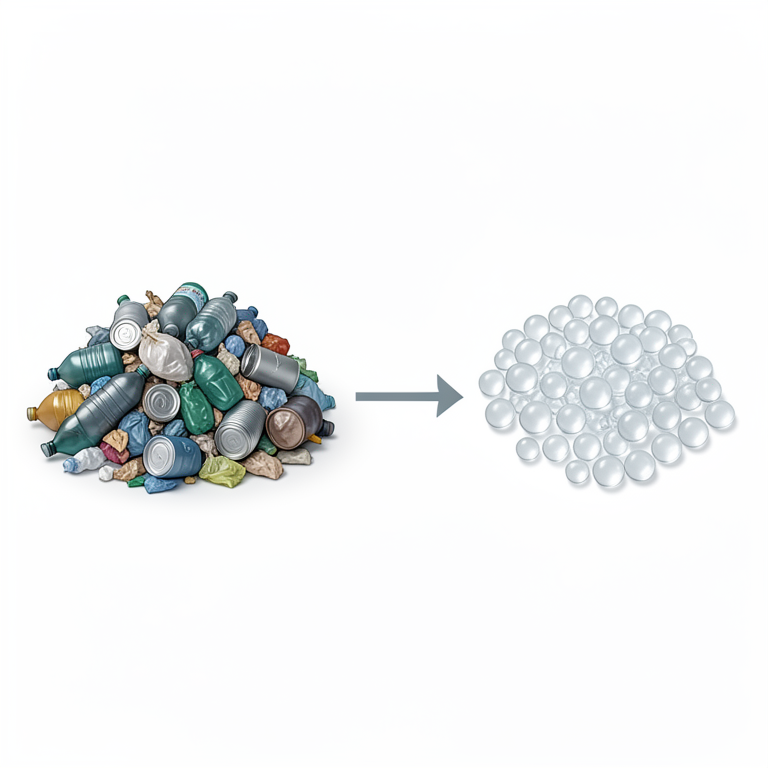
Study overview
AI-generated conceptual illustration (mixed household waste and recycled plastic pellets). It explains the idea and does not show study data.
View source evidence ↗Introduction
The significance of an entity can be determined through its use. Waste, when seen through the prism of significance, reveals its purpose or use via recycling. According to R. Latta, in "Purpose", "the most immediately obvious meaning of purpose is its psychological sense", and, "purpose is a possible course of action, conceived and adopted for execution, but not yet executed" [1] . From the "Explicit Definitions and Ethical Rules" by C.D. McGee, waste can be philosophically defined as "an entity having a certain eternal truth about it which requires for its ethical disposal through human's moral conduct". Thus, a potential solution to the problem of waste handling ethically, becomes, recycling by integrating the concepts of purpose and waste. Recycling, is a course of action with some latent ability, though a psychological one, which becomes a solution to the problem of waste management when executed as a moral human action. In order to make the action, mentioned above, materially right through human action, the faculty of desire must be analysed which becomes the primary motive behind a human action performed efficiently. Mary Gregor, in Kant-The Metaphysics of Morals, says that the faculty of desire is the cause of the objects of one's representations-which is called life [2] . Susceptibility to pleasure or displeasure is a feeling which is connected to desire or aversion. Recycling, as a solution to the problem of waste can be done out of the desire of pleasure (beauty) or aversion of waste. This pleasure or aversion can be the cause of recycling or the effect of waste. Thus, there is a relation between feeling and action, wherein, the feeling becomes the motivation behind the committed action. In this paper, it will be established that the feeling inside a human regarding an environmental action is the Kantian aesthetics at play.
Kant's sense of morality
Kant's morality can be understood from the Groundwork of the Metaphysic of Morals. He begins the discussion by the concept of good will. Analysing the different aspects of moral law as given by Kant, one goes onto the concepts like freedom and autonomy. The translation by H.J Paton is used here for the work of the Groundwork of the metaphysic of morals. The following points are highlighted for understanding where waste and recycling fit in the picture of morality as given by Kant:
1. Good Will According to Kant, as per the translation by H.J. Paton, anything without qualification is unlikely to be conceived as good except for a good will [3] . The different talents of mind are intelligence, wit, judgement etc. which are desirable qualities of temperament, yet, they can be hurtful when the will behind them is not good. Good-will is, therefore, necessary to be the motivating factor behind an act. This good-will seems to lie somewhere past the feelings and affections. Acts done out of feelings/emotions might be out of inclination aimed towards the benefits of action's consequences and not out of the pure will behind it. Good will, in other words, is good in itself. Therefore, the good will behind the treatment of waste has to come to a person to be able to make him motivated to do actions of environmental concerns. Kant proposes a critique of reason concerning good will in order to have a will not directed at happiness but at the deed of the cause at hand. Paton also states that the more a reason is cultivated, the farther does man get away from contentment. So, in a way Kant does not do away with the feelings behind an act. The inclinations might not be revered as a moral law but they are the second most favoured motivating factor after a good-will which depends upon moral law. Thus, the feeling which originates upon the perception of waste becomes vital in how the agent would handle it. Good will emanating from duty is an action done for the sake of 'being done', which is different from an action done out of love, kindness, or, one's happiness. Duty for duty's sake entails absence of inclinations. But for the waste to be treated, one has to focus upon the driving force of the duty which is inclination more often than simple duty. For duty to fully function, a moral law must be abided by the agents to which they offer reverence. For our present purpose, 'waste to be treated by all means in an environmentally friendly way of recycling' can be said to be a moral law to be followed by agents of morality.
Source of moral worth
A significant aspect of scrutiny is the source of moral law, since it is the source which determines how powerful a will is in the execution of an action. For the purpose of waste management, it is necessary to ascertain the source of moral law in order to conduct ethical actions accordingly. Kant says that-'a man shows moral worth if he does good, not from inclination, but from duty' [4] . Kant would suggest cultivation of inclination and desires to conform them to duty. But for the present purpose of waste management, Kant's first choice of doing an action out-of-duty does not collaborate with the first choice of having happiness. Therefore, it is the secondary option of inclinations of conduct that make waste management aesthetically possible and ethically viable. Contrary to Kant's notion of duty being the prime factor behind motivation, it is worth noting that inclinations play a better role at committing to an action with full diligence.
The process of waste management is not such which can be maintained effectively out of duty because people have been under the influence of duty, and yet, somehow the scenario of waste all around us is prevalent. Some might contend that an action will, then, lack the discipline to be followed under a moral law if not done out of duty. It is worth mentioning here that environmental actions done under the influence of inclination might not be disciplined but they will be more efficient and nearer to perfection. Waste management has to be seen aesthetically and not ethically to have a better ethical solution to it. Thus, it has to be done out of volition and not a only sense of purpose assigned to the act of waste management.
Reverence for law
To have a moral law abided by all ethical agents, Kant, suggests that a principle of morality is required first to which agents can grant a reverence. This reverence becomes crucial for better adherence to the law. According to Kant, the basis for obligation towards a moral law lies not in man, not in nature but is a priori [5] . If the issue of waste management is taken then the law to 'deal with waste ethically through recycling' becomes a law to be followed. In a community where cleanliness has to be maintained, a strong will to adhere to a good law becomes very important. Without reverence, the law might fall back to the arena of inclinations. When inclinations come to the picture, then a new law needs to be made regarding 'the beauty behind recycling' which can lead people to adhere to that law. Therefore, this two-step process of law-making is something which needs to be focussed upon before coming up with laws either via reverence or via inclinations.
Moral law vs practical rules
Moral laws are determined by imperatives and commands in Kantian philosophy. This is different from practical rulemaking in the sense that practical rules are not so strict to be followed, unlike imperatives which are to be followed as duty. Reason is required to derive actions from rules but it is not solely sufficient to determine the will behind the action. 6 Also, imperatives come with 'shall' or 'ought' and such directness is lacking in practical rules. It is much easier to come up with practical rules for the present purpose of waste management than coming up with a maxim to follow for the moral agents of a community. For practical purposes, a rule can simply be followed by well willed people to have a better society in terms of cleanliness and environmental well-being by efficient waste handling.
Autonomy of the Will and Freedom
Kant talks about the autonomy of the will in the sense that a principle, of humanity, and in general, of every rational agent, as an end itself is not borrowed from experience as it is universal and no experience is adequate to determine universality [7] . In that effect, even a law pertaining to waste management can be said to be a principle of humanity and it needs to be followed universally as an autonomous will of a moral agent in a community. The autonomy of the will is, thus, a property the will has of being a law to itself thereby making the practical rules as imperatives. For example, a rule to cleanliness becomes an imperative if it is willed to be a law to itself. 'Being a law to itself' makes sure that the rule is not dependent upon mere experience but rather is dependent upon its existence which makes it a universal property. According to Kant, the will is a kind of causality belonging to living beings so far as they are rational in capacity. Thus, freedom becomes a property of this causality of being able to work independently of alien causes [8] . In the parlance of waste management too, freedom plays an important role in determining the autonomy of the will of a moral agent to act responsibly and ethically towards the environment. The relation of the will and freedom is direct, and, if the second priority given to instincts is taken into account in determining the action of ethical importance, then, this will out-of-instincts might prove to be of lesser value than the will out of duty according to Kant. Such a dichotomy of wills should rarely affect the final result of waste management to be done by a moral agent even when the will out-of-duty may be more impactful for recycling.
Kantian perspective in recycling Recycling as an act of beauty
In his Critique of Judgment, Kant has divided Philosophy into two parts, namely, Natural Philosophy which consists of the theoretical part of principles, and, Moral Philosophy, which consists of the practical part [9] . He laid Judgment somewhere in between Understanding and Reason as a faculty of pleasure and pain, lying between the faculties of knowledge and desire [10] . As pleasure or pain is necessarily combined with the faculty of desire, all that can be said of the special principles of Judgment must be counted belonging to the theoretical part i.e. to rational cognition in accordance with natural concepts [11] . Kant defines Judgment as the faculty of thinking the particular as contained under the Universal. As per the criteria mentioned above of Judgment, one can think of recycling as a thing of nature falling under the Universal waste as a particular concept of a refined waste material. Recycling, therefore, lies between knowledge and desire. Kant further says in his Critique of Judgment that to decide if anything is beautiful or not, it is to be done by Imagination and the object's imposed-feeling of pleasure or pain. The judgment of taste (beauty) is not a judgment of cognition but it is aesthetical and its determining is subjective [12] . As per this understanding, recycling being a judgment which lies between knowledge and desire is also a thing of taste which makes it aesthetical because it is done with a view in mind of how a waste item must appear after recycling. That image in mind towards which recycling tends to, makes it an act of taste i.e. beauty. As per Kant, the satisfaction which determines the Judgment of taste is disinterested [13] . Interest is nothing but the gratification achieved by the representation of the existence of a thing. When the question is whether a thing is beautiful, we do not want to know whether anything depends or can depend on the existence of the thing either for oneself or anyone else, but we do want to know how we judge the existence of the thing by mere observation (intuition or reflection) [14] . For recycling to be an act of beauty, it is neither supposed to be an act of pleasure nor of goodness because both will require recycling to be done for some purpose. In order for recycling to be a thing of beauty, it is necessary that it is done for the sake of itself. But practically speaking, recycling cannot be done without thinking of the next step to achieve in waste management. Therefore, what we need is a new kind of ethic which combines the ideas of goodness (which makes waste morally viable) and disinterestedness in one and the same act of recycling.
Beauty as concept for Ethics
For a concept to make a mark in ethics, it needs to be accepted by a set of social elements such as a community of moral agents. Or, there needs to be a sense of universality attached to the concept. In other words, from a Kantian perspective, can beauty be universal? For a concept to be universal, first, it needs to be 'free'. Free from further concepts. Now, Kant talks about three kinds of satisfaction with respect to the Pleasant, the Beautiful and the Good [15] . "That which gratifies man is called pleasant; that which merely pleases him is beautiful; that which is esteemed by him, is good" [16] . Out of all the three kinds of satisfaction, that of taste in the Beautiful is alone a disinterested and free satisfaction. The three aforesaid cases can be linked to inclination, to favour, or to respect. Kant has only called favour to be the free satisfaction. Interest presupposes or generates a want and the disinterestedness in beauty leaves its judgment free and such a judgment can be universal and, thereby, ethical (aesthetical) [17] . The Beautiful cannot entirely be universal because, as per Kant, this universality is of particular kind. He states, "the judgment of taste, accompanied with the consciousness of separation from all interest, must claim validity for everyone, without this universality depending on Objects. That is, there must be bound up with it a title to subjective universality." [18] . Thus, the aesthetical universality is of a particular kind as it does not unite the predicate of beauty with the concept of the Object. To answer the question mentioned above, beauty may be universal but only in a particular way which makes recycling an act of beauty done bereft of the purpose of waste. Thus, we do not attach the predicate of beauty to waste. However it is the object, waste, which is put to some purpose, keeping recycling in the domain of beautiful and waste in the domain of particular instance of recycling (subjective universality).
Beauty as the motivation behind morality
For Kant, "Beauty is the symbol of the morally Good." 19 Pleasure makes a claim for the good in this respect. Whatever is pleasurable in respect to the morally good becomes universally accepted to Kant. Recycling, therefore, when seen as an act of goodness becomes pleasurable to do not by a single member of a community but by everyone i.e. universally. Beauty, therefore, becomes a motivating factor behind the deed of recycling which is a moral act.
When an act is to be considered moral, not only the will of the people committing the act but also their freedom comes into question. But the most important factor which remains in considering an act duly committed is the motivation behind it which comes not from the will or freedom but from the aspect of beauty of the act done. If an act produces beautiful outcome, then, there is a universal acceptance in the commitment to that act because, firstly, it becomes an act done out of a consequence in mind which makes the act deliberate and well-thought, secondly, it becomes an act socially motivated because beauty is a universal concept as per Kant, and, lastly, it becomes an act of repetition again and again for the simple reason of the motivation being beauty behind the act which makes it worth revisiting to. The relation between beauty and recycling is analogical in the sense that just like there is beauty in art from a universal perspective, similarly, there is a beauty in the act of recycling done by agents as a deed of art. A contradiction arises here as art is not always supposed to be useful, but, recycling, is mostly done with the end in minds. As a reply to this contradiction, it can be said that recycling done as art is the solution to the problem of waste but the motivation behind it, comes purely from ethical perspectives of environmental benefits which makes the uses of recycling an inherent consideration of the whole act of it.
Value in waste and environment
Value is worth observing in entities because it adds meaning to our activities in relation to the entities. Value can be seen in various ways such as the 'usefulness' of the entities or the 'function' of the entities. Such defining elements of value prove to be commercial in nature. Therefore, to reach more philosophical accounts of value, one must ponder deeper into the concept like 'purpose' which can add meaning to the debate of value with respect to waste and environment. Locating value in the waste and environment around us has the direct benefit of having defined a motivation to act towards the solution of the problems of waste and environment. Humans by means of their self-interested nature are more prone to doing good for the society and locating value adds to their incentives to work for the good. Hence, there is the need to focus on value of waste and environment.
Value and purpose
One of the first observations in determining 'purpose' is 'its psychological sense' [20] . It is like 'a project which is adopted for execution, but not yet executed.' [21] This makes the whole idea behind determining a purpose for a thing 'a hidden quality of the object'. It is further worth mentioning that Latta has called it an 'unrealised end' [22] . Since, purpose is related to an unrealised end, that makes it dependent on objects that are not yet in one's mind. For example, waste as an entity requires to be discarded, yet, recycling becomes an act of utilising the purpose hidden somewhere in the waste. When purpose does not have to be looked at from the standpoint of recycling, it may even mean any vague form not necessarily defined in crisp terms. For instance, a waste product may have a purpose that might be something as immediate as conception of it as a thing to 20 Latta, "Purpose", p. 17. 21 Ibid., p. 17. 22 Ibid., p. 17. discard, and, its ultimate end may not be apparent, yet, it has to be called to be a thing of purpose. This brings us to the question, "Is purpose always present in an entity or is it a creative process of the mind which generates purpose?" To this question, it can be said that purpose is a creative process because it depends not only on the value of the object to determine its meaning but also on the agent who ascribes value to it from using his feelings and thought process. The problem arises when it comes to the third person to analyse an agent's feelings and thought processes regarding an entity. The way to analyse in such a scenario is to either have the same feelings and thought processes as the agent or be a spectator to her actions. This makes the whole process of finding purpose in any object a process of conduct of an activity either directly by the agent or indirectly by a spectator. Assigning purpose to waste, thus, culminates in the "tendency" or "potentiality" of activities that result from recycling of the waste.
Purpose and Beauty
When Kant talks about 'purposiveness' in general, he means to explain purpose according to its "transcendental determinations" [23] . i.e. without presupposing anything empirical like the feeling of pleasure. Purpose, then, becomes the object of a concept, where, concept is regarded as the cause of the object. Thus, "the causality of a concept in respect of its object is its purposiveness" [24] . From this arises a link between purpose and beauty. For example, a recycled entity being an object, its concept when taken to be beauty, becomes the cause of recycling. Thus, beauty becomes the cause of recycling and this causality of recycling becomes the purpose behind waste material and its disposal done aesthetically. From the previous section, it becomes clear that purpose is something which is hidden or vague and is shown after execution of an activity. This makes beauty a valid concept behind treatment given to waste for want of recycled goods. This hidden essence in waste becomes the driving force for treating it aesthetically and things done in aesthetic spirit are also motivated in the right direction. The sense of motivation can be understood by the faculty of desire as per Kant. He says that the faculty of desire would be the "Will". An action will be called purposive, as per Kant, even when its possibility does not necessarily presuppose the representation of purpose, because, its possibility can be conceived by us according to a will. Thus, purposiveness can be noticed in objects by reflection (ex. By imagination or thinking). Kant, further mentions, that a purpose carries with itself an interest as the determining ground of the judgment, and, no subjective purpose can lie at the basis of the judgment of taste [25] . This goes with the fact that the conception of beauty with recycling becomes a universal concept as per Kant and no subjectivity lies there for changes from person to person. One needs only find an interest as the determining ground for beauty which lies in the usefulness of recycled objects. Thus, the purpose behind recycling becomes beauty as the will of the agent. It does not become apparent as it is only a faculty of desire of the agent, rather it becomes a prime motivating factor in carrying out the process of recycling upon receiving the object which could be the waste material.
Value in Beauty
The purpose of beauty defines the value that it holds. Every waste material tends to generate a recycled good and that purposiveness is evident in the psychological effect of reflecting or perceiving beauty in the final recycled good. The following three arguments make the value in beauty clearer:
The argument of immediacy
The reflection of beauty in an action or entity is a direct effect or is presented to us immediately. It is this immediacy which makes beauty a favourable outcome of the action or entity. The benefit of the immediate effect of beauty on one's psyche is that without any delay the action is performed. Humans are naturally inclined to work steadfastly with vigour when the purpose of work comes to them immediately. The concept of beauty comes naturally to people and makes them willingly take up actions towards achieving the beauty which they can reflect about upon perceiving a waste material. But the problem arises when the perception of waste material does not invoke a sense of beauty coming into fruition upon recycling. In such a scenario, humans are susceptible to discard that waste material and move on. Thus, humans act for betterment of environment as far as the concept of beauty is associated with recycling. Anything which accompanies the feeling of aversion makes them not commit to the action of recycling. Therefore, it becomes utmost important for moral agents to perceive waste as a probable item of beauty and willingly work upon further recycling measures.
The argument of motivation
The value in beauty also amounts to the motivation it instils in a moral agent to work towards fulfilling the purpose behind waste material which is recycling. Recycling done simply for the sake of recycling might be an action out of duty. Such actions will lack the natural will to do the best because there will be a notion of reluctance added to the action. To have moral agents who can perform tasks diligently and with pure will, beauty becomes an important criterion to keep in mind. Thus, motivation becomes the factor attached to beauty which makes it a valuable pursuit by moral agents. A problem, here, arises pertaining to the case wherein a waste material does not invoke a feeling of motivation. In such a case, it becomes the duty of the moral agent to see the beauty in the probable recycled product. Duty, thus, becomes a notion for the unknown probability of the beauty in recycled good not necessarily for the action of recycling. This makes the moral agent stay committed to the act of recycling not out of duty but out of the will. Duty takes care of the determination of beauty, not in the action or process of recycling, but, in the final finished recycled good.
The argument of goodness
The value in beauty lies in the goodness behind beauty as humans have a naturalistic tendency to conform to goodoriented activities. Beauty pertains to goodness in the sense that the ill-effects of beauty are nil and the feel-good effect of beauty is taken to be good by humans. So as far as goodness can be seen in beauty behind the recycled waste material, the motivation will also be intact in a moral agent to act for the cause of recycling. One problem arises when humans cannot see goodness behind beauty attached to recycling due to hard-work and other such difficulties associated with it. In such a case, a change of perspective is needed to create more flexible psyche in humans and see the positivity behind hard-work etc. Such changes of perspectives are a solution to the problem of waste and require extensive awareness programmes to evolve human psyche from attaching disgust towards waste to attaching beauty and thereby, goodness, to it.
Value in waste
The value in waste is stagnant just like purpose is dormant of an entity and it depends upon our intellectual prowess to unlock the possibilities assigned to that entity viz. waste. The value of waste lies in the activity of recycling. Recycling is the possibility which is generated from the waste. The source of value always lies in the unknowns of the mind. Mind construes meaning of objects wherein lies the value of them. Similarly, waste becomes an object of meaning when its value is imagined in the process of recycling or the final recycled object produced. In other words, value might not always be tangible or evident in an object such as waste material. It depends upon the human psyche to find the value in it. If one has to disregard waste as having value then it is to disregard the power of the human mind. Therefore, it becomes necessary to assign value to waste for the betterment of environment in particular.
Value in environment
The value in environment is of the same category as that of any other entity. Its hidden, is tending towards something and is contained in an end. The value in environment is judged by what is hidden in it such as beauty or what it is tending towards such as a tree tending towards being made into a wooden table and as an end in some final product such as paper which also comes from the tree or nature. The functions of environment also make it known about the values that it holds. Therefore, value is not always evident, sometimes it has to be searched for.
Value Theory
A rationalist account of value theory inspired by Kant is given by Korsgaard in "Aristotle and Kant on the source of Value", Ethics, which is as follows: "an object or state of affairs is good if there is a sufficient practical reason for realising it or bringing it about" [26] . There must, then, be a test for determining whether there is sufficiency for the practical reason. Since not every reason will turn out to be a sufficient and a practical one, so, not every interest or pleasure will establish the goodness of its object. We sometimes fail to be motivated by reasons that are available to us and so do not want what is good. We sometimes are motivated by insufficient reasons and so want what is not good. For the rationalist view what is required is some sort of test of the adequecy of the reasons for the adoption of an end. It is important to emphasize that three theories are being compared with respect to their assessments of single goods, or it will be hard to see what distinguishes the rationalist view. The subjectivist may say that a given pleasure say, a malicious one, should not be brought about because of the pain that it causes to others. And an objectivist may say of some intrinsic good that it should not be realized because there are better things we can do. In these cases, both the subjectivist and the objectivist may say that there is not a sufficient reason for the existence of some prima facie good. One may think of this as a negative test of sufficiency: the fact that something is pleasant or desired or intrinsically good is a sufficient reason for it as long as there is no extrinsic reason for its existence. By contrast, the rationalist account seeks a positive test of sufficiency and seeks this even for conditional goods taken singly. The rationalist thinks that if an object of pleasure or desire is only conditionally good in the first instance, then the fact that it does not interfere with other conditional goods is not sufficient to make it absolutely good. What is unconditionally good is like what is intrinsically good in that it is objectively valuable, but there is an important difference. Moore and other proponents of intrinsic values have thought that one cannot argue for them; they must be known through intuition. But one can argue about what is unconditionally valuable. The reason that there must be something that is unconditionally valuable is that there must be a source of value. Arguments about what is unconditionally valuable can proceed in terms of questions about what is suitable to be a source of value. As per Korsgaard, goodwill is suitable to be the source of value, for Kant. As stated in the beginning of the paper, the goodwill is good in itself. Thus, fixating the of value at goodwill makes the handling of waste an activity which is good in itself and has value which emerges from the goodwill of the agent. This makes the role of goodwill in the psyche of the agent crucial. As moral agents, one must uphold the virtue of having a goodwill which will ultimately make the process of waste management a lot easier on the part of the agent because the act will be emanating from a feeling which is good in itself. Our theory of value, therefore, culminates into the goodwill of Kant for providing solutions to the problem of disgust towards waste and inaction towards the benefit of environment. By having and nurturing a goodwill, individuals can better help the environment because then the actions will be out of a sense of goodness which makes actions as well as the intended consequences to be good in themselves.
Conclusion
The Kantian aesthetics understood via beauty and value theory hints at coming up with an ethic of waste and recycling to deal with the problem of waste. For it, in Kantian terminology, focus should be on a maxim such as-"Have a good-will about purposeful disinterested delight in the act of recycling." Though such an ethic is not very pragmatic in nature as it relies on idealistic norms such as that of beauty. Therefore, its ethical viability depends upon the ethical conduct of rational agents of a community. There seems to be an indirect relation between creativity of human mind involved in recycling, and, the pragmatic approach needed for recycling. This makes the ethic free from hardbound rules leading to a newer and fresher concept of 3R's i.e. reflect, reconsider and recreate for creative recycling as a method for environmentalism.
References
13 in the original paper- Callenbach E. Values. In: Ecology: A Pocket Guide, Revised and Expanded. University of California Press; 2008.
- Davies S. Aesthetic judgements, artworks and functional beauty. The Philosophical Quarterly. 2006;56(223):224-241.
- Hagan E. Moral self-knowledge in Kantian ethics. Ethical Theory and Moral Practice. 2009;12(5):525537.
- Hale B. Moral considerability: deontological, not metaphysical. Ethics and the Environment. 2011;16(2):37-62.
- Hawkins G. The Ethics of Waste: How We Relate to Rubbish. Rowman & Littlefield Publishers; 2006.
- Kant I. Groundwork of the Metaphysics of Morals. Gregor M, editor and translator. Cambridge University Press; 2012.
- Kant I. The Critique of Judgement. Meredith JC, translator. Oxford University Press; 2007.
- Korsgaard CM. Aristotle and Kant on the source of value. Ethics. 1986;96(3):486-505.
- Latta R. Purpose. Proceedings of the Aristotelian Society. 1907-1908.
- Lopes DM. Aesthetic experts, guides to value. The Journal of Aesthetics and Art Criticism. 2015;73(3):235-246.
- McGee DC. Explicit definitions and ethical rules. Ethics. 1963;73(3):198-207.
- Paton HJ. Kant-The Moral Law: Groundwork of the Metaphysic of Morals. Routledge Classics; 2012.
- Zemach EM. Thirteen ways of looking at the ethicsaesthetics parallelism. The Journal of Aesthetics and Art Criticism. 1971;29(3):391-398.