
Research article · 2025 · Full text
International Journal of Agriculture and Food ScienceEffect of Saccharomyces Cerevisiae Supplementation on Growth Performance of Broiler Chickens
Volume 7(11) · Pages 18–21 · DOI: 10.33545/2664844x.2025.v7.i11a.936 ↗
Research areasAnimal Nutrition and PhysiologyRabbits: Nutrition, Reproduction, HealthFood Science and Nutritional Studies
Abstract
Author-writtenThe present experiment was conducted to evaluate the effect of dietary supplementation of Saccharomyces cerevisiae on the growth performance of broiler chickens. A total of 120-day-old Cobb-400 broiler chicks were randomly allotted to four dietary treatments with five replications of six birds each. The treatments consisted of T₀ (control, basal diet), T₁ (basal diet + 1% yeast), T₂ (basal diet + 1.5% yeast), and T₃ (basal diet + 2% yeast). The feeding trial lasted for 42 days under uniform managemental conditions. Results indicated that yeast supplementation significantly (P
Summary
Source-checkedPlain-language reading of the full paper, prepared with AI and checked against the text. Each point links to the authors' own words.
Why it matters
- Poultry production is a rapidly growing global sector essential for providing affordable, high-quality animal protein to a growing population. View evidence ↗
- While antibiotic growth promoters (AGPs) were traditionally used to improve broiler growth and efficiency, their use is now discouraged due to concerns over antimicrobial resistance and product residues. View evidence ↗
- Saccharomyces cerevisiae (yeast) is considered a natural alternative to antibiotics because it contains proteins, vitamins, and minerals that can improve gut health and nutrient digestibility. View evidence ↗
The question
- The study aimed to determine the optimal inclusion level of Saccharomyces cerevisiae (among 1.0%, 1.5%, and 2.0%) to maximize growth and feed efficiency in broiler chickens. View evidence ↗
What they did
- The experiment used 120 day-old Cobb-400 broiler chicks, divided into four treatment groups with five replicates of six birds per replicate. View evidence ↗
- The four dietary treatments consisted of a control (T₀) and three levels of yeast supplementation: 1.0% (T₁), 1.5% (T₂), and 2.0% (T₃). View evidence ↗
- The feeding trial was conducted over a period of 42 days. View evidence ↗
- Growth was monitored via weekly body weight and feed intake measurements, which were used to calculate the Feed Conversion Ratio (FCR). View evidence ↗
What they found
- Significant differences in body weight only emerged from the third week onwards, with the 1.5% yeast group consistently showing higher weights. View evidence ↗
What it means
- The authors conclude that 1.5% Saccharomyces cerevisiae supplementation optimizes broiler growth and feed efficiency, and they recommend this level for enhancing productivity. View evidence ↗
Visual summary
3 visualsIllustrations explain the paper; charts are replotted from the paper's own table values.
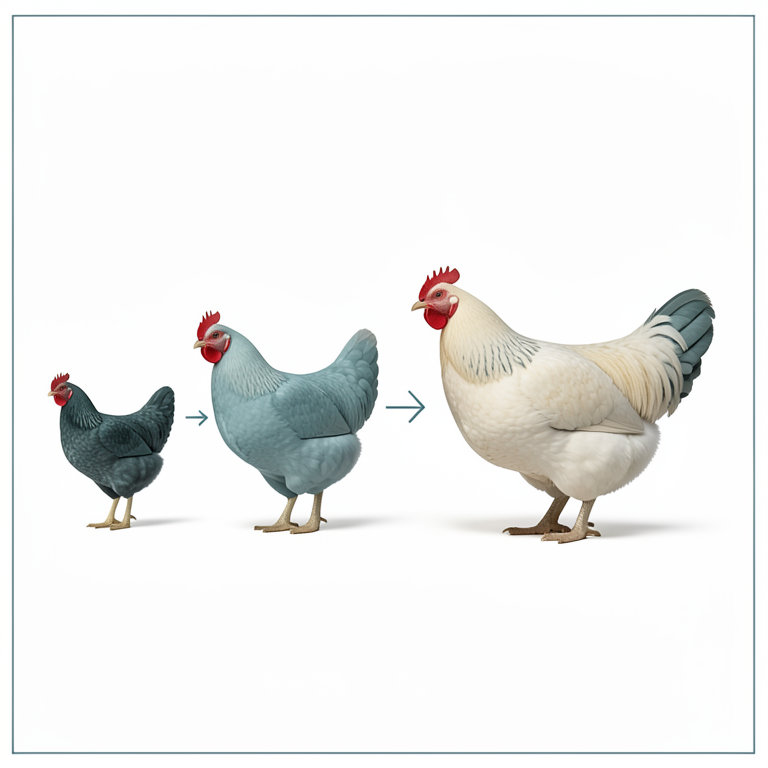
Experimental Group Layout
AI-generated conceptual illustration (broiler chickens). It explains the idea and does not show study data.
View source evidence ↗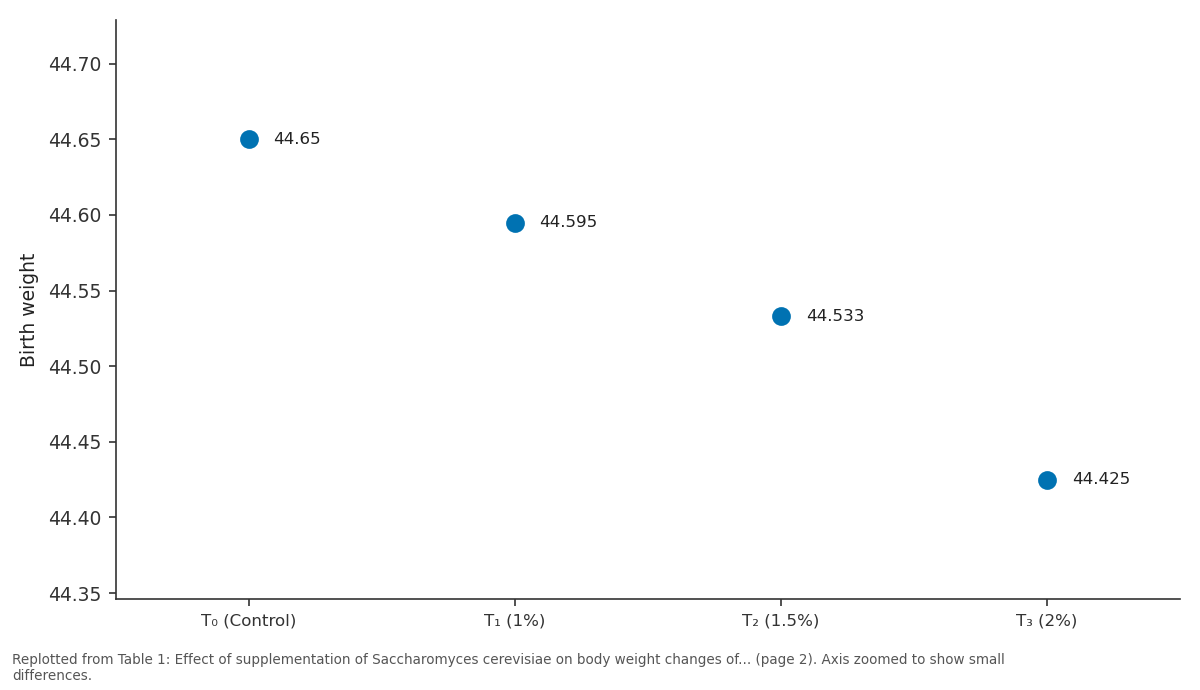
Birth weight: T₀ (Control) vs T₁ (1%) vs T₂ (1.5%) vs T₃ (2%)
Replotted from Table 1 (page 2) of the original paper. Every bar is the paper's own table value.
View source evidence ↗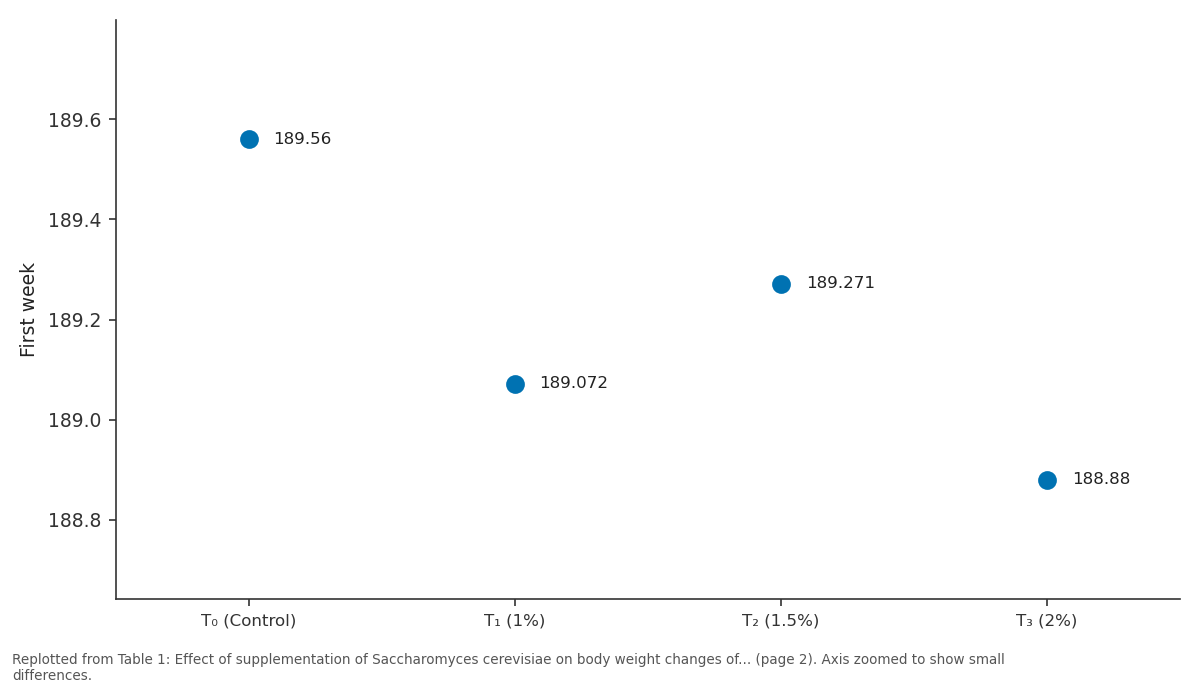
First week: T₀ (Control) vs T₁ (1%) vs T₂ (1.5%) vs T₃ (2%)
Replotted from Table 1 (page 2) of the original paper. Every bar is the paper's own table value.
View source evidence ↗Figures & tables
From the original paper Table 1
 Table 2
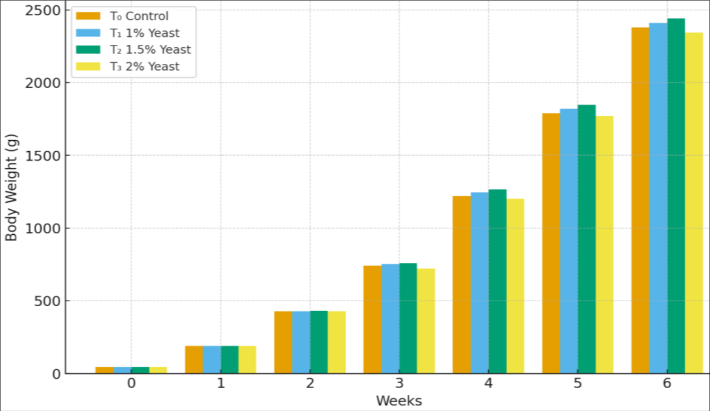 Figure 1
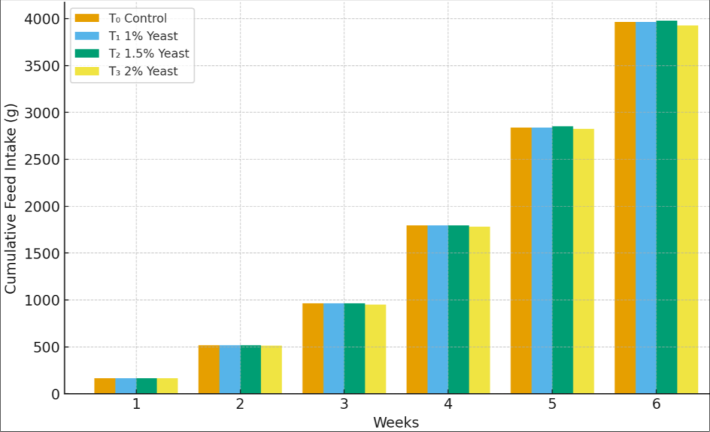 Figure 2
 Table 3
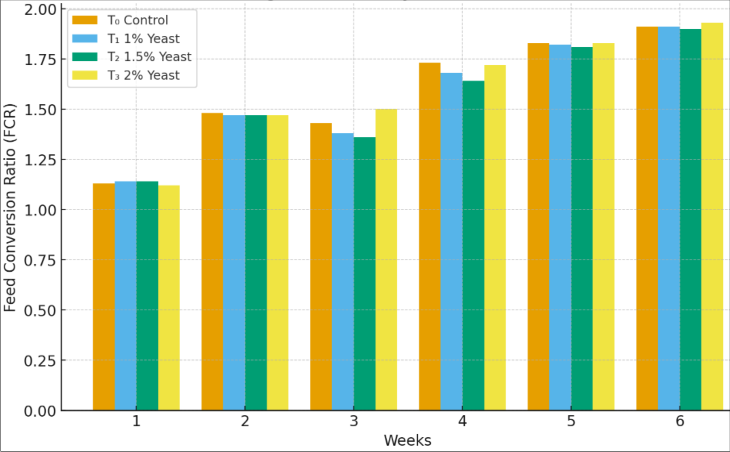 Figure 3
Introduction
Poultry production is one of the most dynamic and rapidly expanding sectors of animal agriculture worldwide, playing a pivotal role in providing affordable and high-quality animal protein to meet the nutritional demands of a growing population. Broiler meat, in particular, has emerged as a preferred source of protein because of its relatively low cost, short production cycle, and wide consumer acceptance. In developing countries like India, poultry farming also contributes significantly to rural employment, income generation, and food security. In recent decades, the poultry industry has faced increasing challenges associated with intensive production systems, including disease outbreaks, environmental stressors, and fluctuating feed costs. Traditionally, antibiotic growth promoters (AGPs) were widely incorporated into poultry diets to enhance growth rate, improve feed efficiency, and reduce disease incidence. However, the routine use of antibiotics has raised global concerns due to the emergence of antimicrobial resistance, transfer of resistant genes, and potential residues in poultry products. As a result, there is growing consumer demand and regulatory pressure to reduce or eliminate AGPs from poultry production systems. This scenario has led to the search for safe and natural alternatives that can sustain or improve broiler performance while ensuring food safety and animal welfare. Among the various alternatives explored, probiotics, prebiotics, organic acids, plant extracts, and yeast-based products have attracted considerable attention. Yeast and yeast-derived products, particularly Saccharomyces cerevisiae, have been studied extensively for their potential as natural feed additives. Yeast cells contain high-quality proteins, essential amino acids, vitamins, minerals, mannan oligosaccharides (MOS), and β-glucans, which are known to enhance nutrient digestibility, stabilize intestinal microflora, improve immune response, and promote gut health. Additionally, yeast supplementation has been associated with reduced pathogenic bacterial load, better feed conversion efficiency, and improved carcass yield. Several experimental studies have demonstrated the positive influence of S. cerevisiae on broiler growth performance. Onifade et al. (1999) [4] reported improved weight gain and feed utilization with yeast supplementation. Santin et al. (2001) [6] observed enhanced immune response and nutrient absorption in broilers fed yeast culture. [3] highlighted its role in modulating gut microbial ecology, while Paryad and Mahmoudi (2008) [5] reported significant improvement in feed efficiency and growth performance with optimal inclusion levels of yeast. Nevertheless, the reported outcomes are not always consistent, as the magnitude of response varies depending on strain, dosage, diet composition, management conditions, and bird genotype. In particular, the optimum level of supplementation that yields maximum growth and feed efficiency benefits remains to be clarified.
Considering these aspects, the present investigation was undertaken to evaluate the effect of dietary supplementation of Saccharomyces cerevisiae at three different inclusion levels (1.0%, 1.5%, and 2.0%) on the growth performance of broiler chickens under controlled experimental conditions.
Materials and Methods Experimental Site and Birds
The experiment was carried out at the Poultry Unit, Division of Animal Husbandry and Dairy Science, College of Agriculture, Dhule, Maharashtra. A total of 120-day-old Cobb-400 broiler chicks of uniform body weight were procured from a commercial hatchery. The chicks were wing-banded, weighed individually, and randomly allotted to four dietary treatments.
Experimental Design and Treatments
The trial was conducted using a completely randomized design (CRD) with four treatments and five replicates per treatment, each replicate comprising six birds.
Management Practices
All chicks were reared under deep litter housing conditions with uniform management. Standard vaccination schedules were followed. Brooding temperature, ventilation, and lighting were maintained as per recommended practices. Mortality was recorded daily, and strict hygiene was maintained during the trial period.
Data Collection
Weekly body weight was recorded on a replicate basis to monitor growth. Feed intake was measured as the difference between feed offered and feed residue at weekly intervals. Feed conversion ratio (FCR) was calculated as the ratio of feed consumed to body weight gain.
Statistical Analysis
The experimental data were subjected to one-way analysis of variance (ANOVA) as per the procedure of Snedecor and Cochran (1994). Treatment means were compared using the Critical Difference (CD) test at a 5% probability level.
Results
The growth performance of broiler chickens as influenced by dietary supplementation of Saccharomyces cerevisiae was evaluated in terms of weekly body weight changes, cumulative feed intake, and feed conversion ratio. The observations are summarized in Tables 1-3 and corresponding graphical trends are depicted in Figures 123.
Weekly body weight changes
The effect of yeast supplementation on body weight is presented in Table 1 and Figure 1. Initial body weights were comparable across treatments (44.4-44.6 g), indicating uniformity at the beginning of the trial. No significant differences were observed up to the second week. From the third week onwards, significant variation was noted, with birds in T₂ (1.5% yeast) recording consistently higher weights than the control and other supplemented groups. At the sixth week, T₂ achieved the highest body weight (2439.96 g), followed by T₁ (2410.24 g), the control (2378.85 g), and T₃ (2342.70 g). These results demonstrate that yeast supplementation at 1.5% improved growth performance in broilers.
| Weeks | T₀ (Control) | T₁ (1%) | T₂ (1.5%) | T₃ (2%) | SE of Mean | CD @ 5% |
|---|---|---|---|---|---|---|
| Birth weight | 44.650 | 44.595 | 44.533 | 44.425 | 0.39 | NS |
| First week | 189.560 | 189.072 | 189.271 | 188.880 | 0.41 | NS |
| Second week | 428.836 | 428.348 | 429.057 | 427.106 | 0.33 | 1.00 |
| Third week | 740.178 | 751.124 | 756.756 | 720.626 | 0.27 | 0.82 |
| Fourth week | 1220.018 | 1245.462 | 1265.614 | 1200.802 | 0.25 | 0.75 |
| Fifth week | 1790.172 | 1820.102 | 1848.112 | 1770.300 | 0.08 | 0.25 |
| Sixth week (Final) | 2378.850 | 2410.240 | 2439.962 | 2342.696 | 0.20 | 0.62 |
Table text extracted from the original PDF; superscript letters are shown inline. The original table image is below.
View original table image
Cumulative feed intake
Cumulative feed intake across treatments is shown in Table 2 and Figure 2. During the first four weeks, differences among groups were statistically non-significant. By the fifth week, significant variation was observed, with T₂ recording the highest intake (2850.21 g) and T₃ the lowest (2823.28 g).
| Weeks | T₀ | T₁ | T₂ | T₃ | SE of Mean | CD @ 5% |
|---|---|---|---|---|---|---|
| First | 164.34 | 165.09 | 164.50 | 161.44 | 1.10 | NS |
| Second | 517.40 | 517.45 | 517.09 | 512.13 | 3.08 | NS |
| Third | 964.08 | 962.94 | 963.37 | 951.71 | 3.43 | NS |
| Fourth | 1792.81 | 1792.38 | 1795.62 | 1779.62 | 3.94 | NS |
| Fifth | 2838.69 | 2839.43 | 2850.21 | 2823.28 | 3.64 | 10.9 |
| Sixth (Final) | 3963.38 | 3964.81 | 3976.30 | 3926.02 | 3.62 | 10.86 |
Table text extracted from the original PDF; superscript letters are shown inline. The original table image is below.
View original table image
A similar trend persisted until the sixth week, where T₂ consumed 3976.30 g compared with 3926.02 g in T₃, while the control and T₁ remained intermediate. Although differences were marginal, the higher feed intake in T₂ corresponded with superior body weight gain.
Feed conversion ratio
Weekly FCR values are summarized in Table 3 and Figure 3. During the initial two weeks, no significant differences were detected among treatments (1.12-1.48). From the third week onwards, T₂ exhibited superior feed efficiency, with significantly lower.
| Weeks | T₀ | T₁ | T₂ | T₃ | SE of Mean | CD @ 5% |
|---|---|---|---|---|---|---|
| First | 1.13 | 1.14 | 1.14 | 1.12 | 0.0074 | NS |
| Second | 1.48 | 1.47 | 1.47 | 1.47 | 0.0096 | NS |
| Third | 1.43 | 1.38 | 1.36 | 1.50 | 0.0055 | 0.016 |
| Fourth | 1.73 | 1.68 | 1.64 | 1.72 | 0.0029 | 0.0087 |
| Fifth | 1.83 | 1.82 | 1.81 | 1.83 | 0.0020 | 0.0070 |
| Sixth (Final) | 1.91 | 1.91 | 1.90 | 1.93 | 0.0010 | 0.0030 |
Table text extracted from the original PDF; superscript letters are shown inline. The original table image is below.
View original table image
FCR (1.36 at week 3 and 1.64 at week 4) compared with other treatments. By the end of the sixth week, the most efficient FCR was observed in T₂ (1.90), followed by T₁ (1.91), while the least efficient was in T₃ (1.93). These findings indicate that supplementation of S. cerevisiae at 1.5% optimized feed utilization in broilers.
Discussion
The results clearly demonstrated that supplementation of Saccharomyces cerevisiae influenced the growth performance of broilers, with the most consistent improvements observed at the 1.5% level (T₂). Body weight gain was significantly higher in T₂ compared to control and other treatments. Feed intake was slightly higher in T₂, though differences were mostly non-significant in early weeks. The improved feed conversion ratio in T₂ indicates that nutrients were more efficiently converted into body mass. These findings agree with earlier reports by [4,5,2] , who observed similar improvements in broiler performance with yeast supplementation. In contrast, excessive supplementation at 2% (T₃) reduced performance, which supports Zhang et al. (2005).
Conclusion
Supplementation of Saccharomyces cerevisiae at 1.5% significantly improved the growth performance and feed efficiency of broilers, while higher supplementation at 2% was less effective. It is therefore recommended to include yeast at 1.5% in broiler diets to enhance productivity and sustainability.
References
7 in the original paper- BIS. Nutrient requirements of poultry. New Delhi: Bureau of Indian Standards; 1992.
- Gao J, Zhang HJ, Yu SH, Wu SG, Yoon I, Quigley J, et al. Effects of yeast culture in broiler diets on performance and immune-modulatory functions. Poult Sci. 2008;87(7):1377-84. doi:10.3382/ps.2007-00418
- Mountzouris KC, Tsirtsikos P, Kalamara E, Nitsch S, Schatzmayr G, Fegeros K. Evaluation of the efficacy of a probiotic containing Lactobacillus, Bifidobacterium, Enterococcus, and Pediococcus strains in promoting broiler performance and modulating cecal microflora composition and metabolic activities. Poult Sci. 2007;86(2):309-17. doi:10.1093/ps/86.2.309
- Onifade AA, Odunsi AA, Babatunde GM, Olorede BR, Muma E. Comparison of the supplemental effects of Saccharomyces cerevisiae and antibiotics in diets of broiler chickens. Arch Tierernahr. 1999;52(1):29-39. doi:10.1080/17450399909386147
- Paryad A, Mahmoudi M. Effect of different levels of supplemental yeast (Saccharomyces cerevisiae) on performance, blood constituents and carcass characteristics of broiler chicks. Afr J Agric Res. 2008;3(12):835-42.
- Santin E, Maiorka A, Macari M, Grecco M, Sanchez JC, Okada TM, et al. Performance and intestinal mucosa development of broiler chickens fed diets containing Saccharomyces cerevisiae cell wall. J Appl Poult Res. 2001;10(3):236-44. doi:10.1093/japr/10.3.236
- Zhang AW, Lee BD, Lee SK, Lee KW, An GH, Song KB, et al. Effects of yeast (Saccharomyces cerevisiae) cell components on growth performance, meat quality, and ileal mucosa development of broiler chicks. Poult Sci. 2005;84(7):1015-21. doi:10.1093/ps/84.7.1015