
Research article · 2025 · Full text
International Journal of Agriculture and Food ScienceStudy on association among production traits of GIR cattle
Volume 7(11) · Pages 26–28 · DOI: 10.33545/2664844x.2025.v7.i11a.938 ↗
Research areasGenetic and phenotypic traits in livestockLivestock Management and Performance ImprovementGenetics and Plant Breeding
Abstract
Author-writtenThe data on production performance of Gir maintained at “Shree Nashik Panchavati Panjarpole”, Nashik (M.S). were utilized for present study. The least squares means of total lactational milk yield (kg), lactation length (days), dry period (days) and peak milk yield (kg) were estimated by considering the effects of period of calving, season of calving and lactation order as non-genetic factors. Phenotypic correlations among these traits were estimated using Snedecor and Cochran (1994). The strong positive association between milk yield and lactation traits indicates that improvement in one trait may lead to a desirable change in the other. The study suggests that selection for higher peak yield and optimum lactation length can result in enhanced total milk production.
Summary
Source-checkedPlain-language reading of the full paper, prepared with AI and checked against the text. Each point links to the authors' own words.
Why it matters
- Gir cattle are highly valued for their ability to produce significant amounts of milk, their adaptability to harsh climates, and their natural resistance to tropical diseases. View evidence ↗
- The productivity of dairy cattle is influenced by both genetic factors and non-genetic factors such as the season, period of calving, and the order of lactation. View evidence ↗
- Understanding how different production traits relate to one another is essential for creating selection indices that can improve multiple economic traits at once. View evidence ↗
The question
- The study aimed to investigate the associations between various production traits in Gir cattle. View evidence ↗
What they did
- Production data for Gir cattle were collected from the Shree Nashik Panchavati Panjarpole farm in Nashik, Maharashtra, covering the period from 2018 to 2024. View evidence ↗
- The researchers measured four key traits: total lactational milk yield (TLMY), lactation length (LL), dry period (DP), and peak milk yield (PMY). View evidence ↗
- Data were analyzed using the least squares method for means and the Snedecor and Cochran technique for estimating phenotypic correlations. View evidence ↗
What they found
- The overall mean total lactational milk yield for the Gir cattle in this study was 1887.38 ± 16.68 kg. View evidence ↗
- The average lactation length for the cows was found to be 266.14 ± 1.38 days. View evidence ↗
- The overall mean dry period for the cattle was 108.15 ± 1.25 days. View evidence ↗
- The overall mean peak milk yield (PMY) was 9.14 ± 0.12 kg. View evidence ↗
What it means
- The authors conclude that because TLMY, PMY, and LL are positively associated, improving one of these traits is likely to enhance the others. View evidence ↗
- The study recommends selecting animals based on these key production traits to achieve sustainable dairy performance and genetic improvement. View evidence ↗
Figures & tables
From the original paper Table 1
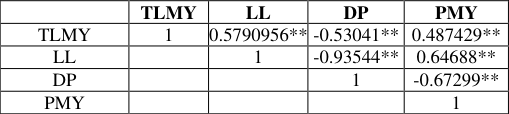 Table 2
Introduction
India is endowed with one of the world's richest bovine genetic resources, comprising several well-established indigenous cattle breeds. Among these, Gir cattle hold a distinctive position due to their remarkable milk production potential, adaptability to adverse climatic conditions, and natural resistance to tropical diseases. Originating from the Gir forest region of Gujarat, this breed is well known for its characteristic appearance, gentle temperament, and superior dairy performance. The production performance of dairy cattle is affected by a combination of genetic and non-genetic factors, including period of calving, season of calving, and lactation order. These factors significantly influence key economic traits such as total lactational milk yield, peak milk yield, lactation length, and dry period. Evaluating production performance is therefore essential for identifying high-yielding animals and improving herd management efficiency under organized farm conditions. In addition, understanding the relationship among various production traits is crucial for efficient selection and breeding strategies. Traits like total lactational milk yield (TLMY), peak milk yield (PMY), lactation length (LL), and dry period (DP) are often interdependent. Knowledge of their interrelationships helps in formulating effective selection indices that facilitate simultaneous genetic improvement of multiple economically important traits. Considering the economic importance and dairy potential of Gir cattle, it becomes essential to assess their present performance under organized herd conditions and to study the interrelationship among milk production traits. Understanding the association among production traits is essential for effective selection and genetic improvement programs. Correlation studies provide valuable information on how one trait influences another, thereby helping breeders identify key traits for selection. Previous studies on indigenous breeds have reported positive correlations between total milk yield and lactation length, and negative associations with dry period. Hence, the present investigation was undertaken to study the association among production traits in Gir cattle.
Material and Methods
Material and Methods
Source of data
The investigation's data collection consisted of information about production performance of Gir cattle from 2018 to 2024 that was in the history cum-pedigree sheets kept at the "Shree Nashik Panchavati Panjarpole, Nashik (M.S).
Statistical analysis
The least squares analysis method as suggested by Harvey (1990) was used for analysis of data.
Least squares analysis
The least squares analysis of data was carried out by considering non-genetic factors as per Harvey (1990) model. Total Lactation milk yield (kg), lactation length (days), dry period (days), peak milk yield (kg) was estimated by considering period of calving, season of calving and lactation order. The following statistical models were used.
Where, Y ijkl -Observation of l th parameters for i th season of calving, j th period of calving & k th lactation order µ -Overall mean S i -Effect of i th season of calving (i=1,2,3) P j -Effect of j th period of calving (j=1,2, 3) L k -Effect of k th lactation order (k=1,2,3, 7)
Correlation
Correlation among different milk production trait will be studied as per the technique of Snedecor and Cochran (1994)
𝑟 = ∑𝑥𝑦 √(∑𝑥2). (∑𝑦2)
Where, x and y are various traits under study
Result and Discussion
Result and Discussion
Dry period (DP)
The overall least squares mean of the dry period in Gir cattle was 108.15 1.25 days. These results were similar to those reported by Jadhav (2011) in Phule Triveni (100.84 ± 3.78 days). The highest dry periods were observed by Javed et al. (2000) in Sahiwal. However, the lowest dry period was observed by Khade (2001) in HF × Gir halfbreds.
Peak milk yield (PMY)
The overall least squares mean of PMY in Gir cattle was 9.14 ± 0.12 kg. These results were similar to Chigale et al.
(2016) in Red Sindhi (9.13 ± 0.18 kg). However, the highest PMY observed by Patond (2009) in Jersey cows. The lower PMY was found by Kumar et al. (1992) in Hariana (5.00 kg).
Correlation
The results are belongs to correlation among the milk Productive trait of Gir cow are given in Table 2.
| — | TLMY | LL | DP | PMY |
|---|---|---|---|---|
| TLMY | 1 | 0.5790956** | -0.53041** | 0.487429** |
| LL | 1 | -0.93544** | 0.64688** | |
| DP | 1 | -0.67299** | ||
| PMY | 1 |
Table text extracted from the original PDF; superscript letters are shown inline. The original table image is below.
View original table image
Total lactational Milk Yield with LL, PMY and DP
The correlation between total lactational milk yield with LL and PMY was positive and significant, phenotypic correlation between total lactational milk yield and dry period was negative and significant, suggesting that cows with higher peak yield and longer lactation lengths tend to produce more milk
Lactation Length with DP and PMY
The correlation between lactation length with DP was negative and significant, indicating that cows with shorter International Journal of Agriculture and Food Science https://www.agriculturaljournals.com dry periods had better total milk yield. However, the correlation between lactation length and PMY was positive and significant.
Peak Milk Yield with DP, LL and TLMY
The correlation between Peak milk yield with dry period was negative and significant. However, correlation between Peak milk yield with lactation length and total lactational milk yield was positive and significant.
Conclusion
The present study on the production performance of Gir cattle revealed that the breed possesses good milk-producing ability, moderate lactation length, and satisfactory peak yield under farm conditions. The positive and significant associations among total lactation milk yield, peak milk yield, and lactation length indicate that improvement in one trait can lead to enhancement in others. These findings confirm the productive potential and adaptability of Gir cattle and highlight the importance of selecting animals based on key production traits to achieve genetic improvement and sustainable dairy performance.
Figures and tables from the paper
References
13 in the original paper- Bairwa M, Joshi RK, Bairwa AK. Non-genetic factors affecting production traits in Gir cattle. Pharma Innov J. 2022;11(7):858-60.
- Chigale PS. Effect of non-genetic factors on production performance of Red Sindhi cattle [MSc thesis]. Rahuri: MPKV; 2013.
- Harvey WR. Least-squares analysis of data with unequal subclass numbers. Washington (DC): USDA; 1990. ARS H-4.
- Jadhav SS, Deshmkh AR, Deokar DK, Fulpagare YG. Effect of non-genetic factors on production traits of Gir halfbreds. Asian J Anim Sci. 2010;5(1):23-4.
- Jadhav PD. Generation wise comparative reproduction and production performance of HF × Gir and Phule Triveni synthetic cows [MSc thesis]. Rahuri: MPKV; 2011.
- Javed K, Mohiuddin G, Abdullah M. Environment factors affecting various productive traits in Sahiwal cattle. Pak Vet J. 2000;20(4):187-92.
- Khade PB. Studies on herd structure of Holstein Friesian crosses in relation with production performance at RCDP on cattle, Rahuri [MSc thesis]. Rahuri: MPKV; 2001.
- Kumar V, Chauhan VPS, Singh BP. Genetic parameters of 300 days and part lactation milk yield of Hariana cattle. Indian J Anim Sci. 1992;62(7):655-8.
- Kumar MK, Prakash MG, Reddy AR. Productive and reproductive performance of Deoni cattle. Indian J Anim Sci. 2006;76(3):263-5.
- Patond MN. Persistency of milk yield in Jersey cattle [MSc thesis]. Rahuri: MPKV; 2009.
- Patond MN. Modelling of lactation curve in Gir triple cross cows [PhD thesis]. Rahuri: MPKV; 2013.
- Snedecor GW, Cochran WG. Statistical methods. 8th ed. New Delhi: Oxford & IBH Publishing Co.; 1994.
- Yadav AS, Rathi SS, Arora DN, Singh B. Factors affecting some economic traits in Tharparkar cattle. Indian J Dairy Sci. 1994;47(5):430-4.