
Research article · 2025 · Full text
International Journal of Agriculture and Food ScienceDeterminants of livelihood options of farm households under changing climatic conditions in Southeast Nigeria
Volume 7(11) · Pages 01–05 · DOI: 10.33545/2664844x.2025.v7.i11a.933 ↗
Research areasClimate change impacts on agricultureClimate Change and Environmental ImpactClimate Change and Sustainable Development
Abstract
Author-writtenThis study examined the determinants of livelihood options of farm households under changing climatic conditions in Southeast Nigeria. A total of 360 respondents were selected through a multistage sampling procedure across Abia, Anambra, and Ebonyi States. Primary data were obtained using structured questionnaires, complemented by secondary weather data (2001-2020). Analysis employed descriptive statistics, rainfall anomaly index, Z-test, and multinomial regression. Results revealed significant variability in rainfall and temperature, with alternating periods of flooding and drought. Results showed that 71% of respondents were male, with an average age of 56 years and household size of seven. About 52% were married, 40% attained primary education, and 83% had not migrated. The average farm size was 2.15 hectares and mean annual income ₦507,205.56k. Major livelihood options included agro-processing (20.8%), wage labor (18.3%), tricycle operation (14.4%), petty trading (11.9%), and carpentry/furniture (10.8%). Other options comprised food vending (8.9%), plumbing/painting (8.3%), GSM repair (7.5%), vulcanizing (6.7%), tile work (6.1%), and hairdressing (3.9%). The study found that rainfall variability, extreme temperatures, and shifting rainfall onset/cessation significantly reduced agricultural productivity, forcing farmers into non-farm activities. It concludes that climate variability threatens rural livelihoods and recommends climate-smart policies, early warning systems, and promotion of sustainable non-farm enterprises.
Summary
Source-checkedPlain-language reading of the full paper, prepared with AI and checked against the text. Each point links to the authors' own words.
Why it matters
- Agriculture is highly vulnerable to climate variability, particularly in sub-Saharan Africa where more than 60% of people rely on rain-fed farming for their income and food. View evidence ↗
- Southeast Nigeria faces specific challenges including high population density and severe gully erosion, which limit the amount of land available for farming. View evidence ↗
- When agricultural output drops, it leads to lower income and food shortages, prompting rural households to diversify their livelihoods to survive. View evidence ↗
The question
- The study aimed to identify the factors that determine the livelihood choices of farm households in Southeast Nigeria amidst changing climatic conditions. View evidence ↗
What they did
- The researchers used a multistage sampling process to select 360 respondents from Abia, Anambra, and Ebonyi States. View evidence ↗
- Data collection involved structured questionnaires and interviews for primary data, and meteorological data from 2001 to 2020 for secondary climate trends. View evidence ↗
- The study analyzed data using Z-tests for climatic variables, Chi-square tests for socio-economic associations, and a multinomial logit regression model to determine livelihood choices. View evidence ↗
What they found
- Farm households had an average annual income of ₦507,205.56k and cultivated an average farm size of 2.15 hectares. View evidence ↗
- Comparing 2001-2010 to 2011-2020, there was a statistically significant decrease in mean annual rainfall (Z=2.41) and a significant increase in mean annual temperatures (Z=2.87). View evidence ↗
- Age and migration status were not found to be significant determinants of the choice of livelihood strategies. View evidence ↗
What it means
- The authors conclude that diversifying livelihoods in Southeast Nigeria acts as both a short-term survival tool and a long-term strategy to adapt to climate stress. View evidence ↗
- The authors recommend improving education, expanding rural credit access, and promoting climate-smart agricultural practices to strengthen farmers' adaptive capacity. View evidence ↗
- The authors note that the ability of households to diversify effectively is limited by low education, poor credit access, and decreasing farm sizes. View evidence ↗
Visual summary
1 visualsIllustrations explain the paper; charts are replotted from the paper's own table values.
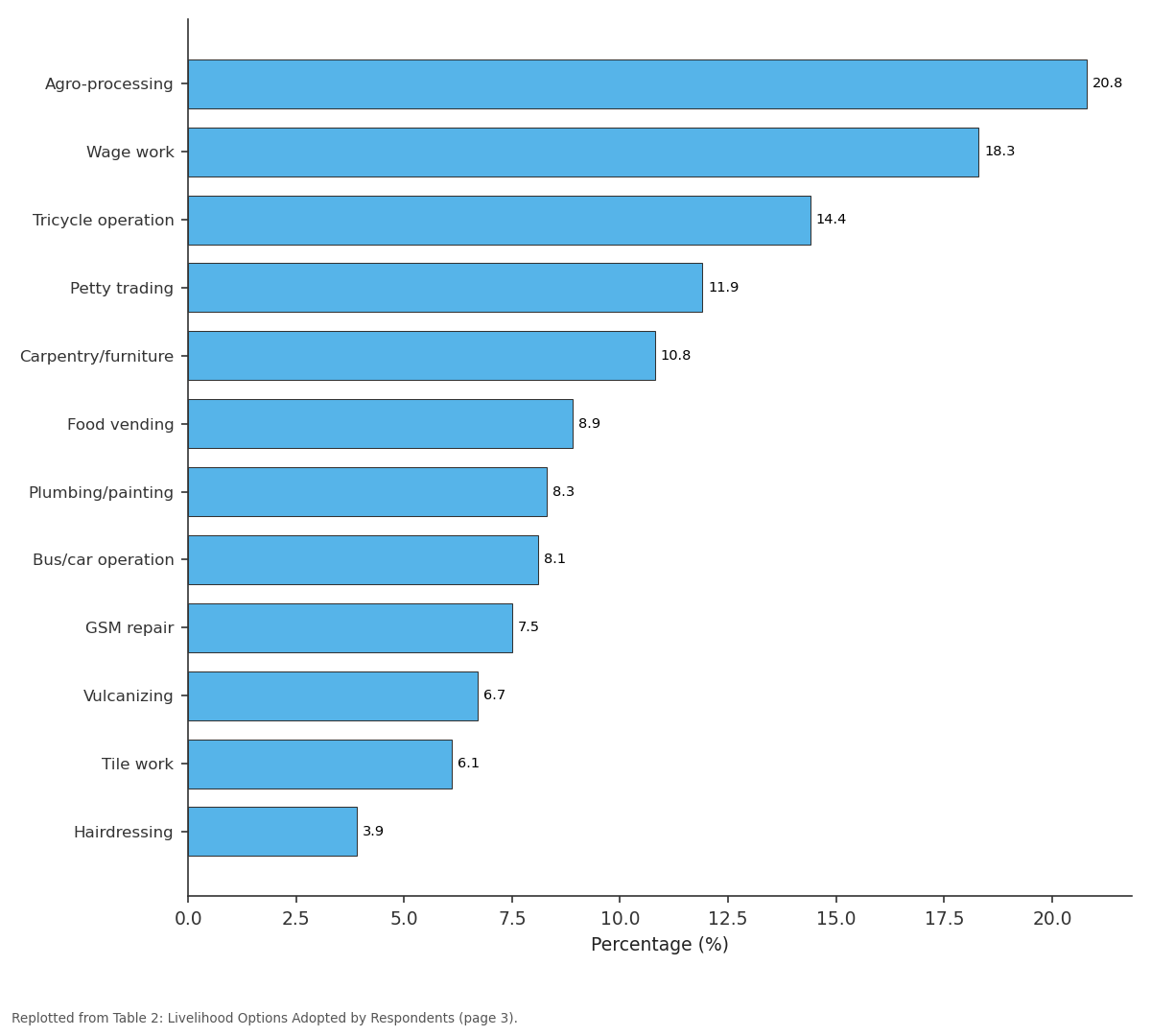
Percentage (%): Agro-processing vs Wage work vs Tricycle operation vs Petty trading vs Carpentry/furniture
Replotted from Table 2 (page 3) of the original paper. Every bar is the paper's own table value.
View source evidence ↗Figures & tables
From the original paper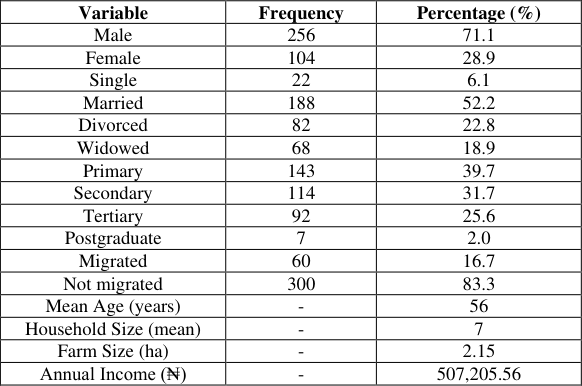 Table 1
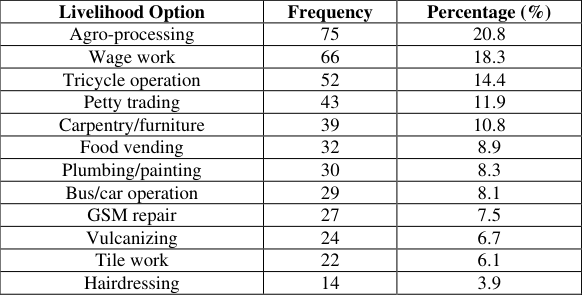 Table 2
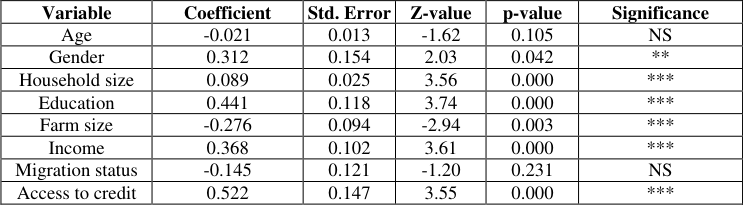 Table 3
Introduction
Climate change has emerged as one of the most pressing global development challenges of the 21st century, with disproportionate impacts on developing economies that are heavily dependent on agriculture (IPCC, 2021). Agriculture, being highly sensitive to climatic conditions, is among the most vulnerable sectors to climate variability, especially in sub-Saharan Africa where over 60% of the population depends on rain-fed farming for subsistence and income generation (Nhemachena & Hassan, 2007). Variability in rainfall, rising temperatures, recurrent droughts, and floods are increasingly undermining agricultural productivity, food security, and rural livelihoods across the continent. In Nigeria, climate change manifests through erratic rainfall, prolonged dry spells, flooding, soil erosion, and declining soil fertility. The Southeast region, in particular, faces unique challenges due to high population density, intense land use pressure, and severe gully erosion which have reduced the availability of arable land (Ezeh et al., 2012) [11] . Rain-fed farming systems dominate the region, exposing farm households to high levels of climatic risk and vulnerability. With limited access to irrigation, mechanization, and adaptive technologies, the capacity of smallholder farmers to withstand climate shocks is severely constrained. The implications of climate variability extend beyond crop yield reduction to broader livelihood insecurity. Declines in agricultural output translate into reduced household income, food shortages, and heightened poverty. Consequently, rural households increasingly resort to livelihood diversification as a survival strategy. Such diversification often includes engagement in non-farm activities such as agro-processing, wage labor, trading, and artisanal work, which serve to supplement income and reduce dependence on climate-sensitive agriculture.
Research Design
A survey research design was employed to collect both primary and secondary data relevant to the study objectives.
The design was chosen because it facilitates the collection of cross-sectional data from a large population within a limited period, thereby enabling reliable generalization of findings.
Population of the Study
The target population comprised all farm households in Abia, Anambra, and Ebonyi States. These households are predominantly smallholder farmers who rely heavily on rain-fed agriculture and are highly vulnerable to the effects of climate variability.
Sampling Procedure and Sample Size
A multistage sampling procedure was employed in selecting the respondents for the study. In the first stage, three states, Abia, Anambra, and Ebonyi were purposively selected because of their high vulnerability to climate variability and severe soil erosion. In the second stage, two senatorial zones were randomly selected from each state, giving a total of six zones. From each zone, two Local Government Areas (LGAs) were randomly chosen, amounting to 12 LGAs. In the fourth stage, three farming communities were selected from each LGA, making a total of 36 communities. Finally, ten farm households were randomly selected from each community, resulting in a total sample size of 360 respondents. This multistage approach ensured representativeness across the ecological and socio-economic variations within the study area.
Data Collection Methods
Data for the study were obtained from both primary and secondary sources. Primary data were collected through the administration of structured questionnaires and oral interviews. The questionnaire captured information on the socio-economic characteristics of respondents, household livelihood options, and perceptions of climate variability. Secondary data were sourced from meteorological agencies, agricultural institutions, and published reports. In particular, rainfall and temperature data spanning 2001 to 2020 were obtained to capture long-term trends in climate variability in the study area.
Data Analysis
The data collected were subjected to both descriptive and inferential statistical analyses in line with the objectives of the study. Descriptive statistics such as frequencies, percentages, means, and standard deviations were employed to summarize the socio-economic characteristics of respondents and to present the livelihood options adopted by farm households under changing climatic conditions. Inferential statistics were further applied to test relationships and draw inferences. Specifically, the Z-test was used to compare mean differences between climatic variables and household livelihood outcomes, thereby assessing the impact of climate variability on agricultural activities. The Chi-square (χ²) test was employed to examine associations between categorical socio-economic variables (such as gender, education, and marital status) and the type of livelihood options pursued by households. Furthermore, the multinomial logit regression model was fitted to identify the determinants of household choice of livelihood strategies. This model was considered appropriate because the dependent variable (livelihood option) was categorical and comprised multiple discrete outcomes. The explanatory variables included age, gender, household size, educational level, farm size, annual income, migration status, and access to credit. The model estimated the probability of households adopting one livelihood option relative to another, thereby revealing the socio-economic and demographic drivers of livelihood diversification under climate stress.
Results and Discussion Socioeconomic Characteristics of Respondents
Table 1 presents the socio-economic characteristics of the respondents. The results indicate that a majority (71.1%) of the respondents were male, while 28.9% were female, suggesting that farming activities in the area are largely male-dominated. The average age of the respondents was 56 years, which implies that most households are managed by individuals within the economically active age group. Household size was relatively large, averaging seven members per household, which provides labor for agricultural and non-agricultural livelihood activities. With respect to marital status, 52.2% of respondents were married, 22.8% divorced, 18.9% widowed, and only 6.1% single. The educational attainment of respondents showed that 39.7% had primary education, 31.7% secondary education, 25.6% tertiary education, while only 2.0% had postgraduate education. Migration status revealed that 83.3% of respondents had not migrated, while 16.7% reported some form of migration experience. The mean annual income of respondents was estimated at ₦507,205.56k, while the mean farm size cultivated was 2.15 hectares.
| Variable | Frequency | Percentage (%) |
|---|---|---|
| Male | 256 | 71.1 |
| Female | 104 | 28.9 |
| Single | 22 | 6.1 |
| Married | 188 | 52.2 |
| Divorced | 82 | 22.8 |
| Widowed | 68 | 18.9 |
| Primary | 143 | 39.7 |
| Secondary | 114 | 31.7 |
| Tertiary | 92 | 25.6 |
| Postgraduate | 7 | 2.0 |
| Migrated | 60 | 16.7 |
| Not migrated | 300 | 83.3 |
| Mean Age (years) | - | 56 |
| Household Size (mean) | - | 7 |
| Farm Size (ha) | - | 2.15 |
| Annual Income (₦) | - | 507,205.56 |
Table text extracted from the original PDF; superscript letters are shown inline. The original table image is below.
View original table image
Livelihood Options Adopted by Households
Farm households in the study area engaged in a wide range of livelihood diversification strategies in response to changing climatic conditions. Table 2 shows that the dominant options were agro-processing (20.8%), wage labor (18.3%), tricycle operation (14.4%), petty trading (11.9%), and carpentry/furniture making (10.8%). Other livelihood activities included food vending (8.9%), plumbing/painting (8.3%), bus/car operation (8.1%), GSM repair (7.5%), vulcanizing (6.7%), tile work (6.1%), and hairdressing (3.9%).
| Livelihood Option | Frequency | Percentage (%) |
|---|---|---|
| Agro-processing | 75 | 20.8 |
| Wage work | 66 | 18.3 |
| Tricycle operation | 52 | 14.4 |
| Petty trading | 43 | 11.9 |
| Carpentry/furniture | 39 | 10.8 |
| Food vending | 32 | 8.9 |
| Plumbing/painting | 30 | 8.3 |
| Bus/car operation | 29 | 8.1 |
| GSM repair | 27 | 7.5 |
| Vulcanizing | 24 | 6.7 |
| Tile work | 22 | 6.1 |
| Hairdressing | 14 | 3.9 |
Table text extracted from the original PDF; superscript letters are shown inline. The original table image is below.
View original table image
Perceived Effects of Climate Change
Respondents reported several manifestations of climate variability in the study area. These included irregular rainfall patterns, increased temperature, prolonged dry spells, late onset and early cessation of rains, and heightened incidence of flooding and soil erosion. These climate-related changes were consistently perceived as having adverse impacts on crop production, household food availability, and income stability.
Inferential Results
Chi-square results revealed significant associations between socio-economic variables and household livelihood options.
For instance, education level was significantly associated with the type of non-farm activity adopted (χ² = 19.62, p < 0.05), indicating that better-educated respondents were more likely to engage in diversified, higher-income non-farm enterprises. Similarly, household size showed a significant relationship (χ² = 13.41, p < 0.05), suggesting that larger households relied more heavily on diversification due to greater labor availability. The Z-test revealed significant differences between climatic variables over time. Rainfall variability between the period 2001-2010 and 2011-2020 showed a statistically significant reduction in mean annual rainfall (Z = 2.41, p < 0.05), while temperature patterns revealed a significant increase in mean annual temperatures over the same period (Z = 2.87, p < 0.01). These results confirm farmers' perceptions of worsening climatic conditions in the study area. The multinomial logit model identified the key determinants of livelihood diversification among respondents (Table 3). The results showed that household income, education level, farm size, and access to credit significantly influenced the choice of livelihood strategies.
| Variable | Coefficient | Std. Error | Z-value | p-value | Significance |
|---|---|---|---|---|---|
| Age | -0.021 | 0.013 | -1.62 | 0.105 | NS |
| Gender | 0.312 | 0.154 | 2.03 | 0.042 | ** |
| Household size | 0.089 | 0.025 | 3.56 | 0.000 | *** |
| Education | 0.441 | 0.118 | 3.74 | 0.000 | *** |
| Farm size | -0.276 | 0.094 | -2.94 | 0.003 | *** |
| Income | 0.368 | 0.102 | 3.61 | 0.000 | *** |
| Migration status | -0.145 | 0.121 | -1.20 | 0.231 | NS |
| Access to credit | 0.522 | 0.147 | 3.55 | 0.000 | *** |
Table text extracted from the original PDF; superscript letters are shown inline. The original table image is below.
View original table image
Discussion
The results of this study revealed important socio-economic characteristics of farm households in Southeast Nigeria that have direct implications for livelihood diversification under climate variability. The finding that 71.1% of respondents were male shows that farming is largely male-dominated in the area, though women still play supportive roles in household food and income security. The average age of 56 years implies that farmers are mostly within the productive age range, but approaching older age, which may affect labor availability in the future. The relatively large household size (average of seven members) suggests that households have access to family labor, which is critical for engaging in multiple livelihood activities. Education was found to be an important factor influencing diversification. The fact that a significant proportion (39.7%) had primary education, with fewer attaining tertiary and postgraduate levels, indicates that while literacy exists, limited education may constrain access to skilled non-farm opportunities. This is supported by the Chi-square results, which showed that education was significantly associated with livelihood diversification (χ² = 19.62, p < 0.05). Households with better education were more likely to engage in non-farm and higher-income activities such as petty trading, transportation, and agro-processing. The analysis of livelihood options revealed that households engaged in a broad range of activities, with agro-processing (20.8%), wage labor (18.3%), and tricycle operation (14.4%) being the most common. This indicates that households are gradually shifting away from sole dependence on crop farming towards non-farm activities that provide more stable income. These results confirm that diversification is both a survival and adaptation strategy in the face of declining farm productivity and increasing climatic risks. The perception of farmers about climate change was validated by the Z-test results, which showed a significant reduction in rainfall and an increase in temperature between 2001-2010 and 2011-2020. This aligns with respondents' reports of late onset and early cessation of rainfall, prolonged dry spells, flooding, and soil erosion. Such climatic stressors negatively affect crop yield, income, and household food security, compelling households to seek alternative livelihood options. The multinomial logit model identified income, education, farm size, and access to credit as significant determinants of livelihood diversification. Households with higher income and better education were more likely to adopt profitable non-farm activities such as agro-processing and trading. Smaller farm sizes pushed households to diversify away from farming, while access to credit enabled investment in income-generating enterprises. On the other hand, age and migration status were not significant determinants, indicating that demographic factors play a lesser role compared to economic and institutional variables. Overall, the findings demonstrate that livelihood diversification in Southeast Nigeria is strongly influenced by socio-economic factors and the pressures of climate variability. Households are adopting multiple strategies to cope with declining farm output and unstable climatic conditions. However, limited education, restricted access to credit, and small farm sizes constrain their ability to diversify effectively. This highlights the urgent need for interventions that strengthen farmers' adaptive capacity through education, financial inclusion, and improved access to resources.
Conclusion
This study examined the determinants of livelihood options of farm households under changing climatic conditions in Southeast Nigeria. The findings revealed that most of the respondents were male, middle-aged, and operated relatively large households, which provided labor for agricultural and non-agricultural activities. The results also showed that education, income, farm size, and access to credit were significant determinants of livelihood diversification, while age and migration status were not significant. Agroprocessing, wage labor, tricycle operation, petty trading, and carpentry were identified as the major livelihood options pursued by households, indicating a gradual shift from dependence on climate-sensitive agriculture to more resilient non-farm income sources. The perception of farmers on climate variability was validated by statistical evidence, as rainfall was shown to have declined while temperature increased significantly over the last two decades. These changes were linked to reduced crop yields, food insecurity, and income instability, thereby forcing households to diversify their livelihoods as a coping and adaptive strategy. It can therefore be concluded that livelihood diversification in Southeast Nigeria serves both as a survival mechanism and as a long-term adaptation strategy to climate stress. However, the capacity of households to diversify effectively is constrained by low levels of education, limited access to credit, and shrinking farm sizes, which continue to undermine resilience and sustainability.
Recommendations
Based on the findings of this study, it is recommended that efforts should be made to strengthen the adaptive capacity of farm households in the study area. Improved access to formal and informal education is necessary to enhance farmers' knowledge and skills, thereby enabling them to participate more effectively in non-farm and higher-income activities. Credit delivery systems should also be expanded to rural areas, as access to finance plays a crucial role in enabling households to invest in profitable livelihood options. Furthermore, extension services should intensify the promotion of climate-smart agricultural practices such as soil conservation, improved crop varieties, and small-scale irrigation, which will help households reduce their dependence on rainfall and increase agricultural resilience. In addition, government and development agencies should promote livelihood empowerment programs that encourage non-farm enterprises such as processing, trading, and transportation, which were identified in this study as the most common adaptation strategies. Investment in rural infrastructure, erosion control, and flood management is equally essential in mitigating environmental challenges that threaten agricultural production and rural livelihoods. Addressing these challenges through education, credit access, extension support, and environmental management will not only improve the resilience of households but also ensure sustainable livelihoods under changing climatic conditions in Southeast Nigeria.
References
12 in the original paper- Adefolalu DO. Ecological and land use mapping of Niger State. Phase III report. 1989.
- Amikuzuno ET, Donkoh OI. Heterogeneous constraints, incentives and income diversification strategies in rural Africa. Ithaca (NY): Cornell University, Department of Applied Economics and Management; 2012. Working Paper No. 14761. p. 5668.
- Antwi-Agyei P, Stringer LC, Dougill AJ. Livelihood adaptations to climate variability: insights from farming households in Ghana. Reg Environ Change. 2014;14(4):1615-26.
- Branca G, McCarthy N, Lipper L, Jolejole MC. Food security, climate change and sustainable land management. Agron Sustain Dev. 2013;33:635-50.
- Enete AA, Amusa TA. Challenges of agricultural adaptation to climate change: a synthesis from the literature. FACTS Rep. 2010;4(6):32-56.
- Enete AA, Onyekuru AN. Challenges of agricultural adaptation to climate change: empirical evidence from Southeast Nigeria. Tropicultura. 2011;29(4):243-9.
- Igwe GVC, Mbam BN. Determinants of rural farmers' adaptation to climate change measures in Ivo LGA of Ebonyi State. J Environ Sci Toxicol Food Technol. 2013;5(4):10-2.
- Nasreen M, Hossain KM, Azad AK. Climate change and livelihood in Bangladesh: experiences of people living in coastal regions. 2015.
- Onu DO. Socio-economic factors influencing farmers' adoption of alley farming technologies under intensified agriculture in Imo State, Nigeria. Philipp Agric Sci. 2006;89(2):521-43.
- Onu DO. Farm level analysis of investment behaviours in soil conservation and erosion control practices in the ecologically vulnerable communities in Southeast Nigeria. Agric Biol J N Am. 2013;4(4):441-58.
- Onu DO, Ezeh AN. Farm level analysis of investment behaviours in soil conservation and erosion control practices in the ecologically vulnerable communities in Southeast Nigeria. Agric Biol J N Am. 2015;1(2):21517517.
- Sampson Y, Divine OA, Lawrencia P, Felix A. Smallholder farmers' livelihood security options amidst climate variability and change in rural Ghana. Scientifica Ghana J Fish Dev. 2017;4(3):21-35.