
Research article · 2025 · Full text
International Journal of Advanced Chemistry ResearchExploring bio pesticide as an eco-friendly alternative to mitigate the risk posed by chemical pesticide
Volume 7(11) · Pages 01–03 · DOI: 10.33545/26646781.2025.v7.i11a.324 ↗
Research areasPesticide Exposure and ToxicityPesticide and Herbicide Environmental StudiesHumic Substances and Bio-Organic Studies
Abstract
Author-writtenIf we do not save the soil after year 2045, 50% of population does not get food. Bio pesticide is best alternative to increase production. To improve the nation's economy while reducing environmental pollution and health issues. Society must embrace a new agricultural paradigm for food production that is safer for both people and the environment because the ongoing use of pesticides has an adverse effect on the ecosystem and human health. (Stamatis, P & et al 2016). Depending on pesticide many more people may be at risk of developing chronic effects (such as cancer, poor reproductive outcome, and immunological effects) (Al-Saleh, I. A. 1994) pesticides transferred from the mother to the foetus through the placenta, resulting in birth abnormalities, (Repetto, R & et al 1996). Many more people may be susceptible to long-term consequences from pesticide use, including cancer, poor reproductive outcomes, and immunological problems. chemicals that are passed from the mother to the foetus via the placenta and cause birth defects, Excellent soil quality (prevents soil contamination), environmental preservation, economic stability through your own business and marketing, and societal health through wholesome food (free of hazardous residues) are all benefits of this activity. It opposes the use of chemical fertilisers, herbicides, and insecticides and promotes the use of easily accessible natural resources. Because our fruits, vegetables, and produce don't include chemical fertiliser residues, there is a lower risk of diabetes, cancer, heart attacks, paralysis, and other illnesses. Dashparni Arak, Panchparni Arak, Buttermilk, Jivamrut, Ghan Jivamrut are used in farming. Save health of community and working hours of nation
Summary
Source-checkedPlain-language reading of the full paper, prepared with AI and checked against the text. Each point links to the authors' own words.
Why it matters
- Agriculture is a critical sector in India, supporting 70% of the country's population. View evidence ↗
- The continuous use of chemical pesticides is stated to have negative impacts on both human health and the environment. View evidence ↗
- The authors suggest that failure to protect soil health by 2045 could lead to 50% of the global population facing hunger. View evidence ↗
The question
- The project aims to find ways to conserve natural resources and public health while boosting the economy by reducing pollution and health risks. View evidence ↗
What they did
- The approach involves using various bio-fertilizers and growth promoters, including Dashparni, Amrut Jal, Jivamrut, and forest vegetable biomass. View evidence ↗
- Dashparni is prepared using 1 kg each of various plant leaves (except 2.5 kg of neem), mixed with cow urine, cow dung, green chili, garlic, ginger, tobacco, and water. View evidence ↗
- Amrut jal is formulated from cow urine, cow dung, water, and jaggery, stirred twice daily for three days before further dilution. View evidence ↗
What they found
- Chemical pesticides are reported to contaminate over 90% of agricultural water sources and reduce soil respiration by 35%. View evidence ↗
- The authors state that excessive pesticide use in Punjab during the Green Revolution left 70% to 80% of its inhabitants cancer-stricken. View evidence ↗
- In European countries, pesticide use is linked to a 70% reduction in insect biomass and a 50% decline in farmland birds. View evidence ↗
- According to the United Nations, 40% of invertebrate pollinators, such as bees and butterflies, are at risk of extinction. View evidence ↗
- In a cited study on 1st instar larvae, Dashparni ark showed the highest toxicity (LC50 8.28%), followed by Brahmastra, Agniastra, Neemastra, and a garlic-ginger-mint mixture. View evidence ↗
- Cited research indicates that Dashparni leaf extract is effective in suppressing fungal pathogens. View evidence ↗
What it means
- The authors conclude that traditional bio-pesticides like Dashparni ark, Panchparni ark, and Jivamrut are safe and eco-friendly alternatives to chemical pesticides. View evidence ↗
- The authors recommend immediate policy changes and education for farmers to facilitate the shift from chemical to organic agriculture. View evidence ↗
Visual summary
1 visualsIllustrations explain the paper; they do not show study data.
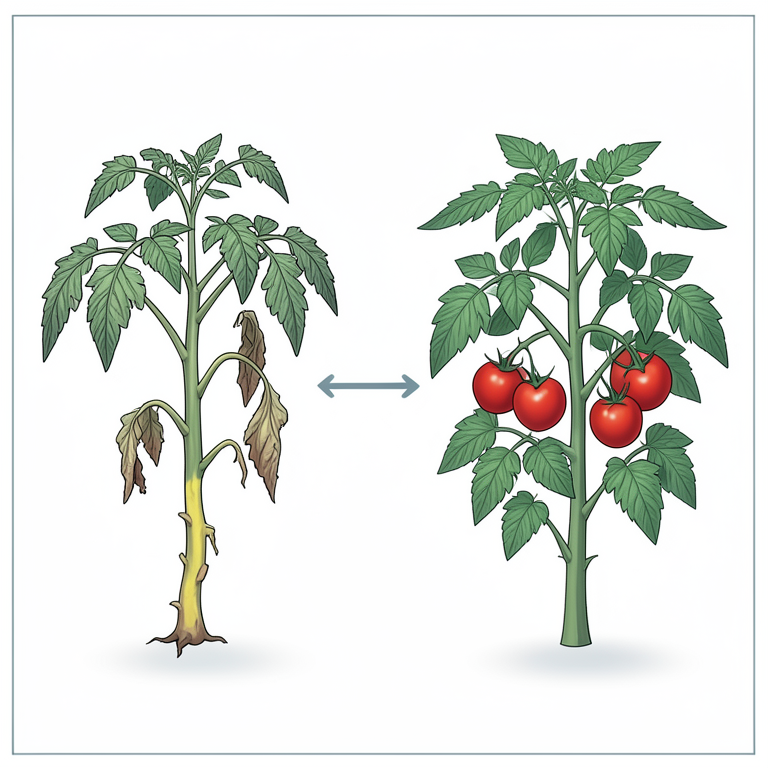
Study overview
AI-generated conceptual illustration (Tomato plants in a field). It explains the idea and does not show study data.
View source evidence ↗Introduction
In our country, science and technology were developed by 10% of the population, while the other 90% followed mindlessly. Nobody considers the consequences of the challenges we are experiencing today, which include water contamination, soil degradation, and a variety of health issues. This Project benefits to 90% of the follower population who can solves today's environmental problem. Agriculture and allied goods support 70% of India's population. Food, water and air, the most fundamental need of all living things, is presently being influenced by very harmful substances such as pesticides, fertilisers, insecticides, and so on. The green revolution prompted Punjab state to utilise excessive pesticides in crop production, transforming it into a "Storage of Wheat" capable of meeting the entire nation's demands but leaving 70 to 80 percent of its inhabitants cancer-stricken. Punjab is presently the state with the highest cancer sufferers. Punjab has surpassed all other states in terms of cancer patients. There is no space in Delhi hospital so the government has started operating a cancer train between Chandigarh and Bikaner. If we do not want any state to become Punjab, we must completely eliminate the use of pesticides in agricultural farming. And Diabetes, cancer, heart attacks, and high blood pressure are just a few of the health difficulties prevented by avoiding the use of chemical products. With rising food and fibre demand, today's agro ecosystem is increasingly reliant on pesticides. Massive volumes of synthetic insecticides are employed to boost output. Because 98% of pesticides sprayed directly or indirectly affect non-target creatures, this scenario poses a major risk to them. Additionally, 80% of pesticides sprayed directly contaminate the environment, ecosystem, natural biodiversity, pollinators, and food chains. Pesticide contamination of agro-lands' water sources exceeds 90%, and soil respiration is decreased by 35%. If we do not rescue the land by 2045, 50% of the world's population would be hungry. Bio pesticide is the finest option for increasing output. "Samarth Krushi" is best option to boost the nation's economy while lowering pollution and health hazards. Farmers must also have a reasonable way of life and a solid income in order to prevent farmer suicide.
Need of Project
In the entire world, 35% population of total population and in India, 33% population is suffering from cancer. And 7.6 millions of people die every year in the world by cancer. Cancer is the second leading cause of death in America. Diabetic patients make up 10.5% of the global population in 2021, and by 2045, this figure will have risen to 46%. If we do not save the land by 2045, half of the world's population will be hungry. To conserve soil, water, air and people's health, to increase the national economy while reducing pollution and health risks. This project was undertaken During the rainy season, grass and many vegetables are grown automatically called wild vegetable and are a very rich source of nutrients and minerals. These wild vegetables play a role as a nutritive diet as well as a curative medicine for many diseases. However, since the last few years, farmers have used growth inhibitors to destroy these useful vegetables, resulting in the loss of numerous natural medicines and the emergence of various diseases. Because of the repeated usage of this plant growth inhibitor, the soil became infertile. 90% of Indians are afflicted with some type of disease.
Methodology
Prepare healthy soil for crop growth by providing all nutrients to soil. A healthy soil is a good foundation for a healthy crop. If mother (soil) is healthy then baby (crop) is also healthy. Use of different bio-fertilizers, pesticides, insecticides, and growth promoters (Dashparni, Amrut Jal, biomass of forest vegetable, Jivamrut, Gokrupa amrut jal), among other things. Modern and traditional techniques are also used. Dashparni includes crush of neem, giloy, sharifa, jatrofa, karanj, mandar, raymunir, nirgudi, papita, kanher. All plant leaf 1 kg, except neem 2.5 kg and 5lit cow urine, 3kg cow dung, 1 kg green chili, 250 gm garlic, 250 gm ginjar, 250gm tobacco and 100 lit water. Mix it properly with wooden stick cover jute cloth, stir twice a day after 30 days it become very effective on all type diseases of plant. For spraying use 200 ml dashparni extract in 100 liter water. Amrut jal use as nutrient as well as growth promotor. Amrut jal include cow urine 1lit,cow dung 1kg, 10 lit water, 50 gm jaggery, cover it for 3day and stir it for twice a day after 3 day add 100 water. Spray it on plant or, pour it near plant while watering.
Result and Discussion
A few pesticide granules are sufficient to kill a little bird (https://www.pan-uk.org/our-environment/). Numerous types of pesticides, their hazardous action, and the various routes through which they contaminate our land, water, and air. Insecticides, fungicides, herbicides, garden chemicals, household disinfectants and rodenticides that are operated to both destroy and protect from pests. Decreased sperm motility, who exposed to pesticides. (Hossain, F& et al 2010) [8] People from 14 distinct in Pakistan's rural area were found residue of DDT, DDE, polytrin-C, diazinon, and monocrotophos. (Azmi, M. A et al 2006) [4] . Negative impacts of pesticide on human, animal, and higher plant health from prolonged exposure. (Igbedioh, S. O. 1991) [9] . Depending on pesticide many more people may be at risk of developing chronic effects (such as cancer, poor reproductive outcome, and immunological effects) (Al-Saleh, I. A. 1994) [3] . In 100 women, the transmission of organochlorine pesticides from the mother to the foetus has been investigated. The levels of organochlorine pesticides in the mother's blood, placenta, and umbilical cord blood of the same mother and child were investigated. (Saxena, M. C et al 1981). long-term effects (e.g., cancer, asthma, and diabetes), (Kim, K. H.& et al 2017) [13] . European countries have recorded a 70% reduction in insect biomass and a 50% decline in farmland birds. Similarly, species richness decreased by 42% in North America, Europe, and Australia. Bees are harmed by pesticide residues, which ultimately reduces their ecological value. The United Nations issued a warning that 40% of invertebrate pollinators, including bees and butterflies in particular, were in risk of going extinct on Earth. Due to harsh weather, there has been a nearly 30% decrease in honey bee populations in American and European countries (Ali, S& et al. 2021) [2] . Without chemicals, soil quality is higher, Fungicides used in agriculture may kill earthworms, which may lower populations of the animals and birds that eat them but are only marginally hazardous to birds and mammals. A few pesticide granules are sufficient to kill a little bird (https://www.pan-uk.org/our-environment/). People from 14 distinct in Pakistan's rural area were found residue of DDT, DDE, polytrin-C, diazinon, and monocrotophos. (Azmi, M. A et al 2006) [4] . Crude leaf extracts Om ten medicinal plants Azadirachta indica, Trida procumbens, Viter negundo, Tinospora cordifolia, Annona squamo, Sapongamia pinnata, L., Nerium oleander, Calotropis gigantea, Jatropha curcas L., and Carica papaya L. were made in order to assess the antifungal activity of Dashparni leaf extract against fungal pathogens. The agar well diffusion assay was used to measure the antifungal activity, and the results showed that it was effective in suppressing the fungus. (Adhao, A. D. & et al 2023) [1] . Neem seed kernel extract (NSKE), NSKE + Cow urine, Agniastra, Neemastra, Brahmastra, Panchparni ark and Dashparni ark against sucking insect pests of organic pigeonpea, (Gothi, H. R.& et al 2023) [6] . Natural plant ark used to control pest like Agrotis ipsilon Hufnagel (Joshi, M. J., Verma K.S.2023) [12] . The fourth, fifth, and sixth instar larvae of A. ipsilon were used in a feeding inhibition investigation of the bioformulations Neemastra, Agniastra, Brahmastra, Dashparni atra, and garlic + ginger + mint combo. (Joshi, M. J.& et al 2020) [10] . Thorder of toxicity 1st instar larvae was-dahparni ark > brahmastra > agniastra > neemastra > garlic + ginger + mint mixture with LC50 values 8.28, 10.38, 11.19, 14.53 and 16.66%, respectively (Joshi, M. J.& et al, 2021) [11] . Using the thin film residue method, a study was conducted on adults of Trichogrammatoidea bactrae Nagaraja (Hymenoptera: Trichogrammatidae) using neem-based insecticides, specifically azadirachtin. (Murthy, J. S.& et al 2024) [14] .
Chemical farming has reduced biodiversity, including crop and crop species, disturbed wildlife, decreased soil fertility, deteriorated food quality, and negatively impacted both human and animal health. A movement known as "organic farming" was started to counteract the harmful consequences of chemical farming. (Bhede, B. et al 2024) [5] . Applying organic and inorganic fertilisers in equal amounts to meet the recommended nitrogen level improved both the soil's nutrient availability and crop content while also raising the amount of chlorophyll. (Yadav, P. et al 2023) [22]
Conclusion
In conclusion, our study convincingly shows that biopesticides made from conventional formulations such as Dashparni ark, Panchparni ark, and Jivamrut provide a safe, environmentally friendly substitute for dangerous chemical pesticides. Chemical pesticides have been shown to have disastrous effects on human health (such as cancer, birth deformities, and reproductive diseases), the environment (such as biodiversity loss, soil infertility, and water contamination), and agricultural sustainability. We can safeguard ecosystems, enhance food safety, lower the prevalence of chronic illnesses, and guarantee long-term food security by using organic agricultural methods that make use of these organic bio-pesticides. To enable a broad shift from chemical-dependent agriculture to these safer, conventional options that support ecological balance and public health concerns, immediate policy changes and farmer education initiatives are required.
References
21 in the original paper- Adhao AD, Patel AD. Studies on dashparni as pest control against Fusarium oxysporum causing wilt in soybean. BIOINFOLET-A Quarterly Journal of Life Sciences. 2023;20(2b):355-357.
- Ali S, Khan MA, Jabeen F, Akhtar K. Pesticide-induced oxidative stress and antioxidant responses in tomato (Solanum lycopersicum) seedlings. Ecotoxicology. 2021;30(1):1-12. DOI:10.1007/s10646-020-02325-x.
- Al-Saleh IA. Pesticides: a review article. Journal of Environmental Pathology, Toxicology and Oncology. 1994;13(3):151-161.
- Bhede B. Comparative efficacy of aqueous and ethanolic Dashparni extracts against cotton aphid (Aphis gossypii). International Journal of Advanced Biochemistry Research. 2024;8(12):10-15.
- Gothi HR, Panickar BK, Rabari PH, Patel BC, Barad CS. Field efficacy of botanicals against sucking pests in pigeonpea [Cajanus cajan (L.) Millsp.] under organic cultivation. Journal of Advances in Biology & Biotechnology. 2023;27(10):1-8.
- He F. Biological monitoring of exposure to pesticides: current issues. Toxicology Letters. 1994;72(1-3):209217. DOI:10.1016/0378-4274(94)90030-2.
- Hossain F, Ali O, D'Souza UJ, Naing DKS. Effects of pesticide use on semen quality among farmers in rural areas of Sabah, Malaysia. Journal of Occupational Health. 2010;52(6):353-360.
- Igbedioh SO. Effects of agricultural pesticides on humans, animals, and higher plants in developing countries. Archives of Environmental Health: An International Journal. 1991;46(4):218-224.
- Joshi MJ. Feeding inhibition with bioformulations in cut worms Agrotis ipsilon (Hufnagel). Indian Journal of Entomology. 2020;82(1):134-138.
- Joshi MJ, Verma KS, Chandel RS, Inamdar AG, Kaushal S, Rana A. Efficacy of bioformulations against cut worm Agrotis ipsilon Hufnagel in potato. [publisher unknown]; 2021.
- Joshi MJ, Verma KS, Chandel RS. Potency of indigenous natural products against Agrotis ipsilon Hufnagel (Lepidoptera: Noctuidae). International Journal of Tropical Insect Science. 2023;43(2):581-589. DOI:10.1007/s42690-023-00972-1.
- Kim KH, Kabir E, Jahan SA. Exposure to pesticides and the associated human health effects. Science of The Total Environment. 2017;575:525-535. DOI:10.1016/j.scitotenv.2016.09.009.
- Murthy JSV, Satpute NS, Undirwade DB, Bhalkare SK. Residual toxicity of neem-based insecticides against egg parasitoid Trichogrammatoidea bactrae Nagaraja. 2024.
- Kumar R. The cancer train: agricultural chemicals and public health in Punjab. Economic & Political Weekly. 2020;55(12):34-40.
- PAN UK. The environmental impact of pesticides. London: Pesticide Action Network UK; 2023. https://www.pan-uk.org/our-environment/.
- Repetto R, Baliga SS. Pesticides and the immune system: the public health risks. Washington (DC): World Resources Institute; 1996.
- Saxena MC, Siddiqui MKJ, Seth TD, Krishna Murti CR, Bhargava AK, Kutty D. Organochlorine pesticides in specimens from women undergoing spontaneous abortion, premature or full-term delivery. Journal of Analytical Toxicology. 1981;5(1):6-9. DOI:10.1093/jat/5.1.6.
- Stamatis P, Konstantinou I, Hela D. Occurrence and risk assessment of pesticides in surface water of Louros River (N.W. Greece). Environmental Science and Pollution Research. 2016;23(15):15854-15867. DOI:10.1007/s11356-016-6676-3.
- UNEP. Global assessment of pollinators. Nairobi: United Nations Environment Programme; 2022. https://www.unep.org/resources/report/globalassessment-pollinators.
- WHO. Global report on diabetes. Geneva: World Health Organization; 2021. Available from: https://www.who.int/publications/i/item/978924156525
- Yadav P, Sharma SK, Choudhary R, Jat G, Upadhayay B, Sisodia SS, et al. Effect of different natural farming practices on NPK and chlorophyll content of cowpea (Vigna unguiculata L.) under sub-humid southern plains of Rajasthan. Biological Forum-An International Journal. 2023;15(1):289-293.