
Research article · 2025 · Full text
International Journal of Biology SciencesOptimizing mountages selection for better pre and post cocoon performance in mulberry silkworm
Volume 7(10) · Pages 110–121 · DOI: 10.33545/26649926.2025.v7.i10b.505 ↗
Research areasSilkworms and Sericulture ResearchSilk-based biomaterials and applicationsEntomological Studies and Ecology
Abstract
Author-writtenMountages serve as essential devices for providing platforms on which mature silkworms spin their cocoons. Farmers employ different mountage types, often utilizing locally available materials, though each has specific limitations. The present study evaluated five mountages Rotary Collapsible, Mulberry Twig, Egg Tray, Paddy Husk, and Pinus for their impact on cocoon and post-cocoon parameters. Results revealed that Paddy Husk Mountage produced the highest single cocoon weight and maximum average filament length (93.33), whereas Rotary Collapsible Mountage recorded the lowest. The non-breakable average filament length was highest in Pinus Mountage (78.66) and lowest in Rotary Collapsible Mountage (71.33). In terms of average filament denier, Rotary Collapsible Mountage showed the highest (2.61) while Pinus Mountage exhibited the lowest (2.33). Based on cocoon quality and post-cocoon traits, Paddy Husk Mountage emerged as the most effective, being inexpensive, widely available, and superior in performance compared to other mountages.
Summary
Source-checkedPlain-language reading of the full paper, prepared with AI and checked against the text. Each point links to the authors' own words.
Why it matters
- Mountages are critical platforms used by mature silkworms to spin their cocoons. View evidence ↗
- The design and type of mountage directly influence cocoon quality and the resulting raw silk yield. View evidence ↗
The question
- The study aimed to evaluate how five different mountage types, Rotary Collapsible, Mulberry Twig, Egg Tray, Paddy Husk, and Pinus, affect cocoon and post-cocoon parameters. View evidence ↗
What they did
- The experiment used the Chakmajra mulberry variety and the bivoltine silkworm hybrid Fc1×Fc2. View evidence ↗
- The study employed a Complete Randomized Design (CRD) and analyzed the resulting data using ANOVA. View evidence ↗
What they found
- Paddy Husk Mountage produced the highest single cocoon weight (1.611 g), while Rotary Collapsible Mountage produced the lowest (1.340 g). View evidence ↗
- The highest single shell weight was recorded for Mulberry Twig Mountage (0.363 g), and the lowest for Rotary Collapsible Mountage (0.318 g). View evidence ↗
- Paddy Husk Mountage resulted in the maximum mean pupal weight (1.262 g), whereas Rotary Collapsible Mountage had the lowest (1.020 g). View evidence ↗
- The highest shell ratio was observed in Mulberry Twig Mountage (24.770%), while the lowest was in Paddy Husk Mountage (21.095%). View evidence ↗
- The pupation rate was highest in Paddy Husk Mountage (94.665%) and lowest in Pinus Mountage (89.333%). View evidence ↗
- Rotary Collapsible Mountage had the longest spinning duration (8.000 days), while Paddy Husk Mountage had the shortest (5.665 days). View evidence ↗
- The highest percentage of good cocoons was found in Paddy Husk Mountage (83.333%), and the lowest in Rotary Collapsible Mountage (72.000%). View evidence ↗
- The lowest dead cocoon percentage was observed in Paddy Husk Mountage (5.250%), while the highest was in Rotary Collapsible Mountage (13.250%). View evidence ↗
- The highest average filament length was recorded for Paddy Husk Mountage (93.33), and the lowest for Rotary Mountage (74.66). View evidence ↗
- The highest average non-breakable filament length was seen in Pinus Mountage (78.66), and the lowest in Rotary Mountage (71.33). View evidence ↗
- The highest average filament denier was observed in Rotary Mountage (2.61), and the lowest in Pinus Mountage (2.33). View evidence ↗
What it means
- The authors conclude that Paddy Husk mountage is the best option for silkworm rearing due to its high performance and local availability. View evidence ↗
- A limitation of Paddy Husk mountage is its tendency to biodegrade and stick to the cocoon shell. View evidence ↗
- The authors state that further studies are required to determine the best version of Paddy Husk mountage for release to farmers. View evidence ↗
Visual summary
3 visualsIllustrations explain the paper; charts are replotted from the paper's own table values.
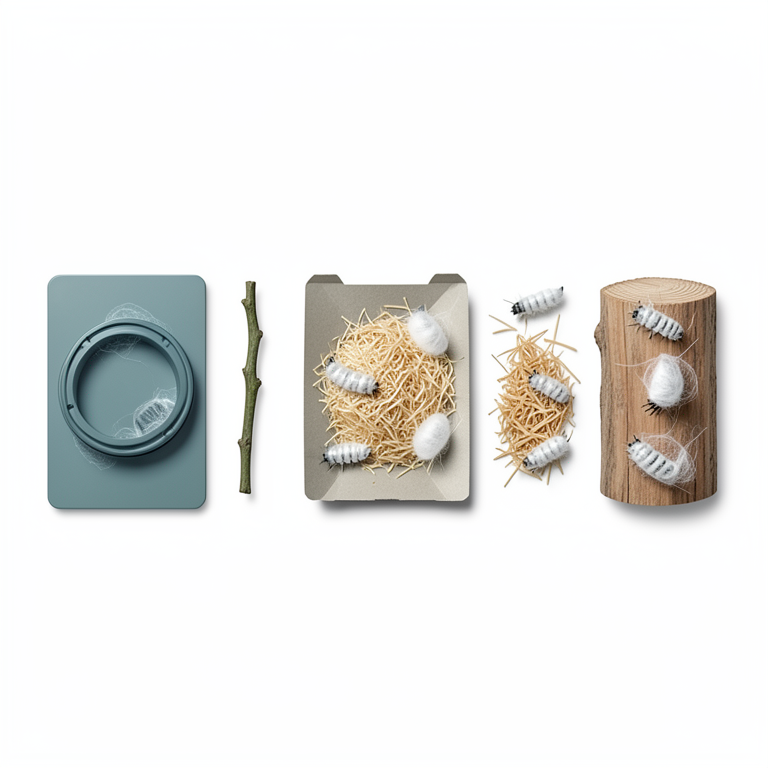
Comparison of Mountage Types
AI-generated conceptual illustration (Bombyx mori silkworms and various mounting substrates). It explains the idea and does not show study data.
View source evidence ↗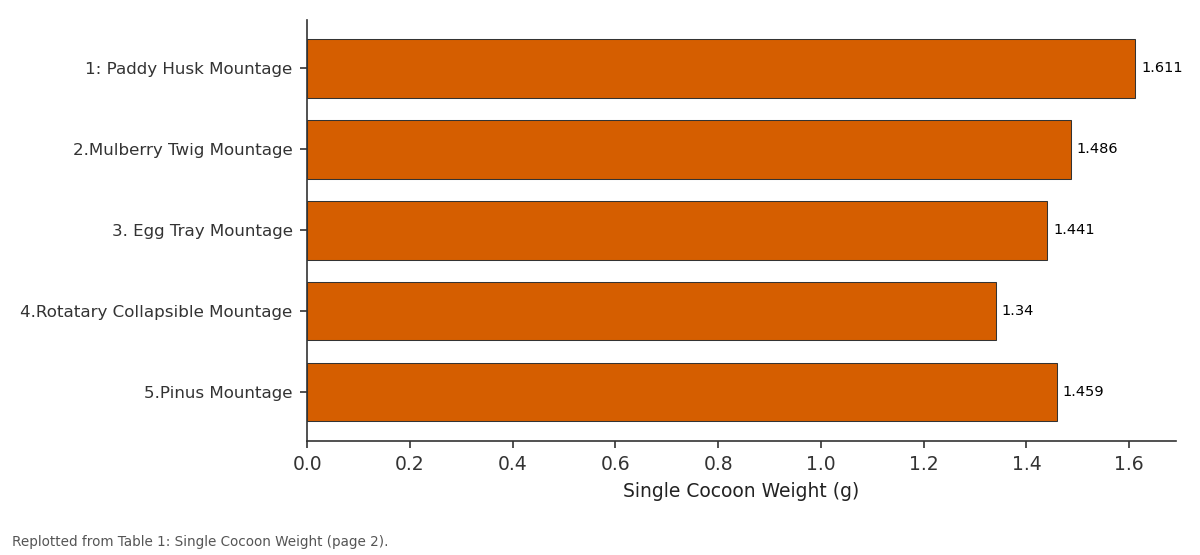
Single Cocoon Weight (g) / Mean: 1: Paddy Husk Mountage vs 2.Mulberry Twig Mountage vs 3. Egg Tray Mountage vs 4.Rotatary Collapsible... vs 5.Pinus Mountage
Replotted from Table 1 (page 2) of the original paper. Every bar is the paper's own table value.
View source evidence ↗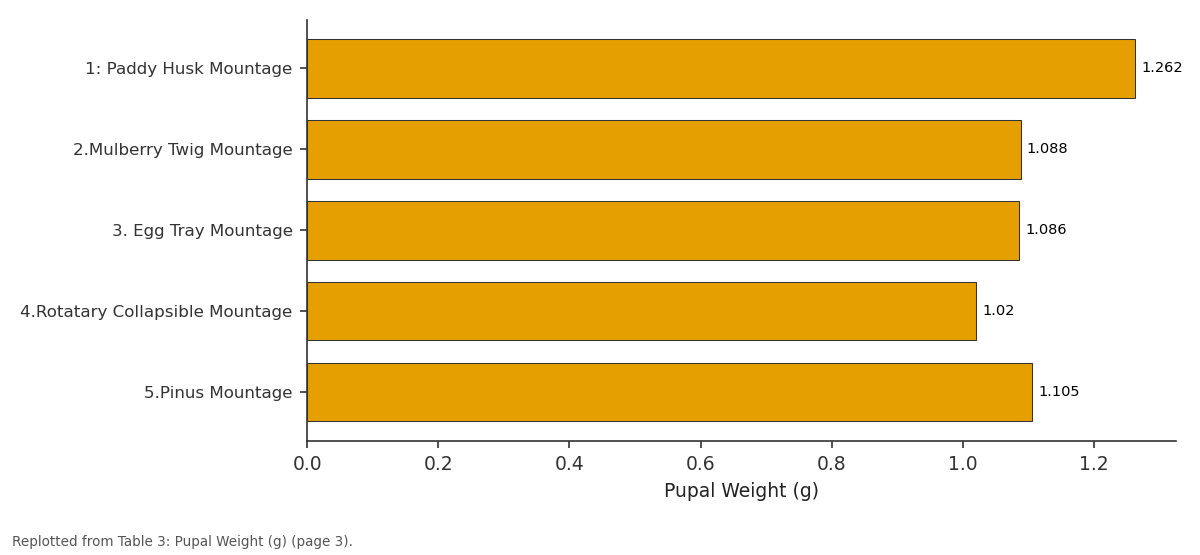
Pupal Weight (g) / Mean: 1: Paddy Husk Mountage vs 2.Mulberry Twig Mountage vs 3. Egg Tray Mountage vs 4.Rotatary Collapsible... vs 5.Pinus Mountage
Replotted from Table 3 (page 3) of the original paper. Every bar is the paper's own table value.
View source evidence ↗Figures & tables
From the original paper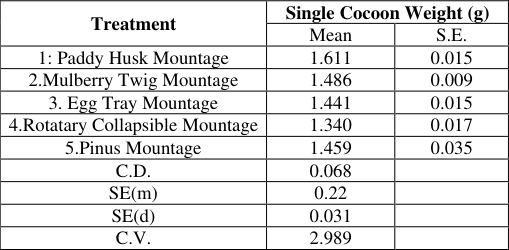 Table 1
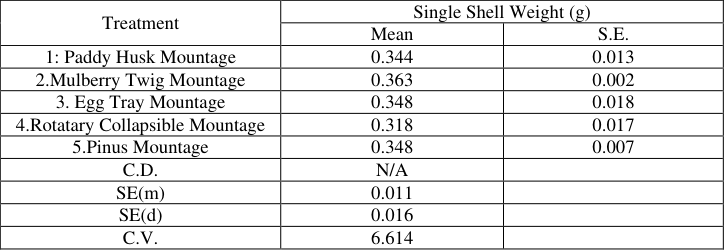 Table 2
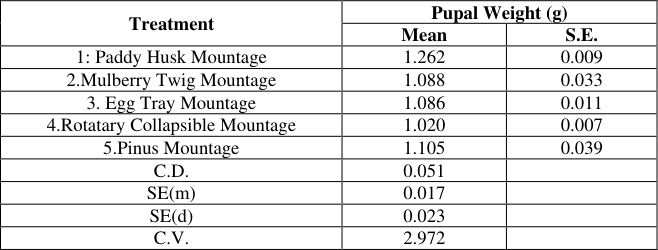 Table 3
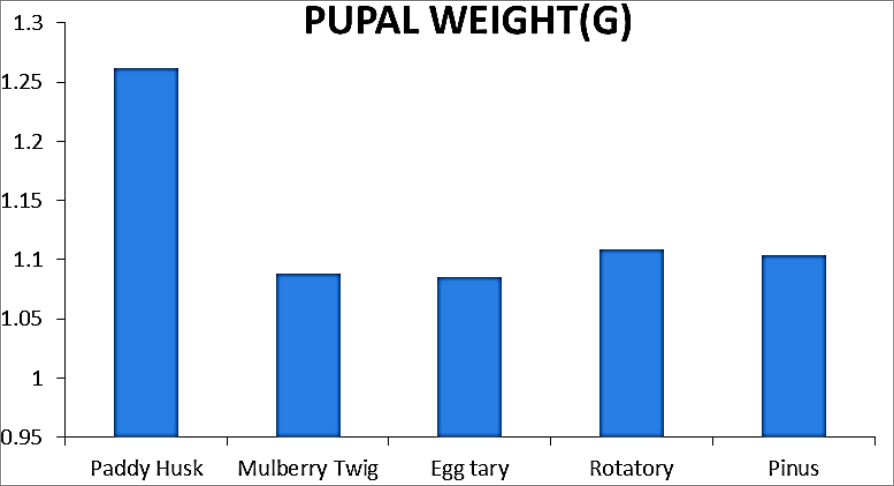 Figure 3
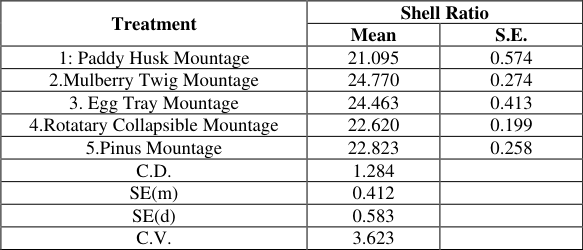 Table 4
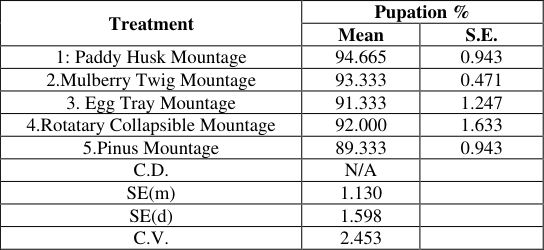 Table 6
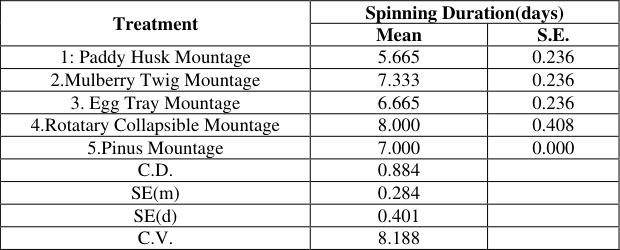 Table 7
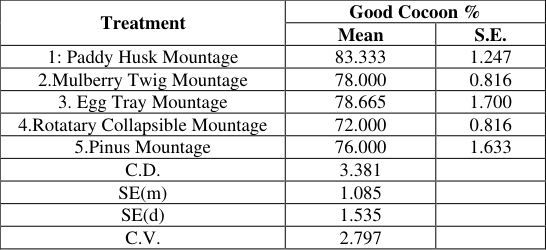 Table 8
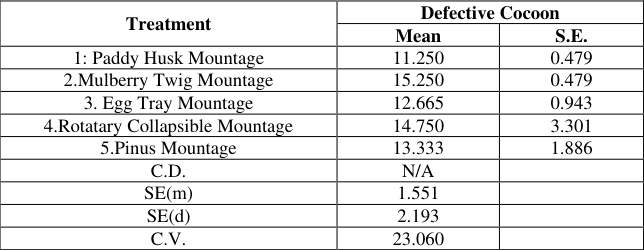 Table 9
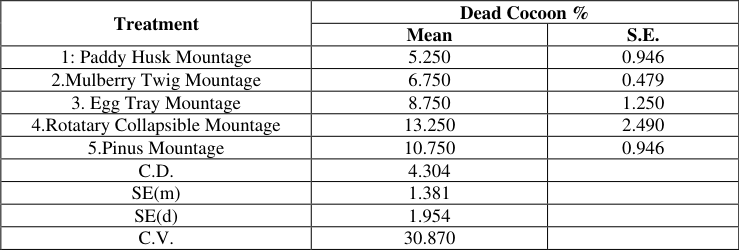 Table 10
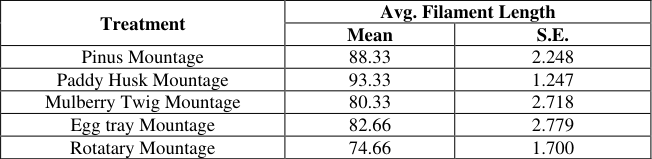 Table 11
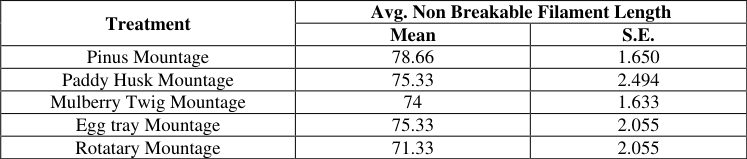 Table 12
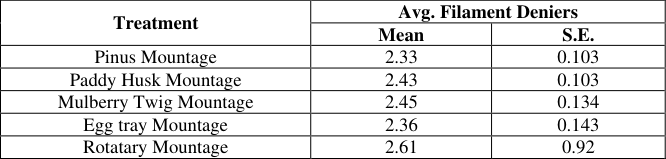 Table 13
Introduction
Sericulture is the scientific practice of silk production through the rearing of silkworms, primarily Bombyx mori L. Due to its luster, softness, strength, and durability, silk is regarded as the "queen of textiles." Mulberry sericulture involves mulberry cultivation, silkworm rearing, cocoon production, reeling, and weaving. Although sericulture originated nearly 5000 years ago in China, it continues to play an important agro-industrial role worldwide. In Jammu and Kashmir, sericulture is practiced in 20 districts, with Anantnag, Kupwara, Pulwama, Baramulla, Ganderbal, Udhampur, Rajouri, Reasi, and Kathua as major production areas. Despite favorable climatic conditions, productivity remains low due to factors such as limited leaf availability, poor hybrid performance, technical constraints, and low farmer awareness. Research and extension agencies including SKUAST, CSB, CSRTI Pampore, and RSRS Miran Sahib are working to address these challenges and promote sericulture development in the region. Among the different stages of silkworm rearing, cocoon spinning is critical. It begins with the transfer of mature larvae to cocooning devices called mountages, where they spin cocoons through continuous head movements. The quality of cocoons depends heavily on the type, structure, and design of mountages. Poor mounting practices, improper density, or substandard mountages often result in inferior cocoons and reduced raw silk yield. Thus, selection of suitable mountages is essential for ensuring high-quality cocoon and silk production.
Material and Method
The present study was designed and will be executed at post graduate department of Sericulture Poonch Campus University of Jammu.Material to be used: Silkworm bivoltine hybrid:-Fc1×Fc 2 Data analyzed by ANOVA (analysis is variance) Procurement of live material and type of seed Silkworm hybrid strain FC1 X FC2 was procured from the State Sericulture Department, Mendhar for the present investigation. After incubation of eggs at 25±1°C and relative humidity of 80±5%, black box was carried out on 8th day to achieve uniformity in hatching. The larvae hatched from the loose eggs were reared separately under uniform laboratory conditions as described by Yokoyama (1963) and Krishnaswami (1978). Area of study The present investigation on effects of mountage types on silkworm Bombyx mori spinning FC1×FC2 was conducted in Department of Sericulture, Poonch Campus, and University of Jammu.
Result and Discussion
The results on the present investigation entitled "Effect of Mountages Types in Silkworm Spinning" (FC1 X FC2 Silkworm hybrid). The experimental result showed that there were significant changes in the growth, development and economical attributes of silkworm due to different mountages.
A. Single Cocoon weight (gms)
A. Single Cocoon weight (gms)
Discussion
The final stage of the rearing process is mounting. Mounting is the process of transferring adult fifth instar larvae to mountages. When larvae reach full maturity, their bodies become translucent, they stop feeding, and they begin looking for a suitable location to attach themselves for cocoon spinning and pupation. These actions plainly suggest that the developed larvae should be transferred into the mountages. They are collected and placed on mountages. The worms hook themselves to the mountages' spirals and begin spinning the cocoon. Silk fluid is discharged in minute amounts as the head moves, hardening to form a long continuous strand. The silkworm first builds the framework for the cocoon structure by weaving a preliminary web that gives the larva a place to stand while spinning the compact cocoon shell. The silk filament is deposited in a succession of brief waves producing the figure of eight due to the head's unique movements. Layers are constructed and added in this manner to form the tight cocoon shell. The shrinking larva wraps itself around the cocoon's compact shell and detaches from it, transforming into a pupa or chrysalis. Multi-voltine cultivars need 2-3 days to spin, whereas uni and bivoltine variants take 3-4 days. Mountages are essential for producing high-quality cocoons. Farmers rely on local resources and employ various types of materials to construct Mountages. The quality of a cocoon is determined by the materials used, the finishing of Mountages, the space available for spinning worms in Mountages, and other factors. Narrow space affects ventilation and results in poor reliability of cocoons. Similarly more space results in wastage of silk in the form of floss (Manual on Mountages, Mounting and Harvesting Technology for Quality Coon Production by Mathur and Quadri, (2010) [42] .
Our study showed that the single cocoon weight was recorded highest inthe Paddy Husk Mountages ( [33] , Shinde et al., (2012) [31] , and Ademola et al., (2014) [1] did comparable experiments on mountages and found similar results.
Summary and Conclusion
Mountage is a mechanism that allows mature silkworms to spin cocoons on a platform. At the field, there are several sorts of mountages, some of which are more popular. Farmers construct such mountages out of a variety of locally accessible materials. According to previous research, the type of material utilized, as well as the design and construction of the mountage, will determine the quality of the silkworm cocoon, Bombyx mori L. In addition to providing support for spinning worms, mountages should meet the following requirements: providing a convenient and uniform space with appropriate dimensions for spinning good sized cocoons, preventing the formation of double and malformed cocoons, providing ventilation for drying up the worm's last excreta prior to spinning, and allowing easy mounting and harvesting. Narrow area limits ventilation for spinning larvae, resulting in poor cocoon reelability; larger room, on the other hand, wastes silk in the form of floss used by the silkworm to build foundation for cocoon formation. (Mathur and Qadri, 2010) [42] . Improper mounting structure and careless handling and maintenance of mature silkworms result in the creation of faulty cocoons, resulting in a loss of 5 to 8% of cocoon output. As a result, the In conclusion, the Paddy Husk mountage employed in this study is the best for silkworm rearing, because it is easily and locally available in everywhere in the villages as well as town. The cost of the Paddy Husk was very low and quality of cocoon formed by Paddy Husk mountage is very good cocoon and the post cocoon parameters. The result of the present study reveals that, the Paddy Husk mountage is the better when compared to the other mountages for various parameters such as cocoon and the post cocoon parameters viz., total number of cocoon and their weight of good cocoon per mountage. Similarly, number of defective cocoon per mountage was found least on Paddy Husk mountage than egg tray mountage. The cocoon production is the end product of silkworm rearing before transferring to textile industry. The quality and quantity of cocoon produced is very essential to every Sericulturist. Paddy husk mountage exhibit the highest cocoon quality and quantity among the parameters measured. Although the Paddy husk mountage has some demerit in terms of biodegradation and sticking to the shell of the cocoon. All needed precaution are needed to put into Consideration to get optimum quantity and quality of cocoon. It is therefore been recommended that sericulturist should explore the use of paddy husk mountage which are readily available in their environment. The main objective of the sericulture is the production of large quantity of good cocoon which in turn result in production of good quality of silk. This cannot be obtained only by the use improvement of mulberry cultivation and silkworm rearing, but also by the method of mounting and mountages used (Singh et al., 2012) [4] . Therefore, the present study was conducted "To investigate the effect of different mountage on spinning of cocoon" obtained from the Paddy Husk mountage in comparison to with the control and showed that, the Paddy Husk mountage exhibited better results when compared to the Mulberry twig mountage and Rotatary collapsible mountage. However, subsequent studies are needed to verify as which of these Paddy Husk mountage would be the best mountages to release into farmers field.
Figures and tables from the paper
| Treatment | Single Cocoon Weight (g) | — |
|---|---|---|
| Mean | S.E. | |
| 1: Paddy Husk Mountage | 1.611 | 0.015 |
| 2.Mulberry Twig Mountage | 1.486 | 0.009 |
| 3. Egg Tray Mountage | 1.441 | 0.015 |
| 4.Rotatary Collapsible Mountage | 1.340 | 0.017 |
| 5.Pinus Mountage | 1.459 | 0.035 |
| C.D. | 0.068 | |
| SE(m) | 0.22 | |
| SE(d) | 0.031 | |
| C.V. | 2.989 |
Table text extracted from the original PDF; superscript letters are shown inline. The original table image is below.
View original table image
| Treatment | Single Shell Weight (g) | — |
|---|---|---|
| Mean | S.E. | |
| 1: Paddy Husk Mountage | 0.344 | 0.013 |
| 2.Mulberry Twig Mountage | 0.363 | 0.002 |
| 3. Egg Tray Mountage | 0.348 | 0.018 |
| 4.Rotatary Collapsible Mountage | 0.318 | 0.017 |
| 5.Pinus Mountage | 0.348 | 0.007 |
| C.D. | N/A | |
| SE(m) | 0.011 | |
| SE(d) | 0.016 | |
| C.V. | 6.614 |
Table text extracted from the original PDF; superscript letters are shown inline. The original table image is below.
View original table image
| Treatment | Pupal Weight (g) | — |
|---|---|---|
| Mean | S.E. | |
| 1: Paddy Husk Mountage | 1.262 | 0.009 |
| 2.Mulberry Twig Mountage | 1.088 | 0.033 |
| 3. Egg Tray Mountage | 1.086 | 0.011 |
| 4.Rotatary Collapsible Mountage | 1.020 | 0.007 |
| 5.Pinus Mountage | 1.105 | 0.039 |
| C.D. | 0.051 | |
| SE(m) | 0.017 | |
| SE(d) | 0.023 | |
| C.V. | 2.972 |
Table text extracted from the original PDF; superscript letters are shown inline. The original table image is below.
View original table image
| Treatment | Shell Ratio | — |
|---|---|---|
| Mean | S.E. | |
| 1: Paddy Husk Mountage | 21.095 | 0.574 |
| 2.Mulberry Twig Mountage | 24.770 | 0.274 |
| 3. Egg Tray Mountage | 24.463 | 0.413 |
| 4.Rotatary Collapsible Mountage | 22.620 | 0.199 |
| 5.Pinus Mountage | 22.823 | 0.258 |
| C.D. | 1.284 | |
| SE(m) | 0.412 | |
| SE(d) | 0.583 | |
| C.V. | 3.623 |
Table text extracted from the original PDF; superscript letters are shown inline. The original table image is below.
View original table image
| Treatment | Pupation % | — |
|---|---|---|
| Mean | S.E. | |
| 1: Paddy Husk Mountage | 94.665 | 0.943 |
| 2.Mulberry Twig Mountage | 93.333 | 0.471 |
| 3. Egg Tray Mountage | 91.333 | 1.247 |
| 4.Rotatary Collapsible Mountage | 92.000 | 1.633 |
| 5.Pinus Mountage | 89.333 | 0.943 |
| C.D. | N/A | |
| SE(m) | 1.130 | |
| SE(d) | 1.598 | |
| C.V. | 2.453 |
Table text extracted from the original PDF; superscript letters are shown inline. The original table image is below.
View original table image
| Treatment | Spinning Duration(days) | — |
|---|---|---|
| Mean | S.E. | |
| 1: Paddy Husk Mountage | 5.665 | 0.236 |
| 2.Mulberry Twig Mountage | 7.333 | 0.236 |
| 3. Egg Tray Mountage | 6.665 | 0.236 |
| 4.Rotatary Collapsible Mountage | 8.000 | 0.408 |
| 5.Pinus Mountage | 7.000 | 0.000 |
| C.D. | 0.884 | |
| SE(m) | 0.284 | |
| SE(d) | 0.401 | |
| C.V. | 8.188 |
Table text extracted from the original PDF; superscript letters are shown inline. The original table image is below.
View original table image
| Treatment | Good Cocoon % | — |
|---|---|---|
| Mean | S.E. | |
| 1: Paddy Husk Mountage | 83.333 | 1.247 |
| 2.Mulberry Twig Mountage | 78.000 | 0.816 |
| 3. Egg Tray Mountage | 78.665 | 1.700 |
| 4.Rotatary Collapsible Mountage | 72.000 | 0.816 |
| 5.Pinus Mountage | 76.000 | 1.633 |
| C.D. | 3.381 | |
| SE(m) | 1.085 | |
| SE(d) | 1.535 | |
| C.V. | 2.797 |
Table text extracted from the original PDF; superscript letters are shown inline. The original table image is below.
View original table image
| Treatment | Defective Cocoon | — |
|---|---|---|
| Mean | S.E. | |
| 1: Paddy Husk Mountage | 11.250 | 0.479 |
| 2.Mulberry Twig Mountage | 15.250 | 0.479 |
| 3. Egg Tray Mountage | 12.665 | 0.943 |
| 4.Rotatary Collapsible Mountage | 14.750 | 3.301 |
| 5.Pinus Mountage | 13.333 | 1.886 |
| C.D. | N/A | |
| SE(m) | 1.551 | |
| SE(d) | 2.193 | |
| C.V. | 23.060 |
Table text extracted from the original PDF; superscript letters are shown inline. The original table image is below.
View original table image
| Treatment | Dead Cocoon % | — |
|---|---|---|
| Mean | S.E. | |
| 1: Paddy Husk Mountage | 5.250 | 0.946 |
| 2.Mulberry Twig Mountage | 6.750 | 0.479 |
| 3. Egg Tray Mountage | 8.750 | 1.250 |
| 4.Rotatary Collapsible Mountage | 13.250 | 2.490 |
| 5.Pinus Mountage | 10.750 | 0.946 |
| C.D. | 4.304 | |
| SE(m) | 1.381 | |
| SE(d) | 1.954 | |
| C.V. | 30.870 |
Table text extracted from the original PDF; superscript letters are shown inline. The original table image is below.
View original table image
| Treatment | Avg. Filament Length | — |
|---|---|---|
| Mean | S.E. | |
| Pinus Mountage | 88.33 | 2.248 |
| Paddy Husk Mountage | 93.33 | 1.247 |
| Mulberry Twig Mountage | 80.33 | 2.718 |
| Egg tray Mountage | 82.66 | 2.779 |
| Rotatary Mountage | 74.66 | 1.700 |
Table text extracted from the original PDF; superscript letters are shown inline. The original table image is below.
View original table image
| Treatment | Avg. Non Breakable Filament Length | — |
|---|---|---|
| Mean | S.E. | |
| Pinus Mountage | 78.66 | 1.650 |
| Paddy Husk Mountage | 75.33 | 2.494 |
| Mulberry Twig Mountage | 74 | 1.633 |
| Egg tray Mountage | 75.33 | 2.055 |
| Rotatary Mountage | 71.33 | 2.055 |
Table text extracted from the original PDF; superscript letters are shown inline. The original table image is below.
View original table image
| Treatment | Avg. Filament Deniers | — |
|---|---|---|
| Mean | S.E. | |
| Pinus Mountage | 2.33 | 0.103 |
| Paddy Husk Mountage | 2.43 | 0.103 |
| Mulberry Twig Mountage | 2.45 | 0.134 |
| Egg tray Mountage | 2.36 | 0.143 |
| Rotatary Mountage | 2.61 | 0.92 |
Table text extracted from the original PDF; superscript letters are shown inline. The original table image is below.
View original table image
References
42 in the original paper- Ademola IT, Alebiosu IB, Toyinbo EO, Ayoola OA, Fakorede CO. Quality and quantity assessment of cocoon spinning by silkworm (Bombyx mori) on different mountages. Science and Technology. 2014;2(4):29078-29080.
- Barman H, Bagri G, Hani PN, Choudhury BC, Geridhar K. Development of pull strips mountages and mounting performance over traditionally used mountages. Indian Journal. 2014;3(1):34-40.
- Chen F, Porter D, Vollrath F. Studies on structure and physical properties of silkworm cocoons. J R Soc. 2012;9(2):2299-2305.
- Debaraj Y, Singh N, Sarmah MC, Singh R. Fabrication of suitable low-cost bamboo mountages for silkworm spinning. Entomology & Zoology. 2012;7(1):646-649.
- Gowda NB, Reddy N. Influence of different environmental conditions on cocoon parameters and their effects on reeling performance of bivoltine hybrids of silkworm, Bombyx mori L. International Journal of Industrial Entomology. 2015;14(1):15-21.
- Gulamova A, Avazov K, Abrayqulov B. Research of quality silk and cocoon making technology. Institute of Physics. 2021;4(7):1-10.
- Gowda BN, Reddy NM. Influence of different environmental conditions on cocoon parameters and their effects on reeling performance of bivoltine hybrids of silkworm, Bombyx mori L. International Journal of Industrial Entomology. 2006;14(1):15-21.
- Hailu A. Assessment of growth and performance of silkworm (Bombyx mori L.) on mulberry leaves at Jimma, South West Ethiopia. Journal of Biology, Agriculture and Healthcare. 2016;6(9):10-16.
- Himanthraj MT, Das KM, Kumari V, Rajan RK. Acceleration of self-mounting method and its effect on cocooning and reeling characters in silkworm Bombyx mori. International Journal of Industrial Entomology. 2002;4(1):19-22.
- Hussain M, Khan SA, Naeem M, Mohsin AU. Effect of relative humidity on factors of seed cocoon production in some inbred silkworm (Bombyx mori) lines. International Journal of Agriculture and Biology. 2009;13(1):57-60.
- Hussain M, Naeem M, Khan SA, Bhatt MF, Munawar M. Influence of temperature and humidity on biological traits of silkworm (Bombyx mori L., Bombycidae). African Journal of Biotechnology. 2011;10(57):1236812375.
- Hussain M, Khan SA, Naeem M, Aquil T, Khushed R, Mohsin AU. Evaluation of silkworm lines against variations in temperature and RH for parameters of commercial cocoon production. Hindawi Publishing Corporation. 2011;4(2):1-11.
- Ibrahim A, Shifa K, Tilahun A, Terefe M. Evaluation of different types and sizes of Eri and mulberry feed silkworm cocoon yield and silk quality at Melkasa Agricultural Research Centre, East Shoa, Ethiopia. Science and Technology Research Journal. 2015;4(2):48-52.
- Kiyosawa M, Shirai EI, Kanekatsu R, Miura M, Kiguchi K. Cocoon-spinning behavior in the silkworm, Bombyx mori: comparison of three strains constructing different cocoon shapes. Zoological Science. 1999;16(5):219-223.
- Kumar GA, Reddy BS, Goudappa S, Hiremath GM, Patil SS. Growth performance of silkworm cocoon production in Karnataka, India. International Journal of Current Microbiology and Applied Sciences. 2019;8(11):675-679.
- Kumar J, Kumar NS. Production efficiency of cocoon shell of silkworm Bombyx mori L. (Bombycidae: Lepidoptera) as an index for evaluating nutritive value of mulberry (Morus sp.). Hindawi Publishing Corporation. 2011;12(4):1-13.
- Kumar R, Raylehowa G, Goswami D, Singh BK. Study on different cocooning devices. International Journal. 2019;9(1):1-6.
- Liu M, Zhau Q, Wand G, Li F, Tian F, Song H, et al. Research and design of automatic silkworm cocoon harvester for plastic collapsible mountages. Journal of Applied Science and Environment. 2005;11(4):85-89.
- Naik V, Sabhas T, Somashekar TH. Influence of cocoon spinning conditions on reeling performance and quality of raw silk of multivoltine cocoons. NISCAIRCSIR, India. 2004;29(3):324-332.
- Nguku EK, Muliea EM, Raina KS. Larvae, cocoon and post-cocoon characteristics of Bombyx mori (Lepidoptera: Bombycidae) fed on mulberry leaves International Journal of Biology Sciences https://www.biologyjournal.net fortified with Kenyan royal jelly. Journal of Applied Science and Environment. 2007;1(4):85-89.
- Neog K, Dutta P, Changma S, Goswami D, Choudhury B. Comparative study on the rearing performance of muga silkworm under indoor and outdoor conditions. International Journal of Agricultural Science and Food Technology. 2015;1(1):20-24.
- Naphade ST, Hiware CJ, Avhad SB. Development of improved mountages using mango twigs during shortage of mountages for silkworm cocooning. Recent Research in Science and Technology. 2010;2(7):5-8.
- Offord C, Vollrath F, Holland C. Environmental effect on construction and physical properties of Bombyx mori cocoons. Journal of Applied Science and Environment. 2016;3(2):10863-10872.
- Pandey RK, Khan MA, Bindroo BB, Dhar A, Chauhan SS. Plant shoot mountages of north-western India. Indian Silk. 2007;46(8):4-5.
- Rashid H, Khan GA, Babulal, Gosh. Field evaluation of different locally available mounting materials for their suitability under hilly areas of Kashmir. International Journal of Current Microbiology and Applied Science. 2018;7(6):1597-1604.
- Ramachandra YL, Bali G, Rai PS. Effect of temperature and relative humidity on spinning behavior of silkworm (Bombyx mori). Indian Journal of Experimental Biology. 2001;38(2):37-39.
- Rahmathulla VK. Management of climatic conditions for successful silkworm Bombyx mori crop and higher silk production. Hindawi Publishing Corporation. 2012;4(2):1-12.
- Shana S, Bhanuprakash G, Vinoda KS. Evaluation of fabricated mountages on cocoon yield parameters of two silkworm hybrids (Bombyx mori L.). Journal of Entomology and Zoology Studies. 2020;8(4):229-235.
- Sahana KP, Bhanuprakash KG, Vinoda KS, Lakshminarayan MT, Manvi D. Evaluation of different fabricated mountages for cocoon reeling parameters of silkworm Bombyx mori. International Journal of Current Microbiology and Applied Science. 2020;8(12):1629-1636.
- Seidavi A, Keroumi AEL, Mohammadi-Terkashvand A, Naamani A. Effect of delay and anticipation in silkworm mounting on economic traits of Bombyx mori (Lepidoptera: Bombycidae) cocoons. Progress in Biological Sciences. 2017;7(2):127-134.
- Shinde KS, Avhad SB, Jamadar SV, Hiware CJ. Comparative studies on the performance of mountages on cocoon quality of Bombyx mori. Science Journal. 2012;1(4):8-11.
- Shillin S, Raj B, Srinivasa G, Dandin SB. Impact of different types of mountages on raw silk production and quality. Indian Journal of Science. 2009;2(4):15-19.
- Singh A, Himantharaj MT, Alon K. Acceleration of natural mounting process in silkworm Bombyx mori by applying eucalyptus leaf formulations. Journal of Pharmacognosy and Phytochemistry. 2020;9(4):146149.
- Shiva G, Shamitha GA. Evaluation of cocoon characters of outdoor and indoor reared tasar silkworm Antheraea mylitta. Trends in Entomology. 2019;9(3):132-138.
- Shi Y, Lin G, Lian FU, Keller M, Smagghe G. Cocoonspinning behavior of silkworm Bombyx mori and 20hydroxyecdysone regulation of fibroin genes in Plutella xylostella. Frontiers in Physiology. 2020;11(2):1-10.
- Sudhakara SN, Narayanaswamy TK. Post cocoon parameters of silkworm as influenced by feeding mulberry leaf obtained by different organic nitrogen sources. International Journal of Current Research. 2017;9(10):58504-58508.
- Singh A, Bandey SA. Various types of locally available materials used for silkworm spinning and their impact on economic parameters in Bombyx mori. Remarking and Analisation. 2020;5(2):31-33.
- Sekar P, Kaplana S, Ganga S, George N, Krishnamoorthy R. Growth parameters and cocoon production in Bombyx mori fed upon mulberry leaves. International Journal of Current Research. 2016;8(4):29127-29132.
- Sarkhel S, Shrivastava S, Pouranik M. Effective influence of temperature on varied characteristics of silkworm. Asian Journal of Experimental Science. 2017;31(2):31-37.
- Tilahun A, Shifa K, Ibrahim A, Terefe M. Study on silkworm bed cleaning frequency during larval growth period. Science, Technology and Arts Research Journal. 2015;4(2):39-47.
- Zulpanov S, Sultanova S, Sobirova D, Petkovic M, Safarov J. Experimental study on processing of silkworm cocoons. FDP Science. 2021;5(4):12-19.
- Mathur VB, Quadri MG. Manual on Mountages, Mounting and Harvesting Technology for Quality Cocoon Production. Central Silk Board, Ministry of Textiles, Government of India; 2010.