
Research article · 2025 · Full text
International Journal of Agriculture and Food ScienceStatus of sericulture in Jammu and Kashmir with special reference to Reasi District
Volume 7(10) · Pages 533–540 · DOI: 10.33545/2664844x.2025.v7.i10h.918 ↗
Research areasSilkworms and Sericulture ResearchPapaya Research and ApplicationsDiverse Academic Research Areas
Abstract
Author-writtenSericulture, known as the “Queen of Textiles” industry, provides a vital livelihood to millions in rural India due to its low capital requirement, high employment potential, and profitability. India is the only country producing all five commercial silks—mulberry, tropical tasar, oak tasar, eri, and muga with Jammu and Kashmir (J&K) recognized for its high-quality bivoltine silk. The present study entitled “Status of Sericulture with Special Reference to Pouni Tehsil, Reasi District of Jammu and Kashmir UT” was undertaken to analyze the status of sericulture, cocoon production, and socio-economic conditions of sericulturists. Data were collected from 42 farmers selected across five villages (Lehar, Kundkhanyari, Kheralair, Kothian, and Ransoo) using a structured questionnaire and personal interviews. Results revealed that most farmers (66.6%) were elderly, with moderate to low education levels (47.6% secondary; 21.4% illiterate). Families were mostly medium-sized (56%), and small land holdings (
Summary
Source-checkedPlain-language reading of the full paper, prepared with AI and checked against the text. Each point links to the authors' own words.
Why it matters
- Sericulture is a critical livelihood source for millions of rural Indians because it is profitable, creates many jobs, and requires little initial capital. View evidence ↗
- India is unique globally for producing all five commercial silk types, and Jammu and Kashmir is specifically noted for producing high-quality bivoltine silk. View evidence ↗
- In the Reasi district, sericulture is viewed as one of the most promising agricultural activities due to its high returns relative to low investment. View evidence ↗
The question
- The study aimed to analyze the status of sericulture in Pouni Tehsil (Reasi district), determine cocoon production levels, and evaluate the socio-economic status of local farmers. View evidence ↗
What they did
- Researchers collected data from 42 farmers across five specific villages, Lehar, Kundkhanyari, Kheralair, Kothian, and Ransoo, using personal interviews and structured questionnaires. View evidence ↗
- The investigation utilized an online mode for administering questionnaires to assess the status of silkworm rearing in Pouni tehsil. View evidence ↗
What they found
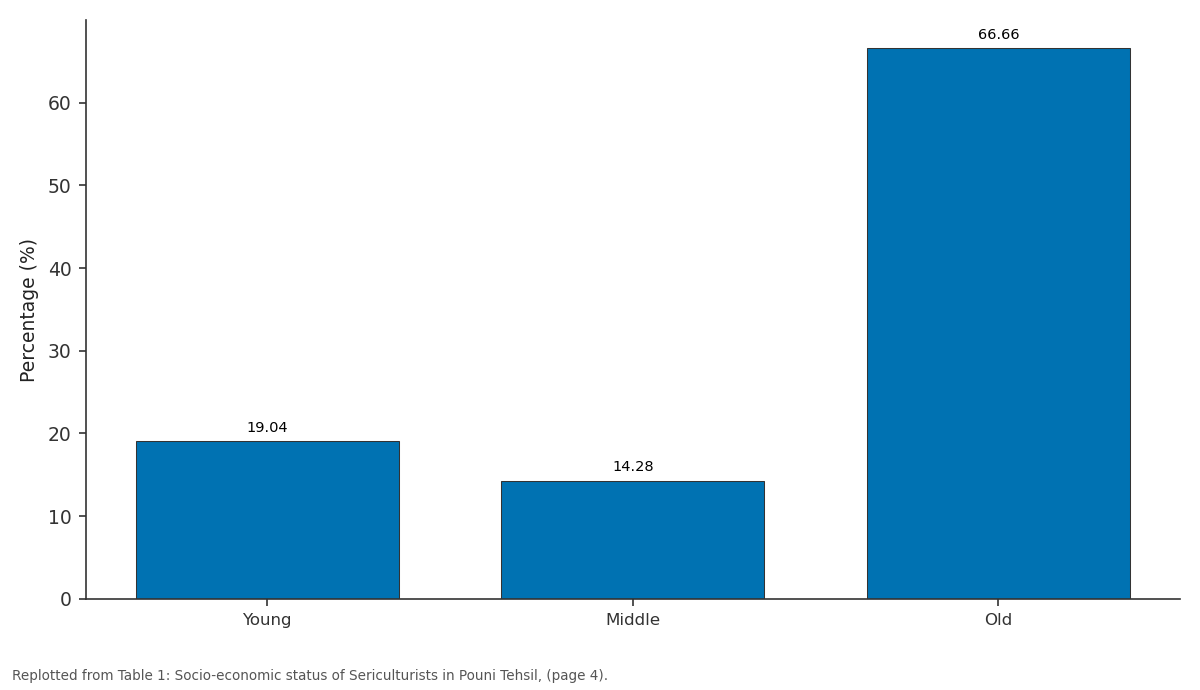
- The majority of the surveyed farmers were elderly, with 66.66% (28 farmers) in the old age group, compared to 14.28% in the middle age and 19.04% in the young age group. View evidence ↗
- Education levels were generally low to moderate: 47.61% (20 farmers) reached secondary level, while 21.42% (9 farmers) were illiterate. View evidence ↗
- Small land holdings were most common, with 52.38% (22 farmers) owning less than 5 acres. View evidence ↗
- All 42 farmers used the Chakmajra mulberry variety, maintained 3x3 ft spacing, and relied on canal irrigation. View evidence ↗
- Cocoon productivity was low across the entire sample, with all 42 farmers producing less than 60 kg per 100 disease-free larvae (DFLs). View evidence ↗
- A lack of knowledge regarding Integrated Pest Management (IPM) for uzi fly and mulberry pests led 83% (35 respondents) to not adopt these technologies. View evidence ↗
What it means
- The authors conclude that low productivity in Pouni Tehsil is caused by poor adoption of recommended technologies, despite the farmers' awareness of them. View evidence ↗
- To improve cocoon yields and farmer livelihoods, the authors recommend enhancing extension services, providing hands-on training, and ensuring the timely supply of quality inputs. View evidence ↗
Visual summary
2 visualsIllustrations explain the paper; charts are replotted from the paper's own table values.
Percentage (%): Young vs Middle vs Old
Replotted from Table 1 (page 4) of the original paper. Every bar is the paper's own table value.
View source evidence ↗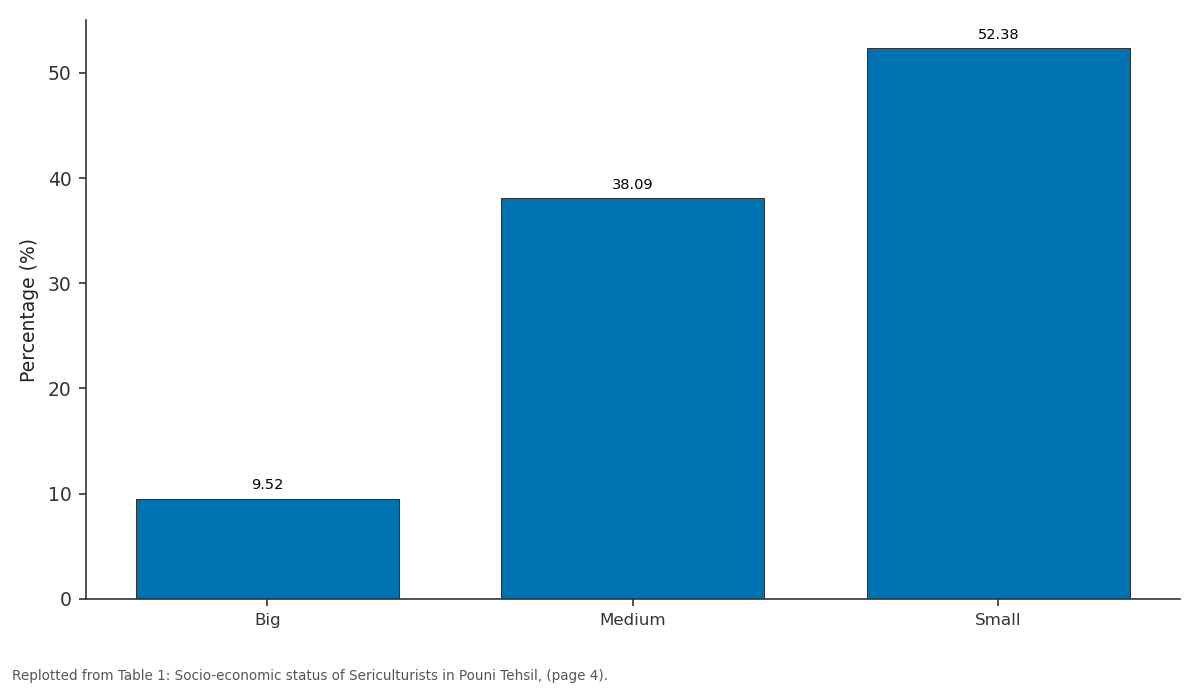
Percentage (%): Big vs Medium vs Small
Replotted from Table 1 (page 4) of the original paper. Every bar is the paper's own table value.
View source evidence ↗Figures & tables
From the original paper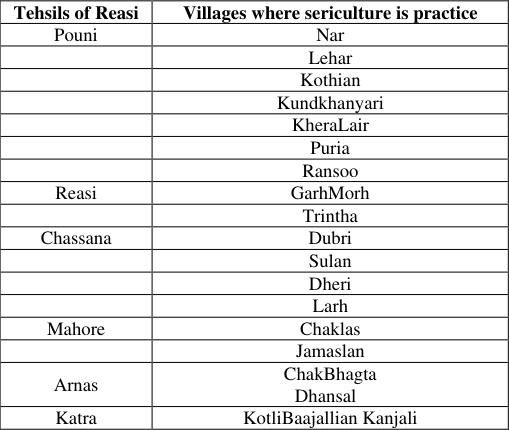 Table 1
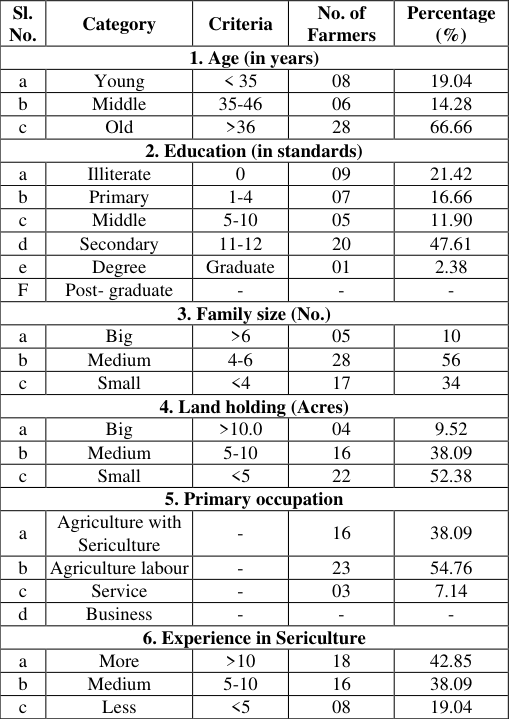 Table 1
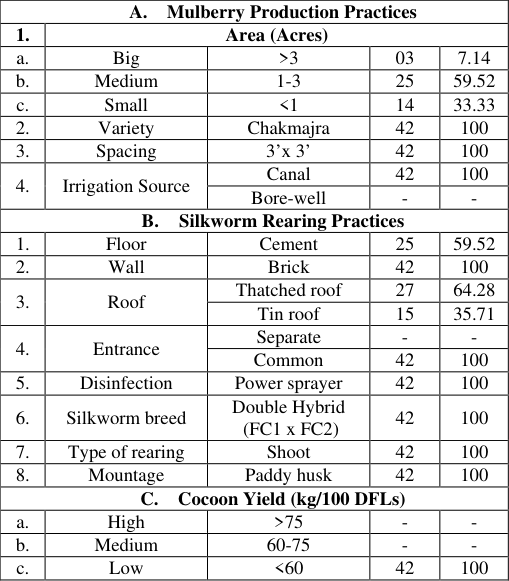 Table 2
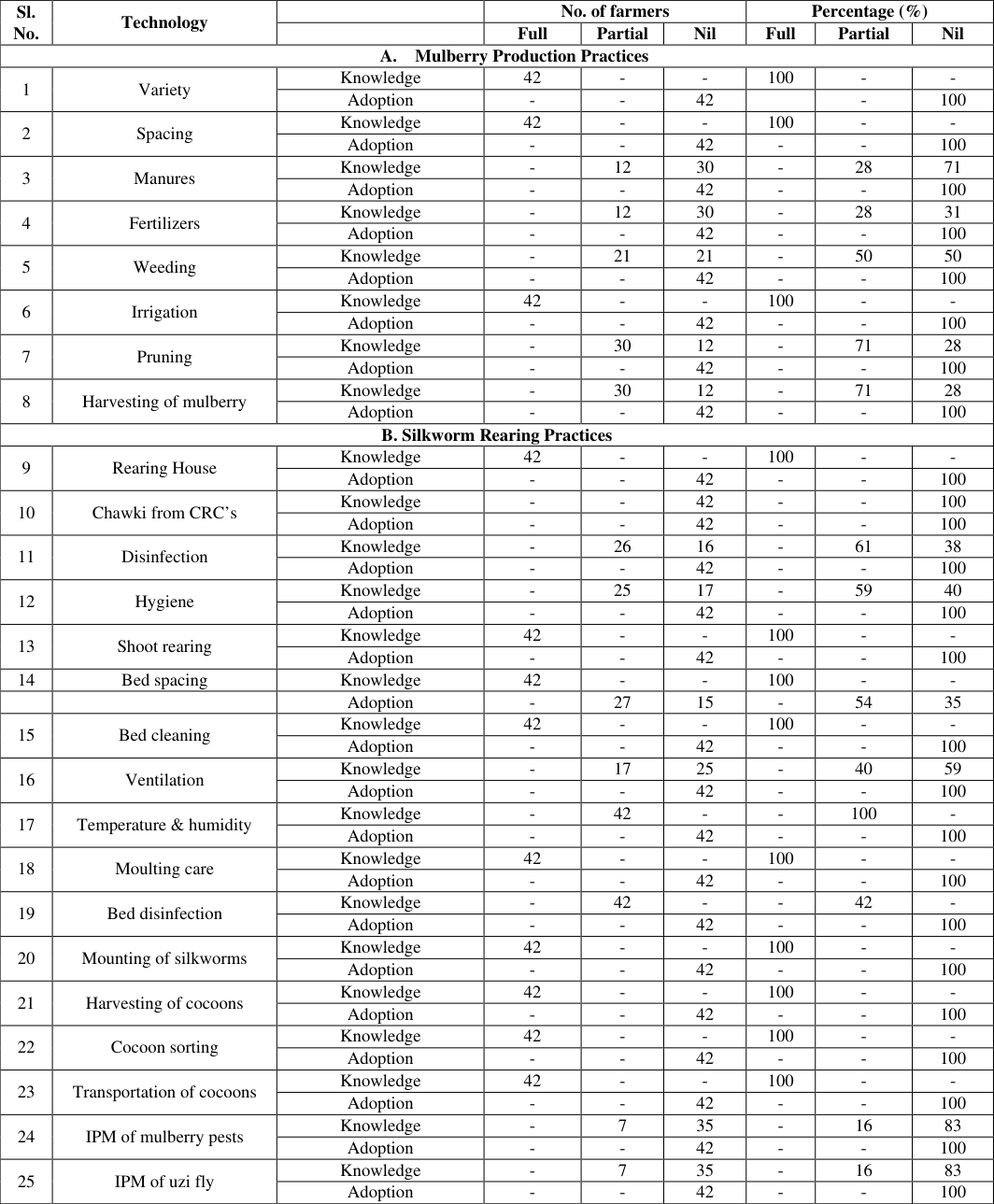 Table 3
Introduction
Silk is the most elegant textile in the world with unparalleled grandeur, natural sheen, and inherent affinity for dyes, high absorbance, light weight, soft touch and high durability and known as the "Queen of Textiles" the world over. On the other hand, it stands for livelihood opportunity for millions owing to high employment oriented, low capital intensive and remunerative nature of its production. The very nature of this industry with its rural based on-farm and off-farm activities and enormous employment generation potential has attracted the attention of the planners and policy makers to recognize the industry among one of the most appropriate avenues for socio-economic development of a largely agrarian economy like India. India has the unique distinction of being the only country producing all the five known commercial silks, namely, mulberry, tropical tasar, oak tasar, eri and muga, of which muga with its golden yellow glitter is unique and prerogative of India. The Ministry of Textiles Government of India and Departments of Sericulture in various states provide technical and financial assistance for enhancing the bivoltine silk production. In Jammu & Kashmir Sericulture is practiced in different districts. Jammu & Kashmir Union Territory produces bivoltine silk in the country. India enjoys the special importance of This chapter deals with the main features of the study area, sampling design, source and method of data collection, statistical methods and tools with the help of which the data were collected, analyzed and interpreted. The methodology adopted for conduct of the study has been presented under the following headings: 1. General characteristics of the study area 2. Sampling design 3. Source and method of data collection 4. Method of data analysis 5. Statistical analysis of data Reasi is a district of the Indian Union territory of Jammu &Kashmir. Covering an area of 1,719km 2 (664 sqm) in the Himalayan mountains, the district has its headquarters in the town of Reasi. The sericulture is practiced in different tehsils of Reasi district. Reasi district comprises nine tehsils i.e., Reasi, Bhomag, Thakrakote, Pouni, Katra, Arnas, Thuroo, Mahore, and Chassana out of which sericulture is practised in six tehsils only. In Pouni tehsil the villages involved in sericulture are Kahana, Lehar, Nar, Kundkhanyari. Nar, Kheralair is the village of Pouni tehsil where the people are involved in silkworm rearing. The climate and soil conditions of Pounitehsil are very suitable for silkworm rearing. The sericulture is practiced in different tehsils of Reasi district. In Reasi district sericulture is the main occupation of the farmers in the villages. In state of Jammu &Kashmir silkworm rearing is conducted in different districts namely Poonch, Reasi, Udhampur, Rajouri, Samba, Kathua, Doda, Kishtwar, Ramban etc. The Reasi districts having a population of 314,667 lakhs (2011census) consists of 9 Tehsils and 12 blocks and 259 villages spreading over an area of 2,380 sqkm. In Reasi district the total area is 862 km 2 including 822.52km2 rural area and 39.01 km 2 urban areas.
Table 1: Tehsil of Reasi district
Table 1: Tehsil of Reasi district
Results
The results of the studies on "Status of Sericulture in India with Special reference to Reasi district in Jammu and Kashmir UT" are presented below:
Socio-economic status of sericulturists
The data on the socio-economic status of Sericulturists among the farmers of the study are tabulated in Table 1.
| Sl. No. | Category | Criteria | No. of Farmers | Percentage (%) |
|---|---|---|---|---|
| 1. Age (in years) | ||||
| a | Young | < 35 | 08 | 19.04 |
| b | Middle | 35-46 | 06 | 14.28 |
| c | Old | >36 | 28 | 66.66 |
| 2. Education (in standards) | ||||
| a | Illiterate | 0 | 09 | 21.42 |
| b | Primary | 1-4 | 07 | 16.66 |
| c | Middle | 5-10 | 05 | 11.90 |
| d | Secondary | 11-12 | 20 | 47.61 |
| e | Degree | Graduate | 01 | 2.38 |
| F | Post- graduate | - | - | - |
| 3. Family size (No.) | ||||
| a | Big | >6 | 05 | 10 |
| b | Medium | 4-6 | 28 | 56 |
| c | Small | <4 | 17 | 34 |
| 4. Land holding (Acres) | ||||
| a | Big | >10.0 | 04 | 9.52 |
| b | Medium | 5-10 | 16 | 38.09 |
| c | Small | <5 | 22 | 52.38 |
| 5. Primary occupation | ||||
| a | Agriculture with Sericulture | - | 16 | 38.09 |
| b | Agriculture labour | - | 23 | 54.76 |
| c | Service | - | 03 | 7.14 |
| d | Business | - | - | - |
| 6. Experience in Sericulture | ||||
| a | More | >10 | 18 | 42.85 |
| b | Medium | 5-10 | 16 | 38.09 |
| c | Less | <5 | 08 | 19.04 |
Table text extracted from the original PDF; superscript letters are shown inline. The original table image is below.
View original table image
| Tehsils of Reasi | Villages where sericulture is practice |
|---|---|
| Pouni | Nar |
| Lehar | |
| Kothian | |
| Kundkhanyari | |
| KheraLair | |
| Puria | |
| Ransoo | |
| Reasi | GarhMorh |
| Trintha | |
| Chassana | Dubri |
| Sulan | |
| Dheri | |
| Larh | |
| Mahore | Chaklas |
| Jamaslan | |
| Arnas | ChakBhagta Dhansal |
| Katra | KotliBaajallian Kanjali |
Table text extracted from the original PDF; superscript letters are shown inline. The original table image is below.
View original table image
Age
Age is a very important factor, which considerably affects the personal and social life of an individual. In this study, the age of the farmers varies from young age to old age. During the study, it was observed that 28 farmers (66.66%) belonged to old age group, while 06 (14.28%) farmers belonged to middle age group and 08 farmers (19.04%) belonged to young age group.
Education
In the present investigation, of the 42 farmers, 09 farmers (21.42%) belong to illiterate group, while 05 farmers (11.90%) comes under a group of 5-10 th standard, followed by 07 farmers (16.66%) belong to primary, followed by 20 farmers (47.61%) secondary levels and 01 farmers (2.38%) belong to degree.
Family size
The study revealed that, majority (28) of the respondents (56%) had medium family size (4-6 members), while 17 farmers (34%) having small family size (<4) and rest of the 5 respondents (10%) having big family size (>6).
Land holding
In the study area, it was observed that, land holding varied among the farmers, 04 farmers (9.52%) are having big land holding (>10 acres), similarly 16 farmers (38.09%) are having medium land holding (5-10 acres) and rest of the 22 farmers (52.38%) are having small land holding (<5 acres).
Primary occupation
The study indicate that agriculture along with sericulture was the main occupation among the 16 respondents (38.09%), 23 farmers (54.76%) are having agriculture as an occupation and only 3 farmers (7.14%) involving in the services.
Mulberry and Silkworm Rearing Practices
The data on the adoption of mulberry and silkworm rearing practices by the farmers of Pouni Tehsil, Reasi District are presented in Table 2.
| A. Mulberry Production Practices | — | — | — | — |
|---|---|---|---|---|
| 1. | Area (Acres) | |||
| a. | Big | >3 | 03 | 7.14 |
| b. | Medium | 1-3 | 25 | 59.52 |
| c. | Small | <1 | 14 | 33.33 |
| 2. | Variety | Chakmajra | 42 | 100 |
| 3. | Spacing | 3’x 3’ | 42 | 100 |
| 4. | Irrigation Source | Canal | 42 | 100 |
| Bore-well | - | - | ||
| B. Silkworm Rearing Practices | ||||
| 1. | Floor | Cement | 25 | 59.52 |
| 2. | Wall | Brick | 42 | 100 |
| 3. | Roof | Thatched roof | 27 | 64.28 |
| Tin roof | 15 | 35.71 | ||
| 4. | Entrance | Separate | - | - |
| Common | 42 | 100 | ||
| 5. | Disinfection | Power sprayer | 42 | 100 |
| 6. | Silkworm breed | Double Hybrid (FC1 x FC2) | 42 | 100 |
| 7. | Type of rearing | Shoot | 42 | 100 |
| 8. | Mountage | Paddy husk | 42 | 100 |
| C. Cocoon Yield (kg/100 DFLs) | ||||
| a. | High | >75 | - | - |
| b. | Medium | 60-75 | - | - |
| c. | Low | <60 | 42 | 100 |
Table text extracted from the original PDF; superscript letters are shown inline. The original table image is below.
View original table image
Mulberry production practices
Among 42 farmers, 25 farmers (59.52%) are having medium land source (1-3 acres), followed by 3 farmers (7.14%) are having big land sources (>3) and rest of the 14 farmers (33.33%) are having less land sources (<1). Among 42 farmers, all are propagating Chakmajra mulberry variety and all are maintaining the 3'x 3' plant spacing. About irrigation, all farmers adopted canal irrigation source.
Silkworm rearing practices
• Floor: All the 25 farmers constructed the floor with the help of cement • Wall: All the farmers constructed the rearing houses with the help of bricks.
• Roof: Majority of the farmers, i.e., 27 farmers (64.28%), had a thatched roof system, and the rest of the 15 farmers (35.71%) had tin rearing houses • Entrance: All 42 farmers (100%) had common entrance. • Disinfection: All the 42 farmers (100%) carried out disinfection with the help of power sprayer.
• Silkworm breed: All the 42 farmers rear double hybrid (FC1 X FC2) silkworm. • Type of rearing: All the 42 farmers adopted shoot rearing technology. • Mountage: All the 42 respondents use paddy husk as mountage for construction of cocoons.
Cocoon yield / 100 DFLs Among 42 farmers, all farmers have less than 60kg.
Knowledge and Adoption of Sericultural Technologies
The data on the knowledge and adoption of sericultural technologies by the farmers of Pouni Tehsil, Reasi District are tabulated in Table 3.
| Sl. No. | Technology | — | No. of farmers | — | — | Percentage (%) | — | — |
|---|---|---|---|---|---|---|---|---|
| Full | Partial | Nil | Full | Partial | Nil | |||
| A. Mulberry Production Practices | ||||||||
| 1 | Variety | Knowledge | 42 | - | - | 100 | - | - |
| Adoption | - | - | 42 | - | 100 | |||
| 2 | Spacing | Knowledge | 42 | - | - | 100 | - | - |
| Adoption | - | - | 42 | - | - | 100 | ||
| 3 | Manures | Knowledge | - | 12 | 30 | - | 28 | 71 |
| Adoption | - | - | 42 | - | - | 100 | ||
| 4 | Fertilizers | Knowledge | - | 12 | 30 | - | 28 | 31 |
| Adoption | - | - | 42 | - | - | 100 | ||
| 5 | Weeding | Knowledge | - | 21 | 21 | - | 50 | 50 |
| Adoption | - | - | 42 | - | - | 100 | ||
| 6 | Irrigation | Knowledge | 42 | - | - | 100 | - | - |
| Adoption | - | - | 42 | - | - | 100 | ||
| 7 | Pruning | Knowledge | - | 30 | 12 | - | 71 | 28 |
| Adoption | - | - | 42 | - | - | 100 | ||
| 8 | Harvesting of mulberry | Knowledge | - | 30 | 12 | - | 71 | 28 |
| Adoption | - | - | 42 | - | - | 100 | ||
| B. Silkworm Rearing Practices | ||||||||
| 9 | Rearing House | Knowledge | 42 | - | - | 100 | - | - |
| Adoption | - | - | 42 | - | - | 100 | ||
| 10 | Chawki from CRC’s | Knowledge | - | - | 42 | - | - | 100 |
| Adoption | - | - | 42 | - | - | 100 | ||
| 11 | Disinfection | Knowledge | - | 26 | 16 | - | 61 | 38 |
| Adoption | - | - | 42 | - | - | 100 | ||
| 12 | Hygiene | Knowledge | - | 25 | 17 | - | 59 | 40 |
| Adoption | - | - | 42 | - | - | 100 | ||
| 13 | Shoot rearing | Knowledge | 42 | - | - | 100 | - | - |
| Adoption | - | - | 42 | - | - | 100 | ||
| 14 | Bed spacing | Knowledge | 42 | - | - | 100 | - | - |
| Adoption | - | 27 | 15 | - | 54 | 35 | ||
| 15 | Bed cleaning | Knowledge | 42 | - | - | 100 | - | - |
| Adoption | - | - | 42 | - | - | 100 | ||
| 16 | Ventilation | Knowledge | - | 17 | 25 | - | 40 | 59 |
| Adoption | - | - | 42 | - | - | 100 | ||
| 17 | Temperature & humidity | Knowledge | - | 42 | - | - | 100 | - |
| Adoption | - | - | 42 | - | - | 100 | ||
| 18 | Moulting care | Knowledge | 42 | - | - | 100 | - | - |
| Adoption | - | - | 42 | - | - | 100 | ||
| 19 | Bed disinfection | Knowledge | - | 42 | - | - | 42 | - |
| Adoption | - | - | 42 | - | - | 100 | ||
| 20 | Mounting of silkworms | Knowledge | 42 | - | - | 100 | - | - |
| Adoption | - | - | 42 | - | - | 100 | ||
| 21 | Harvesting of cocoons | Knowledge | 42 | - | - | 100 | - | - |
| Adoption | - | - | 42 | - | - | 100 | ||
| 22 | Cocoon sorting | Knowledge | 42 | - | - | 100 | - | - |
| Adoption | - | - | 42 | - | - | 100 | ||
| 23 | Transportation of cocoons | Knowledge | 42 | - | - | 100 | - | - |
| Adoption | - | - | 42 | - | - | 100 | ||
| 24 | IPM of mulberry pests | Knowledge | - | 7 | 35 | - | 16 | 83 |
| Adoption | - | - | 42 | - | - | 100 | ||
| 25 | IPM of uzi fly | Knowledge | - | 7 | 35 | - | 16 | 83 |
| Adoption | - | - | 42 | - | - | 100 |
Table text extracted from the original PDF; superscript letters are shown inline. The original table image is below.
View original table image
Mulberry production practices
All the farmers (42) had full knowledge about adoption of recommended variety (Chakmajra) and plant spacing and none of them adopted the technologies. However, 12 farmers (28) had knowledge about application of recommended quantity of manures and fertilizers, but none farmers had full and partial adoption, respectively. Further, all the farmers (42) had knowledge irrigation and 21 farmers weeding, but nil farmers had adoption, respectively. Further, all the farmers had knowledge about pruning and harvesting of mulberry, but 30 of them adopted the recommended pruning method and remaining 12 of them had nil adopted, in contrast to cent percent adoption of shoot harvest of mulberry.
Silkworm rearing practices
All the Sericulturists ( 42) had knowledge about rearing house and CRC's, 42 farmers (100%) had full and 7 farmers and cent per had adoption of rearing house and procured silkworms from CRCs. Though 26 (61%) farmers had partial knowledge about disinfection and hygiene practices followed during silkworm rearing, of which 25 (59%) of them had partial adoption and 42 (100%) farmers had nil adoption of disinfection, while 42 (100%) had full and partial adoption of hygiene practices. All the farmers (42) had full knowledge about shoot rearing technology and silkworm bed spacing. Further, as many as 42 farmers adopted the nil shoot rearing technology, but only 27 farmers (64%) adopted recommended bed spacing for silkworms and 42 farmers (100%) adopted nil. Through all the farmers (42) had full knowledge about silkworm bed cleaning and 42 (100%) of them adopted nil. Sericulturists of the study area 17 (40%) had partial knowledge about ventilation, but only 25 farmers (59%) had nil adoption. However, all 42 farmers had full knowledge on maintenance of temperature and related humidity. All farmers of the study area had knowledge about moulting care and bed disinfection, however, all farmers had nil adoption of moulting. Though all the farmers (42) aware of recommended method and time of mounting of silkworm and harvesting of cocoons and none of them adopted the technologies, respectively. All the sericulturists (42) had knowledge about cocoons sorting and transportation of cocoons for marketing and also had nil adoption (100%) of the technologies. However, 7 (16%) of the farmers possess nil knowledge about IPM of mulberry pests and uzi fly and hence 35 (83%) respondents did not adopt the technologies.
Discussion
The results of the studies on "Socio-economic status on knowledge and adoption of Sericultural technologies among the farmers ofPouni Tehsil, Reasi District" are discussed in the light of earlier works in the following paragraphs: [17] reported that 68.4% of male members (n=519) were engaged in sericulture, of whom 120 as full time job and 235 part time, while 59.8% of the women were engaged in sericulture. Out of which 103 as full time and 156 worked part time basis. Further, they also stated that 37.61% were un-educated followed by 31.4% educated up to primary and 21.3% up to high school.
Socio-Economic Status of
Socio-Economic Status of
Mulberry and Silkworm Rearing Practices
In respect of mulberry production practices, among 42 farmers, 25 farmers (59.52%) are having medium land source (1-3 acres) and 14 farmers (33.33%) are having less land source (<1), further, all of them cultivated Chakmajra mulberry variety by maintaining 3'x 3' plant spacing. About irrigation, none farmers are having bore-well as irrigation source for mulberry garden and 42 farmers (100%) adopted canal water as an irrigation sour. About silkworm rearing practices, all the farmers constructed their rearing houses with the help of cement and brick sand about roof, majority of the farmers i.e., 27 farmers (64%) had thatched roof and rest of the 15 farmers (35.71%) having tin roof rearing house, regarding entrance, all farmers having common entrance and none had separate entry to the rearing house. With respect to disinfection, all the 42 farmers (100%) carry out disinfection with the help of power sprayer. Further, all farmers rear FC1 X FC2 by adopting shoot feeding technology. Cent per cent of the respondents used chandrike as a mountage for cocoon construction. About cocoon yield / 100 DFLs, all farmers harvested cocoon yield of <60kg. Adoption is a decision taken by an individual to continue an innovation. An innovation may be an idea or objective, which is perceived as new by an individual (Rogers, 1962) [37] . Rao and Moulik (1966) [19] concluded that application of nitrogenous fertilizers was partial due to no knowledge. According to Somasundaram (1976) [43] , there was no significant association between socio-economic status and adoption among small farmers. Krishnaswami et al. (1980) [16] reported that by adopting improved techniques of rearing the sericulturists could harvest an average yield of 27.72 kg/100 DFLs in rainfed areas. Kher et al. (1991) [15] reported that increase in education (formal, informal or non-formal) would lead to increase in adoption of technologies by the farmers. Dolli et al. (1993) [10] indicated that number of layings brushed and cocoon yield per unit area was less and productivity was also lower mainly due to non-adoption or partial adoption of improved technologies.
Knowledge and Adoption of Sericultural Technologies
In respect of knowledge and adoption of mulberry variety and plant spacing, cent per cent of the farmers adopted both the technologies. About manures, though all the respondents (12) had partial knowledge about the manures, but 30 farmers (71%) partial adopted and all farmers (100%) are nil adopted. Similarly, about fertilizers 12 farmers had partial knowledge about the importance and quantity of application of fertilizers to mulberry but only partially adopted the technology. About weeding, irrigation, pruning and harvesting of mulberry, all the farmers know about them, about adoption on weeding, 30 farmers (71%) adopted partially, about irrigation all farmers (100%), pruning 30 farmers (71.42%) had partial and harvesting of mulberry 30 farmers (71.42%) had partial knowledge. Among 42 farmers, all of them are having knowledge about rearing house, chawki from CRC's, disinfection, hygiene, shoot rearing, bed spacing, bed cleaning, ventilation, moulting care, bed disinfection, mounting of silkworms, harvesting, sorting and transportation of cocoons. However, adoption of these technologies varies namely rearing house having a partial adoption of 16 (38%) and nil adoption 42 (100%) farmers, chawki from CRC's 42 (100%) had nil knowledge, disinfection 26 (61%) had partial knowledge and 25 (59.52%) farmers had partial knowledge of hygiene, shoot rearing 42 farmers (100%) had full knowledge, bed spacing 27 (54.28%) had partial, bed cleaning 42 (100%) had full knowledge, ventilation 17 (40.47%) had partial knowledge, moulting care 42 (100%) had full knowledge, bed disinfection 42 (100%) had full knowledge, mounting 42 (100%) had full knowledge, harvesting of cocoons 42 (100%) had full knowledge and 42 (100%) farmers had full knowledge of cocoon sorting and transportation 42 farmers (100%), respectively. With regard to knowledge and adoption about temperature and humidity 42 farmers (100%) had full knowledge, IPM of mulberry pests and uzi fly 7 (16%) had partial knowledge and hence they did not adopt them. According to Somasundaram (1976) [43] , there was no significant association between socio-economic status and adoption among small farmers. Krishnaswami et al. (1980) [16] reported that by adopting improved techniques of rearing the sericulturists could harvest an average yield of 27.72 kg/100 DFLs in rainfed areas. Coleman (1951) reported that there was no significant association between the age of respondents, their knowledge and adoption level, on the basis of a research study conducted in a New York rural community. Wilson and Gallup (1955) [47] observed that the farmers in the middle age group adopted more number of practices. SudhakarRao (1993) [44] reported that the young and middle aged farmers could had better understanding about the complexity of uzicide and had favourable perception than the old age farmers who were generally to the traditional practices.
Conclusion
The results of the studies on "Socio-economic status on knowledge and adoption of sericultural technologies among the farmers of Pouni Tehsil, Reasi District" are summarized below:
During the investigation, more farmers belong to old age group and few belong to middle age group, about education, more farmers coming under secondary education and few of them studied upto middle group. In respect of family size, majority of the respondents belong to small family size and few respondents possess big family size, about the land holding, majority of the farmers having small land sources and less number of farmers having big scale land sources. About the primary occupation, all are having agriculture and few in services, further, none of the respondents are in a possession of membership in societal organization and as office bearers. About the experience in sericulture, noticeably more farmers having medium experience and few farmers have less experience. In respect of mulberry production practices, majority of the farmers having medium land source and few farmers having less land source, further, the farmers are having Chakmajra mulberry garden by maintaining 3'x 3' plant spacing. About irrigation, majority all farmers having canal water as an irrigation source. With respect to silkworm rearing practices, all the farmers constructed silkworm rearing house with bricks and cement and majority of them are having thatched roof, however, few of the them having RCC rearing house. All the farmers carry out disinfection with the help of power sprayer and all the respondents rear double hybrid (FC1 X FC2) silkworm adopting shoot method of rearing. Further, all the farmers are using paddy husk as a mountage, about cocoon yield, all of the farmers obtain less yield. Majority of the farmers are in a possession of knowledge and adoption about variety, spacing, manures, fertilizers, weeding, irrigation, pruning, harvesting of mulberry leaves, rearing house, chawki from CRC's disinfection, hygiene, shoot rearing, bed spacing, bed cleaning, ventilation, moulting care, bed disinfection, mounting, harvesting of cocoons, sorting and transportation of cocoons. However, about temperature and humidity, IPM of mulberry pests and IPM of uzi fly all the farmers do not know about knowledge and hence these technologies are not adopted by them.
The study clearly indicated that, Socio-economic status on knowledge and adoption of sericultural technologies among the farmers of Pouni Tehsil, Reasi District" varied greatly and thus the knowledge and adoption of sericultural practices too differed considerably. Hence, concerted efforts must be made by the extension personnel in transfer of improved sericultural technologies among the farmers to maximize cocoon production.
References
46 in the original paper- Anonymous. Report on "Survey on crop production and cocoon loss". World Bank Project -A. Bangalore: UAS; 1984.
- Ashwathanarayana N. A study on the knowledge and adoption of improved silkworm rearing practices and marketing problems of sericulturists in Kolar. [M.Sc. (Agri.) thesis]. Bangalore: UAS; 1989. p.119.
- Byra Reddy HN. A study of differential characteristics of adoption and non-adoption of fertilizers to rainfed ragi in Bangalore North Taluk. [M.Sc. (Agri.) thesis]. Bangalore: UAS; 1971.
- Choudhary KP. Farmers' response to farm planning programme in an AIDP block. Res Found Bull. 1967;89:119-122.
- Choukidar VK, George PS. Adoption behaviour and characteristics of farmers. Indian J Ext Educ. 1972;8(34):40.
- Coleman AL. Differential contact with extension network in New York rural community. Rural Sociol. 1951;16:201-216.
- Das KK. Adoption of improved farm practices in a West Bengal village. Society and Culture. 1970;1(1):81-93.
- Dhanashekara Babu. Role of quality clubs in promoting sericulture -A case study in Mysore and Mandya districts of Karnataka. [M.Sc. dissertation]. Mysore: University of Mysore; 2001.
- Dolli SS, Kalappa HK, Subramaniam RK, Chikkanna, Singh NR, Sen AK, et al. Extent of adoption of improved sericultural practices by the sericulturists. Indian Silk. 1993;31(10):25-30.
- Gopala M. A study on adoption of recommended mulberry cultivation and silkworm rearing practices in developed and less developed areas of Kolar district. [M.Sc. (Agri.) thesis]. Bangalore: UAS; 1991. p.104.
- Jalihal KA. Subsidiary enterprises in dry farming area programmes and strategy. Agric Technol. 1974;2(2):3839.
- Jha PN, Shaktawat GS. Adoption behaviour of farmers towards hybrid bajra cultivation. Indian J Ext Educ. 1972;8:24-32.
- Jolly MS. Appropriate Sericulture Techniques. Mysore: ICTRETS, CSR&TI; 1987.
- Kher SK, Mukku KN, Supe SV. Socio-economic factors contributing to the level of adoption of improved cultural practices of almond. Maharashtra J Ext Educ. 1991;10(1):81.
- Krishnaswami S, Parthasarathy R, Raghavendra M, Syed Samiulla. The role of extension centre in implementing new systems of mulberry cultivation and improved techniques of silkworm rearing in dry farming mulberry tracts of Mysore district. Proc Seric Symp Sem. Coimbatore: Tamil Nadu Agricultural University; 1980. p.210-231.
- Kshama Giridhar KV, Benchamin, Nagaraj CS. Socioevaluation of sericulturists in Karnataka. Indian Silk. 1986;25(12):21-24.
- Lakshmanan S, Mallikarjuna B, Jayaram H, Ganapathy Rao R, Subramaniam MR, Geetha Devi RG, et al. Studies on adoption of sericultural innovations at farmers' level in Tamil Nadu -An empirical analysis. Indian J Seric. 1998;37(1):44-47.
- Lakshmanan S, Mallikarjuna B, Jayaram H, Ganapathy Rao R, Subramaniam MR, Geetha Devi RG, et al. Economic issues on production of mulberry cocoons in Tamil Nadu -Micro economic study. Indian J Seric. 1996;35(2):128-131.
- Lionberger HF. Adoption of New Ideas and Practices. Iowa: Iowa State University Press; 1960. p.96-101. International Journal of Agriculture and Food Science https://www.agriculturaljournals.com
- Madhu Prasad VL, Ramakrishna Naika, Sannappa B. Technological gap in the adoption of integrated management practices for major pests of mulberry. J Seric Technol. 2011;2(1):74-78.
- Mallikarjuna B, Munikrishnappa HM, Guru Raj R, Vijayaprakash NB. Assessment of new technologies of mulberry production and silkworm rearing in rainfed area. Indian J Seric. 2006;45(1):1-6.
- Mani A, Lakshmanan S, Balasaraswathi S, Qadri SMH. Studies on adoption of new sericultural technologies at farmers' field in Erode district of Tamil Nadu: An empirical analysis. Indian J Seric. 2006;45(1):55-57.
- Manjunatha Reddy P, Chinnappa Reddy BV, Govindan R. Income and employment generation in sericulture vis-a-vis alternative crops in Kolar district. In: Chinnaswamy KP, Govindan R, Krishnaprasad NK, Reddy DNR, editors. Non-Mulberry Sericulture, Silk Technology, Sericulture Economics and Extension. Bangalore: Dept. of Sericulture, UAS; 1999. p.114-117.
- Meenal R, Rajan RK. Impact of socio-economic characters of sericulturists on knowledge, adoption and cocoon production in Tamil Nadu. Indian J Seric. 2007;46(1):49-51.
- Motamed MK. Socio-economic and personal correlates of adoption of improved sericulture practices. Sericologia. 2010;50(2):219-226.
- Motamed MK. Knowledge level and constraints to adoption of improved sericulture practices among sericulture growers. Sericologia. 2010;50(4):417-427.
- Narasimhanna MN. Achievements of the Central Sericultural Research and Training Institute, Mysore. Bombay: Central Silk Board; 1973.
- Narasimhanna MN. Report of Tariff Commission on the Continuation of Protection to the Sericulture Industry. Bombay: Ministry of Industry and Commerce, Government of India; 1974. p.18-19.
- Palvanan K. A study on adoption of improved dairy management practices, information sources consulted and problems faced by dairy farmers in Bangalore district. [M.Sc. (Agri.) thesis]. Bangalore: UAS; 1985.
- Pamadi BM. A study on adoption behaviour and consultancy pattern of groundnut grower in Dharwad district, Karnataka state. [M.Sc. (Agri.) thesis]. Bangalore: UAS; 1980.
- Paramashivaiah NT. An economic analysis of impact of size of holdings on farm operations and organizations in Tungabhadra project area. [M.Sc. (Agri.) thesis]. Bangalore: UAS; 1973.
- Pasha Mohideen HM. Future is bright. Indian Silk. 1994;32(11):25-26.
- Prakash Kumar R. A study on adoption of improved sericultural practices and labour utilisation among big, small and tenant farmers of Ramanagara taluk, Bangalore district. [M.Sc. (Agri.) thesis]. Bangalore: UAS; 1986.
- Rajashekaraiah S. A study on the knowledge and adoption of selected recommended practices of silkworm rearing by small and big farmers of Kanakapura taluk, Bangalore district. [M.Sc. (Agri.) thesis]. Bangalore: UAS; 1979.
- Reddy B, Srinivasa Rao TVS, Reddy DC, Krishna Rao JV. Impact of integrated sericultural technologies on mulberry leaf yield and cocoon yield at farmers' level. Indian J Seric. 2008;47(2):155-160.
- Rogers EM. Diffusion of Innovations. New York: The Free Press; 1962. p.250.
- Shetty KK. Non-government organizations in sericulture -Problems and prospects. Indian Silk. 1994;33(6):32-36.
- Sreenivasa DH. A study on adoption of sericultural production technology by farmers and constraints in central dry zone of Karnataka. [M.Sc. (Agri.) thesis]. Bangalore: UAS; 1989.
- Srinivasa G, Dolli SS, Raveendra M, Iyengar MNS. Socio-economic factors and their relation to adoption of improved sericultural practices. Indian J Seric. 1996;35(1):43-45.
- Srinivasa G, Doddagadad CB, Jayaram H, Geetha GS, Geetha Devi RG. A logit function analysis of adoption behaviour of sericulturists in non-traditional areas in Karnataka. Indian J Seric. 1998;37(2):163-166.
- Somasundaram D. A diagnostic study of small farmers with respect to new agricultural technology and its effective communication for adoption. [Ph.D. thesis]. New Delhi: IARI; 1976.
- Sudhakara Rao P. Perception of sericulturists towards R.K.O. and Uzicide and their value orientation -A study in Kolar district. [STS dissertation]. Mysore: CSR&TI; 1993.
- Thangaraju V, John Knight A. Adoption of sericulture technology by trained and untrained sericulturists. Proc Seric Symp Sem. Coimbatore: TNAU; 1980. p.252255.
- Veerabhadraiah V, Dwarakinath R. Study on adoption of hybrid maize in Bangalore district. Mysore J Agric Sci. 1970;4:326-327.
- Wilson MC, Gallup. Extension teaching methods and other factors that influence practices. Extension Service Circular 495. Washington D.C.: Federal Extension Service, USDA; 1955. p.22-25.
- Young JM, Marsh PC. The adoption of recommended farm practices and source of information. Progress Rep 40. Lexington (KY): Kentucky Agric Exp Stn; 1956.
Social participation
None of the farmers were involved in self-help group, membership in organizations and as office bearers.
Experience in sericulture Among the 42 respondents, 18 farmers (42.85%) had high experience, 16 farmers (38.09%) medium experience (5-10 years) and only 8 farmers (19.04%) had less experience (<5 years).