
Research article · 2025 · Full text
International Journal of Agriculture and Food ScienceAssessing human capability dimensions for sustainable rural livelihoods in Bikaner division of Rajasthan
Volume 7(10) · Pages 541–544 · DOI: 10.33545/2664844x.2025.v7.i10h.919 ↗
Research areasAgricultural Innovations and PracticesAgricultural risk and resilienceAgriculture, Land Use, Rural Development
Abstract
Author-writtenThe human capital capabilities of farm families play a crucial role in securing sustainable livelihoods, particularly in ecologically fragile regions like the Bikaner Division of Rajasthan. This study examines the status of human capital among rural households engaged in agriculture under arid and semi-arid conditions, where climatic uncertainties and resource constraints heighten livelihood vulnerabilities. Using an ex-post facto research design and multistage sampling procedure, primary data were collected from farm families through a structured interview schedule supported by secondary sources. Human capital was evaluated using key indicators including educational status, economically active members, health conditions, vocational training, and migration for wage work, traditional skill proficiency, and occupational knowledge. Results reveal that households possess adequate family labor and strong experience-based occupational knowledge, enabling them to sustain agricultural activities despite limited resources. However, low participation in formal training programs, minimal skill diversification, and negligible retention of traditional skills indicate critical constraints in human capability enhancement. Findings highlight the dependence on off-farm wage migration as a coping strategy in response to agricultural uncertainty. The study concludes that strengthening access to education, health services, and capacity-building initiatives is essential to improve adaptive capability, promote livelihood diversification, and build long-term resilience of farm families in the region. Targeted interventions focusing on youth and women can significantly uplift overall human capital and contribute to sustainable rural development.
Summary
Source-checkedPlain-language reading of the full paper, prepared with AI and checked against the text. Each point links to the authors' own words.
Why it matters
- Farming in the Bikaner Division of Rajasthan is highly vulnerable due to its arid and semi-arid environment and reliance on unstable water sources. View evidence ↗
- Human capital, which includes health, education, and skills, is a critical factor in determining how well farm families can adapt and remain productive. View evidence ↗
- Livelihood improvements in rural Rajasthan are hindered by poor access to healthcare, education, and a lack of diverse skills. View evidence ↗
The question
- The study aims to evaluate the human dimensions of sustainable livelihoods in the Bikaner Division by analyzing labor participation, training, health, and literacy. View evidence ↗
What they did
- The researchers used an ex-post facto research design to assess human capital among farm families in the Bikaner division. View evidence ↗
- Respondents were selected using a multistage sampling procedure involving random village selection and proportionate household selection. View evidence ↗
- Data were collected from 300 farm families through face-to-face interviews using a structured, pre-tested schedule. View evidence ↗
- Human capital was measured using indicators such as education, age, family size, health status, and access to training. View evidence ↗
What they found
- Most households have a strong labor base, with 49.3% having 3-4 economically active members and 41.7% having more than 4. View evidence ↗
- Physical disability is rare in the surveyed households, with 95.3% reporting no disabled members. View evidence ↗
- Off-farm wage migration is a common coping strategy, with 40.0% of households having more than 2 members migrate for work. View evidence ↗
- Formal vocational training is severely lacking, as 80.3% of families reported no participation in such programs. View evidence ↗
- There is a significant loss of indigenous knowledge, as 93.7% of respondents did not possess traditional occupational skills. View evidence ↗
- Despite low formal training, occupational knowledge is relatively high, with 41.0% rated as excellent and 31.7% as good. View evidence ↗
- The overall human capital index was slightly higher in Bikaner (15.46) compared to Hanumangarh (15.06), with a total average of 15.26. View evidence ↗
What it means
- The authors conclude that improving access to health, education, and capacity-building is essential for enhancing the resilience and adaptive capacity of farm families. View evidence ↗
- The authors recommend targeted interventions for women and youth to uplift human capital and support sustainable rural development. View evidence ↗
Visual summary
3 visualsIllustrations explain the paper; charts are replotted from the paper's own table values.
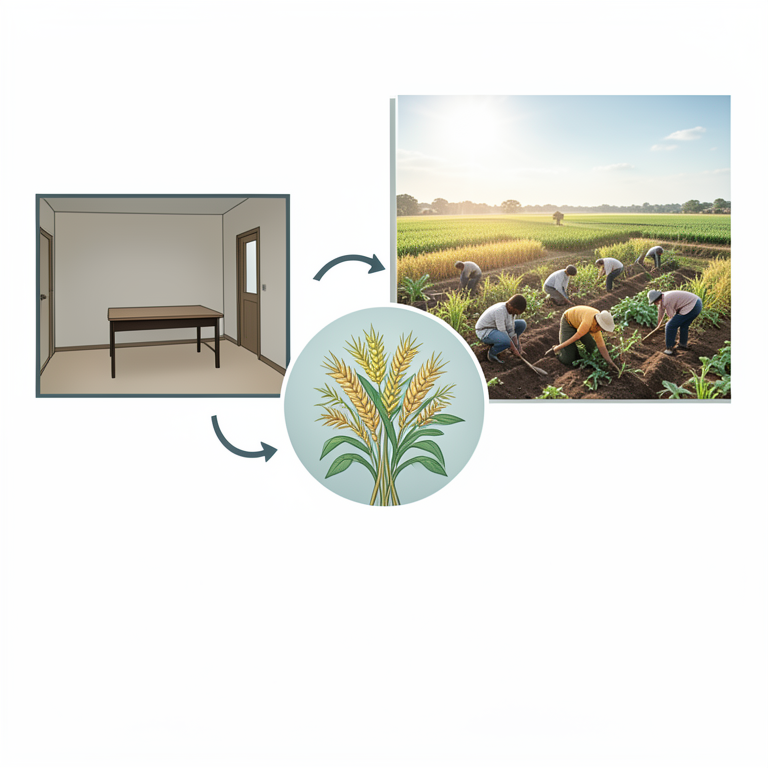
Formal vs. Experiential Knowledge Gap
AI-generated conceptual illustration (Rural farmers in Bikaner, Rajasthan). It explains the idea and does not show study data.
View source evidence ↗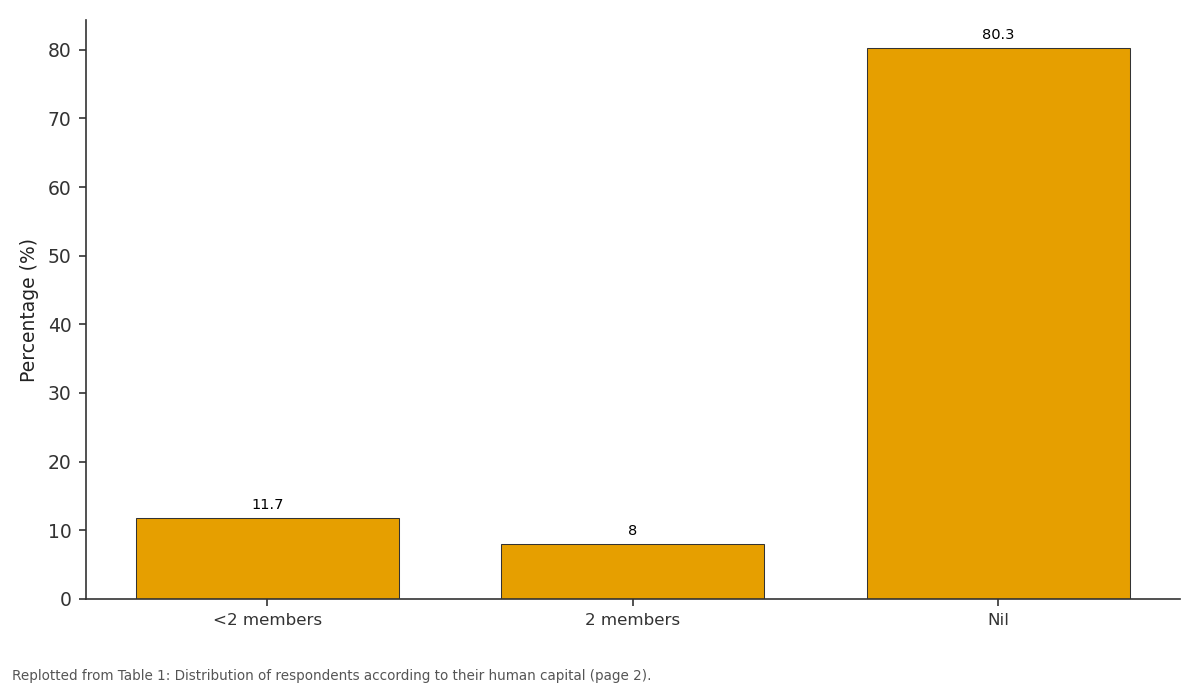
(%): <2 members vs 2 members vs Nil
Replotted from Table 1 (page 2) of the original paper. Every bar is the paper's own table value.
View source evidence ↗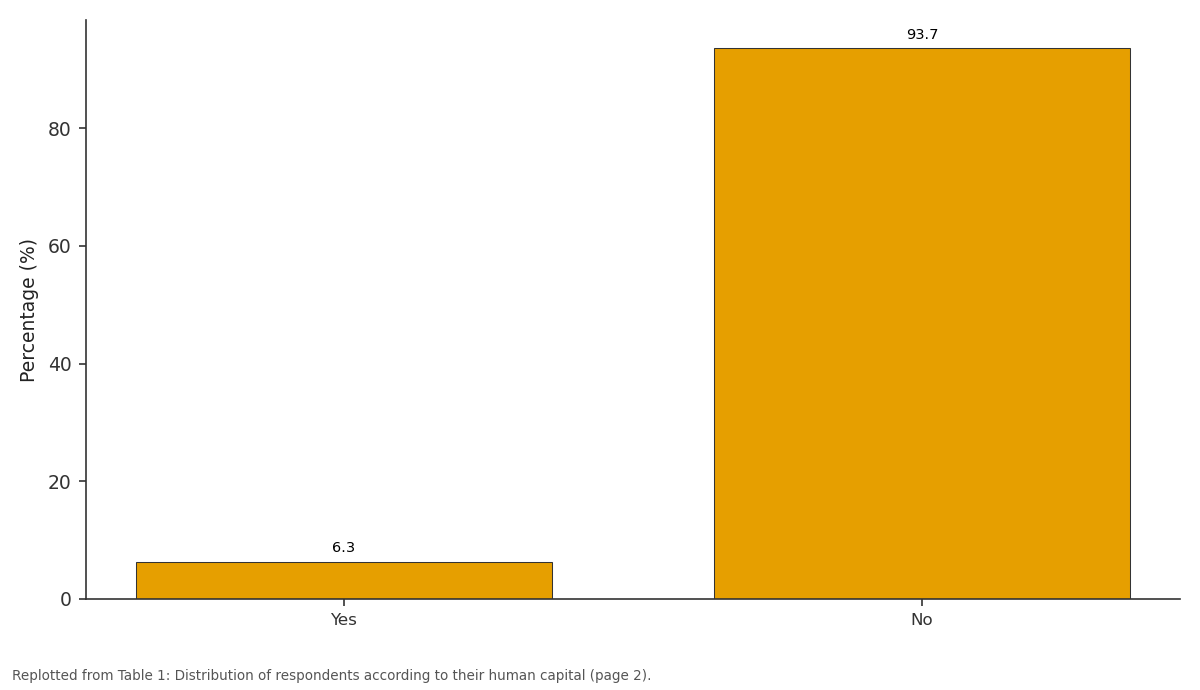
(%): Yes vs No
Replotted from Table 1 (page 2) of the original paper. Every bar is the paper's own table value.
View source evidence ↗Figures & tables
From the original paper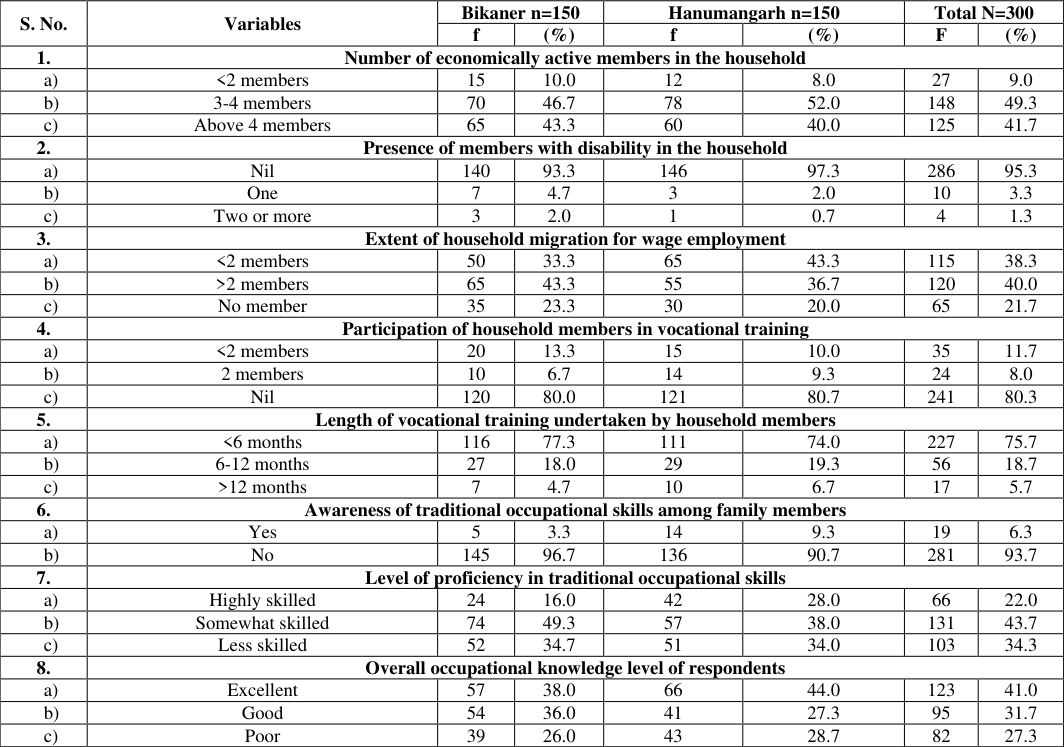 Table 1
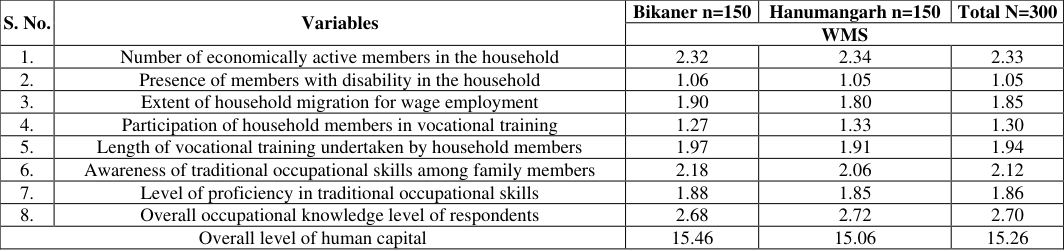 Table 2
Introduction
Agriculture remains the central pillar of India’s rural economy, providing livelihoods to a majority of its population. In Rajasthan, particularly the Bikaner Division, farming operates under arid and semi-arid conditions, where dependence on rainfall, canal irrigation, and groundwater exposes farm families to frequent climatic and resource-related vulnerabilities. The sustainability of rural livelihoods in such regions depends heavily on the capabilities of individuals and households to adapt, innovate, and manage available resources effectively. Human capital a core element of livelihood capabilities comprises education, health, skills, knowledge, and labor availability that collectively determine the adaptive capacity and productivity of farm families.
It not only influences the efficient use of physical and natural resources but also affects participation in agricultural innovation and decision-making processes. Households with higher levels of education and better health status tend to diversify income sources, adopt improved practices, and maintain stronger resilience against livelihood shocks. In rural Rajasthan, limited access to educational facilities, inadequate healthcare services, and low skill diversification have constrained the development of human capital, thereby limiting livelihood improvements. Gender disparities further exacerbate these challenges, particularly for women-headed households that shoulder multiple responsibilities with restricted access to institutional and extension support.
Exploring the human capital capabilities of farm families is thus essential to understand their overall livelihood strength and vulnerability profile. By assessing factors such as literacy, training, health awareness, and labor participation, this study aims to reveal the human dimension of livelihood sustainability in the Bikaner Division of Rajasthan. NAAS Rating (2025): 4.97 IJAFS 2025; 7(10): 541-544 Manisha Sharma Ph.D. Research Scholar, Department of Extension Education and Communication Management, College of Community Science, SKRAU, Bikaner, Rajasthan, India Dr.
Neena Sareen Professor, Department of Extension Education and Communication Management, College of Community Science, SKRAU, Bikaner, Rajasthan, India Manisha Sharma Ph.D. Research Scholar, Department of Extension Education and Communication Management, College of Community Science, SKRAU, Bikaner, Rajasthan, India https://www.agriculturaljournals.com Research Methodology The present study adopted an ex-post facto research design to assess the human capital component of livelihood capabilities among farm families in the Bikaner division of Rajasthan. The locale of research included purposively selected districts within the division, where agriculture forms the primary livelihood source. A multistage sampling procedure was used for selection of respondents; villages were randomly selected and from each selected village, farm households were chosen proportionately to ensure adequate representation.
A total of farm families were surveyed using a structured and pre-tested interview schedule administered in face-to-face interactions. Human capital was operationalized through measurable indicators including age, education, family size, farming experience, health and nutritional status, skill acquisition, extension contact, and access to training, among others. Primary data were supported with secondary information obtained from published reports, government documents, and online sources. Data collected were coded, tabulated, and analyzed using descriptive statistics such as frequency, percentage, mean, and standard deviation to portray the profile and human capability status of farm families.
The overall
Methodology
ensured reliability and validity through careful tool design, pilot testing, and standardized data collection procedures.
Results And Discussion
Table 1: Distribution of respondents according to their human capital respondents underwent training for less than 6 months, 18.7 percent between 6-12 months, and just 5.7 percent for more than a year. Traditional skills were reported by only 6.3 percent of respondents, whereas 93.7 percent did not possess such skills. In terms of knowledge regarding traditional skills, 43.7 percent were somewhat skilled, 34.3 percent less skilled, and 22.0 percent highly skilled. Finally, in occupational knowledge, 41.0 percent were rated as excellent, 31.7 percent as good, and 27.3 percent as poor.
| S. No. | Variables | Bikaner n=150 | — | Hanumangarh n=150 | — | Total N=300 | — |
|---|---|---|---|---|---|---|---|
| f | (%) | f | (%) | F | (%) | ||
| 1. | Number of economically active members in the household | ||||||
| a) | <2 members | 15 | 10.0 | 12 | 8.0 | 27 | 9.0 |
| b) | 3-4 members | 70 | 46.7 | 78 | 52.0 | 148 | 49.3 |
| c) | Above 4 members | 65 | 43.3 | 60 | 40.0 | 125 | 41.7 |
| 2. | Presence of members with disability in the household | ||||||
| a) | Nil | 140 | 93.3 | 146 | 97.3 | 286 | 95.3 |
| b) | One | 7 | 4.7 | 3 | 2.0 | 10 | 3.3 |
| c) | Two or more | 3 | 2.0 | 1 | 0.7 | 4 | 1.3 |
| 3. | Extent of household migration for wage employment | ||||||
| a) | <2 members | 50 | 33.3 | 65 | 43.3 | 115 | 38.3 |
| b) | >2 members | 65 | 43.3 | 55 | 36.7 | 120 | 40.0 |
| c) | No member | 35 | 23.3 | 30 | 20.0 | 65 | 21.7 |
| 4. | Participation of household members in vocational training | ||||||
| a) | <2 members | 20 | 13.3 | 15 | 10.0 | 35 | 11.7 |
| b) | 2 members | 10 | 6.7 | 14 | 9.3 | 24 | 8.0 |
| c) | Nil | 120 | 80.0 | 121 | 80.7 | 241 | 80.3 |
| 5. | Length of vocational training undertaken by household members | ||||||
| a) | <6 months | 116 | 77.3 | 111 | 74.0 | 227 | 75.7 |
| b) | 6-12 months | 27 | 18.0 | 29 | 19.3 | 56 | 18.7 |
| c) | >12 months | 7 | 4.7 | 10 | 6.7 | 17 | 5.7 |
| 6. | Awareness of traditional occupational skills among family members | ||||||
| a) | Yes | 5 | 3.3 | 14 | 9.3 | 19 | 6.3 |
| b) | No | 145 | 96.7 | 136 | 90.7 | 281 | 93.7 |
| 7. | Level of proficiency in traditional occupational skills | ||||||
| a) | Highly skilled | 24 | 16.0 | 42 | 28.0 | 66 | 22.0 |
| b) | Somewhat skilled | 74 | 49.3 | 57 | 38.0 | 131 | 43.7 |
| c) | Less skilled | 52 | 34.7 | 51 | 34.0 | 103 | 34.3 |
| 8. | Overall occupational knowledge level of respondents | ||||||
| a) | Excellent | 57 | 38.0 | 66 | 44.0 | 123 | 41.0 |
| b) | Good | 54 | 36.0 | 41 | 27.3 | 95 | 31.7 |
| c) | Poor | 39 | 26.0 | 43 | 28.7 | 82 | 27.3 |
Table text extracted from the original PDF; superscript letters are shown inline. The original table image is below.
View original table image
The data suggest that farm families possess a moderate level of human capital, with a strong base of economically active members, minimal disability, and reasonable occupational knowledge. The substantial migration for wage earning points to reliance on off-farm income to supplement livelihoods. However, the low exposure to vocational training and short duration of training programs indicate S. No.
Variables Bikaner n=150 Hanumangarh n=150 Total N=300 f (%) f (%) F (%) 1. Number of economically active members in the household a) <2 members 15 10.0 12 8.0 27 9.0 b) 3-4 members 70 46.7 78 52.0 148 49.3 c) Above 4 members 65 43.3 60 40.0 125 41.7 2. Presence of members with disability in the household a) Nil 140 93.3 146 97.3 286 95.3 b) One 7 4.7 3 2.0 10 3.3 c) Two or more 3 2.0 1 0.7 4 1.3 3. Extent of household migration for wage employment a) <2 members 50 33.3 65 43.3 115 38.3 b) >2 members 65 43.3 55 36.7 120 40.0 c) No member 35 23.3 30 20.0 65 21.7 4.
Participation of household members in vocational training a) <2 members 20 13.3 15 10.0 35 11.7 b) 2 members 10 6.7 14 9.3 24 8.0 c) Nil 120 80.0 121 80.7 241 80.3 5. Length of vocational training undertaken by household members a) <6 months 116 77.3 111 74.0 227 75.7 b) 6-12 months 27 18.0 29 19.3 56 18.7 c) >12 months 7 4.7 10 6.7 17 5.7 6. Awareness of traditional occupational skills among family members a) Yes 5 3.3 14 9.3 19 6.3 b) No 145 96.7 136 90.7 281 93.7 7. Level of proficiency in traditional occupational skills a) Highly skilled 24 16.0 42 28.0 66 22.0 b) Somewhat skilled 74 49.3 57 38.0 131 43.7 c) Less skilled 52 34.7 51 34.0 103 34.3 8.
Overall occupational knowledge level of respondents a) Excellent 57 38.0 66 44.0 123 41.0 b) Good 54 36.0 41 27.3 95 31.7 c) Poor 39 26.0 43 28.7 82 27.3 Table 1 presents the distribution of respondents according to their human capital across eight dimensions in Bikaner and Hanumangarh districts. Regarding economically active members, 49.3 percent of families reported having 3-4 members, followed by 41.7 percent with above 4 members, while only 9.0 percent had fewer than 2 members. In terms of disabled members in the family, a large majority (95.3%) reported nil, while 3.3 percent had one disabled member and 1.3 percent had two or more. With respect to family members migrating for wage earning, 40.0 percent had more than 2 members migrating, 38.3 percent had fewer than 2, and 21.7 percent reported no member migrating.
Vocational training exposure was very low as 80.3 percent of families reported nil training, 11.7 percent had less than 2 members trained, and only 8.0 percent had exactly 2 members trained. Regarding the duration of training, 75.7 percent of https://www.agriculturaljournals.com limited formal skill enhancement. The near absence of traditional skills further highlights gaps in preserving indigenous knowledge, while the moderate-to-high occupational knowledge reflects experience-based learning rather than structured training. The relatively better occupational knowledge in some households may be linked to exposure to extension services, peer learning, and cumulative experience in farming and allied activities.
Table 2 Overall human capital score of farm families Table 2: Distribution of respondents according to their overall level of human capital S. No. Variables Bikaner n=150 Hanumangarh n=150 Total N=300 specific areas for improvement, particularly in formal vocational training and skill development. Strengthening these aspects could optimize labor productivity, facilitate livelihood diversification, and enhance resilience among farm households.
| S. No. | Variables | Bikaner n=150 | Hanumangarh n=150 | Total N=300 |
|---|---|---|---|---|
| WMS | ||||
| 1. | Number of economically active members in the household | 2.32 | 2.34 | 2.33 |
| 2. | Presence of members with disability in the household | 1.06 | 1.05 | 1.05 |
| 3. | Extent of household migration for wage employment | 1.90 | 1.80 | 1.85 |
| 4. | Participation of household members in vocational training | 1.27 | 1.33 | 1.30 |
| 5. | Length of vocational training undertaken by household members | 1.97 | 1.91 | 1.94 |
| 6. | Awareness of traditional occupational skills among family members | 2.18 | 2.06 | 2.12 |
| 7. | Level of proficiency in traditional occupational skills | 1.88 | 1.85 | 1.86 |
| 8. | Overall occupational knowledge level of respondents | 2.68 | 2.72 | 2.70 |
| Overall level of human capital | 15.46 | 15.06 | 15.26 |
Table text extracted from the original PDF; superscript letters are shown inline. The original table image is below.
View original table image
These findings align with previous research by Singh and Sharma (2018) [13] and Kumar et al. (2020) [14], which emphasize the reliance of rural households on experiential knowledge and family labor, and highlight the limited reach of formal vocational training programs. The Rajasthan Livelihood Survey (2017) similarly underscores that targeted initiatives to improve human capital through structured education and training can significantly boost agricultural efficiency and adoption of modern practices.
Conclusion
The assessment of human capital among farm families in the Bikaner Division reveals a livelihood structure driven primarily by family labor and experience-based knowledge rather than formal skill development. Most households possess a strong base of economically active members with minimal physical constraints, enabling them to sustain agricultural and allied activities. Wage-based migration continues to serve as an important strategy to supplement farm income, reflecting the economic insecurity inherent in arid agriculture. The study highlights a clear gap in vocational training exposure, technical skill enhancement, and preservation of traditional skills, which limits the ability of farm families to diversify livelihoods or adopt improved innovations.
The comparatively high level of occupational knowledge indicates that farmers have developed practical competencies over time, yet these capabilities require institutional reinforcement to translate into improved productivity and resilience. Strengthening access to education, health care, training programs, and extension support can play a crucial role in enhancing the adaptive capacity of these households. Focused interventions for women and youth, as well as targeted skill-building initiatives, hold potential for transforming the human capital landscape. Overall, the findings underscore that investments in human capital development are essential to secure and stabilize rural livelihoods in the Bikaner Division, enabling farm families to better navigate climatic risks, optimize WMS 1.
Number of economically active members in the household 2.32 2.34 2.33 2. Presence of members with disability in the household 1.06 1.05 1.05 3. Extent of household migration for wage employment 1.90 1.80 1.85 4. Participation of household members in vocational training 1.27 1.33 1.30 5.
Length of vocational training undertaken by household members 1.97 1.91 1.94 6. Awareness of traditional occupational skills among family members 2.18 2.06 2.12 7. Level of proficiency in traditional occupational skills 1.88 1.85 1.86 8. Overall occupational knowledge level of respondents 2.68 2.72 2.70 Overall level of human capital 15.46 15.06 15.26 The weighted mean scores (WMS) of human capital indicators among respondents in Bikaner and Hanumangarh districts provide a comprehensive understanding of the labor composition, skill levels, and knowledge base within farm households.
The number of economically active members in the household was nearly identical across the two districts, with Bikaner recording a WMS of 2.32 and Hanumangarh 2.34, resulting in an overall WMS of 2.33. This indicates that households generally possess an adequate labor force to manage agricultural and allied activities effectively. The presence of disabled members in households was minimal, with WMS values of 1.06 in Bikaner and 1.05 in Hanumangarh, suggesting that physical limitations do not significantly constrain household productivity. Migration for wage employment showed moderate variation, with Bikaner scoring 1.90 and Hanumangarh 1.80 (overall 1.85), reflecting slightly higher off-farm labor engagement in Bikaner, whereas households in Hanumangarh retain a larger proportion of members locally for farm work.
Participation in vocational training remained limited, with WMS values of 1.27 in Bikaner and 1.33 in Hanumangarh (overall 1.30), and the length of training undertaken was short-term (1.97 in Bikaner, 1.91 in Hanumangarh; overall 1.94), indicating minimal enhancement of technical skills through formal training programs. Awareness of traditional occupational skills showed slightly higher scores in Bikaner (2.18) compared to Hanumangarh (2.06), reflecting a stronger retention of indigenous knowledge. Similarly, the level of proficiency in traditional skills was marginally higher in Bikaner (1.88) than Hanumangarh (1.85), suggesting a modest advantage in practical agricultural competencies. Overall occupational knowledge was the strongest indicator, with WMS values of 2.68 in Bikaner and 2.72 in Hanumangarh, resulting in the highest overall WMS of 2.70.
This highlights a relatively high capacity among households to apply acquired knowledge and practices to agricultural activities. The cumulative human capital index, calculated as the sum of all WMS values, was slightly higher in Bikaner (15.46) than Hanumangarh (15.06), giving an overall WMS of 15.26. This suggests that while both districts maintain a functional and balanced human capital profile, there remain https://www.agriculturaljournals.com resource utilization, and pursue sustainable livelihood diversification.
References
15 in the original paper- Aafaw A, Simane B, Hassen A, Bantider A. Determinants of non-farm livelihood diversification: evidence from rainfed-dependent smallholder farmers in north central Ethiopia (Woleka sub-basin). Development Studies Research. 2017;4(1):22-36.
- Akter S. Investigation of livelihood security in poor settlements in Bangladesh. In: 86th Annual Conference of Agricultural Economic Society; 2016; University of Warwick, UK. https://www.warwick.ac.uk
- Punia A. Livelihood security of small and marginal farm families in Rohtak division of Haryana state [PhD thesis]. Hisar (IN): CCS Haryana Agricultural University; 2017.
- Bhargava M. An overview of fertilizer subsidies in India. Zenith International Journal of Business Economics and Management Research. 2015;5(5):138- 147.
- Food and Agriculture Organization (FAO). Working with local institutions to support sustainable livelihoods. Rome: FAO; 2000.
- Jodha R. Livelihood security of small and marginal farm families in Gurgaon Division of Haryana State [PhD thesis]. Hisar (IN): CCS Haryana Agricultural University; 2018.
- Naser I, Jalil R, Muda WA. Association between household food insecurity and nutritional outcomes among children in Northeastern Peninsular Malaysia. Nutrition Research and Practice. 2014;8(3):304-311.
- Orisakwe L, Agomuo FO. Adoption of improved agroforestry technologies among contact farmers in Imo State, Nigeria. Asian Journal of Agriculture and Rural Development. 2016;2(1):1-9.
- Prasanna P. Socio-economic empowerment of women construction workers in Tamil Nadu. International Journal of Multidisciplinary Research. 2016;3(3):1-7.
- Sakamma S, et al. Women’s role and challenges in Indian agriculture. International Journal of Agriculture Sciences. 2018;10(18):7177-7179.
- Shrilakshmi B. Nutrition sciences. New Delhi: New Age International (P) Ltd.; 2018. p. 417-418, 437-439.
- Singha AK, Talukdar RK. Protection of forest resources. Indian Journal of Extension Education. 2014;23(3-4):186-193.
- Punit N, Singh R. A statistical analysis of human and environmental indicators to measure development process: A case study. Int J Geogr Geol Environ 2023;5(1):168-176. DOI: 10.22271/27067483.2023.v5.i1b.158
- Singh D, Sharma RR. Postharvest diseases of fruits and vegetables and their management. InPostharvest disinfection of fruits and vegetables 2018 Jan 1 (pp. 1- 52). Academic Press.
- Kumar M, Patel AK, Shah AV, Raval J, Rajpara N, Joshi M, Joshi CG. First proof of the capability of wastewater surveillance for COVID-19 in India through detection of genetic material of SARS-CoV-2. Science of The Total Environment. 2020 Dec 1;746:141326.