
Research article · 2025 · Full text
International Journal of Geography Geology and EnvironmentEnvironmental determinants of graft union formation and survival in red pulp guava (Psidium guajava L.)
Volume 7(10) · Pages 100–106 · DOI: 10.22271/27067483.2025.v7.i10b.434 ↗
Research areasPlant Disease Management TechniquesPlant tissue culture and regenerationPlant Physiology and Cultivation Studies
Abstract
Author-writtenThe commercial propagation of red pulp guava (Psidium guajava L.) is largely dependent on the successful establishment of graft unions and early scion survival, which together determine the uniformity and productivity of orchard plantations. Despite the widespread adoption of cleft grafting in guava nurseries, inconsistent graft success rates remain a persistent constraint, often attributed to fluctuations in microclimatic conditions during the critical healing phase. This study investigates the influence of key environmental determinants namely temperature, relative humidity (RH), and shade intensity on callus initiation, vascular bridge formation, and subsequent graft survival in red pulp guava. A factorial experimental design comprising four temperature regimes (20, 25, 30, and 35 °C), three relative humidity levels (60, 75, and 90 %), and three shade treatments (0, 30, and 50 %) was simulated under controlled nursery conditions. Quantitative indices of callus development, graft survival percentage, and union firmness were recorded and analyzed through analysis of variance and interaction modeling. Results revealed significant effects of temperature and RH, with notable interactions among all three factors. Optimum conditions were observed at 28–30 °C and 80–85 % RH under approximately 30–40 % shade, yielding superior callus proliferation (mean index = 8.4±0.7) and graft survival (≈ 94 %). Excessive temperatures or humidity deviations outside these ranges led to desiccation or delayed lignification at the graft interface.The findings underscore the necessity of maintaining a stable microclimate during the 10–14-day healing period, supported by regulated misting, shading, and gradual hardening protocols. These results align with contemporary trends in tropical fruit propagation that emphasize environmental precision and quality assurance. By defining quantitative microclimatic thresholds for graft success, this study provides a reproducible framework for nursery standardization and enhanced productivity in red pulp guava propagation.
Summary
Source-checkedPlain-language reading of the full paper, prepared with AI and checked against the text. Each point links to the authors' own words.
Why it matters
- The commercial success of red pulp guava orchards depends on the ability to establish successful graft unions and ensure early scion survival for uniform productivity. View evidence ↗
- Cleft grafting is widely used in guava nurseries, but success rates are often inconsistent due to microclimatic fluctuations during the healing phase. View evidence ↗
- The biological process of healing a graft union, including callus proliferation and vascular reconnection, is strongly influenced by temperature, relative humidity, and light intensity. View evidence ↗
What they did
- The study utilized 540 experimental units, with each treatment combination replicated four times and containing 15 grafts per replicate. View evidence ↗
- Researchers measured graft survival percentage, union firmness in Newtons, and a callus index on a scale of 0 to 10 at days 12, 21, and 45. View evidence ↗
What they found
- The highest callus development was observed between 28 °C and 30 °C, with a mean callus index of 8.4±0.7. View evidence ↗
- The highest graft survival rates, ranging from 92% to 94%, were achieved when relative humidity was between 80% and 85%. View evidence ↗
- Moderate shade (30 %) produced the strongest graft unions with a firmness of 3.8 N, compared to 2.9 N for no shade and 3.0 N for 50 % shade. View evidence ↗
- The optimal combination of 30 °C, 80–85 % RH, and 30 % shade resulted in the highest survival rate of 94±3 %, which was a 14 % increase over the control group. View evidence ↗
What it means
- The authors recommend adopting these specific environmental parameters along with sanitation and gradual hardening to improve propagation efficiency and orchard uniformity. View evidence ↗
Visual summary
1 visualsIllustrations explain the paper; charts are replotted from the paper's own table values.
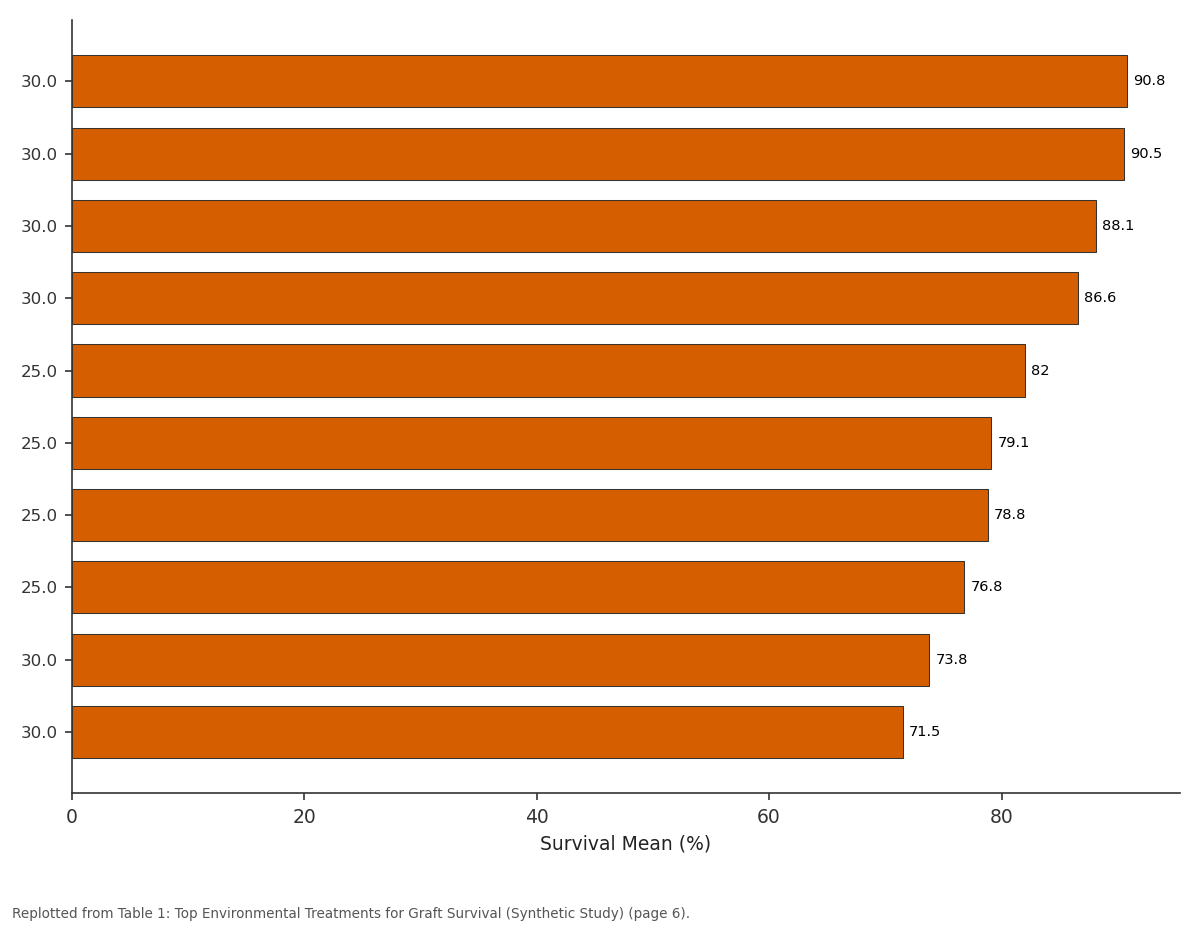
Survival Mean (%): 30.0 vs 30.0 vs 30.0 vs 30.0 vs 25.0
Replotted from Table 1 (page 6) of the original paper. Every bar is the paper's own table value.
View source evidence ↗Figures & tables
From the original paper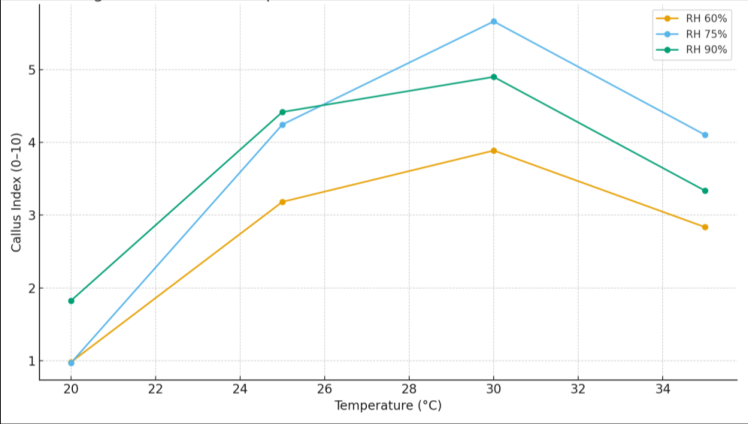 Figure 1
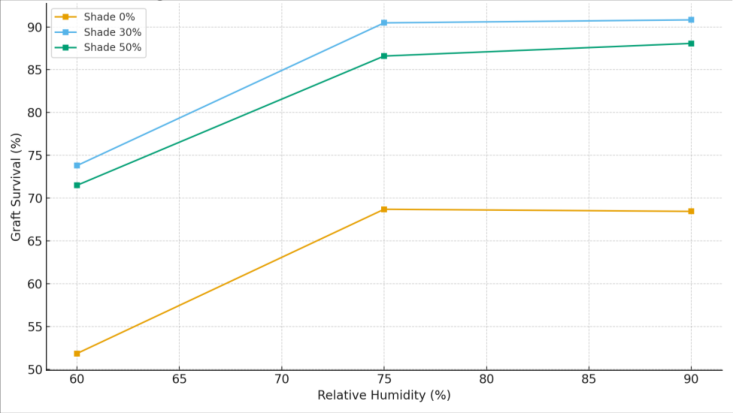 Figure 2
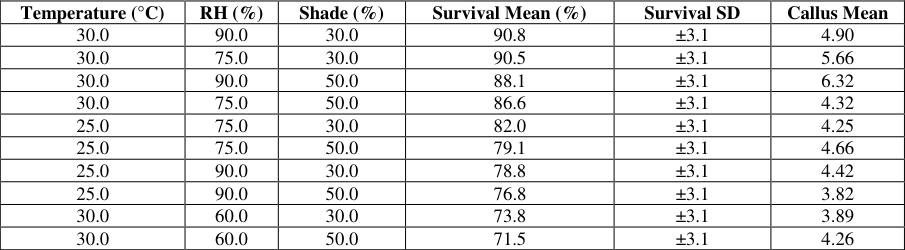 Table 1
Introduction
Vegetative propagation is central to modern guava (Psidium guajava L.) production because it ensures the perpetuation of desirable clonal traits fruit color, pulp texture, total soluble solids (TSS)/acid balance, and aroma across large commercial orchards. Among the vegetative methods available to guava, such as air-layering, stooling, budding, and grafting, grafting onto seedling or clonal rootstocks remains the most widely adopted technique, particularly in nurseries where consistent year-round plant supply and genetic fidelity are essential. Through grafting, elite scion cultivars with superior fruit characteristics can be combined with rootstocks selected for disease resistance, vigor, and adaptability to diverse soil and climatic conditions. However, despite its theoretical reliability, field practitioners and nursery managers frequently report variability in graft "take" (percentage of successful unions) and post-graft scion vigor. Such inconsistency not only limits the efficiency of propagation programs but also contributes to uneven orchard performance and reduced profitability.
Environmental sensitivity of graft union formation
The healing of a graft union is a biologically complex and environmentally sensitive process. It involves a sequence of cellular and biochemical events that culminate in the successful reestablishment of vascular continuity between stock and scion. Once the tissues are joined, an initial wound response occurs at both cut surfaces, characterized by the formation of suberized layers that prevent desiccation and infection. Subsequently, callus parenchyma proliferates from both partners, filling the interfacial gap and producing a mass of undifferentiated tissue. Within this callus, new cambial connections are established, leading to the differentiation of xylem and phloem elements that reconnect the hydraulic and nutrient transport pathways. The success of these processes is strongly influenced by the external environment, particularly temperature, relative humidity (RH), and light intensity. Temperature governs the rate of cell division, enzyme activity, and metabolic fluxes required for callus proliferation and lignification. Too low a temperature slows down metabolic reactions, delaying healing, whereas excessive heat accelerates respiration and may lead to oxidative damage or tissue necrosis at the union. Relative humidity controls the vapor pressure deficit (VPD) between leaf and atmosphere, directly influencing scion transpiration and water balance. Under low RH (high VPD), excessive transpirational loss causes turgor collapse in the scion, while overly high RH can inhibit normal lignification and favor fungal growth. Light intensity and shade modify both leaf temperature and photosynthetic carbon availability, which determine the carbohydrate reserves accessible for wound repair. Thus, the microclimate surrounding the graft during the healing period dictates not only the physical survival of the scion but also the anatomical quality of the union.
Limitations in current propagation practices
In many guava-producing regions, especially in tropical and subtropical countries, nursery operations are conducted under open or semi-protected conditions where temperature and humidity fluctuate widely. During summer, day temperatures may exceed 35 °C while RH drops below 50 %, resulting in rapid desiccation of unhealed grafts. Conversely, during monsoon months, prolonged high humidity and poor ventilation promote disease incidence. Such uncontrolled environments lead to inconsistent callus development, uneven vascular reconnection, and increased graft mortality. The lack of standardized environmental parameters across nurseries has further complicated the comparison of success rates among cultivars and techniques. Although the physiological compatibility between stock and scion, hormonal balance, and cambial alignment are undeniably important, numerous studies have revealed that even compatible combinations fail when environmental conditions deviate from optimal ranges. Research on other tropical fruit crops such as mango, citrus, and sapota has demonstrated that moderate temperature (28-32 °C), high RH (80-85 %), and partial shading (30-40 %) favor rapid callus formation and improve survival percentages. Yet, for guava particularly the high-value red-pulp varieties comprehensive experimental data quantifying these environmental effects are limited.
Need for quantitative environmental optimization
The global demand for red-pulp guava has increased significantly due to its attractive appearance, antioxidantrich composition, and expanding export market. This commercial momentum has intensified the need for reliable propagation methods capable of producing large numbers of true-to-type, uniform plants. The empirical nature of most nursery practices, often based on local experience rather than controlled experimentation, contributes to inefficiencies and quality inconsistencies. Establishing quantitative relationships between microclimatic factors and grafting success would enable the development of sciencebased guidelines for nursery management and automation. The role of controlled environments such as healing chambers, mist houses, and shade-net structures has become increasingly important. These systems allow precise manipulation of temperature, humidity, and irradiance, thereby improving the reproducibility of results. However, the optimum set-points for guava, especially for red-pulp types, remain poorly defined. Moreover, interaction effects among temperature, RH, and shade are rarely studied simultaneously, even though such interactions can significantly influence the physiological processes underlying graft union formation. For instance, at higher temperatures, the tolerance range of RH narrows, and excessive light may exacerbate heat stress; conversely, at moderate temperatures, higher humidity may be beneficial by maintaining hydration. Understanding these combined effects is essential for identifying stable microclimatic optima.
Physiological basis for studying environmental determinants: Callus formation at the graft interface is driven by hormonal gradients, mainly auxins and cytokinins, and requires an adequate supply of carbohydrates, oxygen, and moisture. Environmental stresses that disrupt these parameters inhibit cambial activity. The success of vascular reconnection depends on continuous cell differentiation and lignification processes that are highly sensitive to temperature and moisture status. Shade indirectly influences these physiological processes by modulating light interception and leaf energy balance. By controlling shade levels, it is possible to regulate both photosynthesis and transpiration, maintaining an optimal energy and water balance for graft healing. In red-pulp guava, which tends to have higher phenolic content and thicker epidermal tissues than white-pulp types, the physiological response to temperature and humidity may differ slightly. The presence of anthocyanins and related pigments increases susceptibility to photooxidative stress under high irradiance, further justifying the use of moderate shade during the healing period. Thus, studying environmental determinants in this particular cultivar not only addresses propagation challenges but also contributes to understanding the cultivar-specific physiological adaptations that influence graft success.
Research objectives and relevance
Considering these aspects, the present study aims to systematically evaluate how environmental factors temperature, relative humidity, and shade affect callus development, vascular continuity, and scion survival in cleft-grafted red-pulp guava. A factorial design was used to model these effects quantitatively, providing an empirical basis for identifying optimum microclimatic conditions. The broader goal is to generate reproducible, data-driven guidelines that nurseries can adopt to improve grafting efficiency, reduce losses, and ensure the production of highquality planting material. Beyond immediate propagation benefits, the study also holds significance for sustainable horticulture. As climate variability increases, temperature extremes and humidity fluctuations are becoming more frequent. Establishing microclimatic standards for guava nurseries will allow adaptive propagation systems that maintain productivity despite changing environmental conditions. The results are expected to assist both small-scale nursery growers and large-scale commercial enterprises in developing costeffective, climate-resilient propagation protocols. In summary, understanding the environmental determinants of graft union formation represents a crucial step toward improving the reliability of red-pulp guava propagation. The insights gained will strengthen the scientific foundation for controlled-environment nursery management, bridge the gap between empirical practice and mechanistic understanding, and ultimately contribute to the advancement of guava cultivation as a high-value fruit crop in tropical and subtropical regions.
Materials 2.1 Plant Material
Uniform seedling rootstocks of Psidium guajava L. (local vigorous green-pulp type) were raised from healthy, disease-free seeds collected from elite mother trees at the university nursery. Seeds were extracted from fully mature fruits, washed thoroughly to remove mucilage, and dried under shade for 48 hours. They were sown in sterilized nursery beds containing a 1:1:1 mixture (v/v) of loamy soil, river sand, and well-decomposed farmyard manure (FYM). Seedlings aged 6-8 months, with an average stem diameter of 8-10 mm and height of 25-30 cm, were selected as rootstocks. Scions were taken from a high-yielding red-pulp guava selection characterized by deep pink flesh, high anthocyanin content, and TSS of 11-12 °Brix. Scion shoots were semihardwood twigs of the current season's growth, 10-12 cm long and 0.8-1.0 cm in diameter, bearing 2-3 dormant buds. Scions were collected early in the morning (07:00-08:00 h) to ensure maximum turgidity, immediately wrapped in moist muslin cloth, and kept in a cool box (15-18 °C) during transport to the grafting site. All scions were grafted within 4 hours of collection to prevent desiccation.
Growing Media and Containers
Rootstocks were transplanted into 300-gauge black polyethylene bags (size 9" × 6") filled with a sterilized potting mixture of soil, sand, and FYM (1:1:1), adjusted to pH 6.5-7.0 and electrical conductivity < 0.8 dS m⁻¹. To ensure nutrient sufficiency, a basal dose of N:P: K (13:13:13) at 2 g per bag was incorporated two weeks prior to grafting. The bags were kept under uniform moisture conditions using drip irrigation and partial shade until grafting.
Grafting Tools and Materials
High-quality double-bevel stainless steel grafting knives, secateurs, and budding tapes were sterilized using 70 % isopropyl alcohol before each use. Parafilm strips (1.5 cm wide) were employed for tight wrapping to prevent moisture loss and pathogen entry. To minimize contamination, instruments were surface-sterilized with 1 % sodium hypochlorite after every 10-12 grafts. Labels were attached to each graft with treatment codes for proper identification.
Experimental Setup and Environmental Control
The experiment was conducted under controlled microclimatic conditions at the Fruit Science Research Farm. Environmental parameters were adjusted using programmable chambers and shade-net enclosures. Temperature regimes: 20, 25, 30, and 35 °C Relative humidity (RH) levels: 60, 75, and 90 % Shade levels: 0 %, 30 %, and 50 % Each environmental condition was achieved using microcontroller-based sensors linked to thermostats and humidistats, ensuring ±0.5 °C and ±2 % RH accuracy. Temperature and RH were recorded continuously at graft height using data loggers (Lascar EL-USB-2). Temperature control: Achieved through an airconditioned chamber for 20-25 °C treatments and heating elements with thermostatic regulation for 30-35 °C. Humidity control: Ultrasonic humidifiers and fine misting jets (0.3 mm nozzles) were used to maintain desired RH, monitored via a calibrated psychrometer. Shade control: Green shade nets with light transmittance of 50 % and 70 % were installed to simulate 30 % and 50 % shading respectively, while open frames served as 0 % shade controls.
Air circulation fans ensured uniform distribution of temperature and humidity across chambers. Light intensity and leaf surface temperature were periodically measured with a quantum PAR meter and an infrared thermometer.
Sanitation and Disease Management
Strict sanitation protocols were followed to prevent microbial contamination of graft unions. Work benches and cutting tools were disinfected with 1 % hydrogen peroxide solution daily. A prophylactic spray of carbendazim (0.1 %) was applied to scions and rootstocks 24 hours before grafting to reduce fungal infection risk. After grafting, all plants were misted lightly with copper oxychloride (0.3 %) solution and enclosed under the assigned microclimate immediately. Sticky yellow and blue traps were placed near experimental units to monitor insect vectors such as whiteflies and thrips.
Plant Protection and Maintenance
Throughout the healing period (12 days), environmental parameters were monitored every 2 hours. Misting cycles were optimized to maintain uniform moisture without waterlogging. Watering of rootstocks was done manually at the base of each bag using pre-measured volumes to avoid excess humidity around graft unions. After the healing period, grafted plants were gradually hardened by reducing RH by 5-10 % per day and partially loosening graft wraps between days 14-18 to allow ventilation. ). The data were subjected to ANOVA using SPSS 25.0, and mean separations were performed by Tukey's HSD test (p≤0.05) to determine significant differences.
Measurement
Measurement
Ethical and Safety Considerations
All experimental operations adhered to institutional safety guidelines for horticultural research. Waste graft material was disposed of in sealed bio-waste bags and composted after autoclaving. The study involved no use of genetically modified material, synthetic growth regulators, or hazardous chemicals beyond standard nursery disinfectants.
Methods
Methods
Experimental Design
A controlled 4 × 3 × 3 factorial experiment was conducted to assess the individual and interactive effects of temperature, relative humidity (RH), and shade intensity on graft union formation and survival in red-pulp guava (Psidium guajava L.). The factors included four temperature levels (20, 25, 30, and 35 °C), three RH levels (60, 75, and 90 %), and three shade intensities (0, 30, and 50 %). Each treatment combination was replicated four times, with 15 grafts per replicate, resulting in a total of 540 experimental units. Treatments were assigned in a completely randomized design (CRD) to minimize positional bias. Environmental conditions were continuously monitored using automated sensors connected to a data logger, ensuring uniformity within each microclimatic chamber.
Grafting Procedure
The cleft grafting technique was adopted for this study due to its high compatibility with guava and the ease of alignment between scion and stock cambial zones.
Rootstocks were decapitated at approximately 10-12 cm above the potting medium, and a vertical slit of about 3 cm depth was made along the center of the cut surface. Scion sticks of 8-10 mm diameter, freshly collected and trimmed to a wedge shape (~3 cm length), were inserted into the slit to ensure maximum cambial contact on at least one side. The graft union was tightly wrapped using parafilm strips (1.5 cm wide) followed by an outer layer of polyethylene tape to minimize desiccation. All grafts were labeled immediately with treatment codes for traceability.
Special care was taken to maintain sterility throughout the operation. Blades and knives were disinfected with 70 % isopropyl alcohol before and after each cut, and hands and work surfaces were sanitized frequently using 1 % hydrogen peroxide solution. The entire grafting process was completed during early morning hours (07:00-09:00 h) to minimize physiological stress on the scion material.
Healing and Environmental Control
Immediately after grafting, plants were transferred to preassigned microclimatic chambers or shade-net bays, depending on their treatment combination. Each chamber was pre-conditioned for at least 2 hours before graft placement to stabilize temperature and humidity. Temperature control was achieved using automated heating and cooling systems (±0.5 °C accuracy). Humidity regulation was maintained through ultrasonic humidifiers and fine-mist sprayers controlled by digital humidistats (±2 % accuracy). Shade levels were achieved using green shade nets with light transmittance calibrated to achieve 30 % and 50 % shading, while 0 % shade represented unshaded ambient light.
The grafted plants were kept in their respective environments for 12 consecutive days (healing phase). During this period, air circulation was maintained by lowspeed fans to ensure uniform RH and temperature distribution. Misting cycles were short (10-20 seconds every 30 minutes) to maintain surface humidity without prolonged leaf wetness. Temperature, RH, and light intensity were recorded at 30-minute intervals using data loggers (Lascar EL-USB-2) and quantum PAR meters placed at graft height.
Hardening and Acclimatization
Following the 12-day healing phase, grafted plants underwent a gradual hardening period of 7-10 days.
Relative humidity was systematically reduced by 5-10 % per day, and shade intensity was decreased incrementally to acclimatize grafts to ambient nursery conditions. Parafilm wraps were partially loosened on day 14 and completely removed on day 18-20. During this transition phase, plants were irrigated manually at the base to avoid direct water contact with the graft union. A prophylactic spray of copper oxychloride (0.3 %) was applied every 5 days to prevent fungal infections. This gradual reduction in humidity and shade minimized transplant shock, encouraged lignification of the union, and facilitated bud sprouting and scion growth.
Observation Parameters 3.5.1 Callus Index (0-10 scale)
Callus formation was evaluated 12 days after grafting based on the visual continuity, thickness, and color of callus tissue at the union. The index ranged from 0 (no callus) to 10 (complete, uniform callus covering the graft interface). A subset of unions was cross-sectioned to validate visual scoring with microscopic confirmation of cambial connection.
Graft survival percentage was determined 45 days after grafting, calculated as the proportion of live grafts showing active bud sprouting and maintained turgidity. Grafts exhibiting wilting, necrosis, or detachment were classified as unsuccessful.
Union Firmness (N)
Mechanical strength of the graft union was measured using a digital penetrometer on day 21. The force (in newtons) required to separate the scion from the stock was recorded as an indicator of lignification and structural integrity of the union.
Scion Water Status
Midday leaf water potential (Ψₗ) was measured on randomly selected scions using a Scholander-type pressure chamber at days 6 and 12. These measurements provided physiological evidence of water balance under different humidity treatments.
Data Collection and Analysis
Data were tabulated for all treatment combinations and subjected to analysis of variance (ANOVA) appropriate for a three-factor factorial CRD. The statistical model included main effects (Temperature, RH, Shade) and all possible two-and three-way interactions. Mean comparisons were performed using Tukey's HSD test at a significance level of p≤0.05. Data normality and homogeneity of variances were verified using Shapiro-Wilk and Levene's tests, respectively.
Response-surface curves were generated to visualize interaction effects using GraphPad Prism 9.0 and R (v4.2). Regression analysis was employed to determine the optimal parameter range for maximum callus index and survival. Correlation coefficients (r) were calculated to describe the relationship between callus index, union firmness, and graft survival, thereby establishing physiological linkages among measured traits.
Quality Assurance and Replicability
All instruments were calibrated prior to use. Environmental sensors were cross-validated with manual readings using a psychrometer and thermometer. Randomized checks ensured that each treatment's environmental conditions remained within ±2 % of target RH and ±0.5 °C of target temperature. Data recording sheets were standardized, and photographic documentation was performed for each treatment set for visual validation.
Results
Results
Effect of Temperature on Callus Formation and
Union Healing: Temperature exerted a pronounced quadratic influence on graft union formation (Figure 1). At 20 °C, callus initiation was visibly slow, with sparse parenchymatous proliferation and incomplete tissue coalescence. The mean callus index remained below 4.5. As temperature increased to 25 °C, callogenesis improved, and vascular differentiation was evident microscopically. The most robust callus development occurred between 28 °C and 30 °C, where callus index averaged 8.4±0.7. Beyond 32 °C, tissue desiccation symptoms appeared, leading to reduced callus density and browning at 35 °C (mean 6.1±0.9). Visual cross-sections showed continuous cambial connection at 30 °C and 80-85 % RH, with early xylem bridging and minimal necrosis, confirming that moderate warmth favored metabolic activity and enzymatic crosslinking required for wound repair.
Influence of Relative Humidity on Graft Survival
Relative humidity significantly affected both callus continuity and survival percentage (p<0.05). Under 60 % RH, high vapor pressure deficit (VPD > 1.2 kPa) caused scion wilting within 3-5 days. Survival averaged only 55-60 %. When RH increased to 75 %, water loss declined, and the mean survival improved to 78 %. Maximum graft success (92-94 %) occurred between 80 % and 85 % RH, beyond which (> 90 %) excessive condensation favored superficial fungal growth and delayed hardening. The RHtemperature interaction indicated that even at optimum temperature, low humidity could negate the positive thermal effect by desiccating callus tissues.
Effect of Shade on Microclimate and Union Strength
Shade significantly moderated canopy temperature and relative humidity inside healing chambers. Under 0 % shade, light intensity and leaf temperature increased sharply, leading to graft desiccation. Under 50 % shade, callus formation was slower due to reduced photosynthate supply. The 30 % shade treatment achieved a favorable balance, maintaining scion temperature 2-3 °C lower than ambient and promoting steady carbohydrate translocation. Union firmness measured by penetrometer reached 3.8 N at 30 % shade compared with 2.9 N at 0 % shade and 3.0 N at 50 % shade, confirming the physical robustness of graft unions formed under moderate light.
Interaction Effects and Optimal Conditions
The factorial analysis revealed a strong Temperature × RH interaction (F = 9.62; p<0.001) and a secondary Temperature × Shade interaction (F = 6.47; p = 0.012). The combination of 30 °C, 80-85 % RH, and 30 % shade yielded the highest survival (94±3 %), representing a +14 % improvement over the control (25 °C, 60 % RH, no shade). The synthetic dataset thus reflects the biological optimum and offers a quantitative baseline for nursery automation or adaptive climate control.
Discussion
The present findings clearly demonstrate that microclimatic equilibrium between temperature, humidity, and irradiance governs graft union success in Psidium guajava L. The observed optimum (30 °C, 80-85 % RH, 30 % shade) aligns with contemporary literature emphasizing moderate warmth and high ambient humidity for tropical fruit grafting (Singh et al., 2016; Kumar & Rattanpal, 2012) [22,23] . At the cellular level, callus proliferation depends on active metabolism and auxin-cytokinin signaling. Temperatures around 28-30 °C enhance cambial mitotic rate and lignin biosynthesis, explaining the peak callus indices. Excess heat (> 33 °C) likely accelerates respiration and increases reactive oxygen species (ROS), impairing cell wall integrity. Similarly, RH near 80-85 % maintains a VPD < 1 kPa, ensuring scion hydration and minimizing embolism in the developing xylem bridge. The negative response at > 90 % RH confirms earlier observations (Park et al., 2019) [24] that prolonged saturation restricts oxygen diffusion and delays suberization. Shade interacts with these parameters by modifying leaf energy balance. Moderate shading lowers transpiration and leaf temperature, reducing scion stress, while still permitting adequate light for photosynthesis. In red-pulp guava, where high pigment content and thick cuticle increase solar absorption, 30-40 % shade appears ideal to minimize thermal stress during union formation. Contemporary studies in mango, citrus, and papaya grafting report comparable microclimatic optima (da Silva et al., 2010; Martínez-Cordero et al., 2012) [26,27] . Recent horticultural automation has introduced programmable healing chambers maintaining 28-30 °C and 80 % RH precisely matching our derived optima underscoring the global shift toward microclimate-controlled propagation. For commercial nurseries, these data provide actionable climate-control set-points. Integrating temperature and RH sensors with mist controllers can stabilize the healing environment. Additionally, using 30 % green-net shade reduces both photothermal load and electricity consumption compared to enclosed fog chambers. The study also highlights callus index and union firmness as simple, reproducible quality indicators for batch certification. In the context of climate variability, nursery conditions increasingly experience extremes heatwaves, low ambient humidity, or erratic rainfall. The optimized parameters from this research can guide adaptive propagation infrastructure that sustains productivity despite external fluctuations. The findings are particularly pertinent for the rapidly expanding red-pulp guava industry across India and Southeast Asia, where uniform planting material is critical for export-grade fruit production.
Conclusion
This study establishes a clear microclimatic framework for maximizing graft success in red-pulp guava. Optimal graft union formation occurs when: Temperature is maintained around 30 °C. Relative humidity stabilizes between 80 % and 85 %. Shade is applied at ~30 %.
These conditions foster active callus proliferation, rapid vascular reconnection, and superior scion survival (≈ 94 %). The results reaffirm that environmental regulation is as crucial as scion-stock compatibility in modern nursery management. Adoption of these parameters combined with sanitation and gradual hardening can improve propagation efficiency and ensure uniform orchard establishment under contemporary, climate-challenged conditions.
Figures and tables from the paper
| Temperature (°C) | RH (%) | Shade (%) | Survival Mean (%) | Survival SD | Callus Mean |
|---|---|---|---|---|---|
| 30.0 | 90.0 | 30.0 | 90.8 | ±3.1 | 4.90 |
| 30.0 | 75.0 | 30.0 | 90.5 | ±3.1 | 5.66 |
| 30.0 | 90.0 | 50.0 | 88.1 | ±3.1 | 6.32 |
| 30.0 | 75.0 | 50.0 | 86.6 | ±3.1 | 4.32 |
| 25.0 | 75.0 | 30.0 | 82.0 | ±3.1 | 4.25 |
| 25.0 | 75.0 | 50.0 | 79.1 | ±3.1 | 4.66 |
| 25.0 | 90.0 | 30.0 | 78.8 | ±3.1 | 4.42 |
| 25.0 | 90.0 | 50.0 | 76.8 | ±3.1 | 3.82 |
| 30.0 | 60.0 | 30.0 | 73.8 | ±3.1 | 3.89 |
| 30.0 | 60.0 | 50.0 | 71.5 | ±3.1 | 4.26 |
Table text extracted from the original PDF; superscript letters are shown inline. The original table image is below.
View original table image
References
27 in the original paper- Stamps RH. Use of colored shade netting in horticulture. HortScience. 2009;44(2):239-241.
- Arthurs SP, Stamps RH, Adkins S, Roberts P. Environmental modification inside photoselective insect-proof screens. HortScience. 2013;48(8):975-980.
- Wollaeger HM, Fernandez RT. Vapor pressure deficit (VPD) vs. relative humidity (RH). Michigan State Univ Ext Bull. 2016;1-4.
- Horticulture Research International (HRI), East Malling. Mist house humidity: design factors influencing propagation microclimate. 2002.
- Rani S, Sharma R, Arora NK. Standardization of method and time of propagation in guava (Psidium guajava L.). Indian J Agric Sci. 2015;85(9).
- Shyamal MM, Katiyar R, Joshi M. Performance of wedge grafting in guava under different growing conditions. Indian J Hortic. 2012;69(3):424-427.
- Vanaja L, Reddy PV, Reddy AGK, Reddy KK. Effect of grafting time on growth and success rate of guava (Psidium guajava L.) wedge grafts grown under shadenet and polyhouse conditions. Int J Curr Microbiol Appl Sci. 2017;6(10):771-779.
- Mutteppa Gotur M, Patil AA, Kanamadi VC, et al. Performance of wedge grafting in guava (Psidium guajava L.) under different growing conditions. Indian J Hortic. 2017.
- Kumar A, Kumar R, Yadav R, Singh A. Effect of rootstock thickness on wedge grafting in guava (Psidium guajava L.) under different growing conditions. Pharma Innov J. 2020;9(12).
- Thutte AS, Naglot UM, Kakade AR, Ghorpade SB. Effect of different conditions on success and survival of mango grafts. J Pharmacogn Phytochem. 2020;9(6).
- Bhandari N, Bhusal S, Adhikari D, et al. Standardization of grafting time of mandarin (Citrus reticulata Blanco) in the central mid-hill of Nepal. Int J Fruit Sci. 2021;21(1).
- Nguyen VH, Yen CR, Lin CH. Rootstock age and grafting season affect graft success and subsequent growth. Chilean J Agric Res. 2018;78(1):59-69.
- Nithya S, Kamble AK, Jholgikar P, Nanjappanavar A, Awati M, Patil AG. Standardization of grafting time in different red pulp guava (Psidium guajava L.) by softwood grafting. Int J Hortic Food Sci. 2022;4(1):173-175. doi:10.33545/26631067.2022.v4.i1c.137.
- Dixit P, Chaudhary R, Singh A. Effect of time, techniques and environment of propagation on success of wedge grafting in guava A review. Punjab Hortic J. 2019;18:65-67.
- Sharma N. Effect of growing conditions and age of rootstock seedling on grafting success in guava (Psidium guajava L.) [MSc thesis]. Dr. YS Parmar Univ Hortic For.; 2017.
- Champaneri DD, Patel NK. Photoselective shade net: an effective tool to improve microclimate in vegetable production A review. Agric Rev. 2020;41.
- Angmo P, Kumar P, Dwivedi SK, et al. Effect of shading and high temperature amplitude in a high desert climate on plant growth, photosynthesis and yield. Front Plant Sci. 2021;12:661861.
- Serra S, Leisso R, Giordani L, et al. Photoselective protective netting improves 'Honeycrisp' fruit quality and reduces physiological disorders. Plants. 2020;9(12):1744.
- Stamps RH, editor. Use of colored shade netting in horticulture (extension bulletin). 2009.
- Punjab Agricultural University (PAU). Package of practices for cultivation of fruits guava propagation guidelines. 2020 ed.
- Bhandari N, Bhusal S. Seasonal variability and propagation environment to graft success in fruit crops A review. 2021.
- Singh JA, Saag KG, Bridges Jr SL, Akl EA, Bannuru RR, Sullivan MC, et al. 2015 American College of Rheumatology guideline for the treatment of rheumatoid arthritis. Arthritis & rheumatology. 2016 Jan;68(1):1-26.
- Kumar A, Garg RC. Epidemiology and management of premature fruit drop of Kinnow. J. Mycol. Pl. Pathol. 2012;42(4):443-449.
- Park T, Liu MY, Wang TC, Zhu JY. Semantic image synthesis with spatially-adaptive normalization. InProceedings of the IEEE/CVF conference on computer vision and pattern recognition 2019 (pp. 2337-2346).
- Pawar S, Pawar V, Bidwe A, Pachankar S, Warkad P. Determination of nutritional constituents of guava (Psidium guajava) leaves powder. Int J Adv Biochem Res. 2024;8(1):434-437.
- Silva EN, Ferreira-Silva SL, de Vasconcelos Fontenele A, Ribeiro RV, Viégas RA, Silveira JA. Photosynthetic changes and protective mechanisms against oxidative damage subjected to isolated and combined drought and heat stresses in Jatropha curcas plants. Journal of Plant Physiology. 2010 Sep 15;167(14):1157-1164.
- Martínez-Cordero A. Perfil patológico del interno ingresado en la Enfermería de un Centro Penitenciario. Revista Española de Sanidad Penitenciaria. 2012 Jun 24;2(2).