
Research article · 2025 · Full text
International Journal of Biology SciencesAssessment of quality attributes parameter in different sowing media of Broccoli (Brassica oleracea var. italica L.) under Jorhat (Assam)
Volume 7(10) · Pages 86–89 · DOI: 10.33545/26649926.2025.v7.i10b.500 ↗
Research areasAgricultural Science and FertilizationAgricultural Economics and PracticesFood Science and Nutritional Studies
Abstract
Author-writtenAn experiment was conducted at Horticulture Experimental Farm, Department of Horticulture, College of Agriculture, Assam Agricultural University, Jorhat, Assam during the year 2020-21 and 2021-22 for knowing the potentiality of different seedling growing media viz., Cocopeat: Perlite: Vermiculite (3:1:1), Cocopeat: Perlite: Vermiculite (2:1:1), Cocopeat: Vermicompost (1:1),Vermicompost: Perlite: Vermiculite (3:1:1), Vermicompost: Perlite: Vermiculite (2:1:1), Cocopeat: Vermicompost: Perlite: Vermiculite (1:1:1:1) and Conventional nursery. These seven treatments were analyzed in RBD with 3 replications. The higher seedling emergence percentage (93.15), seedling height (17.87 cm), leaf area (9.09 cm2), root length (6.04 cm), shoot length (10.24 cm), seedling growth index (1516.35), chlorophyll content (0.32 mg g-1fw), minimum days to two-true leaf stage (7.03 days), minimum days to transplanting (28.55 days) and the lowest diseases incidence (3.44 %) under the greenhouse condition was recorded in the treatment T3 [(Cocopeat: Vermicompost (1:1)].
Summary
Source-checkedPlain-language reading of the full paper, prepared with AI and checked against the text. Each point links to the authors' own words.
Why it matters
- Broccoli is a highly valued vegetable used both fresh and frozen globally. View evidence ↗
- Broccoli is nutritionally dense, providing significant amounts of vitamins A and C, protein, and various minerals per 100g of edible portion. View evidence ↗
- The type of sowing medium used for seedlings directly affects their overall quality. View evidence ↗
The question
- The study aimed to evaluate the effectiveness of various seedling growing media on broccoli quality attributes. View evidence ↗
What they did
- The research was conducted at the Assam Agricultural University in Jorhat during the 2020-21 and 2021-22 periods. View evidence ↗
- The experiment utilized a Randomized Block Design (RBD) with seven different media treatments and three replications. View evidence ↗
- The treatments compared six artificial media combinations (varying ratios of cocopeat, perlite, vermiculite, and vermicompost) against a conventional nursery (T7). View evidence ↗
What they found
- Treatment T3 (Cocopeat: Vermicompost 1:1) produced the best seedling growth results, including the highest emergence (93.15%), height (17.87 cm), and lowest disease incidence (3.44%). View evidence ↗
- T6 achieved the highest pooled Vitamin-C content at 80.35 mg/100g, while T7 had the lowest at 65.02 mg/100g. View evidence ↗
- The highest pooled dry matter content was found in T6 (8.95%), followed by T3 (7.77%), with T7 being the lowest (5.35%). View evidence ↗
- T6 showed the maximum pooled fiber content at 24.34 mg/100g, whereas T7 showed the lowest at 16.29 mg/100g. View evidence ↗
- The highest pooled ash content was recorded in T6 (10.14%), followed by T3 (9.79%), and the lowest in T7 (7.33%). View evidence ↗
What it means
- The authors conclude that using T3 and T6 media in a greenhouse is more effective for raising broccoli seedlings than using a traditional open-field nursery. View evidence ↗
- The authors state that these specific media can produce healthier seedlings, which is expected to improve yield and performance after transplanting. View evidence ↗
Visual summary
3 visualsIllustrations explain the paper; charts are replotted from the paper's own table values.
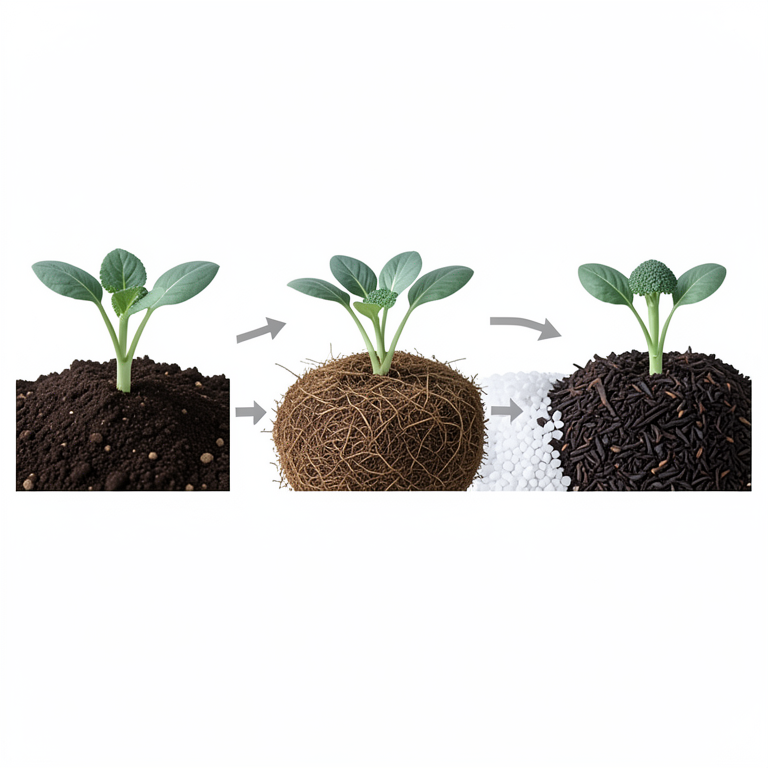
Comparison of Sowing Media Components
AI-generated conceptual illustration (broccoli seedlings (Brassica oleracea var. italica L.)). It explains the idea and does not show study data.
View source evidence ↗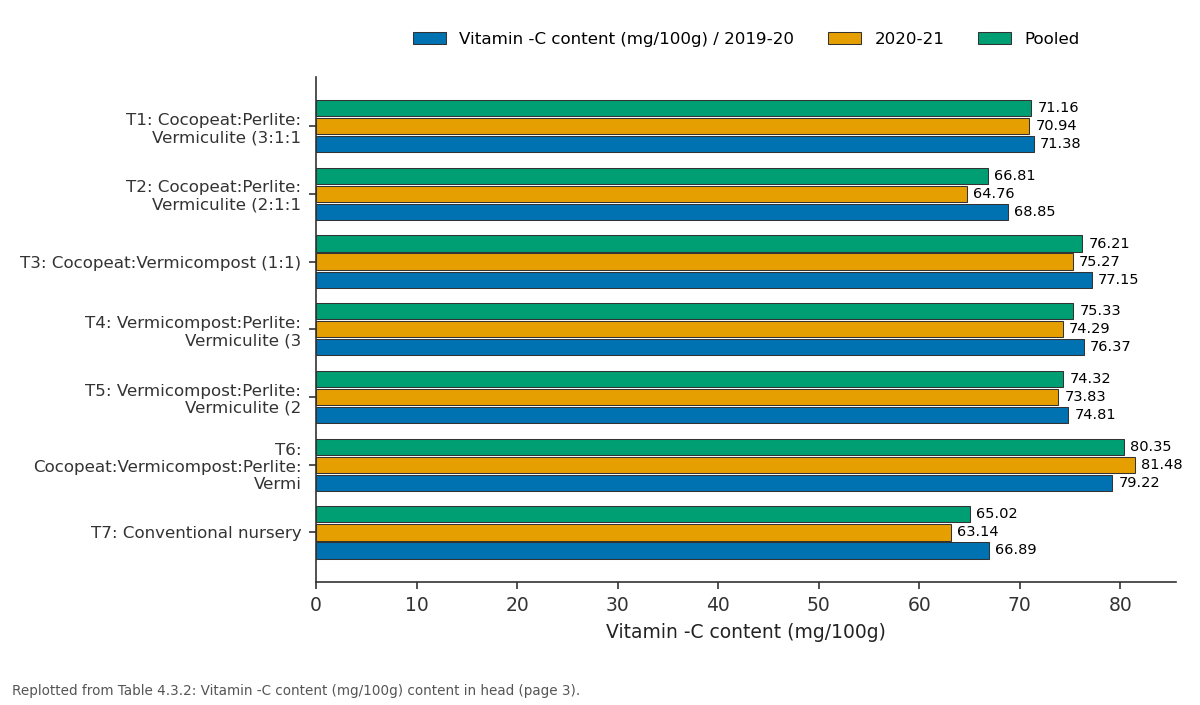
Vitamin -C content (mg/100g) / 2019-20 and 2020-21 and more: T1: Cocopeat:Perlite:... vs T2: Cocopeat:Perlite:... vs T3:... vs T4:... vs T5:...
Replotted from Table 4 (page 3) of the original paper. Every bar is the paper's own table value.
View source evidence ↗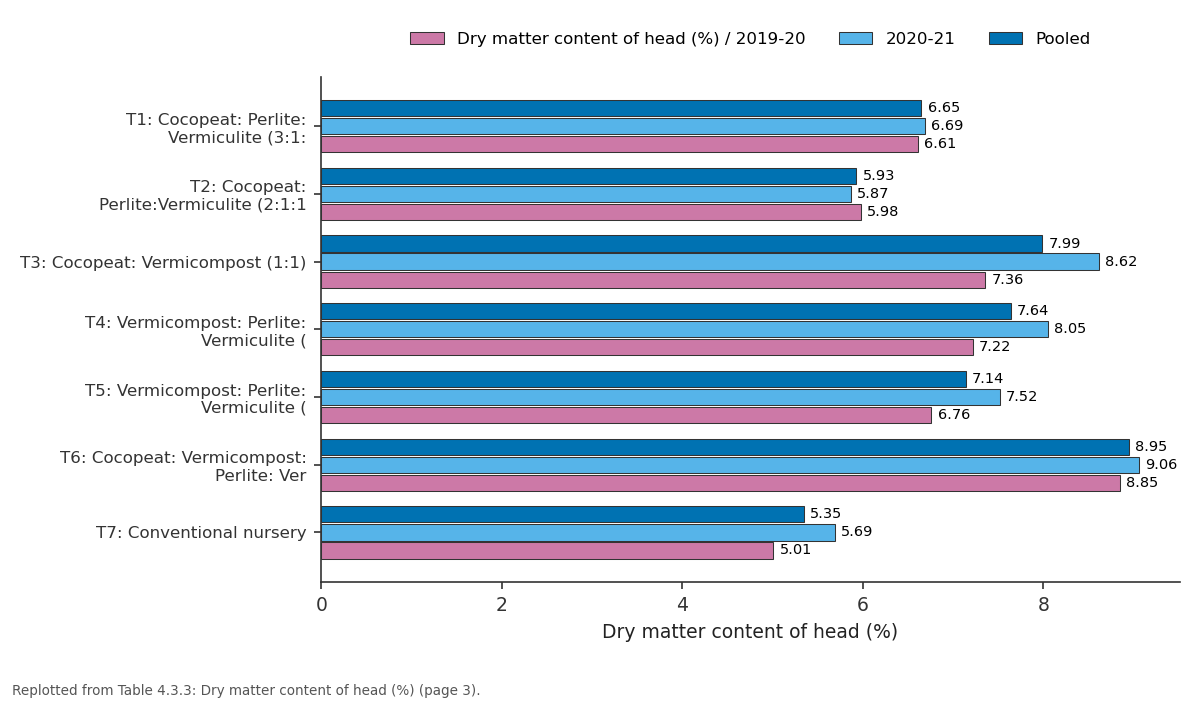
Dry matter content of head (%) / 2019-20 and 2020-21 and more: T1: Cocopeat: Perlite:... vs T2: Cocopeat:... vs T3: Cocopeat:... vs T4: Vermicompost:... vs T5: Vermicompost:...
Replotted from Table 4 (page 3) of the original paper. Every bar is the paper's own table value.
View source evidence ↗Figures & tables
From the original paper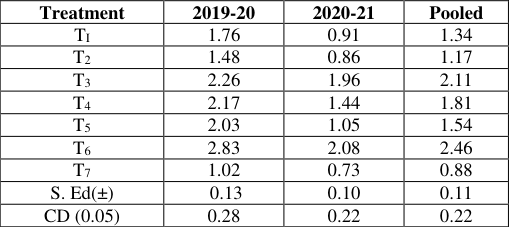 Table 4
 Figure 1
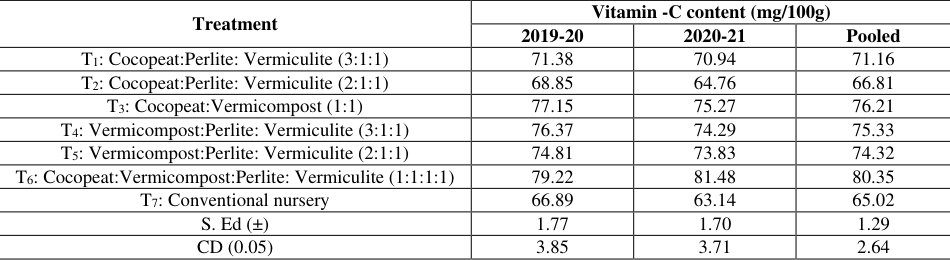 Table 4
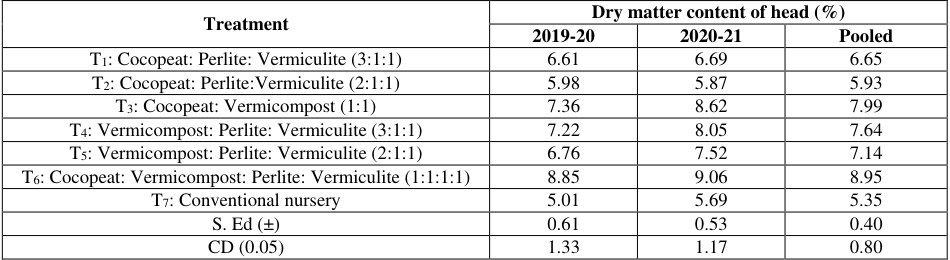 Table 4
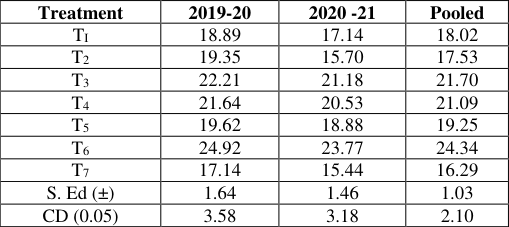 Table 4
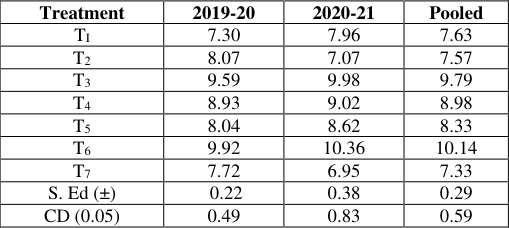 Table 4
Introduction
Broccoli is a high-quality vegetable for fresh use and is one of the most popular frozen vegetables. It is also used as a vegetable in many other countries, such as Spain, Mexico, Italy, France and the United States. Broccoli production in India 674 tones from an area of 369 hectare (Anonymous, 2018) [9] . India is the second largest producer of broccoli after China. Nutritionally, it is rich in vitamin-A (2500 I.U.), vitamin C (113 mg), protein (3.6 g), carbohydrates (5.9 g) and minerals like calcium (103 mg), iron (1.1 mg), phosphorous (78 mg), potassium (382 mg) and sodium (15 mg) per 100 g of an edible portion (Rana, 2008) [5] . The composition of the medium influences the quality of the seedlings (Wilson et al., 2001) [8] . For a plant to strengthen its new root system there must be a ready supply of moisture and oxygen for growth of all living cells. Coarse-textured media often meet these requirements. Most commercially prepared mixes are termed "artificial", which means they contain no soil. Artificial growing media are materials other than soils in which plants are grown. These can include organic materials such as compost, peat, cocopeat, vermicompost, and tree bark, or inorganic materials such as clay, vermiculite, minerals, rock wool, etc. (Vaughn et al., 2011) [7] . Several growing media such as cocopeat, perlite, vermiculite, rock wool, sawdust, and compost were found to be individually or in combination suitable for high-value crops such as broccoli, tomato, capsicum, and cucumber. The soil is generally used as a basic medium because it is easily available and cheap for supplementing the soil, which is aimed to make media more porous (vermiculite, perlite, cocopeat etc.) while the organic matter (vermicompost) is added so as to supplement adequate nutrients for the seedling. The Growing media have three main functions: 1) provide aeration and water, 2) allow for maximum root growth and 3) physically support the plant. The growing medium should have adequate pore space between the particles (Bilderback et al., 2005) [2] . Appropriate particle size selection or combination is critical for a light and fluffy (well-aerated) medium that promotes fast seed germination, strong root growth and adequate water drainage.
Material and methods
The present investigation was conducted in the Experimental Farm, Department of Horticulture, Assam Agricultural University, Jorhat during 2019-2020 and 2020-21. The methodology followed and the materials used in the present study are detailed below. All the observed data were statistically analyzed by the method of analysis of variance describe by Panse and Sukhatme (1978) [4] . The data obtained from different treatments during field experimentation were subjected to the analysis of variance by Randomized Block Design. The size of plot was 3.60 m x 3.15 m and the total experimental area was 330 sq. m. The space between replications was 60 cm and between plots was 50 cm. The plant population in each plot was 42. The greater availability of nitrogen in the organic manure promotes protein synthesis with the help of enzymes and growth regulators received from growing media, this may also contribute to the increased uptake of nutrients by broccoli roots. These findings of the present investigation were supported by the findings of Sable and Bhamare (2007) [6] . [1] the higher level of organic sowing media and vermicompost combinations increased the ascorbic acid content, this may be attributed to the increased availability of nutrients which may result in the synthesis and accumulation of more photosynthates, which may have mobilised the ascorbic acids biosynthesis. In addition to this, it was reported that organic growing media (cocopeat, perlite, vermiculite, and vermicompost) improved the levels of vitamin -C in broccoli head.
Treatment detail (Nursery Media composition)
) recorded the significantly lowest 5.35% dry matter content. However, the treatment T 2 and T 7 were at par. High dry matter content might be due to the high-water holding capacity to hold water in the plant, more water accumulation in the plant leads to more photosynthesis and accumulates high photosynthates, which is positively correlated with the dry matter. The highest fiber content is might be due to the better nutritional environment in the root zone of the plant, early vigorous growth which contributes more protein synthesis in the head and good succulent growth of the plant which ultimately contribute higher fiber content in the head of broccoli.
The perusal of data from the Table 4.4.5 revealed ash content in broccoli heads was significantly influenced by the sowing media treatments. The highest (10.14 %) ash content in the head was recorded under T 6 [Cocopeat: Vermicompost: Perlite: Vermiculite (1:1:1:1)], followed by 9.79% in T 3 [Cocopeat: vermicompost (1:1)] and the lowest 7.33% ash content in the head was recorded in T 7 t (Conventional nursery), T 7 was inferior among all the sowing media treatments. However, there was no significant difference was observed among T 1 , T 2 and T 7 . Ash content and fiber content are positively correlated with each other. After fiber was extracted the weight of the dry material (fiber) of the broccoli was measured using a balance machine to determine the ash content. Ash content is dependent on the fiber content of the broccoli. Dhiman k. (2019) [3] reported that ash content in broccoli heads was highest (9.10%) in organic sowing media (cocopeat + perlite + vermiculite + vermicompost).
| Treatment | 2019-20 | 2020-21 | Pooled |
|---|---|---|---|
| TI | 7.30 | 7.96 | 7.63 |
| T2 | 8.07 | 7.07 | 7.57 |
| T3 | 9.59 | 9.98 | 9.79 |
| T4 | 8.93 | 9.02 | 8.98 |
| T5 | 8.04 | 8.62 | 8.33 |
| T6 | 9.92 | 10.36 | 10.14 |
| T7 | 7.72 | 6.95 | 7.33 |
| S. Ed (±) | 0.22 | 0.38 | 0.29 |
| CD (0.05) | 0.49 | 0.83 | 0.59 |
Table text extracted from the original PDF; superscript letters are shown inline. The original table image is below.
View original table image
| Treatment | 2019-20 | 2020 -21 | Pooled |
|---|---|---|---|
| TI | 18.89 | 17.14 | 18.02 |
| T2 | 19.35 | 15.70 | 17.53 |
| T3 | 22.21 | 21.18 | 21.70 |
| T4 | 21.64 | 20.53 | 21.09 |
| T5 | 19.62 | 18.88 | 19.25 |
| T6 | 24.92 | 23.77 | 24.34 |
| T7 | 17.14 | 15.44 | 16.29 |
| S. Ed (±) | 1.64 | 1.46 | 1.03 |
| CD (0.05) | 3.58 | 3.18 | 2.10 |
Table text extracted from the original PDF; superscript letters are shown inline. The original table image is below.
View original table image
| Treatment | Dry matter content of head (%) | — | — |
|---|---|---|---|
| 2019-20 | 2020-21 | Pooled | |
| T1: Cocopeat: Perlite: Vermiculite (3:1:1) | 6.61 | 6.69 | 6.65 |
| T2: Cocopeat: Perlite:Vermiculite (2:1:1) | 5.98 | 5.87 | 5.93 |
| T3: Cocopeat: Vermicompost (1:1) | 7.36 | 8.62 | 7.99 |
| T4: Vermicompost: Perlite: Vermiculite (3:1:1) | 7.22 | 8.05 | 7.64 |
| T5: Vermicompost: Perlite: Vermiculite (2:1:1) | 6.76 | 7.52 | 7.14 |
| T6: Cocopeat: Vermicompost: Perlite: Vermiculite (1:1:1:1) | 8.85 | 9.06 | 8.95 |
| T7: Conventional nursery | 5.01 | 5.69 | 5.35 |
| S. Ed (±) | 0.61 | 0.53 | 0.40 |
| CD (0.05) | 1.33 | 1.17 | 0.80 |
Table text extracted from the original PDF; superscript letters are shown inline. The original table image is below.
View original table image
| Treatment | Vitamin -C content (mg/100g) | — | — |
|---|---|---|---|
| 2019-20 | 2020-21 | Pooled | |
| T1: Cocopeat:Perlite: Vermiculite (3:1:1) | 71.38 | 70.94 | 71.16 |
| T2: Cocopeat:Perlite: Vermiculite (2:1:1) | 68.85 | 64.76 | 66.81 |
| T3: Cocopeat:Vermicompost (1:1) | 77.15 | 75.27 | 76.21 |
| T4: Vermicompost:Perlite: Vermiculite (3:1:1) | 76.37 | 74.29 | 75.33 |
| T5: Vermicompost:Perlite: Vermiculite (2:1:1) | 74.81 | 73.83 | 74.32 |
| T6: Cocopeat:Vermicompost:Perlite: Vermiculite (1:1:1:1) | 79.22 | 81.48 | 80.35 |
| T7: Conventional nursery | 66.89 | 63.14 | 65.02 |
| S. Ed (±) | 1.77 | 1.70 | 1.29 |
| CD (0.05) | 3.85 | 3.71 | 2.64 |
Table text extracted from the original PDF; superscript letters are shown inline. The original table image is below.
View original table image
| Treatment | 2019-20 | 2020-21 | Pooled |
|---|---|---|---|
| TI | 1.76 | 0.91 | 1.34 |
| T2 | 1.48 | 0.86 | 1.17 |
| T3 | 2.26 | 1.96 | 2.11 |
| T4 | 2.17 | 1.44 | 1.81 |
| T5 | 2.03 | 1.05 | 1.54 |
| T6 | 2.83 | 2.08 | 2.46 |
| T7 | 1.02 | 0.73 | 0.88 |
| S. Ed(±) | 0.13 | 0.10 | 0.11 |
| CD (0.05) | 0.28 | 0.22 | 0.22 |
Table text extracted from the original PDF; superscript letters are shown inline. The original table image is below.
View original table image
Figures and tables from the paper
References
9 in the original paper- Bahadur A, Singh J, Upadhyay AK, Singh KP. Effect of organic manures and biofertilizers on growth, yield and quality attributes of broccoli. Veg Sci. 2003;30(2):192194.
- Bilderback TE, Warren SL, Owen JS Jr, Albano JP. Healthy substrates need physicals too! Hort Tec. 2005;15:747-757.
- Dhiman AK, Attri S, Hamid. Nutritional quality of organic and conventionally grown broccoli (Brassica oleracea var. italica L.). Pharma Innov J. 2019;8(9):160-162.
- Panse VS, Sukhatme PV. Statistical methods for agricultural workers. New Delhi: Publication and Information Division, ICAR; 1978. p.301.
- Rana MK. Olericulture in India. New Delhi: Kalyani Publishers; 2008. p.301.
- Sable PB, Bhamare VK. Effect of biofertilizers (Azotobacter and Azospirillum) alone and in combination on reduced levels of nitrogen and quality of cauliflower cv. Snowball-16. Asian J Hort. 2007;2:215-217.
- Vaughn SF, Deppe NA, Palmquist DE, Berhow MA. Extracted sweet corn tassels as a renewable alternative to peat in greenhouse substrates. Ind Crops Prod. 2011;33:514-517.
- Wilson SB, Stoffella PJ, Graetz DA. Use of compost as a media amendment for containerized production of two subtropical perennials. J Environ Hort. 2001;19(1):3742.
- Ivanov S, Burnaev E. Anonymous walk embeddings. InInternational conference on machine learning 2018 Jul 3 (pp. 2186-2195). PMLR.