
Research article · 2025 · Full text
International Journal of Agriculture and Food ScienceSequential degradation of pesticides on wheat and wheat based food products in storage, milling and food processing - A review
Volume 7(10) · Pages 445–454 · DOI: 10.33545/2664844x.2025.v7.i10g.906 ↗
Research areasPesticide Residue Analysis and Safety
Abstract
Author-writtenAgricultural practices are heavily dependent on the application of chemical pesticides from crop production to grain storage. However, in farmers' fields, recommended and registered pesticide types and doses of application of pesticides are not often followed. The purpose of this review paper is to study the effects of storage and various sequential processing practices on wheat, like milling, baking of biscuits and bread, kneading, fermentation in bread making, noodle, semolina, and pasta making processes on the degradation of pesticides. Factors that may affect the degradation and consequent accumulation of pesticides in these food products will also be identified. Very little literature is available on the levels of pesticide residue in food products. However, data on pesticide degradation, P.f., on various wheat processing, were accumulated from various published research papers and various Government websites. Such data were analysed to reach a meaningful conclusion. Degradation of residue starts from grain storage, milling, flours storage, and continues to change further in a sequential manner in every stages involved in food processing of wheat based food products like noodles, biscuits, bread, semolina, pasta and spaghetti. Factors that affect presence of pesticides in wheat based food products are Pesticide type, Storage, Processing, Source of ingredients, and Nature of ingredients. A mathematical model has also been derived which can be applied, if P.f. data on different industrial wheat processing are available. Careful selection of ingredients and understanding of processing factors (P.f.s) and sequential degradation of residues in wheat based food processing under industrial conditions, will be very beneficial for food industries to make pesticide-free food products.
Summary
Source-checkedPlain-language reading of the full paper, prepared with AI and checked against the text. Each point links to the authors' own words.
Why it matters
- Modern agricultural practices rely heavily on chemical pesticides for both crop production and the storage of grains. View evidence ↗
- Pesticide contamination is a concern because farmers often do not follow the recommended types or doses of application in the field. View evidence ↗
- Wheat is a critical food source consumed directly or processed into various products like bread, pasta, and biscuits. View evidence ↗
The question
- The study aims to review how storage and sequential processing steps, including milling, baking, kneading, and fermentation, affect the degradation of pesticide residues in wheat and its products. View evidence ↗
What they did
- The authors accumulated data on Processing Factors (P.f.) from published research and government websites to analyze pesticide degradation. View evidence ↗
- The study uses the Processing Factor (P.f.), defined as the ratio of pesticide residue levels before and after processing, to measure degradation. View evidence ↗
What they found
- During wheat grain storage, the most significant pesticide degradation occurs rapidly within the first 0-10 days. View evidence ↗
- Higher storage temperatures increase degradation; for dimethoate and chlorpyrifos, degradation was optimal at 35°C compared to 10°C and 26°C. View evidence ↗
- Milling significantly reduces pesticide levels in flour; for example, 99% of leptophos was degraded during the milling of wheat grains. View evidence ↗
- The combination of yeast fermentation and baking removes a substantial portion of organophosphorus pesticides, specifically 50.66%-88.35% of chlorpyrifos and 59.85%-79.04% of malathion. View evidence ↗
- Baking is highly effective for certain pesticides, with methylphoxim and malathion showing degradation rates between 79.1% and 100%. View evidence ↗
- Pesticide residues are not distributed evenly during milling, with the highest concentrations found in the bran and lower amounts in the semolina. View evidence ↗
What it means
- The authors recommend that industries utilize storage of wheat and flour for 0 to 20 days to effectively degrade pesticide residues. View evidence ↗
- Establishing a database of Processing Factors under constant industrial Standard Operating Procedures (SOPs) is essential for optimizing the removal of residues from food. View evidence ↗
- A limitation of current data is that it is largely derived from in vitro experiments rather than actual industrial conditions; future research should focus on industrial settings. View evidence ↗
Visual summary
1 visualsIllustrations explain the paper; they do not show study data.
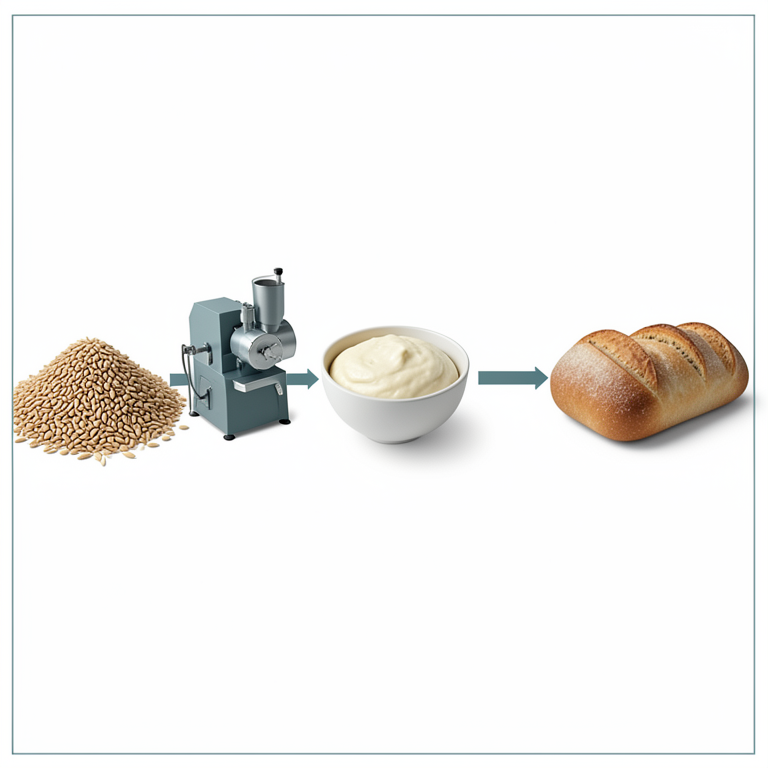
Sequential Processing Flow
AI-generated conceptual illustration (wheat grains and wheat-based food products). It explains the idea and does not show study data.
View source evidence ↗Figures & tables
From the original paper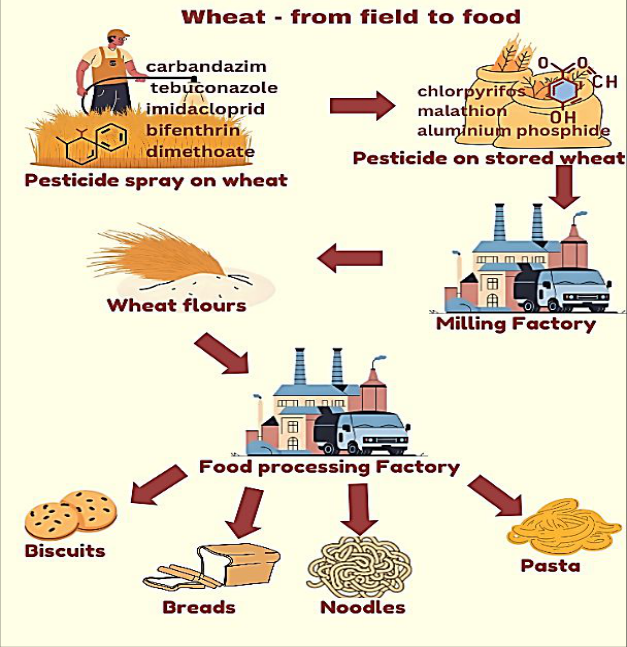 Figure 1
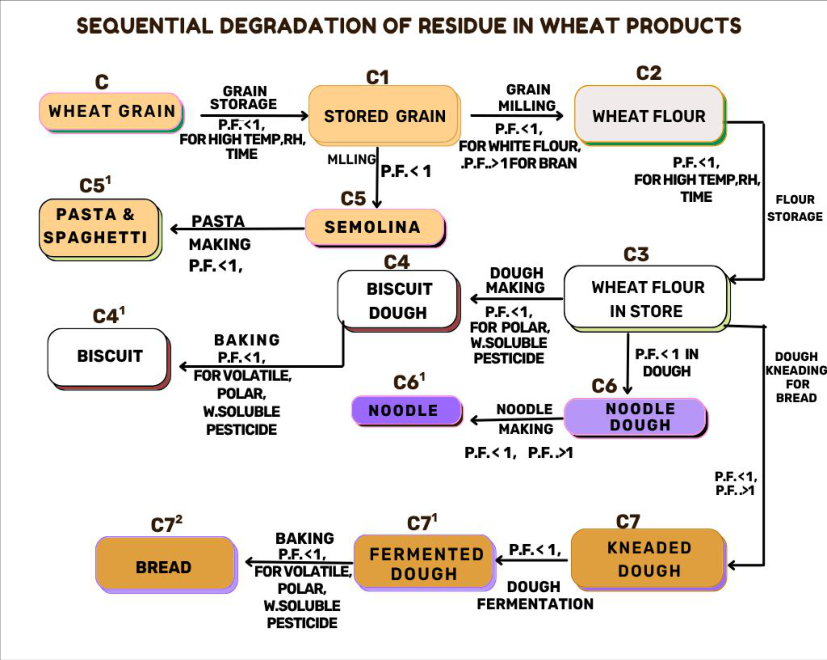 Figure 2
Introduction
Wheat is not only consumed directly as a cereal grain in breakfast or small meals but also in the form of biscuits, cakes, pastries, bread, and pasta, which are prepared from wheat flour and semolina (Stevenson et al. 2012) [24] . Hard wheat has a higher protein content of more than 10% and is used for bread, semolina & noodle production, whereas soft wheat, which has protein content from 7% to 10%, is used in biscuit and cake preparation. In modern days, various kinds of chemical pesticides are used heavily not only in crop production but also to store grain to prevent it from pest or fungal infestation. Pesticides used in wheat production are weedicides used against weeds, fungicides used to treat fungal diseases, and insecticides used to control insects. Rezaei et al. (2017) [32] found that pirimicarb, chlorpyrifos, carbaryl, malathion, propiconazole, tebuconazole, and triadimenol are the main pesticides used in wheat to control insects, fungi, and weeds. In India, herbicides registered for use in wheat are 2, 4-D dimethyl amine salt, clodinafop, fenoxaprop, isoproturon, metsulfuron methyl, sulfosulfuron, pinoxadenetc**. However, the primary formulations in this category are glyphosate (15% of market share among weedicides), 2, 4-D amine salt (15%), and pretilachlor (12%). Insecticides registered for use in wheat for grain storage in India are aluminum phosphide, chlorpyriphos, deltamethrin, malathion, methyl bromide, etc., whereas carbofuran, chlorpyrifos, cypermethrin, and fipronil are used for wheat plant application in India. Leading formulations include chlorpyriphos with 14% of the market share of insecticide, followed by malathion (7%), and quinalphos (6%)**. pesticides. As very little literature is available in Indian context, the voids in research areas will also be identified. Factors that may affect the presence and accumulation of pesticides in these food products will also be found out, and finally, with the knowledge of Processing factors (P.f.), we shall attempt to establish some model equations that will be helpful for Indian food industries to estimate residue concentrations in the final food commodity. Fig - 1 represents a Flow diagram of wheat based food products manufacturing. The Maximum Residue Limit (MRL) of a pesticide is the maximum legally permissible concentration of pesticide residue in mg/kg in the commodity, which is acceptable for food and animal feeds, in accordance with the Good Agricultural Practices (GAP). MRLs of wheat have been established by many countries and organizations, such as the European Union (EU), Codex Alimentarius Commission (FAO), as well as FASSI (Food Safety and Standards Authority of India) in India. On the other hand, Processing Factor (P.f) is the ratio of pesticide residue level in mg/kg in the post-processing and pre-processing commodity (Lili et al 2021).
Pf= Residue in post-processed material (mg/ kg)/Residue in pre-processed material (mg/kg) For example, P.f. for the biscuit baking process is the ratio of pesticide residue level in the biscuit to that in the flour. If P.f. for the process is greater than 1, it means an increase in the residue during processing. On the other hand, if the P.f. value is found to be less than 1, a decrease in the residue is indicated. Scholz et al (2018) [39] concluded that the reason for the decrease of P.f. from 1 may be due to dilution, evaporation, or thermal degradation. P.f., as well as MRL data, is useful in understanding the quality of food in terms of pesticide residue content. On the other hand, the half-life of a pesticide is the time taken for the pesticide to degrade 50% of its original concentration (Helfrich 2009) [21] . These terms are essential to study pesticide levels and their degradation on wheat. The half-life of pesticides differs from one pesticide to another, depending on the crop on which it is applied and experimental conditions.
Pesticide detected on wheat grain
It has been found by Satya et al. (2016) [38] that for controlling pests on wheat storage, chlorpyrifos and malathion are used as surface treatment, and aluminium phosphide tablets are used as fumigants. In China, out of 350 wheat samples collected between 2020 to 2021, pesticides like carbandazim, tebuconazole, and imidacloprid were mostly detected. However, no pesticide residue was detected in 65.3% to 75.5% of collected wheat samples (Wang L et al, 2025) [49] . In Algeria pirimiphos methyl was found on wheat in 46 out of 80 wheat samples analysed (57.5%), whereas, benalaxyl, chlorpyrifos and metalaxyl were detected above MRL in 5% of samples. (Mebdoua, Samira & Ounane, Ghania. 2019) [28] .
Bhatnagar et al (2022) [12] detected pesticide residues of chlorpyrifos and carbendazim in the wheat samples from agricultural fields near Ghaziabad city of India, collected between 2017 and 2019. It was also observed that, barring carbendazim, which was detected above MRL as per FSSAI MRL standard in a few wheat samples, all the pesticides were found to be below MRL.
Pesticides degradation Pesticide degradation in wheat grain storage
Pesticides on wheat can be degraded by biotic causes like metabolism, mainly by microbes, and also by plants and animals, and abiotic causes like oxidation-reduction, photolysis, and hydrolysis. High temperature and pH accentuate such degradation (Helfrich 2009 [21] , NPIC 2011). Storage, various food processing operations during product manufacturing also cause changes in the level of pesticide residues to various extents (Bajwaet al 2014) [7] . Pesticide residue degradation on wheat grain is affected by storage time, temperature, and Relative Humidity.
Grain Storage time (t)
In wheat grain storage, the pesticide residues gradually decreased with the increase in storage time. The rate of degradation was faster in the early stage and slower in the later stage as shown by Ding Z et al (2023) and Tsumura et al (1994) [44] as well as Alnaji and Kadoum (1979) [5] . When spring wheat is stored for 6 months, residues were relatively higher in bran and middlings than in flour. Malathion, bromophos, and iodofenphos degraded at a relatively higher rate than Iodofenphos and Pirimiphos methyl. Moisture present in wheat grain plays an important role in pesticide degradation, as it was found that insecticide residues on grain with 12% moisture content are higher than those on wheat grain with 16% moisture (Mensah et al. 1979) [30] . A Similar result was found by Alnaji et al. (1987) [4] with Pirimiphosmethyl. Tsumura et al. (1994) [44] found that Half-lives of pesticides like chlorpyriphos-methyl, DDVP (dichlorvos), malathion, orfenitrothion, and fumigants like methyl bromide on buckwheat, stored at 15°C ranged from 13 days to 124 days. Fenitrothion. Dimethoate, chlorpyrifos, and chlorpyrifos-methyl on wheat grain degraded gradually over time in 90 days of storage when temperature and R.H. are constant. (Liu, Y et al 2023) [27] . Ding, Z. et al (2023) [15] studied the degradation of carbendazim (fungicide), bensulfuron methyl (herbicide), triazophos (organophosphorus insecticide), chlorpyrifos (thiophosphate insecticide), and carbosulfan (carbamate insecticide) during wheat storage, and found that residues on wheat decreased with storage time during the 90-day storage period. In all cases, pesticide residue concentration on wheat grain decreases rapidly in 0-10 days and major degradation takes place within this period, but thereafter it decreases very slowly. In contrast, Balinova et al (2006) [8] found lower degradation rates associated with chlorpyrifos-methyl and pirimiphos-methyl, applied on wheat grain during storage. It was also found that deltamethrin, malathion, and permethrin concentrations in stored wheat decrease rapidly, and in 274 days of storage, almost 100% degradation of permethrin takes place. (Meghdad et al 2019) [29] ,
Grain Storage temperature (T) At three experimental temperatures of 10, 26 and 35 °C, degradation of dimethoate, chlorpyrifosand chlorpyrifosmethyl on wheat grain is optimumwhen temperature is 35 0 C. High temperature shows more degradation effect for dimethoateand chlorpyrifos-methyl than chlorpyrifos. Out of storage time, temperature and humidity, temperature is the main factor affecting the degradation of pesticide residues in wheat (Liu Y et al 2023) [27] . Ding, Z et al (2023) [15] observed that under the four temperatures of 20, 30, 40 and 50 0 C from low to high, the carbendazim residue on wheat diminishedin the range from 86.83%, to 98.14%(half-lives of 10.27, 7.33, 8.04, and 6.97 days) in 90 days and chlorpyrifos residue on wheat diminishedin the range from 97.40%, to 98.70%(half-lives of 10.09, 9.64, 9.11, and 6.43 days), bensulfuron methyl residue decreased in the range of 96.00%, to 99.00%(half-lives of 8.93, 9.11, 7.50, and 5.37 days), the triazophos residue decreased in the range of 90.87%, to 98.80%(half-lives of 13.47, 11.16, 8.48, and 6.61 days,),whereas carbosulfan residue shows least degradation among others, reducing in the range of 77.85%, to 87.95% with half-lives being 20.42, 11.87, 12.67, and 9.73 days respectively. Thus, degradation reached the peak at 50 0 C.
Grain Storage relative humidity (RH)
Dimethoate, chlorpyrifos, and chlorpyrifos-methyl were found to degrade at 54%, 65% and 75% relative humidity.
The higher is the humidity, the faster is the decrease in concentration of pesticide residues under the same storage temperature (Liu, Y et al 2023) [27] . Under the four relative humidity at 50%,60%,70%,80% from low to high, Ding, Z et al (2023) [15] observed that the carbendazim residue diminished in the range 89.14%, to 94.64% (half-lives of 8.93, 8.31, 7.68, and 7.15 days), the bensulfuron methyl residue diminishedin the range 96.50%, to 98.75% (halflives of 8.39, 7.68, 7.06, and 6.61 days), the triazophos residue diminishedin the range 90.20%, to 98.60% (halflives of 10.62, 9.64, 8.75, and 8.04 days), the chlorpyrifos residue decreased in the range 96.60%, to 98.60% (halflives of 10.62, 9.91, 9.29, and 8.66 days), whereas carbosulfan residue decreased to a lesser extent which isin the rangeof 77.83%, to 89.23% (half-lives of 14.01, 13.70, 12.76, and 12.05 days). Thus, in all cases, degradation increases with R.H. and reaches a peak at 80% RH. The moisture content in stored grains and the storehouse environment was found to affect the degradation of organophosphate and pyrethroid pesticide residues on grains (Afridi et al. 2001) [2] .
Degradation of pesticides on wheat grain milling
During grain milling, white flour (maida) is obtained from wheat endosperm after separating germ and bran from endosperm, and whole wheat flour is obtained by grinding the entire wheat kernel, including the bran, germ, and endosperm. Djurovic-Pejciv (2017), as well as Kausik et al (2017) observed that milling significantly degrades pesticide residue on wheat. Abu-Elamayem et al. (1979) [1] added leptophos at a concentration of 100 ppm to wheat grains before milling and found that 99 % of it had degraded in the flour and less than 1% remained (0.99 ppm). However, in bran residue, degradation was to a lower extent, and the amounts of residue present in the bran were highest (Dobrinas et al. 2013) [17] . A similar result was observed by Alnaji and Kadoum (1979) [5] with methyl phoxim. But during milling, the residue degraded by 8 to10% (p.f. 0.9 to 0.92). Deltamethrin, fenvalerate, permethrin, and phenothrin residues were highly stable on stored wheat and degraded to a lesser extent in the bran fractions during milling, but were reduced in white flour (Bengston et al. 1983). Similar result was reported by Joia et al. (1985) [22] with cypermethrin and fenvaleratewhich degraded in the range of 79%-84% for cypermethrin(P.f. 0.16 to 0.21)and 87%-88% for fenvalerate, Alnaji (1987) [4] with primipho-methyl (86.15% reduction p.f. 0.14 in milling), Uygun et al 2005 [46] with malathion (95% reduction P.f. 0.05 in milling), Lili et al (2021) with chlorpyrifos (P.f 0.1 to 0.15), omethoate, (P.f 0.02 to 0.14) cypermethrin (P.f 0.16 to 0.61), and deltamethrin (P.F 0.6 to 0.37 in milling). All data indicate that the milling process affects the removal of pesticide residues significantly, though variation exists in P.f. of a particular pesticide during wheat milling due to differences in experimental conditions. However, these data are generated from experiments under varying laboratory conditions, not under real-time industrial processing under Standard Operating Procedure (SOP), which is lacking. Bran and germ contain high levels of triglycerides. Lipophilic pesticides tend to remain on the seed coat, and only a fraction can move to the bran and germ. Some pesticides appear to be in bound form on wheat, whereas some pesticides could enter the grain by translocation. Cleaning of dust also decreases pesticide levels during milling, as pesticides tend to accumulate on that also. Storage fungi may also assist in the degradation of insecticides. (Halland et al. 1994) [19] .
Degradation of pesticides on wheat flour
After milling of grain to flour, pesticides tend to degrade during flour storage, depending on storage time, storage temperature, and relative Humidity.
Flour Storage time versus degradation
Under any given temperature, Ding et al (2023) [15] found that pesticides tend to degrade in wheat flour over time during 60 days of storage. Degradation is rapid in 0-20 days, but thereafter it decreases slowly with time. Balinovaet al. (2007) [9] observed when deltamethrin was applied in the 3 wheat flours at 0.5 mg/Kg, 0.03 to 0.2 mg/Kg residue remains after 180 days and after treatment at a rate of 4 mg/Kg 0.4 to 1.5 mg/Kg residues remains in wheat flour after 270 days, showing considerable degradation in flour storage. A similar result was also observed by Uygunet.al. (2009) [47] .
Flour Storage temperature versus degradation
Ding et al. (2023) [15] observed that under the four temperatures of 20,30,40 and 50 °C from low to high, the carbendazim residue diminished in the range of 83.41%, to 84.00%,bensulfuron methyl residue diminished in the range of 57.74% to 92.25%,triazophos residue decreased in the range of 90.22%, to 95.21%,the chlorpyrifos residue decreased in the range of 82.40%to 98.62%, whereas carbosulfan residue does not follow a definite trend but decreased by 83.48%, 83.58%, 86.38%, and 79.18% with half-lives being 6.08, 5.49, 4.54, and 4.25 days, respectively. This in a broad sense indicate that high temperature degrade residue on wheat flour, may be due to the fact that with the increase of storage temperature, the chemical reaction rate of pesticide degradation process is accelerated, and the volatility of the pesticide is enhanced,especially those with lower boiling point may be more susceptible.Susceptibility to temperature of the five pesticides ishowever, different.Similar result was also obtained by Liu. Y. et al (2020) [26] who showed that temperature promote pesticide degradation on corn flour. Carbandazim was mostly degraded at 25 °C out of three temperatures of -20 °C, 4 °C and 25 °C, compared to acetochlor, metolachlor, triadimefon and imidacloprid.
Flour Storage Relative Humidity versus degradation
Carbendazim, bensulfuron methyl, triazophos, chlorpyrifos, carbosulfanresidues decreased with increase in relative humidity during storageof flour at 50%, 60%, 70%, 80% R.H., in 60-day storage period (Ding, et al 2023) [15] . Under the four relative humidity states from low to high, the carbendazim residue decreased in the range of 79.84%to 86.96%, with highest degradation taking place at 70% RH, the bensulfuron methyl residue decreased in the rangeof 60.32%to 73.35% with highest degradation taking place at 80% RH, the triazophos residue decreased by 84.91%to 99.24 with highest degradation at 80% RH, the chlorpyrifos residue decreased in the range of 79.62%to 89.42% (maximum at 80% RH), whereascarbosulfan residue decreased by 88.88% to 90.89% with maximum degradation occurring at 60% RH. Thus though humidity plays a significant role in residue degradation but maximisation of reduction takes place at different RH. The effect of high humidity on degradation is greater on water soluble pesticide than on lyophilic pesticide. (Varanasi et al. 2016) [48] .
Pesticide degradation during baking of biscuits and cookies
Elena. et al (2020) studied processing factors for the baking for 41 pesticides in cereal bran-based biscuits containing wheat, rye, oat, and barley grains, and it was found thatfor polar compounds such as carbendazim and volatile compounds such as chlorpyrifos-methyl, malathion, and pirimiphos-methyl, larger degrades up to 33% took place which corresponds to P.f. of 0.67. Bifenthrin and pirimicarb were unaltered by the baking process. However, azoxystrobin, bixafen, boscalid, carbendazim, chlorpyrifos, cypermethrin, cyproconazole, cyprodinil, deltamethrin, difenoconazole, epoxiconazole, fenpropidin, fenpropimorph, fludioxonil, fluopyram, fluquinconazole, flusilazole, fluxapyroxad, iprodione, kresoxym-methyl, metconazole, metrafenone, prochloraz, propiconazole, prothioconazole, pyraclostrobin, spiroxamine, tebuconazole, triadimenol, and trifloxystrobin exhibit P.f. less than 1 for baking of food products made of wheat, rye and oats, whereas pyraclostrobin and tebuconazole has P.f. greater than 1 for oats. Average P.f. ranged from 0.80 to 1.20. Main degradation of residue took place within the first 6 min, and as such, prolonged baking time did not significantly affect the P.f. On the other hand, highly volatile compounds and compounds with low degradation temperature were significantly reduced with prolonged baking time, resulting in up to 95% degradation of pesticide residues (Elena et al, 2024). During baking, methylphoxim and malathion residues were found to be degraded in the range of 79.1to 100% and 80.1 to 100%, respectively. A similar result was observed by Uygun et al. 2009 [47] with malathion and chlorpyrifos-methyl in cookie processing. During baking, considerable physical and biochemical changes occur, including water evaporation, volume increase, porous structure and crust formation, browning, protein denaturation and starch gelatinization (Mirade et al., 2004) [31] . Most relevant thermal reactions occurring during baking are the Mallard reaction and the caramelization of sugars. The thermal effect of baking may also have a degradative/inactivating effect on pesticides and mycotoxins possibly present in biscuit dough. Physicochemical properties of each pesticide control its fate during baking.
Pesticide degradation during bread making
Bread making involves dough mixing, fermentation and kneading and baking. Dough mixing step in both Chinese steamed bun and bread processing reduces the concentration of pesticide residues significantly by 33 to 46%. Increase of moisture content in mixed dough during dough preparation was the reason for such change (Lili et al 2021). For three types of flours under experiment,P.f. for Chlorpyrifosin the kneaded dough ranged between 0.10 to 0.13and for flour milling,P.f. was also in the same range of 0.10 to 0.13. But for omethoate P.f. increased slightly in kneading from flour, whereas for cypermethrin, and deltamethrin, concentrations of residues increases significantly in kneading compared to flour in CSB (Chinese Steam Bread). The change in P.f. from flour milling to kneaded dough is from 0.16 to 0.17 in one case and from 0. 61 to 0.79 in the other with cypermethrin and for P.f. increases from 0.37 in flour to 0.54 in kneaded dough in one type and from 0.11 to 0.13 in other variety of flour. However, most of the groups of cypermethrin and deltamethrin showed various degrees of increases in residue in kneaded and fermented dough in steamed bread compared to flour (Lili et al 2021). Chlorpyrifos, omethoate, cypermethrin, and deltamethrin showed different sensitivity in the dough fermentation process. After fermentation at 38°C, for 1 hr, chlorpyrifos and omethoate showed lower pesticide concentrations compared with the flour (Lili et al 2021). Zhou, X. W., Liu, H. F., & Zhao, X. H. (2015) reported that yeast could degrade Organophosphorus pesticides during the bread making progress, and yeast fermentation and subsequent baking removed 50.66%-88.35% of chlorpyrifos and 59.85%-79.04% of malathion compared to wheat flour. Pyrethroid groups showed a completely opposite trend in comparisontoorganophosphorus groups during fermentation, and their level increased during the process as, higher concentrations of cypermethrin and deltamethrin residues in fermented dough were observed compared to flour. It was also reported by Zhou, Liu, and Zhao (2015) [51] that, after a fermentation time of 5 hr, organophosphorus pesticide concentrations of chlorpyrifos and malathion decreased in ranges from 16.6%-26.6% and from 23.4%-31.8% when exposed to 1.5% and 3.0% yeast. Degradation depends on the fermentation time and yeast addition levels.Similar results were reported by Lili et al (2021), in which organophosphorus pesticides, chlorpyrifos and omethoate showed lower concentrations in fermented dough.These results proved that yeast had a clear ability to degrade some pesticides belonging to organophosphorus groups, and fermentation time also played an important role in pesticide degradation (Sharma et al 2005) [40] . Concentrations of chlorpyriphos methyl, pirimifos and malathion were significantly lower in the breads than in flours (Bolletti et al. 1996) [13] . When the content of bran is low and white flour is high in bread making, dilution effect of pesticide residue originating from bran takes place even before the breads making process. It has been reported that many factors such as chemical structure, volatility, adsorption of pesticides, biodegradation by microorganisms, and cleavage of extracellular enzymes could affect the fate of pesticides during food fermentation, (Aislabie & Lloyd-Jones, 1995 [3] ; Azizi& A. Homayouni 2009 [6] , Bayarri, Conchello, Ariño, Lázaro, & Herrera, 2015) [10] . Thesefactors, themselves, are also inter dependent on many environmental parameters, including processing temperature, moisture content, pH, andlight. (Aislabie& Lloyd-Jones, 1995 [3] ; Azizi& A. Homayouni, 2009) [6] . Deltamethrin and malathion degrade by 63% and 60%, respectively, through entire bread making process which corresponds to P.f. of 0.37 and 0.40 respectively. (Sharma et al 2004) [40] . However, among permethrin, deltamethrin and malathion in flour and bread obtained from Kermanshah province Iran, malathion residues were higher than those reported in other works around the world but all 3 pesticides has residue concentration lower than the MRL in bread set by the WHO (Meghdad et al 2019) [29] .
Pesticide degradation during noodles making
Ying Liang et al (2022) [25] studied the fate of triadimefon, imidacloprid, fenitrothion, chlorpyrifos-methyl, and chlorpyrifos in wheat flour during noodle production and storage. He found that dough mixing reduced the pesticide residues significantly owingto the increase inmoisture content. Dough resting decreased the levels of chlorpyrifosmethyl and chlorpyrifos significantly, but not the levels of triadimefon, imidacloprid and fenitrothion. Pesticide residue levels changesin different degreesduring the noodle drying step. This indicate different role played by thermal evaporation or thermal degradation on levels of different pesticides. P.f.s of five pesticides ranged from0.15 to 0.27 in the whole process for fresh noodles preparation, and ranged from 0.24 to 0.35 for dried noodles preparation. Thusthe whole process for noodle production was beneficial to reduce the pesticide residues with P.f.s ranging from 0.15 to 0.35. Further, Alnaji 1987 [4] observed that,in the noodles prepared from stored wheat, 100% of 2,2-dichlorovinyl dimethyl phosphate residue degraded, while 39% of the initial chlorpyriphos-methyl, 60% of malathion, 58% of fenitrothion and 79% of methyl bromide degraded during the making process.
Pesticide degradation during semolina and spaghetti making
Dissipation of chlorpyrifos-methyl and pirimiphos-methyl residues in post-harvest-treated wheat grain was studied by Balinovaet al. (2006) [8] . Samples of treated grain were milled in a fractionating laboratory mill and eight fractions-bran, semolina, three types of groats and three types of flour werecollected and analysed. Insecticides on the grain were concentrated partlyin the bran and partly in semolina fractions. Pelosi et al. (2025) [34] studied242 P.f. for 34 pesticides for durum wheat and observed that P.f. was Low (P.f. <1) for semolina but P.f. werehigh for bran and wholemeal food. Thus, semolina making process reduces pesticides residue. In another study by Simona Dobrinas, Elisabeta Chirila &Alina Serban (2013) [41] , mixture of pesticides (organophosphorus pesticides, organochlorine pesticides and pyretroides) were added to seven varieties of Romanian wheat grain like Dropia, Delabrad 2, Izvor, Faur F, Gruia, Boema and Glosa and contamination level of each fraction resulting after grinding i.e. bran, semolina and flour were analysed. It was found that encountered pesticide amounts ranged between 0.0529 mg/kg and 0.2163 mg/kg. α HCH and cypermethrin were found in Dropia semolina. Deltamethrin, fenvalerate, iprodione, endosulfan-sulphate, bifenthrin, β endosulfan, op DDT, captan, op DDE, lindan and α endosulfan were not found into any of the three fractions bran, semolina or flour. The result also showed that pesticides were contaminated in the bran in highest amount and in a smaller amount was in semolina. Uygunet al. (2008) observed that although a considerable amount of the insecticides remained in the semolina, spaghetti processing significantly reduced it's residue concentrations. Pirimiphosmethyl was the most persistent of the insecticides and loss occurred during milling and spaghetti processing was somewhat less substantial. This may be due to its physicochemical properties.
Pesticide degradation during pasta making
Pelosi, et al. (2025) [34] studied P.f. for pesticides in wheat milling products and pasta. A total of 242 processing factors (Pf) were determined for 34 pesticides in milling products (flour, semolina, bran, middlings, fine bran), in refined and wholemeal pasta from durum wheat, after treating with acetamiprid, λ-cyhalothrin, deltamethrin, benzovindiflupyr, and prothioconazole, at dosages 5 times higher than normal level. The result shows that for pasta P.f.is less than 1 meaning decrease in residue in pasta making process but high in bran and middlings (Pf = 1.9-6.8). Preparation of dried pasta from semolina and flour obtained in milling reduced concentration of glyphosate herbicide by a factor of 1.8. (Tittlemier 2023) [42] .
Factors that may have effect pesticides in food made of wheat flour
Pesticide degradation in various foods processing ultimately affect accumulation of pesticide residue in various wheat based food products. From the discussionof pesticide degradation in storage,milling and food processing of wheat products like bread, biscuit, semolina, pasta and noodles, it appears that following factors may have effects presence of pesticides in wheat and wheat based food products.
Pesticide type
In the biscuit, bread, noodle manufacturing process involving dough making, baking, polar pesticide like carbendazim and volatile pesticides like malathion degrade more than non-volatile and nonpolar pesticides. The effectiveness of the baking, fermentation process in reducing pesticide residues and consequent accumulation varies depending on the pesticide's chemical and physical properties.
Storage
Storage
Storage time
In both flour and wheat, the pesticide residues gradually decreased with the increase of storage time, and the degradation rate was faster in the early stage and slower in the later stage quite resembles first order or pseudo first order chemical initially.
In some cases pesticide residue dynamics do not follow first-order kinetics, but instead a more complex. bi-phasic or bi-exponential or double first-order in parallel (DFOP) kinetics. (Torabi et al, 2021) [43] , (Zijian et al, 2022) [52] .
Storage Humidity
Organophosphate and pyrethroid pesticide on flour & wheat degrade rapidly with increase in Relative Humidity. The effect is more pronounced on water soluble pesticides.
Storage temperature
High storage temperature of wheat grain and flour increases degradation of residue.
Processing
The baking can reduce some pesticides depending on the physical and chemical characteristics of pesticides. High temperature of baking of 200-300 °C causes degradation of pesticides compounds have comparatively low degradation temperatures (below 200 °C).Similarly milling and fermentation also tend to decrease pesticide residues whereas kneading seems to have the little or opposite effect.
Source of ingredients
Biscuits, noodles, breads made from wheat that has been treated with pesticides to a greater extent will naturally have higher chances of contamination levels of pesticides residues compared to biscuits made from untreated or organic wheat.
Nature of ingredient
Highest amounts of pesticides were detected in the bran (Dobrinas et al., 2013) [17] than whole wheat flour and least in white flour of wheat derived from wheat endosperm. Thus food items made of wheat bran, whole wheat flour tend to have more pesticide residue than white flour. P.f. and calculation of pesticide residue in wheat based food items Knowledge of P.f.s are essential for ensuring that thedetected residues in processed cereal products, comply with the established MRLs. For example, when pesticide residue data is available for whole grains but not for bran, a PF (for milling to bran) can be used to estimate the residue content in bran. (Hakme. et al 2024) [20] . As food processing of wheat based productsis a continuous one, starting from storage of grain to milling offlour,then to dough preparation, fermentation, baking or noodle/pasta making,as shown in Figure -1, from the knowledge of pesticide residue in wheat grain and P.f.s for each step for each pesticide, pesticide residue content in final product can be easily estimated by using simple formulae. For wheat milling C Residue in wheat flour = Residue in Grain (C1) ×Sw× P.f. milling (C2)
Again, for biscuit preparation, in the sequence C -C1-C2-C3-C4-C4 1 when pesticide residue in wheat grain is known then from the knowledge of various P.f. data for that particular pesticide during baking, pesticide residue in biscuit can be calculated.
Residue in biscuit = C × S w ×P.f milling ×S f × P.f. dough × P.f. baking
When Residue in wheat flour is known Residue in biscuit = C × S f × P.f. dough × P.f. baking (4) S w =f(x,y,z)=a+bx+cy+dz+ex 2 +fy 2 +gz 2 +hxy+ixz+jyz (5); This is actually P.f. in wheat grain storage, a, b, c, d, e, f, g, h, i, j are constants, values of which varies from pesticide to pesticide, x is the storage time in days, y is the storage temperature (in 0 C) and z is the relative humidity (in %) during storage.
Or when residue in flour is known,
Residue in noodle = C f × S f × P.f. dough ×P.f. noodle (8) Similarly for bread making,
Residue in bread = C w × S w × P.f milling ×S f × P.f. kneaded dough × P.f. fermented dough × P.f. baking (9) or when residue in flour is known, Residue = C f × S f × P.f. kneaded dough × P.f. fermented dough × P.f. baking (10) These equationsare applicable when end product of a processing is the principal ingredient of next processing and a particular pesticide residue is under study. When no storage time is allowed, Sw, Sf is 1, and when multiple processing are clubbed into a single processing the processing factors in between are also considered as unity.
Limited data are available on continuous degradation of pesticide on wheat during milling, storage, kneading, fermentation and baking which makes such study very difficult. However, as per L. Yue et al (2019) [50] for Deltamethrin Kneading of dough has P.f. 0.54, Fermented dough P.f 1.03, Steamed dough P.f. 0.53 P.f, as such for processing of the entire Chinese bread processing P.F is 0.294 considering S f =1, as no storage time was considered, which is in agreement with Sharma et al (2004) [40] who found that for Deltamethrin P.f. is 0.37 through entire bread making process from flour. These data were however generated from different in vitro experimental conditions. But for industries, which operates under constant SOPs (standard Operating Procedure) throughout the year there is high chances that these data will be in a certain range and calculation will yield constant results, the year round. And as such, residue in final products can be predicted with more accuracy. Hence, future research must be focused on industries. Further, under actual farm condition or in industries where multiple pesticides are applied simultaneously or sequentially, factors of antagonistic or synergistic effect on degradation caused by application of multiple pesticides may arise which has not been accommodated in these studies. Detailed researches are however required to ascertain residue level, P.f., of pesticide on wheat under actual farm condition or industrial condition to have a meaningful prediction of residue on wheat based food products.
The EU has set up a database of processing factors for pesticide residues in 2018 which is also updated from time to time with the third being in 2025.The database now contains 2838 studies, 19384 individual and 4564 median processing factors. In the same way a P.f data base for various industrial food processing operations, (which follows constant SOPs) on wheat based food products and storage under the similar agro-climatic region of Indian Subcontinent or South East Asia can also be set up. (Kittelmann, Arno & Scholz, Rebekka & Tietz, Enrico & Zincke, Fabian Michalski, Britta. (2025) [23]
Conclusion
Pesticide application in farmer's field does not often follow recommended pesticide types and doses. This may lead to pesticide contamination in foods produced obtained from various wheat products which poses harmful health hazards to the consumers. Factors that may generally affect level of pesticide in food may be categorised as Pesticide type, Storage of processed and unprocessed products, Processing like milling baking fermentation, Source of ingredients as well as Nature of ingredients. Storage of wheat and flour from 0 to 20 days degrade residue to a good extent, and as such, the same may be followed by the industries. Further research on P.f. and pesticide degradation is necessary under actual industrial condition are required, as little literature is available on the level of pesticide residue in raw materials and food products produced by industry. Pesticide analysis is not included in the mandatory Quality control analytical procedure in Food industries. As in wheat based food products preparation, each sequence of processes on wheat plays a role in change in residue level, data on processing factors (P.f.) for different pesticides during various processes under constant SOPs, followed by industries will also serve as a database to understanding optimum storage time, and optimum food processing conditions in milling, baking, fermentation that tend to eliminate residues from food items. This will immensely help food industries to manufacture pesticide free wheat based food products to accommodate health concerns of the consumers.
Funding
Funding
Acknowledgement
AcknowledgmentsNil.
Figures and tables from the paper
References
52 in the original paper- Abu-Elamayem MM, Abdel A, Tantawy GA. Fate of leptophos in milk and wheat during the processing steps. Alex J Agric Res. 1979;27:659-663.
- Afridi IAK, Parveen Z, ZafarMasud S. Stability of organophosphate and pyrethroid pesticides on wheat in storage. Journal of Stored Products Research. 2001;37(2):199-204.
- Aislabie J, Lloyd-Jones G. A review of bacterial degradation of pesticides. Australian Journal of Soil Research. 1995;33:925-942.
- Alnaji LK. Distribution of primipho-methyl residue on Iraqui hard wheat milling fractions and in bread during storage. Iraq J Agric Sci "Zanco". 1987;5:191-199.
- Alnaji LK, Kadoum AM. Residues of methyl phoxim in wheat and milling fractions. J Agric Food Chem. 1979;27:583-584.
- Azizi A, Homayouni A. Bacterial-degradation of pesticides residue in vegetables during fermentation. Asian Journal of Chemistry. 2009;21:6255-6264.
- Bajwa U, Sandhum KS. Effect of handling and processing on pesticide residues in food-a review. Journal of Food Science and Technology. 2014;51(2):201-220. https://DOI:10.1007/s13197-0110499-5
- Balinova AM, Mladenova RI, Obretenchev D. Effect of grain storage and processing on chlorpyrifos-methyl and pirimiphos-methyl residues in post-harvest-treated with regard to baby food safety requirements. Food Addit Contam. 2006;23(4):391-397. https://DOI:10.1080/02652030500438035
- Balinova AM, Mladenova RI, Shtereva DD. Study on the effect of grain storage and processing on deltamethrin residues in post harvest treated wheat with regard to baby-food safety requirements. Food Addit Contam. 2007;24:896-901. DOI:10.1080/02652030701278313.
- Bayarri S, Conchello P, Ariño AA, Lázaro R, Herrera A. Evaluation of an analytical method for an in-vitro study of degradation of organochlorine compounds by 'meat starter' micro-organisms. Pest Management Science. 2015;50:120-126.
- Bengston M, Davies RAH, Demarchelier JM, Henning R, Murrav W, Simpson BW, et al. Organophosphorothioates and synergized synthetic pyrethroids as grain protectants on bulk wheat. Pest Sci. 1983;14:373-384.
- Bhatnagar A, Dave R, Jindal T, Virdij S. Occurrence and Dietary Risk Assessment of Pesticides in Wheat Fields of Ghaziabad City, India. Asian Journal of Chemistry. 2022;34(3):695-703.
- Bolletti P, Tellini L, Becciolini S. Organophosphate residues in flour and bread. Tecnica Molitoria. 1996;47:857-860.
- Directorate of Plant Protection, Quarantine & Storage. Major Uses Of Pesticides (Registered under the Insecticides Act, 1968). Reference: Central Insecticide Board and Registration Committee. [cited n.d.]. Available from: http://cibrc.nic.in
- Ding Z, Lin M, Song X, Wu H, Xiao J. Quantitative Modeling of the Degradation of Pesticide Residues in Wheat Flour Supply Chain. Foods. 2023;12:788. https://DOI.org/10.3390/foods12040788.
- Djordjevic T, Djurovic-Pejcev R. Food processing as a means for pesticide residue dissipation. Pesticidi I Fitomedicina. 2017;31(3-4):89-105. https://DOI.org/10.2298/pif1604089d
- Dobrinas S, Chirila E, SerbanOlgos A. Distribution and quantification of pesticides in processed wheat grain fractions. NATO Science for Peace and Security Series C: Environmental Security. 2013;134:257-264. https://DOI.org/10.1007/978-94-007-6461-3_23.
- Hakme E, Herrmann SS, Poulsen ME. Processing factors of pesticide residues in biscuits and their relation to the physicochemical properties of pesticides. Food Additives & Contaminants: Part A. 2020;37(10):1695-1706. https://DOI.org/10.1080/19440049.2020.1791975.
- Halland PT, Hamilton D, Ohlin B, Skidmore MW. Effects of storage and processing on pesticide residues in plant products. IUPAC reports on pesticides (31). Pure Appl Chem. 1994;66:335-356.
- Hakme E, Hajeb P, Herrmann SS, Poulsen ME. Processing factors of pesticide residues in cereal grain fractions. Food Control. 2024;161. https://DOI.org/10.1016/j.foodcont.2024.110369
- Helfrich LA. Aquatic animals; a guide to reducing impacts on Aquatic systems. [cited 2025 Apr]. Available from: http://publc.ext.vt.edu/420/420013/420-013htm
- Joia BS, Webster GRB, Loschiavo SR. Cypermethrin and fenvalerate residue in stored wheat and milled fractions. J Agric Food Chem. 1985;33:618-622.
- Kittelmann A, Scholz R, Tietz E, Zincke F, Michalski B. Third update of the EU database of processing factors for pesticide residues. EFSA Supporting Publications. 2025;22. 10.2903/sp.efsa.2025.EN-9477.
- Stevenson L, Phillips F, O'sullivan K, Walton J. Wheat bran: its composition and benefits to health, a European perspective. Int J Food Sci Nutr. 2012;63(8):1001-1013. DOI:10.3109/09637486.2012.687366.
- Liang Y, Duan J, Gao Q, Zhang Z. Degradation of pesticides in wheat flour during noodle production and storage. Food Additives & Contaminants: Part A. 2022;39:1239-1247. https://DOI.org/10.1080/19440049.2022.2077459.
- Liu Y, Qin X, Chen Q, Zhang Q, Yin P, Guo Y. Effects of moisture and temperature on pesticide stability in corn flour. Journal of the Serbian Chemical Society. 2020;85(2):191-201. DOI:10.2298/JSC190622100L
- Liu Y, Zhang Q, Dong W, Li Z, Liu T, Wei W, Zuo M. Autoformer-Based Model for Predicting and Assessing Wheat Quality Changes of Pesticide Residues during Storage. Foods. 2023;12:1833. https://DOI.org/10.3390/foods12091833.
- Mebdoua S, Ounane G. Evaluation of pesticide residues in wheat grains and its products from Algeria. Food Additives & Contaminants: Part B. 2019;12:1-7. DOI:10.1080/19393210.2019.1661529.
- Meghdad P, Yadolah F, Mohammad K, Rokhsareh A, Zahra S, Nazir F, Mika S, Anvar A. Measurement of permethrin, deltamethrin and malathion pesticide residues in the wheat flour and breads and probabilistic health risk assessment: a case study in Kermanshah, Iran. International Journal of Environmental Analytical Chemistry. 2019. https://DOI.org/10.1080/03067319.2019.1622009.
- Mensah GWK, Watters FL, Webster GR. Insecticide residues in the milled fractions of dry or tough wheat treated with malathion, bromophos, iodofenophs and pirimiphos-methyl. J Econ Entomol. 1979;72:728-731.
- Mirade PS, Daudin JD, Ducept F, Trystram G, Clément J. Characterization and CFD modelling of air temperature and velocity profiles in an industrial biscuit baking tunnel oven. Food Research International. International Journal of Agriculture and Food Science https://www.agriculturaljournals.com 2004;37(10):1031-1039. https://DOI.org/10.1016/j.foodres.2004.07.001.
- Mohammad Rezaei, Nabi Shariatifar, Shahram Shoeibi, Maryam Amir Ahmadi, Gholamreza Jahed KhanikiIran. Simultaneous Determination of Residue from 58 Pesticides in the Wheat Flour Consumed in Tehran, Iran by GC/MS. J Pharm Res. 2017;16(3):1048-1058.
- NPIC. National pesticide information Center. [cited 2025 Feb]. https://npic.orst.Edu/envir/efate.html
- Pelosi P, Gazza L, Beni C, AttardBarbini D, Picardo V, Gambale C, Amendola G. Processing factors of pesticide residues in durum wheat milling fractions and pasta. Food Chemistry. 2025;477:143622. https://DOI.org/10.1016/j.foodchem.2025.
- Pesticide Usage on Wheat and Hay Grown in Minnesota. Minesota Dept of Ariculture. 2018. https://www.mda.state.mn.us/sites/default/files/docs/20 21-07/2018pesticiteonwheathay.pdf.
- Pesticide report Govt. of India. FSSAI. [cited 2025 Apr]. https://fssai.gov.in/upload/advisories/2019/10/5da705b3 1ca78Letter_Report_Pesticide_MRL_16_10_2019.pdf
- Reddy AA, Reddy M, Mathur V. Pesticide Use, Regulation, and Policies in Indian Agriculture. Sustainability. 2024;16(17):7839. https://DOI.org/10.3390/su16177839.
- Satya S, Kadian N, Arjoo, Kaushik G, Sharma U. Impact of chemical pesticides for stored grain protection on environment and human health. In: Jayas DS, Alagusundaram K, editors. Proceedings of the 10th International Conference on Controlled Atmosphere and Fumigation in Stored Products. CAF Permanent Committee Secretariat, Winnipeg, Canada. 2016:92-97.
- Scholz R, Donkersgoed G, Herrmann M, Kittelmann A, Schledorn M, Graven C, et al. Database of processing techniques and processing factors compatible with the EFSA food classification and description system. FoodEx 2 Objective 3: European database of processing factors for pesticides in food. EFSA Supporting Publications. 2018;15. 10.2903/sp.efsa.2018.EN-1510.
- Sharma J, Satya S, Kumar V, Tewary DK. Dissipation of pesticides during bread-making. Chem Health & Saf. 2005;12:17-22. DOI:10.1016/j.chs.2004.08.003
- Simona Dobrinas, Elisabeta Chirila, Alina Serban (Olgos). Distribution And Quantification Of Pesticides In Processed Wheat Grain Fractions. Environmental Security Assessment and Management of Obsolete Pesticides in Southeast Europe, Conference paper. 2013:p. 257-264. https://DOI.org/10.1007/978-94-0076461-3_23
- Tittlemier SA, Bestvater L, Chan J, Timofeiev V, Richter A, Wang K, et al. Diverging fates of cadmium and glyphosate during pasta cooking. Food Additives & Contaminants: Part A. 2023;40(11):1459-1469. https://DOI.org/10.1080/19440049.2023.2264976
- Torabi E, Talebi Jahromi K, Homayoonzadeh M, Torshiz AO, Tavakoli E. Residue kinetics of neonicotinoids and abamectin in pistachio nuts under field conditions: model selection, effects of multiple sprayings, and risk assessment. Environ Sci Pollut Res Int. 2022;29(2):2598-2612. DOI:10.1007/s11356-02115822-1.
- Tsumura Y, Hasegawa S, Sekiguchi Y, Nakamura Y, Tonogai Y, Ito Y. Residues of post-harvest application pesticides in buckwheat after storage and processing into noodles. J Food Hyg Soc Japan. 1994;35:1-7.
- Umran Uygun, Berrin Senoz, Hamit Koksel. Dissipation of organophosphorus pesticides in wheat during pasta processing. Food Chemistry. 2008;109(2):355-360. https://DOI.org/10.1016/j.foodchem.2007.12.048
- Uygun U, Koksel H, Atli A. Residue levels of malathion and its metabolites and fenitrothion in postharvest treated wheat during storage, milling and baking. Food Chemistry. 2005;92(4):643-647. https://DOI.org/10.1016/j.foodchem.2004.08.045.
- Uygun U, Senoz B, Öztürk S, Koksel H. Degradation of pesticides in wheat during cookie processing. Food Chemistry. 2009;117(2):261-264. DOI.10.1016/j.foodchem.2009.03.111.
- Varanasi A, Prasad PV, Jugulam M. Impact of climate change factor on weed and herbicide efficacy. Advances in Agronomy. 2016;135:107-114. DOI:10.1016/bs.agron.2015.09.002
- Wang L, Dong Y, Cai D, Zhao S. Type B trichothecenes, pesticides and heavy metals in wheat in shandong, China: Occurrence and risk assessment. Journal of Food Composition and Analysis. 2025. https://DOI.org/10.1016/J.2025.107637.
- Yu L, Zhang H, Niu X, Wu L, Zhang Y, Wang B. Fate of chlorpyrifos, omethoate, cypermethrin, and deltamethrin during wheat milling and Chinese steamed bread processing. Food Science & Nutrition. 2021;9(6):2791-2800. https://DOI.org/10.1002/fsn3.1523.
- Zhou XW, Liu HF, Zhao XH. The potencies of three microorganisms to dissipate four organophosphorus pesticides in three food materials during traditional fermentation. Journal of Food Science and Technology. 2015;52:7353-7360.
- Zijian L, Peter F. Considering degradation kinetics of pesticides in plant uptake models: proof of concept for potato. Pest Manag Sci. 2022;79(3):1154-1163. DOI:10.1002/ps.7288.
Cited by 1
From OpenAlex, OpenCitations and reference lists read by Scinovex
- Mitigation of field-derived pesticide residues in wheat flour through combined partial germination and lactic acid bacteria fermentation ↗
Giuseppe Perri, Francesco De Mastro, Claudia Sardella, Simona Carbone, Marco Laiolo, Federico Rametta et al. · Journal of Agriculture and Food Research · 2026
The persistence of pesticide residues in cereal grains represents a critical issue for food safety. In this field study, wheat grains were treated with selected herbicide, fungicide, and insecticide active ingredients to assess residue occurrence under different application timings. No detectable residues were observed following conventional application schedules, whereas late and/or repeated applications resulted in measurable contamination by the herbicide…
❝ 0PDF