
Research article · 2025 · Full text
International Journal of Agriculture and Food ScienceMillet-Based Bhakarwadi: Development, Sensory Evaluation and Shelf-Life Study
Volume 7(10) · Pages 441–444 · DOI: 10.33545/2664844x.2025.v7.i10g.905 ↗
Research areasPhytochemicals and Medicinal Plants
Abstract
Author-writtenThe present study focuses on the development, sensory evaluation and shelf-life assessment of bhakarwadi—a traditional Indian savory snack—prepared using a composite flour of sorghum, buckwheat, and corn. The aim was to design a gluten-free and nutrient-enriched snack that combines traditional appeal with modern nutritional requirements. A standardized blend (50% sorghum, 25% buckwheat, and 25% corn flour) was optimized through preliminary trials for desirable texture and flavor. The developed bhakarwadi was evaluated by a semi-trained panel of ten members using a nine-point hedonic scale. Results revealed high sensory acceptability, with an overall mean score of 8.0, indicating strong consumer preference. Shelf-life analysis conducted over 30 days in high-density polyethylene (HDPE) packaging at ambient conditions showed no significant (p > 0.05) decline in sensory attributes. The findings demonstrate that millet-based bhakarwadi can serve as a functional, gluten-free alternative to conventional snacks, promoting the incorporation of underutilized millets into value-added convenience foods that cater to health-conscious consumers.
Summary
Source-checkedPlain-language reading of the full paper, prepared with AI and checked against the text. Each point links to the authors' own words.
Why it matters
- Global food security is threatened by climate change, water shortages, and population growth, particularly in arid and semi-arid regions. View evidence ↗
- Most commercially available convenience foods rely on refined flours, which makes them unsuitable for many consumers. View evidence ↗
- Millets are valuable as a food source because they are climate-resilient and can grow in areas with water scarcity and poor soil. View evidence ↗
The question
- The study aimed to create a nutrient-enriched, gluten-free snack that maintains traditional appeal while meeting modern nutritional needs. View evidence ↗
What they did
- The researchers developed a standardized composite flour blend consisting of 50% sorghum, 25% buckwheat, and 25% corn flour. View evidence ↗
- The bhakarwadi was prepared by kneading the composite flour with salt, oil, and water, then filling the dough with a blend of gram flour, seeds, and spices. View evidence ↗
- A panel of ten selected members performed the organoleptic evaluation to standardize the product. View evidence ↗
- To test shelf life, the snacks were stored in high-density polyethylene (HDPE) pouches at ambient temperature for 30 days, with evaluations at day 15 and 30. View evidence ↗
What they found
- The millet-based bhakarwadi received high sensory scores, including 8.0 for color and appearance, and an overall acceptability score of 8.0. View evidence ↗
- The overall acceptability of the product remained stable over 30 days, moving from 7.9 on day 0 to 7.8 on days 15 and 30. View evidence ↗
What it means
- The authors conclude that underutilized millets can be successfully used to create nutrient-rich, gluten-free, and shelf-stable snacks. View evidence ↗
Visual summary
3 visualsIllustrations explain the paper; charts are replotted from the paper's own table values.
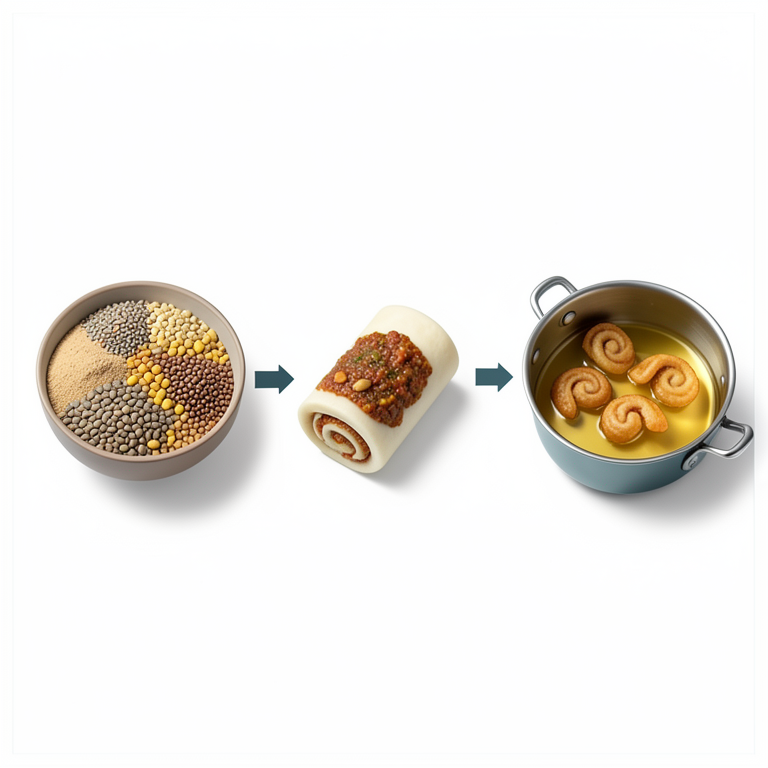
Bhakarwadi Production Process
AI-generated conceptual illustration (millet-based bhakarwadi snacks). It explains the idea and does not show study data.
View source evidence ↗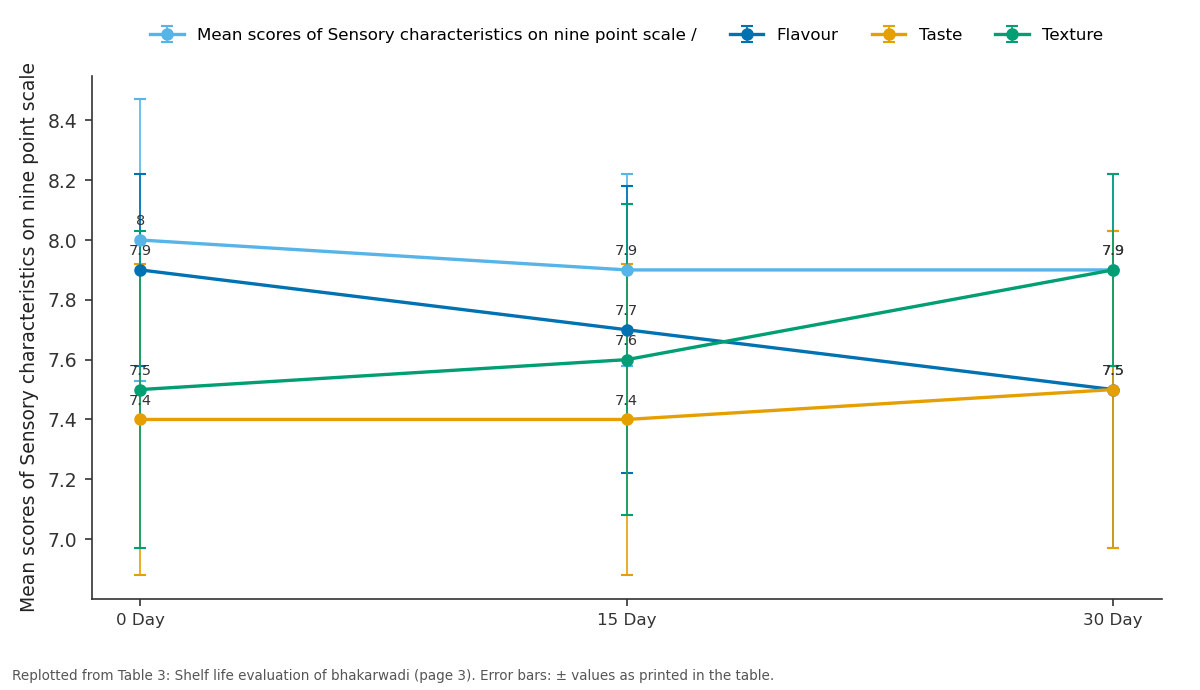
Mean scores of Sensory characteristics on... and Flavour and more: 0 Day vs 15 Day vs 30 Day
Replotted from Table 3 (page 3) of the original paper. Every bar is the paper's own table value.
View source evidence ↗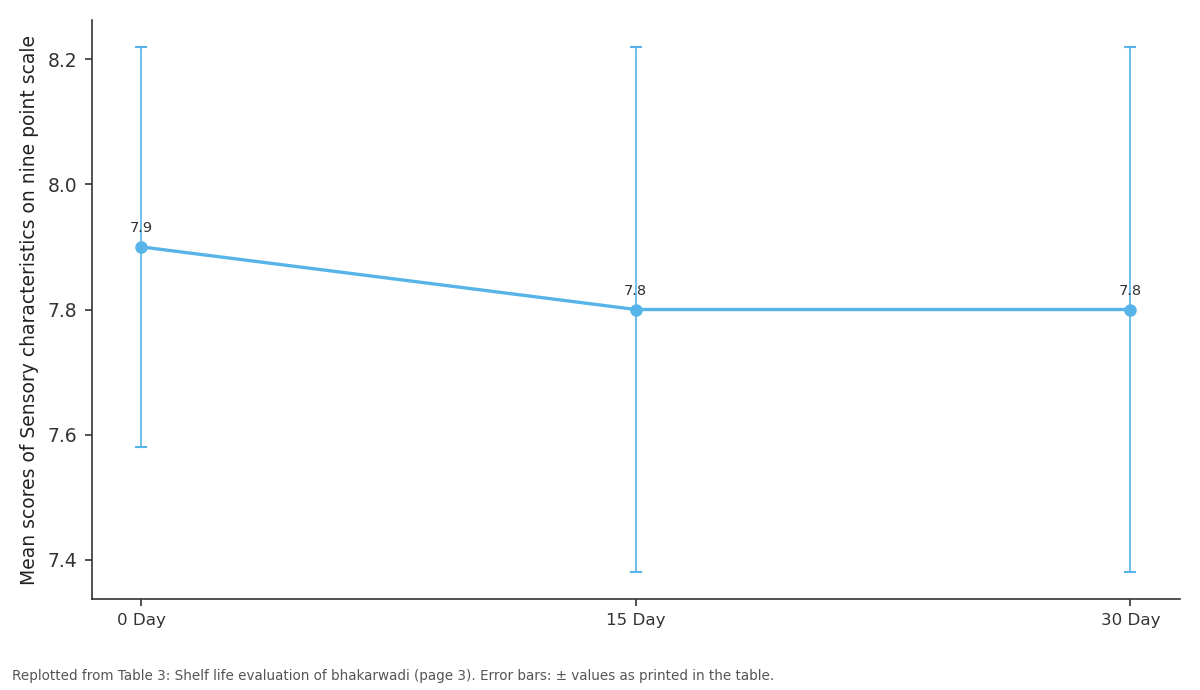
Overall Acceptability: 0 Day vs 15 Day vs 30 Day
Replotted from Table 3 (page 3) of the original paper. Every bar is the paper's own table value.
View source evidence ↗Figures & tables
From the original paper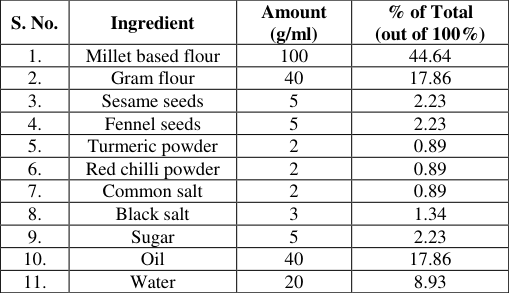 Table 1
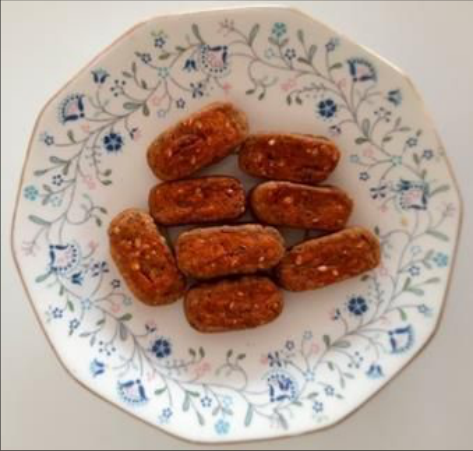 Plate 1
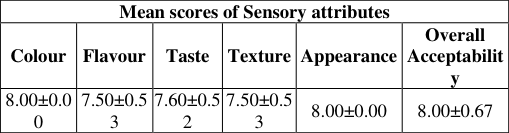 Table 2
 Table 3
Introduction
The twenty-first century is growing difficult due to challenges including climate change, water shortages, rising food costs, expanding global population and other socioeconomic issues. Food security and agriculture are now under danger globally, especially for the world's poorest residents in arid and semi-arid areas. Therefore, a substitute nutritious food supply is required in order to successfully provide food and nutrition security. The emphasis may now be placed on small-grain cereals, notably millets. Millets are more reliable since they can still provide a crop under adverse growing circumstances. The name millet is derived from the French word "mille," which signifies that a handful of millet contains thousands of seed grains (Taylor and Emmambux, 2008) [17] . Millet is a broad term for various kinds of small-grained cereal that are a staple in regions of India, Africa, and China. It has been farmed in North Africa and Central Asia since prehistoric times, however, its origin is unknown (Ronzio, 2004) [13] . Typical habits of modern societies push individuals towards nutritional overload and a sedentary lifestyle. Eating patterns are changing, snack foods play very important roles in the diet of the modern consumer. Many consumers do not have time to prepare traditional meals and increasingly even lack the knowledge of how to cook. The majority of convenience foods available commercially are refined flour-based, rendering these unsuitable for many people. It is remarkable that despite millet grain being an ancient food, its potential utilization in convenience foods is vastly untapped. Millet, being an underutilized food crop, can be a cost-effective raw material for developing convenience foods. Convenience foods are those that need little or no preparation, such as ready-to-cook meals like idli mix, mathari, muruku and upma mix. Advances in food preservation technology have expanded convenience foods to include canned meals, morning cereals, snack foods, dosa mixes, cake mixes and soup mixes. Changing lifestyles, socioeconomic patterns, increasing working populations and altered dietary preferences have driven the demand for high-quality, readyto-eat foods that combine traditional appeal with modern technology, reducing post-harvest losses of seasonal crops (Ghosh et al., 2001) [9] .
In recent years, millets have been recognized as important substitutes for major cereal crops to support global food security and meet the demands of growing populations. Millet grains, which account for about one-sixth of total food grain production, hold a significant place in India's food grain economy (Shree et al., 2008) [15] . Historically consumed in India, millets became 'orphan crops' following the Green Revolution, reducing their share from over 40 per cent of total grains to roughly 20 per cent. Recognizing their nutritional significance, the Government of India has designated millets as Nutri-Cereals, celebrated the National Year of Millets in 2018, and proposed the International Year of Millets, which was declared by the UN in 2023 with support from 72 countries. India is the largest producer of several millets, which form a staple for a large section of the population in India and Africa (Seth and Rajamanickam, 2012) [14] . The lack of ready-to-eat millet products has limited their use mainly to traditional diets among lower economic strata. Millets are nutritionally comparable or superior to major cereals in terms of protein, minerals, vitamins and energy content (Desikachar, 1975) [8] . Increasing recognition of their health benefits, including bioactive components, dietary fiber, and mineral richness, has led to their categorization as "nutricereals" (Bhavsar et al., 2013) [4] . Millets are climateresilient crops capable of thriving under poor soil fertility and water scarcity (Chauhan et al., 2018) [6] . Their incorporation into modern foods offers opportunities for dietary diversification, nutritional enrichment, and functional food development (Das and Rakshit, 2016; Changmei and Dorothy, 2014) [7,5] . Sorghum (Sorghum bicolor), known as the "king of millets," is drought-tolerant, gluten-free and rich in fiber, unsaturated fatty acids and phenolic compounds, making it suitable for health-oriented food applications (Anglani, 1998; Awika and Rooney, 2004) [2,3] . Buckwheat (Fagopyrum esculentum), a pseudo-cereal, is high in proteins, minerals, and bioactive compounds, offering antidiabetic, hypocholesterolemic and anti-inflammatory benefits (Zhang et al., 2007) [18] . Both crops can be processed into a variety of foods while maintaining nutritional integrity, providing versatile options for traditional and novel food applications. Building on the nutritional and functional potential of millets, this study focuses on developing a nutrient-dense, gluten-free finger food using sorghum and buckwheat. The research evaluates sensory qualities and shelf stability to determine the feasibility of transforming underutilized grains into modern, convenient snacks. By combining traditional culinary appeal with enhanced nutritional value, the study aims to offer a practical solution for healthconscious consumers while promoting the inclusion of millets in value-added food products.
Material and Method Procurement and Preparation of Raw Materials
Sorghum (Sorghum bicolor), buckwheat (Fagopyrum esculentum) and other ingredients were procured in bulk from the local market of Bikaner, Rajasthan in a single lot to ensure consistency and minimize variation. The grains were cleaned thoroughly by repeated washing with tap water, followed by rinsing with distilled water (Agrahari & Dunkwal, 2012) [1] and shade dried at room temperature (27 ± 3°C) for 2-3 days. Once dried, they were ground using a laboratory grinder and sieved through a 100-mesh sieve to obtain fine flour. The flours were then stored in airtight, food-grade containers under ambient conditions until further use in product formulation. A composite flour blend was standardized based on preliminary trials in the ratio of 50 per cent sorghum, 25 per cent buckwheat and 25 per cent corn flour for optimal sensory and textural characteristics.
Product Preparation
For product preparation (Table 1.), the flour was first sieved and mixed with salt and oil. It was then kneaded into a dough using water, divided into two equal portions and allowed to rest for 30 minutes. Meanwhile, the stuffing ingredients i.e., gram flour, sesame seeds, fennel seeds, turmeric powder, red chilli powder, common salt, black salt, sugar etc., were thoroughly blended. The dough was rolled into thin sheets resembling chapattis and the stuffing was evenly spread across the surface. The sheet was then rolled tightly into a cylindrical shape, gently pressed with a spatula and cut into uniform pieces. Each pinwheel was lightly flattened with the palm before being deep-fried in moderately heated oil until crisp and golden. The formulated bhakarwadi were presented in Plate 1.
| S. No. | Ingredient | Amount (g/ml) | % of Total (out of 100%) |
|---|---|---|---|
| 1. | Millet based flour | 100 | 44.64 |
| 2. | Gram flour | 40 | 17.86 |
| 3. | Sesame seeds | 5 | 2.23 |
| 4. | Fennel seeds | 5 | 2.23 |
| 5. | Turmeric powder | 2 | 0.89 |
| 6. | Red chilli powder | 2 | 0.89 |
| 7. | Common salt | 2 | 0.89 |
| 8. | Black salt | 3 | 1.34 |
| 9. | Sugar | 5 | 2.23 |
| 10. | Oil | 40 | 17.86 |
| 11. | Water | 20 | 8.93 |
Table text extracted from the original PDF; superscript letters are shown inline. The original table image is below.
View original table image
Organoleptic evaluation of the developed product
The developed product was standardized through organoleptic evaluation by a panel of ten selected members, consisting of staff from the College of Community Science, SKRAU, Bikaner. Panellists were carefully screened using the threshold test (Potter, 1987) [12] , considering their experience, knowledge, willingness and reliability. Sensory attributes such as color, appearance, aroma, texture, taste and overall acceptability were assessed using a nine-point hedonic scale (Swaminathan, 1987) [16] . Samples were presented in coded, identical containers to prevent bias and evaluations were conducted in a controlled, distraction-free environment to ensure accurate and reliable results.
Shelf-Life Study:
The developed products were packed in HDPE pouches and stored at ambient temperature for one month. Sensory evaluations were conducted on the 15 th and 30 th day of storage using the hedonic ranking scale to assess product stability over time (Swaminathan, 1987) [16] .
Statistical Analysis: Data were analyzed statistically as per Gupta (2000) [10] . Arithmetic mean, standard deviation, standard error of mean and critical difference at 5 per cent significance were calculated to interpret the results accurately.
Result and Discussion
Organoleptic Evaluation of Bhakarwadi: Product development plays a vital role in enhancing nutrition security by improving the quality, shelf life and consumer appeal of food products. In this study, bhakarwadi was developed using a standardized composite flour blend of sorghum, buckwheat and cornflour to create a nutrient-rich finger food. Sensory evaluation was conducted to assess color, flavor, taste, texture, appearance and overall acceptability. Results (Table 2) indicated favorable scores across all attributes i.e., color (8.0), flavor (7.5), taste (7.6), texture (7.5) and appearance (8.0) with an overall acceptability score of 8.0, reflecting a high level of consumer acceptance and potential for broader application.
| Mean scores of Sensory attributes | — | — | — | — | — |
|---|---|---|---|---|---|
| Colour | Flavour | Taste | Texture | Appearance | Overall Acceptabilit y |
| 8.00±0.0 0 | 7.50±0.5 3 | 7.60±0.5 2 | 7.50±0.5 3 | 8.00±0.00 | 8.00±0.67 |
Table text extracted from the original PDF; superscript letters are shown inline. The original table image is below.
View original table image
Shelf life evaluation of Bhakarwadi
The sensory appeal of food significantly influences consumer acceptance, making organoleptic assessment a critical tool for evaluating product quality over time. To assess the stability of the developed millet-based bhakarwadi, sensory attributes including color, flavor, taste, texture, appearance and overall acceptability were evaluated by a panel of trained judges at 0, 15 and 30 days of ambient storage. The product maintained consistent sensory scores, with overall acceptability rated at 7.9 on day 0 and 7.8 on both day 15 and 30 (Table 3), indicating the product remained "liked moderately" throughout the storage period.
| — | Mean scores of Sensory characteristics on nine point scale | — | — | — | — | — |
|---|---|---|---|---|---|---|
| Storage Days | Colour | Flavour | Taste | Texture | Appearance | Overall Acceptability |
| 0 Day | 8.00±0.47 | 7.90±0.32 | 7.40±0.52 | 7.50±0.53 | 8.00±0.00 | 7.90±0.32 |
| 15 Day | 7.90±0.32 | 7.70±0.48 | 7.40±0.52 | 7.60±0.52 | 7.90±0.32 | 7.80±0.42 |
| 30 Day | 7.90±0.32 | 7.50±0.53 | 7.50±0.53 | 7.90±0.32 | 7.90±0.32 | 7.80±0.42 |
| SEm | 0.08 | 0.13 | 0.18 | 0.16 | 0.08 | 0.12 |
| CD (5%) | 0.25NS | 0.40 NS | 0.54NS | 0.47 NS | 0.25 NS | 0.36 NS |
Table text extracted from the original PDF; superscript letters are shown inline. The original table image is below.
View original table image
The minor decline in scores was statistically non-significant (p>0.05), suggesting the product retained acceptable sensory quality over a month.
Conclusion
The millet-based Bhakarwadi developed using a standardized composite flour of sorghum, buckwheat, and corn flour demonstrated high sensory acceptability, with excellent scores for appearance, texture, and overall palatability. Shelf-life evaluation revealed that the product maintained consistent sensory quality over 30 days of ambient storage in HDPE packaging, with no significant decline in consumer-perceived attributes. These results highlight the potential of underutilized millets in the development of nutrient-rich, gluten-free, and shelf-stable snack products. Incorporating such functional ingredients into traditional recipes not only supports dietary diversification and enhanced nutritional intake but also promotes the sustainable utilization of millet grains, offering a practical approach to address contemporary food and health challenges.
Figures and tables from the paper
References
18 in the original paper- Agrahari K, Dunkwal V. Quality evaluation of developed multigrain flour for weight management. Unpub. M.Sc. Thesis. SKRAU, Bikaner; 2012.
- Anglani C. Sorghum for human food -A review. Plant Foods Hum Nutr. 1998;52:85-95.
- Awika JM, Rooney LW. Sorghum phytochemicals and their potential impact on human health. Phytochemistry. 2004;65(9):1199-1221.
- Bhavsar GJ, Sawate AR, Kshirsagar RB, Chappalwar VM. Studies on physico-chemical characteristics of buckwheat and its exploration in bread as functional food. Int J Eng Res Technol. 2013;2(1):3971-3980.
- Changmei S, Dorothy J. Millet -the frugal grain. Int J Sci Res Rev. 2014;3(4):75-90.
- Chauhan M, Sonawane SK, Arya SS. Nutritional and nutraceutical properties of millets: a review. Clin J Nutr Diet. 2018;1(1):1-10.
- Das IK, Rakshit S. Millets, their importance, and production constraints. In: Biotic stress resistance in millets. Academic Press; 2016. p. 3-19.
- Desikachar HSR. Processing of maize, sorghum and millets for food uses. J Sci Ind Res. 1977;34(4):231237.
- Ghosh KG, Krishnappa KG, Srivatsava AN, Eapen KC, Vijayaraghavan PK. In pack processing of ready-to-eat International Journal of Agriculture and Food Science https://www.agriculturaljournals.com foods in indigenous flexible packaging materials, Part III: Studies on newer packaging materials capable of withstanding the processing temperatures. J Food Sci Technol. 2001;16:198-201.
- Gupta PS. Statistical Methods. Revised Edition. New Delhi: Sultan Chand and Sons; 2000. p. 130-210.
- Kulkarni DB, Sakhale BK, Giri NA. A potential review on millet grain processing. Int J Nutr Sci. 2018;3(1):1018.
- Potter NN. Food Science. 3rd ed. New Delhi: CBS Publishers and Distributors; 1987.
- Ronzio R. The encyclopedia of nutrition and good health. 2nd ed. New Delhi: Viva Books Pvt. Ltd.; 2004.
- Seth D, Rajamanickam G. Development of extruded snacks using soy, sorghum, millet and rice blend -A response surface methodology approach. Int J Food Sci Technol. 2012;47(7):1526-1531.
- Shree B, Rao SG, Puharaj S. Formulation and preparation of Bajra (Pennisetum typhoideum) papad. Indian J Nutr Diet. 2008;45:221.
- Swaminathan M. Food science chemistry and experimental food. Mysore: The Bangalore Printing and Publishing Co. Ltd.; 1987.
- Taylor JR, Emmambux MN. Gluten-free foods and beverages from millets. In: Gluten-free cereal products and beverages. Academic Press; 2008. p. 119-V.
- Zhang HW, Zhang YH, Lu MJ, Tong WJ, Cao GW. Comparison of hypertension, dyslipidaemia and hyperglycaemia between buckwheat seed-consuming and non-consuming Mongolian-Chinese populations in Inner Mongolia, China. Clin Exp Pharmacol Physiol. 2007;34(9):838-844.