
Research article · 2025 · Full text
International Journal of Agriculture and Food ScienceEffect of Different Spacing on Growth Parameters of Okra
Volume 7(10) · Pages 387–389 · DOI: 10.33545/2664844x.2025.v7.i10f.897 ↗
Research areasAgricultural Practices and Plant GeneticsAgriculture, Plant Science, Crop ManagementAgricultural Science and Fertilization
Abstract
Author-writtenA field experiment titled “Effect of different Spacing on Growth Parameters of Okra (Abelmoschus esculentus (L.) Moench) Variety Phule Utkarsha” was carried out during the summer season of 2013 at the Research Farm, Horticulture Section, College of Agriculture, Kolhapur. The study evaluated four spacing treatments: 30 × 15 cm, 30 × 30 cm, 45 × 30 cm, and 60 × 30 cm. Data were collected on various growth and yield parameters, including plant height, number of branches per plant, internodal length, number of internodes per plant, fruit length, fruit diameter, fruit weight. The results indicated that wider spacing, particularly 60 × 30 cm, significantly enhanced the number of branches (2.60), number of internodes (7.53), fruit diameter (1.97 cm), and fruit weight (13.78 g). In contrast, the closest spacing (30 × 15 cm) produced the tallest plants (170.41 cm). These findings emphasize the important role of plant spacing in optimizing growth and yield characteristics of okra.
Summary
Source-checkedPlain-language reading of the full paper, prepared with AI and checked against the text. Each point links to the authors' own words.
Why it matters
- Okra, commonly known as Lady's Finger, is a vegetable widely cultivated in India during the monsoon and summer seasons. View evidence ↗
- Okra is commercially valuable and highly nutritious, serving both domestic needs and export markets, particularly in the Middle East. View evidence ↗
- Agronomic practices like plant spacing can impact okra productivity, where improper spacing may lead to reduced yields and poor fruit quality. View evidence ↗
The question
- The study aims to evaluate how different plant spacing techniques affect the growth performance of the okra variety Phule Utkarsha. View evidence ↗
What they did
- The field experiment was conducted during the summer of 2013 at the College of Agriculture's Horticulture Section Research Farm in Kolhapur. View evidence ↗
- Four distinct spacing treatments were tested: 30 × 15 cm, 30 × 30 cm, 45 × 30 cm, and 60 × 30 cm. View evidence ↗
- The researchers measured several growth and yield parameters, including plant height, fruit weight, fruit diameter, fruit length, internodal length, and the number of branches and internodes per plant. View evidence ↗
- Data for the various parameters were collected from 10 plants randomly selected within each plot. View evidence ↗
What they found
- The closest spacing (30 × 15 cm) produced the tallest plants at 170.41 cm, while the widest spacing (60 × 30 cm) produced the shortest plants at 154.28 cm. View evidence ↗
- Wider spacing (60 × 30 cm) led to the highest number of branches per plant (2.60), compared to the lowest number (1.87) found in the closest spacing (30 × 15 cm). View evidence ↗
- The widest spacing (60 × 30 cm) resulted in the highest number of internodes per plant (22.80) and the shortest internodal length (7.07 cm). View evidence ↗
- The widest spacing (60 × 30 cm) produced the largest fruits, with a maximum length of 13.25 cm and a diameter of 1.97 cm. View evidence ↗
- Fruit weight was significantly enhanced by wider spacing, with the 60 × 30 cm treatment reaching 13.78 g. View evidence ↗
What it means
- The authors conclude that while closer spacing increases plant height due to light competition, wider spacing improves fruit traits and increases the number of branches per plant. View evidence ↗
- The study concludes that plant spacing significantly impacts both the yield components and the vegetative growth of okra. View evidence ↗
Visual summary
3 visualsIllustrations explain the paper; charts are replotted from the paper's own table values.
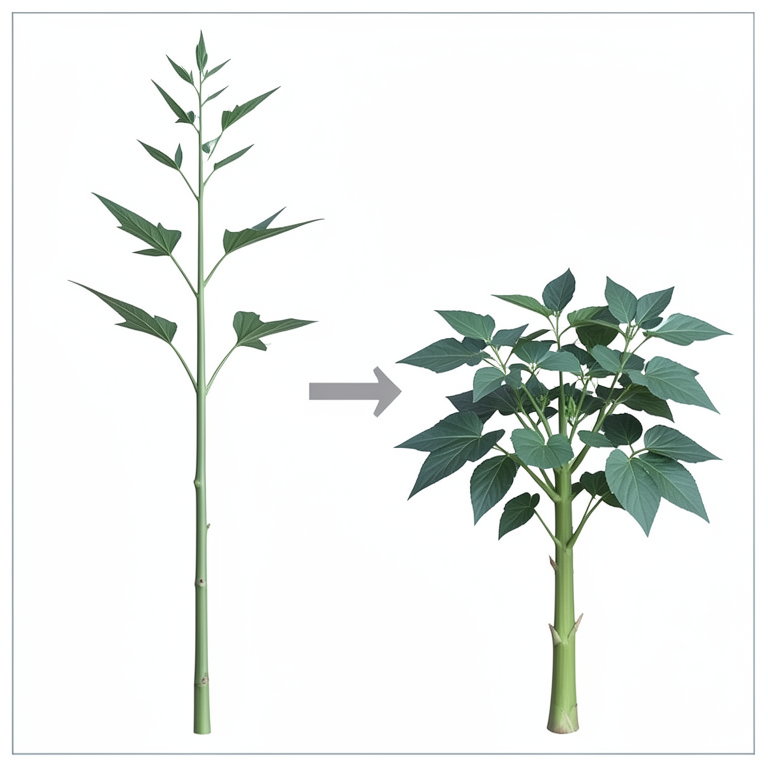
Trade-off between Height and Branching
AI-generated conceptual illustration (okra plants). It explains the idea and does not show study data.
View source evidence ↗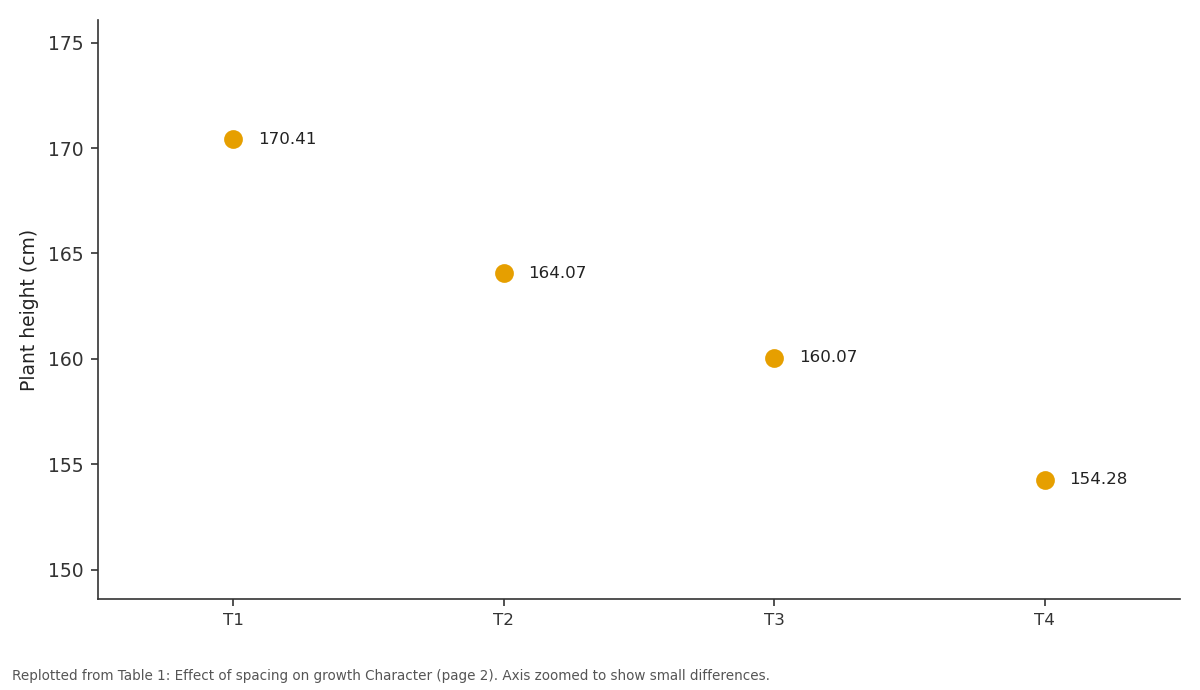
Plant height (cm): T1 vs T2 vs T3 vs T4
Replotted from Table 1 (page 2) of the original paper. Every bar is the paper's own table value.
View source evidence ↗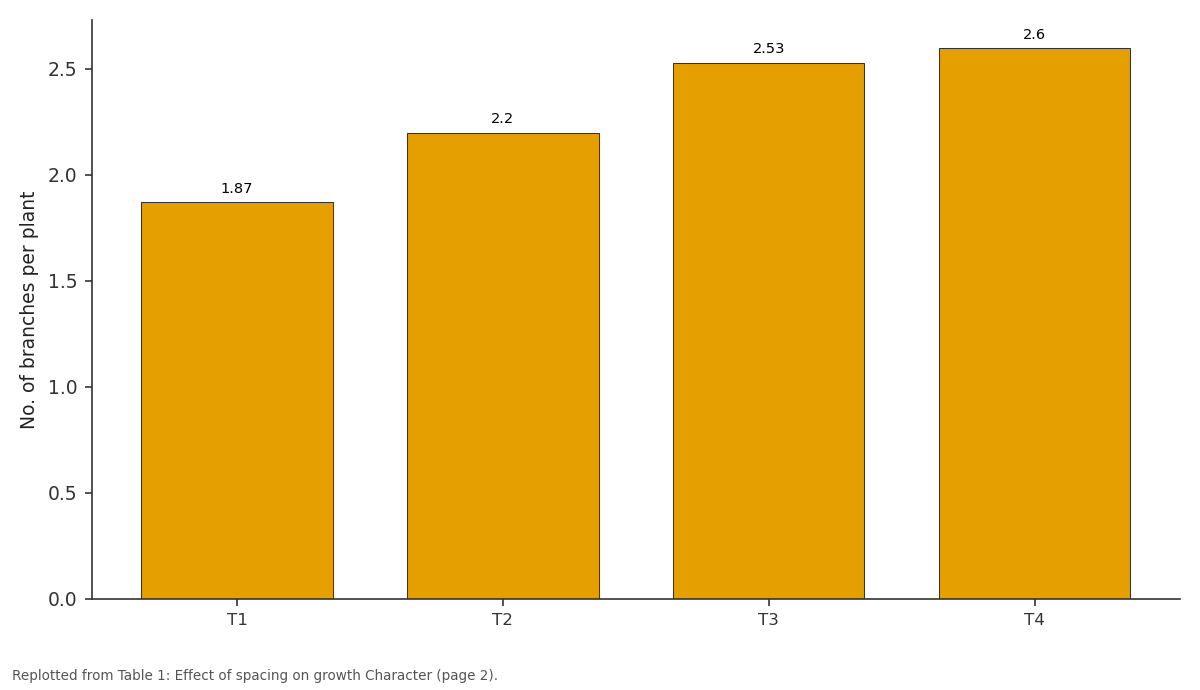
No. of branches per plant: T1 vs T2 vs T3 vs T4
Replotted from Table 1 (page 2) of the original paper. Every bar is the paper's own table value.
View source evidence ↗Figures & tables
From the original paper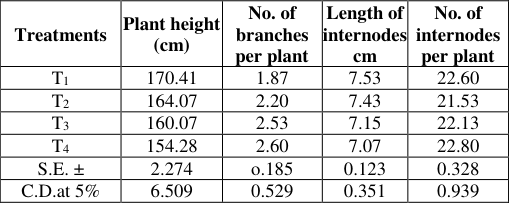 Table 1
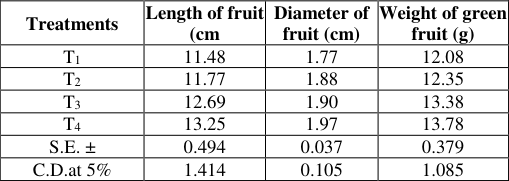 Table 2
Introduction
Okra (Abelmoschus esculentus (L.) Moench), also known as Lady's Finger, is a widely grown vegetable in India, particularly during the summer and monsoon seasons. Native to tropical and subtropical areas such as Africa, South America, and India, okra holds significant agricultural importance in the country. It is cultivated extensively in states like Maharashtra, Uttar Pradesh, Bihar, and Karnataka. In Maharashtra alone, okra is grown on over 22,000 hectares, producing 3.28 lakh metric tons (Anon, 2013) [1] , with major producing districts including Nasik, Pune, and Solapur. Highly nutritious and commercially valuable, okra is important both for domestic consumption and export, especially to the Middle East. However, its productivity is often affected by agronomic practices, such as plant spacing. Improper spacing can result in poor fruit quality and reduced yields. Hence, optimizing plant population through proper spacing is critical for enhancing growth and maximizing yield. This study, titled "Effect of Different Spacing on Growth Parameters of Okra (Abelmoschus esculentus (L.) Moench) Cv. Phule Utkarsha," aims to assess the effect of various spacing techniques on the growth performance of okra.
Materials and Methods
The experiment was conducted during the 2012-13 growing season at the Horticulture Sectional Farm, College of Agriculture, Kolhapur. The study evaluated four different plant spacing treatments: T1 (30 × 15 cm), T2 (30 × 30 cm), T3 (45 × 30 cm), and T4 (60 × 30 cm). The selected site was uniformly levelled, with medium black soil characterized by good texture, fertility, and drainage. Land preparation involved conventional practices, including ploughing, harrowing, clod crushing, and leveling to achieve a fine tilth. Farmyard manure was applied at the rate of 20 tonnes per hectare during land preparation. Ridges and furrows were formed according to the specified spacing's for each treatment.
A basal dose of fertilizers was applied at 100:50:50 kg NPK per hectare. This included the full recommended dose of phosphorus and potassium, and half of the nitrogen dose, applied prior to sowing. The remaining half of the nitrogen was administered as a top dressing in two equal split doses during the crop growth period.
Seeds were soaked in water for 24 hours before sowing to promote better germination. Sowing was done by dibbling method on the ridges prepared as per the respective spacing treatments (30 × 15 cm, 30 × 30 cm, 45 × 30 cm, and 60 × 30 cm), placing seeds at a depth of 1.5-2.0 cm. Standard cultural practices such as gap filling, thinning, rouging, insecticide spraying, and other necessary intercultural operations were carried out as needed to maintain healthy crop growth. The field was kept free of weeds, and irrigation was provided at intervals of 5-6 days. Observations were recorded on various parameters from 10 randomly selected plants in each plot. The data collected were analyzed statistically for interpretation. [2,9,12,7,4,5] .
Number of Branches per Plant
The highest number of branches per plant (2.60) was recorded under the widest spacing (T4: 60 × 30 cm), while the lowest (1.87) was observed in the closest spacing (T1: 30 × 15 cm). The increased branching at wider spacing may be due to reduced competition for light, nutrients, and space, allowing plants to allocate more resources toward vegetative growth. [3,14,4] .
Internodal Length and Number of Internodes
Treatment T4 (60 × 30 cm) also resulted in the shortest internodal length (7.07 cm) and the highest number of internodes (22.80) per plant. These findings are in line with the results reported by Kumar et al. (2011) [5] , who also observed similar trends in okra.
Fruit Characteristics
Plant spacing had a significant influence on fruit traits such as fruit length, diameter, and both fresh and dry fruit weights. The maximum green fruit length (13.25 cm) and diameter (1.97 cm) were recorded under the widest spacing (T4: 60 × 30 cm). This improvement in fruit size under wider spacing is likely due to better access to nutrients, moisture, and space, which collectively enhance overall plant growth and fruit development. Ashtaputre (1987) [2] also reported similar results, attributing increased fruit size to the abundance of growth resources in wider spacing conditions. Supporting studies include, Ijoyah et al. (2010) [4] .
Conclusion
The findings from the present study suggest that closer spacing (30 × 15 cm) promotes greater plant height (170.41 cm), likely due to inter-plant competition for light. On the other hand, wider spacing (60 × 30 cm) results in increased number of branches per plant (2.60) and enhanced fruit traits, including maximum length and diameter of green fruits. Therefore, plant spacing has a significant impact on both vegetative growth and yield components in okra.
Figures and tables from the paper
| Treatments | Plant height (cm) | No. of branches per plant | Length of internodes cm | No. of internodes per plant |
|---|---|---|---|---|
| T1 | 170.41 | 1.87 | 7.53 | 22.60 |
| T2 | 164.07 | 2.20 | 7.43 | 21.53 |
| T3 | 160.07 | 2.53 | 7.15 | 22.13 |
| T4 | 154.28 | 2.60 | 7.07 | 22.80 |
| S.E. ± | 2.274 | o.185 | 0.123 | 0.328 |
| C.D.at 5% | 6.509 | 0.529 | 0.351 | 0.939 |
Table text extracted from the original PDF; superscript letters are shown inline. The original table image is below.
View original table image
| Treatments | Length of fruit (cm | Diameter of fruit (cm) | Weight of green fruit (g) |
|---|---|---|---|
| T1 | 11.48 | 1.77 | 12.08 |
| T2 | 11.77 | 1.88 | 12.35 |
| T3 | 12.69 | 1.90 | 13.38 |
| T4 | 13.25 | 1.97 | 13.78 |
| S.E. ± | 0.494 | 0.037 | 0.379 |
| C.D.at 5% | 1.414 | 0.105 | 1.085 |
Table text extracted from the original PDF; superscript letters are shown inline. The original table image is below.
View original table image
References
14 in the original paper- Anonymous. Indian Horticulture Database. National Horticulture Board, Ministry of Agriculture, Govt. of India; 2013. p. 155-156.
- Ashtaputre VN. Effect of different spacing and number of pickings of green pods on yield and quality of okra seed (Abelmoschus esculentus (L.) Moench) [MSc thesis]. Rahuri: Mahatma Phule Krishi Vidyapeeth; 1987.
- Bilekudari MK, Deshpande VK, Shekhargoudam M. Effect of spacing and fertilizer levels on growth, seed yield and quality of radish. Karnataka J Agric Sci. 2005;18(2):338-342.
- Ijoyah MO, Unah PO, Fanen FT. Response of okra (Abelmoschus esculentus L. Moench) to intra-row spacing in Makurdi, Nigeria. Agric Biol J N Am. 2010;1(6):1328-1332.
- Kumar SP, Bhagawati R, Das Y, Basar J. Effect of row spacing and fertilizer on growth and yield attributes of okra. Veg Sci. 2011;38(2):176-179.
- Lee KH, Cho CY, Yoon ST, Park SK. Effect of nitrogen fertilizer, plant density and sowing date on the yield of okra. Korean J Crop Sci. 2000;35(8):179-183.
- Moniruzzaman M, Uddin MZ, Choudhury AK. Response of okra seed crop to sowing time and plant spacing in south eastern hilly region of Bangladesh. Bangladesh J Agric Res. 2007;32(3):393-402.
- Nadkarni KM. Indian Materia Medica. Bombay: Nadkarni & Co.; 1972.
- Pandita UK, Randhawa KS. Row spacing and leaf cutting in relation to seed production of fenugreek. Seed Res. 1994;22(2):122-129.
- Panse VG, Sukhatme PV. Statistical Methods for Agricultural Workers. 2nd ed. New Delhi: ICAR; 1985. International Journal of Agriculture and Food Science https://www.agriculturaljournals.com
- Paththinige SS, Upashantha PSG, Ranaweera Banda RM, Fonseka RM. Effect of plant spacing on yield and fruit characteristics of okra (Abelmoschus esculentus). Trop Agric Res. 2008;20:336-342.
- Patil VS, Kale PB, Wankhade RV, Nagdeve MB. Effect of fertilizer levels and spacing on growth and green pod yield of dolichos bean var. Konkan Bhushan. Veg Sci. 1995;22(1):9-12.
- Randhawa GS, Pannum MS. Effect of row spacing on the growth and yield of okra. Punjab Agric Univ Res J. 2000;6:320-324.
- Shrikanth. Effect of spacings and fertilizer levels on crop growth, seed yield and quality in Lablab bean (Lablab purpureus L.) [MSc thesis]. Dharwad: University of Agricultural Sciences; 2007.