
Research article · 2025 · Full text
International Journal of Agriculture and Food ScienceEvaluation of OFT on different spacing in okra during Rabi season in the Dangs
Volume 7(10) · Pages 35–36 · DOI: 10.33545/2664844x.2025.v7.i10a.853 ↗
Research areasAgricultural Practices and Plant GeneticsAgricultural Science and FertilizationIrrigation Practices and Water Management
Abstract
Author-writtenThe On Farm Testing (OFT) on “Evaluation of different spacing in okra during Rabi season in the Dangs” was conducted by Krishi Vigyan Kendra, Navsari Agricultural University, Waghai on farmers field in three villages namely Ambapada, Davdahad and Khatal of Waghai taluka during the years 2013-14 to 2015-16 comprising of three different spacings tratments viz., T1 = 30 x 10 cm (Farmers practices), T2 = 45 x 30 cm (Normal spacing) and T3 = 30 x 30 x 60 cm (Paired row spacing). The results revealed that the okra crop sown at paired row spacing of 30 x 30 x 60 cm for resulted in higher yield of 9768 kg/ha as well as net returns of Rs. 1,04,190/ha as compared to 9572 kg/ha yield & Rs. 1,01,250/ha net income under normal spacing of 45 x 30 cm and farmer's practices of 30 x 10 cm recorded the least values for both the parameters (8513 kg/ha and Rs. 79,365/ha, respectively). So, on the basis of OFT results, it is recommended to grow okra crop at a spacing of 30 x 30 x 60 cm for obtaining higher yield & net returns.
Summary
Source-checkedPlain-language reading of the full paper, prepared with AI and checked against the text. Each point links to the authors' own words.
Why it matters
- Okra is a primary vegetable crop in the Dangs district, particularly during the Rabi season, which allows farmers to achieve better financial returns because it is an off-season period. View evidence ↗
- Local farmers in Dangs typically use very narrow sowing spacing, which increases seed requirements, raises the incidence of pests and diseases, and complicates crop management tasks. View evidence ↗
The question
- The On Farm Testing (OFT) aimed to increase okra production, reduce cultivation costs, and raise awareness among tribal farmers in the district. View evidence ↗
What they did
- The study was conducted from 2013-14 to 2015-16 on farmers' fields across three villages (Ambapada, Davdahad, and Khatal) in the Waghai taluka. View evidence ↗
- Three spacing treatments were evaluated: T1 (30 x 10 cm, representing farmer practices), T2 (45 x 30 cm, normal spacing), and T3 (30 x 30 x 60 cm, paired row spacing). View evidence ↗
- The trial involved six farmers (two per village) covering a total area of 1.8 hectares, with 0.1 hectares allocated to each treatment per farmer. View evidence ↗
- Farmers implemented a comprehensive package of practices, including soil testing, seed treatment, ridge and furrow sowing, and integrated pest management (IPM). View evidence ↗
What they found
- The paired row spacing (T3: 30 x 30 x 60 cm) achieved the highest average yield of 9,768 kg/ha. View evidence ↗
- Normal spacing (T2: 45 x 30 cm) yielded 9,572 kg/ha, while the lowest yield of 8,513 kg/ha was recorded for farmer practices (T1: 30 x 10 cm). View evidence ↗
- The paired row spacing (T3) resulted in a 14.7% increase in yield compared to the traditional farmer practices (T1). View evidence ↗
- The paired row spacing (T3) also achieved the highest benefit-cost ratio (BCR) of 1:3.46. View evidence ↗
What it means
- The authors recommend using paired row spacing (30 x 30 x 60 cm) to maximize both yield and net financial returns for okra. View evidence ↗
- The study had a practical impact, with at least 200 farmers in the target villages adopting the recommended spacing technology. View evidence ↗
Visual summary
3 visualsIllustrations explain the paper; charts are replotted from the paper's own table values.
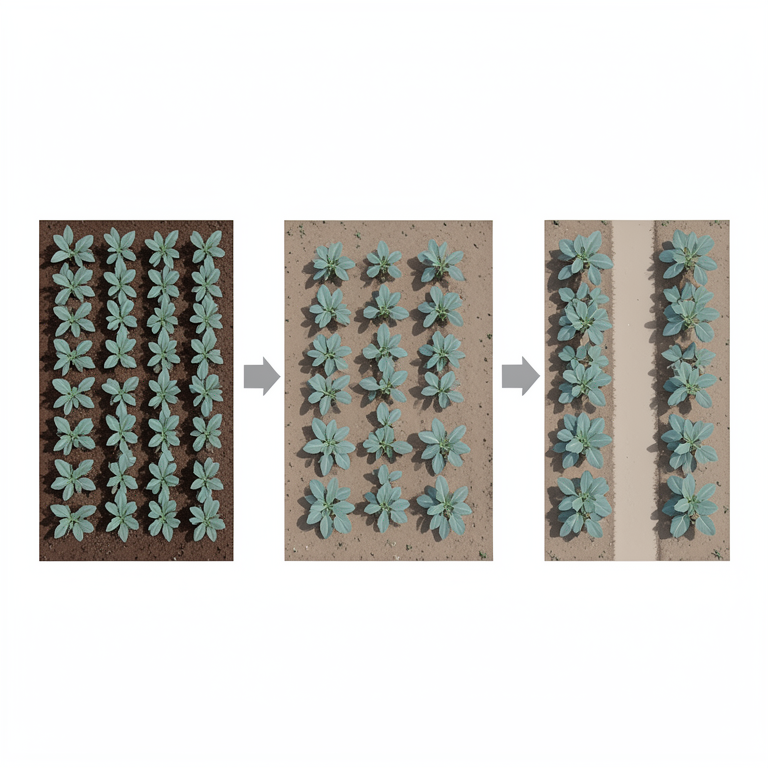
Comparison of Sowing Spacings
AI-generated conceptual illustration (okra plants). It explains the idea and does not show study data.
View source evidence ↗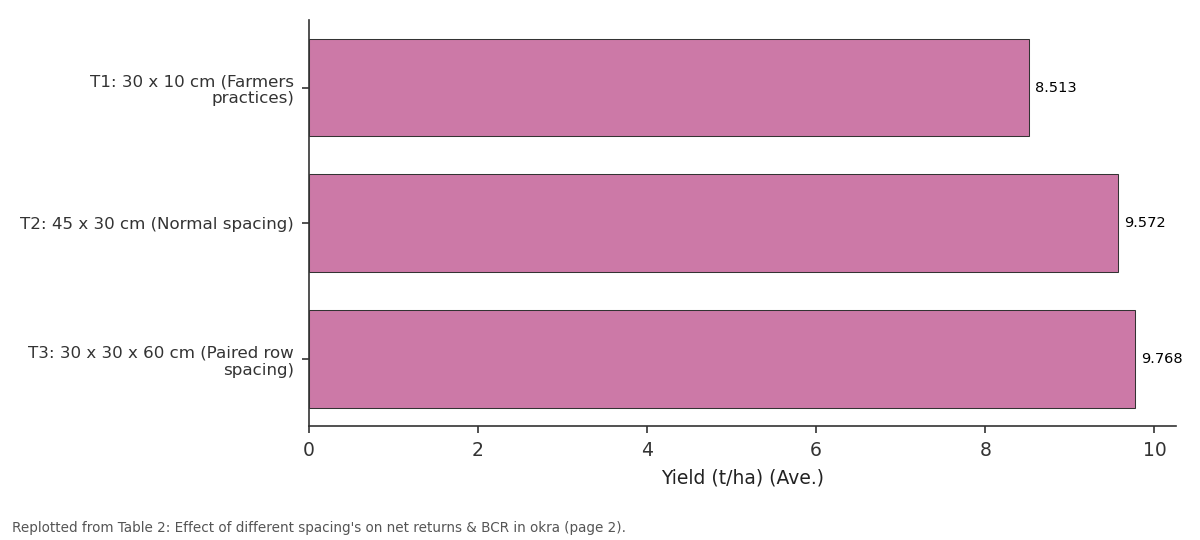
Yield (t/ha) (Ave.): T1: 30 x 10 cm (Farmers... vs T2: 45 x 30 cm (Normal... vs T3: 30 x 30 x 60 cm...
Replotted from Table 2 (page 2) of the original paper. Every bar is the paper's own table value.
View source evidence ↗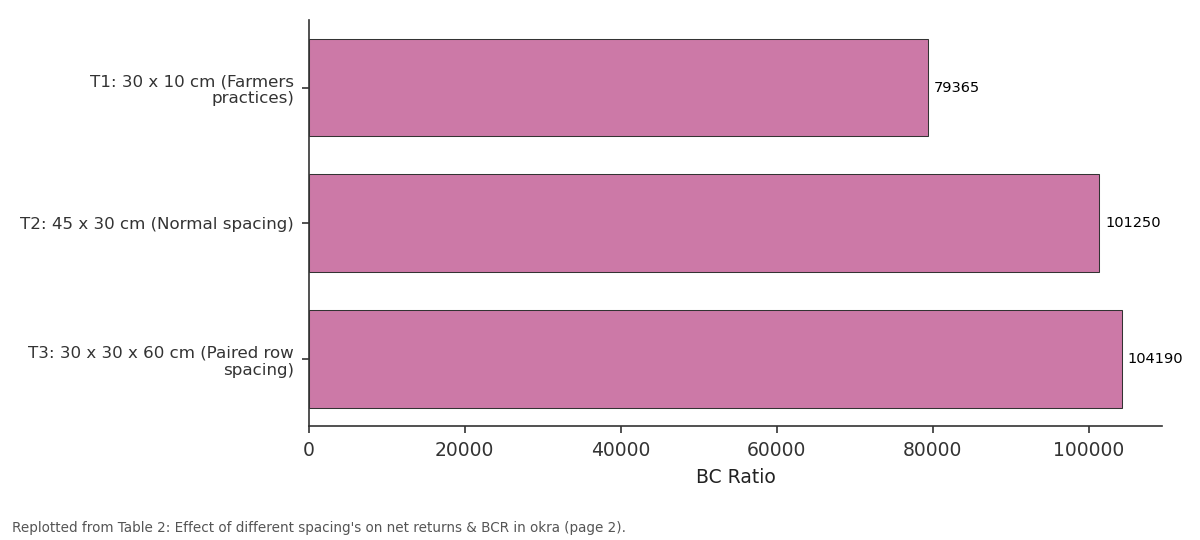
Net Returns (Rs./ha): T1: 30 x 10 cm (Farmers... vs T2: 45 x 30 cm (Normal... vs T3: 30 x 30 x 60 cm...
Replotted from Table 2 (page 2) of the original paper. Every bar is the paper's own table value.
View source evidence ↗Figures & tables
From the original paper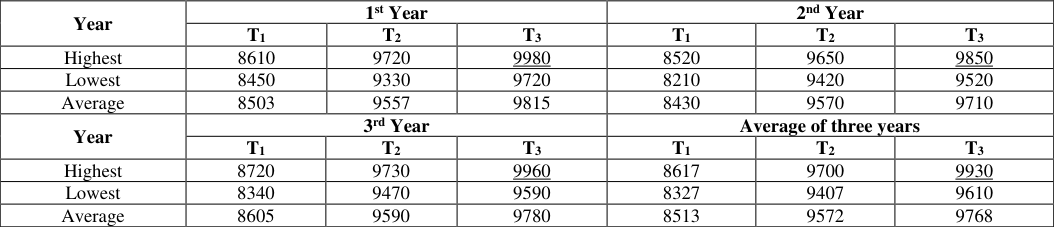 Table 1
 Table 2
Introduction
Okra (Abelmoschus esculentus L. Moench) also known as Lady's Finger or Bhindi is the major vegetable crop grown in certain pockets of the Dangs district especially during Rabi season due to which farmers also gets better monitory returns as the cultivation is restricted to small area during this period as it is considered as off season for this crop. In Gujarat, it is grown in an about 65,410 ha area with production of 7,17,254 M.T, whereas in the Dangs it is grown in an about 740 ha area and production of about 11,100 M.T. In Dangs, the farmers are doing sowing at very narrow spacing due to which requirement of seed is very higher, incidence of pest and disease is more and management practices (irrigation, fertilizer application, weeding, spraying of pesticides, harvesting, etc.) also become difficult as compared to normal or paired row spacing. In this regards, the OFT was conducted by KVK, NAU, Waghai with main objectives to increase production and decrease cost of cultivation and bring awareness among the tribal farmers of the district.
Material and Methods
The present investigation was conducted in Rabi season for three years during 2013-14, 2014-15 and 2015-16 by KVK, NAU, Waghai, District Dangs of Gujarat state. The treatment comprising of three different spacings viz., T1 = 30 x 10 cm (Farmers practices), T2 = 45 x 30 cm (Normal spacing) and T3 = 30 x 30 x 60 cm (Paired row spacing). Two farmers from each village and total six farmers were selected from the three villages namely Ambapada, Davdahad and Khatal of Waghai taluka and the total area of the OFT was 1.8 ha with 0.1 ha under each treatment/farmer. The team of KVK scientists had made survey of the village to identify the adoption gap and technological needs of farmers as well as their socio economic status. Farmers were trained to follow the practices for okra cultivation as recommended by the State Agricultural Universities and need based input materials were also provided to the farmers. The farmers followed the full package of practices like soil testing, seed treatment, ridge & furrow method of sowing, timely manures and fertilizer application, use of biofertilizers, weed and water management, IPM practices, etc. The yield data were collected from all the treatments during the three years and the average was worked out.
Results and Discussion
The data presented in Table-1 revealed that the paired row spacing of 30 x 30 x 60 cm in okra resulted in maximum average yield of 9768 kg/ha and was followed by normal spacing of 45 x 30 cm which recorded 9572 kg/ha yield, whereas the least production of 8513 kg/ha was obtained under farmers practices (30 x 10 cm spacing). Moreover, there was 14.7% increase in yield under T3 as compared to farmer's practices. It was observed that potential yield can be achieved by imparting scientific knowledge to the farmers by providing the need based techniques & quality inputs. This results clearly indicated that the higher average yield in T3 over the years as compare to farmers practice may be due to knowledge and adoption of full package of practices i.e. use of recommended dose of fertilizers through INM, bio fertilizer, vermicompost, and timely application of plant protection chemicals. Similar results were also reported by Dhemre and Desale (2010) and Aklade et al. (2018) in okra and also by Kalalbandi et al. (2006) in chilli crop [1, 2, 3] . Further for calculating cost of cultivation, gross return, net return and benefit: cost ratio, the input and output prices of commodities prevailed during the study were taken into consideration and the data as presented in Table-2 indicated that the cultivation of okra at paired row spacing gave maximum net returns of Rs.1,04,190/ha along with higher BCR of 1: 3.46 as compared to T2 and T1. This may be due to higher yield obtained under improved technologies as compared to local check (farmers practice). These findings are also in accordance to those obtained by Singh et al. (2011) in solanaceous vegetables and Shalini et al. (2016) in tomato [4, 5] .
Conclusion
On the basis of OFT results, it is recommended to grow okra crop at a spacing of 30 x 30 x 60 cm (paired row) for obtaining higher yield & net returns. In terms of impact of this OFT, at least 200 farmers had adopted this technology in there field around Ambapada, Davdahad and Khatal villages.
Figures and tables from the paper
| Year | 1st Year | — | — | 2nd Year | — | — |
|---|---|---|---|---|---|---|
| T1 | T2 | T3 | T1 | T2 | T3 | |
| Highest | 8610 | 9720 | 9980 | 8520 | 9650 | 9850 |
| Lowest | 8450 | 9330 | 9720 | 8210 | 9420 | 9520 |
| Average | 8503 | 9557 | 9815 | 8430 | 9570 | 9710 |
| Year | 3rd Year | Average of three years | ||||
| T1 | T2 | T3 | T1 | T2 | T3 | |
| Highest | 8720 | 9730 | 9960 | 8617 | 9700 | 9930 |
| Lowest | 8340 | 9470 | 9590 | 8327 | 9407 | 9610 |
| Average | 8605 | 9590 | 9780 | 8513 | 9572 | 9768 |
Table text extracted from the original PDF; superscript letters are shown inline. The original table image is below.
View original table image
References
5 in the original paper- Aklade SA, Dobariya JB, Thesiya NM. Impact of frontline demonstrations of INM in okra during off season in the Dang district of Gujarat. Int J Eco Pl. 2018;5(3):123-126. doi:10.23910/IJEP/2018.5.3.0257.
- Dhemre JK, Desale SB. Impact of front line demonstration on production technology of okra cv. "Phule Utkarsha" in Dhule district of Maharashtra. Asian Sci. 2010;5(1):29-31.
- Kalalbandi BM, Dudhate DG, More SS. Impact of front line demonstration on chilli (Capsicum annum L.) production technology in Parbhani district of Maharashtra state. Crop Prot Prod. 2006;3(1):157-158.
- Shalini M, Devaraja, Manjunath Gowda. Impact of front line demonstrations on yield and economics of tomato in Chikkaballapur district of Karnataka. Int J Appl Pure Sci Agric. 2016;2(7):4-8.
- Singh R, Soni RL, Singh V, Bugalia HL. Dissemination of improved production technologies of solanaceous vegetables in Banswara district of Rajasthan through Frontline demonstrations. Raj J Extn Edu. 2011;19:97100.