
Research article · 2025 · Full text
International Journal of Agriculture and Food ScienceThe impact of technology innovation on coconut milk extraction for sustainable production
Volume 7(10) · Pages 99–103 · DOI: 10.33545/2664844x.2025.v7.i10b.859 ↗
Research areasCoconut Research and ApplicationsCocoa and Sweet Potato AgronomyPlant-Derived Bioactive Compounds
Abstract
Author-writtenThis paper analyzes the impact of technology innovation in coconut milk extraction affecting demand and community preference coping with current utilization in the City of Kabankalan. The first coconut milk extractor designed with screw process, requires two laborers to operate the system. The innovation reduces labor requirement from two to one laborer, utilizing the screw for preliminary pressing and finally use the lifting power of hydraulic jack for the extraction. New designs also came up with a fixed upper plate and use only hydraulic jack for the smooth, efficient and sustainable extraction of coconut milk. Results shows the demand for coconut milk in the City in the last five years (2020-2025) increases from 880 - 985 nuts/day, excluding processors who also extract coconut milk for their VCO production. Grated Coconut meat demand decreases from 60.23 -10.66%. Fresh extracted coconut milk demand increases from 39.77-89.33% showing the shift of demand. Utilization of coconut milk increased by 49.57% compared to declining demand for grated coconut meat. Shift in consumer preference in readily available coconut milk sold at Php 25.00/160 grams than grated coconut meat at php 50.00/nut manifested by increase of available coconut milk extractors from 1 to 7 units in the last 5 years. It is recommended that materials used in the extraction process must utilize a stainless steel material to reduce the hazard of milk contamination and safeguard the health of the community.
Summary
Source-checkedPlain-language reading of the full paper, prepared with AI and checked against the text. Each point links to the authors' own words.
Why it matters
- Coconut milk is a valuable substitute for dairy, particularly for individuals with lactose intolerance who experience digestive issues. View evidence ↗
- Coconut milk is a globally significant product, accounting for an estimated 25% of total world coconut output. View evidence ↗
- Consumers are moving away from manual coconut milk extraction because the process of hand-squeezing grated meat is tedious and rigorous. View evidence ↗
The question
- The study aims to determine the current demand for coconut milk in the city, the available extraction methods, and how technological innovations have impacted extraction. View evidence ↗
What they did
- The research was conducted across three market stall sites (A, B, and C) in the City of Kabankalan, covering various grating and extraction operations. View evidence ↗
- Supply and demand data were collected through interviews based on the personal accounts of the market operators. View evidence ↗
- The researchers used actual field testing to determine extraction efficiency and recorded pricing data during May 2025. View evidence ↗
What they found
- Total daily coconut demand in the city increased by 11.93%, rising from 880 to 985 nuts per day. View evidence ↗
- Demand for grated coconut meat dropped sharply from 530 nuts per day to 105 nuts per day, now representing only 10.66% of demand. View evidence ↗
- Demand for fresh coconut milk increased from 350 to 880 nuts per day, capturing 89.34% of consumer preference. View evidence ↗
- The number of available coconut milk extractors in the market grew from 1 to 7 units over the last five years. View evidence ↗
- Technological innovation reduced the labor requirement for extraction from two laborers to one. View evidence ↗
- The efficiency of the coconut milk extractors used in the study ranges between 50% and 56% by weight of the input. View evidence ↗
What it means
- The authors conclude that using innovative extractors to maximize milk yield and reduce waste is key to sustainable coconut supply. View evidence ↗
- The authors recommend using stainless steel for extraction equipment to prevent contamination and protect community health. View evidence ↗
Visual summary
3 visualsIllustrations explain the paper; charts are replotted from the paper's own table values.
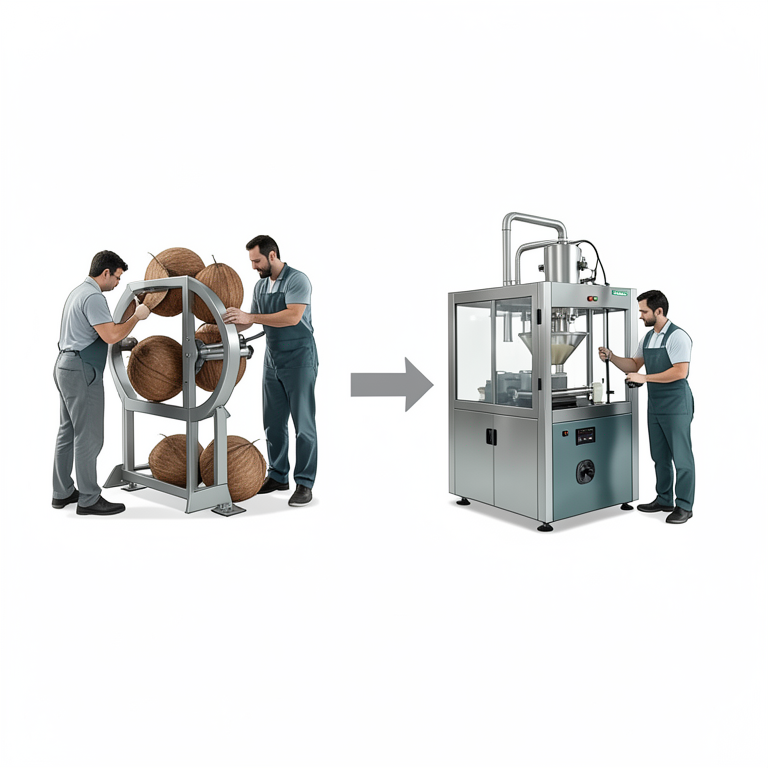
Labor Reduction Flow
AI-generated conceptual illustration (coconut milk extraction machinery). It explains the idea and does not show study data.
View source evidence ↗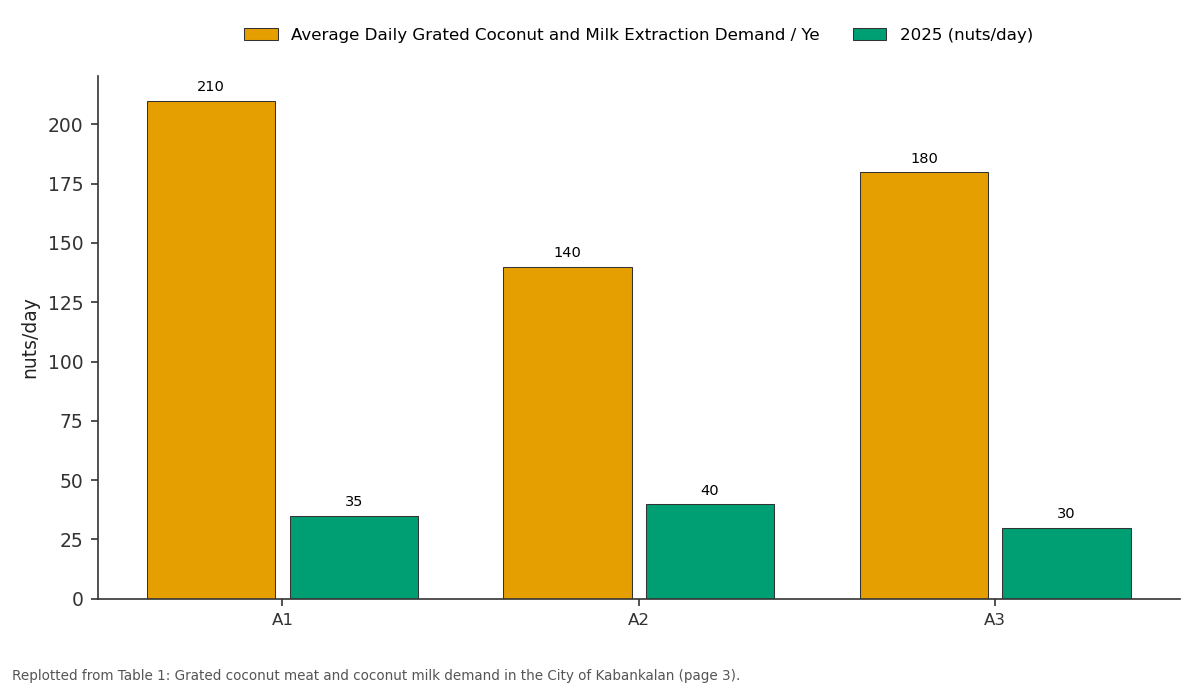
Average Daily Grated Coconut and Milk... and 2025 (nuts/day): A1 vs A2 vs A3
Replotted from Table 1 (page 3) of the original paper. Every bar is the paper's own table value.
View source evidence ↗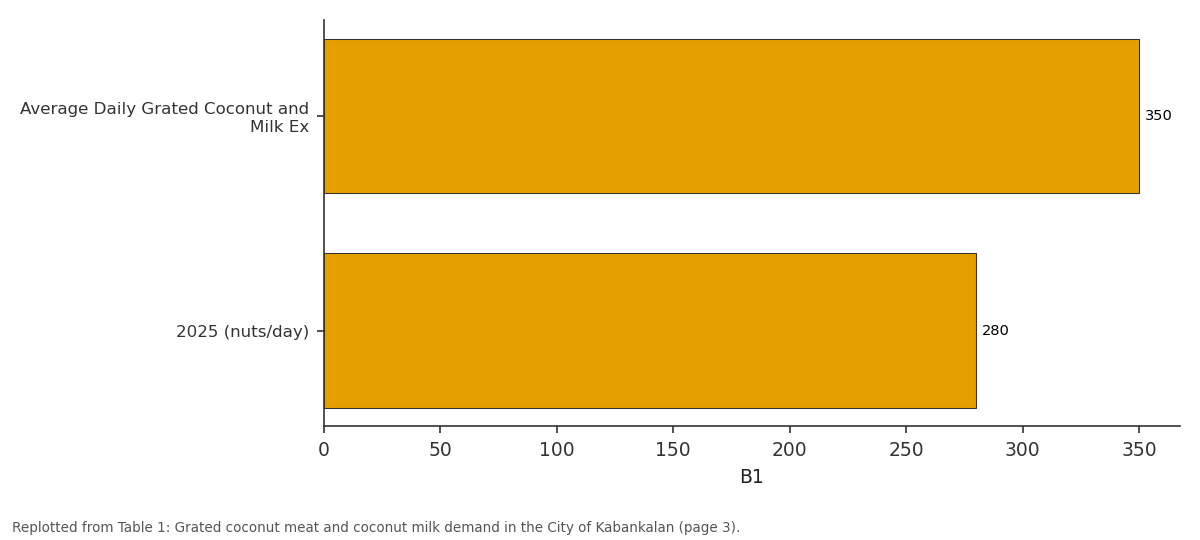
B1: Average Daily Grated... vs 2025 (nuts/day)
Replotted from Table 1 (page 3) of the original paper. Every bar is the paper's own table value.
View source evidence ↗Figures & tables
From the original paper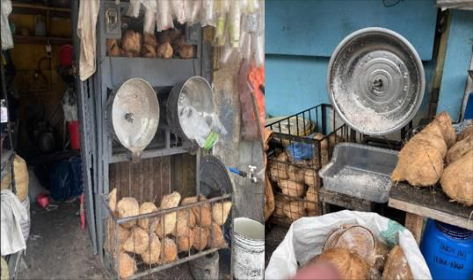 Figure 1
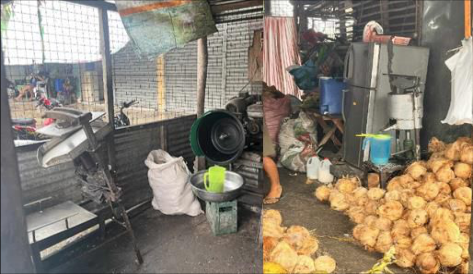 Figure 2
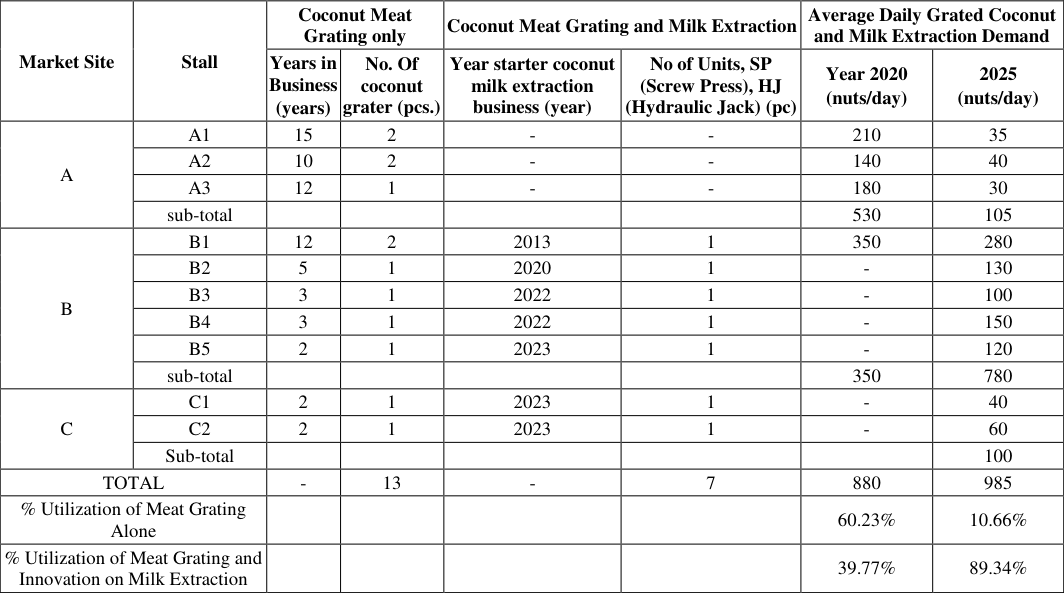 Table 1
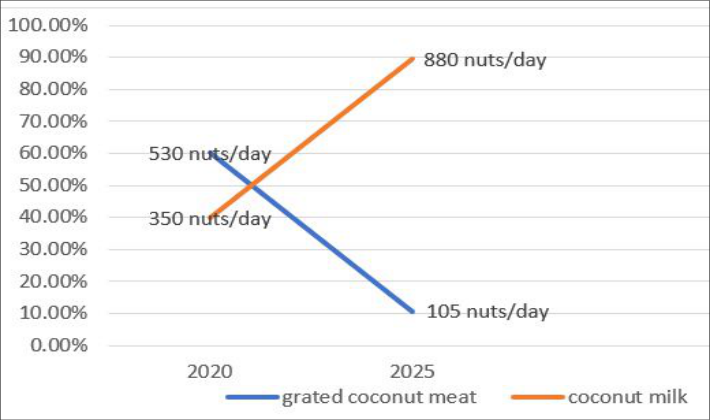 Figure 3
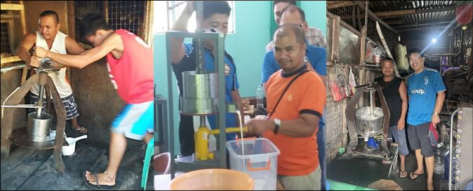 Figure 4
Introduction
Coconuts are considered the most popular fruit worldwide. The fruit consist of 51.7% kernel, 9.8% water and 38.5% shell [1] . The kernel or coconut meat consist of 50-55% coconut milk by volume, is immensely utilized as milk substitute specially for lactose intolerance individual who have problems in digestion, diarrhea and stomach pain [2][3] . Coconut milk comes with an increasingly important ingredient in home cooking as well as in the food processing industries [4] . It is estimated that 25% of the world coconut output is consumed as coconut milk [4] . It is classified as a major and an essential ingredient in the production of a wide variety of food products such as curry, desserts, jam, spread, syrup, cheese, bakery products, ice cream and beverages [5][6] . Coconut milk can be produced at home using readily available grated coconut meat in the market. Clean Cheese cloth material can be utilized and by squeezing with hand, coconut milk is produced [7] . However, due to its tedious preparation and rigorous hand squeezing work, consumers tend to shift in the utilization of readily available fresh pure coconut milk which is now also available in the market [7][8] . As early as 2013, one market vendor invested in the extraction of coconut milk using screw press to maximize extraction [9] . Grated coconut meat is placed inside a nylon net bag and place inside a chamber and pressed against the lower plate with the upper plate being pushed down by screw [10][11] . The unit requires two people in operation, acting on the opposing side of the bar, turning the screw for the process. The screw press is mounted on its base so as to provide stability during the screw turning and pressing operation [12][13] . Research and innovation activities of universities contribute to economic growth in significant ways. A utility model for coconut milk extraction was innovated, utilizing the screw process for preliminary pressing and hydraulic jack on its base to press the coconut meat against the upper press plate supported by the screw [14][15][16] .
Labor requirement was reduced in this method to one operator only. The device also operates without mounting its base considering that it the set -up can even be place on top of the table [17] . Mobility is very high that transfer from one place to the other is very easy and cleaning can be done at the designated place to maintain its hygiene and reducing the risk of contamination [18] . The setup also brings advantage to vendors who sell produce in market day "tabo" considering that every barangay, town and cities in the province of negros occidental have their own specific market day [19] . The design also, encourage other innovators two fabricate their own unit and set up. New designs come up with only the hydraulic jack doing the pressing while the upper part is already fixed [20] . Innovations also provide an opportunity for local designers and manufacturers to help increase in national economic competitiveness [21][22] . With a limited time, labor, capital and still able to maximize extraction capacity and increasing its efficiency contributes to sustainability effort of every individual to reduce waste [23][24] . Unextracted coconut milk in a coconut meat, especially if done manually, provides foul odor after a day, contributing to air pollution aside from increase in waste [25] . Challenge on food production and processing is really critical on maximizing the utilization of available inputs and minimize waste as to help the government attain food sufficiency and sustainability around the country [26] . The demand for dairy products is rapidly on the increasing trend, resulting in insufficient available fresh milk in the market. The need to improve agricultural food production through innovative research necessitates. Government agencies may contribute on the regulating efforts for these kinds of operation. Hygiene must always be a priority of the process, and machineries must pass minimum standards on the utilization of stainless-steel materials for the machines in direct contact to food. While food availability is a major concern, food safety affecting community health must always be secured at all times, considering its impact on the economic side and sustainability of the product at the end. This research is focused on determining the current demand on coconut milk, the extraction methods available, current innovation utilization and its impact on coconut milk extraction available in the city.
Materials and Methods
Materials and Methods
Mature coconut
Local coconut farmers have always considered copra as a primary product of coconut. Unstable copra price always seems to be a problem for farmers which provide option to sell mature coconuts for fresh coconut milk production and or to further process it to Virgin Coconut Oil (VCO). Dehusked coconut is sold by middleman at a cost Php. 22.00 -25.00/nut, delivered directly to market stall owners with warranty of changing nuts found to be immature, damaged, spoiled during harvesting, de-husking and transportation.
Coconut meat grating
Cutting ang grating of mature coconut starts as early as 3 am due to demand of coconut milk by cafeteria, canteen and restaurant owners for their dishes requiring fresh milk. Current charge of coconut grating per piece range from Php. 15.00 -20.00 depending on size. Consumers of coconut milk who still used the traditional method of extracting coconut milk have the option to buy de-husked coconut and have it grated or buy directly from stall owners who also offer coconut with grating (figure1). Price of coconut with grating range from Php. 50.00-60.00 depending also on size of the nut. Stall owners utilizes manual mechanical coconut grater power by 1 hp electric motor. Capacity and efficiency on grating depend on the experience and acquired skills of the operator. One mature coconut at the average contain 450 grams of coconut meat.
Coconut milk Extraction
The available milk extractors in the market includes a screw press and hydraulic jack. It operates using the upper plate for screw pressing and adjustment for upper plate for preliminary pressing and no milk extraction was made. The second process requires operating the jack, positioned at the bottom to lift the plate and pressing it against the screw plate producing the fresh coconut milk. Other innovations provide only hydraulic jack at the bottom plate and the upper plate is fixed for the extraction process (figure 2). Grated coconut meat is placed in a nylon net bag, usually about 2-5 kg depending on the design of the pressing chamber. The process is repeated for second extraction process, using same grated coconut meat arrange upside down in the bucket to maximize extraction. The extraction efficiency of coconut milk extractors ranges from 50-56% by weight of input.
Market stalls operating coconut grating and coconut milk extraction
In the City of Kabankalan, there are three site location of market stalls operating coconut grating and coconut milk extraction. These sites have all been considered with site A located at the market stall area for coconut graters. Site B, the extension sites occupied mostly by coconut milk extractors utilizing the screw press and hydraulic jack extractions process. Site C, on a new extension area mostly used for common market day or "tabo" during Saturday was also considered as part of the study considering that the milk extractors are also present and allowed to process coconut milk extraction throughout the week. VCO processors were not included in the study considering they do not sell coconut milk to any consumers but process their own extracted milk to another product.
Coconut Milk Supply and Demand
Data on demand and supply of coconut and coconut milk available in the city was recorded using interview based on personal accounts of the operators. Average supply and demand for the day was recorded and personal recollection for year 2020 supply and demand during pandemic time. Grating and extraction capacity and efficiency was based on actual field testing and operation. Cost of grating and coconut milk was based on data recorded for the month of May 2025 when this research was conducted.
Results and Discussion
The supply and demand for the grated coconut meat and coconut milk is presented in table 1.
| Market Site | Stall | Coconut Meat Grating only | — | Coconut Meat Grating and Milk Extraction | — | Average Daily Grated Coconut and Milk Extraction Demand | — |
|---|---|---|---|---|---|---|---|
| Years in Business (years) | No. Of coconut grater (pcs.) | Year starter coconut milk extraction business (year) | No of Units, SP (Screw Press), HJ (Hydraulic Jack) (pc) | Year 2020 (nuts/day) | 2025 (nuts/day) | ||
| A | A1 | 15 | 2 | - | - | 210 | 35 |
| A2 | 10 | 2 | - | - | 140 | 40 | |
| A3 | 12 | 1 | - | - | 180 | 30 | |
| sub-total | 530 | 105 | |||||
| B | B1 | 12 | 2 | 2013 | 1 | 350 | 280 |
| B2 | 5 | 1 | 2020 | 1 | - | 130 | |
| B3 | 3 | 1 | 2022 | 1 | - | 100 | |
| B4 | 3 | 1 | 2022 | 1 | - | 150 | |
| B5 | 2 | 1 | 2023 | 1 | - | 120 | |
| sub-total | 350 | 780 | |||||
| C | C1 | 2 | 1 | 2023 | 1 | - | 40 |
| C2 | 2 | 1 | 2023 | 1 | - | 60 | |
| Sub-total | 100 | ||||||
| TOTAL | - | 13 | - | 7 | 880 | 985 | |
| % Utilization of Meat Grating Alone | 60.23% | 10.66% | |||||
| % Utilization of Meat Grating and Innovation on Milk Extraction | 39.77% | 89.34% |
Table text extracted from the original PDF; superscript letters are shown inline. The original table image is below.
View original table image
Technology Utilization in coconut milk extraction
The hydraulic coconut milk extractor was introduced to screw press operator in 2018 with the utilization of screw for preliminary adjustment and final pressing will be done operating the hydraulic jack. Eventually due to reduction in labor requirement from two to one laborer, the stall owner tried and utilized the innovation and transformed his screw press to combination of screw and hydraulic process (Figure 4). No significant increase in coconut milk extraction was recorded, however capacity was increased due to reduction of labor and ease on force requirement. The innovation was utilized and further simplified by local manufacturers using only the hydraulic process without the screw. At present, there are six units of different design used in the market utilizing only the lifting power of hydraulic jack for extraction.
Conclusion
Sustainability on supply of available coconut can be attained through reduction of waste and maximizing extraction of coconut milk utilizing the innovations on coconut milk extractors. The shift in consumer preference in the utilization of readily available coconut milk demand for innovators for further improvement for more efficient and highly productive designs while maintaining hygiene and safety of the product.
Acknowledgement
The author would like to acknowledge the support of the Central Philippines State University administration for the support, Coconut meat graters and coconut milk extractors in the City of Kabankalan for providing factual data in the conduct of this study. Mr. Joel Garpa, stall owner on coconut milk extraction utilizing the screw type and hydraulic coconut milk extractor for facilitating in the conduct of the interview and data collection.
Figures and tables from the paper
References
26 in the original paper- Patil U, Benjakul S. Coconut milk and coconut oil: their manufacture associated with protein functionality. Journal of Food Science. 2018;83(8):2019-27.
- Paul AA, Kumar S, Kumar V, Sharma R. Milk analog: plant-based alternatives to conventional milk, production, potential and health concerns. Critical Reviews in Food Science and Nutrition. 2020;60(18):3005-23.
- Tulashie SK, Amenakpor J, Atisey S, Odai R, Akpari EE. Production of coconut milk: a sustainable alternative plant-based milk. Case Studies in Chemical and Environmental Engineering. 2022;6:100206.
- Alyaqoubi S, Abdullah A, Samudi M, Abdullah N, Addai ZR, Musa KH. Study of antioxidant activity and physicochemical properties of coconut milk (Pati santan) in Malaysia. Journal of Chemical and Pharmaceutical Research. 2015;7(4):967-73.
- Belewu MA, Belewu KY. Comparative physicochemical evaluation of tiger-nut, soybean and coconut milk sources. International Journal of Agriculture and Biology. 2007;9(5):785-7.
- Edem VE, Elijah AI. Optimization of coconut (Cocos nucifera) milk extraction using response surface methodology. International Journal of Nutrition and Food Sciences. 2016;5(6):384-94.
- Abdulkareem LO. Quality, sensory and storage attributes of cheese produced from cow milk International Journal of Agriculture and Food Science https://www.agriculturaljournals.com supplemented with tiger nut and coconut milk [dissertation]. Federal University Oye Ekiti; 2020.
- Tipvarakarnkoon T, Sornsa-ard S, Imcha W. Development of fresh cheese made from coconut milk in combination with cow's milk. British Food Journal. 2017;119(10):2183-93.
- MM, Rasul M, Khan M, Ashwath N, Mofijur MJ. Comparison of oil extraction between screw press and solvent (n-hexane) extraction technique from beauty leaf (Calophyllum inophyllum L.) feedstock. Industrial Crops and Products. 2020;144:112024.
- Patel A, Devraja HC, Sharma P, Singh RR. Food technology II [Internet]. 2019 [cited 2025 Sept 12]. Available from: https://example.com
- Castro A. Fabrication and performance evaluation of an improved mechanical coconut milk extractor. Philippine Journal of Arts, Sciences and Technology. 2023;1:1-10.
- Huang Z, Li Q, Ding H. Theory of parallel mechanisms. Springer Science & Business Media; 2012.
- Campbell GA, Spalding MA. Analyzing and troubleshooting single-screw extruders. Carl Hanser Verlag GmbH Co KG; 2020.
- Saipulnizam HL, Rusli AN. Design and fabrication of coconut milk extractor machine. 2019.
- Murali V, Abhilash P, Chandan CS, Yeshwanth N, Harshith C. Design and development of hydraulic powered coconut water extraction machine. 2021.
- Yusneta AS, Mohd Yusof AA, Md Isa K. Portable fresh coconut milk extractor for small and medium industries (SMI). 2022.
- Schneider S, Susi P. Ergonomics and construction: a review of potential hazards in new construction. American Industrial Hygiene Association Journal. 1994;55(7):635-49.
- Del Rosario RR, Mabesa R. Quality control in coconut milk processing I: sources of microbial contamination. Philippine Agriculturist. 1976;60:66-72.
- Sandoval AC. Organization, management and utilization of the tabo (flea market) among rural communities in Region VIII. Annals of Tropical Research. 1989;11(1-4):21-30.
- Shantha KY, Pathiraja PM, Ranatunga YM, Rajawatta KM. Development and evaluation of jack operated herbal juice/oil extractor for ayurvedic medicine preparation. Research Unit. 2024;18:53.
- Fox S. Third wave do-it-yourself (DIY): potential for prosumption, innovation, and entrepreneurship by local populations in regions without industrial manufacturing infrastructure. Technology in Society. 2014;39:18-30.
- Reynolds EB. Innovation and production: advanced manufacturing technologies, trends and implications for US cities and regions. Built Environment. 2017;43(1):25-43.
- Lindsey TC. Sustainable principles: common values for achieving sustainability. Journal of Cleaner Production. 2011;19(5):561-5.
- Susilo D, de Leon MV, Putranto TD, Hartati FK. Food waste handling perception in Indonesia: communicating the sustainability of food and environment. IOP Conference Series: Earth and Environmental Science. 2021;892(1):012109.
- Manikantan MR, Pandiselvam R, Beegum S, Mathew AC. Harvest and postharvest technology. In: The Coconut Palm (Cocos nucifera L.)-Research and Development Perspectives. Singapore: Springer; 2019. p. 635-722.
- Augusto PE. Challenges, trends and opportunities in food processing. Current Opinion in Food Science. 2020;35:72-8.