
Research article · 2025 · Full text
International Journal of Agriculture and Food ScienceForecasting India’s Agricultural Production Using ARIMA Models: Trends, Challenges, and Policy Implications
Volume 7(10) · Pages 129–131 · DOI: 10.33545/2664844x.2025.v7.i10b.863 ↗
Research areasAgricultural Economics and PracticesAgricultural risk and resilienceForecasting Techniques and Applications
Abstract
Author-writtenAccurate forecasting of agricultural production is critical for food security, policy planning, and economic stability in India. This study employs the Auto-Regressive Integrated Moving Average (ARIMA) model to forecast food grain production using annual time series data from 1950 to 2024, sourced from the Reserve Bank of India (RBI). Following the Box-Jenkins methodology, the Augmented Dickey-Fuller (ADF) test confirmed stationarity (p < 0.05). Among competing models, ARIMA (0,1,1) was selected as optimal due to its lowest Akaike Information Criterion (AIC = 12.254) and statistically significant coefficients (p < 0.0001). Diagnostic checks, including the Ljung-Box Q test (p> 0.05) and Jarque-Bera test (p= 0.284), confirmed residual white noise and normality. The model forecasts a continued decline in food grain production, projecting values of 489.46, 451.64, and 413.81 (units) for 2025-2027, respectively. While the ARIMA model effectively captures short-term temporal patterns, its linear assumptions and exclusion of exogenous variables (e.g., climate, policy) limit long-term accuracy. This study underscores the utility of ARIMA as a policy tool for short-term planning while advocating for future integration of multivariate or machine learning models to enhance predictive robustness.
Summary
Source-checkedPlain-language reading of the full paper, prepared with AI and checked against the text. Each point links to the authors' own words.
Why it matters
- Agriculture is a fundamental pillar of the Indian economy, supporting approximately 42.3% of the population and contributing 18.2% to the GDP. View evidence ↗
- The sector is vulnerable to market fluctuations, policy shifts, and climate variability, as evidenced by a growth slowdown to 1.4% in 2023-24. View evidence ↗
- Traditional forecasting methods are often inadequate because they cannot capture the autocorrelation and complex temporal dependencies found in agricultural data. View evidence ↗
The question
- The study aims to analyze historical food grain production trends, create an optimal ARIMA forecasting model, and offer data-driven insights for policy planning. View evidence ↗
What they did
- The researchers used annual time series data for total food grain production in India from 1950 to 2024, sourced from the Reserve Bank of India (RBI). View evidence ↗
- Analysis was performed using R software (version 4.3.1) with the `forecast` and `tseries` packages. View evidence ↗
- The study followed the Box-Jenkins ARIMA framework, consisting of identification, estimation, and diagnostic checking stages. View evidence ↗
- The Augmented Dickey-Fuller (ADF) test was used to determine if the time series data was stationary. View evidence ↗
What they found
- The ADF test confirmed the series was stationary (p-value = 0.0001, test statistic = 14.44642) without needing further differencing. View evidence ↗
- ARIMA (0,1,1) was identified as the optimal model because it had the lowest AIC (12.254), BIC (12.348), and HQC (12.292) compared to other tested models. View evidence ↗
- The ARIMA (0,1,1) model showed a negative drift, with a statistically significant MA (1) coefficient of -0.544 (p < 0.0001) and a constant term of -37.825 (p < 0.0001). View evidence ↗
- The model predicts a continuing decline in food grain production, with projected values of 489.46 units in 2025, 451.64 units in 2026, and 413.81 units in 2027. View evidence ↗
- The model demonstrated a MAPE of 19.80% and a Theil’s Inequality Coefficient of 0.0857, though a bias proportion of 0.761 suggests systematic deviation. View evidence ↗
What it means
- The authors suggest that these forecasts should act as a warning for policymakers to invest in irrigation, market linkages, and climate-resilient crops. View evidence ↗
- The study concludes that the ARIMA (0,1,1) model effectively revealed a statistically significant downward trend in India's food grain production. View evidence ↗
- A major limitation is that the model is univariate and ignores external factors like temperature, rainfall, fertilizer use, and policy interventions. View evidence ↗
- The authors recommend that future research use machine learning (e.g., Random Forest, LSTM) or multivariate models (VAR) to incorporate economic and climate variables. View evidence ↗
Visual summary
1 visualsIllustrations explain the paper; they do not show study data.
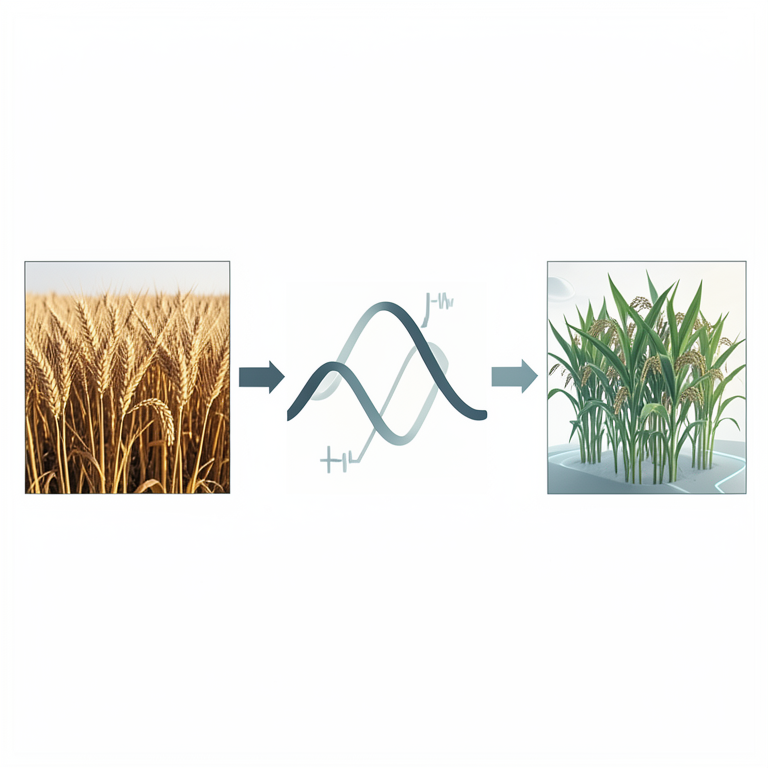
ARIMA Modeling Workflow
AI-generated conceptual illustration (Indian agricultural food grain crops). It explains the idea and does not show study data.
View source evidence ↗Introduction
Agriculture remains the backbone of India's economy. According to the Economic Survey, the Indian agriculture sector provides livelihood support to about 42.3% of the population and contributes 18.2% to the country's GDP at current prices. The sector has shown resilience, registering an average annual growth rate of 4.18% at constant prices over the last five years. However, provisional estimates for 2023-24 indicate a slowdown to 1.4%, highlighting the sector's vulnerability to climatic variability, policy shifts, and market fluctuations. Accurate forecasting of agricultural output is therefore essential for ensuring food security, guiding policy formulation, and enabling economic stability. Historically, the Green Revolution of the 1960s marked a transformative phase in Indian agriculture, significantly boosting food grain production-particularly in states like Punjab and Haryana-through the adoption of high-yielding variety (HYV) seeds, chemical fertilizers, and expanded irrigation. This era established India as self-sufficient in staple crops like wheat and rice. Scholars such as Singh (2018) and Chand (2019) [11,3] emphasize the success of this period in addressing food shortages and enhancing productivity. However, long-term studies by Birthal et al. (2015) and Kaur and Singh (2020) [2,7] reveal adverse environmental consequences, including soil degradation, groundwater depletion, and biodiversity loss, especially in intensively farmed regions. Over time, India has witnessed a shift in cropping patterns, with a growing diversification from food grains to high-value commercial crops such as cotton, oilseeds, fruits, and vegetables-particularly in states like Maharashtra, Gujarat, and Andhra Pradesh. While food grains remain dominant, this diversification reflects changing consumer preferences, market liberalization, and government policies promoting horticulture and allied sectors (Birthal et al., 2017, 2020) [10] . Despite progress, regional disparities persist. Eastern and northeastern states continue to lag due to inadequate infrastructure, fragmented landholdings, and limited access to credit and technology (Jha, 2011; Mohanty, 2013) [6,8] .
In recent years, India has emerged as one of the world's top agricultural producers. For 2023-24, total food grain production was estimated at 3288.52 Lakh Metric Tons (LMT), with projections for 2025 reaching around 332 million metric tons. Uttar Pradesh, Punjab, Madhya Pradesh, and West Bengal are among the leading agricultural states, each specializing in key crops-wheat in Punjab and Uttar Pradesh, rice in West Bengal, and oilseeds in Madhya Pradesh. Technological advancements, including satellitebased monitoring, drones, artificial intelligence, and the Internet of Things, are driving a paradigm shift toward smarter, data-driven farming (Reddy et al., 2021) [10] . Despite these developments, agricultural forecasting remains a challenge. Traditional methods often fail to capture the complex temporal dependencies and autocorrelation inherent in agricultural time series data. In contrast, time series models such as ARIMA, grounded in the methodology, have demonstrated robustness in modeling and forecasting economic and agricultural trends. ARIMA models are particularly suited for data exhibiting trends, seasonality, and serial correlation-common features in agricultural production series. This study addresses the critical need for reliable, datadriven forecasting of India's food grain production by employing the ARIMA model. The primary research problem lies in the sector's sensitivity to exogenous shocks-climate change, policy changes, and market dynamics-which traditional models often overlook. By analyzing annual time series data from 1950 to 2024 sourced from the Reserve Bank of India (RBI), this study aims to: (1) examine historical trends in food grain production, (2) develop an optimal ARIMA model for forecasting, and (3) provide evidence-based insights for policymakers. The findings contribute to the growing literature on agricultural forecasting in developing economies and offer a replicable framework for regional and crop-specific analyses (Bheemanna et al, 2024) [12] .
Materials and Methods.
Materials and Methods.
Discussion and Conclusion
The findings of this study reveal a concerning long-term decline in India's food grain production, as captured by the ARIMA (0,1,1) model. The forecasted drop from 489.46 units in 2025 to 413.81 units in 2027 contradicts some official projections, such as the anticipated 332 million metric tons for 2024 (Government of India, 2024), suggesting a possible discrepancy in data units or definitions-likely due to the use of an index value rather than absolute production figures. This highlights the importance of contextual interpretation when applying statistical models to policy planning. The selection of ARIMA (0,1,1) as the optimal model aligns with prior studies, such as Padhan (2012) [9] , which also found MA components effective in capturing shock adjustments in agricultural output. The significant negative MA (1) coefficient indicates that unanticipated negative shocks-such as droughts or pest outbreaks-have a persistent dampening effect on production, consistent with the sector's vulnerability to climatic risks (Aggarwal, 2009) [1] . In conclusion, this study successfully applied the ARIMA (0,1,1) model to forecast India's food grain production, revealing a statistically significant downward trend. While the model is robust for short-term planning, its limitations underscore the need for integrated, data-rich forecasting frameworks to ensure long-term food security in India's evolving agrarian landscape.
Acknowledgement
AcknowledgmentsThe authors would like to express their sincere gratitude to Dr. Tojo Jose and Prof. Dr. Roy Scaria for their invaluable
References
12 in the original paper- Aggarwal PK. Climate change and crop production: Issues and challenges. Indian J Agric Sci. 2009;79(1):112.
- Chand R. Agricultural growth in India: Trends, patterns, and prospects. New Delhi: Indian Council for Research on International Economic Relations (ICRIER); 2019.
- Food and Agriculture Organization (FAO). The state of food security and nutrition in the world 2023: Urbanization, agrifood systems transformation, and healthy diets across the rural-urban continuum. Rome: FAO; 2023.
- Government of India, Ministry of Agriculture & Farmers Welfare. Second advance estimates of crop production 2023-24. New Delhi: Department of Agriculture & Farmers Welfare; 2024.
- Jha R. Economic development in India: The role of human capital and infrastructure. London: Palgrave Macmillan; 2011.
- Kaur M, Singh K. Environmental impact of Green Revolution in Punjab: A critical analysis. J Environ Manage Health. 2020;31(3):456-70.
- Mohanty BB. Regional disparities in agricultural development: A case study of eastern India. Indian J Agric Econ. 2013;68(1):56-70.
- Padhan PC. Application of ARIMA model for forecasting agricultural productivity in India. J Agric Soc Sci. 2012;8(2):50-6.
- Reddy DN, Birthal PS, Negi DS. Digital agriculture in India: Status, challenges, and future pathways. Indian J Agric Econ. 2021;76(2):189-208.
- Singh R. Agricultural transformation in India: From subsistence to commercial farming. New Delhi: Sage Publications; 2018.
- Bheemanna, Megeri MN. Forecasting of population and economic variables in India using the Bayesian Structural Time Series (BSTS) Model. Int J Stat Appl Math 2024;9(6):205-210. DOI: 10.22271/maths.2024.v9.i6c.1922
- Reserve Bank of India. Index of Agricultural Production [Internet]. [cited 2025 Oct 9]. Available from: https://www.rbi.org.in/