
Research article · 2025 · Full text
International Journal of Agriculture and NutritionInfluence of potassium fulvate with iron and zinc foliar nutrition on nutrient uptake in chickpea
Volume 7(10) · Pages 01–03 · DOI: 10.33545/26646064.2025.v7.i10a.292 ↗
Research areasAgricultural Science and FertilizationAgronomic Practices and Intercropping SystemsPlant Micronutrient Interactions and Effects
Abstract
Author-writtenA field experiment was conducted during the Rabi season of 2024-25 at the Instructional Farm, College of Agriculture, Karad, to evaluate the effect of foliar application of potassium fulvate, iron, and zinc on total nutrient uptake in chickpea (Cicer arietinum L.). The experiment was laid out in a Randomized Block Design with nine treatments replicated thrice, consisting of foliar sprays of potassium fulvate at 200, 400, and 600 ppm applied singly or in combination with FeSO₄ and ZnSO₄ (0.5% each), along with the general recommended dose of fertilizers (GRDF). Results revealed that foliar application significantly enhanced total uptake of both macronutrients and micronutrients. The treatment with 400 ppm potassium fulvate + FeSO₄ (0.5%) + ZnSO₄ (0.5%) recorded the highest total uptake of N (93.41 kg ha⁻¹), P (15.21 kg ha⁻¹), K (20.15 kg ha⁻¹), Fe (73.79 g ha⁻¹), Mn (63.42 g ha⁻¹), Zn (129.02 g ha⁻¹), and Cu (42.50 g ha⁻¹), compared to the control. The findings demonstrate that foliar sprays of potassium fulvate with Fe and Zn improve nutrient assimilation, mobility, and utilization efficiency in chickpea.
Summary
Source-checkedPlain-language reading of the full paper, prepared with AI and checked against the text. Each point links to the authors' own words.
Why it matters
- Chickpea is a significant rabi pulse crop in India, prized for its high protein levels and its ability to improve soil fertility via biological nitrogen fixation. View evidence ↗
- The productivity of chickpea is limited by inefficient nutrient use and common deficiencies of zinc and iron in Indian soils. View evidence ↗
- Potassium fulvate, a water-soluble humic substance, can act as a chelator to improve nutrient solubility and facilitate their transport across plant membranes. View evidence ↗
The question
- The study aimed to evaluate how the foliar application of iron, zinc, and potassium fulvate affects the total nutrient uptake of chickpea plants. View evidence ↗
What they did
- The researchers used a Randomized Block Design with nine different treatments, each replicated three times. View evidence ↗
- Treatments included foliar sprays of potassium fulvate (200, 400, or 600 ppm) applied alone or combined with 0.5% FeSO₄ and ZnSO₄, all alongside a general recommended fertilizer dose. View evidence ↗
- Foliar sprays were administered twice: once at 35 days after sowing (flower initiation) and again at 55 days after sowing (pod initiation). View evidence ↗
- Nutrient content was analyzed using grain and straw samples collected at harvest, which were oven-dried and ground. View evidence ↗
What they found
- The combination of 400 ppm potassium fulvate with 0.5% FeSO₄ and ZnSO₄ (T8) resulted in the highest nitrogen uptake at 93.41 kg ha⁻¹, compared to 50.51 kg ha⁻¹ in the control. View evidence ↗
- Phosphorus uptake was highest in T9 (15.34 kg ha⁻¹) and T8 (15.21 kg ha⁻¹), while the control group only reached 9.32 kg ha⁻¹. View evidence ↗
- Potassium uptake was maximized in T8 at 20.15 kg ha⁻¹, significantly higher than the 12.01 kg ha⁻¹ observed in the control. View evidence ↗
- Iron (Fe) uptake peaked in T8 at 73.79 g ha⁻¹, while the control group had the lowest uptake at 40.22 g ha⁻¹. View evidence ↗
- Zinc (Zn) uptake in T8 (129.02 g ha⁻¹) was more than twice that of the control group (63.12 g ha⁻¹). View evidence ↗
- T8 increased manganese uptake from 35.12 g ha⁻¹ (control) to 63.42 g ha⁻¹ and copper uptake from 27.01 g ha⁻¹ (control) to 42.50 g ha⁻¹. View evidence ↗
- Because T9 (600 ppm fulvate + Fe + Zn) performed similarly to T8, the authors suggest that 400 ppm of potassium fulvate is the optimal dose. View evidence ↗
What it means
- The authors conclude that applying 400 ppm potassium fulvate combined with 0.5% FeSO₄ and ZnSO₄ and GRDF significantly improves the total uptake of all measured macro and micronutrients in chickpea. View evidence ↗
- The authors state that this integrated foliar nutrition approach improves nutrient uptake efficiency, which leads to higher protein content and productivity in the crop. View evidence ↗
Visual summary
3 visualsIllustrations explain the paper; charts are replotted from the paper's own table values.
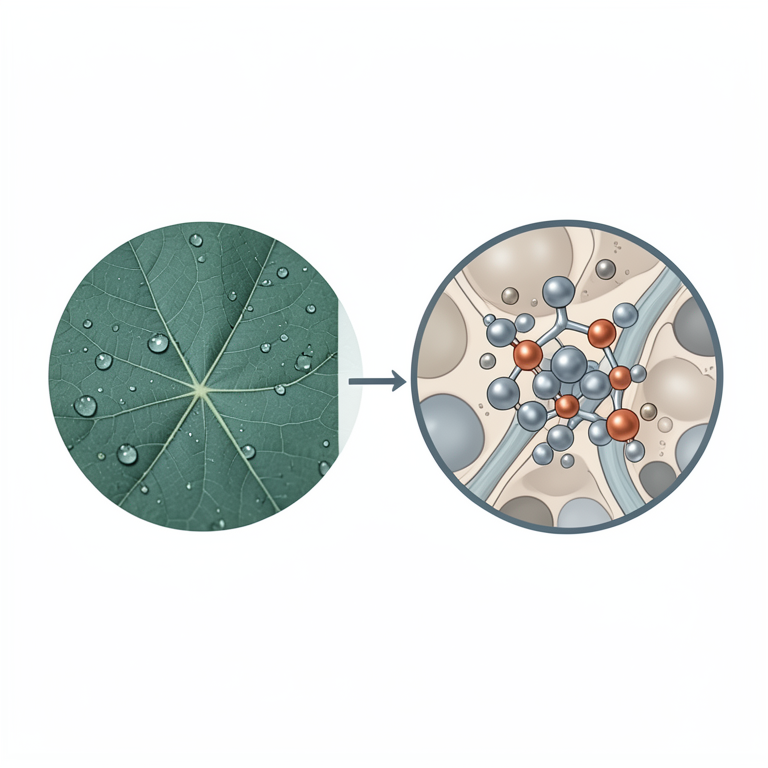
Mechanism of Potassium Fulvate as a Chelator
AI-generated conceptual illustration (chickpea leaves). It explains the idea and does not show study data.
View source evidence ↗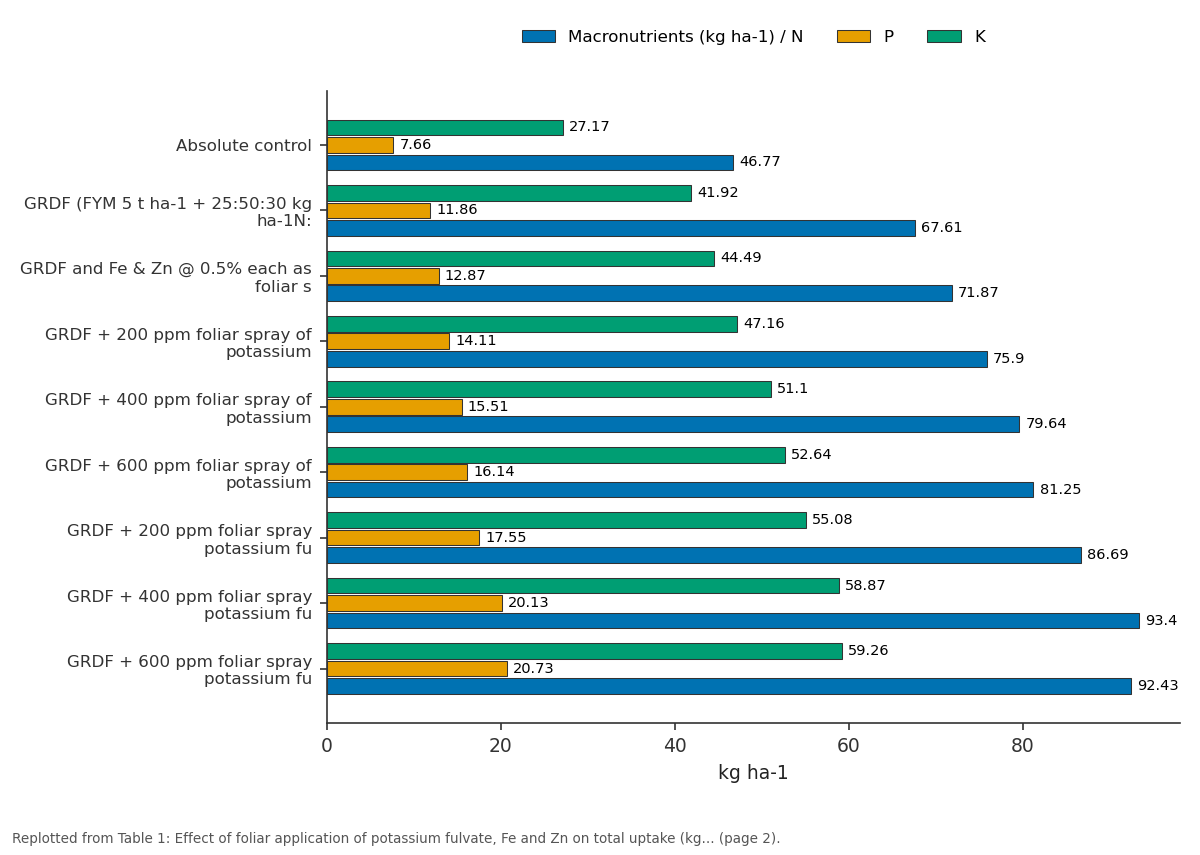
Macronutrients (kg ha-1) / N and P and more: Absolute control vs GRDF (FYM 5 t ha-1 +... vs GRDF and Fe & Zn @ 0.5%... vs GRDF + 200 ppm foliar... vs GRDF + 400 ppm foliar...
Replotted from Table 1 (page 2) of the original paper. Every bar is the paper's own table value.
View source evidence ↗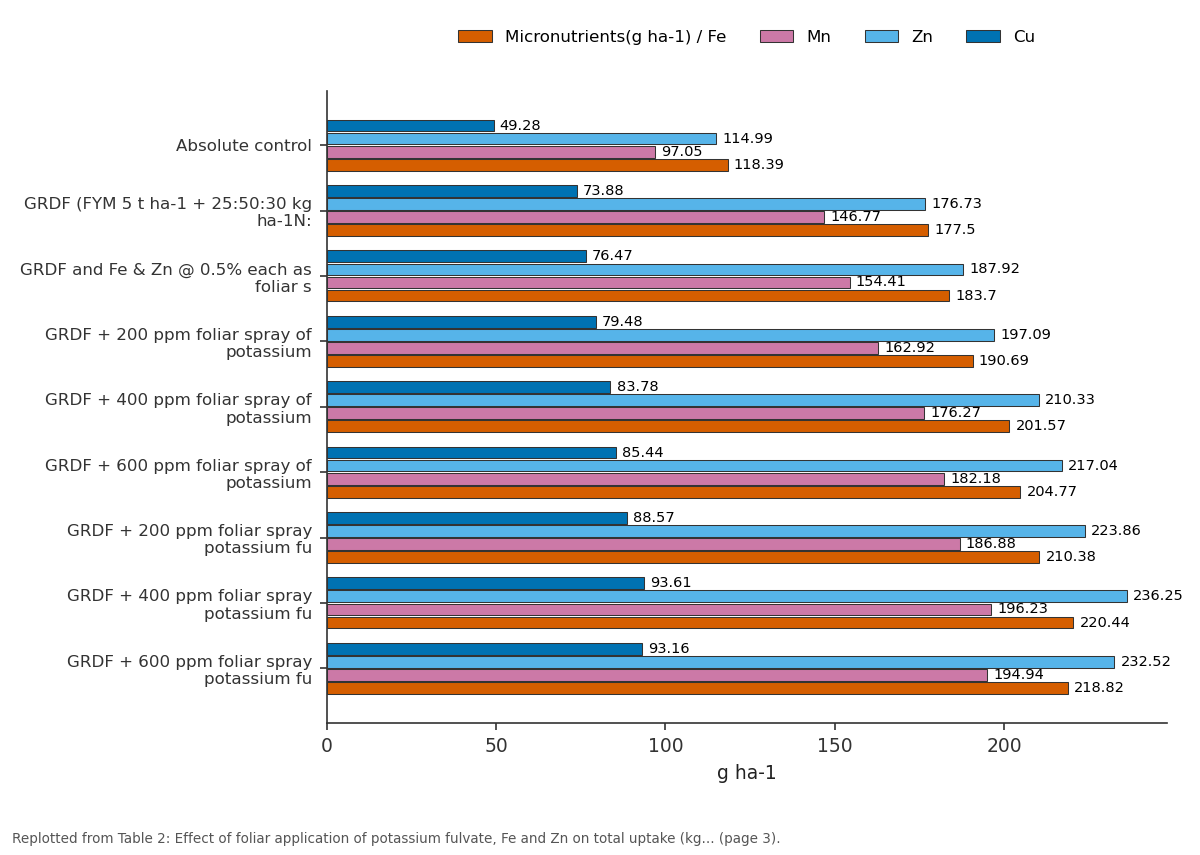
Micronutrients(g ha-1) / Fe and Mn and more: Absolute control vs GRDF (FYM 5 t ha-1 +... vs GRDF and Fe & Zn @ 0.5%... vs GRDF + 200 ppm foliar... vs GRDF + 400 ppm foliar...
Replotted from Table 2 (page 3) of the original paper. Every bar is the paper's own table value.
View source evidence ↗Figures & tables
From the original paper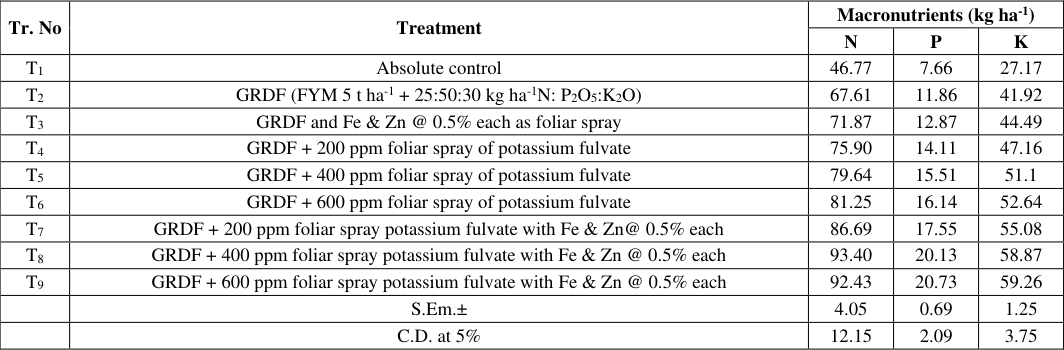 Table 1
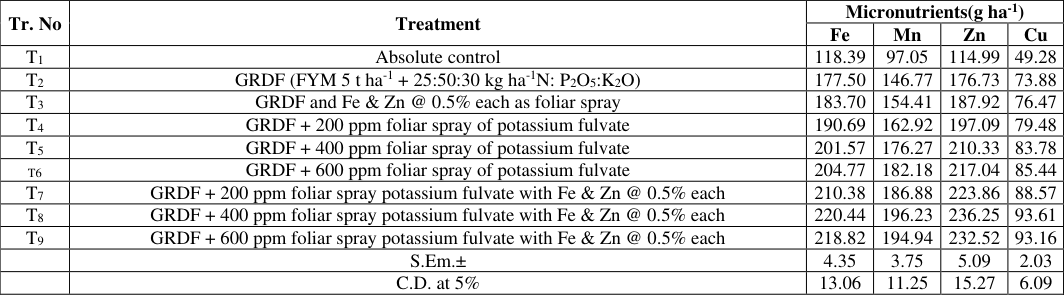 Table 2
Introduction
Nutrient uptake efficiency is one of the most critical factors influencing productivity and nutritional value of pulses. Chickpea (Cicer arietinum L.), a major rabi pulse crop in India, is valued for its high protein content and contribution to soil fertility through biological nitrogen fixation. However, its productivity is constrained by poor nutrient use efficiency and widespread deficiencies of micronutrients such as iron and zinc in Indian soils (Ahmad et al., 2019) [1] . These deficiencies adversely affect nodulation, chlorophyll synthesis, enzymatic activity, and nutrient enrichment of grains, ultimately leading to reduced crop performance and lower nutritional quality (Rehman et al., 2022) [7] . Foliar application of nutrients is an efficient method for meeting plant nutrient requirements during critical growth stages. Unlike soil application, it ensures rapid absorption and effective translocation of nutrients into metabolic pathways. In pulses, Fe and Zn foliar sprays have been shown to improve nutrient assimilation, enhance nitrogen fixation, and enrich micronutrient concentration in grains (Rane et al., 2019; Kaur et al., 2020) [6,3] . Humic substances, particularly fulvic acid and its potassium salts, have recently gained importance as biostimulants for enhancing nutrient uptake. Potassium fulvate is a low molecular weight, water-soluble fraction of humic substances that chelates nutrients, improves their solubility, and facilitates absorption and transport across plant membranes (Mora et al., 2019) [5] . Its combined application with Fe and Zn can synergistically improve nutrient uptake efficiency in legumes, but such studies in chickpea remain limited.
Materials and Methods
The experiment was conducted during Rabi 2024-25 at the Instructional Farm, College of Agriculture, Karad (17°16′ N latitude, 74°12′ E longitude, altitude 576 m above mean sea level). The soil was an Inceptisol, clay loam in texture, slightly alkaline (pH 7.78), non-saline (EC 0.28 dS m⁻¹), low in available N (183.72 kg ha⁻¹), medium in P (13.60 kg ha⁻¹), and high in K (525.14 kg ha⁻¹), with 0.58% organic carbon. DTPA-extractable Fe and Zn (1.12 mg kg⁻¹) was near the critical limit, while other micronutrients were adequate.
The experiment was laid out in a Randomized Block Design (RBD) with nine treatments replicated thrice. Treatments consisted of foliar sprays of potassium fulvate at 200, 400, and 600 ppm, applied either alone or with FeSO₄ and ZnSO₄ (0.5% each), along with the general recommended dose of fertilizers (25:50:25 kg N:P₂O₅:K₂O ha⁻¹). Chickpea variety (Phule digvijay) was sown at 30 × 10 cm spacing using a seed rate of 80 kg ha⁻¹. Seeds were treated with Rhizobium and Trichoderma cultures before sowing. Two foliar sprays were applied at 35 DAS (flower initiation) and 55 DAS (pod initiation). At harvest, grain and straw samples were collected, oven-dried, ground, and analyzed for nutrient content. Nitrogen was determined by the Kjeldahl method, phosphorus by the vanadomolybdate yellow color method, and potassium by flame photometry. Micronutrients (Fe, Zn, Mn, Cu) were estimated using atomic absorption spectrophotometry after di-acid digestion. Total nutrient uptake was calculated by multiplying concentration with grain and straw yield and depicated in table 1
| Tr. No | Treatment | Macronutrients (kg ha-1) | — | — |
|---|---|---|---|---|
| N | P | K | ||
| T1 | Absolute control | 46.77 | 7.66 | 27.17 |
| T2 | GRDF (FYM 5 t ha-1 + 25:50:30 kg ha-1N: P2O5:K2O) | 67.61 | 11.86 | 41.92 |
| T3 | GRDF and Fe & Zn @ 0.5% each as foliar spray | 71.87 | 12.87 | 44.49 |
| T4 | GRDF + 200 ppm foliar spray of potassium fulvate | 75.90 | 14.11 | 47.16 |
| T5 | GRDF + 400 ppm foliar spray of potassium fulvate | 79.64 | 15.51 | 51.1 |
| T6 | GRDF + 600 ppm foliar spray of potassium fulvate | 81.25 | 16.14 | 52.64 |
| T7 | GRDF + 200 ppm foliar spray potassium fulvate with Fe & Zn@ 0.5% each | 86.69 | 17.55 | 55.08 |
| T8 | GRDF + 400 ppm foliar spray potassium fulvate with Fe & Zn @ 0.5% each | 93.40 | 20.13 | 58.87 |
| T9 | GRDF + 600 ppm foliar spray potassium fulvate with Fe & Zn @ 0.5% each | 92.43 | 20.73 | 59.26 |
| S.Em.± | 4.05 | 0.69 | 1.25 | |
| C.D. at 5% | 12.15 | 2.09 | 3.75 |
Table text extracted from the original PDF; superscript letters are shown inline. The original table image is below.
View original table image
Results and Discussion Total Macronutrient Uptake (N, P, K)
The data presented in Table 1 showed that total macronutrient uptake by chickpea was significantly improved with foliar application of potassium fulvate, iron, and zinc. The highest total nitrogen uptake (93.41 kg ha⁻¹) was recorded in T 8 (400 ppm potassium fulvate + FeSO₄ 0.5% + ZnSO₄ 0.5%), followed by T 9 (92.70 kg ha⁻¹), while the lowest was observed in control (50.51 kg ha⁻¹). The increase in nitrogen uptake may be attributed to the improved chelation and transport of nutrients by fulvate and the catalytic role of Fe and Zn in nitrogen metabolism (Kaur et al., 2020; Mora et al., 2019) [3,5] . Similar increases in nitrogen uptake due to Fe and Zn sprays have been reported in chickpea and lentil (Rane et al., 2019; Rehman et al., 2022) [6,7] . Total phosphorus uptake also varied significantly among treatments. The maximum uptake was recorded in T 9 (15.34 kg ha⁻¹), followed closely by T 8 (15.21 kg ha⁻¹), whereas control recorded only 9.32 kg ha⁻¹. The enhancement may be due to fulvate improving phosphorus solubility and root permeability, while Zn facilitates the enzymatic activity associated with phosphorus metabolism (Ahmad et al., 2019) [1] . Potassium uptake showed a similar trend. The highest total potassium uptake (20.15 kg ha⁻¹) was observed in T 8 , compared to only 12.01 kg ha⁻¹ in control. Fulvic substances are known to enhance ion transport and membrane permeability, which likely improved K absorption and translocation (Mora et al., 2019) [5] . These findings corroborate earlier studies in legumes where humic substances enhanced K uptake efficiency (Kolape et al., 2023) [4] .
Total Micronutrient Uptake (Fe, Zn, Mn, Cu) The effect of treatments on total micronutrient uptake is presented in Table 2. The maximum Fe uptake (73.79 g ha⁻¹) was recorded in T 8 , followed by T 9 (72.95 g ha⁻¹), whereas the lowest was in control (40.22 g ha⁻¹). The improvement in Fe uptake may be due to fulvate preventing Fe precipitation and enhancing its mobility within the plant (El-Sayed et al., 2024) [2] . Zinc uptake exhibited the most pronounced response. T 8 recorded 129.02 g ha⁻¹, which was more than double the uptake in control (63.12 g ha⁻¹). This is attributed to fulvate's chelating property and Zn's role in seed development and auxin metabolism (Ahmad et al., 2019) [1] . Rehman et al. (2022) [7] also reported similar increases in Zn uptake with foliar Zn sprays in lentil. Manganese uptake increased from 35.12 g ha⁻¹ in control to 63.42 g ha⁻¹ in T 8 , while copper uptake increased from 27.01 g ha⁻¹ in control to 42.50 g ha⁻¹ in T 8 . The enhancement of Mn and Cu uptake may be attributed to fulvate's role in mobilizing divalent cations and increasing their bioavailability (Mora et al., 2019; Kaur et al., 2020) [5,3] . Overall, the treatment with 400 ppm potassium fulvate + FeSO₄ 0.5% + ZnSO₄ 0.5% (T 8 ) consistently recorded the highest total uptake of both macronutrients and micronutrients. The next best treatment was T 9 (600 ppm fulvate + Fe + Zn), which was at par with T 8 , suggesting that 400 ppm fulvate is the optimum dose. These results demonstrate the synergistic role of fulvate, Fe, and Zn in enhancing nutrient absorption, assimilation, and translocation efficiency in chickpea (Mora et al., 2019; Kolape et al., 2023) [5,4] .
| Tr. No | Treatment | Micronutrients(g ha-1) | — | — | — |
|---|---|---|---|---|---|
| Fe | Mn | Zn | Cu | ||
| T1 | Absolute control | 118.39 | 97.05 | 114.99 | 49.28 |
| T2 | GRDF (FYM 5 t ha-1 + 25:50:30 kg ha-1N: P2O5:K2O) | 177.50 | 146.77 | 176.73 | 73.88 |
| T3 | GRDF and Fe & Zn @ 0.5% each as foliar spray | 183.70 | 154.41 | 187.92 | 76.47 |
| T4 | GRDF + 200 ppm foliar spray of potassium fulvate | 190.69 | 162.92 | 197.09 | 79.48 |
| T5 | GRDF + 400 ppm foliar spray of potassium fulvate | 201.57 | 176.27 | 210.33 | 83.78 |
| T6 | GRDF + 600 ppm foliar spray of potassium fulvate | 204.77 | 182.18 | 217.04 | 85.44 |
| T7 | GRDF + 200 ppm foliar spray potassium fulvate with Fe & Zn @ 0.5% each | 210.38 | 186.88 | 223.86 | 88.57 |
| T8 | GRDF + 400 ppm foliar spray potassium fulvate with Fe & Zn @ 0.5% each | 220.44 | 196.23 | 236.25 | 93.61 |
| T9 | GRDF + 600 ppm foliar spray potassium fulvate with Fe & Zn @ 0.5% each | 218.82 | 194.94 | 232.52 | 93.16 |
| S.Em.± | 4.35 | 3.75 | 5.09 | 2.03 | |
| C.D. at 5% | 13.06 | 11.25 | 15.27 | 6.09 |
Table text extracted from the original PDF; superscript letters are shown inline. The original table image is below.
View original table image
Conclusion
Foliar application of 400 ppm potassium fulvate along with FeSO₄ (0.5%) and ZnSO₄ (0.5%) along with GRDF significantly improved total uptake of N, P, K, Fe, Zn, Mn, and Cu in chickpea. The study highlights the importance of fulvate as a natural chelator that enhances nutrient absorption and utilization efficiency when combined with micronutrient sprays. This integrated foliar nutrition approach found to be to improve nutrient uptake efficiency leads to increased productivity and protein content in chickpea.
References
7 in the original paper- Ahmad M, Aslam M, Hussain S, Anwar S. Role of fulvic acid and micronutrients in nutrient uptake and yield of pulses. J Plant Nutr. 2019;42(18):2150-2162.
- El-Sayed M, Atta A, Khalifa M. Foliar fulvic acid application improves nutrient efficiency and yield: a systematic review. BMC Plant Biol. 2024;24:118.
- Kaur P, Singh J, Sharma R. Effect of humic substances and micronutrients on productivity and nutrient uptake of legumes. Indian J Agron. 2020;65(2):245-252.
- Kolape SM, Patil HB, Jadhav SD, Waghmare MN. Effect of humic substances and micronutrients on crop productivity. Indian J Soil Sci. 2023;71(2):145-152.
- Mora V, Bacaicoa E, Zamarreño AM, Aguirre E, Garnica M, Fuentes M, García-Mina JM. The role of humic substances in plant physiology: interactions with plant growth and mineral nutrition. Front Plant Sci. 2019;10:657.
- Rane M, Pawar S, Patil P. Foliar iron and nitrogen nutrition improves chickpea productivity and nutrient uptake. J Plant Nutr. 2019;42(19):2250-2258.
- Rehman A, Khan M, Ahmad W, Iqbal A. Foliar application of zinc and iron enriches lentil grains with micronutrients and improves nutrient uptake. Agronomy. 2022;12(5):1062.