
Research article · 2025 · Full text
International Journal of Agriculture and Food ScienceExploring the effect of seed biopriming with MPKV bacterial consortium on macronutrient uptake, soil fertility and economic returns in cowpea (Vigna unguiculata (L.) Walp)
Volume 7(9) · Pages 889–894 · DOI: 10.33545/2664844x.2025.v7.i9l.840 ↗
Research areasAgricultural pest management studies
Abstract
Author-writtenA field experiment was carried out during kharif 2024 at the College of Agriculture, Pune to evaluate the influence of seed biopriming with the MPKV bacterial consortium on growth, nutrient uptake, and yield performance of cowpea. The consortium, formulated at Mahatma Phule Krishi Vidyapeeth, comprises beneficial microbial strains capable of nitrogen fixation and phosphorus solubilization, thereby improving nutrient availability in the rhizosphere. Findings revealed that seed biopriming combined with 75% of the recommended fertilizer dose (RDF) proved most effective. This treatment achieved significantly higher germination (95.43%), plant height (47.53 cm at flowering and 63.60 cm at harvest), root length (17.93 cm and 22.30 cm), as well as maximum shoot (12.18 g plant⁻¹) and root dry matter (2.63 g plant⁻¹). Yield parameters were also enhanced, including number of nodules (32 plant⁻¹), pods per plant (43.33), 1000-seed weight (132.60 g), and seed yield (11.92 q ha⁻¹). In addition, greater uptake of nitrogen, phosphorus, and potassium (90.07, 17.54, and 45.15 kg ha⁻¹, respectively) and increased populations of Rhizobium, PSB, and KMB were recorded. Notably, the performance of the consortium with 75% RDF was statistically comparable to that with 100% RDF, indicating that 25% of nitrogen and phosphorus fertilizers can be saved without compromising yield. Hence, seed biopriming with the MPKV bacterial consortium emerges as a sustainable strategy for improving cowpea productivity, nutrient efficiency, and soil microbial activity, while reducing reliance on chemical fertilizers.
Summary
Source-checkedPlain-language reading of the full paper, prepared with AI and checked against the text. Each point links to the authors' own words.
Why it matters
- Pulses are critical to Indian agriculture as they provide a primary source of dietary protein for a largely vegetarian population. View evidence ↗
- Legumes benefit the environment by improving soil fertility through organic matter addition and nitrogen fixation. View evidence ↗
- Cowpea productivity in India is considered insufficient, with a national mean of approximately 607 kg per hectare. View evidence ↗
The question
- The study aimed to evaluate how seed biopriming with the MPKV bacterial consortium affects the growth, yield, and nutrient uptake of cowpea. View evidence ↗
What they did
- The field experiment was conducted during the kharif 2024 season at the College of Agriculture, Pune. View evidence ↗
- Seed biopriming involved immersing cowpea seeds in bacterial solutions for 12 hours before they were sown. View evidence ↗
- The experiment tested seven treatments: the MPKV consortium and a reference strain combined with 100%, 75%, or 50% of the recommended fertilizer dose (RDF), plus an untreated control. View evidence ↗
What they found
- The combination of MPKV bacterial consortium and 75% RDF (T2) achieved the highest nitrogen uptake at 90.07 kg ha-1. View evidence ↗
- The T2 treatment (MPKV consortium + 75% RDF) also resulted in the highest potassium uptake, measuring 45.15 kg ha-1. View evidence ↗
- Post-harvest soil analysis showed that T2 (MPKV consortium + 75% RDF) left the highest available nitrogen in the soil at 205.51 kg ha-1. View evidence ↗
- T2 (MPKV consortium + 75% RDF) provided the best economic outcome with a grain yield of 11.92 q ha-1, a net return of ₹32,774 per hectare, and a benefit-to-cost ratio of 1.85. View evidence ↗
- The results indicate that using the MPKV consortium with 75% RDF is statistically similar to using 100% RDF, allowing for a 25% reduction in chemical fertilizer use without losing yield. View evidence ↗
What it means
- The authors conclude that seed biopriming with the MPKV consortium and 75% RDF is a sustainable way to reduce chemical fertilizer needs while maintaining yield and improving soil health. View evidence ↗
Visual summary
3 visualsIllustrations explain the paper; charts are replotted from the paper's own table values.
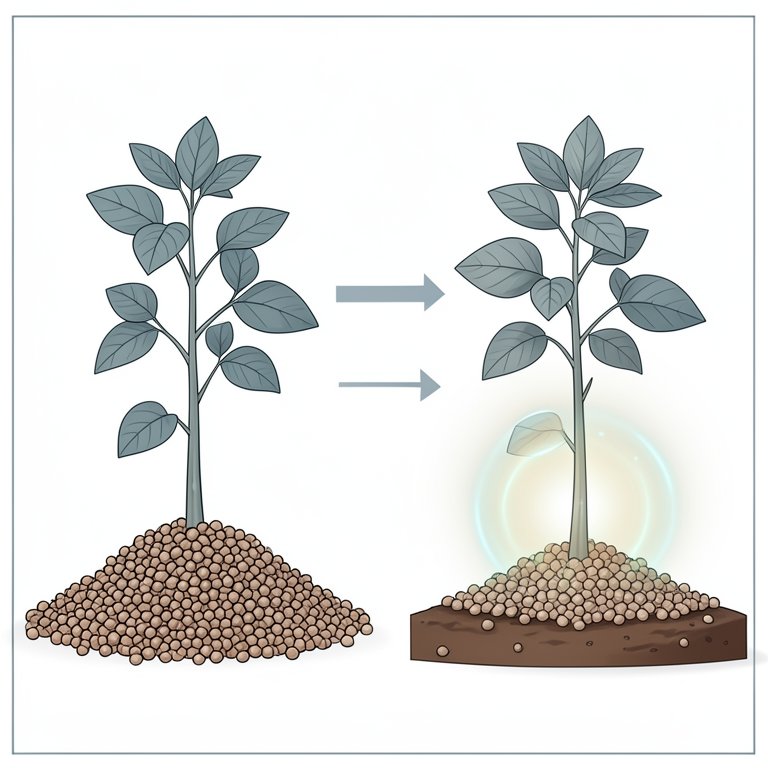
Fertilizer Reduction Strategy
AI-generated conceptual illustration (cowpea plants (Vigna unguiculata)). It explains the idea and does not show study data.
View source evidence ↗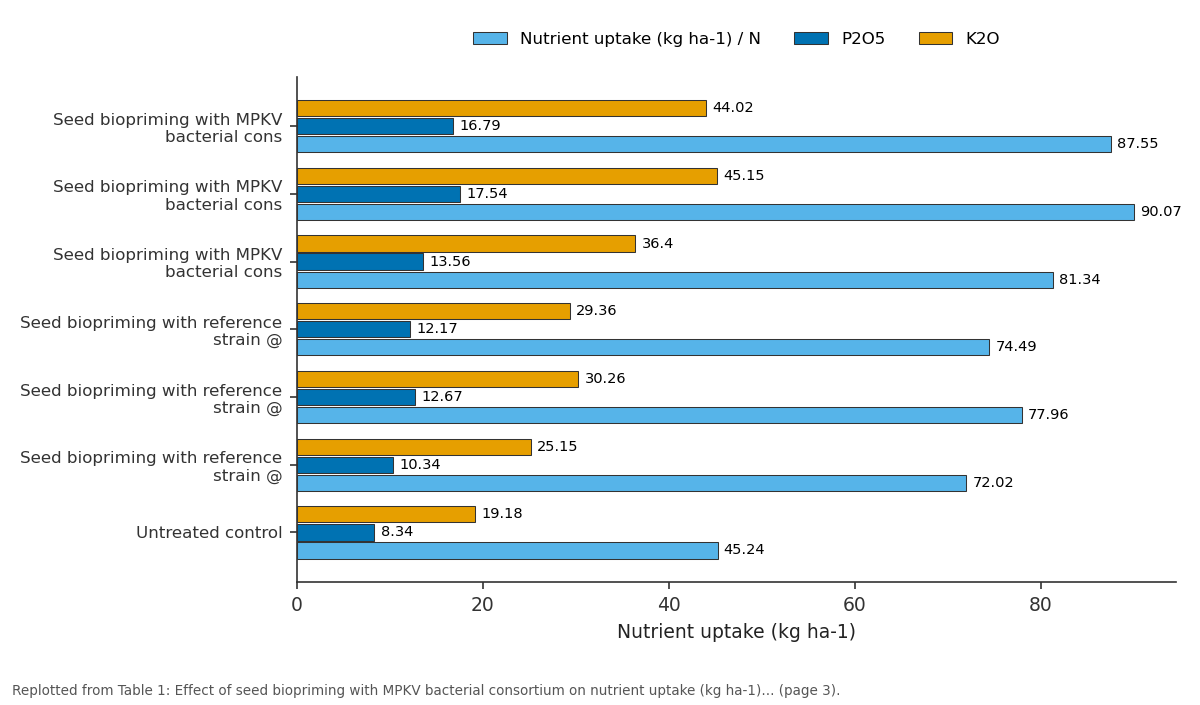
Nutrient uptake (kg ha-1) / N and P2O5 and more: Seed biopriming with... vs Seed biopriming with... vs Seed biopriming with... vs Seed biopriming with... vs Seed biopriming with...
Replotted from Table 1 (page 3) of the original paper. Every bar is the paper's own table value.
View source evidence ↗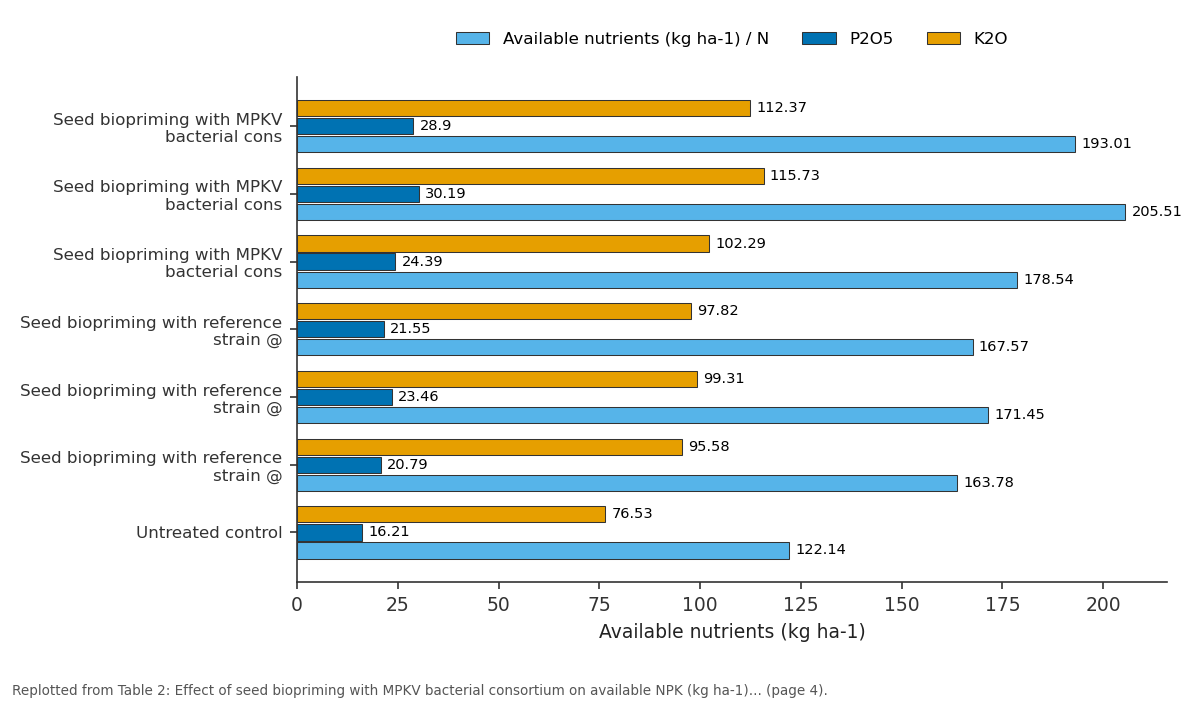
Available nutrients (kg ha-1) / N and P2O5 and more: Seed biopriming with... vs Seed biopriming with... vs Seed biopriming with... vs Seed biopriming with... vs Seed biopriming with...
Replotted from Table 2 (page 4) of the original paper. Every bar is the paper's own table value.
View source evidence ↗Figures & tables
From the original paper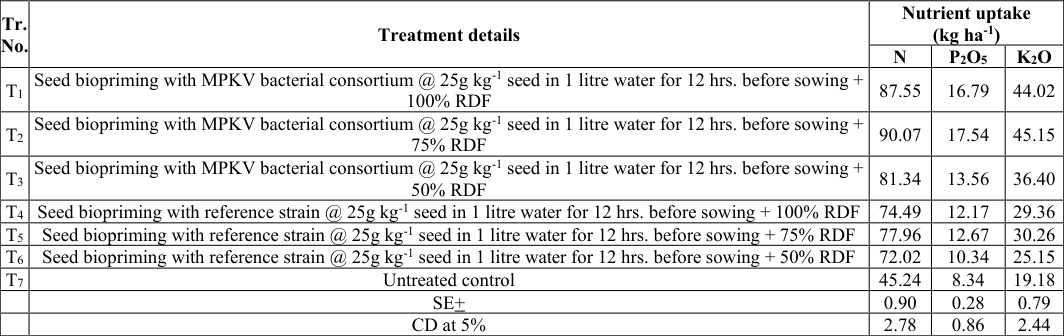 Table 1
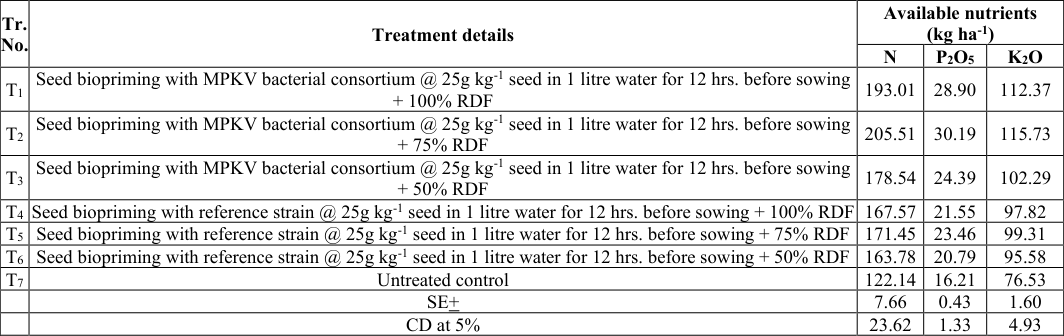 Table 2
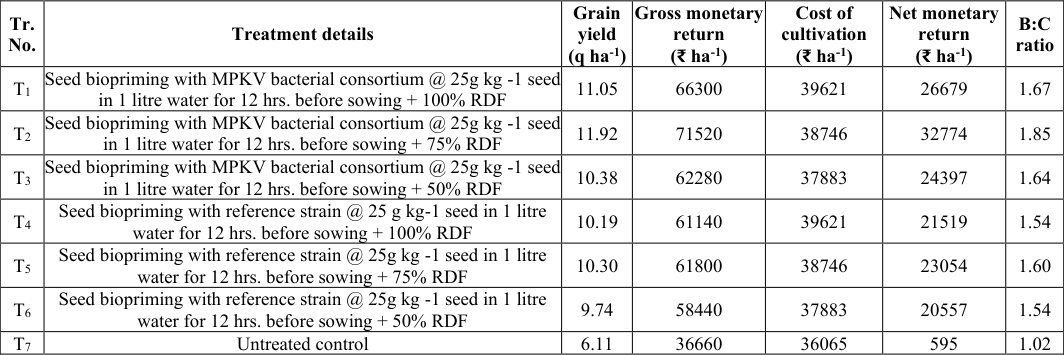 Table 3
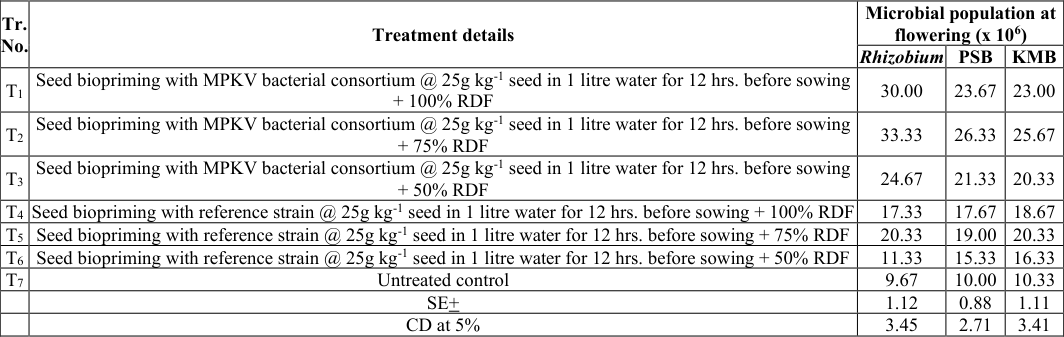 Table 4
Text
The national mean productivity of cowpea is approximately 607 kg per hectare, according to ICAR (2020) which is relatively insufficient. Key factors contributing to the low yield of cowpea are cultivation on infertile lands, inefficient crop management, scarcity of resources available to farmers, and slow adoption of modern farming methods. Bio-priming is a biological seed treatment that combines controlled hydration with inoculation using beneficial microbes. This technique enhances seed viability, germination, seedling vigor, and plant growth, while also providing protection against diseases and improving crop yield. Commonly, microbial inoculant like, PGPR's beneficial bacteria or fungi are employed for seed biopriming. Seed bio-priming is an emerging method of seed treatment that facilitates faster and more uniform germination, leading to improved seedling vigor and plant growth. Moeinzadeh et al., 2010) [10] Seed bio-priming serves as an effective alternative to conventional seed treatments, as beneficial microbes colonize the root surface, develop biofilms, and safeguard plants against soil-borne pathogens throughout their growth cycle (Singh et al., 2016) [15] . Seed biopriming with plant growth-promoting rhizobacteria, including Bacillus megaterium and Azospirillum brasilense, together with biocontrol organisms such as Trichoderma harzianum and Pseudomonas fluorescens, resulted in a significant rise in defence enzyme activity, establishing its utility as a sustainable strategy for managing damping-off disease (Rajendraprasad et al. 2017) [14] . Microorganisms promote plant development by releasing compounds that enhance seed germination and stimulate root formation, such as auxins, abscisic acid, gibberellic acid, cytokinins, and ethylene (Santner et al., 2009) [16] .
Materials and Methods
Present investigation was carried out during kharif 2024 on the field of Biological Nitrogen Fixation Scheme and Department of Plant Pathology, College of Agriculture Pune.
Seeds:
The seeds of cowpea variety Phule Sonali (PCP-1123) required for the experiment were obtained from the Pulses and Oilseed Crop Research and Training Centre, Pandharpur, Solapur.
Soil sampling:
Soil samples were collected from the experimental plot before and after harvesting of the Cowpea for analysis of nutrient status of the soil. The collected soil samples were air dried, crushed in wooden mortar and pestle. Soil was sieved through a 2 mm sieve. Then the soil samples were analyzed for their chemical properties by using standard analytical methods.
Plant sampling:
The plant samples for total N, P, and K analysis were collected separately from each treatment plot at the harvesting stage. The plant samples were then kept in paper bags and dried in a hot air oven at 70°C for 48 hours. The dried plant parts were finely grounded in a mixer. This fine powder was again dried in the oven at 60°C for a couple of hours and stored properly till the samples were used for chemical analysis of nutrients.
Collection of bacterial consortium:
The required MPKV bacterial consortium and reference strain of Pseudomonas fluorescens and Bacillus subtilis was collected from the department of plant pathology and agriculture microbiology MPKV Rahuri.
Biopriming of seed with bacterial consortium:
For the experiment, the bacterial consortium along with the reference strains of Pseudomonas and Bacillus subtilis were used as per treatments. A quantity of 25 g from each inoculant the consortium and the individual reference strains was measured and separately suspended in 1000 ml of water in beakers. Cowpea seeds were then immersed in these prepared solutions for a period of 12 hours prior to sowing. After soaking, the seeds were removed, air-dried under shade for about 30 minutes, and subsequently sown in the field.
Observation recorded:
The observations on nutrient uptake by cowpea viz. Nitrogen, Phosphorous, Potassium; soil available nutrients viz. Nitrogen, Phosphorous, Potassium; Economic of cowpea.
Treatment details:
The cowpea seeds were inoculated before sowing as T1-Seed biopriming with MPKV bacterial consortium @ 25g kg -1 seed in 1 litre water for 12 hrs. before sowing + 100% RDF, T2-Seed biopriming with MPKV bacterial consortium @ 25g kg -1 seed in 1 litre water for 12 hrs. before sowing + 75% RDF, T3-Seed biopriming with MPKV bacterial consortium @ 25g kg -1 seed in 1 litre water for 12 hrs. before sowing + 50% RDF, T4-Seed biopriming with reference strain @ 25g kg -1 seed in 1 litre water for 12 hrs. before sowing + 100% RDF, T5-Seed biopriming with reference strain @ 25g kg -1 seed in 1 litre water for 12 hrs. before sowing + 75% RDF, T6-Seed biopriming with reference strain @ 25g kg -1 seed in 1 litre water for 12 hrs. before sowing + 50% RDF and T7-Untreated control.
Result and Discussion
Result and Discussion
Inoculation Effect of Seed Biopriming with MPKV Bacterial Consortium on Nutrient Uptake by Cowpea at Harvest 3.1.1 Nitrogen Uptake
The results related to the nutrient uptake of cowpea by using MPKV bacterial consortium as seed treatment are reported. When comparing different inoculation treatment, T2 i.e. seed biopriming with MPKV bacterial consortium + 75% RDF was found to be the most effective as it recorded significantly highest nitrogen uptake (90.07 kg ha -1 ) over rest of the treatments, however it was statistically at par with T1 i.e. seed biopriming with MPKV bacterial consortium + 100% RDF for nitrogen uptake (87.55 kg ha -1 ) by cowpea at harvest. The untreated control plot recorded the lowest nitrogen uptake (45.24 kg ha -1 ).
Phosphorus Uptake
The results related to the nutrient uptake of cowpea by using MPKV bacterial consortium as seed treatment are reported. When comparing different inoculation treatment, T2 i.e. seed biopriming with MPKV bacterial consortium + 75% RDF was found to be the most effective as it recorded significantly highest phosphorus uptake (17.54 kg ha -1 ) over rest of the treatments, however it was statistically at par with T1 i.e. seed biopriming with MPKV bacterial consortium + 100% RDF for phosphorus uptake (16.79 kg ha -1 ) by International Journal of Agriculture and Food Science https://www.agriculturaljournals.com cowpea at harvest. The untreated control plot recorded the lowest phosphorus uptake (8.34 kg ha -1 ).
Potassium Uptake
The results related to the nutrient uptake of cowpea by using MPKV bacterial consortium as seed treatment are reported. When comparing different inoculation treatment, T2 i.e. seed biopriming with MPKV bacterial consortium + 75% RDF was found to be the most effective as it recorded significantly highest potassium uptake (45.15 kg ha -1 ) over rest of the treatments, however it was statistically at par with T1 i.e. seed biopriming with MPKV bacterial consortium + 100% RDF for potassium uptake (44.02 kg ha -1 ) by cowpea at harvest. The untreated control plot recorded the lowest potassium uptake (19.18 kg ha -1 ).
Seed biopriming with the MPKV bacterial consortium influenced nutrient uptake in cowpea because the beneficial microbes enhanced nitrogen fixation, phosphorus solubilization, and potassium mobilization. This improved root growth and microbial activity in the rhizosphere, leading to better availability and absorption of N, P and K at harvest. Similar findings were also reported by Bansal (2009) [2] , Qureshi et al. (2011) [13] , Argaw (2012) [1] , Tarafder et al. (2016) [19] , Shete et al. (2019) and Ghadge and Murumkar (2020) [6] .
Available Phosphorus
After harvesting of cowpea, the soil was analyzed to determine the availability of Phosphorus, and the results are reported accordingly under the influence of seed biopriming with MPKV bacterial consortium. When comparing different inoculation treatment, T2 i.e. seed biopriming with MPKV bacterial consortium + 75% RDF was found to be the most effective as it recorded significantly highest available phosphorus (30.19 kg ha -1 ) in soil compared to the other treatments, however it was statistically at par with T1 i.e. seed biopriming with MPKV bacterial consortium + 100% RDF for available phosphorus (28.90 kg ha -1 ) after harvest in soil. The untreated control plot recorded lowest available phosphorus (16.21 kg ha -1 ) after harvest in soil.
Available Potassium
After harvesting of cowpea, the soil was analyzed to determine the availability of Potassium, and the results are reported accordingly under the influence of seed biopriming with MPKV bacterial consortium. When comparing different inoculation treatment, T2 i.e. seed biopriming with MPKV bacterial consortium + 75% RDF was found to be the most effective as it recorded significantly highest available potassium (115.73 kg ha -1 ) in soil compared to the other treatments, however it was statistically at par with T1 i.e. seed biopriming with MPKV bacterial consortium + 100% RDF for available potassium (112.37 kg ha -1 ) after harvest in soil. The untreated control plot recorded lowest available potassium (76.53 kg ha -1 ) after harvest in soil.
Seed biopriming with the MPKV bacterial consortium influenced the availability of NPK in soil after harvest because the microbes fixed atmospheric nitrogen, solubilized insoluble phosphorus, and mobilized potassium, thereby enriching the soil nutrient pool. Enhanced microbial activity maintained higher residual nutrients even after crop uptake, improving soil fertility for subsequent crops. Similar findings were also reported by Bansal (2009) [2] , Qureshi et al. (2011) [13] , Argaw (2012) [1] , Tarafder et al. (2016) [19] , Shete et al. (2019) and Ghadge and Murumkar (2020) [6] .
Inoculation Effect of Seed Biopriming with MPKV Bacterial Consortium on Fertilizer Nitrogen and Phosphorus Economy of Cowpea
In a recent study, different treatments were examined to assess their effects on grain yield and economic returns, and multiple approaches were analyzed and compared. When comparing different seed inoculation treatments, T1 i.e. seed biopriming with an MPKV bacterial consortium at 25g per kilograms of seed in 1 litre of water for 12 hours before sowing, combined with recommended dose of fertilizers which is 100% (RDF). This treatment resulted in a grain yield of 11.05 quintals per hectare, a gross monetary return of ₹66,300 per hectare, a cost of cultivation of ₹39,621 per hectare and a net monetary return of ₹26,679 per hectare, with a benefit-to-cost ratio of 1.67. Treatment T2 which also used the MPKV bacterial consortium but with 75% RDF, yielded slightly more at 11.92 q ha -1 . It produced a gross return of ₹71,520 per hectare, with a cultivation cost of ₹38,746 per hectare, leading to a net return of ₹ 32,774 per hectare and B:C ratio of 1.85. Lastly, the untreated control yielded 6.11 q ha -1 , with a gross return of ₹36,660 per hectare, a cultivation cost of ₹36,065 per hectare, a net return of ₹595 per hectare, and B:C ratio of 1.02. Overall, treatments involving the MPKV bacterial consortium in combination with higher RDF levels consistently resulted in significantly higher grain yields and improved economic returns compared to treatments utilizing reference strains or lower RDF levels. [3] and Shete et al. (2019) [17] .
Conclusion
The present investigation clearly demonstrated that seed biopriming of cowpea with the MPKV bacterial consortium significantly improved nutrient uptake, soil fertility, yield performance, microbial population, and economic returns over the untreated control. The treatment with seed biopriming + 75% RDF (T₂) proved to be most effective, as it recorded highest uptake of nitrogen, phosphorus, and potassium, enhanced residual availability of NPK in soil, and sustained higher beneficial microbial populations at flowering. This treatment also resulted in superior grain yield and net monetary return with a higher benefit:cost ratio compared to 100% RDF or control, thereby highlighting its fertilizer economy potential. The findings suggest that integration of MPKV bacterial consortium through seed biopriming with 75% RDF can effectively reduce chemical fertilizer requirement without compromising yield, while simultaneously improving soil health and microbial activity. Thus, MPKV bacterial consortium-based seed biopriming technology offers a sustainable and eco-friendly approach for enhancing productivity, profitability, and soil fertility in cowpea cultivation systems.
Figures and tables from the paper
| Tr. No. | Treatment details | Nutrient uptake (kg ha-1) | — | — |
|---|---|---|---|---|
| N | P2O5 | K2O | ||
| T1 | Seed biopriming with MPKV bacterial consortium @ 25g kg-1 seed in 1 litre water for 12 hrs. before sowing + 100% RDF | 87.55 | 16.79 | 44.02 |
| T2 | Seed biopriming with MPKV bacterial consortium @ 25g kg-1 seed in 1 litre water for 12 hrs. before sowing + 75% RDF | 90.07 | 17.54 | 45.15 |
| T3 | Seed biopriming with MPKV bacterial consortium @ 25g kg-1 seed in 1 litre water for 12 hrs. before sowing + 50% RDF | 81.34 | 13.56 | 36.40 |
| T4 | Seed biopriming with reference strain @ 25g kg-1 seed in 1 litre water for 12 hrs. before sowing + 100% RDF | 74.49 | 12.17 | 29.36 |
| T5 | Seed biopriming with reference strain @ 25g kg-1 seed in 1 litre water for 12 hrs. before sowing + 75% RDF | 77.96 | 12.67 | 30.26 |
| T6 | Seed biopriming with reference strain @ 25g kg-1 seed in 1 litre water for 12 hrs. before sowing + 50% RDF | 72.02 | 10.34 | 25.15 |
| T7 | Untreated control | 45.24 | 8.34 | 19.18 |
| SE+ | 0.90 | 0.28 | 0.79 | |
| CD at 5% | 2.78 | 0.86 | 2.44 |
Table text extracted from the original PDF; superscript letters are shown inline. The original table image is below.
View original table image
| Tr. No. | Treatment details | Available nutrients (kg ha-1) | — | — |
|---|---|---|---|---|
| N | P2O5 | K2O | ||
| T1 | Seed biopriming with MPKV bacterial consortium @ 25g kg-1 seed in 1 litre water for 12 hrs. before sowing + 100% RDF | 193.01 | 28.90 | 112.37 |
| T2 | Seed biopriming with MPKV bacterial consortium @ 25g kg-1 seed in 1 litre water for 12 hrs. before sowing + 75% RDF | 205.51 | 30.19 | 115.73 |
| T3 | Seed biopriming with MPKV bacterial consortium @ 25g kg-1 seed in 1 litre water for 12 hrs. before sowing + 50% RDF | 178.54 | 24.39 | 102.29 |
| T4 | Seed biopriming with reference strain @ 25g kg-1 seed in 1 litre water for 12 hrs. before sowing + 100% RDF | 167.57 | 21.55 | 97.82 |
| T5 | Seed biopriming with reference strain @ 25g kg-1 seed in 1 litre water for 12 hrs. before sowing + 75% RDF | 171.45 | 23.46 | 99.31 |
| T6 | Seed biopriming with reference strain @ 25g kg-1 seed in 1 litre water for 12 hrs. before sowing + 50% RDF | 163.78 | 20.79 | 95.58 |
| T7 | Untreated control | 122.14 | 16.21 | 76.53 |
| SE+ | 7.66 | 0.43 | 1.60 | |
| CD at 5% | 23.62 | 1.33 | 4.93 |
Table text extracted from the original PDF; superscript letters are shown inline. The original table image is below.
View original table image
| Tr. No. | Treatment details | Grain yield (q ha-1) | Gross monetary return (₹ ha-1) | Cost of cultivation (₹ ha-1) | Net monetary return (₹ ha-1) | B:C ratio |
|---|---|---|---|---|---|---|
| T1 | Seed biopriming with MPKV bacterial consortium @ 25g kg -1 seed in 1 litre water for 12 hrs. before sowing + 100% RDF | 11.05 | 66300 | 39621 | 26679 | 1.67 |
| T2 | Seed biopriming with MPKV bacterial consortium @ 25g kg -1 seed in 1 litre water for 12 hrs. before sowing + 75% RDF | 11.92 | 71520 | 38746 | 32774 | 1.85 |
| T3 | Seed biopriming with MPKV bacterial consortium @ 25g kg -1 seed in 1 litre water for 12 hrs. before sowing + 50% RDF | 10.38 | 62280 | 37883 | 24397 | 1.64 |
| T4 | Seed biopriming with reference strain @ 25 g kg-1 seed in 1 litre water for 12 hrs. before sowing + 100% RDF | 10.19 | 61140 | 39621 | 21519 | 1.54 |
| T5 | Seed biopriming with reference strain @ 25g kg -1 seed in 1 litre water for 12 hrs. before sowing + 75% RDF | 10.30 | 61800 | 38746 | 23054 | 1.60 |
| T6 | Seed biopriming with reference strain @ 25g kg -1 seed in 1 litre water for 12 hrs. before sowing + 50% RDF | 9.74 | 58440 | 37883 | 20557 | 1.54 |
| T7 | Untreated control | 6.11 | 36660 | 36065 | 595 | 1.02 |
Table text extracted from the original PDF; superscript letters are shown inline. The original table image is below.
View original table image
| Tr. No. | Treatment details | Microbial population at flowering (x 106) | — | — |
|---|---|---|---|---|
| Rhizobium | PSB | KMB | ||
| T1 | Seed biopriming with MPKV bacterial consortium @ 25g kg-1 seed in 1 litre water for 12 hrs. before sowing + 100% RDF | 30.00 | 23.67 | 23.00 |
| T2 | Seed biopriming with MPKV bacterial consortium @ 25g kg-1 seed in 1 litre water for 12 hrs. before sowing + 75% RDF | 33.33 | 26.33 | 25.67 |
| T3 | Seed biopriming with MPKV bacterial consortium @ 25g kg-1 seed in 1 litre water for 12 hrs. before sowing + 50% RDF | 24.67 | 21.33 | 20.33 |
| T4 | Seed biopriming with reference strain @ 25g kg-1 seed in 1 litre water for 12 hrs. before sowing + 100% RDF | 17.33 | 17.67 | 18.67 |
| T5 | Seed biopriming with reference strain @ 25g kg-1 seed in 1 litre water for 12 hrs. before sowing + 75% RDF | 20.33 | 19.00 | 20.33 |
| T6 | Seed biopriming with reference strain @ 25g kg-1 seed in 1 litre water for 12 hrs. before sowing + 50% RDF | 11.33 | 15.33 | 16.33 |
| T7 | Untreated control | 9.67 | 10.00 | 10.33 |
| SE+ | 1.12 | 0.88 | 1.11 | |
| CD at 5% | 3.45 | 2.71 | 3.41 |
Table text extracted from the original PDF; superscript letters are shown inline. The original table image is below.
View original table image
References
19 in the original paper- Argaw A. Evaluation of co-inoculation of Bradyrhizobium japonicum and phosphate solubilizing Pseudomonas spp. effect on soybean (Glycine max L. Merr.) in Assossa area. J Agric Sci Technol. 2012;14:213-24.
- Bansal RK. Synergistic effect of Rhizobium, PSB and PGPR on nodulation and grain yield of mung bean. J Food Legumes. 2009;22(1):37-9.
- Cao ND, Duong BS, Nguyen BT, Phan VHL. Effects of rhizobia and phosphate-solubilizing bacteria on soybean (Glycine max) cultivated on ferrosols of Daklak province, Vietnam. World J Pharm Sci. 2016;5(4):31833.
- Chapman HD, Pratt PF. Methods of analysis for soils, plants, and waters. Berkeley, Calif.: Univ Div Agr Sci; 1961. 309 p.
- Choudhary VK, Kumar PS. Nutrient budgeting, economics and energetics of cowpea under potassium and phosphorus management. SAARC J Agric. 2013;11(2):129-40.
- Ghadge JR, Murumkar DR, Shete MH. Development of microbial consortia of nitrogen fixing, phosphate solubilizing and potash mobilizing bacteria for optimizing nutrient supplementation to soybean. Int J Curr Microbiol Appl Sci. 2020;9(7):1889-902.
- Jackson ML. Soil chemical analysis. New Delhi: Prentice Hall of India; 1973. p. 134-9.
- Jaybhay SA, Taware SP, Philips V. Microbial inoculation of Rhizobium and phosphate-solubilizing bacteria along with inorganic fertilizers for sustainable yield of soybean [Glycine max (L.) Merril]. J Plant Nutr. 2017;40(15):2209-16.
- Knudsen D, Peterson GA, Pratt PF. Lithium, sodium, and potassium. In: Methods of soil analysis: Part 2 chemical and microbiological properties. Madison: ASA; 1982. p. 225-46.
- Moeinzadeh A, Sharif-Zadeh F, Ahmadzadeh M, Tajabadi FH. Biopriming of sunflower (Helianthus annuus L.) seed with Pseudomonas fluorescens for improvement of seed invigoration and seedling growth. Aust J Crop Sci. 2010;4(7):564-70.
- Olsen SR, Cole CV, Watanabe FS, Dean LA. Estimation of available phosphorus in soils by extraction with NaHCO₃. USDA Circ. 1954;939.
- Parkinson JA, Allen SE. A wet oxidation procedure suitable for determination of N and mineral nutrients in biological materials. Commun Soil Sci Plant Anal. 1975;6(1):6-11.
- Qureshi MA, Shair MA, Iqbal A, Ahtar N, Khan A. Coinoculation of phosphate solubilizing bacteria and rhizobia for improving growth and yield of mung bean (Vigna radiata L.). J Anim Plant Sci. 2011;21(3):4.
- Rajendraprasad M, Vidyasagar B, Devi GU, Rao SK. Biological control of tomato damping off caused by Rhizoctonia solani. Int J Curr Microbiol Appl Sci. 2017;5(4):1426-32.
- Rajendra Prasad S, Kamble UR, Sripathy KV, Udaya Bhaskar K, Singh DP. Seed bio-priming for biotic and abiotic stress management. In: Microbial inoculants in sustainable agricultural productivity: Vol. 1: Research perspectives. New Delhi: Springer India; 2016. p. 21128.
- Santner A, Calderon-Villalobos LIA, Estelle M. Plant hormones are versatile chemical regulators of plant growth. Nat Chem Biol. 2009;5(5):301-7.
- Shete MH, Murumkar DR, Tirmali AM, Landge KB. Formulation of culture media for growth of nitrogen fixing, phosphate solubilizing and potash mobilizing International Journal of Agriculture and Food Science https://www.agriculturaljournals.com bacteria in a consortium. J Plant Dis Sci. 2019;14(1):41-6.
- Subbiah BV, Asija GL. A rapid procedure for estimation of available nitrogen in soils. Curr Sci. 1956;25:259-60.
- Tarafder HK, Dey A, Dasgupta S. Co-inoculation of phosphate solubilizing bacteria and rhizobia for improving growth and yield of mung bean (Vigna radiata L.). Asian J Soil Sci. 2016;11(1):207-12.