
Research article · 2025 · Full text
International Journal of Agriculture and Food ScienceAntimicrobial Residues in Raw Milk of Mastits Cattle Treated with Ethnoveterinary Product: A Pilot Study
Volume 7(9) · Pages 724–726 · DOI: 10.33545/2664844x.2025.v7.i9j.817 ↗
Research areasAnimal Diversity and Health StudiesMilk Quality and Mastitis in Dairy CowsFood Science and Nutritional Studies
Abstract
Author-writtenOf all the infectious diseases of cattle, mastitis is the most predominant disease that affects the dairy cattle globally. Mastitis in cattle is common in laccating cattle but also recorded during dry period. The condition is caused by various infectious pathogens that not only affects the udder tissue but also the quality and quantity of the milk in the affected animal thus rendering huge economic loss to the farmer. Milk from mastitis treated cattle often contains residues of antimicrobials following their administration through different routes. As per the European Commission, antibiotic residues are “pharmacologically active substances and their metabolites which remain in foodstuffs obtained from animals to which the veterinary medicinal products have been administered.” Tetracyslines, Beta lactams and fluoroquinolones are the most common antibiotic residues detected in certain states of India. The present study was carried out to evaluate the presence of antimicrobial residues in the raw milk of mastitis affected cattle vis a vis antibiotic treated ones. 10 cattle with 18 affected quarters whose milk was found positive for Staphylococcus sps. and E.coli were treated with topical ethno-veterinary product, Herbolact for 3-5 days and milk samples were evaluated for the presence of antimicrobial residues on day 5,10 and 15. From the present study all the samples from the cattle that were treated with ethnoveterinary product were found negative for antimicrobial residues on day 5, 10 and 15.
Summary
Source-checkedPlain-language reading of the full paper, prepared with AI and checked against the text. Each point links to the authors' own words.
Why it matters
- Mastitis is the most common infectious disease affecting dairy cattle worldwide. View evidence ↗
- The disease is caused by infectious pathogens that damage udder tissue and reduce milk quality and quantity, leading to significant economic losses for farmers. View evidence ↗
- Standard antimicrobial treatments for mastitis often leave residues in raw milk and dairy products, posing a serious threat to human health. View evidence ↗
The question
- The study aimed to compare the presence of antimicrobial residues in the raw milk of cattle treated with an ethnoveterinary product versus those treated with antibiotics. View evidence ↗
What they did
- Ten crossbred cattle with 18 affected quarters positive for Staphylococcus sps. and E.coli were treated with a topical ethnoveterinary product called Herbolact for 3 to 5 days. View evidence ↗
- The treatment involved applying 20 g of Herbolact mixed with 100 ml of lukewarm water topically to the udder three times daily for 3 to 7 days. View evidence ↗
- Milk samples were collected on days 5, 10, and 15 and tested for beta-lactams, tetracyclines, and sulfonamides using the TriTest BTS lateral flow assay kit. View evidence ↗
- To provide a comparison, the researchers also evaluated milk from cattle treated with standard beta-lactams and tetracyclines. View evidence ↗
What they found
- All milk samples from cattle treated with the ethnoveterinary product Herbolact tested negative for antimicrobial residues on days 5, 10, and 15. View evidence ↗
- In contrast, cattle treated with beta-lactams and tetracyclines had milk that tested positive for antimicrobial residues on days 5 and 10, only becoming negative by day 15. View evidence ↗
- Clinical signs improved and milk abnormalities disappeared in all affected quarters within 5 to 7 days following treatment with the ethnoveterinary product. View evidence ↗
- After 5 to 7 days of Herbolact application, all affected milk samples were culture-negative, and no recurrence of the disease was observed for 6 months. View evidence ↗
What it means
- The authors conclude that while antimicrobial treatments leave residues in raw milk, the ethnoveterinary compound Herbolact does not. View evidence ↗
- The study suggests that Herbolact is therapeutically effective due to its antibacterial and anti-inflammatory properties without contaminating milk with residues. View evidence ↗
- The authors state that further studies with a larger sample size are necessary. View evidence ↗
Visual summary
1 visualsIllustrations explain the paper; they do not show study data.
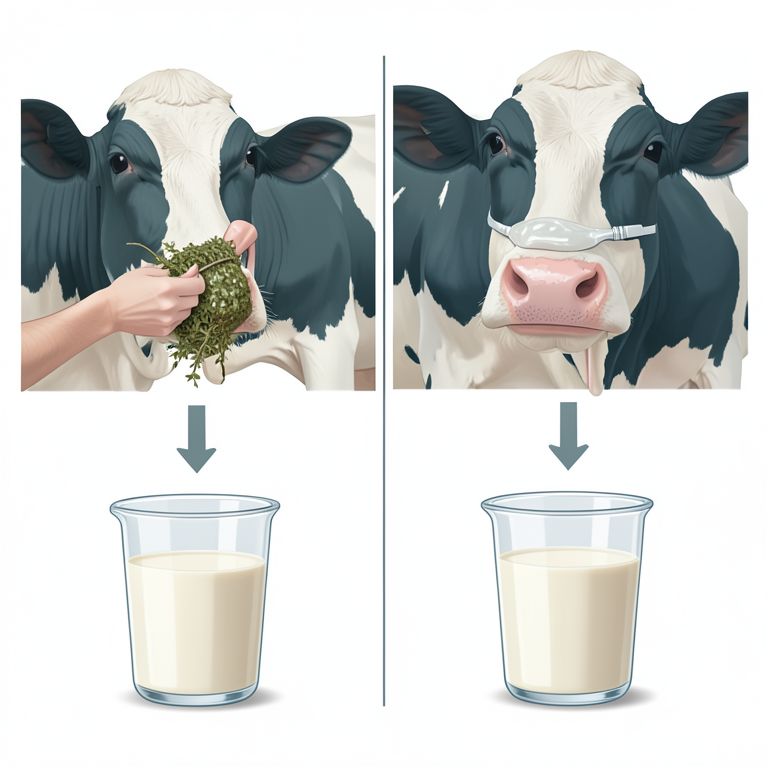
Study overview
AI-generated conceptual illustration (crossbred dairy cattle). It explains the idea and does not show study data.
View source evidence ↗Introduction
Milk being a complete balanced nutrition, is one of the most consumed animal origin food for human. In Indian scenario, milch animal rearing has been one of the common livelihood for small and marginal livestock farmers. Among the various infectious diseases, mastitis is one of the most important diseases that not only affects the health and production of the milch animals but also affects the economy of the livestock farmer in general. Mastitis in general is being treated with various antimicrobials which lead to the presence of their residues in raw milk and in its products too that cause a serious threat to the human health. Misuse of antibiotics both in humans and animals leading to antimicrobial resistance, thus tackling AMR as a global priority (Zhang et al., 2022) [18] . Several antimicrobial residues were identified in bovine milk samples even after the withdrawal period of drugs (Natalia et al., 2024) [14] . In this scenario, ethnoveterinary products plays a major role not only in treating the diseases of livestock with herbal therapeutic agents but also combating the presence of antibiotic residues in their products. The present study was carried out to assess the presence of antimicrobial residues in mastitis affected cattle milk samples that were treated with ethnoveterinary product, Herbolact.
Materials and Methods:
The pilot study on the presence of antimicrobial residues in the raw milk of the mastitis cattle treated with ethnoveterinary product was carried out in farmerowned crossbred cattle of Warangal, Mahaboobnagar and Jagityal districts of Telangana State. A total of 10 crossbred cattle with clinical mastitis were selected for the present investigation. Milk samples from the affected quarter were collected in sterile vials to identify the specific etiology. Depending on the severity of the condition, the ethnoveterinary product Herbolact @ 20 g was applied topically on the affected udder thrice daily for 3 -7 days. The product was thoroughly mixed with lukewarm water (100 ml) and applied all over the affected quarters and healthy quarters with gentle massage.
Before each application, milk was completely stripped out and the udder was cleaned and dried. Milk from all the affected quarters was collected on day 5, 10 and 15 and were subjected for detection of the presence of antimicrobial residues using lateral flow assay kit, TriTest BTS Test Kit (β-Lactams& Tetracyclines & Sulfonamides) supplied by M/S Ring Biotechnology Co., Ltd., China. However, milk from mastitis cattle that were treated with beta lactams and tetracyclines were also evaluated to establish comparison.
Results and Discussion
A total of 10 crossbred adult cattle with signs of clinical mastitis of 18 affected quarters were identified for the present investigation. All these affected animals were presented with swollen hot and painful udder that has engorged teats, flaky/watery milk with clots. The dairy cattle globally are affected with the most common clinical entity, the mastitis that is caused by a variety of infectious pathogens resulting in either clinical or subclinical forms. While affecting the quality and quantity of the milk in the affected animal resulting a huge economic loss to the farmer, mastitis has been considered as one of the most important infectious diseases that affects the livelihood of middle and small-scale livestock farmers (Mushtaq et al., 2018) [12] . The clinical form of mastitis is characterised by certain significant signs such as, hard and swollen udder and teats with the presence of clots that even affect the quality and quantity of the milk (Kholif et al., 2017) [8] . Mastitis in severe cases and forms not only cause huge economic loss to the farmer, but may also cause death of the affected cattle. In the present study, the common bacteria that were isolated from the milk samples were Staphylococcus sps and E.coli (Krishnamoorthy et al., 2021) [9] . Apart from CMT, somatic cell count, milk pH and detection of pathogenic bacteria in the milk samples, mastitis has been diagnosed by a recently developed Immuno Chromatographic Strip coated with anti-ribosomal protein L7/L12 for detecting staphylococcus aureus associated bovine mastitis (Nagasawa et al., 2020) [13] . Some of the common bacteria like Streptococcus sp., and Staphylococcus aureus that was normally seen on the skin are common pathogens apart from other environmental microorganisms like E.coli and other coliforms. Mastitis always exists a positive correlation between high milk yield and its occurrence (Cheng and Han 2020) [6] . Mastitis is predominantly a bacterial disease of the mammary gland of high-yielders (Sharun et al., 2021) [17] . Antibiotics are often used or misused in the dairy sector for therapeutic and prophylactic purposes (Manyi-Loh et al., 2018) [11] . Antibiotics are also eliminated in the milk till 7 days post-treatment. However, there is an absence of compliance to milk withdrawal periods following antibiotic administration, which leads to antibiotic residues in milk. Hence, improper use of antibiotic therapy in milch animals poses a threat to the public, especially if milk is consumed unpasteurized (Anika et al., 2019; Kumar et al., 2021) [1,10] . Following treatment with the ethnoveterinary product, improvement in the signs along with absence of abnormalities in the milk was noticed in all the affected quarters by day 5-7. Further, none of the milk samples on days 5, 10 and 15 revealed positive for the presence of antimicrobial residues in the milk by Tritest BTS test kit. However, the milk samples from the animals treated with beta lactams and tetracyclines revealed positive reaction for the antimicrobial residues on day 5 and 10 but negative on day 15. Antimicrobials remain the mainstay of mastitis treatment in bovines, that raised a concern for human consumers due to the presence of antimicrobial residues in the milk even after recovery. Thus, the role of alternative medicine is emerging and most of the diseases including the mastitis is now being treated with various herbal drugs. The modern ethnoveterinary practices has been used by rural people traditionally. This alternate medicine involves the utilisation of whole plant or its components as medicine that has antibacterial, antifungal and antioxidant properties and thus help in preventing or curing the disease (Bakare et al., 2020) [3] . The present ethnoveterinary medicine, Herbolact contains aloe vera, curcuma longa and calcium hydroxide acts synergistically and provides an effective cure in clinical mastitis owing to its wide spectrum of antimicrobial, antioxidant, anti-inflammatory and immunomodulator affects, that are similar which can be attained by use of an antimicrobial. The herbal ingredients, aloe vera, curcuma longa and calcium hydroxide improve the status of metabolism, reduces the inflammation and microbial load, cleanse the toxins of various parts of the body including udder and lactiferous tissue and pacify the aggravated pitta dosha and raktha doosha (Charaka Samhitha, 1992) [5] . Following topical application of the herbolact for 5-7 days, all the affected milk samples were found negative for culture with no recurrence till 6 months. Antimicrobial residues are of most important concern in different products like meat and milk particularly from mastitis-treated cows, resulting in antibiotic resistance a most significant public health risks. Following prescribed milk withdrawal periods the farmers can prevent having these residues in milk. However, as it affects the economic status of particularly small-scale livestock farmers, these residues that are pharmacologically active substances are seen in milk. Poor hygiene and management on farms, coupled with a lack of farmer education on proper antibiotic use and withdrawal, contribute to the prevalence of these residues in the milk supply. The best ways to avoid consuming this contaminated milk are to discard the milk until the recommended withdrawal period and to minimize the use of antibiotics. The primary reason for its presence in milk is incorrect antibiotic use for treating diseases, especially mastitis (Sachi et al., 2019) [15] . Milk from mastitis treated cattle often contains residues of antimicrobials following their administration through different routes. As per the European Commission, antibiotic residues are "pharmacologically active substances and their metabolites which remain in foodstuffs obtained from animals to which the veterinary medicinal products have been administered." There is a milk withdrawal period that extends to 7 days following antibiotic therapy. Tetracyslines, Beta lactams and fluoroquinolones are the most common antibiotic residues detected in certain states of India (Sahoo et al., 2023) [16] . From the available literature, Staphylococcus spp. emerged as the most prevalent mastitis-causing bacteria, accounting for 45% of cases in India. Moreover, vide variety of antimicrobials including that of penicillin, streptomycin, erythromycin, tetracycline and ampicillin developed resistance against S. aureus in mastitis cattle. Studies also shown S. aureus isolates that were resistant to various β-lactams like penicillin, amoxicillin, and methicillin, as well as oxytetracycline (Chandrasekaran et al., 2015; Hamid et al., 2017) [4,7] . In a similar study, the resistance pattern of S. aureus to ampicillin, methicillin, oxacillin, ceftriaxone, rifampicin, vancomycin, amoxiclav, oxytetracycline, erythromycin, nitrofurantoin, cefuroxime, gentamicin, norfloxacin, ciprofloxacin, and levofloxacin was observed in milk of cows and buffaloes (Baghel et al., 2018) [2] .
Conclusion
The ethno-veterinary practice is one of the most sustainable alternative medical practices that incorporate traditional beliefs to scientific knowledge on medicinal plants is a simple, easy and cost effective alternate approach with much less to no side effects. It also provides a promising therapeutic efficacy with minimal side effects, lack of AMR to these phytochemicals, and reduced drug residues in animal products. From the present study, it may be concluded that the antibiotic residues are present in raw milk that were treated with the antimicrobials, but with no residues among the milk samples that were treated with ethnoveterinary compound, Herbolact. Hence, the pilot study puts on record about its therapeutic efficacy including anti-inflammatory and antibacterial properties of the herbolact, along with no antimicrobial residues in the milk of the affected cattle both during and after treatment. However, further studies involving a larger sample are warranted.
References
18 in the original paper- Anika TT, Al Noman Z, Ferdous MR, Hasan Khan S, Mukta MA, Shakil Islam M, et al. Time dependent screening of antibiotic residues in milk of antibiotics treated cows. J Adv Vet Anim Res. 2019;6(4):516-20. doi:10.5455/javar.2019.f376
- Baghel A, Chabbra D, Sharda Shukla S, Audarya S, Sikrodia R, et al. Isolation of Staphylococcus from bovine mastitis and their antibiotic sensitivity pattern. Indian J Vet Sci Biotechnol. 2018;13(4):49-52. doi:10.21887/ijvsbt.v13i4.11558
- Bakare AG, Shah S, Bautista-Jimenez V, Bhat JA, Dayal SR, Madzimure J. Potential of ethnoveterinary medicine in animal health care practices in the South Pacific Island countries: a review. Trop Anim Health Prod. 2020;52(5):2193-203.
- Chandrasekaran D, Nambil AP, Thirunavukkarasu PS, Venkatesan P, Tirumurugaan KG, Vairamuthu S. Incidence of resistant mastitis in dairy cows in Tamil Nadu, India. J Appl Nat Sci. 2015;7(1):304-8. doi:10.31018/jans.v7i1.606
- Charaka Samhitha of Agnivesha. Revised by Charaka and Drudabala with Ayurveda Dipika commentary of Chakradatta, edited by Vaidya Jadavji Trikamji Acharya. 5th ed. Delhi: Munshiram Manoharlal Publishers Pvt Ltd; 1992.
- Cheng WN, Han SG. Bovine mastitis: risk factors, therapeutic strategies, and alternative treatments-a review. Asian-Australas J Anim Sci. 2020;33(11):1699713. doi:10.5713/ajas.20.0156
- Hamid S, Bhat MA, Mir IA, Taku A, Badroo GA, Nazki S, et al. Phenotypic and genotypic characterization of methicillin-resistant Staphylococcus aureus from bovine mastitis. Vet World. 2017;10(3):363-7. doi:10.14202/vetworld.2017.363-367
- Kholif AE, Matloup OH, Morsy TA, Abdo MM, Abu Elella AA, Anele UY, et al. Rosemary and lemongrass herbs as phytogenic feed additives to improve efficient feed utilization, manipulate rumen fermentation and elevate milk production of Damascus goats. Livest Sci. 2017;204:39-46.
- Krishnamoorthy P, Goudar AL, Suresh KP, Roy P. Global and countrywide prevalence of subclinical and clinical mastitis in dairy cattle and buffaloes by systematic review and meta-analysis. Res Vet Sci. 2021;136:561-86. doi:10.1016/j.rvsc.2021.04.021
- Kumar N, Sharma G, Leahy E, Shome BR, Bandyopadhyay S, Deka RP, et al. Understanding antibiotic usage on small-scale dairy farms in the Indian states of Assam and Haryana using a mixed-methods approach-outcomes and challenges. Antibiotics (Basel). 2021;10(9):1124. doi:10.3390/antibiotics10091124
- Manyi-Loh C, Mamphweli S, Meyer E, Okoh A. Antibiotic use in agriculture and its consequential resistance in environmental sources: potential public health implications. Molecules. 2018;23(4):795. doi:10.3390/molecules23040795
- Mushtaq S, Shah AM, Shah A, Lone SA, Hussain A, Hassan QP, et al. Bovine mastitis: An appraisal of its alternative herbal cure. Microb Pathog. 2018;114:35761.
- Nagasawa Y, Kiku Y, Sugawara K, Yabusaki N, Oono K, Fujii K. Rapid Staphylococcus aureus detection from clinical mastitis milk by colloidal gold nanoparticlebased immunochromatographic strips. Front Vet Sci. 2020;6:1-12.
- Climova N, Nejeschlebová H, Hasoňová L, Hanuš O, Čítek J, Reindl K, et al. The presence of antibiotic residues in raw milk samples obtained after the withdrawal period and other quality parameters in relation to selected factors. Food Control. 2024;164:110374. doi:10.1016/j.foodcont.2024.110374
- Sachi S, Ferdous J, Sikder MH, Hussani SA. Antibiotic residues in milk: past, present, and future. J Adv Vet Anim Res. 2019;6(3):315. doi:10.5455/javar.2019.f350
- Sahoo S, Behara MR, Mishra B, Sahoo P, Kar S. Antibiotic-resistant bacteria in bovine milk in India. J Adv Vet Anim Res. 2023;10(1):21-9. doi:10.5455/javar.2023.j648
- Sharun K, Dhama K, Tiwari R, Gugjoo MB, Yatoo MI, Patel SK, et al. Advances in therapeutic and managemental approaches of bovine mastitis: a comprehensive review. Vet Q. 2021;41(1):107-36. doi:10.1080/01652176.2021.1882713
- Zhang T, Sukolrath B, Niu G. Association of mastitis and farm management with contamination of antibiotics in bulk tank milk in Southwest China. Animals (Basel). 2022;12(23):3392. doi:10.3390/ani12233392