
Research article · 2025 · Full text
International Journal of Agriculture and Food ScienceDesign and Performance Evaluation of Coconut Milk Extractor for Cleaner Production
Volume 7(9) · Pages 377–384 · DOI: 10.33545/2664844x.2025.v7.i9e.768 ↗
Research areasCoconut Research and Applications
Abstract
Author-writtenThe study aimed to evaluate the performance of coconut milk extractor to determine its capacity and efficiency in extracting coconut milk from grated coconut meat. The extractor is geared towards sustainable production of coconut milk, maximizing extraction to reduce waste compared to the screw press currently used in the city. The extractor with Intellectual Property Office Philippines Utility Model registration no. 2-2016000363 was fabricated using stainless-steel materials on parts with direct contact with the food, and the rest were painted mild-steel materials using 3- ton hydraulic jack. Mature coconut fruits were selected, cut, grated, and packed with nylon net. Capacity and efficiency were evaluated based on 2 kg grated coconut meat load per press. The findings revealed that the design had a capacity of 50.78 kg/h with 2.30 minutes average pressing time, producing 1.08 kg of coconut milk, with 54% extraction efficiency. The screw press produced 21.65 kg/h capacity in 5.5 minutes of pressing time, producing 1.09 kg coconut milk with 54.50% extraction efficiency. There was a significant difference in extraction capacity and no significant difference in extraction efficiency at 1% level of significance. The extractor production cost amounted to Php14, 599.00 per unit can be recovered in 72 days, operating at four (4) hours per day, charging Php 1.00/kg pressing load. It is recommended to conduct further improvements on the design to suit the needs of the coconut milk producers, and Virgin Coconut Oil processors.
Summary
Source-checkedPlain-language reading of the full paper, prepared with AI and checked against the text. Each point links to the authors' own words.
Why it matters
- Existing local screw presses may contribute to milk contamination because the machine and collection bucket are positioned below the operator. View evidence ↗
The question
- The study aimed to evaluate the capacity and efficiency of a newly designed coconut milk extractor. View evidence ↗
- The research specifically sought to compare the new extractor's capacity and efficiency against existing market screw presses and determine the unit's production cost. View evidence ↗
What they did
- The extractor was built using a 3-ton hydraulic jack, with stainless steel used for all food-contact parts and painted mild steel for the remaining structure. View evidence ↗
- A Completely Randomized Design (CRD) was used, and results were analyzed using ANOVA and t-tests at 95% and 99% confidence levels. View evidence ↗
What they found
- The new extractor achieved a capacity of 50.78 kg/h and an extraction efficiency of 54%, with an average pressing time of 2.30 minutes. View evidence ↗
- The existing screw press had a lower capacity of 21.65 kg/h and a longer pressing time of 5.5 minutes, though it had a slightly higher efficiency of 54.50%. View evidence ↗
- There was a statistically significant difference in extraction capacity between the new extractor and the screw press at a 1% significance level. View evidence ↗
- No significant difference was found in extraction efficiency between the new design and the existing screw press. View evidence ↗
What it means
- The authors conclude that the extractor significantly increases labor productivity, increasing a worker's hourly output capacity by 134.54% compared to the screw press. View evidence ↗
- The authors recommend further design improvements to better meet the specific needs of coconut milk and Virgin Coconut Oil (VCO) processors. View evidence ↗
Figures & tables
From the original paper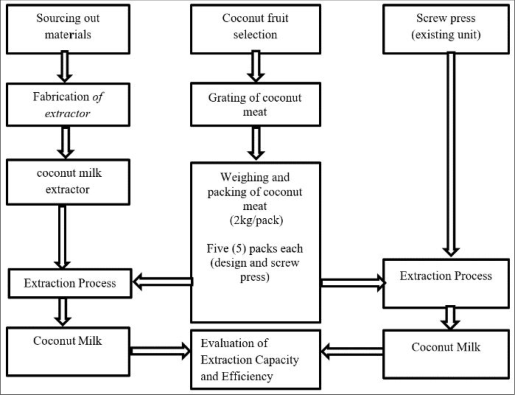 Figure 2
 Figure 1
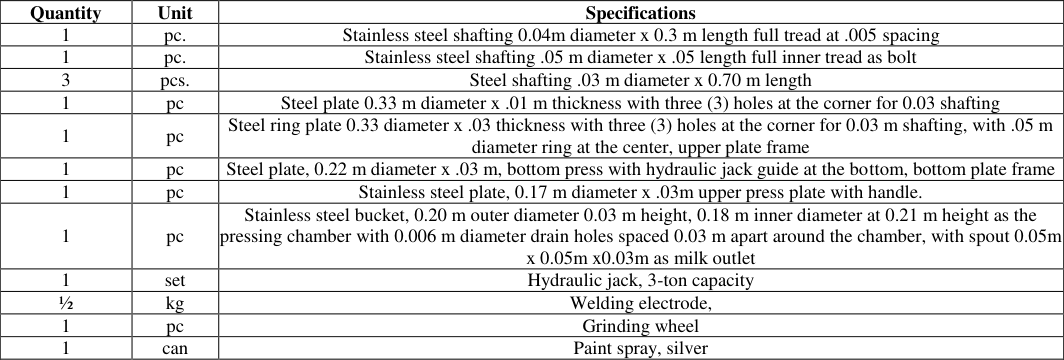 Table 1
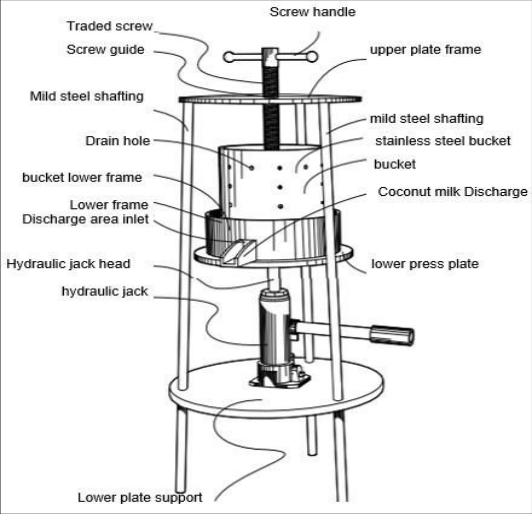 Figure 3
 Table 2
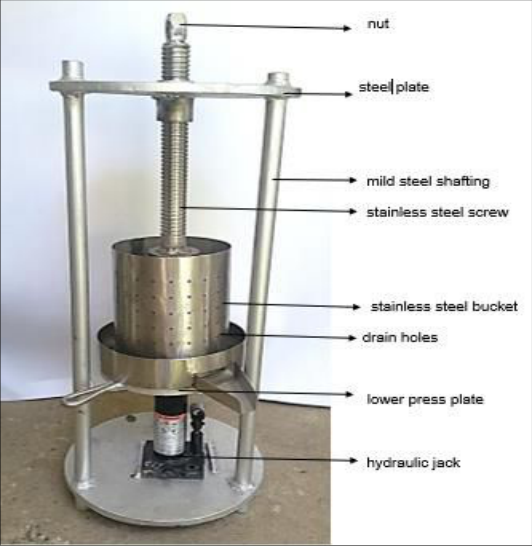 Figure 4
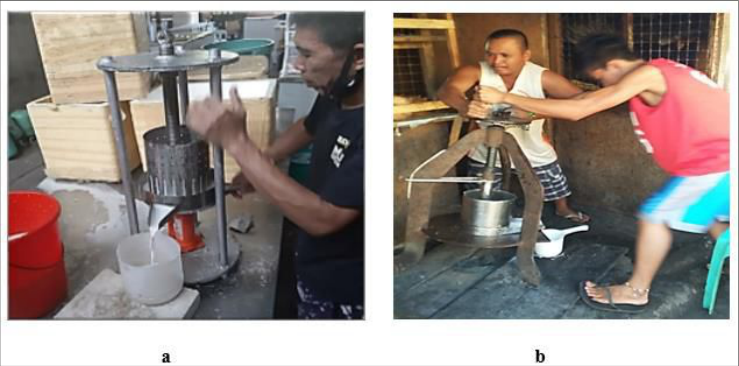 Figure 5
 Table 3
 Table 5
 Table 4
Introduction
The coconut tree, also known as the "tree of life," is one of the major crops in the Philippines. The fruit generally consist of 51.7% kernel, 9.8% water and 38.5% shell [1] . In 2013, it marked its significance to the country's economy with export sales gross of PhP77.4 billion behind rice, banana, and corn as top earners. It is estimated to grow in 3.56 million hectares of agricultural land, where 3 million farmers are primarily engaged in coconut production as a primary livelihood and source of income [2][3] . Senate Bill 1233 and House Bill 5745 which are the consolidated bills creating the Coconut Farmers and Industry Trust Fund and strengthening the Philippine Coconut Authority(PCA) was vetoed [4][5][6] . These bills were created to address the stagnant growth of the coconut industry, anchored to aid programs for the purpose improving the farm production and farmers' economic return. Given the coconut industry's current situation and the twin bills' veto, the government must address other emerging needs affecting coconut farmers [7] . Coconut's main products such as "copra" and coconut oil have been greatly affected by world price fluctuations primarily due to competitors like palm oil, soybean, and corn oil [8-9]. Coconut farms affected by typhoon require at least a year to recover fully. Production quality even comes to a lower end due to nutritional deficiencies [10] . More problems are evident in diminishing coconut plant farm density due to the demand for coco-lumber products used as scaffoldings and forms in building construction which also results in declining fruit production [11] . Limited funds for research endeavors, postharvest technologies adaptation, and poor farm road conditions also contribute to the existing problems [12] . Coconut farmers in the Philippines have been crying out for copra prices, which continued to plunge, affecting their livelihood. The market price of copra dropped to almost 30% in three years, from Php36.44 in 2017, to Php31.94 in 2018, and a sharp decline to Php12.17 per kilogram in February 2019.
In 2023, at least 500,000 farmers affected by the slump in prices of copra ranged between P21 and P24 per kilo [13] . Records shows that a certain time, price jump high and then suddenly drop without notice [14] . Clearly, the government has no control over the fluctuating copra price as it is dictated by the global oil market dominated by palm oil and soybean oil, with a share of 35% and 26%, respectively. It is estimated that 1.83 million people, or nearly half of the region's 4.4 million population, dependent on coconut production, are affected [15][16] . Coconut milk is now used as a coffee creamer in other countries [17] . It is best as a milk substitute in food for persons who are lactose-intolerant and have a prevalence of hypercholesterolemia [18][19][20] . Various coconut products such as coconut milk, coconut powder, desiccated coconut, are now sold in the United States [21][22] . Locally, the production of coconut milk is also gaining ground in public market business. Many food vendors adopt buying ready-to-use extracted coconut milk rather than buying coconut or grated coconut meat, considering the time of preparation from breaking, grating, and hand and cloth utilization for manual extraction of coconut milk, which contribute to microbial contamination [23] . Current extraction of coconut milk from grated coconut is currently done by a screw press in the locality. Farmers turn the screw clockwise with this lever, pushing the materials downward and creating a force against the lower press plate [24][25] . With the present setup, the foundation of the mechanical press is bolted onto the flooring of the establishment to counter the screw turning up to a pressure the operator can sustain by force. The setup requires the machine and bucket containing the material below the operator, which could be a factor in milk contamination. The Coconut milk extractor, with utility model registration no. 2-2016000363 [26] , have been developed and adopted/utilized by ten (10) coconut farmers' association from Region VI. The innovation address problems on mobility, making it transferrable to any location anytime, to make it more convenient for the operator since the machine can just be placed on top of the table. Barangay market day "tabo" is still observed in Negros Island, hence transportation and utilization are projected to increase. Improvements have been made in the second prototype to address the bending of angle bars as frame support by incorporating upper support with ring plate and solid shafting underneath the lower press frame. Coconut farmers association who are producing virgin coconut oil (VCO), a vegetable oil extracted from coconut milk [27] . VCO is a new, highly value-added version of coconut oil in health food markets [28][29] . VCO producers shift on coconut milk extraction from traditional method to mechanical process are the silent beneficiaries of the utility model. The frame used solid shafting to address the bending of base support as observed and based on the feedback from coconut processors' collaborators of the original design. Other improvement for the extractor includes utilizing stainless-steel materials for all parts in direct contact with coconut meat. To ensure the hygiene of the milk extracted and to scrupulously clean it after every extraction. With the innovation, the performance of the design, will be evaluated based on its capacity and efficiency in extracting coconut milk from grated coconut meat [30] . The study aimed to design, fabricate, and evaluate the performance of coconut milk extractors. Specifically, the study aimed to determine the following: The specifications of the coconut milk extractor; the extraction capacity and extraction efficiency compared to the existing screw press, to determine if there is a significant difference in extraction capacity and efficiency between the extractor and screw press coconut milk extraction presently utilized in the market, and the cost of production for one-unit coconut milk extractor.
Materials and Methods
Coconut Milk Extractor: Using stainless steel materials with direct contact with coconut meat, which include the screw, upper press plate, and bucket, was used for the performance evaluation of the improved coconut milk extractor on its performance, based on capacity and efficiency using 2 kg/load grated coconut meat. The coconut milk extractor utilized in the study with stainless-steel materials used on parts with direct contact with the food, and other parts such as the frame, were painted with mild-steel materials using three (3) tones hydraulic jack. Figure 3 shows the isometric view of the UM on coconut milk extraction.
Coconut Milk Extraction Evaluation Flowchart
Coconut Milk Extraction Evaluation Flowchart
Materials for Fabrication of One Unit Coconut Milk
Extractor: The materials used to fabricate a one-unit mechanical coconut milk extractor are shown in Table 1. Some of these materials formed the frame and were welded, while the stainless bucket was fabricated based on specifications. The hydraulic jack formed part of the system.
Fig 3: Isometric view of the coconut milk extractor
Fig 3: Isometric view of the coconut milk extractor
Fabrication of Coconut Milk Extractor
The fabrication of the frame, bucket, and screw of the mechanical coconut milk extractor was done using the materials seen in Table 1. From the given design, the height of the hydraulic jack, bucket, and screw was the determining factor of the frame height. After welding the 3 shafting's to the steel plates to form the frame, all welding points and edges were ground to smoothen the surface, and the design project was finally painted. The stainless bucket was preordered from stainless steel shop fabricator with the given specifications considering their workforce expertise. The stainless-steel screw and nut were treaded in a machine shop following the square thread requirements at five threads per inch at ¼ deep for higher compression strength. The screw nut has been welded on the central part of the upper plate frame, and three (3") diameter stainless steel plate was welded at the bottom end of the screw. One-inch stainless steel nut has also been welded at the upper end of the screw that was used as a turning mechanism.
Coconut Fruit Selection, Grating, and Weighing
Fifty pieces of mature coconut fruits were selected, dehusked, and cut in half; inspection was done as to the meat's color, smell, and firmness in texture without any discoloration as a sign of damage. The fruits were grated using a mechanical grater, and the meat was mixed thoroughly to have an even mixture. Out of the grated meat, 10 packs were prepared, each weighing 2 kg that was used in the milk extraction, five (5) packs were used for the design of mechanical coconut milk extraction, and another five (5) packs for the screw press currently used in the public market.
Coconut Milk Extractor Operation
The performance evaluation of the improved coconut milk extractor for coconut milk extraction used 2kg /load of grated coconut meat using 5 samples. Data were gathered to determine its capacity and efficiency. The 2kg grated coconut meat was placed inside a net bag and the stainlesssteel bucket, and on top of it, the stainless steel upper pressing plate was placed. The hydraulic jack was inserted on the bottom of the frame using the guide to secure that it was positioned at the central part of the pressing frame. On top of the jack, the bottom press plate was placed, and the bucket was positioned on top of it. The pressing screw was adjusted, turning it clockwise until its bottom reached the bucket's upper press plate, providing the initial pressure to firm the assembly. The hydraulic jack was secured by turning the lock clockwise, and the lever was operated by pushing it up and down to move the piston upward, pressing the coconut meat inside the bucket cylinder, extracting the coconut milk going to the downspout of the bucket until no more milk came out. The coconut milk was collected using a plastic bucket and weighed. The materials were removed by unlocking the hydraulic jack, pushing the bucket downward, and turning the screw counterclockwise until its lower end was free from the top of the bucket. The bucket was removed from the assembly, as the upper press plate and the nylon net containing the grated coconut meat.
For maximum extraction of milk, a second pressing was done, placing the extracted meat upside down in the bucket, and the operation of the design was repeated for loading and unloading.
Screw Press Extractor Operation
The screw press extractor in the market used five (5) samples to gather data on coconut milk extracted per 2kg grated coconut meat to determine its capacity and efficiency. The 2 kg grated coconut meat was placed inside a net bag and the stainless-steel bucket, and on top of it, the stainless steel upper pressing plate was placed. The pressing screw was turned clockwise, moving the screw downward, pushing the upper press plate downward against the bottom plate, extracting the coconut milk. The milk was collected using a plastic bucket, weighted, and recorded for the first pressing. Pressing was unlocked by turning the screw counterclockwise, moving the screw upward until its lower end was above the top of the bucket, and the bucket was removed from the assembly. The net containing the grated coconut meat was removed from the bucket, placed upside down for the second pressing, and positioned again at the bottom plate. The screw was turned clockwise, and the milk for the second pressing was collected.
Performance Evaluation
The improved coconut milk extractor and the existing screw press were evaluated using the extraction capacity and efficiency of the machine to extract coconut milk as output in the process. Two-kilogram grated coconut meat was utilized as input, and time elapsed in the extraction process was recorded. The extracted coconut milk for the first and second pressing was used as output. For the calculation of Extraction Capacity and Efficiency, the formula below was used.
Extraction Capacity
The capacity(kg/h) of the improved coconut milk extractor and the existing screw press was done in an actual setting in the public market. The capacity was computed using the amount of grated coconut meat (2 kg) as input per load and the elapsed time (h) in the first and second extraction, according to equation (1).
Extraction Efficiency
The extraction efficiency (%) was computed with the total amount of coconut milk extracted (kg) in the first and second pressing as output and the amount of grated coconut meat used (2 kg /load) as input, according to equation ( 2)
Experimental design
The experiment followed a Completely Randomized Design (CRD), with each extraction methods having 5 samples.
After completing the experimental procedure, a statistical analysis was performed to evaluate the result including percentage mean, analysis of variance (ANOVA) and comprising of means using t-test for two independent samples at 95% confidence level (p < 0.05) and further tested at 99% confidence level (p < 0.01).
Results and Discussion
This section presents the coconut milk extraction as the output of this study; it includes the capacity and efficiency of the improved coconut milk extractor and the existing screw press presently used in the market, the significant difference in extraction capacity and efficiency between the design and screw press, and the cost of production for oneunit coconut milk extractor.
Design Specifications of the Coconut Milk Extractor
The actual picture of the improved coconut milk extractor is shown in Figure 4. All materials with direct contact with the grated coconut meat and milk, including the screw, were made of stainless steel, and other materials were coated with paint as a requirement for food grade products. The height of the machine was 0.71 m, the frame diameter at 0.33 m, and a gross weight of 35 kg with a 3-ton hydraulic jack. The major components of the improved coconut milk extractor included the bucket, frame, screw press, upper and lower press plates, and hydraulic jack.
The bucket was made of stainless steel with a maximum grated coconut meat capacity of 3 kg, provided with drain holes spaced 1 inch apart to facilitate drainage for milk extracted from the meat. It comprised an outer collection layer to hold the milk and drain it to the spout. The frame comprised one ring plate and one round plate connected at the top and bottom with 1-inch diameter mild steel shafting. The upper plate supported the nut of the screw press located at the central part of the plate, and the lower plate served as a platform for the hydraulic jack.
The screw press, 12 inches long, was made of stainless steel 1 ½ inch shafting, full square trade at five (5) grooves per inch. One-inch stainless steel nut was attached at the upper end and used as a turning mechanism and adjustment where the other end was welded to 3-inch diameter stainless round plate, which was in contact with the upper press plate in the bucket. The upper press plate, made of stainless steel, was smaller than the inner diameter of the bucket. The plate held the grated coconut meat inside the bucket and was supported by the round plate at the end of the screw. The lower press plate was made of ordinary steel; its diameter was equal to the outer diameter of the bucket. It was located directly above the hydraulic jack; it pushed the bucket upward as the hydraulic jack was operated to press the coconut meat inside the bucket. The hydraulic jack, 3ton capacity, was positioned at the bottom plate of the frame, centrally located to push the lower press plate upward from its center. The pressing capacity and efficiency of the design were dependent on the power of this mechanism. 2 shows the extraction capacity and efficiency of the coconut milk extractor (figure 5). The extraction efficiency was 54% by weight. On average, 2 kg grated coconut meat used as input load yielded 1.08 kg of pure coconut milk. This extraction efficiency was 4.97%, higher than the extraction efficiency of a machine designed and developed for coconut milk extraction with nozzle clearance of 2 mm with a rotational speed of 40 rpm, which yielded about 49.03% coconut milk [31] . Maximizing milk extraction from grated coconut meat increases yield and productivity. Based on manual extraction as practiced by one VCO producer in Negros
Occidental, extracted coconut meat, when subjected to further extraction using the design, resulted in 110 ml additional coconut milk. This extracted milk contributes at least 10% more coconut milk. According to the stall owner of coconut milk during regular days, on average, his coconut milk stall in the public market utilized 200 coconut fruit equivalents to 100 kg of coconut meat, about 50 loads at 2kg /load in the extractor. Using the coconut milk extractor, it generates 5,500 ml more milk and additional possible income amounting to Php 440.00, using the prevailing market price of Php 20.00/250ml coconut milk.
Extraction Efficiency of the Existing Screw Press
Table 3 shows the extraction capacity and efficiency of the existing screw press (figure 6). The capacity of the existing screw press utilized in the public market was 21.65 kg/h or a total of 173.20 kg grated coconut meat/day for an 8-hour operation equivalent to 347 nuts. The efficiency of the existing screw press utilized in the market was 54.50% by volume. On average, for 2 kg grated coconut meat used as input yielded to 1.09 kg of pure coconut milk. This extraction efficiency was 0.50% higher than the design, amounting to 10 grams of coconut milk per load, resulting in a longer time of extraction contributing to a higher amount of coconut milk. At 54.50% efficiency, the screw press could also maximize the extraction of coconut milk from grated coconut meat, which could also protect the environment through the reduction of waste and air pollution.
| Trial | Input (kg) | Existing Screw Press | — | — | — |
|---|---|---|---|---|---|
| Milk extracted (kg) | Time of extraction (s) | Capacity (Kg/h) | Efficiency (%) | ||
| 1 | 2.00 | 1.08 | 318.00 | 22.64 | 53.75 |
| 2 | 2.00 | 1.05 | 338.00 | 21.30 | 52.50 |
| 3 | 2.00 | 1.12 | 331.00 | 21.75 | 56.25 |
| 4 | 2.00 | 1.10 | 353.00 | 20.39 | 55.00 |
| 5 | 2.00 | 1.10 | 323.00 | 22.29 | 55.00 |
| total | 10.00 | 5.45 | 1,663.00 | 21.65 | 54.50 |
| Ave | 2.00 | 1.09 | 332.60 | 21.65 | 54.50 |
Table text extracted from the original PDF; superscript letters are shown inline. The original table image is below.
View original table image
Significant Difference in Extraction Capacity and Efficiency between the Improved Coconut Milk Extractor and Screw Press on Coconut Milk Extraction
Table 4 shows the significant difference in extraction capacity with two independent samples using a t-test. In addition, Table 5 shows the significant difference in extraction efficiency with two independent samples using a t-test. There was a significant difference in coconut milk extraction capacity between the improved coconut milk extractor and the screw press utilized in the market. The computed t value was 5.20, greater than the t value at 3.35 at a 1 % level of significance (Table 4). This only means that the capacity of the design, which was 50.77 kg/h, was significantly higher than the screw press at 21.64 kg/h; an increase of 29.13 kg/h in capacity was significant. Maximizing the capacity of one labor force is a significant factor in reducing labor costs and attaining maximum productivity by utilizing the design of coconut milk extraction. The design increases the coconut milk extraction capacity to 235% compared to the screw press utilized in the market. The coconut milk extractor increases the operator's productivity, saving time that can be spent on other productive work. However, there was no significant difference in extraction efficiency between the design and the screw press. The computed t value at 0.51 was lesser than the t value at 2.30 (Table 5). This proves that the design extraction efficiency, which was 54%, lower than the screw press efficiency at 54.50%, was not significant and that the extraction efficiency of the design was comparable with the screw press presently utilized in the market.
Cost of Production for One-unit Mechanical Coconut Milk Extractor
The improved coconut milk extractor's cost of production for one unit amounted to Php. 14,599.00 (Appendix A). The reduced cost was based on the utilization of stainless steel materials for items with direct contact with the materials, such as buckets, upper press plates, screw plates, and nuts only; other parts, especially the frame, an ordinary steel plate used and covered with paint to comply to requirements of Food and Drug Authority (FDA). The cost of production can be recovered within 72 days, at 4 hours of operation, by
Figures and tables from the paper
| Trial | Input (kg) | coconut milk extractor | — | — | — |
|---|---|---|---|---|---|
| Milk extracted (kg) | Time of extraction (s) | Capacity (Kg/h) | Efficiency (%) | ||
| 1 | 2.00 | 1.05 | 112.00 | 64.29 | 52.50 |
| 2 | 2.00 | 1.05 | 140.00 | 51.42 | 52.50 |
| 3 | 2.00 | 1.08 | 151.00 | 47.68 | 53.75 |
| 4 | 2.00 | 1.10 | 160.00 | 45.00 | 55.00 |
| 5 | 2.00 | 1.12 | 146.00 | 49.32 | 56.25 |
| total | 10.00 | 5.40 | 709.00 | 50.78 | 54.00 |
| Ave | 2.00 | 1.08 | 141.80 | 50.78 | 54.00 |
Table text extracted from the original PDF; superscript letters are shown inline. The original table image is below.
View original table image
References
29 in the original paper- Patil U, Benjakul S. Coconut milk and coconut oil: their manufacture associated with protein functionality. J Food Sci. 2018 Aug;83(8):2019-27.
- Philippine Statistics Authority. Data on Coconut Production, Yield, and Area Planted [Internet]. 2019.
- Philippine Coconut Authority. Coconut statistics. 2021 [cited 2022]. Available from: https://pca.gov.ph/index.php/resources/coconutstatistics
- House of Representatives. House ratifies coco levy twin bill. 2018 [cited 2022]. Available from: https://business.mb.com.ph/2018/08/25/the-philippinecoconut-industry-in-the-long-term-2/
- Senate of the Philippines. Official statement re: veto of Senate Bill No. 1233/House Bill 5745. 2019. Available from: https://issuanceslibrary.senate.gov.ph/taxonomy/legislat ive%2Bstatus/vetoed%2Bby%2Bthe%2Bpresident%2B of%2Bthe%2Bphilippines
- Castillo MB, Ani PA. The Philippine coconut industry: status, policies and strategic directions for development. FFTC Agric Policy. 2019 Jun.
- Punzalan JK, Rosentrater KA. Copra meal: a review of its production, properties, and prospects. Animals. 2024 Jun 5;14(11):1689.
- Broaddus H. Supply and demand in the coconut oil market (Market Update). CentraFoods [Internet]. 2016.
- Lim JA, Yaacob JS, Mohd Rasli SR, Eyahmalay JE, El Enshasy HA, Zakaria MR. Mitigating the repercussions of climate change on diseases affecting important crop commodities in Southeast Asia, for food security and environmental sustainability-A review. Front Sustain Food Syst. 2023 Jan 16;6:1030540.
- Fathi L, Hasanagić R, Bjelić A, Bahmani M. Performance of coconut wood in timber structures: a review of its properties and applications. IOP Conf Ser Mater Sci Eng. 2023 Dec 1;1298(1):012014.
- Ani PA, Aquino A. The long climb towards achieving the promises of the Tree of Life: A review of the Philippine coconut levy fund policies. FFTC Agric Policy. 2016 Jan 28 [Internet].
- Cariaso B. PCA confirms copra price slump, 500,000 farmers affected. Philippine Star. 2023 Jun 27. Available from: https://www.philstar.com/headlines/2023/06/27/227680
- Mu'min H, Telaumbanua E, Sya'rani R, Basir B, Hasdiansa IW. Building competitive advantage: Copra marketing strategy with SWOT analysis approach. J Econ Entrep Manag Bus Account. 2024 Jan 28;2(1):1628.
- Mendoza TC, Teves MR, Miciano MN. Value chain assessment of coconut-intercropping systems of smallholders in southern Mindanao, Philippines: options for improvement. 2018.
- Philippine News Agency. Copra price. 2019. Copra price drop hurts Region 8 coco-dependent families.
- Okwume UG, Onyeka FN. Effects of natural sweeteners on the nutrient composition and organoleptic attributes of tigernut-coconut drinks. Int J Home Econ Hosp Allied Res. 2023 Nov 21;2(1):10318.
- El-Bialy EF, Abd-Elkader MH, Yousef NS. Non-dairy alternative milk for people with lactose and casein intolerance. J Food Dairy Sci. 2020 Dec 1;11(12):34753.
- Philippine News Agency. Non-traditional products. 2019. Non-traditional products to enhance coconut industry.
- Tulashie SK, Amenakpor J, Atisey S, Odai R, Akpari EE. Production of coconut milk: a sustainable alternative plant-based milk. Case Stud Chem Environ Eng. 2022 Dec 1;6:100206.
- Rethinam P. International scenario of coconut sector. In: The Coconut Palm (Cocos nucifera L.)-Research and Development Perspectives. Singapore: Springer; 2019. p. 21-56.
- Raghavendra SN, Raghavarao KS. Aqueous extraction and enzymatic destabilization of coconut milk emulsions. J Am Oil Chem Soc. 2011 Apr;88(4):481-7.
- Surata IW, Nindhia TG, Budyanto D, Yulianto AE. Design and manufacture a coconut milk squeezer. IOP Conf Ser Mater Sci Eng. 2017 May 1;201(1):012015.
- Atienza AH, Arce JL, Banawa KI, Rabanal MC. Design and performance assessment of a combined grater and milk extraction mechanism for coconut meat. J Phys Conf Ser. 2025 Feb 1;2947(1):012007.
- Castro AJR. Coconut milk extractor. Utility Model No. 2-2016000363. 2016. Available from: https://www.ipophil.gov.ph/services/utility-model/
- Tagle FR. Automatic virgin coconut oil (VCO) extractor. MATEC Web Conf. 2018;192:01045.
- Agarwal RK, Bosco SJ. Extraction processes of virgin coconut oil. MOJ Food Process Technol. 2017 Apr;4(2):00087.
- do Couto MV, da Costa Sousa N, Abe HA, Dias JA, Cordeiro CA, Paixão PE, et al. Benefits of virgin coconut oil in diet to Colossoma macropomum (Cuvier, 1818). Aquac Nutr. 2022;2022(1):4387692.
- Olanrewaju TO, Bello KI, Lawal AO, Jeremiah IM, Onyeanula PE. Development and performance evaluation of a coconut milk extracting machine. 2015.
- Mohan L, Anand T. Design and development of coconut milk extractor. Int J Agric Sci. 2019;11(12):8650-5.
Cited by 1
From OpenAlex, OpenCitations and reference lists read by Scinovex
- Peningkatan Kapasitas Produksi dan Efisiensi Manajemen pada Usaha Rendang Kemasan di Pasaman Barat melalui Modernisasi Peralatan dan Digitalisasi Pencatatan Produksi ↗
Rizki Dwi Setiawan, Indri Juliyarsi, Sri Melia, Surya Aulia H, Ikhlas Pratama Sandy, Chairilisa Azzahra · Jurnal Hilirisasi IPTEKS · 2025
Program pengabdian kemitraan masyarakat membantu usaha berkembang (PKM-MUB) ini bertujuan untuk meningkatkan kapasitas produksi dan efisiensi manajemen pada UMKM Rendang Bu Pit di Pasaman Barat melalui modernisasi peralatan dan digitalisasi pencatatan produksi. Permasalahan utama mitra adalah keterbatasan kapasitas akibat penggunaan peralatan manual serta pencatatan usaha yang masih sederhana, sehingga sulit melakukan evaluasi dan perencanaan usaha. Metode pelaksanaan meliputi perumusan kegiatan…
❝ 0PDF