
Research article · 2025 · Full text
International Journal of Agriculture and Food ScienceDevelopment of Phytohormone-Based Bio inoculants from Beneficial Endophytic Microorganisms
Volume 7(9) · Pages 433–434 · DOI: 10.33545/2664844x.2025.v7.i9f.775 ↗
Research areasAlgal biology and biofuel productionPlant and fungal interactions
Abstract
Author-writtenThe present study investigates the potential of endophytic microorganisms for the production of phytohormones, particularly Indole-3-acetic acid (IAA) and Gibberellic acid (GA3), and their subsequent application as bioinoculants for plant growth promotion. A range of bacterial isolates including Acetobacter diazotrophicus, Azospirillum brasilens, Azoarcus spp, Burkholderia spp, Herbaspirillum spp, and Agrobacterium diazotrophicus were screened for their ability to produce phytohormones. Quantitative estimations of IAA and GA3 were carried out using spectrophotometric assays. Bioformulations were developed based on high-yielding isolates and tested in vitro and in vivo on maize, wheat, and pea seeds. Results demonstrated significant enhancement in seed germination, shoot elongation, and overall growth, indicating the potential of microbial phytohormones as sustainable alternatives to synthetic growth regulators.
Summary
Source-checkedPlain-language reading of the full paper, prepared with AI and checked against the text. Each point links to the authors' own words.
Why it matters
- Endophytic bacteria are beneficial microorganisms that live inside plant tissues without causing disease and support plant growth through various mechanisms, including the production of phytohormones. View evidence ↗
- Indole-3-acetic acid (IAA) and Gibberellic acid (GA3) are key phytohormones that regulate essential plant processes such as root initiation and shoot elongation. View evidence ↗
The question
- The study aimed to identify endophytic microorganisms capable of producing phytohormones and to create bioinoculant formulations for use in pea, wheat, and maize crops. View evidence ↗
What they did
- The researchers screened several bacterial isolates, including Acetobacter diazotrophicus, Azospirillum brasilens, Azoarcus spp, Burkholderia spp, Herbaspirillum spp, and Agrobacterium diazotrophicus, for phytohormone production. View evidence ↗
- Spectrophotometric assays were used to quantitatively estimate the levels of GA3 and IAA produced by the isolates. View evidence ↗
- The study developed various bioformulations, including liquid bioinoculants, compressed cell mass, PGPR-N2 fixing combinations, and endophytic consortia. View evidence ↗
- Bioinoculants were applied to seeds of pea, wheat, and maize at concentrations ranging from 10% to 100%. View evidence ↗
What they found
- Among the tested isolates, Azospirillum Brasilens produced the most IAA at 65.16 µg/ml, while Azoarcus spp and Acetobacter diazotrophicus produced 48.76 µg/ml and 44.87 µg/ml, respectively. View evidence ↗
- Herbaspirillum spp produced the highest concentration of GA3 (32.4 µg/ml), followed by Burkholderia spp (14.88 µg/ml) and Acetobacter diazotrophicus (12.26 µg/ml). View evidence ↗
- In wheat, seed germination was improved using extract concentrations of 0.05-0.1 ml, whereas higher doses had an inhibitory effect on growth. View evidence ↗
- The application of GA3 to maize resulted in a significant increase in shoot length, with treated plants growing up to 12.7 cm more than the control group. View evidence ↗
- Compared to the control, bioinoculant treatments improved both the vigor of seedlings and the rates of seed germination. View evidence ↗
What it means
- The authors conclude that microbial phytohormones could serve as sustainable, eco-friendly alternatives to synthetic hormones and chemical fertilizers. View evidence ↗
- The study highlights that microbial phytohormones have significant potential for application within sustainable crop production systems. View evidence ↗
Visual summary
1 visualsIllustrations explain the paper; they do not show study data.
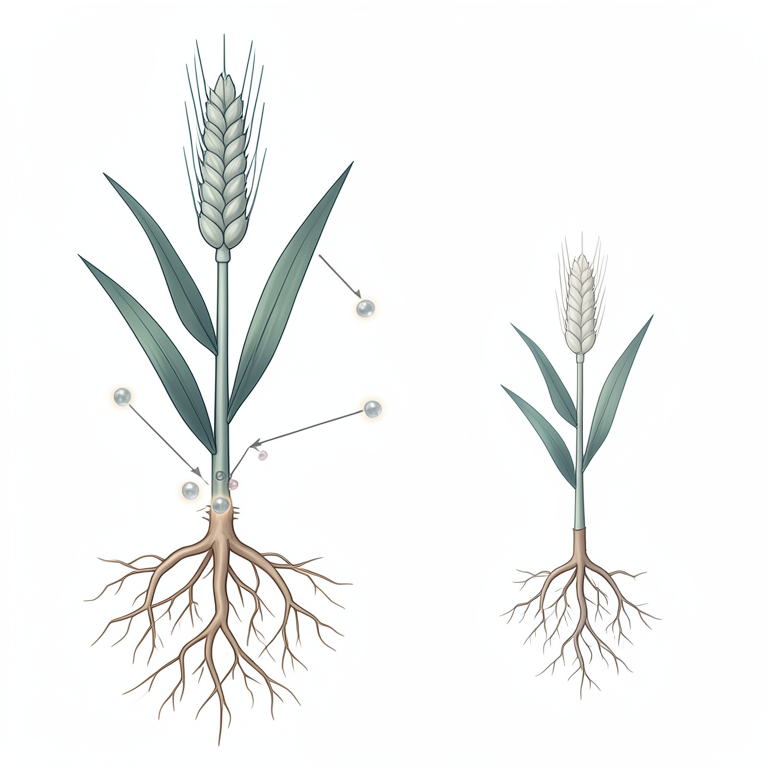
Mechanism of Endophytic Bioinoculants
AI-generated conceptual illustration (wheat plants and endophytic bacteria). It explains the idea and does not show study data.
View source evidence ↗Introduction
Plant growth-promoting rhizobacteria (PGPR) and endophytic microorganisms have emerged as promising tools in sustainable agriculture. Endophytic bacteria colonize internal plant tissues without causing disease and facilitate growth by producing phytohormones, nitrogen fixation, nutrient solubilization, and pathogen suppression. Among phytohormones, Indole-3- acetic acid (IAA) and Gibberellic acid (GA3) play critical roles in root initiation, cell elongation, vascular differentiation, and shoot elongation. The objective of this study was to isolate and characterize endophytic microorganisms with phytohormone-producing potential and to develop bioinoculant formulations for application in maize, wheat, and pea crops.
Materials And Methods
Isolation and Identification of Endophytes Endophytic microorganisms were isolated from sugarcane and other plant sources. Selective media were used for the enrichment and isolation of Acetobacter diazotrophicus, Azospirillum brasilensin, Herbaspirillum spp, Burkholderia spp, Azoarcus spp, and Agrobacterium diazotrophicus. Standard strains were also procured from NCIM and MTCC for comparative studies. Quantitative Estimation of Indole-3-Acetic Acid (IAA) Isolates were grown in tryptophan-supplemented broth for 10-12 days at 32°C with shaking.
Supernatants were collected, acidified, and extracted using diethyl ether. The residue was dissolved in methanol, and IAA concentration was determined using Salkowski’s reagent at 535 nm against a standard curve. Quantitative Estimation of Gibberellic Acid (GA3) Bacterial isolates were cultured in selective broth, and supernatants were processed with zinc acetate and potassium ferrocyanide. After treatment with 30% HCl and incubation at 20°C for 75 minutes, GA3 concentration was determined spectrophotometrically at 254 nm using standard calibration curves.
NAAS Rating (2025): 4.97 IJAFS 2025; 7(9): 433-434 Avinash Salunke Scientist, Miracle Bioorganics, Pune Maharashtra, India Avinash Salunke Scientist, Miracle Bioorganics, Pune Maharashtra, India https://www.agriculturaljournals.com 3. Khalid A, Arshad M, Zahir ZA. Auxins production by plant associated bacteria: impact on plant growth and development. Soil Biol Biochem. 2004;36:701-708. 4.
Ryan RP, Germaine K, Franks A, Ryan DJ, Dowling DN. Bacterial endophytes: recent developments and applications. FEMS Microbiol Lett. 2008;278:1-9. 5. Binaco D, Defez R.
Plant responses to endophytic IAA under stress conditions. Environ Exp Bot. 2009;66:357- 362. Bioformulation Development Based on IAA and GA3 production, the top-performing isolates were selected for formulation development. Liquid bioinoculants, endophytic consortia, PGPR-N2 fixing combinations, and compressed cell mass formulations were prepared.
Seed Germination and Pot Assays Maize, wheat, and pea seeds were treated with bioinoculants at different concentrations (10-100%). Seed germination percentage, shoot and root length, and vigor index were recorded. Pot experiments were conducted to evaluate the effect of GA3 formulations on shoot elongation in maize seedlings.
Results
Quantitative analysis revealed significant variation among isolates in IAA and GA3 production. Azospirillum Brasilens produced the highest IAA (65.16 µg/ml), followed by Azoarcus spp (48.76 µg/ml) and Acetobacter diazotrophicus (44.87 µg/ml). For GA3, Herbaspirillum spp produced the highest concentration (32.4 µg/ml), followed by Burkholderia spp (14.88 µg/ml) and Acetobacter diazotrophicus (12.26 µg/ml). Seed germination assays demonstrated that bioinoculant treatments enhanced germination rates and seedling vigor compared to control.
In wheat, extracts at 0.05-0.1 ml concentrations promoted better germination, while higher doses inhibited growth. In maize, GA3 application led to significant increases in shoot length, with treated plants showing up to 12.7 cm more growth than controls.
Discussion
The results confirm that endophytic bacteria can produce substantial amounts of phytohormones that directly influence plant growth. The positive response of maize, wheat, and pea to microbial phytohormones suggests their potential as eco-friendly alternatives to chemical fertilizers and synthetic hormones. Interestingly, lower concentrations of extracts were more effective in promoting seed germination than higher doses, indicating a threshold level for optimal phytohormonal activity.
Conclusion
This study demonstrates that endophytic microorganisms such as Azospirillum Brasilens, Azoarcus Spp, Acetobacter diazotrophicus, Herbaspirillum spp, and Burkholderia spp are efficient producers of IAA and GA3. Bioinoculant formulations developed from these isolates significantly enhanced seed germination and seedling growth in maize, wheat, and pea. These findings highlight the potential application of microbial phytohormones in sustainable crop production systems.
References
2 in the original paper- Boddey RM, Urquiaga S, Alves BJR, Reis V. Biological nitrogen fixation associated with sugarcane and other grasses. Plant Soil. 2003;252:139-149.
- Boiero L, Perrig D, Masciarelli O, Penna C, Cassán F, Luna V. Phytohormone production by Azospirillum strains isolated from wheat and maize. Plant Growth Regul. 2007;52:107-116.