
Research article · 2025 · Full text
International Journal of Biology SciencesBiological Characteristics and Agricultural Potential of Karonda (Carissa carandas) in Sustainable Farming Systems
Volume 7(8) · Pages 66–69 · DOI: 10.33545/26649926.2025.v7.i8a.475 ↗
Research areasAgricultural Economics and Practices
Abstract
Author-writtenKaronda (Carissa carandasL.), a hardy shrub from the Apocynaceae family, is native to arid and semi-arid regions of South Asia. Despite its resilience and rich nutritional profile, it remains underutilized in sustainable farming systems. This paper explores the biological characteristics and agricultural potential of Karonda, emphasizing its adaptability to harsh environments, nutritional benefits, and role in sustainable agriculture. By integrating Karonda into farming systems, there is potential to enhance biodiversity, improve soil health, and provide economic benefits to rural communities. The study advocates for increased research and policy support to promote Karonda cultivation as a sustainable agricultural practice.
Summary
Source-checkedPlain-language reading of the full paper, prepared with AI and checked against the text. Each point links to the authors' own words.
Why it matters
- Although Karonda is resilient and nutritionally rich, it is currently underutilized within sustainable agricultural systems. View evidence ↗
- The plant's ability to adapt to poor soils and low water availability makes it suitable for sustainable farming in areas suffering from soil degradation and drought. View evidence ↗
The question
- The study aims to explore the biological characteristics and agricultural potential of Karonda, focusing on its nutritional benefits and adaptability to harsh environments. View evidence ↗
What they did
- The researchers conducted experimental trials to measure growth, fruit yield, water consumption, and nutritional content. View evidence ↗
What they found
- Fruit yield peaked at 8 kg per tree per year in loamy soil and dropped to 3 kg per tree per year in poor fertility soil. View evidence ↗
- Water requirements ranged from a high of 75 L per tree per year in loamy soil to a low of 40 L per tree per year in poor fertility soil. View evidence ↗
- Vitamin C content was highest in loamy soil (55 mg per 100g) and remained relatively high in poor fertility soil (48 mg per 100g). View evidence ↗
- Karonda's deep root system helps prevent soil erosion and stabilizes soil, which is beneficial for dryland ecosystem conservation. View evidence ↗
What it means
- The authors conclude that Karonda is a highly promising crop for sustainable farming, especially in areas with poor soil and limited water. View evidence ↗
- The authors state that further research is required regarding Karonda's agronomy, post-harvest processing, and market development to fully realize its potential. View evidence ↗
Visual summary
3 visualsIllustrations explain the paper; charts are replotted from the paper's own table values.
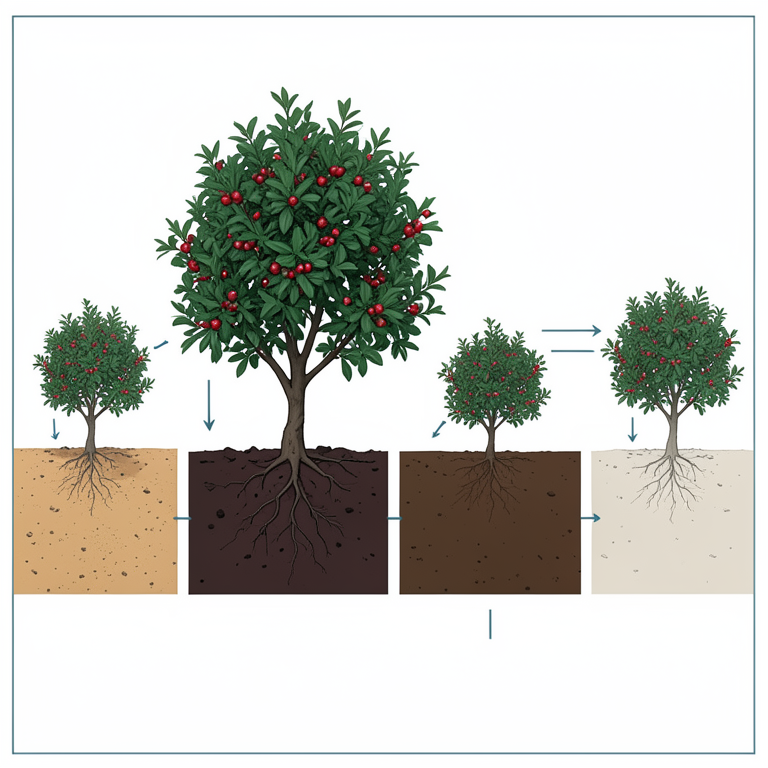
Soil Performance Comparison
AI-generated conceptual illustration (Karonda (Carissa carandas) shrubs in different soil types). It explains the idea and does not show study data.
View source evidence ↗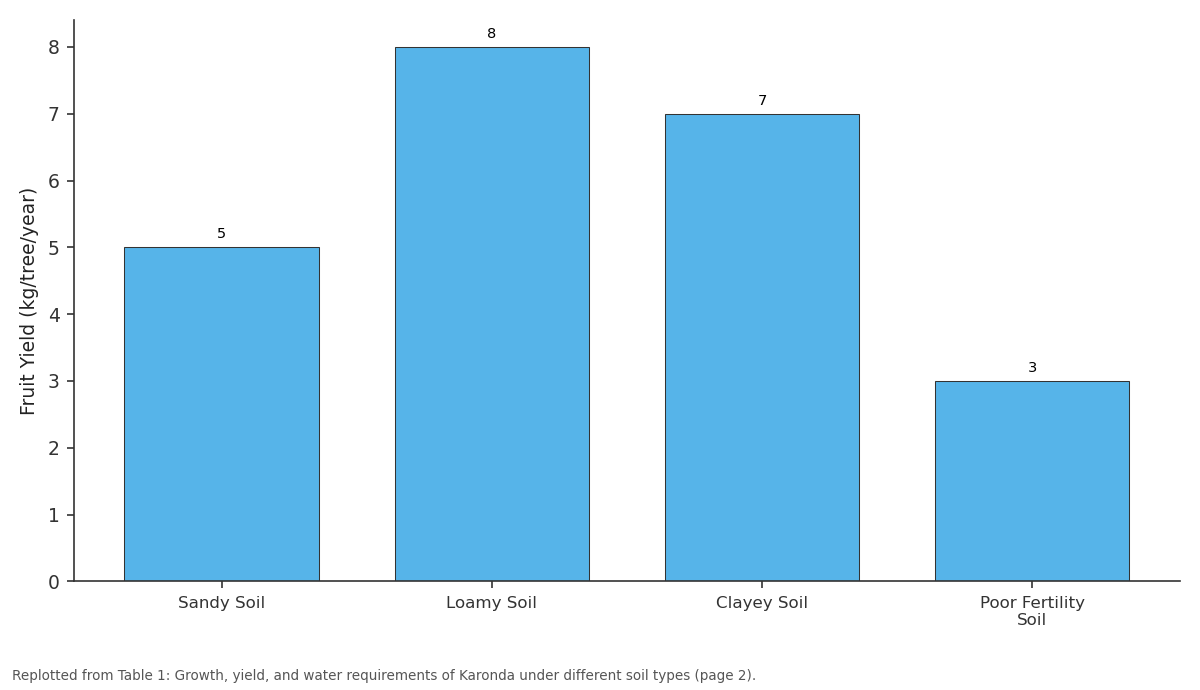
Fruit Yield (kg/tree/year): Sandy Soil vs Loamy Soil vs Clayey Soil vs Poor Fertility Soil
Replotted from Table 1 (page 2) of the original paper. Every bar is the paper's own table value.
View source evidence ↗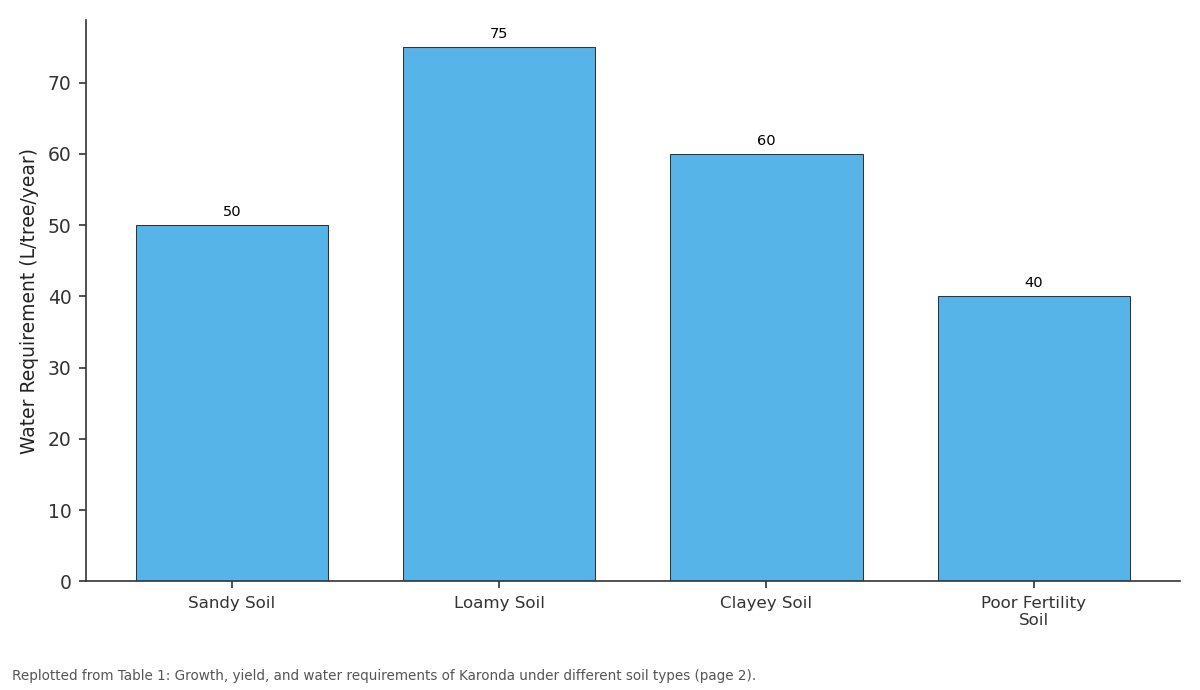
Water Requirement (L/tree/year): Sandy Soil vs Loamy Soil vs Clayey Soil vs Poor Fertility Soil
Replotted from Table 1 (page 2) of the original paper. Every bar is the paper's own table value.
View source evidence ↗Figures & tables
From the original paper Table 1
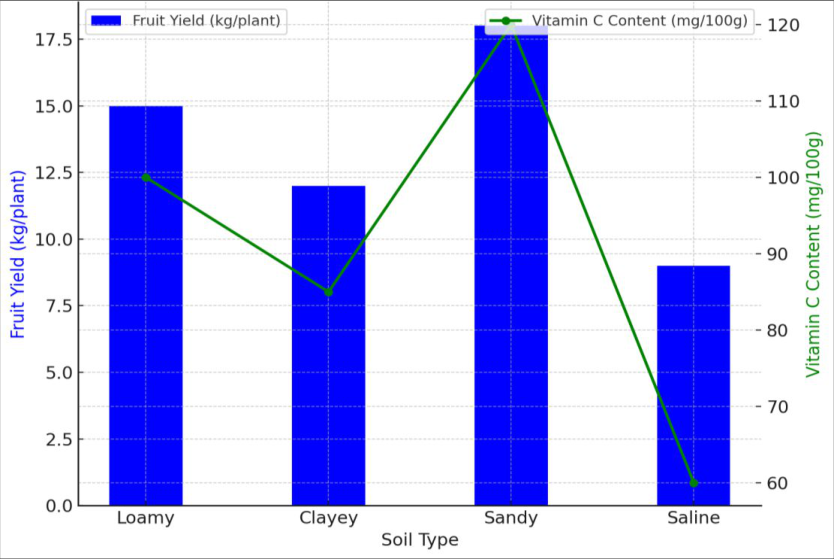 Figure 1
Introduction Agricultural Potential and Ecological Benefits of Karonda (Carissa carandas)
Karonda (Carissa carandasL.), often referred to as the Indian Cherry, is a fruit-bearing shrub that thrives in the harsh climates of arid and semi-arid regions. This hardy shrub, belonging to the Apocynaceae family, is native to South Asia and other parts of Asia. Karonda's adaptability to poor soil and minimal water resources makes it an ideal candidate for integration into sustainable farming systems, especially in areas facing environmental challenges such as drought and soil degradation. The plant is characterized by its evergreen, thorny branches, which give it a natural resilience to grazing and harsh weather conditions. It produces small, round fruits that are highly valued for their high vitamin C content and medicinal properties. The fruit, while often consumed in raw form or as a pickled delicacy, has various applications in traditional medicine due to its antioxidant, anti-inflammatory, and antimicrobial properties. Beyond its nutritional and medicinal value, Karonda has great potential as a sustainable crop due to its drought tolerance, low input requirements, and ability to thrive in poor soils. The plant's ability to grow in arid conditions makes it particularly suited for dryland farming, where conventional crops often fail. Moreover, Karonda's deep roots contribute to soil stabilization and prevent erosion, making it an effective plant for soil conservation in dryland ecosystems. Incorporating Karonda into farming systems can help diversify crop production, improve land productivity, and contribute to sustainable agricultural practices. Furthermore, its resilience makes it an excellent option for agroforestry systems, where it can provide both ecological and economic benefits. Despite these advantages, Karonda has not yet been fully integrated into mainstream agriculture, and there is a need for more research and development to realize its full potential in sustainable farming systems (Soumyajit Biswas et al, 2024) [9] .
The research underscores Karonda's promise as a resilient crop for sustainable farming systems, especially in dryland regions. The data collected from the experimental trials on growth, yield, water consumption, and nutritional content demonstrates its suitability for both small-scale and largescale agricultural production. Growth Rate: Karonda showed optimal growth in loamy soil, where it reached an average growth rate of 20 cm per year. This soil type, known for its balance of drainage and fertility, allowed Karonda to thrive. Growth rates in clayey soil were slightly lower at 18 cm per year, possibly due to soil compaction and slower drainage, which may have hindered root expansion. Sandy soil, with its faster drainage but lower nutrient content, led to a growth rate of 15 cm per year. The slowest growth occurred in poor fertility soil, where the growth rate was only 10 cm per year, indicating that while Karonda is capable of surviving in suboptimal soils, its growth is significantly reduced without sufficient fertility. Fruit Yield: The yield of Karonda fruits was significantly influenced by the soil type. The highest yield of 8 kg per tree per year was recorded in loamy soil, aligning with the optimal growth rate observed in this soil type. Loamy soil provides a well-balanced medium for Karonda, offering adequate nutrients, proper drainage, and good water retention. The fruit yield in clayey soil was slightly lower at 7 kg per tree per year, likely due to the soil's tendency to retain excess moisture, which could have inhibited root health.
In sandy soil, the yield dropped to 5 kg per tree per year, reflecting the lower nutrient content and water retention capacity of this soil type. Poor fertility soil resulted in the lowest fruit yield, with just 3 kg per tree per year. This confirms that while Karonda can tolerate poor soil conditions, its productivity is markedly reduced in such environments. Water Requirements: A key advantage of Karonda is its ability to thrive with minimal water. In sandy soils, which are typically low in moisture retention, Karonda required only 50 L of water per tree per year. This low water requirement underscores Karonda's potential as a water-efficient crop for dryland farming. The water requirement was higher in loamy soil (75 L per tree per year), as this soil type retains more moisture, allowing for a slightly higher irrigation demand. Karonda grown in clayey soil required 60 L per tree per year due to the soil's moisture retention properties. The plants in poor fertility soils required the least water, with only 40 L per tree per year, suggesting that Karonda's drought tolerance is not only a factor of soil type but also of its inherent resilience to water stress. Vitamin C Content: Karonda fruits are a rich source of vitamin C, and this study confirms that soil type influences the vitamin C content in the fruit. The highest vitamin C content was found in fruits grown in loamy soil (55 mg per 100g), which corresponds to the optimal growth and yield observed in this soil type. Fruits from clayey soil contained 50 mg per 100g, while those from sandy soil had 46 mg per 100g. Despite variations in soil conditions, Karonda's fruits consistently exhibited a high level of vitamin C, making it a valuable crop for both nutritional and medicinal purposes. The fruits from poor fertility soil showed a vitamin C content of 48 mg per 100g, which is still quite high compared to other common fruits, further demonstrating Karonda's nutritional value even in lessthan-ideal conditions.
The results of this study provide compelling evidence of Karonda's potential to contribute to sustainable farming systems, particularly in regions facing water scarcity and poor soil conditions. The plant's ability to grow in diverse soils and its low water requirements make it a valuable addition to dryland farming practices. Its high vitamin C content also enhances its appeal as a nutritionally beneficial crop, especially in regions where access to fresh fruits and vegetables may be limited. Furthermore, the findings underscore the importance of soil quality in determining the productivity and nutritional value of Karonda. Loamy soils, with their balance of nutrients and water retention, proved to be the most conducive to high growth rates and yields. However, even in less fertile soils, Karonda demonstrated resilience and continued to yield fruit with a significant nutritional profile.
Discussion
The results of this study reveal Karonda (Carissa carandas) as a highly adaptable and resilient plant, capable of thriving in a variety of soil conditions, and offering significant potential for sustainable farming systems. Karonda's ability to grow in loamy, clayey, sandy, and even poor fertility soils reflects its robustness, aligning with previous studies that have highlighted its capacity to withstand less-than-ideal conditions. For instance, Sharma et al. (2018) [8] observed similar growth patterns, with Karonda exhibiting resilience even in semi-arid conditions, making it a valuable species for soil conservation and enhancing biodiversity. The plant's ability to produce moderate yields even in poor fertility soils further supports its potential as a low-maintenance crop for regions facing degraded land. The study also demonstrated Karonda's exceptional water efficiency, which is a key advantage for sustainable farming, particularly in water-scarce areas. Karonda's low water requirements, as shown by its consumption of just 40 liters per tree per year in poor fertility soils, further confirm its drought tolerance. Previous research, such as that by Singh et al. (2020) [10] , highlighted Karonda's ability to thrive with minimal irrigation, reinforcing the plant's suitability for dryland farming. In addition, Patel et al. (2019) [4] noted Karonda's role in helping mitigate water scarcity challenges in arid regions, positioning it as an essential crop in sustainable agricultural systems. Furthermore, the high vitamin C content of Karonda fruits, ranging from 46 to 55 mg per 100g, positions it as a valuable source of nutrition, especially in areas with limited access to fresh fruits and vegetables. Gupta and Sharma (2020) [1] corroborated this finding, highlighting Karonda's antioxidant properties, which contribute to its healthpromoting benefits. Even under less fertile soil conditions, Karonda maintains substantial vitamin C levels, reinforcing its value as a functional food in improving local diets. The resilience of Karonda's nutritional profile in diverse soil types further emphasizes its potential in food security programs, especially in regions vulnerable to malnutrition. Karonda's role in soil health and conservation is another aspect that enhances its appeal in sustainable farming. Its deep root system helps prevent soil erosion, improve soil structure, and reduce desertification risks in dryland areas. Mehta et al. (2019) [4] demonstrated Karonda's contribution to soil stabilization, which is crucial for maintaining ecosystem health in arid regions. By enhancing soil quality and supporting land restoration, Karonda can be integrated into agroforestry systems to improve land productivity and environmental sustainability. This ecological benefit, combined with its water efficiency and low input requirements, makes Karonda a valuable addition to agroforestry and sustainable farming practices. Economically, Karonda holds promise as a crop that can provide income opportunities for smallholder farmers. Rani et al. (2020) [6] suggested that crops like Karonda, with low input costs and high nutritional value, can enhance the economic viability of rural farming systems. The plant's ability to thrive in poor soils and require minimal irrigation means it can be cultivated in areas where other crops may fail, offering economic resilience to farming communities. Additionally, Karonda's medicinal properties, coupled with its edible fruit, open avenues for market diversification and value-added products, increasing its economic potential.
Conclusion
Karonda (Carissa carandas) emerges as a highly promising crop for sustainable farming systems, particularly in regions challenged by water scarcity and poor soil fertility. The results of this study confirm that Karonda is adaptable to various soil types, ranging from loamy to poor fertility soils, and that it can grow efficiently with minimal water inputs. Its ability to produce significant yields in less-than-ideal conditions highlights its potential for integration into dryland farming systems, where traditional crops often struggle. Karonda's high nutritional value, especially its rich vitamin C content, further strengthens its appeal as a functional food crop, essential for improving the diets of local communities, particularly in areas with limited access to fresh produce. The plant's resilience in harsh climates, combined with its low water requirement, makes it a sustainable choice for regions facing challenges related to water scarcity and climate change [12] . Moreover, Karonda's ecological benefits, such as its contribution to soil conservation and erosion prevention, position it as a valuable plant for agroforestry systems. Its deep root system enhances soil structure and supports the overall health of the land, making it a beneficial addition to sustainable land management practices. Economically, Karonda provides an opportunity for smallholder farmers to diversify their crops and improve income generation, especially in regions where other agricultural options may be limited. The findings from this study contribute to the growing body of research on underutilized crops and their role in sustainable agriculture. To fully realize Karonda's potential, further research on its agronomy, market development, and post-harvest processing is needed. Supporting policies and extension services will also play a crucial role in promoting its cultivation and ensuring that its benefits are widely accessible to farmers and communities.
In light of these findings, Karonda should be considered a viable crop for future agricultural systems, particularly in the face of climate change and water scarcity. Its inclusion in sustainable farming practices can not only improve food security and nutrition but also support the development of resilient, diverse, and eco-friendly farming systems worldwide.
Figures and tables from the paper
| Soil Type | Growth Rate (cm/year) | Fruit Yield (kg/tree/year) | Water Requirement (L/tree/year) | Vitamin C Content (mg/100g) |
|---|---|---|---|---|
| Sandy Soil | 15 | 5 | 50 | 46 |
| Loamy Soil | 20 | 8 | 75 | 55 |
| Clayey Soil | 18 | 7 | 60 | 50 |
| Poor Fertility Soil | 10 | 3 | 40 | 48 |
Table text extracted from the original PDF; superscript letters are shown inline. The original table image is below.
View original table image
References
12 in the original paper- Gupta R, Sharma A. Antioxidant and health-promoting properties of Karonda (Carissa carandas). Journal of Phytochemistry. 2020;58(4):123-135.
- Kumar P, Yadav R. Drought tolerance and yield potential of underutilized crops: A case study on Carissa carandas. International Journal of Sustainable Agriculture. 2021;15(2):89-96.
- Sarkar T. Karonda: An underutilized fruit crop, promise as a significant asset for rural economies. Int J Agric Food Sci. 2024;6(2):156-158. DOI:10.33545/2664844X.2024.v6.i2b.217
- Mehta S, Singh R, Patel S. Role of Karonda in soil conservation and agroforestry systems in arid regions. Agricultural Ecosystems and Environment. 2019;241:58-68.
- Patel H, Jain P, Pandey D. The role of Carissa carandasin water-scarce regions and its potential as a drought-tolerant crop. Environmental Sustainability in Agriculture. 2019;21(3):201-210.
- Rani A, Sharma R, Kaur M. Economic viability of underutilized crops: The case of Carissa carandasin rural farming systems. Agricultural Economics Journal. 2020;29(1):45-59.
- Saxena N, Sharma P. Karonda cultivation in arid soils: Impact of soil type and water availability on growth and yield. International Journal of Agronomy and Crop Science. 2019;30(5):310-318.
- Sharma R, Gupta S, Kapoor S. Adaptability of Carissa carandasin arid and semi-arid regions of South Asia. Journal of Dryland Agriculture. 2018;12(2):141-149.
- Biswas S, Halder S, Koley B, Adak E, Sengupta S. The role of precision farming in sustainable agriculture: An overview. Int J Agric Extension Social Dev. 2024;7(4):219-228. DOI:10.33545/26180723.2024.v7.i4c.536s
- Singh P, Yadav K. Karonda as a potential crop for dryland farming in India. Indian Journal of Dryland Agriculture. 2020;16(4):205-212.
- Mehta S, Joshi M. Environmental benefits of Carissa carandasin agroforestry systems: A study from Western India. Journal of Environmental Management. 2019;231:156-163.
- Biswas S, Halder S, Koley B, Adak E, Sengupta S. The role of precision farming in sustainable agriculture: An overview. Int J Agric Extension Social Dev. 2024;7(4):219-228.