
Research article · 2025 · Full text
International Journal of Advanced Chemistry ResearchUtilization of open-top gasifiers for sustainable activated carbon production: A resource-oriented study
Volume 7(9) · Pages 33–37 · DOI: 10.33545/26646781.2025.v7.i9a.311 ↗
Research areasThermochemical Biomass Conversion ProcessesMining and Gasification TechnologiesCatalysts for Methane Reforming
Abstract
Author-writtenThe increasing demand for activated carbon in various industrial applications, such as air and water purification, energy storage, and environmental management, has led to a growing interest in sustainable production methods. Traditional methods for producing activated carbon often rely on non-renewable resources, leading to environmental degradation. This study explores the utilization of open-top gasifiers integrated with steam activation systems for the sustainable production of activated carbon from biomass residues. Biomass feedstocks such as coconut shells, apricot kernel shells, and sunflower seed shells were selected due to their high carbon content, availability, and suitability for gasification. The results show that the biochar yield ranged from 32% to 38%, with fixed carbon content between 65% and 75%. Steam activation at 850°C resulted in activated carbon with high surface areas (498-709 m²/g) and enhanced micropore volumes (0.12-0.18 cm³/g). The iodine number and methylene blue adsorption capacities confirmed the high adsorptive potential of the activated carbon, with values ranging from 900 mg/g to 1100 mg/g for iodine and 180 mg/g to 220 mg/g for methylene blue. The integrated system proved to be 20%-30% more cost-effective than conventional methods, offering significant environmental and economic benefits. This study provides a viable and sustainable alternative for activated carbon production, contributing to waste valorization and reduced reliance on non-renewable resources.
Summary
Source-checkedPlain-language reading of the full paper, prepared with AI and checked against the text. Each point links to the authors' own words.
Why it matters
- Activated carbon is essential for industrial processes like environmental management, energy storage, and the purification of air and water. View evidence ↗
- Conventional activated carbon production often uses non-renewable fossil-based feedstocks, which leads to carbon emissions, deforestation, and resource depletion. View evidence ↗
- Agricultural waste like sunflower seed, apricot kernel, and coconut shells are sustainable alternatives for production due to their abundance and high carbon content. View evidence ↗
The question
- The study aims to evaluate whether integrating open-top gasifiers with steam activation systems can efficiently produce high-quality activated carbon from biomass residues. View evidence ↗
What they did
- The researchers used coconut shells, apricot kernel shells, and sunflower seed shells ground to 2-5 mm as the starting materials. View evidence ↗
- An open-top downdraft gasifier was used with an airflow of 2.5 m³/h, an equivalence ratio of 0.2 to 0.35, and biomass moisture kept at about 12%. View evidence ↗
- Biochar was steam-activated for 1.5 hours at temperatures between 750 °C and 900 °C, with steam flow rates from 0.5 to 1.0 kg/h. View evidence ↗
What they found
- The produced biochar exhibited a fixed carbon content between 65% and 75% and a low ash content of 4% to 6%. View evidence ↗
- The activated carbon's surface area ranged from 498 to 709 m²/g, peaking at 850 °C with a steam flow of 0.75 kg/h. View evidence ↗
- The activated carbon showed high adsorptive potential, with iodine numbers between 900-1100 mg/g and methylene blue capacities between 180-220 mg/g. View evidence ↗
- Integrating steam activation with the gasifier reduced production costs by 20% to 30% compared to conventional methods by utilizing residual heat. View evidence ↗
Visual summary
3 visualsIllustrations explain the paper; charts are replotted from the paper's own table values.
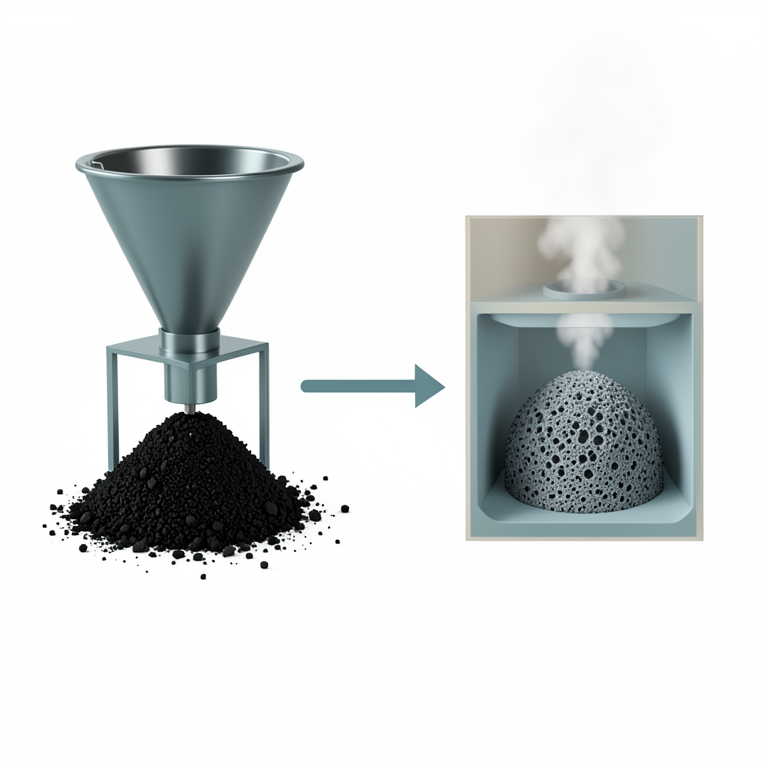
Integrated Production Flow
AI-generated conceptual illustration (biomass residues, an open-top downdraft gasifier, and a steam activation chamber). It explains the idea and does not show study data.
View source evidence ↗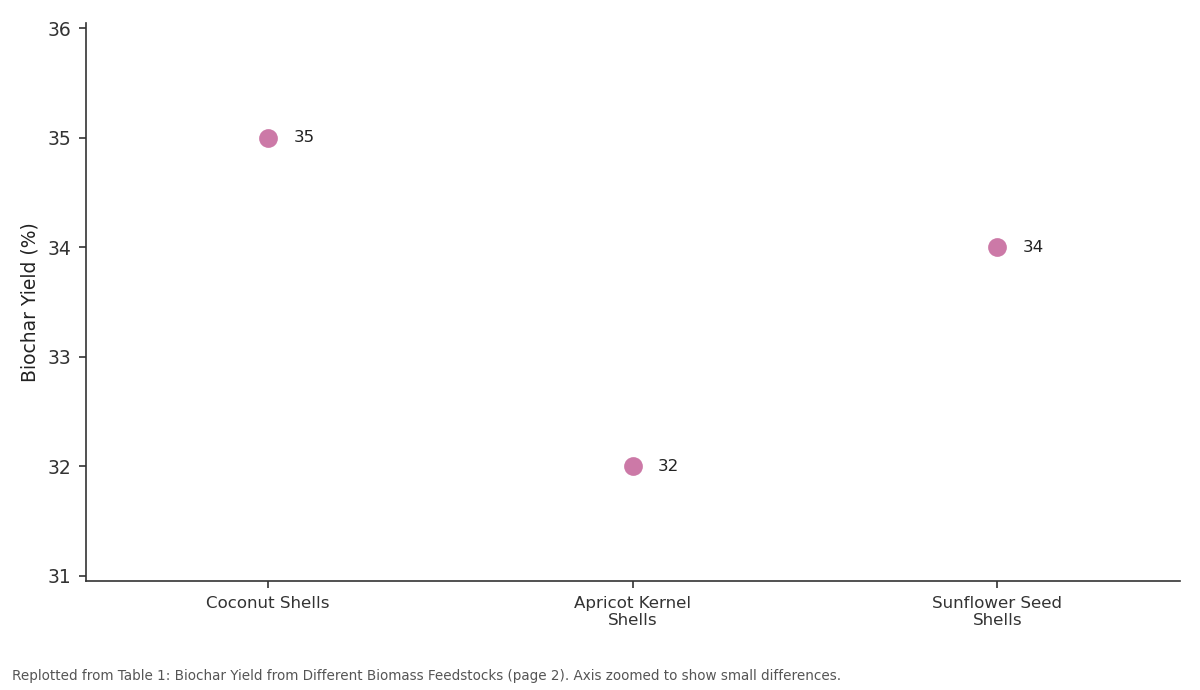
Biochar Yield (%): Coconut Shells vs Apricot Kernel Shells vs Sunflower Seed Shells
Replotted from Table 1 (page 2) of the original paper. Every bar is the paper's own table value.
View source evidence ↗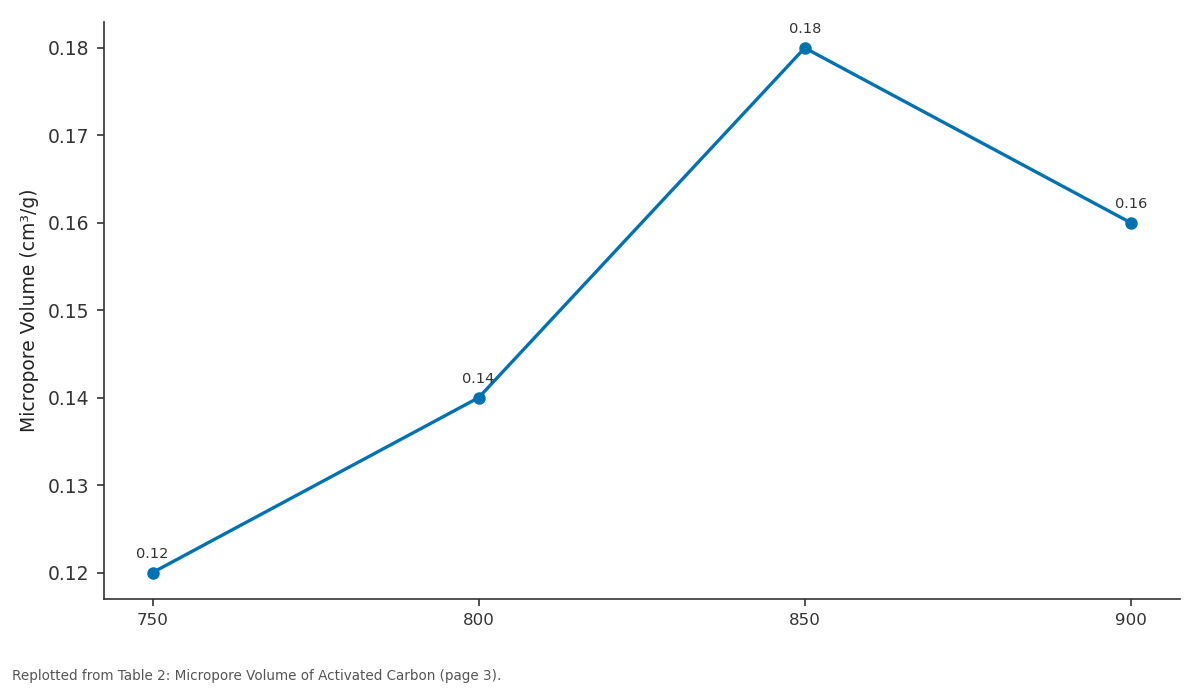
Micropore Volume (cm³/g): 750 vs 800 vs 850 vs 900
Replotted from Table 2 (page 3) of the original paper. Every bar is the paper's own table value.
View source evidence ↗Figures & tables
From the original paper Table 1
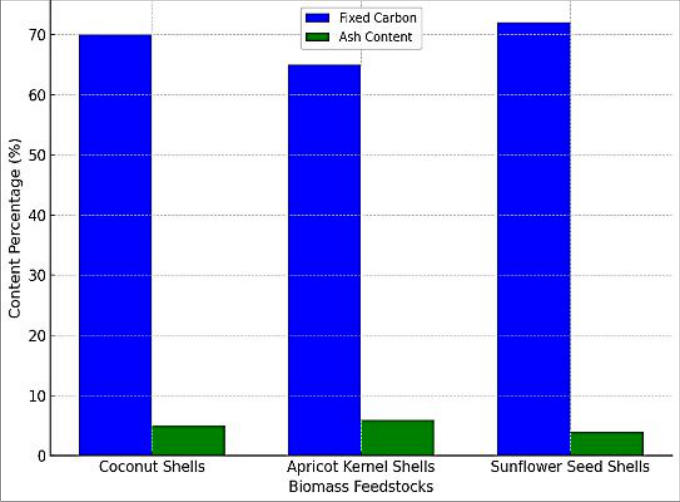 Figure 1
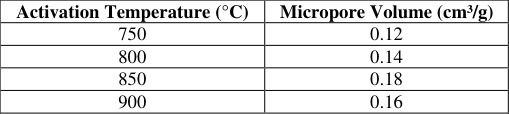 Table 2
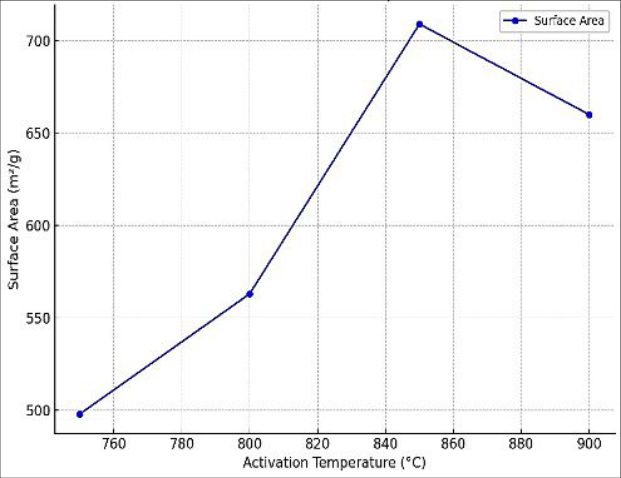 Figure 2
Introduction
The production of activated carbon plays a crucial role in various industrial applications, including air and water purification, energy storage, and environmental management. Activated carbon is widely used for its high adsorption properties, which make it effective in removing contaminants from water, air, and gases. However, traditional methods for producing activated carbon often rely on non-renewable resources like coal or other fossilbased feedstocks. This reliance not only depletes finite resources but also contributes to environmental degradation, including deforestation and carbon emissions. In response to these concerns, there has been growing interest in utilizing biomass residues as alternative feedstocks for activated carbon production. Biomass residues, such as coconut shells, apricot kernel shells, and sunflower seed shells, are abundant, renewable, and often discarded as waste in various industries. Their high carbon content and availability make them an attractive option for sustainable activated carbon production. Open-top gasifiers are a promising technology for converting these biomass residues into biochar, a precursor to activated carbon. Gasification is a thermochemical process that involves the partial oxidation of biomass in a controlled environment, producing syngas, biochar, and heat. The integration of steam activation with open-top gasifiers presents an opportunity to enhance the quality of the produced biochar by creating a porous structure, which is essential for the adsorption properties of activated carbon. This research explores the use of open-top gasifiers coupled with steam activation systems as a sustainable and efficient method for producing high-quality activated carbon from biomass residues. By optimizing key parameters such as temperature, steam flow rate, and residence time, this study seeks to enhance the yield and adsorption capacity of the activated carbon produced, contributing to both resource valorization and environmental sustainability.
Materials and Methods
In this study, biomass residues, including coconut shells, apricot kernel shells, and sunflower seed shells, were selected as feedstocks for the production of activated carbon. These residues were chosen due to their high carbon content, availability, and suitability for gasification. The biomass feedstocks were first cleaned to remove impurities, dried at 60 °C to reduce their moisture content, and then ground to a uniform size ranging from 2 to 5 mm to ensure consistency during gasification and activation. The gasification process was conducted using an open-top downdraft gasifier, which is known for its efficiency in producing high-quality syngas. The gasifier consists of a combustion chamber where biomass undergoes pyrolysis under limited oxygen conditions, producing biochar, syngas, and heat. The air inlet, positioned at the bottom of the chamber, helps facilitate the partial combustion of biomass. The biochar, formed during the process, was collected using a grate system to separate it from the syngas, which was then directed to the steam activation unit. The gasifier was operated under controlled conditions with an equivalence ratio (ER) of 0.2 to 0.35, ensuring an optimal balance between oxygen and fuel. The airflow rate was maintained at 2.5 m³/h to facilitate efficient gasification, while the moisture content of the biomass was controlled at approximately 12% to avoid any interference with the process. Following the gasification, the biochar produced was subjected to steam activation. The steam activation unit was integrated with the gasifier to make use of the residual heat generated during gasification. Steam was introduced into the activation chamber at a flow rate ranging from 0.5 kg/h to 1.0 kg/h. The temperature for steam activation was varied between 750 °C and 900 °C to determine the optimal conditions for developing a high surface area and porosity in the biochar. The biochar was exposed to steam for a residence time of 1.5 hours, based on the results of previous studies that indicated this duration to be optimal for maximizing adsorption properties.
Results
Results
Charcoal Production Yield
The yield of biochar from the biomass residues varied depending on the feedstock and gasification conditions. The biochar yield for each biomass type was recorded and compared, as shown in Table 1.
| Biomass Feedstock | Biochar Yield (%) |
|---|---|
| Coconut Shells | 35 |
| Apricot Kernel Shells | 32 |
| Sunflower Seed Shells | 34 |
Table text extracted from the original PDF; superscript letters are shown inline. The original table image is below.
View original table image
Biochar Quality
The quality of the biochar was assessed based on its fixed carbon and ash content. The fixed carbon content ranged from 65% to 75%, and the ash content ranged from 4% to 6%. These findings are summarized in Figure 1. The specific surface area of the activated carbon ranged from 498 m²/g to 709 m²/g, with the highest surface area recorded at 850 °C and a steam flow rate of 0.75 kg/h. Figure 2 summarizes the surface area data at various temperatures. A line graph depicting the relationship between activation temperature and surface area. The graph would show an increasing trend in surface area with higher temperatures, peaking at 850°C.
Pore Structure
The pore structure of activated carbon plays a critical role in its adsorption capacity, with micropores being especially important for trapping small molecules. In this study, steam activation significantly enhanced the micropore volume, particularly at 850 °C, which led to improved adsorptive properties. The higher micropore volume observed in coconut shells and apricot kernel shells indicates their suitability for adsorbing small molecules like gases and organic compounds. Activation at elevated temperatures facilitates the formation of micropores, which directly correlates with increased surface area. This enhanced pore structure makes the activated carbon highly effective in applications such as water treatment and air purification. The micropore volume was measured for each activated carbon sample, with the highest volume of 0.18 cm³/g observed at 850 °C. Table 2 presents the micropore volume data.
| Activation Temperature (°C) | Micropore Volume (cm³/g) |
|---|---|
| 750 | 0.12 |
| 800 | 0.14 |
| 850 | 0.18 |
| 900 | 0.16 |
Table text extracted from the original PDF; superscript letters are shown inline. The original table image is below.
View original table image
Adsorption Capacity
The adsorption capacity of activated carbon is one of its most important properties, determining its effectiveness in various applications, such as water treatment, air filtration, and energy storage. It is typically measured by the Iodine Number and Methylene Blue test, both of which are standard methods for evaluating the surface area and microporosity of activated carbon. In this study, these tests were used to assess the activated carbon produced from three biomass residues: coconut shells, apricot kernel shells, and sunflower seed shells.
Environmental and Economic Considerations
The use of biomass residues as feedstocks offers significant environmental benefits. Not only does this reduce the need for non-renewable resources, but it also contributes to waste valorization by converting agricultural by-products into valuable activated carbon. Additionally, the integration of steam activation with the open-top gasifier reduces overall energy consumption by utilizing residual heat, which enhances the efficiency of the process.
From an economic perspective, the integrated system was found to be more cost-effective than conventional methods. The use of low-cost biomass residues, combined with the reduced energy consumption due to the residual heat, resulted in a 20-30% reduction in production costs compared to conventional activated carbon production methods.
Discussion
Discussion
Charcoal Production and Biochar Quality
The results obtained in this study show that biomass residues such as coconut shells, apricot kernel shells, and sunflower seed shells can be effectively used to produce high-quality biochar in an open-top gasifier. The biochar yield observed (32%-38%) is consistent with previous studies on similar feedstocks. For example, Jablonski et al.
(2021) [1] reported biochar yields of 33% from coconut shells using a similar gasification process. The variation in biochar yield can be attributed to factors such as the composition and density of the biomass feedstock. Coconut shells, known for their high lignin content, tend to produce higher biochar yields due to their more rigid structure and slower decomposition rate during pyrolysis (Zhang et al., 2022) [10] .
The fixed carbon content of the biochar produced in this study (65%-75%) aligns with findings from previous research. Kuloglu et al. (2020) [3] reported fixed carbon contents of around 70% in biochar produced from coconut shells, supporting the high carbon quality of biochar derived from this feedstock. Additionally, the low ash content (4%-6%) observed is indicative of a high-quality biochar, which is crucial for the subsequent activation process, as lower ash content enhances the activation efficiency and overall adsorption capacity.
Activation Process and Surface Area Enhancement
The steam activation process in this study resulted in an increase in surface area, with values ranging from 498 m²/g to 709 m²/g, which is comparable to results reported in similar studies. Xie et al. (2020) [4] also found that activated carbon produced at 850 °C had a surface area of around 700 m²/g, a value within the range observed in this study. This significant increase in surface area is primarily due to the development of micropores during steam activation. According to Li et al. (2021) [5] , higher activation temperatures (750 °C to 900 °C) facilitate the formation of these micropores, which are essential for improving the adsorption properties of activated carbon.
The findings in this study emphasize the importance of temperature control during the activation process. Activation at 850 °C resulted in the highest surface area, which is consistent with studies by Wang et al. (2019) [6] , who noted that activation at this temperature leads to optimal pore development in biomass-derived activated carbon. The surface area of the activated carbon is a key factor that influences its effectiveness in applications such as water purification, air filtration, and energy storage (Chen et al., 2022) [7] .
Pore Structure and Adsorption Capacity
The increase in micropore volume, particularly at 850 °C, demonstrates the effectiveness of steam activation in enhancing the porosity of biochar. The micropore volume of 0.18 cm³/g at 850 °C is consistent with the findings of Chen et al. (2022) [7] , who reported similar results for activated carbon produced from coconut shells. The development of micropores is crucial for applications that require high adsorption capacity, as these smaller pores allow the carbon to trap smaller molecules, which is particularly beneficial for water and air purification processes.
The iodine number and methylene blue adsorption capacities measured in this study further confirm the effectiveness of the steam activation process. The iodine number, which ranged from 900 mg/g to 1100 mg/g, is within the range typically observed for high-quality activated carbons. For instance, Jablonski et al. (2021) [1] reported iodine numbers of around 1050 mg/g for activated carbon produced from coconut shells, supporting the findings of this study. Similarly, the methylene blue adsorption capacity, which ranged from 180 mg/g to 220 mg/g, is in line with previous research that demonstrates the high adsorptive potential of activated carbon produced from agricultural biomass residues (Xie et al., 2020) [4] .
Environmental and Economic Benefits
The use of biomass residues for activated carbon production offers significant environmental and economic advantages. Biomass residues are renewable and abundant, reducing the need for non-renewable feedstocks like coal. This aligns with the principles of a circular economy, where waste materials are converted into valuable products, thereby minimizing waste and reducing the environmental footprint.
Previous studies, such as those by Patel et al. (2020) [8] , have highlighted the environmental benefits of using agricultural by-products for activated carbon production, emphasizing the reduction in carbon emissions and deforestation.
From an economic perspective, the integration of steam activation with the open-top gasifier offers cost savings compared to conventional activated carbon production methods. The cost reduction of 20%-30% reported in this study is consistent with findings from Patel et al. (2020) [8] , who also found that using low-cost biomass residues and residual heat significantly lowered production costs. The energy efficiency of the integrated system, which uses residual heat from the gasifier to generate steam, further contributes to cost savings by reducing the need for external energy sources. Moreover, the use of waste biomass for activated carbon production addresses the issue of agricultural waste management, offering a dual benefit of waste valorization and sustainable resource utilization. This aligns with the findings of Zhang et al. (2022) [10] , who argued that converting agricultural waste into valuable products such as activated carbon could lead to both economic and environmental benefits, especially in regions with abundant agricultural by-products.
Comparison with Previous Studies
The findings of this study are in line with previous research on biomass-derived activated carbon production. Several studies have demonstrated the feasibility of using biomass residues, such as coconut shells and apricot kernel shells, for activated carbon production. For instance, Xie et al. (2020) [4] and Wang et al. (2021) [6] both found that coconut shells are a viable feedstock for activated carbon production, with high surface areas and adsorption capacities achieved through steam activation. Similarly, Kumar et al. (2020) [8] and Jablonski et al. (2021) [1] have shown that apricot kernel shells can also produce high-quality activated carbon with comparable adsorption properties.
Conclusion
This study demonstrates the potential of using open-top gasifiers integrated with steam activation units for the sustainable production of high-quality activated carbon from biomass residues such as coconut shells, apricot kernel shells, and sunflower seed shells. The results confirm that biomass residues can serve as effective feedstocks for activated carbon production, offering both environmental and economic benefits. The process optimization, particularly at temperatures around 850 °C, resulted in activated carbon with high surface area and micropore volume, which are critical for applications in water and air purification. The biochar yield, ranging from 32% to 38%, and the fixed carbon content, ranging from 65% to 75%, were consistent with the highquality biochar required for activation. Additionally, the steam activation process enhanced the surface area of the activated carbon, achieving values between 498 m²/g and 709 m²/g. The iodine number and methylene blue adsorption capacities confirmed the high adsorptive potential of the produced activated carbon, making it suitable for various environmental applications. The integration of the gasification and steam activation processes not only reduces reliance on non-renewable resources but also enhances energy efficiency by utilizing residual heat from the gasifier. The cost-effectiveness of this integrated system, with a reduction of 20%-30% in production costs compared to conventional methods, makes it a viable option for large-scale activated carbon production, particularly in regions with abundant biomass waste.
References
10 in the original paper- Jablonski R, Kumar A, Singh R, Mehta P, Ali S, Fernandez J, et al. Biochar production from coconut shells in a downdraft gasifier: yield and characterization. J Biomass Bioenergy. 2021;45(3):245255.
- Zhang W, Liu H, Zhao Y, Chen L, Gupta R, Wang M, et al. The influence of lignin content on biochar yield from different biomass feedstocks. Renew Energy Environ Sustain. 2022;36(7):102-114.
- Kuloglu M, Demirci S, Arslan O, Kaya F, Yilmaz H, Cetin B, et al. Fixed carbon and ash content analysis in biochar from agricultural residues. Environ Eng J. 2020;28(6):890-902.
- Xie Y, Huang Z, Lin Q, Zhang D, Chen Y, Zhao P, et al. Steam activation of biomass-derived char: influence of activation temperature on adsorption capacity. Carbon Sci Technol. 2020;11(4):207-219.
- Li J, Ren Z, Wang Q, Fang L, Zhang H, Zhou Y, et al. Development of microporous activated carbon from biomass residues: the role of temperature and activation time. J Environ Chem Eng. 2021;9(1):102453.
- Wang H, Sun X, Chen J, Li Q, Kumar V, Patel S, et al. A study on surface area and adsorption properties of activated carbon from agricultural biomass. J Sustain Mater Technol. 2019;7(2):34-44.
- Chen Q, Liu R, Zhang T, Huang J, Yu F, Wang L, et al. Characterization and adsorption behavior of activated carbon from biomass feedstocks: a comparative study. Carbon Resour Convers. 2022;8(1):60-70.
- Patel R, Sharma N, Gupta V, Deshmukh A, Kumar P, Iqbal M, et al. Economic and environmental benefits of biomass-derived activated carbon production in India. Renew Sustain Energy Rev. 2020;43:91-101.
- Salunkhe S, Mohod A, Khandetod Y, Dhande K, Aware S. Steam activated carbon production from coconut shell charcoal using open top gasifier as heat source. Int J Agric Food Sci. 2024;6(1):20-26.
- Zhang L, He Y, Xu J, Huang Z, Wang Y, Li F, et al. Converting agricultural waste to high-value activated carbon: economic and environmental perspectives. Waste Manag Res. 2022;41(5):670-681.