
Research article · 2025 · Full text
International Journal of Biology SciencesPlant growth regulators and their role in plant growth with special reference to mulberry
Volume 7(9) · Pages 94–98 · DOI: 10.33545/26649926.2025.v7.i9b.483 ↗
Research areasSilkworms and Sericulture ResearchPlant Growth Enhancement Techniques
Abstract
Author-writtenPlant growth regulators are organic compounds synthesized in specified plant parts in small quantities and are transported to the place of requirement leading to a change in physiological responses. They can be classified into growth promoters and growth retardants. Plant growth promoters are auxin, gibberellin, cytokinin and growth retardants include abscisic acid and ethylene. The latest growth promoter brassinosteroid, translocates nitrogen and phosphorus. Triacontanol is one of the commercial formulations used to increase the moisture and protein content in mulberry leaves, which ultimately build disease resistance in silkworm. Plant growth promoting rhizobacteria stimulate the plant growth regulators like auxins, gibberellins etc. and help in better nutrient uptake and increase tolerance.
Summary
Source-checkedPlain-language reading of the full paper, prepared with AI and checked against the text. Each point links to the authors' own words.
Why it matters
- Plant growth regulators (PGRs) are biologically active organic compounds that manage various physiological processes in plants. View evidence ↗
- Mulberry leaves are the only food source for silkworms, which use the leaf protein to produce silk. View evidence ↗
- There is a need to increase mulberry foliage production and quality to meet the rising demand of the silk industry despite limited land. View evidence ↗
The question
- The paper aims to review the role of plant growth regulators in general plant growth, specifically focusing on their application in mulberry. View evidence ↗
What they did
- The review categorizes PGRs into growth promoters (such as auxins, gibberellins, and cytokinins) and growth inhibitors (such as abscisic acid and ethylene). View evidence ↗
- The authors distinguish between natural plant hormones (endogenous) and artificially synthesized plant growth regulators (exogenous). View evidence ↗
What they found
- Applying triacontanol to mulberry leaves increases their protein content and moisture retention, improving nutrition for silkworms. View evidence ↗
- In vitro sex modification of mulberry using 2000 µg/l of ethrel resulted in a maximum of 13.6% female inflorescences. View evidence ↗
- For black mulberry seeds, combining 250 mg/l of GA3 with 100 days of stratification increased germination to 96%, compared to 88% with stratification alone. View evidence ↗
- In the Garhwal hill region, treating Morus alba stem cuttings with 2000 mg/l IBA produced the best results for rooting percentage and root length. View evidence ↗
- For black mulberry wood cuttings, a combination of 6000 ppm IBA and 100 ppm cinnamic acid (CA) achieved the highest rooting ratio of 48.3% and an average of 3.1 roots. View evidence ↗
- Research on various mulberry cultivars showed that 6000 ppm IBA maximized root number and length, while 6000 ppm NAA maximized the rooting percentage. View evidence ↗
- The combination of zeatin and 2,4-D was found to induce the highest percentage of cell divisions at 29%. View evidence ↗
- High levels of endogenous abscisic acid (ABA) are associated with a lower rooting rate, suggesting that ABA inhibits the formation of adventitious roots. View evidence ↗
What it means
- The authors conclude that using PGRs can increase the production of high-quality mulberry foliage by improving nutrient assimilation and directing nutrients to the leaves. View evidence ↗
Visual summary
1 visualsIllustrations explain the paper; they do not show study data.
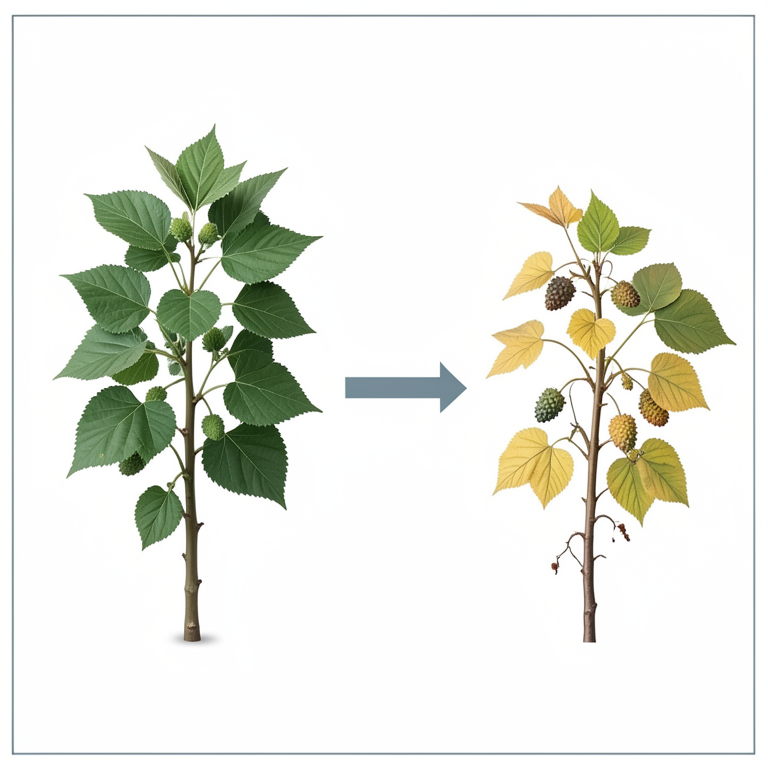
Classification of PGRs
AI-generated conceptual illustration (mulberry plants (Morus alba)). It explains the idea and does not show study data.
View source evidence ↗Introduction
Plant growth regulators (PGRs) are a class of low molecular weight, biologically active organic compounds that regulate various physiological processes in plants. These compounds are synthesized endogenously in specific tissues and are effective at very low concentrations. Once produced, PGRs are translocated to target sites where they modulate plant growth and development by influencing gene expression, enzyme activity, and signal transduction pathways (Taiz et al., 2015) [22] . PGRs are broadly categorized into two functional groups based on their physiological effects: growth promoters and growth inhibitors (retardants). Growth-promoting regulators include auxins, gibberellins, cytokinins, and the more recently characterized brassinosteroids. These compounds are primarily involved in promoting cell elongation, cell division, vascular differentiation, apical dominance, fruit development, and delay of senescence (Davies, 2010) [3] . Brassinosteroids, in particular, have been shown to play a significant role in enhancing the translocation of essential macronutrients such as nitrogen (N) and phosphorus (P), thereby improving overall plant metabolic efficiency and biomass accumulation. In contrast, growth-inhibiting regulators such as abscisic acid (ABA) and ethylene are predominantly associated with responses to environmental stress, induction of seed and bud dormancy, stomatal closure, and acceleration of senescence. These compounds function as key modulators in stress signaling pathways, enabling plants to adapt to abiotic and biotic stressors (Zhang et al., 2006) [25] . Among the commercially utilized plant growth regulators, triacontanol, a long-chain aliphatic alcohol, has been widely applied in sericulture. Triacontanol application enhances the moisture retention and protein content of mulberry (Morus spp.) leaves, which in turn improves the nutritional quality of the leaves for silkworms (Bombyx mori). Enhanced leaf quality has been directly linked to increased disease resistance and improved cocoon production in silkworms (Ramesh et al., 2012) [16] . In addition to synthetic and plant-derived regulators, plant growth-promoting rhizobacteria (PGPR) have emerged as a crucial component in sustainable agriculture. These beneficial soil microorganisms stimulate plant growth through multiple mechanisms, including the biosynthesis or enhancement of phytohormones such as auxins, gibberellins, and cytokinins, as well as by improving nutrient acquisition and stress tolerance. PGPRs play a pivotal role International Journal of Biology Sciences https://www.biologyjournal.net in reducing the need for chemical inputs while promoting plant health and productivity (Glick, 2012) [7] .
Difference between Plant Hormones and Plant Growth Regulators
Difference between Plant Hormones and Plant Growth Regulators
Characteristics of Plant Growth Regulators
As the plants require oxygen, water, sunlight, and nutrition to develop and grow, they do require certain chemical substances to manage their growth and development. These chemical substances are known as Plant Growth Regulators and are naturally produced by the plants itself These are simple organic molecules having different chemical compositions. They are also described as phytohormones, plant growth substances or plant growth hormones (Miheretu Bedassa, 2023) [24] .
They can accelerate as well as retard the rate of growth in plants
Plants growth hormones or plant growth regulators exhibit the following characteristics:
1. Differentiation and elongation of cells 2. Formation of leaves, flowers, and stems 3. Wilting of leaves 4. Ripening of fruit 5. Seed dormancy, etc.
Types of Plant Growth Regulators (PGR)
Growth promoters: They promote cell division, cell enlargement, flowering, fruiting and seed formation.
Growth inhibitors: These chemicals inhibit growth and promote dormancy and abscission in plants.
Auxin
Plants largely produce auxin in shoot tips and translocate to roots. The primary auxin in plants is indole-3-acetic acid (IAA). The synthetic auxins are α-naphthaleneacetic acid (NAA) and 2,4-dichlorophenoxyacetic acid (2,4-D). Auxin, mainly used to induce the apical dominance, fruit development and lateral root formation. Generally, auxin and auxin like compounds induce root formation, increase root number and length of root. (Geetha and Murugan, 2017) [6] .
Types of
Types of
Gibberellins
Gibberellins are isolated from the fungus Gibberella fujikuroi. Gibberellins are synthesized in apical portion of stems and roots. The main function is to stimulate stem growth through cell elongation and cell division, to promote seed germination and break the dormancy in seeds and buds. It slows the process of senescence (biological aging) by preventing the breakdown of chlorophyll in leaves. (Geetha and Murugan, 2017) [6] Cytokinins Cytokinins are largely produced in roots and translocated to shoot tip. Cytokinins are represented by kinetin, zeatin and 6-benzylaminopurine (BAP). It promote cell division and apical dominance. They are involved primarily in cell growth and differentiation but also affect axillary bud growth and leaf senescence. (Geetha and Murugan, 2017) [6] Abscisic Acid It is a growth inhibitor, which is synthesized within the stem, leaves, fruits and seeds of the plant. Abscisic acid serves as an antagonist to Gibberellic acid. It is also known as stress hormone as it helps by increasing the planttolerance to various types of stress. It helps in the maturation and development of seeds, stimulates closing of stomata in the epidermis, involved in regulating abscission and dormancy and inhibits plant metabolism and seed germination. (Geetha and Murugan, 2017) [6] Ethylene Ethylene is a simple, gaseous plant growth regulator, synthesized by most of the plant organs, it causes ripening fruits and ageing tissues. It is an unsaturated hydrocarbon having double covalent bonds between and adjacent to carbon atoms. Ethylene is used as both plant growth promoter and plant growth inhibitor. Breaks the dormancy of seeds and buds. Enhances respiration rate during ripening of fruits and stimulates fruit ripening. Facilitates senescence and abscission of both flowers and leaves. (Geetha and Murugan, 2017) [6] Inhibitors of GA Biosynthesis Plant growth retardants are applied in agronomic and horticultural crops to reduce unwanted longitudinal shoot growth without lowering plant productivity. Most growth retardants act by inhibiting gibberellin (GA) biosynthesis.
Till date, four different types of inhibitors (Onium compounds) are known such as, chlormequat chloride, mepiquat chloride, chlorphonium and AMO-1618, which block the cyclases copalyldiphosphate synthase and entkaurene synthase involved in GA metabolism. Inhibitors of GA biosynthesis may be capable of up-regulating expression of several GA biosynthesis genes in roots, possibly to maintain normal root growth by a feedback regulation. (Geetha and Murugan, 2017) [6] Triacontanol Triacontanol (TRIA) is a natural plant growth regulator found in epicuticular waxes. TRIA has been reported to increase the growth of plants by enhancing the rates of photosynthesis, protein biosynthesis, the transport of nutrients in plant and enzyme activity, reducing complex carbohydrates among many other purposes. (Geetha and Murugan, 2017) [6] Combinations The ratio of auxins and cytokinins influences the outgrowth of plants High auxin: cytokinin ratio promotes activation of shoot branching Low auxin: cytokinin ratio promotes activation of lateral roots The combination of zeatin and 2,4-D induces highest percentage of cell divisions (29%) followed with zeatin and NAA (10%) Foliar spray of IAA and GA₃ significantly improved leaf lobation and sex expression of Mysore local cultivars of mulberry Adding GA₃ along with the 6-benzylaminopurine (BAP) enhanced bud break frequency (Geetha and Murugan, 2017) [6] Polyamines Evans and Malmberg (1989) [5] have reviewed role of polyamines in plant development and have concluded that "polyamines are not plant hormones although they might be considered as plant growth regulators or merely one of several kinds of metabolites needed for certain developmental processes." They require higher concentrations to produce an effect than do the more traditional plant hormones. However, PAs seem to be involved in a wide range of growth and developmental phenomena, as tissues that are deficient in PAs are abnormal. PAs appear to be involved in cell division, cell elongation and rooting and in certain circumstances can be used as a substitute for auxin treatment, which has led some to consider them as secondary messengers. Naturally occurring PAs are precursors and conjugates. The most common of the PAs are putrescine (a diamine), spermidine (a triamine) and spermine (a tetraamine).
Salicylates
Salicylates
Mixtalol
It is a mixture of naturally occurring, biologically active compounds of long chain aliphatic alcohol varying in chain length from C 24 to C 32. Number of formulations of mixtalol have been reported to increases total chlorophyll content, photosynthetic rate, transpiration rate, protein content, uptake of water and nitrogen (N), uptake of phosphorous (P), micronutrients and to reduce photorespiration leading to increased fresh/dry matter yield. (Bhattacharya and Rao, 1996) [2] Biozyme Crop+ Biozyme crop+, a biologically derived plant growth regulator with cytokinin and auxin precursor. This is produced by mixing animal and vegetable products in scientifically controlled conditions to give the optimum output.
Benefits:
Early germination Vigorous seedling growth Profuse primary and secondary root development Reduction in the fruit and flower drop Higher nutrient uptake Increased soil microbial activity Plant Growth-Promoting Rhizobacteria (PGPR) Plant growth-promoting rhizobacteria (PGPR) are bacteria that live and colonize in the rhizosphere and can stimulate plant growth. It can improve health and fitness and increase crop yields. PGPR availability in the soil is very important in increasing plant growth and production. PGPR extracellular products can directly stimulate plant genetic and molecular pathways, leading to increased plant growth and induction of plant resistance and tolerance.
Discussion
Dennis (2004) [4] studied the in vitro sex modification in mulberry by using ethrel. 2-chloroethylphosphonic acid (ethrel) was sterilized and added to Murashige and Skoog (MS) medium supplemented with 5 µM 6-benzyl amino purine (BAP). Ethrel applied at different concentrations produced female, male and mixed inflorescences in male mulberry nodal cuttings. The maximum (13.6 per cent) female inflorescence was observed on media containing 2000 µg/l ethrel. An experiment conducted to determine the effect of cold stratification (0, 20, 40, 60, 80 or 100 days), application of gibberellic acid (GA 3 ) (0, 250, 500, 1000 or 2000 mg/l) and the combination (GA 3 + stratification) on seed germination of black mulberry. The results revealed that application of 1000 mg/l GA 3 proved more effective than any of the other concentrations of GA 3 applied. Seeds stratified for 100 days showed 88 per cent germination while the combined treatment of 250 mg/l GA 3 and 100 days of stratification yielded 96 per cent germination of seeds. (Koyuncu, 2005) The effect of various concentrations of (indole-3-butyric acid) IBA and (naphthalene acetic acid) NAA on the rooting of stem cuttings of mulberry (Morus alba L.) under mist house condition in Garhwal hill region. Stem cuttings of Morus alba were treated with 1000, 1500 and 2000 mg/l IBA and NAA solutions by quick dip method. These cuttings were rooted in a rooting media of 1:1 mixture of sandy soil and farm yard manure in plastic root trainers inside a mist house. Among all the treatments, number of sprouted cuttings, length of the roots per cutting, percentage of rooted cuttings, length of longest sprouts of root were higher in 2000 mg/l IBA compared to all other treatments. (Singh et al., 2014) [18] The role of IBA for rapid clonal propagation of mulberry for higher biomass and large-scale production. The non-treated (control) and treated (1000, 2000 and 3000 mg/l IBA) soft stem cuttings were cultured in mist chamber. After 50 days the rooting percentage, root number and root length were found to be higher in IBA-treated cuttings compared to the non-treated ones. (Husen et al. 2015) [9] Karabulut and Saracoglu (2021) studied the effect of cinnamic acid (CA) and IBA treatments on the rooting of wood cuttings of black mulberry (Morus nigra L.). 6000 ppm IBA, 6000 ppm IBA + 100 ppm CA and 100 ppm CA was applied on the cuttings and compared with no application of IBA and CA. The highest rooting ratio (48.3 per cent) and the highest average root number (3.1) were obtained from the cuttings treated with 6000 ppm IBA + 100 ppm CA. During the rooting process of mulberry twig cuttings, both the control group and the treatment group exhibited a similar change trend in the ABA content, following a pattern of first increase, then decrease, and then increase". In the early stage of cutting (0-12 days), the endogenous ABA content showed a significant increase, indicating that the hormone treatment did not have a notable impact on the initial ABA content. From 12 to 24 days, there was a significant decrease in the endogenous ABA content, with the control group displaying higher levels compared to the treatment group. Furthermore, the endogenous ABA content continued to decrease from 24 to 36 days, and then increased. This observation suggests that the decrease in the ABA content during the transition from the initial callus stage to the large callus stage facilitates the transport of IAA or other rooting substances from leaves to the base of the plant. Subsequently, the ABA content increased from the formation to the elongation of adventitious roots, potentially due to accelerated cell division, resulting in reduced ABA production. Once callus formation occurred, entering the rooting stage was accompanied by reduced cell division, leading to increased ABA production. Additionally, the endogenous ABA content exhibited an inverse relationship with the rooting rate, indicating that high levels of ABA content can inhibit the formation of adventitious roots. (Sun. J et al., 2023) [21] The seasonal timing of cuttings can play an important role in rooting (Harrison-Murray 1991) [8] where different external factors can have an impact on rooting parameters; for example, auxin and naphthylacetic acid treatments can increase the cutting ability for rooting (Marks and Simpson 2000, Kaul 2008) [14] . Rooting percentage, root number and length of roots for mulberry cuttings differed according to cultivars, type of auxin and auxin concentration. The treatment with IBA at a concentration of 6000 ppm gave the highest values for the number of roots and their length, while the highest percentage of rooting resulted when the treatment with NAA was at a concentration of 6000 ppm. (Ayat et al. 2024) [1]
Conclusion
Due to increasing demand of silk and the limited arable land in the country, stress has been laid on the higher production and improvement of foliage quality to meet the growing demand of sericulture industry of the country. Mulberry (Morus alba L.) leaf is the sole food plant of the silkworm (Bombyx mori L.), which converts leaf protein into silk. Through the application of plant growth regulators, the production of quality foliage can be increased by the increasing nutrient assimilation rate of the plant and directing its movements to the foliage.
References
25 in the original paper- Ayat Salah El Den, Hassan MF Elwakeel, Ahmed AA, Mohamed AN. Rootability of some mulberry cultivars treated with growth regulators. Arab Univ J Agric Sci. 2024;32(1):101-110.
- Bhattacharya A, Chakrabarty S, Kaliwal BB. The effect of indole-3-butyric acid (IBA), indole-3-pyruvic acid (IPA) and their synergetic effects on biochemical contents on the silkworm, Bombyx mori. Res Pharm Biotech. 2011;3(8):111-117.
- Davies PJ. Plant hormones: biosynthesis, signal transduction, action. Springer; 2010.
- Dennis TT. In vitro modification of sex expression in mulberry (Morus alba) by ethrel and silver nitrate. Plant Cell Tissue Organ Cult. 2004;77(3):277-281.
- Evans PT, Malmberg RL. Do polyamines have roles in plant development? Plant Physiol. 1989;89(1):1-4.
- Geetha T, Murugan N. Plant growth regulators in mulberry. Annu Res Rev Biol. 2017;13:1-11.
- Glick BR. Plant growth-promoting bacteria: mechanisms and applications. Scientifica. 2012;2012:963401.
- Harrison-Murray RS. A leaf-model evaporimeter for estimating potential transpiration in propagation environments. J Hortic Sci. 1991;66:131-139.
- Husen A, Iqbal M, Siddiqui SN, Sohrab SS, Masresha G. Effect of indole-3-butyric acid on clonal propagation of mulberry (Morus alba L.) stem cuttings: rooting and associated biochemical changes. Proc Natl Acad Sci India Sect B Biol Sci. 2015;87(1):161-166.
- Karabulut NS, Saracoglu O. The effects of cinnamic acid and IBA treatments on the rooting of wood cuttings of black mulberry (Morus nigra L.). Turk J Food Agric Sci. 2021;4(1):1-5.
- Kaul K. Variation in rooting behavior of stem cuttings in relation to their origin in Taxus wallichiana Zucc. New For. 2008;36:217-224.
- Koyuncu F. Breaking seed dormancy in black mulberry (Morus nigra L.) by cold stratification and exogenous application of gibberellic acid. Acta Biol Crac Ser Bot. 2005;47(2):23-26.
- Lakshmikantham V, Bharathi D. Impact of plant growth hormone, indole-3-acetic acid (IAA) on the organic constituents of silkworm, Bombyx mori L. Int J Agric Sci Res. 2014;4(5):37-44.
- Marks TR, Simpson SE. Interaction of explants type and indole-3-butyric acid during rooting in vitro in a range of difficult and easy-to-root woody plants. Plant Cell Tissue Organ Cult. 2000;62:65-74.
- Mustaka Z, Patandjengi B, Alam G, Melina M. Potential of rhizobacterial consortium in increasing area and weight of mulberry leaves (Morus indica). Biodivers J Biol Divers. 2022;23(3):1-7.
- Ramesh M, Arulmozhiselvan K, Balasubramanian A. Effect of triacontanol on the biochemical composition of mulberry leaves and its impact on silkworm performance. J Sericult Sci. 2012;48(1):45-52.
- Sengupta M, Raghunath MK, Mallick P, Ravindran S. Plant regeneration from nodal explant of mulberry (Morus spp.) genotypes AGB24 and AGB43 through in vitro culture of axillary buds. Sci Res Rep. 2016;6(2):109-114.
- Singh KK, Choudhary T, Kumar A. Effect of various concentrations of IBA and NAA on the rooting of stem cuttings of mulberry (Morus alba L.) under mist house condition in Garhwal hill region. Indian J Hill Farming. 2014;27(1):125-131.
- Singh KK. Effect of auxins and rooting media on rooting in stem cutting of mulberry (Morus nigra L.). Pharm Innov J. 2018;7(11):12-15.
- Sokhuma P, Intorrathed S, Phonpakdee R. Effect of IBA and NAA on rooting and axillary shoot outgrowth of 'Himalayan' mulberry stem cutting. Int J Agric Technol. 2018;14(7):1939-1948.
- Sun J, Dou H, Chen H, Wang Y, Wang T, Quan J, et al. Physicochemical response of external plant growth regulator in the cutting process of mulberry. Horticulturae. 2023;9(9):1006.
- Taiz L, Zeiger E, Møller IM, Murphy A. Plant physiology and development. Sunderland: Sinauer Associates; 2015.
- Vijayan K, Chakraborti SP, Roy BN. Regeneration of plantlets through callus culture in mulberry. Indian J Plant Physiol. 1998;3:310-313.
- Bedassa M. Fractionation and distribution of phosphorus in acid soils: Review. Int. J. Hortic. Food. Sci. 2023;5(1):64-70. DOI: 10.33545/26631067.2023.v5.i1b.159
- Zhang J, Jia W, Yang J, Ismail AM. Role of ABA in integrating plant responses to drought and salt stresses. Field Crops Res. 2006;97(1):111-119.